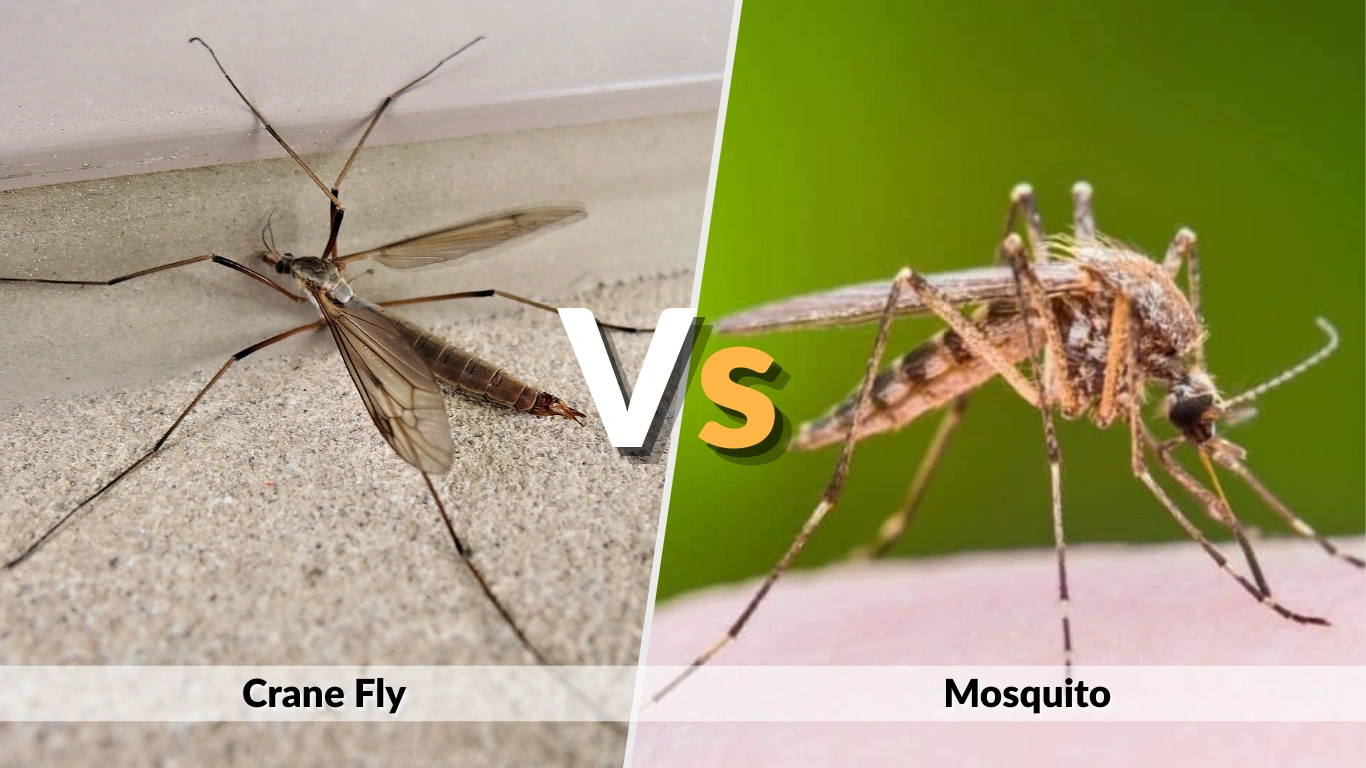
Many people panic when they see a large, mosquito-looking insect flying around their home and immediately assume it is a giant mosquito. In most cases, it is actually a crane fly—often called a mosquito hawk or mosquito eater. These names have created widespread confusion about whether crane flies bite, eat mosquitoes, or are simply oversized mosquitoes. This article clears up the myths by explaining what crane flies really are, how they differ from mosquitoes, and why they are harmless despite their intimidating appearance.
What Is a Crane Fly
A crane fly is a flying insect that belongs to the family Tipulidae. They are commonly known as crane flies, mosquito hawks, or mosquito eaters. Despite these nicknames, crane flies are not predators and have no interest in mosquitoes.
Crane flies are best known for their long legs, slow flight, and awkward movements. They often appear in large numbers during certain seasons and are frequently found near lights or indoors by accident.
What Is a Mosquito
Mosquitoes are small flying insects belonging to the family Culicidae. Unlike crane flies, mosquitoes—specifically females—feed on blood to reproduce. Mosquitoes are responsible for transmitting diseases such as dengue, malaria, Zika, and West Nile virus.
Mosquitoes are agile, aggressive biters and are attracted to body heat, carbon dioxide, and human scent.
Are Crane Flies Mosquitoes
Crane flies are not mosquitoes.
Although both insects are flies and belong to the order Diptera, they come from entirely different families. Crane flies do not bite humans, do not suck blood, and do not spread disease. The confusion comes from their similar body shape and wing structure, especially when crane flies grow much larger than typical mosquitoes.
Why Do Crane Flies Look Like Mosquitoes

Crane flies resemble mosquitoes for several reasons. Both insects have slender bodies, long legs, and narrow wings. From a distance, these features make crane flies look like oversized mosquitoes.
However, crane flies lack the specialized mouthparts mosquitoes use to pierce skin. Their resemblance is purely visual and not behavioral or functional.
Are Crane Flies Male Mosquitoes
A common myth is that crane flies are male mosquitoes. This is false.
Male mosquitoes are much smaller than crane flies and still resemble female mosquitoes closely. While male mosquitoes do not bite, they are still mosquitoes. Crane flies are a completely different insect species and are not related to mosquito gender at all.
Crane Fly vs Mosquito Identification
You can easily tell the difference between a crane fly and a mosquito by looking at a few key features:
- Body size: Crane flies are much larger
- Leg length: Crane flies have extremely long legs
- Mouthparts: Mosquitoes have a visible proboscis; crane flies do not
- Flight style: Crane flies fly slowly and awkwardly
- Behavior: Mosquitoes actively seek humans; crane flies avoid contact
Crane Fly vs Mosquito Size Comparison

Crane flies are often called “giant mosquitoes” because of their size. A typical crane fly can measure 1 to 1.5 inches in length, including legs. In contrast, most mosquitoes are only 3 to 6 millimeters long.
This dramatic size difference is one of the easiest ways to identify a crane fly. If it looks unusually large, it is almost certainly not a mosquito.
Crane Fly vs Mosquito
When comparing crane flies and mosquitoes, the differences are significant.
Crane flies do not bite, do not feed on blood, and do not carry diseases. They are passive insects that spend most of their short adult life resting or reproducing. Mosquitoes, on the other hand, are aggressive feeders that actively seek hosts and pose health risks.
While mosquitoes are pests, crane flies are harmless and pose no threat to humans or pets.
Crane Fly vs Mosquito Hawk
The term mosquito hawk is simply another name for a crane fly. It does not indicate that the insect hunts or eats mosquitoes. This nickname likely came from the mistaken belief that crane flies control mosquito populations.
In reality, crane flies do not hunt mosquitoes at any stage of their life cycle.
Why Are Crane Flies Called Mosquito Eaters

Crane flies are called mosquito eaters because of a long-standing myth. People assumed that since crane flies look like mosquitoes and appear in large numbers, they must prey on them.
This assumption is incorrect. Adult crane flies either feed on nectar or do not feed at all. Their larvae feed on decaying organic matter, not insects.
Do Crane Flies Eat Mosquitoes
Crane flies do not eat mosquitoes.
They lack the mouthparts, speed, and hunting behavior required to catch mosquitoes. Scientific studies and observations confirm that crane flies are not mosquito predators and play no role in controlling mosquito populations.
Do Crane Flies Eat Mosquitoes or Larvae

Despite their nickname, crane flies do not eat mosquitoes at any stage of their life. Neither adult crane flies nor their larvae prey on mosquitoes or mosquito larvae.
Adult Crane Fly Diet
Adult crane flies feed mainly on nectar, plant juices, or not at all. In fact, many adult crane flies live only a few days and lack fully developed mouthparts, which means they are physically unable to hunt or consume other insects.
Crane Fly Larvae Diet
Crane fly larvae, sometimes called leatherjackets, live in soil or wet areas. They feed on decaying organic matter, roots, and grass, not insects. While they may share habitats with mosquito larvae, they do not interact as predators.
Do Crane Flies Kill Mosquitoes
Crane flies do not kill mosquitoes. They are not predators and do not compete with mosquitoes for food in any meaningful way. The belief that crane flies reduce mosquito populations is a misconception that has been passed down for generations without scientific evidence.
Crane Flies vs Mosquito Aggression
Crane flies are harmless and non-aggressive. They do not chase humans, bite, or swarm for feeding. Their slow, clumsy flight often makes them easy to catch or swat, though doing so is unnecessary.
Mosquitoes, in contrast, are highly aggressive feeders. Female mosquitoes actively seek humans using body heat, carbon dioxide, and scent, and they persist until they successfully bite or are killed.
Crane Fly vs Female Mosquito
Female mosquitoes are the only mosquitoes that bite humans. They possess sharp, needle-like mouthparts designed to pierce skin and draw blood. This behavior is necessary for egg development.
Crane flies do not have these mouthparts and cannot bite. Even though crane flies may look intimidating due to their size, they are completely harmless to humans.
Crane Fly vs Male Mosquito
Male mosquitoes do not bite and feed on nectar, which leads some people to confuse them with crane flies. However, male mosquitoes are still much smaller than crane flies and retain the same body structure as females.
Crane flies are a separate species entirely and are not male mosquitoes.
Big Mosquito-Looking Bug Not a Crane Fly
Not every large flying insect is a crane fly. Some flies, wasps, and other insects can resemble mosquitoes at a glance.
To identify a true crane fly:
- Look for extremely long legs
- Notice slow, drifting flight
- Check for lack of a visible proboscis
If the insect bites or moves aggressively, it is not a crane fly.
Are Crane Flies and Mosquitoes Related
Crane flies and mosquitoes are loosely related because they both belong to the order Diptera, which includes all true flies. However, they evolved along very different paths and belong to separate families.
This distant relationship explains their superficial similarity but not their very different behaviors and roles.
Giant Mosquito vs Crane Fly
The term “giant mosquito” is misleading. There is no species of mosquito that grows as large as a crane fly. Large insects commonly mistaken for giant mosquitoes are almost always crane flies.
Size alone is a strong indicator when identifying these insects.
How to Tell a Crane Fly From a Mosquito
The easiest ways to tell them apart include:
- Crane flies do not bite or buzz aggressively
- Mosquitoes have a visible needle-like proboscis
- Crane flies rest with legs spread wide
- Mosquitoes land directly on skin to feed
Observing behavior is often more reliable than appearance.
Are Crane Flies Harmful or Dangerous
Crane flies are not harmful. They do not bite, sting, spread disease, or damage homes. While their larvae can occasionally harm lawns by feeding on grass roots, adult crane flies pose no threat to humans.
Ecological Role of Crane Flies vs Mosquitoes
Crane flies play a small but useful role in ecosystems. Their larvae help break down organic material in soil, while adults serve as food for birds and other predators.
Mosquitoes also serve as food for wildlife, but their role as disease vectors makes them a major public health concern.
FAQs
Do crane flies really eat mosquitoes?
No, crane flies do not eat mosquitoes. Despite being called mosquito hawks or mosquito eaters, crane flies lack the mouthparts and behavior needed to hunt insects. Adult crane flies feed on nectar or do not feed at all, while their larvae eat decaying organic matter.
Is a crane fly a giant mosquito?
A crane fly is not a giant mosquito. Although crane flies look similar because of their long legs and slender bodies, they belong to a different insect family. Mosquitoes are much smaller, bite humans, and can spread diseases, while crane flies are harmless.
Are crane flies male mosquitoes?
Crane flies are not male mosquitoes. Male mosquitoes are smaller insects that still resemble female mosquitoes closely. Crane flies are a separate species entirely and are not related to mosquito gender in any way.
Why are crane flies called mosquito eaters?
Crane flies are called mosquito eaters due to a long-standing myth. People assumed they eat mosquitoes because of their size and appearance. In reality, crane flies do not hunt or consume mosquitoes at any stage of their life cycle.
How can you tell the difference between a crane fly and a mosquito?
You can tell them apart by behavior and features. Crane flies are larger, fly slowly, and do not bite. Mosquitoes are smaller, aggressive, and have a visible needle-like mouthpart used for feeding on blood.