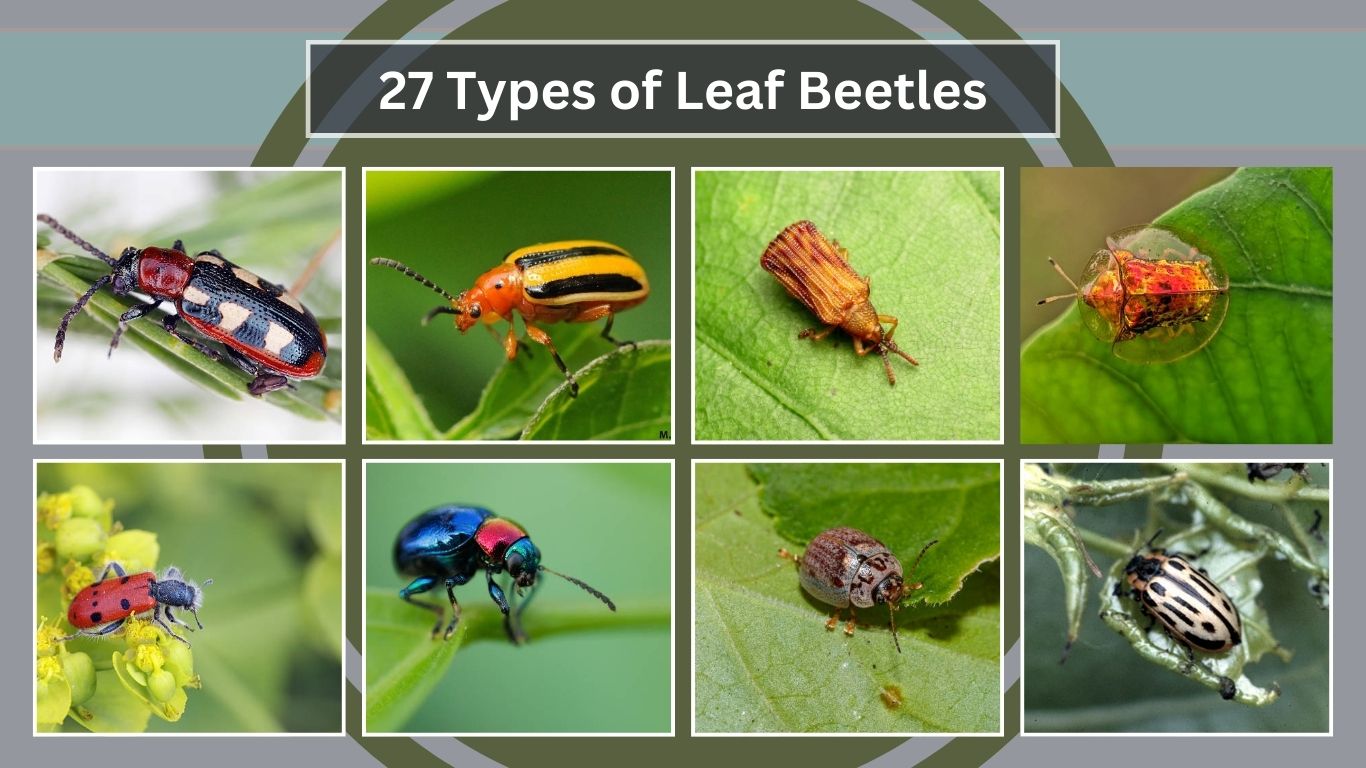
Leaf beetles (family Chrysomelidae) are among the most colorful and diverse insects in the world, with thousands of species found across different habitats. Some are admired for their metallic sheen, while others are notorious crop pests capable of destroying entire fields. From the Colorado potato beetle to the golden tortoise beetle, this list explores 27 unique types of leaf beetles, highlighting their appearance, behavior, and preferred host plants.
1. Colorado Potato Beetle (Leptinotarsa decemlineata)

The Colorado potato beetle is one of the most recognized agricultural pests, especially notorious for damaging potato crops. Known for its striped back and ability to rapidly reproduce, this beetle has become a symbol of crop destruction and pesticide resistance.
Identification
- Oval-shaped body, about 10 mm long
- Yellow-orange elytra (wing covers) with 10 bold black stripes
- Black spots on the pronotum (area behind the head)
- Yellowish underside with dark legs and antennae
- Larvae are reddish with black spots on the sides
Habitat
This beetle thrives in potato-growing regions across North America and Europe. It prefers cultivated fields where potatoes, eggplants, and tomatoes are abundant.
Behavior
Both adults and larvae are leaf-feeding pests that can quickly defoliate entire plants. They overwinter in the soil and re-emerge in spring, ready to feed and reproduce.
Diet
Their primary diet consists of potato leaves, though they also eat other plants in the nightshade family such as tomatoes, peppers, and eggplants.
2. Cereal Leaf Beetle (Oulema melanopus)

The cereal leaf beetle is a significant pest of cereal crops, known for reducing yields in wheat, oats, barley, and rye. Its shiny appearance makes it easy to spot, but controlling infestations can be challenging since both adults and larvae feed on leaves, reducing the plants’ ability to photosynthesize.
Identification
- Small beetle, about 4–5 mm long
- Metallic blue-green wing covers (elytra)
- Bright reddish-orange thorax and legs
- Black head and antennae
- Larvae are soft-bodied, yellowish, and often covered in a slimy coating of their own excrement
Habitat
This beetle is commonly found in cereal-growing regions of North America and Europe. It prefers open fields of wheat, oats, barley, and rye, where host plants are abundant.
Behavior
Adults overwinter in protected areas such as field margins and reappear in spring to feed and lay eggs. Larvae are the most destructive stage, skeletonizing leaves by consuming green tissue and leaving only the veins.
Diet
Primarily feeds on cereal crops, especially wheat, oats, barley, and rye. Heavy infestations can significantly reduce grain yields.
3. Red Turnip Beetle (Entomoscelis americana)

The red turnip beetle is an agricultural pest mainly affecting crops in the mustard family. Its striking red color and black markings make it distinctive, but its feeding habits can cause serious harm to canola, turnips, and related plants.
Identification
- Body length around 7–8 mm
- Bright red body with three distinct black spots on each wing cover
- Black legs and antennae
- Rounded shape with smooth wing covers
- Larvae are dark brown or black with a segmented appearance
Habitat
Found across North America, particularly in regions where canola, mustard, and turnip crops are cultivated. They prefer open, sunny fields with host plants.
Behavior
Both adults and larvae feed aggressively on leaves, often causing severe defoliation. They tend to move in groups and can quickly spread across a field, leading to extensive crop loss.
Diet
Feeds on plants of the mustard family, including canola, mustard greens, radishes, and turnips.
4. Dogbane Leaf Beetle (Chrysochus auratus)

The dogbane leaf beetle is admired for its stunning, metallic colors that shine in shades of green, gold, and copper. Unlike many leaf beetles that are agricultural pests, this species mostly feeds on wild plants and is rarely a threat to crops.
Identification
- Size about 8–11 mm long
- Metallic iridescent body shifting between green, gold, copper, and blue
- Smooth, oval shape with shiny elytra
- Black antennae and legs with metallic reflections
- Larvae are pale with a curved, grub-like body
Habitat
Common in North America, especially in meadows, woodland edges, and areas where dogbane or milkweed plants grow. They thrive in sunny, open habitats.
Behavior
Adults are slow-moving and often seen basking on leaves during the day. They are strong fliers but usually stay close to their host plants.
Diet
Feeds primarily on dogbane (Apocynum) and sometimes milkweed (Asclepias).
5. Spotted Cucumber Beetle (Diabrotica undecimpunctata)

The spotted cucumber beetle is a well-known agricultural pest that damages cucumbers and many other crops. Its spotted back makes it easy to recognize, and it is considered a major threat to both seedlings and mature plants.
Identification
- Small beetle, about 6–8 mm long
- Yellow-green body with 12 distinct black spots on the elytra
- Black head and antennae
- Slender legs adapted for crawling on leaves and stems
- Larvae (known as corn rootworms) are whitish and worm-like with brown heads
Habitat
Widespread across North America, especially in gardens, farms, and crop fields where cucumbers, corn, and melons are grown.
Behavior
Adults are highly active, moving from plant to plant and spreading bacterial wilt disease. Larvae live in the soil, where they feed on roots, weakening seedlings.
Diet
Feeds on cucumbers, melons, squash, beans, corn, and other vegetables.
6. Striped Cucumber Beetle (Acalymma vittatum)

The striped cucumber beetle is one of the most destructive pests of cucurbit crops in North America. Its distinctive striped pattern makes it easy to identify in gardens and fields. Beyond direct feeding damage, it is also a carrier of bacterial wilt and cucumber mosaic virus, making it a serious threat to growers.
Identification
- Small beetle, about 6 mm long
- Bright yellow body with three bold black stripes running lengthwise on the elytra
- Black head, antennae, and legs
- Slender, oval-shaped body with smooth wing covers
- Larvae are creamy-white, worm-like, with brown heads and three pairs of legs near the front
Habitat
Common in the United States and southern Canada, particularly in vegetable gardens and commercial farms. They thrive where cucumbers, melons, pumpkins, and squash are grown.
Behavior
Adults overwinter in plant debris and re-emerge in spring, targeting young seedlings. Both adults and larvae feed heavily—adults chew on leaves and flowers, while larvae attack roots underground, stunting plant growth.
Diet
Feeds almost exclusively on cucurbit plants, including cucumbers, melons, squash, pumpkins, and zucchini. Infestations often lead to stunted or dying plants due to both direct feeding and disease transmission.
7. Golden Tortoise Beetle (Charidotella sexpunctata)

The golden tortoise beetle is a fascinating leaf beetle, often admired for its shimmering, gold-like shell that can change color depending on mood or environment. Unlike agricultural pests, it typically feeds on morning glory and sweet potato plants, rarely causing serious economic harm.
Identification
- Small beetle, about 5–7 mm long
- Distinctive, rounded, shield-like shape resembling a tortoise
- Brilliant metallic golden coloration, though it can shift to reddish or orange when disturbed
- Elytra smooth and dome-like, covering the body completely
- Larvae are spiny with a “fecal shield” carried on their backs for defense
Habitat
Found throughout North and South America, especially in areas with morning glories and related plants. They prefer gardens, fields, and open woodlands.
Behavior
The beetle’s color-changing ability is a natural defense mechanism, allowing it to blend into surroundings or deter predators. Larvae use their fecal shield (a mix of excrement and shed skin) as protection against predators.
Diet
Primarily feeds on morning glory (Ipomoea) and sweet potato (Ipomoea batatas). Adults chew small holes in leaves, while larvae skeletonize foliage.
8. Three-lined Potato Beetle (Lema daturaphila)

The three-lined potato beetle is a striking leaf beetle known for its bold striped pattern. Though smaller than the notorious Colorado potato beetle, it can still cause significant damage to certain garden crops, particularly potatoes and related plants. It is also commonly found on tomatillo and ground cherry plants, making it a persistent garden pest.
Identification
- Small beetle, about 7–8 mm long
- Yellow-orange elytra with three prominent black longitudinal stripes
- Black head, antennae, and legs
- Narrow, elongated body shape compared to other potato beetles
- Larvae are soft-bodied, yellowish to orange, and often covered with a slimy coating of their own excrement for protection
Habitat
Native to North America, this beetle is common in gardens, farms, and fields where potatoes, eggplants, and other solanaceous crops are grown. It is particularly widespread in the eastern and central United States.
Behavior
Adults emerge in late spring and begin feeding on host plants immediately. Females lay clusters of eggs on the underside of leaves. Larvae are the most destructive stage, feeding heavily on foliage and sometimes leaving only the leaf veins intact.
Diet
Specializes in feeding on nightshade family plants (Solanaceae). Potatoes, tomatillos, ground cherries, and eggplants are its preferred hosts. Unlike the Colorado potato beetle, it rarely feeds on tomatoes.
9. Elm Leaf Beetle (Xanthogaleruca luteola)

The elm leaf beetle is a well-known pest of elm trees, capable of defoliating them year after year if infestations are left unchecked. While not usually fatal to trees, repeated damage weakens them, making them more susceptible to diseases and other pests. Its spread across continents has made it a major concern for elm conservation.
Identification
- Adult beetles measure about 6–8 mm long
- Yellow to greenish body with a black stripe along the outer edge of each elytron (wing cover)
- Black spots on the head and pronotum
- Larvae are dark, caterpillar-like, and about 10–12 mm long with rows of small black spots on their sides
- Pupae are orange to yellow and found on tree bark or near the base of trees
Habitat
Native to Europe but now found widely in North America, Australia, and parts of Asia. It inhabits urban parks, woodlands, and forests where elm trees are abundant.
Behavior
Adults overwinter in sheltered places like bark crevices, buildings, or firewood stacks. In spring, they emerge and feed on newly grown elm leaves before laying eggs. Both adults and larvae feed on leaves, with larvae skeletonizing them and causing the most severe damage.
Diet
Feeds almost exclusively on elm species (Ulmus spp.). Heavy infestations result in leaves turning brown, curling, and eventually falling prematurely.
10. Willow Leaf Beetle (Plagiodera versicolora)

The willow leaf beetle is a small but destructive pest of willow trees, often found feeding in large groups that can strip leaves quickly. Though it rarely kills trees, repeated infestations weaken willows, reduce growth, and leave them vulnerable to other stresses.
Identification
- Small beetle, about 4–6 mm long
- Metallic blue-green to bluish-black elytra (wing covers) with a shiny, reflective surface
- Oval body shape with relatively short legs and antennae
- Larvae are dark gray to black, slug-like, and about 6–8 mm long
- Pupae are yellowish to orange, usually attached to leaves or bark
Habitat
Found widely across North America, Europe, and Asia in areas where willows grow. They thrive in wetlands, riverbanks, parks, and urban landscapes where ornamental willow trees are planted.
Behavior
Adults overwinter under bark, leaf litter, or soil. In spring, they reappear and start feeding on fresh willow leaves. Females lay clusters of eggs on the underside of leaves. Both larvae and adults skeletonize leaves, leaving behind only veins and reducing the tree’s photosynthetic capacity.
Diet
Specializes in feeding on willow (Salix spp.) but occasionally feeds on poplars and cottonwoods.
11. Asparagus Beetle (Crioceris asparagi)

The asparagus beetle is a specialized pest that feeds almost exclusively on asparagus plants. It is considered one of the most destructive insects for asparagus crops, damaging both shoots and ferns, which can reduce yields and weaken plants over time.
Identification
- Adult beetles measure about 6–9 mm long
- Bluish-black wing covers with three distinct yellow spots on each elytron
- Red or orange thorax and legs
- Antennae are black and slender
- Larvae are soft-bodied, gray to brown, with dark heads and humped backs
Habitat
Native to Europe but now established in North America, particularly in regions where asparagus is cultivated. They thrive in gardens, farms, and fields where asparagus grows in abundance.
Behavior
Adults emerge in spring around the same time asparagus shoots appear. Females lay small, dark eggs directly on asparagus spears, which leads to scarring and bending of the shoots. Larvae feed heavily on the plant’s foliage, weakening its ability to produce strong spears in subsequent seasons.
Diet
Feeds almost exclusively on asparagus (Asparagus officinalis). Both adults and larvae damage young shoots and ferns, making them a serious agricultural concern.
12. Common Asparagus Beetle (Crioceris duodecimpunctata)

The common asparagus beetle is closely related to the asparagus beetle but can be distinguished by its spotted pattern. Although considered slightly less damaging than its relative, it still poses a threat to asparagus crops, especially when populations are high.
Identification
- Small beetle, about 6–7 mm long
- Reddish-orange elytra with six distinct black spots on each wing cover (12 total)
- Black head, antennae, and thorax with a slight sheen
- Oval, compact body shape
- Larvae are soft-bodied, dark gray to brown, with curved, grub-like bodies and black heads
Habitat
Native to Europe but now found in North America and other regions where asparagus is cultivated. Prefers asparagus farms, gardens, and fields, often coexisting with the closely related asparagus beetle.
Behavior
Adults overwinter in sheltered places such as soil, crop debris, and field margins. In spring, they emerge and feed on asparagus shoots and foliage. Females lay eggs on the plants, and larvae feed heavily on the fern-like foliage, reducing plant vigor.
Diet
Feeds exclusively on asparagus (Asparagus officinalis). Both adults and larvae damage shoots and ferns, impacting crop quality and yield.
13. Mint Leaf Beetle (Chrysolina herbacea)

The mint leaf beetle is a brilliantly colored insect that thrives on mint plants. Though admired for its metallic shine, it is a troublesome pest for herb gardeners, as infestations can quickly strip leaves and reduce the quality of mint harvests.
Identification
- Medium-sized beetle, about 8–10 mm long
- Metallic green elytra with golden or copper reflections
- Oval, domed body with shiny surface
- Antennae and legs are dark with slight iridescence
- Larvae are greenish-black, plump, and soft-bodied with small legs
Habitat
Found across Europe and parts of Asia, particularly in damp meadows, riverbanks, and gardens where wild and cultivated mint grows. Increasingly reported in North America as well.
Behavior
Adults emerge in spring and feed on fresh mint leaves. Females lay eggs on the underside of leaves, where larvae hatch and begin skeletonizing the foliage. Several generations may occur in a single growing season, leading to heavy damage if populations are uncontrolled.
Diet
Specializes in feeding on plants in the mint family (Lamiaceae), especially peppermint (Mentha × piperita) and spearmint (Mentha spicata). Both adults and larvae can cause serious defoliation in herb gardens.
14. Lily Leaf Beetle (Lilioceris lilii)

The lily leaf beetle, also known as the red lily beetle, is a striking pest that targets ornamental and wild lilies. Its bright coloration makes it easy to spot, but it is a serious threat to gardeners, as both adults and larvae can cause heavy defoliation.
Identification
- Adult beetles measure about 6–8 mm long
- Bright, glossy red elytra with smooth surfaces
- Black head, legs, and antennae
- Elongated oval body with a narrow thorax
- Larvae are soft-bodied, yellowish to orange, and cover themselves in their own excrement as a protective shield
Habitat
Native to Europe but now invasive in North America, particularly in gardens and ornamental landscapes where lilies are grown. They thrive in sunny flowerbeds and areas with abundant host plants.
Behavior
Adults overwinter in the soil or sheltered areas and emerge in spring as lilies sprout. They quickly begin feeding and laying eggs. Larvae are highly destructive, consuming large amounts of leaf tissue and sometimes flower buds. Multiple generations can occur in a single growing season.
Diet
Feeds almost exclusively on lilies (Lilium spp.) and fritillaries (Fritillaria spp.). Heavy infestations can strip plants of foliage, weaken bulbs, and reduce flowering.
15. Blue Mint Beetle (Chrysolina coerulans)

The blue mint beetle is a dazzling insect with a metallic blue sheen, admired for its beauty but feared by herb growers. While less widespread than the green mint beetle, it can still cause significant damage to cultivated and wild mint plants when populations increase.
Identification
- Adult beetles measure about 7–9 mm long
- Metallic blue to violet elytra with a glossy, reflective surface
- Oval, domed body shape similar to other Chrysolina species
- Black legs and antennae with slight iridescence
- Larvae are dark, plump, soft-bodied grubs with small legs and faint striping
Habitat
Native to central and southern Europe, often found in meadows, riverbanks, and gardens. It thrives where wild mint and cultivated varieties are grown. Its presence is expanding northward due to warmer climates and trade in potted herbs.
Behavior
Adults appear in spring, feeding on the leaves of mint plants. They lay eggs on the undersides of leaves, and the larvae hatch within days. Both life stages feed on the plant, causing skeletonization of leaves. Several generations may develop each season, leading to widespread damage in warm summers.
Diet
Specializes in feeding on mint (Mentha spp.), particularly peppermint and spearmint. Heavy infestations can strip plants of foliage, reducing leaf production and overall plant health.
16. Alder Leaf Beetle (Agelastica alni)

The alder leaf beetle is a dark, metallic species that primarily targets alder trees. Once considered rare in some regions, its populations have been expanding, and it is now frequently spotted in gardens and woodlands. While not usually fatal to trees, repeated infestations can weaken alders and affect their growth.
Identification
- Adult beetles measure about 6–7 mm long
- Metallic blue-black to deep violet elytra with a shiny surface
- Oval, compact body with a slightly flattened appearance
- Antennae and legs are dark and slender
- Larvae are black, soft-bodied, and slightly wrinkled, resembling small caterpillars
Habitat
Native to Europe and Asia, this beetle inhabits woodlands, riverbanks, wetlands, and urban areas where alder trees grow. Recently, it has become more common in gardens and parks.
Behavior
Adults overwinter in leaf litter and re-emerge in spring to feed on alder leaves. They lay eggs on the undersides of leaves, and larvae hatch to feed voraciously, often skeletonizing foliage. Multiple generations may occur in a single season, leading to repeated defoliation.
Diet
Specializes in feeding on alder (Alnus spp.), though it may occasionally feed on related broadleaf trees such as hazel and birch when alder is scarce.
17. Viburnum Leaf Beetle (Pyrrhalta viburni)

The viburnum leaf beetle is a highly destructive pest of ornamental viburnum shrubs. It can completely defoliate plants, causing dieback and even plant death after repeated infestations. Gardeners often consider it one of the most serious pests of landscape shrubs.
Identification
- Adults measure about 4.5–6.5 mm long
- Brownish-yellow body with small black dots scattered across the elytra
- Oval, somewhat flattened body with short legs and antennae
- Larvae are elongated, yellowish to greenish with black spots and dark heads, reaching about 10–12 mm in length
- Pupae are pale and found in the soil near host plants
Habitat
Native to Europe but now established in North America, particularly in the northeastern United States and parts of Canada. Found in urban gardens, parks, and woodlands where viburnum shrubs are common.
Behavior
Adults overwinter in the soil and emerge in spring to lay eggs on young viburnum twigs. Larvae hatch in early summer and cause the most damage, skeletonizing leaves. If not controlled, both larvae and adults can completely defoliate shrubs, stressing or killing them over successive years.
Diet
Feeds exclusively on viburnum (Viburnum spp.) shrubs. Susceptible species include arrowwood viburnum, European cranberrybush, and nannyberry, while some varieties show resistance.
18. Cottonwood Leaf Beetle (Chrysomela scripta)

The cottonwood leaf beetle is a major pest of cottonwood and poplar trees in North America. Its rapid reproduction and aggressive feeding can lead to severe defoliation, stunted growth, and increased vulnerability of trees to disease and environmental stress.
Identification
- Adults measure about 6–8 mm long
- Elytra are yellow with large black spots or irregular markings
- Pronotum (behind the head) is black with a central yellow patch
- Antennae and legs are black, slender, and adapted for climbing leaves
- Larvae are dark gray to black with a soft body and rows of small tubercles
Habitat
Found throughout North America, especially in riparian zones, plantations, and urban landscapes where cottonwoods and poplars are cultivated. They thrive in moist, lowland habitats where host trees grow abundantly.
Behavior
Adults overwinter under bark and in leaf litter, re-emerging in spring to feed and reproduce. Females lay clusters of eggs on leaf undersides, and larvae quickly skeletonize foliage. Heavy infestations can result in repeated defoliation, which weakens trees and reduces growth rates.
Diet
Feeds mainly on cottonwoods (Populus deltoides), aspens (Populus tremuloides), and other poplars. In plantations and ornamental settings, infestations can cause significant economic and ecological impacts.
19. Imported Willow Leaf Beetle (Plagiodera versicolora)

The imported willow leaf beetle is a common pest of willow trees, often appearing in large numbers during spring and summer. Though small in size, its collective feeding can defoliate young willows, reduce tree vigor, and leave them more vulnerable to disease and environmental stress.
Identification
- Adults are about 4–5 mm long
- Shiny, metallic blue-green or bluish-black elytra with a smooth surface
- Oval, compact body with short legs and antennae
- Larvae are dark gray to black, slug-like, and about 6–8 mm long
- Pupae are yellowish to orange, attached to bark, leaves, or soil near host trees
Habitat
Native to Europe and Asia but introduced to North America, where it has become widespread. Found in wetlands, riverbanks, urban parks, and ornamental landscapes where willow trees are planted.
Behavior
Adults overwinter under bark or in nearby leaf litter, emerging in spring to feed on fresh willow leaves. Females deposit egg clusters on the underside of leaves. Both larvae and adults skeletonize foliage, sometimes leaving only the veins. Multiple generations can occur each season, intensifying damage.
Diet
Feeds almost exclusively on willow (Salix spp.), though occasional feeding on poplar and cottonwood may occur. Repeated infestations can significantly weaken host trees.
20. Ragweed Leaf Beetle (Zygogramma suturalis)

The ragweed leaf beetle is a species introduced in some regions as a biological control agent against common ragweed, a highly invasive and allergenic plant. While not considered a major pest to crops, it plays an important ecological role in managing ragweed populations.
Identification
- Adults measure about 6–8 mm long
- Elytra are pale yellow to light brown with two distinct dark longitudinal stripes along the suture
- Head and pronotum are darker, often brownish to black
- Oval-shaped body with a slightly convex back
- Larvae are pale green to yellow, soft-bodied, with small dark heads
Habitat
Native to North America but introduced into parts of Europe (including the former Soviet Union) to combat ragweed infestations. Found in open fields, roadsides, disturbed soils, and anywhere ragweed grows abundantly.
Behavior
Adults emerge in late spring and begin feeding on ragweed leaves. Females lay eggs on host plants, and larvae feed heavily on foliage, sometimes defoliating entire patches of ragweed. Multiple generations may develop in a season, enhancing its effectiveness as a biocontrol species.
Diet
Feeds almost exclusively on ragweed (Ambrosia artemisiifolia). Unlike other leaf beetles, it is beneficial to humans by reducing ragweed pollen production and spread.
21. Basswood Leaf Beetle (Pyrrhalta luteola)

The basswood leaf beetle is a specialist feeder on basswood trees, capable of causing significant defoliation during heavy outbreaks. While not usually fatal to mature trees, repeated infestations weaken them, reduce growth, and make them more vulnerable to pests and diseases.
Identification
- Adults measure about 5–6 mm long
- Pale yellow to light brown elytra with small dark brown or black dots scattered across the surface
- Head and pronotum are darker, often brownish in tone
- Body is oval and slightly flattened with short antennae
- Larvae are dark gray to black, elongated, and about 8–10 mm long, with fine spots on their backs
Habitat
Found across eastern North America, especially in woodlands, parks, and urban areas where basswood (Tilia americana) trees are planted. It prefers moist environments and shade, where host trees thrive.
Behavior
Adults overwinter in bark crevices, leaf litter, or sheltered places and emerge in spring as basswood leaves begin to grow. Females lay clusters of eggs on the undersides of leaves. Larvae hatch and feed aggressively, skeletonizing leaves, while adults also chew irregular holes, compounding the damage.
Diet
Feeds almost exclusively on basswood (Tilia spp.). Heavy infestations can strip trees of foliage, stunting growth and reducing flowering and seed production.
22. Swamp Milkweed Leaf Beetle (Labidomera clivicollis)

The swamp milkweed leaf beetle is a colorful insect often found on milkweed plants in wetlands and meadows. Unlike many other leaf beetles considered agricultural pests, this species plays an important role in natural ecosystems by interacting with milkweed plants.
Identification
- Adults are relatively large, about 7–12 mm long
- Elytra are orange to reddish with bold black spots (usually 10)
- Pronotum is black with two prominent orange spots
- Antennae and legs are black, strong, and adapted for climbing stems
- Larvae are plump, yellow to orange with black markings, resembling small grubs
Habitat
Widespread in North America, especially in wet meadows, marshes, river edges, and open fields where swamp milkweed and other milkweed species grow.
Behavior
Adults overwinter in leaf litter or soil and reappear in spring. They are strong fliers but usually stay close to their host plants. Females lay eggs in small clusters on the underside of milkweed leaves. Both adults and larvae feed openly on leaves, but infestations are rarely severe enough to kill the plants.
Diet
Feeds primarily on milkweed species, especially swamp milkweed (Asclepias incarnata). They may also feed on common milkweed (Asclepias syriaca) and related plants.
23. Red Milkweed Beetle (Tetraopes tetrophthalmus)

The red milkweed beetle is a striking species known for its bold coloration and strong association with milkweed plants. Its bright red body serves as a warning signal to predators, as it ingests toxic compounds from milkweed that make it unpalatable.
Identification
- Adults measure about 10–14 mm long
- Bright red to orange elytra with four distinct black spots (two on each wing cover)
- Black head, legs, and antennae
- Notable for its “split eyes” that wrap around the antennae base, a trait unique to this genus
- Larvae are creamy-white, elongated grubs that feed underground on plant roots
Habitat
Found widely across eastern and central North America, especially in meadows, fields, and roadsides where milkweed plants are common.
Behavior
Adults are active during summer, often seen feeding on milkweed leaves and flowers. They are clumsy fliers and tend to stay close to host plants. Females lay eggs at the base of milkweed stems, and larvae burrow into the soil to feed on roots.
Diet
Feeds exclusively on milkweed (Asclepias spp.). By consuming toxic compounds from the plant, they become distasteful to birds and other predators, making their bright coloration an effective defense mechanism.
24. Blue Milkweed Beetle (Chrysochus cobaltinus)

The blue milkweed beetle is a brilliantly colored species, often admired for its striking metallic blue sheen. Like other milkweed beetles, it feeds on milkweed plants and absorbs their toxic compounds, which protect it from predators. Though not typically a serious pest, it is an important insect in the ecosystems where milkweed grows.
Identification
- Adults measure about 7–10 mm long
- Metallic cobalt-blue body with a smooth, oval shape
- Elytra (wing covers) shiny and reflective, with no markings
- Black legs and antennae with subtle iridescence
- Larvae are creamy-white grubs that live underground, feeding on roots
Habitat
Found mainly in western North America, especially in grasslands, open meadows, and along roadsides where milkweed is abundant.
Behavior
Adults are often observed feeding on milkweed leaves and flowers during summer. They are slow-moving beetles, usually found in pairs or small groups on host plants. Females deposit eggs near the base of milkweed stems, and larvae feed on underground parts of the plant.
Diet
Feeds primarily on milkweed species (Asclepias spp.). By ingesting milkweed toxins, they gain chemical protection against predators, which explains their bold coloration.
25. Bronze Leaf Beetle (Galerucella pusilla)

The bronze leaf beetle is a small but damaging pest that targets various broadleaf plants, especially in wetland and agricultural environments. Its bronze-colored sheen makes it distinctive, though its feeding habits can cause noticeable harm to crops and wild plants alike.
Identification
- Adults measure about 3–4 mm long
- Elytra are bronze to coppery brown with a faint metallic reflection
- Small, narrow, and oval-shaped body
- Head, legs, and antennae are dark brown to black
- Larvae are pale yellowish-green with darker heads and elongated bodies
Habitat
Found throughout Europe and parts of North America, particularly in moist habitats such as wetlands, riverbanks, and marshy fields. They are also common in agricultural areas where host plants are cultivated.
Behavior
Adults overwinter in soil and emerge in spring to feed on newly grown leaves. They lay eggs on the undersides of host plant leaves. Both larvae and adults skeletonize foliage, often leaving behind only the leaf veins, which can lead to reduced plant vigor.
Diet
Feeds on a wide variety of host plants, including willow, alder, and wetland vegetation. In agriculture, they are occasionally found on certain crops, though their most consistent impact is on natural wetland plants.
26. Birch Leaf Miner Beetle (Galerucella calmariensis)

The birch leaf miner beetle is a leaf-feeding insect that targets birch trees and occasionally other hardwoods. While a single infestation may not be fatal, repeated attacks can weaken trees, making them more vulnerable to disease and environmental stress.
Identification
- Adults measure about 4–6 mm long
- Elytra are yellowish-brown to reddish with faint dark markings
- Body narrow and elongated, typical of Galerucella beetles
- Antennae and legs are slender, dark brown to black
- Larvae are small, pale green to yellow, and feed between leaf layers, creating visible blotches
Habitat
Native to Europe but also present in North America, especially in woodlands, parks, and urban areas where birch trees are planted. They thrive in temperate regions with abundant birch growth.
Behavior
Adults overwinter in soil or leaf litter and reappear in spring. Females deposit eggs on birch leaves, and larvae mine inside the leaves, feeding between the upper and lower surfaces. This creates translucent blotches that reduce photosynthesis. After pupating in the soil, new adults emerge to continue the cycle.
Diet
Feeds mainly on birch (Betula spp.). Heavy infestations can cause entire trees to appear scorched or prematurely defoliated.
27. Sumac Leaf Beetle (Blepharida rhois)

The sumac leaf beetle is a colorful species known for its close association with sumac plants. Its striking spotted pattern makes it easy to recognize, and while it can cause localized defoliation, it is not generally considered a severe pest.
Identification
- Adults measure about 6–8 mm long
- Elytra are yellowish to orange with bold black spots in irregular patterns
- Oval-shaped, slightly domed body with a glossy surface
- Head and pronotum are black with pale markings
- Larvae are yellowish with black spots and often cover themselves with a defensive fecal shield
Habitat
Found across North America, particularly in woodlands, meadows, and edges where sumac shrubs are abundant. They prefer sunny, open areas but may also occur in gardens with ornamental sumac plantings.
Behavior
Adults emerge in spring and begin feeding on young leaves of sumac. Females lay eggs in small clusters, and larvae hatch to feed on the foliage. Both stages can cause visible damage, but infestations rarely kill the plant. Their use of fecal shields by larvae provides effective protection from predators.
Diet
Specializes in feeding on sumac (Rhus spp.). Occasionally feeds on related shrubs but maintains a strong preference for its native host plants.