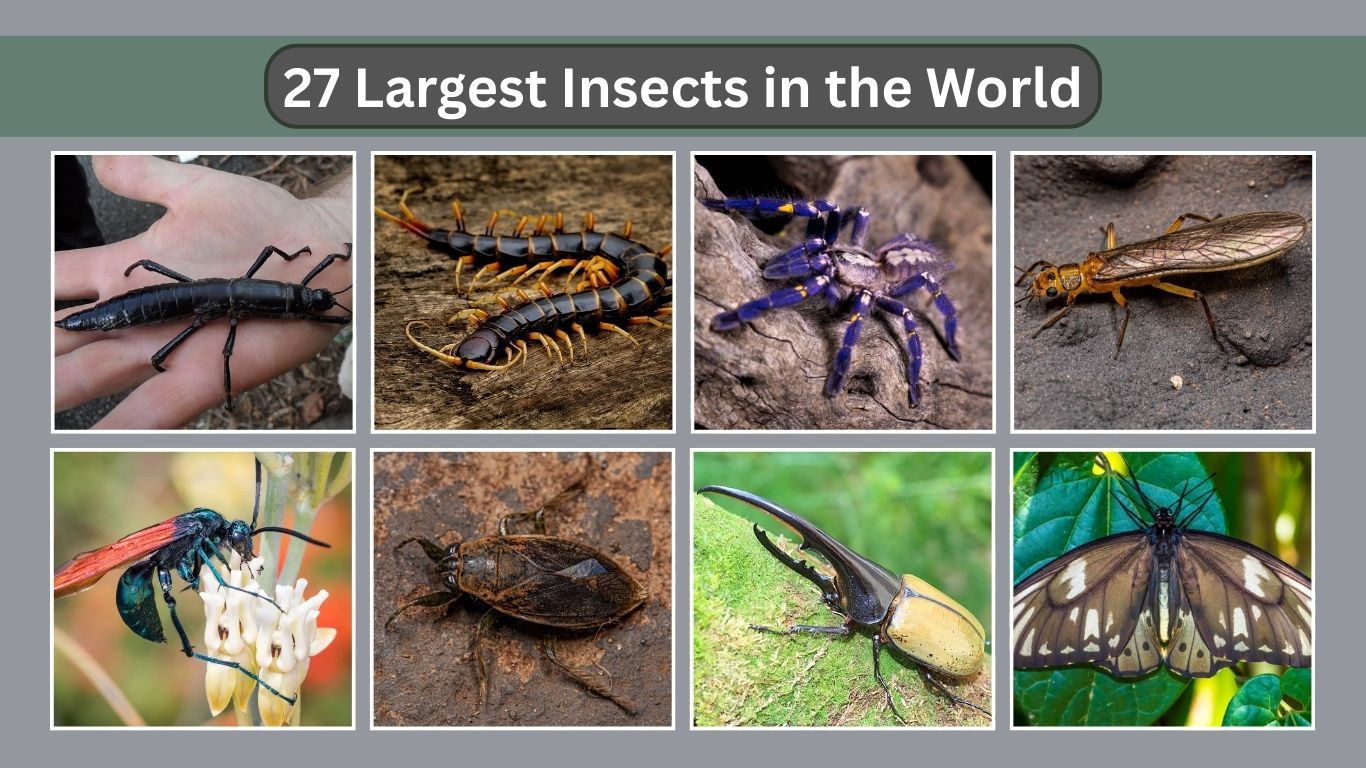
From prehistoric giants that ruled the skies to modern-day beetles, moths, and butterflies that still amaze us with their size, the insect world is full of fascinating giants. Some of these species hold records for their wingspan, weight, or length, while others astonish with their unusual behaviors and adaptations. In this article, we’ll explore 27 of the largest insects ever known—ranging from extinct dragonfly-like creatures to the massive beetles and stick insects that still live among us today.
1. Meganeuropsis

Meganeuropsis is considered the largest insect that ever lived on Earth. This prehistoric giant dragonfly dominated the skies during the late Paleozoic era, around 300 million years ago. With its incredible wingspan, it remains a record holder among insects in history.
Identification
- Wingspan: up to 70 cm (27 inches)
- Body length: around 43 cm (17 inches)
- Order: Meganisoptera (extinct group related to dragonflies)
- Known for enormous compound eyes and strong wings
Habitat
Meganeuropsis thrived in the swampy forests of the Carboniferous and Permian periods, when oxygen levels were much higher than today, allowing insects to grow to massive sizes.
Behavior
This giant predator was likely an aerial hunter, preying on smaller insects and possibly early amphibians. Its flight ability made it a dominant creature of prehistoric skies.
2. Queen Alexandra’s Birdwing

Queen Alexandra’s Birdwing is the world’s largest living butterfly, native to Papua New Guinea. Its extraordinary wingspan and striking coloration make it a rare and highly protected species.
Identification
- Wingspan: up to 28 cm (11 inches)
- Females larger than males
- Family: Papilionidae
- Males display iridescent blue-green wings, females brown with white markings
Habitat
This butterfly is found only in the Oro Province of Papua New Guinea. It thrives in tropical rainforests, especially in areas with abundant food plants like Aristolochia. Its limited range makes it highly vulnerable to habitat loss.
Behavior
The species is diurnal, with males patrolling territories while females remain near host plants. Females lay eggs on Aristolochia vines, which provide food for the caterpillars. Their slow flight and vibrant colors make them highly visible in the forest canopy.
3. White Witch Moth

The White Witch Moth is famous for having the broadest wingspan of any living insect. Its pale coloration and immense size allow it to glide gracefully through the forests of Central and South America.
Identification
- Wingspan: up to 30 cm (12 inches)
- Family: Erebidae
- Long, narrow forewings with pale white, brown, and gray patterns
- Known as “ghost moth” due to its light coloring
Habitat
This moth inhabits tropical and subtropical forests, ranging from Mexico to Brazil. It prefers dense forested environments where it can camouflage against tree bark during the day.
Behavior
Primarily nocturnal, the White Witch Moth spends daylight hours resting on vertical surfaces. At night, it glides through the canopy searching for mates. Despite its size, its movements are surprisingly delicate and silent, making it hard to spot in the wild.
4. Atlas Moth

The Atlas Moth is one of the largest moths in the world, admired for its vibrant wing patterns that resemble snake heads at the tips. Native to Asia, it is often referred to as the “giant silk moth.”
Identification
- Wingspan: up to 25–28 cm (10–11 inches)
- Family: Saturniidae
- Rusty brown wings with white, black, and pink markings
- Distinctive wing tips shaped like snake heads for predator deterrence
Habitat
Atlas Moths are commonly found in tropical and subtropical forests of Southeast Asia, including India, Malaysia, and Indonesia. They prefer dense foliage and humid environments where their caterpillar host plants thrive.
Behavior
Adults live only a few days as they lack functional mouthparts and rely on fat reserves stored during their larval stage. They are nocturnal and spend most of their brief adult life searching for mates. Females are larger and heavier, waiting for males to find them through pheromone trails.
5. Goliath Beetle

Goliath Beetles are among the heaviest insects on Earth, known for their massive size and striking patterns. Found in African tropical forests, they are part of the scarab beetle family.
Identification
- Length: up to 11 cm (4.5 inches)
- Weight: up to 100 g (3.5 oz) in larvae stage
- Family: Scarabaeidae
- Strong exoskeleton with black, white, or brown patterns depending on the species
Habitat
These beetles inhabit equatorial African rainforests, where they live among trees and feed on tree sap, fruit, and other plant material. Their larvae develop in rotting wood and rich soil, benefiting from the warm and humid environment.
Behavior
Goliath Beetles are powerful fliers despite their size, using their strong wings to travel in search of food. They are mostly active during the day, feeding on fruit and tree sap. Their larvae can grow larger than the adults, consuming vast amounts of decaying organic matter before pupating.
6. Titan Beetle

The Titan Beetle is one of the longest beetles in the world, feared for its massive mandibles capable of snapping pencils and even injuring flesh. It roams the Amazon rainforest and is among the most powerful insects.
Identification
- Length: up to 17 cm (6.7 inches)
- Family: Cerambycidae (Longhorn beetles)
- Dark brown to black, elongated body
- Large, strong mandibles used for defense
Habitat
Titan Beetles are found in tropical rainforests of South America, particularly in Brazil, Peru, Colombia, Ecuador, and the Guianas. They prefer dense, humid forest regions near decaying wood, where their larvae likely live.
Behavior
Despite their intimidating appearance, Titan Beetles rarely bite unless threatened. Adults do not feed, surviving only long enough to reproduce. Their larvae are believed to bore into rotting wood, though they have rarely been observed. Adults are nocturnal and attracted to light sources deep in the forest.
7. Hercules Beetle

The Hercules Beetle is famous for its massive horn, which makes it one of the most striking insects. It belongs to the rhinoceros beetle group and is a symbol of strength among insects.
Identification
- Length: up to 17 cm (6.7 inches, including horn)
- Family: Scarabaeidae
- Males possess a long horn extending from the thorax
- Color ranges from olive-green to black with dark spots
Habitat
Hercules Beetles live in the tropical rainforests of Central and South America, particularly in Mexico, Bolivia, and Venezuela. They inhabit decaying logs and leaf litter, where moisture and food are abundant.
Behavior
Males use their long horns to battle rivals for mating rights, flipping opponents with remarkable strength. Adults feed on rotting fruit and tree sap. Their larvae, which can grow larger than the adults, develop in decayed wood. Despite their ferocious appearance, Hercules Beetles are harmless to humans.
8. Elephant Beetle

The Elephant Beetle is a giant member of the rhinoceros beetle group, recognized for its bulky size and horned males. Its strength and impressive appearance make it one of the largest beetles in the Americas.
Identification
- Length: up to 12 cm (4.7 inches)
- Family: Scarabaeidae
- Males have three horns, two on the thorax and one on the head
- Covered in fine yellowish or brown hairs that give a velvety look
Habitat
Elephant Beetles are native to Central and South American rainforests, particularly in countries like Mexico, Honduras, and Brazil. They prefer humid environments rich in rotting logs and fruit sources for larvae and adults.
Behavior
Males use their horns for combat, locking and pushing rivals during mating contests. Adults feed mainly on fruit, tree sap, and nectar. Larvae develop in decomposing wood, taking up to three years to mature. Despite their size and strength, they are harmless to humans
9. Macrodontia Cervicornis (Sabertooth Longhorn Beetle)

Macrodontia cervicornis, also known as the Sabertooth Longhorn Beetle, is one of the longest beetles in the world, notable for its extended mandibles resembling fangs.
Identification
- Length: up to 17 cm (6.7 inches)
- Family: Cerambycidae
- Elongated brown body with long antennae
- Large saber-like mandibles in males
Habitat
This beetle inhabits tropical forests of South America, especially in Brazil, Peru, and Ecuador. It prefers dense rainforests where rotting wood provides shelter and food for larvae.
Behavior
Larvae bore deep into hardwoods, sometimes for several years, before emerging as adults. Adults are mostly nocturnal and are drawn to lights. Though intimidating, they are not aggressive toward humans. Their large mandibles are mainly used in male-to-male competition and defense.
10. Sabertooth Longhorn Beetle

The Sabertooth Longhorn Beetle is another giant among longhorn beetles, often confused with Macrodontia cervicornis due to its similar fang-like mandibles. It is one of the most striking beetles of the tropics.
Identification
- Length: up to 15 cm (6 inches)
- Family: Cerambycidae
- Strong elongated body with long antennae
- Males have exaggerated mandibles resembling sabers
Habitat
This beetle is found in dense tropical rainforests of South America. It thrives in areas where hardwood trees dominate, providing ideal conditions for its larvae to bore and develop.
Behavior
The larvae spend years tunneling inside logs, feeding on the interior wood. Adults are nocturnal, often flying toward lights at night. The long mandibles serve as tools for male rivalry and as a defensive display, though they rarely use them on predators.
11. African Longhorn Beetle

The African Longhorn Beetle is one of the largest beetles found on the African continent, remarkable for its great length and extremely long antennae.
Identification
- Length: up to 13 cm (5 inches)
- Family: Cerambycidae
- Elongated, dark brown to black body
- Antennae often longer than the body
Habitat
This beetle inhabits African tropical forests, particularly regions with abundant dead or decaying trees. They favor warm, humid environments where wood provides food and shelter for developing larvae.
Behavior
Like other longhorn beetles, the larvae bore into wood, sometimes causing damage to trees. Adults are strong fliers and usually active at night. They feed on plant material such as bark and leaves. Their long antennae help them detect pheromones and navigate in dark forest conditions.
12. Chan’s Megastick (Phobaeticus chani)

Chan’s Megastick is the longest insect in the world when measured by body length, holding the record for its extraordinary size. Its slender, stick-like appearance provides excellent camouflage in its forest habitat.
Identification
- Body length: up to 36 cm (14 inches), 56–60 cm (22–24 inches) including legs
- Family: Phasmatidae
- Extremely slender body resembling twigs
- Brown or green coloration for camouflage
Habitat
Chan’s Megastick is native to the rainforests of Borneo. It lives high in the forest canopy, where twigs and leaves offer both food and concealment. Its survival depends heavily on intact rainforest environments.
Behavior
This stick insect is nocturnal, feeding at night on leaves of forest plants. By day, it remains motionless among branches, relying on camouflage to avoid predators. Females lay eggs that resemble seeds, which fall to the forest floor and hatch months later.
13. Giant Stick Insect (Phobaeticus kirbyi)

The Giant Stick Insect is another enormous species closely related to Chan’s Megastick, also holding records for its great length. Its twig-like body makes it almost invisible in its environment.
Identification
- Body length: up to 33 cm (13 inches), 55 cm (21.6 inches) including legs
- Family: Phasmatidae
- Thin, elongated body resembling branches
- Typically brown or green for camouflage
Habitat
Found in Southeast Asia, especially Borneo and Malaysia, this species thrives in tropical forests. It prefers dense vegetation in both lowland and mountain forests, where it feeds on a wide variety of leaves.
Behavior
Nocturnal by nature, the Giant Stick Insect emerges at night to feed. It employs stillness and mimicry during the day to avoid predators. Females are larger and bulkier, laying eggs that drop to the ground and hatch after long incubation periods.
14. Lord Howe Island Phasmid

The Lord Howe Island Phasmid, also known as the “tree lobster,” is one of the rarest insects in the world. Once thought extinct, it was rediscovered on Ball’s Pyramid near Lord Howe Island, Australia.
Identification
- Length: up to 15 cm (6 inches)
- Family: Phasmatidae
- Thick, robust body unlike slender stick insects
- Dark brown to black coloration
Habitat
Originally native to Lord Howe Island, this insect now survives in the rocky crevices and limited vegetation of Ball’s Pyramid, a remote volcanic outcrop. Conservation efforts are ongoing to reintroduce it to its natural island habitat.
Behavior
The Lord Howe Island Phasmid is nocturnal, hiding during the day in rock crevices. At night, it climbs vegetation to feed on leaves. Females produce relatively few but large eggs, which take up to nine months to hatch.
15. Giant Wood Moth

The Giant Wood Moth is considered the heaviest moth in the world, with females far outweighing most other insects. Despite their massive size, they are rarely seen.
Identification
- Wingspan: up to 25 cm (9.8 inches)
- Weight: up to 30 g (1 oz)
- Family: Cossidae
- Females much larger than males
- Gray to brown coloration with patterned wings
Habitat
This moth inhabits forests along Australia’s east coast and parts of New Guinea. Larvae bore into eucalyptus trees and remain hidden for years before emerging as adults. Adults are usually found near forest edges and lighted areas.
Behavior
Larvae feed inside tree trunks for up to several years before pupating. Adults emerge for a very short life span, sometimes just a few days, during which they do not feed. Their main purpose is reproduction, with females laying thousands of eggs on host trees.
16. Malaysian Tree Nymph Butterfly

The Malaysian Tree Nymph, also known as the Paper Kite, is admired for its graceful flight and delicate appearance. Its pale wings with black patterns make it stand out in tropical forests.
Identification
- Wingspan: up to 17 cm (6.7 inches)
- Family: Nymphalidae
- White or pale yellow wings with bold black veins and spots
- Slender body adapted for slow, gliding flight
Habitat
This butterfly is found in Southeast Asia, particularly in Malaysia, the Philippines, and surrounding regions. It thrives in lowland rainforests, mangrove swamps, and gardens where its host plants (Parsonsia species) grow.
Behavior
The Malaysian Tree Nymph is a slow and gentle flier, often seen gliding effortlessly in the forest canopy. It is toxic to predators due to chemicals obtained from its larval host plants. Males participate in puddling behavior, drinking from damp soil to extract minerals.
17. Wallace’s Golden Birdwing

Wallace’s Golden Birdwing is one of the largest butterflies in the world, named after naturalist Alfred Russel Wallace. Its vibrant wings and large size make it a striking species of Southeast Asia.
Identification
- Wingspan: up to 19 cm (7.5 inches)
- Family: Papilionidae
- Males have golden-yellow hindwings with black forewings
- Females are larger, darker, with cream-colored markings
Habitat
Native to the Maluku Islands of Indonesia, this butterfly inhabits tropical lowland forests and coastal areas. It favors environments rich in host plants from the Aristolochia genus, vital for caterpillar development.
Behavior
Males are strong fliers, often patrolling sunny clearings in search of females. The species is diurnal, feeding on nectar from a variety of flowers. Females lay eggs singly on host plants, and the larvae feed on toxic leaves that provide chemical defenses against predators.
18. Giant Weta

The Giant Weta is one of the heaviest insects in the world, often compared in size to small rodents. Endemic to New Zealand, this insect is part of a group considered living fossils, as their ancestors date back over 190 million years.
Identification
- Length: up to 10 cm (4 inches)
- Weight: can exceed 70 g (2.5 oz)
- Family: Anostostomatidae
- Thick, armored body with spiny legs
- Brown to tan coloration for camouflage
Habitat
Giant Weta are native to New Zealand, where they inhabit islands and forested areas free of mammalian predators. Some species are confined to predator-free offshore islands like Little Barrier Island. They thrive in moist forest floors, grasslands, and shrublands where they can hide during the day.
Behavior
Primarily nocturnal, Giant Weta emerge at night to feed on leaves, fruit, and flowers. They are poor jumpers compared to smaller crickets but compensate with their size and strong mandibles. Despite their fearsome appearance, they are generally slow-moving and non-aggressive. Females lay eggs in soil, and their development is slow, reflecting the insect’s ancient lineage.
19. Giant Burrowing Cockroach

The Giant Burrowing Cockroach, also known as the rhinoceros cockroach, is the world’s heaviest cockroach species. Unlike common household pests, it is harmless and even considered beneficial in its ecosystem.
Identification
- Length: 8–9 cm (3–3.5 inches)
- Weight: up to 35 g (1.2 oz)
- Family: Blaberidae
- Wingless, broad, and heavy body
- Shiny dark brown exoskeleton
Habitat
This cockroach is found in Queensland, Australia, where it inhabits tropical and subtropical forests. It spends most of its life underground, burrowing into sandy soils up to a meter deep. These burrows provide safety from predators and stable humidity.
Behavior
Unlike pest cockroaches, this species does not invade homes. It is a slow-moving, burrowing insect that feeds primarily on dry eucalyptus leaves. Giant Burrowing Cockroaches can live up to 10 years, making them among the longest-lived cockroaches. They are also unique for their parental care—adults sometimes remain with their offspring, protecting them in burrows until they mature.
20. Giant Water Bug (Lethocerus)

The Giant Water Bug, sometimes called “toe-biter,” is one of the largest aquatic insects in the world. Known for its painful bite and ambush-hunting style, it is both feared and fascinating.
Identification
- Length: up to 12 cm (4.7 inches)
- Family: Belostomatidae
- Broad, flat, brown body resembling a leaf
- Powerful forelegs adapted for grasping prey
Habitat
Giant Water Bugs inhabit freshwater bodies such as ponds, lakes, and slow-moving rivers. They are found in North America, South America, and Asia, preferring shallow waters with vegetation for cover.
Behavior
These insects are ambush predators, feeding on fish, tadpoles, insects, and even small amphibians. They use their forelegs to grab prey and inject digestive saliva to liquefy tissues. Interestingly, males carry eggs on their backs in some species, providing protection until hatching. Despite their size, they are strong fliers and are often attracted to lights at night.
21. Giant Stonefly

The Giant Stonefly is among the largest of the stoneflies, known for its long wings and aquatic nymph stage. Though not as massive as beetles or moths, it is a remarkable insect in freshwater ecosystems.
Identification
- Wingspan: up to 10 cm (4 inches)
- Body length: about 5 cm (2 inches)
- Family: Pteronarcyidae
- Two long cerci (tails) at the end of the abdomen
Habitat
These stoneflies are native to North America, especially in cool, clean, fast-flowing rivers and streams. Their presence indicates excellent water quality, as their aquatic nymphs are highly sensitive to pollution.
Behavior
The nymphs live under rocks in streambeds for up to three years, feeding on decaying plant matter and algae. Adults emerge in late spring and summer, often seen resting on riverbank vegetation. They are weak fliers and short-lived as adults, surviving only long enough to reproduce. Their life cycle plays a key role in aquatic food webs, providing food for fish such as trout and salmon.
22. Giant Lacewing

The Giant Lacewing is one of the largest lacewing species, admired for its delicate wings that resemble fine lace. Once widespread, it has become rare in many regions, making sightings significant.
Identification
- Wingspan: up to 10 cm (4 inches)
- Body length: around 4 cm (1.5 inches)
- Family: Ithonidae
- Transparent wings with intricate vein patterns
Habitat
Historically distributed across North America, Giant Lacewings are now primarily found in isolated habitats, including old-growth forests. They prefer wooded environments where humidity is moderate and prey insects are abundant.
Behavior
Adults are nocturnal and attracted to light sources, but they remain elusive in the wild. Their larvae are voracious predators, feeding on soft-bodied insects like caterpillars and aphids. Adults live only a few weeks, focusing on reproduction. The species has become rare due to habitat loss and light pollution, though recent rediscoveries have raised hopes for its conservation.
23. Giant Dobsonfly

The Giant Dobsonfly is a dramatic insect with long mandibles and enormous wings. Males have exaggerated jaws that look fearsome but are mostly used for display rather than defense.
Identification
- Wingspan: up to 18 cm (7 inches)
- Body length: 5–6 cm (2–2.5 inches)
- Family: Corydalidae
- Males have long, sickle-shaped mandibles
Habitat
Dobsonflies are found near rivers and streams across Asia and the Americas. They require clean, oxygen-rich waters where their larvae, known as hellgrammites, can develop. Larvae hide under rocks in fast-flowing streams and may take years to mature before pupating.
Behavior
Larvae are fierce aquatic predators, feeding on other insect larvae, small fish, and amphibians. Adults are nocturnal and often attracted to lights but survive only for a week or two. Males use their mandibles to impress females, while females can deliver a painful bite if handled. Despite their short adult lives, dobsonflies play an important role in freshwater ecosystems.
24. Tarantula Hawk Wasp

The Tarantula Hawk Wasp is one of the largest and most powerful wasps in the world, notorious for having one of the most painful stings of any insect. Despite its frightening reputation, it is a solitary species that only targets spiders for reproduction.
Identification
- Length: up to 5 cm (2 inches)
- Wingspan: about 11 cm (4.5 inches)
- Family: Pompilidae
- Metallic blue-black body with bright orange wings
Habitat
Tarantula Hawk Wasps are found in deserts, grasslands, and tropical regions worldwide, especially in the Americas, Africa, and Southeast Asia. They favor open, warm environments where tarantulas and other large spiders are abundant.
Behavior
Females hunt tarantulas, paralyzing them with their sting before dragging them into a burrow. An egg is laid on the immobilized spider, which becomes food for the developing larva. Adults feed primarily on nectar and are strong fliers, often active during the heat of the day. While they rarely sting humans, their sting is ranked among the most excruciating in the insect world, though it subsides quickly.
25. Giant Praying Mantis (Tenodera aridifolia)

The Giant Praying Mantis is one of the largest mantis species, native to Asia, admired for its hunting skills and intimidating appearance. Its folded forelegs, resembling prayer, are actually deadly weapons.
Identification
- Length: up to 17 cm (6.7 inches)
- Family: Mantidae
- Long green or brown body with triangular head
- Enlarged forelegs lined with spines for grasping prey
Habitat
This mantis inhabits forests, grasslands, gardens, and agricultural areas throughout East Asia, particularly Japan, China, and Taiwan. It thrives in places with tall vegetation where it can camouflage and ambush prey.
Behavior
Giant Mantises are formidable ambush predators, feeding on insects, small reptiles, and even birds in rare cases. They rely on camouflage, remaining motionless until striking with lightning speed. Mating behavior is infamous—females sometimes consume males after or during copulation. Their egg cases, called oothecae, can withstand harsh conditions, ensuring survival through winter months.
26. Gooty Sapphire Tarantula (Poecilotheria metallica)

The Gooty Sapphire Tarantula is a striking arachnid often listed in size comparisons due to its vibrant coloration and impressive leg span. Though not a true insect, its rarity and size make it noteworthy.
Identification
- Leg span: 15–20 cm (6–8 inches)
- Family: Theraphosidae
- Brilliant metallic blue coloration with white and yellow markings
- Distinctive hairy body and long legs
Habitat
This tarantula is native to a small forest reserve in Andhra Pradesh, India. It inhabits tree hollows and bark crevices, preferring dry deciduous forests. Its range is extremely restricted, making it one of the rarest tarantulas in the world.
Behavior
The Gooty Sapphire Tarantula is arboreal and nocturnal, spending daylight hours in tree cavities. At night, it hunts insects and small invertebrates. Despite its vivid colors, it is shy and reclusive. When threatened, it may display defensive postures, but it prefers to retreat rather than attack.
27. Giant Centipede (Scolopendra gigantea)

The Giant Centipede is not an insect but a myriapod, yet its enormous size often places it among the largest “insect-like” creatures. It is a powerful predator capable of subduing surprisingly large prey.
Identification
- Length: up to 30 cm (12 inches)
- Family: Scolopendridae
- Flattened, segmented body with 21–23 pairs of legs
- Reddish-brown body with yellowish legs
Habitat
Giant Centipedes are found in tropical and subtropical regions of South America and the Caribbean. They thrive in moist forests, caves, and under rocks or logs, preferring humid environments with abundant prey.
Behavior
These centipedes are nocturnal hunters, preying on insects, lizards, frogs, and even small birds or mammals. They use venomous forcipules (modified legs near the head) to inject toxins into their prey. Though their bite is extremely painful to humans, it is rarely fatal. They are fast-moving, aggressive, and highly effective predators in their ecosystems.