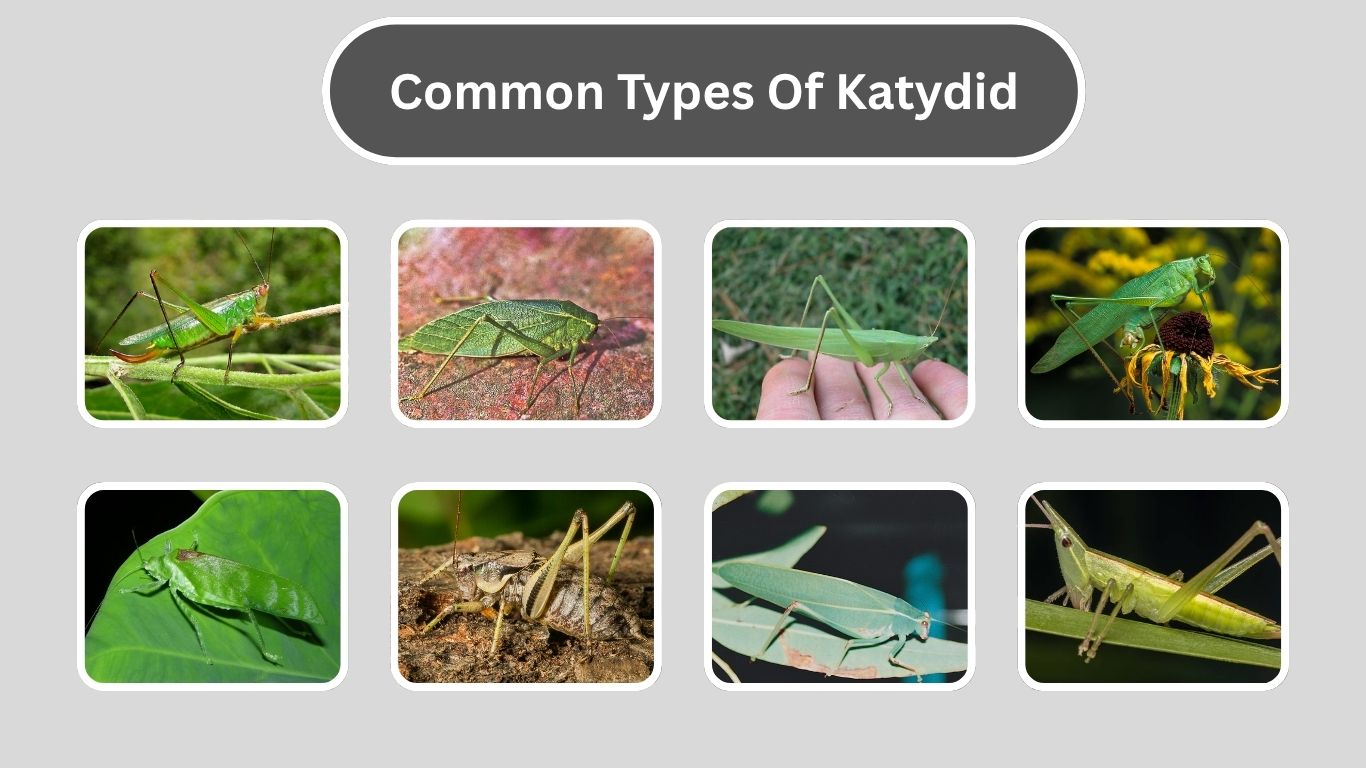
Katydids are fascinating insects known for their leaf-like appearance, long antennae, and unique mating calls. Found in various habitats across the world, these insects come in many forms—from tree-dwelling leaf mimics to colorful meadow jumpers. In this guide, you’ll discover 25 distinct types of katydids, each with detailed identification and natural behavior to help you recognize them in the wild or your own backyard.
1. Common True Katydid

The Common True Katydid (Pterophylla camellifolia) is a large, leaf-like insect native to the eastern United States. Known for their loud, raspy mating calls during summer nights, they’re often heard more than seen. These katydids are flightless and prefer treetops, where they blend in with foliage thanks to their excellent camouflage.
Identification
- Scientific Name: Pterophylla camellifolia
- Size: 45–60 mm (1.75–2.4 inches)
- Color: Bright green with prominent leaf-vein patterns
- Wings: Flat and held tent-like over the body
- Antennae: Extremely long, often longer than the body
- Legs: Hind legs well-developed for jumping
- Sexual Dimorphism: Males have thicker forewings for stridulation (sound production)
Habitat and Distribution
These katydids are commonly found in deciduous forests, suburban areas with mature trees, and dense shrubbery. They range throughout the eastern United States, from Florida to New York and west to Texas.
Diet and Feeding Behavior
Common True Katydids are herbivorous, primarily feeding on the leaves of oak, hickory, and other broadleaf trees. They occasionally nibble on fruit or flowers but cause minimal damage.
Sound and Communication
Males produce a loud, harsh “katy-did, katy-didn’t” call by rubbing their wings together. This rhythmic chirp serves as a mating call and is typically heard at dusk or on warm summer nights.
2. Broad-winged Katydid

The Broad-winged Katydid (Microcentrum rhombifolium) is a striking insect known for its bright green color and wide, leaf-like wings that offer impressive camouflage. Found across much of North America, this katydid is often seen in gardens, trees, and shrubs during the late summer and early fall.
Identification
- Scientific Name: Microcentrum rhombifolium
- Size: 40–50 mm (1.6–2.0 inches)
- Color: Vivid green, leaf-mimicking body
- Wings: Broad and rhombus-shaped, held roof-like
- Antennae: Long, thread-like, extending well beyond the body
- Eyes: Prominent and reddish or brownish in color
- Unique Mark: Slightly serrated wing edges resembling leaf margins
Habitat and Behavior
Broad-winged Katydids prefer wooded areas, forest edges, and suburban gardens. They often rest quietly on leaves during the day and become more active at night. Their excellent mimicry helps them avoid predators such as birds and bats.
Diet and Feeding Habits
They are folivores, feeding mostly on leaves of deciduous trees like cherry, oak, and maple. In gardens, they may occasionally nibble on flowers or soft fruit, though they rarely cause serious damage.
Communication and Mating Call
Males sing a sharp “tsip” sound by rubbing their wings together to attract females. This sound is repeated in bursts during the evening and is softer than the call of the Common True Katydid. Females are silent but locate males by following the sound.
3. Angular-winged Katydid

The Angular-winged Katydid (Microcentrum angustatum) is a close relative of the Broad-winged Katydid but can be distinguished by its more sharply angled wings. It blends seamlessly into foliage and is most active during the late summer and fall.
Identification
- Scientific Name: Microcentrum angustatum
- Size: 40–50 mm (1.6–2.0 inches)
- Color: Bright green with noticeable leaf-vein markings
- Wings: Narrower than Broad-winged Katydid, with sharply angular shape
- Antennae: Very long, filamentous
- Legs: Hind legs adapted for strong jumping
- Distinctive Feature: Sharper wing angles compared to other Microcentrum species
Range and Habitat
These katydids are found primarily in the southeastern United States, often in hardwood forests, overgrown fields, and dense garden shrubs. They prefer warm, humid environments and typically remain hidden in the canopy.
Behavior and Life Cycle
Angular-winged Katydids are nocturnal and secretive. They are rarely seen during the day unless disturbed. Their lifecycle includes egg-laying in late summer, overwintering in the egg stage, and hatching in spring.
Diet and Interaction with Plants
They feed on a variety of plant materials, particularly leaves and flower petals. While not considered major pests, they may occasionally chew on ornamental plants or crops in garden environments.
4. Fork-tailed Bush Katydid

The Fork-tailed Bush Katydid (Scudderia furcata) is a slender, active katydid that’s easily recognized by the forked tip of its abdomen. Unlike many others, it’s a good flyer and often found in low vegetation or flowering plants.
Identification
- Scientific Name: Scudderia furcata
- Size: 30–40 mm (1.2–1.6 inches)
- Color: Pale to medium green
- Wings: Long and narrow, extending past the abdomen
- Abdomen: Males have a distinctive forked tip
- Antennae: Slender and very long
- Eyes: Small and rounded, light in color
Habitat and Activity
This species prefers open fields, meadows, gardens, and forest edges. It can be seen hopping or flying from one plant to another during dusk and early evening. They’re less secretive than tree-dwelling katydids.
Feeding Behavior
Fork-tailed Bush Katydids feed on flower petals, leaves, and tender buds. They’re commonly found on goldenrod, milkweed, and other flowering plants, where their feeding is usually minor and non-destructive.
Sounds and Communication
Males produce a soft “tick-tick-tick” series of notes that sound like tapping. This call is used for courtship and is typically heard during the warm months of summer nights.
5. Oblong-winged Katydid

The Oblong-winged Katydid (Amblycorypha oblongifolia) is known for its rounded body shape and unusually broad, oblong wings. These katydids vary in color, which makes them stand out among their mostly green relatives.
Identification
- Scientific Name: Amblycorypha oblongifolia
- Size: 30–45 mm (1.2–1.8 inches)
- Color Variants: Green (most common), pink, tan, or even bright yellow
- Wings: Broad and rounded, oblong in shape, overlapping the abdomen
- Antennae: Very long and fine
- Distinct Trait: Color polymorphism with pink individuals being rare and striking
Habitat and Behavior
They prefer moist, vegetated areas such as thickets, meadows, and forest edges. These katydids are ground dwellers and also climb low shrubs. They’re often hidden in grasses and foliage during the day and become active in the evening.
Diet and Feeding
Oblong-winged Katydids feed on a variety of leaves, flowers, and even grasses. They are known to consume parts of goldenrod, sunflower, and coneflowers. Despite their varied diet, they typically do not cause major plant damage.
Reproduction and Song
Males sing a soft “s-s-s-s-sip” call to attract females. This rhythmic pattern is slower and less harsh than that of other katydids. Females lay eggs in plant stems or in soil, with hatching occurring the following spring.
6. Greater Angle-wing Katydid

The Greater Angle-wing Katydid (Microcentrum rhombifolium) is a leaf mimic with angular wing edges that help it hide in plain sight. It’s one of the most well-known katydids in North America due to its distinct call and large size.
Identification
- Scientific Name: Microcentrum rhombifolium
- Size: 45–60 mm (1.8–2.4 inches)
- Color: Leafy green with clear vein-like wing texture
- Wings: Triangular or rhombus-shaped, held flat over the body
- Body: Flat and leaf-like, excellent camouflage
- Eyes: Prominent and light-colored
Range and Habitat
Common throughout the United States, especially in the eastern and central regions. They inhabit deciduous trees, bushes, and forest understory and are especially common in suburban gardens with mature vegetation.
Diet and Impact
They feed on the leaves of many trees and shrubs, including oak, maple, cherry, and rose. Their feeding is minimal and does not generally pose a threat to plants.
Communication and Behavior
The male produces a sharp “zik-zik-zik” sound in rhythmic pulses. This song can be heard from treetops during warm evenings. They are solitary and avoid light, usually retreating to foliage when disturbed.
7. Lesser Angle-wing Katydid

The Lesser Angle-wing Katydid (Microcentrum retinerve) is a smaller cousin of the Greater Angle-wing and is just as well camouflaged. It is typically found lower in vegetation and is less commonly seen due to its size and quieter call.
Identification
- Scientific Name: Microcentrum retinerve
- Size: 35–45 mm (1.4–1.8 inches)
- Color: Green with visible leaf-vein patterns on wings
- Wings: Narrower than Greater Angle-wing, angular shape
- Antennae: Thin and extremely long
- Wing Texture: Fine and smooth with leaflike venation
Habitat and Activity
This katydid prefers forest edges, shrubs, and garden hedges. It usually stays within a few feet of the ground, unlike its larger relative that climbs higher into trees. It is most active at dusk and during warm nights.
Feeding and Plant Preferences
Lesser Angle-wing Katydids consume leaves from a wide variety of plants. They especially favor deciduous shrubs like viburnum and hydrangea. Their feeding is minimal and not considered harmful to ornamental plants.
Sound and Mating Call
Their call is a delicate, whisper-like trill that is hard to hear without being close. It’s a short, repetitive “tsick-tsick-tsick” and is used by males to attract females during the evening.
8. Texas Bush Katydid

The Texas Bush Katydid (Scudderia texensis) is a slender, agile species common in the southern United States. It is known for its bushy habitat, quick movements, and soft nighttime songs.
Identification
- Scientific Name: Scudderia texensis
- Size: 35–50 mm (1.4–2.0 inches)
- Color: Green with some yellowish or brownish highlights
- Wings: Narrow and long, extend beyond the abdomen
- Abdomen: Males have a slightly upturned and forked tip
- Legs: Thin and adapted for leaping through brush
Range and Habitat
Widespread throughout the southern U.S., especially in Texas, Oklahoma, and parts of the Southeast. Found in open woodlands, overgrown fields, and roadside vegetation. Prefers bushes and flowering plants.
Diet and Feeding Habits
Feeds on flower petals, young leaves, and buds. It is particularly fond of legumes and wildflowers. They also feed on soybean and clover leaves, making them occasionally noticeable in farmland.
Communication
Texas Bush Katydids produce a soft ticking or clicking sound. Their call is lower in volume compared to tree-top katydids, and they often call from just a few feet off the ground, hidden within shrubs.
9. California Katydid

The California Katydid (Scudderia mexicana) is native to the western United States, particularly California. It’s a slender, agile katydid that favors coastal areas and chaparral environments. It blends well in dry brush with its muted green or pale green color.
Identification
- Scientific Name: Scudderia mexicana
- Size: 30–40 mm (1.2–1.6 inches)
- Color: Pale green to olive green
- Wings: Long and narrow, often extending well past the abdomen
- Abdomen: Males feature slightly forked cerci
- Antennae: Exceptionally long and slender
Habitat and Range
Found mainly in California, especially in coastal zones, scrublands, and oak woodland areas. They often hide in flowering plants and low vegetation, becoming active at dusk.
Feeding and Behavior
This katydid prefers flowering plants and shrubs such as ceanothus, toyon, and sages. It feeds on flower petals and tender leaves, often nibbling without causing noticeable damage.
Sound and Courtship
The call is a soft, ticking sound produced by males in rhythmic pulses. Females respond by approaching the source, often hopping between shrubs to locate the calling male.
10. Meadow Katydid

Meadow Katydids belong to a group of smaller, colorful katydids found in grassy fields, wetlands, and near ponds. They’re active jumpers with high-pitched, rapid songs, especially during the late summer.
Identification
- Genus: Orchelimum and Conocephalus (multiple species)
- Size: 15–30 mm (0.6–1.2 inches)
- Color: Usually green with orange or brown highlights
- Wings: Short in some species, long in others
- Antennae: Very long and thin
- Legs: Hind legs strong and adapted for jumping
Habitat and Distribution
Meadow Katydids are widespread across North America. They thrive in wet meadows, grassy fields, and marshes. Many species prefer areas near water where grass and sedges grow thickly.
Diet and Feeding
They feed primarily on grass blades, small flowers, and occasionally soft insect prey. Their role is both as a herbivore and, in some species, as an opportunistic omnivore.
Communication
The males produce quick, continuous “tick-tick-tick” trills, which are difficult for humans to hear without close proximity. These songs are species-specific and help females locate the correct mate.
11. Round-headed Katydid

The Round-headed Katydid (Amblycorypha spp.) is a small, soft-bodied katydid known for its rounded head and gentle appearance. These katydids are often brightly colored and more likely to be seen in late summer.
Identification
- Genus: Amblycorypha
- Size: 18–30 mm (0.7–1.2 inches)
- Color: Bright green; occasionally pink or tan individuals observed
- Head: Rounded and slightly dome-shaped
- Wings: Vary by species – some long-winged, others short-winged
- Antennae: Thin and much longer than body
- Special Trait: Shorter wings in many species, often exposing the abdomen
Habitat and Activity
Found throughout the eastern United States in open woodlands, weedy fields, and tall grass habitats. They are low fliers and more likely to hop or climb through vegetation rather than fly.
Diet and Feeding Behavior
Round-headed Katydids feed on a variety of soft vegetation, including leaves, flower petals, and grasses. Some may also feed on pollen and fungal material. They are harmless to crops and generally unnoticed.
Communication and Song
Males produce brief, sharp trills or ticks depending on the species. These calls are usually heard in the early evening and may vary in tempo or pitch to distinguish one species from another.
12. Curve-tailed Bush Katydid

The Curve-tailed Bush Katydid (Scudderia curvicauda) gets its name from the distinct curve in the male’s abdomen tip. This species is common in eastern North America and prefers low vegetation over forested areas.
Identification
- Scientific Name: Scudderia curvicauda
- Size: 35–45 mm (1.4–1.8 inches)
- Color: Light green with occasional brownish tinge
- Wings: Long, narrow, extending beyond abdomen
- Abdomen: Males have noticeably curved cerci
- Legs: Slender and adapted for leaping through brush
Habitat and Distribution
Typically found in meadows, grassy fields, and garden margins. It prefers open sunny environments and can often be seen hopping through tall grass and flowering plants.
Feeding Behavior
This katydid primarily feeds on flower parts and tender shoots. It is especially drawn to goldenrod and Queen Anne’s lace, where it hides among blooms during daylight hours.
Mating Call and Sound
The male emits a soft, buzzing or ticking song that’s most active in the evening. The sound helps females locate mates, and different Scudderia species have slightly different calls.
13. Pine-tree Katydid

The Pine-tree Katydid (Amblycorypha spp., possibly Amblycorypha cajennensis in southern regions) is a tree-dwelling species often associated with conifers. It’s well camouflaged and harder to detect due to its quiet song and arboreal habits.
Identification
- Scientific Name: Amblycorypha spp.
- Size: 25–35 mm (1.0–1.4 inches)
- Color: Dull to bright green, sometimes with a bluish tinge
- Wings: Typically shorter than the abdomen, with rounded tips
- Head: Rounded, soft-bodied appearance
- Distinctive Feature: Prefers pine and conifer habitats over deciduous trees
Habitat and Range
Most common in the southeastern U.S. and parts of the Midwest, they live in pine forests, wooded suburban areas, and coniferous hillsides. They stay in the upper parts of pine trees, rarely coming to the ground.
Feeding and Behavior
Pine-tree Katydids feed on pine needles, soft new growth, and occasionally flower petals. Their diet is specialized compared to broadleaf-loving katydids, and they often remain motionless to avoid detection.
Song and Activity
Males produce a faint, whispery buzz that’s difficult to hear without close proximity. It’s most often heard on warm summer nights in pine groves, especially following sunset.
14. Prairie Meadow Katydid

The Prairie Meadow Katydid (Conocephalus saltans) is a small, slender katydid found in grasslands and prairies. Its long legs and wings make it an excellent jumper, and it’s frequently seen in native tallgrass ecosystems.
Identification
- Scientific Name: Conocephalus saltans
- Size: 12–20 mm (0.5–0.8 inches)
- Color: Pale green with brownish or reddish accents
- Legs: Long hind legs adapted for leaping
- Wings: Short to moderately long depending on morph
- Antennae: Very fine and long, often longer than body
Habitat and Distribution
Widespread across the Midwest and Great Plains, especially in tallgrass prairie and restored grasslands. Also found in sunny meadows and along weedy roadside margins.
Feeding and Diet
Feeds mainly on grass blades and sedges, and occasionally flowers. It prefers native prairie plants and does not usually interact with ornamental or garden species.
Call and Mating Behavior
Males emit a rapid, high-pitched buzzing call that blends into the background sounds of summer. The sound resembles static or a gentle “zzzzz” and is used to attract females in open field environments.
15. Agile Meadow Katydid

The Agile Meadow Katydid (Orchelimum agile) is a fast-moving, brightly colored katydid often found near wetlands and grassy areas. It’s well-known for its agility, often leaping quickly when disturbed.
Identification
- Scientific Name: Orchelimum agile
- Size: 15–22 mm (0.6–0.9 inches)
- Color: Bright green with contrasting red or orange accents on legs and face
- Legs: Long, powerful hind legs
- Wings: Short to medium, slightly extend past abdomen in some individuals
- Antennae: Extremely long, filamentous
- Markings: Often has a dark line running from the eye to the base of the antenna
Habitat and Behavior
Typically found in moist meadows, near ponds, marshes, and along streams. Agile Meadow Katydids cling to tall grasses and sedges. They are active by day and night, often jumping into dense vegetation when approached.
Diet and Preferences
Feeds primarily on grasses, sedges, and flowering plant parts. They occasionally eat pollen or small insects, especially aphids or soft-bodied larvae.
Song and Communication
Their song is a sharp, buzzy rattle — a fast “zit-zit-zit” — that sounds somewhat like an electric spark. This song is usually heard during the daytime, especially on hot afternoons.
16. Red-headed Meadow Katydid

The Red-headed Meadow Katydid (Orchelimum erythrocephalum) is one of the most visually striking meadow katydids due to its vivid red head and colorful body. It lives in the southeastern U.S. and favors marshy environments.
Identification
- Scientific Name: Orchelimum erythrocephalum
- Size: 18–25 mm (0.7–1.0 inches)
- Head: Bright red or reddish-orange
- Body: Green with blue and orange highlights
- Wings: Long and narrow, usually extending beyond the body
- Legs: Orange or brown, well adapted for jumping
Habitat and Range
This species prefers freshwater marshes, grassy wetlands, and ditches with standing water. It’s often found in dense clumps of sedges and grasses, especially in the southeastern and Gulf Coast states.
Feeding and Diet
Feeds on a variety of sedges, grasses, and aquatic plants. It may also consume decaying plant matter or small soft-bodied insects, particularly in damp environments.
Vocalization and Mating
The male’s call is a continuous, high-pitched rattle that sounds similar to a sprinkler or rapid sizzle. It calls during both day and night, and its sound carries well in open wetland spaces.
17. Crepitating Katydid

The Crepitating Katydid (Anabrus simplex) is a large, flightless species known for its distinctive “crepitation” — a crackling sound it makes by snapping its wings together during short flights or jumps. Unlike many other katydids, it inhabits drier environments.
Identification
- Scientific Name: Anabrus simplex
- Size: 40–50 mm (1.6–2.0 inches)
- Color: Brown to grayish-brown, blending with dry grass or soil
- Wings: Short and stubby, not used for true flight
- Legs: Robust with strong femurs for digging and leaping
- Body: Heavily built with a humped back
- Unique Trait: Produces clicking or snapping sounds during movement
Habitat and Distribution
Found primarily in the western United States, especially in dry prairies, shrublands, and arid rangelands. This katydid often burrows or hides under debris during the day and becomes active at night.
Feeding and Behavior
The Crepitating Katydid is omnivorous. It feeds on leaves, stems, grains, and even small insects or carrion. In large numbers, it can become an agricultural pest, especially in dry years.
Sound and Defense
Rather than a typical mating call, this katydid produces defensive clicking or crackling sounds during escape leaps. This startling sound may deter predators and is unique among North American katydids.
18. Leaf Katydid

Leaf Katydids (family Phaneropterinae) are masters of camouflage, resembling green or brown leaves with such precision that they often go unnoticed. Many species fall under this common name across the globe.
Identification
- Subfamily: Phaneropterinae
- Size: Varies by species (typically 30–50 mm or 1.2–2.0 inches)
- Color: Green, brown, or mottled to match foliage
- Wings: Veined like leaves, held flat or roof-like over the body
- Head: Triangular with long, thin antennae
- Trait: Some species have notches or “bites” in wings, resembling real damaged leaves
Habitat and Range
These katydids are found worldwide in forests, gardens, and tropical habitats. In North America, they’re most common in woodlands and dense shrubbery.
Diet and Camouflage
They feed on a variety of plant leaves, usually causing little damage. Their primary defense is camouflage — they remain motionless, mimicking dead or live leaves to avoid predators.
Vocalization and Mating
Male leaf katydids produce soft, ticking or hissing sounds. In tropical species, calls may be more musical or varied. Mating behavior includes back-and-forth chirps and brief pursuit through foliage.
19. Scudderia furcata (Fork-tailed Katydid)

The Fork-tailed Katydid is one of the most widespread bush katydids in North America. It is easily identified by the male’s distinctive forked cerci (tail-like appendages) and its preference for flowering plants.
Identification
- Scientific Name: Scudderia furcata
- Size: 30–40 mm (1.2–1.6 inches)
- Color: Bright to pale green
- Wings: Long, slender, and extend well past the abdomen
- Abdomen: Males possess deeply forked cerci
- Legs: Thin and long, with strong jumping capability
- Distinctive Trait: Males have prominent V-shaped tail tips
Habitat and Range
Found across a wide swath of the United States and southern Canada, especially in fields, gardens, and forest edges. They are often observed on goldenrod, milkweed, and other flowering plants.
Diet and Behavior
Scudderia furcata is herbivorous, feeding primarily on flowers, buds, and tender shoots. They are commonly seen during the daytime resting in open flowers, blending well with the greenery.
Sound and Mating Communication
Their call is a light, ticking or “tsip-tsip-tsip” sound, often difficult to hear unless close. Males call at dusk and night to attract nearby females, who locate them through sound.
20. Shield-backed Katydid

Shield-backed Katydids are a distinctive group characterized by their large, flattened thorax that extends like a shield over the back. Many species are ground-dwelling and more robust than typical leaf katydids.
Identification
- Family: Tettigoniidae, Subfamily Decticinae
- Size: 35–60 mm (1.4–2.4 inches)
- Color: Often brown, gray, or greenish
- Thorax: Pronotum forms a hardened shield over the wings and part of the abdomen
- Wings: Reduced or absent in many species
- Legs: Thick and strong, built for jumping
Habitat and Distribution
Most common in the western and southwestern U.S., including deserts, grasslands, and rocky areas. Some species also inhabit woodlands and chaparral zones. They are more likely to be found on the ground than in trees or shrubs.
Feeding and Activity
These katydids are omnivorous, feeding on grasses, seeds, flowers, and even small insects. Their thick armor and terrestrial habits make them well-suited to dry, rugged environments.
Sound and Behavior
Many species have reduced or no sound-producing organs. When they do produce sound, it is often a faint clicking or rasp. Some may drum or vibrate the ground as part of communication.
21. Phaneropterine Katydid

Phaneropterine Katydids belong to a subfamily (Phaneropterinae) known for their delicate structure and musical calls. Many tropical and temperate katydid species fall into this group, including some of the most leaf-like insects in the world.
Identification
- Subfamily: Phaneropterinae
- Size: Varies by species (25–50 mm or 1–2 inches)
- Color: Typically green, some species show brown or mixed tones
- Wings: Long and leaf-veined, often extending beyond abdomen
- Antennae: Thread-like and very long
- Body: Slender with a triangular face
Habitat and Distribution
Found worldwide in warm climates, including Asia, Africa, the Americas, and southern Europe. In North America, they inhabit woodlands, gardens, and shrubby fields.
Diet and Feeding
Primarily folivores, feeding on leaves and flowers. Some species are known to include fruit or soft-bodied insects in their diets. They rarely cause damage to cultivated plants.
Songs and Communication
Males produce melodic, tinkling calls — sometimes resembling tiny bells or harp notes. Their songs are complex and often unique to each species, making sound an important identification tool.
22. Cone-headed Katydid

Cone-headed Katydids (genus Neoconocephalus) are named for the pointed, cone-like structure on their heads. These long-bodied katydids are excellent singers, and their trills are often heard on hot summer nights near water.
Identification
- Genus: Neoconocephalus
- Size: 35–55 mm (1.4–2.2 inches)
- Color: Green or brown
- Head: Sharply pointed, forming a conical snout
- Wings: Long and narrow, extending beyond the body
- Legs: Slender, adapted for both climbing and jumping
Habitat and Range
Common in marshes, meadows, and along lakeshores and rivers. Found widely across the eastern and southern U.S., especially in moist grassy areas.
Diet and Behavior
Feeds on grasses, sedges, and flowering plants. Some may also consume smaller insects. They hide in tall vegetation during the day and become highly active at night.
Sound and Activity
Cone-headed Katydids produce loud, continuous buzzes that can carry over long distances. These trills are often species-specific and are used in both mate attraction and territory establishment.
23. Robust Bush Katydid

The Robust Bush Katydid (Scudderia pistillata) is a sturdy and active species, slightly larger and bulkier than many of its bush katydid relatives. It prefers open woodlands and flowering vegetation, especially in the northeastern United States.
Identification
- Scientific Name: Scudderia pistillata
- Size: 40–50 mm (1.6–2.0 inches)
- Color: Medium green with slight yellow or brown highlights
- Wings: Long, slender, extending beyond the abdomen
- Abdomen: Males have straight, thick cerci; females have a prominent curved ovipositor
- Legs: Sturdy, suited for strong jumping among low vegetation
Habitat and Distribution
Primarily found in the northeastern and mid-Atlantic U.S., including states like New York, Pennsylvania, and New England. Common in hedgerows, forest margins, and flower-filled clearings.
Diet and Feeding
Feeds on petals, buds, and young shoots of many wildflowers and herbaceous plants. May be seen in gardens, often resting on sunflower, goldenrod, or clover blooms.
Song and Behavior
The male produces a ticking “tzip-tzip-tzip” sound, similar to other bush katydids but slightly slower and deeper. They sing mostly at dusk and early night, using their calls to attract females over short distances.
24. Spiny Bush Katydid

The Spiny Bush Katydid (genus Copiphora) is named for the sharp spines found on its legs and thorax. Though most common in tropical regions, some species reach into Central America and southern North America.
Identification
- Genus: Copiphora
- Size: 50–70 mm (2.0–2.75 inches)
- Color: Typically bright green or brown
- Head: Sometimes horned or cone-shaped, depending on species
- Thorax: Features prominent spines or ridges
- Legs: Armed with spines for defense and grip
Habitat and Range
Mostly found in tropical forests and dense jungle environments, including southern Mexico and parts of Central America. Prefers thick foliage, trees, and vines.
Diet and Behavior
Spiny Bush Katydids are omnivores. They consume plant matter but are also opportunistic predators of small insects like caterpillars and leafhoppers. Their strong jaws allow them to feed on tougher materials.
Sound and Defense
They produce sharp, metallic-sounding clicks and trills. When threatened, they raise their spiny legs and produce defensive sounds, deterring predators with both noise and physical defense.
25. Black-legged Meadow Katydid

The Black-legged Meadow Katydid (Orchelimum nigripes) is a small, colorful species most often found near wetlands and grassy ditches. Its vibrant appearance and rapid chirping call make it one of the more noticeable meadow katydids.
Identification
- Scientific Name: Orchelimum nigripes
- Size: 18–25 mm (0.7–1.0 inches)
- Color: Bright green with blue or turquoise highlights
- Legs: Hind legs are dark brown to black, giving the species its name
- Wings: Medium length, extend past the abdomen
- Antennae: Long and fine
Habitat and Range
Found in the eastern and southeastern U.S., especially near ponds, ditches, and marshes. They favor low, wet grassy areas where sedges and reeds dominate.
Feeding and Activity
Feeds on grass blades, flower petals, and sometimes soft-bodied insects. Active during the day and night, they move quickly through dense vegetation and are often spotted by their call rather than sight.
Call and Communication
The male’s call is a rapid “zip-zip-zip” that resembles a sewing machine or soft static. It’s continuous and high-pitched, usually heard during warm summer afternoons and evenings.