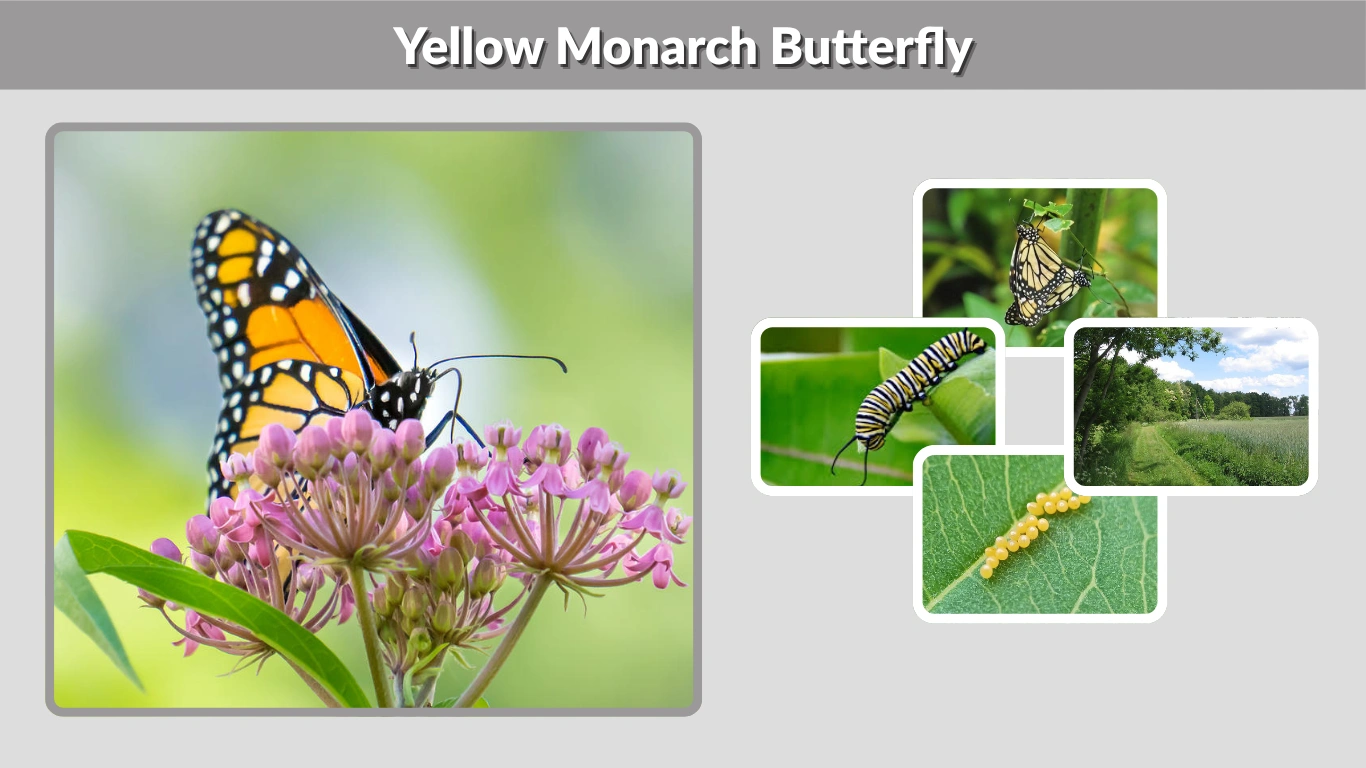
The so-called “yellow monarch butterfly” has long fascinated people who spot what appears to be a monarch in golden shades instead of the familiar orange. In reality, most “yellow monarchs” are not true monarch butterflies but look-alike species with similar patterns. Understanding their identification, habitat, diet, and behavior helps reveal the truth behind these bright-winged beauties and their deeper symbolic meaning in cultures around the world.
Identification

- True Color: Monarch butterflies (Danaus plexippus) are orange and black, not yellow.
- Misidentification: Many “yellow monarchs” are actually tiger swallowtails or queen butterflies.
- Wing Pattern: Monarchs show bold black veins and white-spotted edges.
- Size: Wingspan around 3.5–4 inches, slightly larger than viceroys.
- Gender Difference: Males have two black scent spots; females have thicker black lines.
- Yellow Appearance Causes: Lighting, aging wings, or pigment mutations.
- Common Look-Alikes:
- Tiger Swallowtail – bright yellow with black stripes.
- Viceroy – smaller, has an extra black band on hindwings.
- Queen Butterfly – darker orange-brown with white spots.
- Tiger Swallowtail – bright yellow with black stripes.
Physical Characteristics
A genuine monarch butterfly has a wingspan of 3.5 to 4 inches, vivid orange wings with bold black veins, and white-spotted tips. Males can be recognized by two black scent spots on their hindwings, while females have thicker black lines.
“Yellow monarchs,” by contrast, usually show paler yellow or lemon-colored wings with soft black edges — a strong sign you’re looking at a swallowtail or viceroy instead of a true monarch.
Habitat

Where Yellow-Looking Monarchs Are Found
Monarch butterflies are native to North America, though they’re also found in Central and South America, Hawaii, Australia, and New Zealand. They prefer open fields, prairies, and meadows filled with milkweed and flowering plants.
Yellow look-alikes, such as the tiger swallowtail, are common in woodlands, gardens, and forest edges, where they bask in sunlight and seek nectar from local blooms.
Preferred Environment
Monarchs thrive where milkweed grows since it’s their only larval host plant. Adults, however, depend on a variety of nectar sources like coneflowers and goldenrods.
By contrast, yellow swallowtails adapt to warmer climates and feed from different nectar plants, including lilacs and lantanas. Their flexibility in habitat allows them to appear across many regions where monarchs might not survive year-round.
Seasonal Migration
One of the main differences between monarchs and their yellow counterparts is migration. Monarch butterflies are the only insect species known to migrate thousands of miles annually — from Canada and the northern U.S. to central Mexico. This epic journey is powered by stored energy from nectar.
Yellow swallowtails and queens do not make long migrations. They stay within local ranges, completing shorter seasonal movements based on temperature and food availability.
Behaviors

Flight and Movement Patterns
Monarchs have a distinctive, gliding flight, often soaring effortlessly between flowers. They conserve energy by catching warm air currents.
Yellow swallowtails, on the other hand, exhibit a quicker, fluttering movement, darting between blossoms and trees. Observing their flight style is one of the easiest ways to tell them apart in the wild.
Mating and Reproduction
During breeding season, male monarchs use pheromones and flight displays to attract females. After mating, females search for milkweed plants where they lay one egg at a time on the underside of a leaf.
Other yellow butterflies follow similar behaviors, but they may lay eggs on a wider variety of host plants. Monarchs are more selective, depending solely on milkweed for larval development — a critical factor for species survival.
Defensive Behaviors
The monarch’s brilliant coloration is not just for beauty — it’s a warning. Caterpillars absorb toxic compounds from milkweed called cardenolides, which make both caterpillars and adults taste bitter to predators. Birds quickly learn to avoid them after one unpleasant encounter.
Many yellow species imitate this defense through coloration even though they lack toxins themselves — a clever survival strategy called mimicry. This evolutionary advantage allows harmless butterflies to benefit from the monarch’s fierce reputation.
Diet

What Monarch Caterpillars Eat
Monarch caterpillars are specialists — they eat only milkweed plants (Asclepias species). The plant’s leaves contain a milky sap rich in toxins called cardenolides, which make caterpillars and adult monarchs unpalatable to predators. Common species of milkweed include Asclepias syriaca (common milkweed), A. incarnata (swamp milkweed), and A. tuberosa (butterfly weed). These plants provide the nutrients and chemical defenses monarchs need to survive.
What Adult Monarchs Eat
Once metamorphosis is complete, adult monarchs switch from eating leaves to sipping nectar from flowers. Their long, straw-like proboscis allows them to drink from tubular blooms such as zinnias, goldenrod, coneflowers, lantanas, and asters. Nectar provides sugar for energy during flight and migration. Monarchs can also be seen mud-puddling — drawing minerals from moist soil to supplement their diet.
What Yellow Monarch Look-Alikes Eat
Yellow swallowtails and other monarch-like species share similar feeding habits. They visit brightly colored flowers for nectar and occasionally feed on tree sap or overripe fruit. While monarchs depend heavily on milkweed for their life cycle, swallowtails are more flexible, laying eggs on willow, citrus, or magnolia plants depending on the region.
Feeding Behavior
Butterflies are daytime feeders and rely on visual cues to find food. They’re attracted to red, orange, and yellow blooms. As they feed, pollen sticks to their bodies, turning them into accidental pollinators — essential contributors to healthy ecosystems.
Life Cycle

Egg Stage
The life of a monarch begins when a female lays eggs, one at a time, on the underside of milkweed leaves. These eggs are tiny, cream-colored, and conical, hatching within three to five days. Yellow-looking butterflies such as swallowtails lay their eggs on a broader range of host plants, but the principle remains the same — every life begins as a delicate egg waiting to hatch.
Caterpillar (Larval) Stage
After hatching, the caterpillar eats its own eggshell for nutrients and then begins feeding on host plant leaves. Monarch caterpillars are instantly recognizable with their black, white, and yellow stripes. They grow rapidly, molting five times over 10–14 days. By the final instar, they are nearly two inches long and ready to pupate.
Chrysalis (Pupa) Stage
The caterpillar attaches itself to a branch or leaf and forms a chrysalis, or pupa. For monarchs, this casing is jade green with gold flecks, resembling a tiny piece of jewelry. Inside, the caterpillar transforms completely — a process called metamorphosis. After 10–14 days, the adult butterfly emerges.
Adult Stage
Freshly emerged adults have soft, wrinkled wings that they must pump full of fluid and allow to dry. Within hours, they take their first flight. Monarchs that emerge in spring and summer live for about two to six weeks, while those born in late summer — the migratory generation — can survive up to eight months, completing the journey to Mexico and back.
Yellow swallowtails follow a similar pattern but remain within local environments and have shorter lifespans.
Symbolism and Spiritual Meaning
Cultural Interpretations
Across cultures, yellow butterflies symbolize hope, transformation, and spiritual rebirth. When people speak of seeing a “yellow monarch,” they often interpret it as a sign of positivity, joy, or divine guidance. In some traditions, yellow butterflies are believed to carry messages from ancestors or represent good fortune arriving soon.
Color Symbolism
Yellow is universally associated with light, optimism, and renewal, while monarchs are known for endurance and resurrection. Together, the concept of a “yellow monarch butterfly” symbolizes the blending of spiritual growth and vitality — a visual reminder of life’s beauty, fragility, and constant change.
Conservation and Importance
Why Monarchs and Their Look-Alikes Matter
Both monarchs and yellow mimic species play critical roles in pollination. As they move from flower to flower in search of nectar, they transfer pollen, supporting the growth of countless wild plants. Monarchs are also considered indicator species, meaning their population health reflects broader environmental conditions.
Threats to Survival
Habitat loss, pesticide use, and climate change are major threats to monarch populations. Reduced availability of milkweed along migration routes has led to significant declines in North America. Look-alike species face similar risks due to the destruction of meadows and forest edges where they feed and breed.
How to Help
You can support these butterflies by:
- Planting native milkweed and nectar-rich flowers.
- Avoiding pesticides that harm caterpillars and pollinators.
- Creating butterfly gardens with shelter, sun exposure, and water sources.
- Participating in citizen science programs that monitor butterfly migrations.
Simple actions like these contribute to the conservation of both monarchs and their yellow look-alikes.
FAQs
Can monarch butterflies be yellow?
True monarchs are orange and black, not yellow. However, lighting, wing aging, or pigment mutations can make them appear more yellow. Often, observers are actually seeing yellow swallowtails or queen butterflies.
What butterfly looks like a yellow monarch?
The tiger swallowtail is the most common yellow butterfly mistaken for a monarch. Its yellow wings with bold black stripes resemble a monarch’s pattern from afar, though it belongs to a completely different family.
What does a yellow monarch butterfly symbolize?
A yellow monarch symbolizes hope, joy, and new beginnings. Spiritually, it can represent transformation or a positive message from nature, reminding us of life’s constant evolution.
Where can yellow monarch look-alikes be found?
They thrive in North and South America, Hawaii, Australia, and tropical regions, often near open meadows, gardens, and forest edges rich in flowering plants.
Do yellow butterflies migrate like monarchs?
Most yellow butterflies, including swallowtails, do not migrate long distances. Monarchs are unique among butterflies for their multi-generation migration, traveling up to 3,000 miles each year.