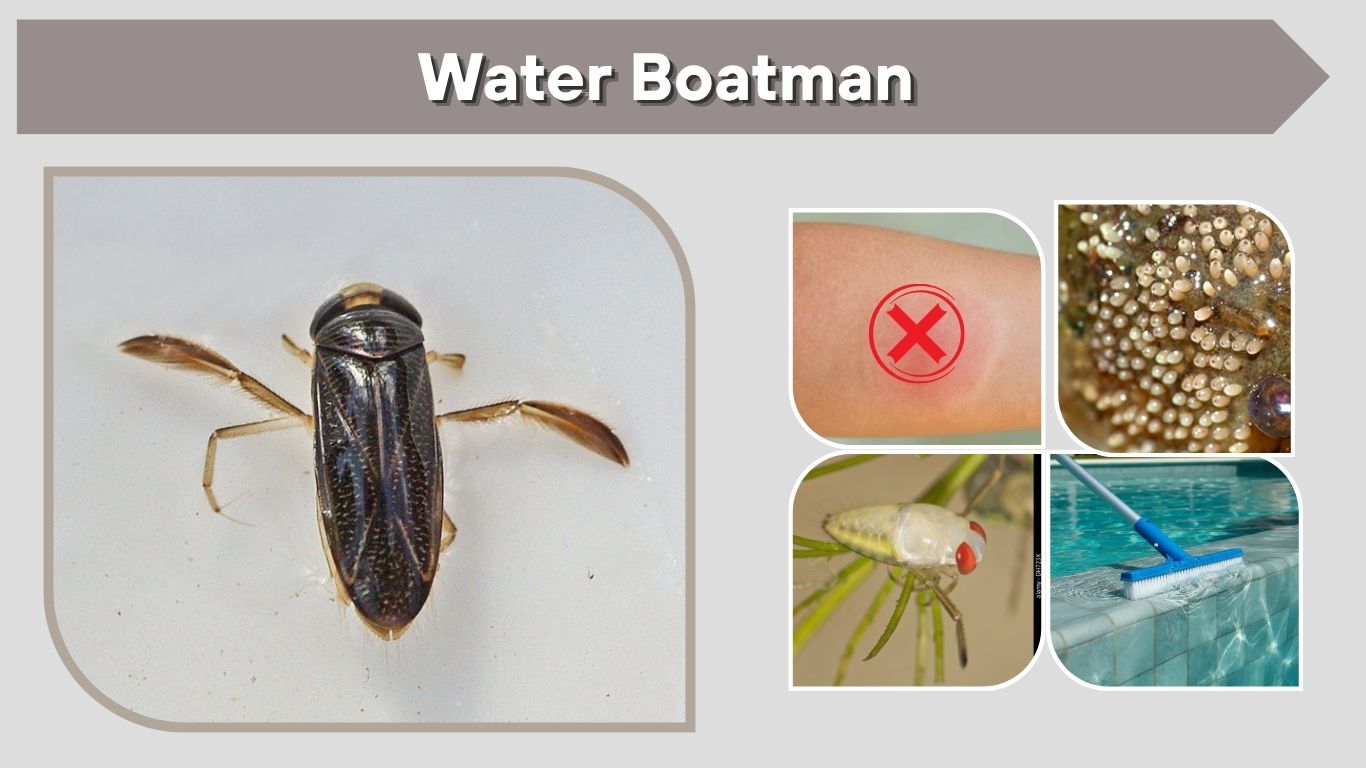
A water boatman is a small aquatic insect often found in ponds, lakes, slow streams, and swimming pools. Many people notice these bugs because they move through the water with oar-like legs and can appear suddenly in backyard pools. Water boatmen are usually harmless, but they are often confused with backswimmers, which can bite. Knowing the difference helps you identify the bug correctly and handle pool problems safely.
What Is a Water Boatman?
A water boatman is an aquatic true bug from the family Corixidae. These insects are commonly called water boatmen because their legs move like tiny paddles as they swim. They are not beetles, even though many people search for “water boatman beetle.” They belong to the order Hemiptera, which includes true bugs.
Water boatmen live most of their lives in water. They are common in ponds, marshes, lakes, ditches, slow-moving streams, and sometimes swimming pools. They are especially common where algae, plant material, and organic debris are present.
What Does a Water Boatman Look Like?
Water boatmen are usually small, oval, and flattened. Their color may be brown, gray, tan, or dark with fine markings across the wings. They often have long hind legs that help them swim.
You can identify a water boatman by these signs:
- It swims right-side up.
- It has a flattened, oval body.
- Its back legs look like small paddles.
- It may rest near the pool wall, bottom, or surface.
- It is usually smaller and less bold-looking than a backswimmer.
The swimming position is one of the easiest clues. True water boatmen usually swim upright, while backswimmers usually swim upside down.
Water Boatman vs Backswimmer
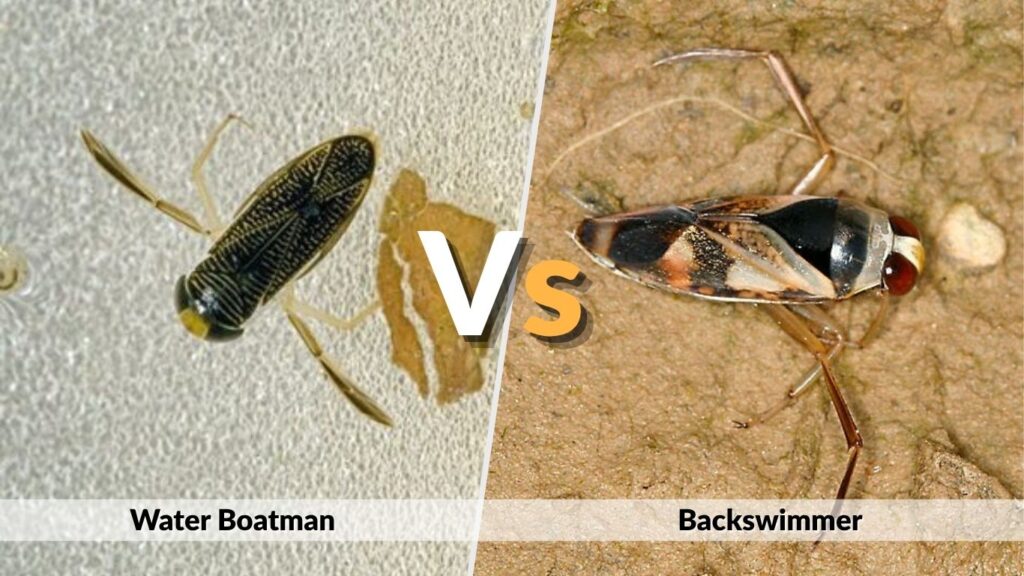
Water boatmen and backswimmers are often confused because both are aquatic bugs with long swimming legs. They may appear in the same pond or pool, but they are not the same insect.
Backswimmers belong to the family Notonectidae, while water boatmen belong to the family Corixidae. The difference matters because backswimmers can deliver a painful bite, while true water boatmen are generally considered harmless to humans.
| Feature | Water Boatman | Backswimmer |
| Family | Corixidae | Notonectidae |
| Swimming style | Right-side up | Upside down |
| Diet | Algae, detritus, microorganisms, tiny aquatic matter | Predatory; eats insects and small aquatic animals |
| Bite risk | Not known for biting humans | Can bite painfully if handled |
| Pool meaning | Often linked to algae or organic debris | Often follows prey bugs such as water boatmen |
| Body shape | Flatter and often less dramatic in color | Often more boat-shaped and active near surface |
Difference Between Water Boatmen and Backswimmers
The easiest difference is how they swim. A water boatman swims with its back upward and belly downward, just like most animals. A backswimmer swims on its back, with its belly facing upward.
Diet is another important difference. Water boatmen often feed on algae, detritus, and tiny organisms. Backswimmers are predators and hunt other aquatic insects. This is why water boatmen may show up first in a pool, followed by backswimmers later.
Do Water Boatmen Bite?
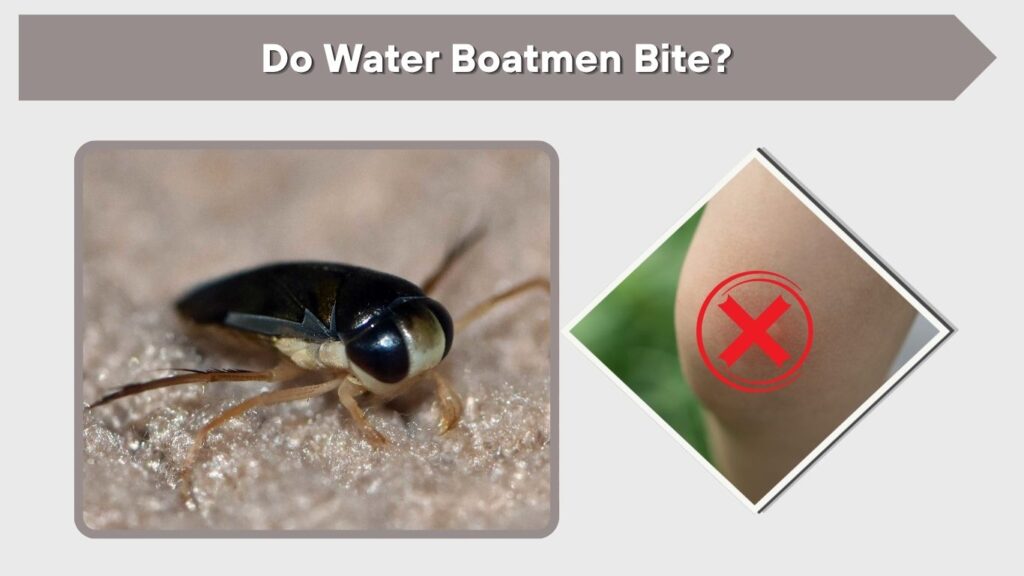
True water boatmen are not known to bite humans. They do not usually sting, attack, or cause skin irritation. If someone says they were bitten by a “water boatman,” there is a good chance the insect was actually a backswimmer.
This confusion is very common because people often call many aquatic bugs “water bugs,” “boatman bugs,” or “water boatmen.” If the insect caused a sharp sting and was swimming upside down, it was probably a backswimmer rather than a true water boatman.
Are Water Boatmen Dangerous?
Water boatmen are not considered dangerous to humans. They do not spread disease in pools, and they are not household pests like roaches, ants, or bed bugs. In ponds, they can even be part of a healthy ecosystem because they feed on algae and organic matter.
However, their presence in a swimming pool can still be a problem. Water boatmen in pool water often suggest that the pool has algae, debris, or enough organic matter to support aquatic insects.
What Do Water Boatmen Eat?
Water boatmen commonly eat algae, detritus, microorganisms, and tiny aquatic material. Some species may also consume small insects or aquatic organisms, but they are much less predatory than backswimmers.
In pools, they are often associated with algae growth. Even if the pool does not look green, there may be a thin film of algae on the walls, steps, ladders, tile line, or shaded areas. This can provide enough food to attract water boatman bugs.
Do Water Boatmen Eat Mosquito Larvae?
Some aquatic bugs may feed on tiny organisms in the water, but water boatmen are not mainly known as mosquito-control insects. They are more strongly linked with algae, plant material, detritus, and microorganisms. If you want to reduce mosquito larvae, the better approach is to remove standing water, improve circulation, and keep water properly treated.
Do Fish and Frogs Eat Water Boatmen?
Yes, fish and frogs may eat water boatmen. In natural ponds and lakes, water boatmen are part of the food chain. They can be eaten by fish, frogs, birds, and other aquatic predators. This is also why terms like “water boatman fly pattern” appear in search data: anglers sometimes imitate water boatmen when fly fishing.
Water Boatman Life Cycle

The water boatman life cycle has three main stages: egg, nymph, and adult. Like other true bugs, water boatmen do not go through a complete butterfly-like metamorphosis. Instead, young water boatmen hatch as nymphs and gradually grow into adults.
Water Boatman Eggs
Female water boatmen lay eggs on underwater surfaces such as plants, sticks, rocks, and debris. In ponds, eggs may be attached to submerged vegetation. In pools, eggs are less likely to survive long-term if the water is clean, filtered, and properly treated.
Water Boatman Nymph
A water boatman nymph looks like a smaller version of the adult, but it does not yet have fully developed wings. As it grows, it molts several times. Nymphs live in the water and feed on tiny aquatic material.
Adult Water Boatman
Adult water boatmen can swim and fly. This is one reason they may appear suddenly in a pool, even if you cleaned it recently. They may fly in from ponds, ditches, birdbaths, neighboring pools, or other water sources.
Can Water Boatmen Fly?
Yes, adult water boatmen can fly. This surprises many pool owners because the bugs seem like they only live in water. They may fly at night or move between water sources during certain seasons.
Water boatmen may be attracted to lights near pools. Outdoor lights can draw flying insects, and some may land in the water. If your pool lights or patio lights are on at night, you may notice more bugs in the pool the next morning.
Water Boatman in Pool: Why They Appear
A water boatman in pool water usually means the pool has something that attracts them. Most of the time, that “something” is algae or organic debris. Even a small amount of algae can support tiny organisms and make the pool more inviting.
How Do Water Boatmen Get in My Pool?
Water boatmen get in pools by flying in from nearby water sources. They may come from ponds, lakes, ditches, fountains, birdbaths, puddles, or neighboring pools. They can also be attracted by pool lights or by algae growing in the water.
Common causes include:
- Algae on pool walls or steps
- Leaves and organic debris
- Poor water circulation
- Low sanitizer level
- Outdoor lights near the pool
- Nearby standing water
- Dirty skimmer baskets
- Poor brushing and vacuuming habits
How to Get Rid of Water Boatmen in Pool
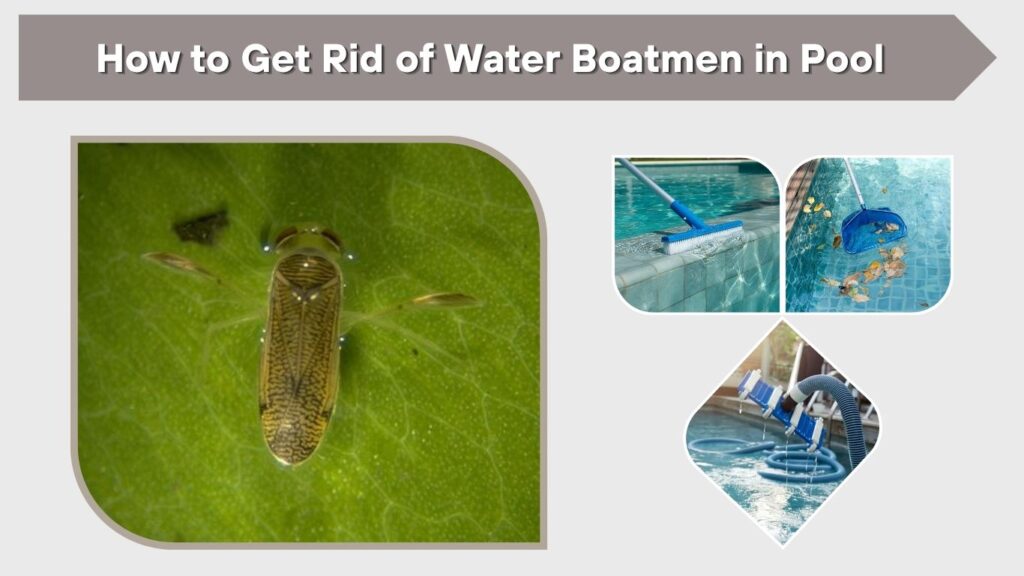
Getting rid of water boatmen in a pool is not just about removing the bugs. You also need to remove the conditions that attracted them. If algae remains, water boatmen may come back.
Step 1: Skim the Pool
Use a pool skimmer net to remove visible water boatmen, leaves, and floating debris. Do not crush bugs in the pool water. Remove them from the pool area and dispose of them away from the water.
Step 2: Brush Pool Surfaces
Brush the walls, steps, ladders, corners, and tile line. Algae can hide in thin layers, especially in shaded areas. Brushing loosens algae so your filter and sanitizer can work better.
Step 3: Vacuum the Pool
Vacuum the pool floor to remove debris, dead bugs, and loosened algae. If your pool has a heavy algae problem, vacuuming to waste may be useful if your system allows it.
Step 4: Shock the Pool
Shocking the pool helps kill algae and organic contaminants. Follow the instructions on the pool shock product and use the correct dose for your pool size. Run the pump after shocking so the treatment circulates.
Step 5: Balance the Water
Test and balance your pool water. Pay attention to chlorine or sanitizer, pH, alkalinity, and stabilizer. A properly balanced pool is less likely to grow algae and attract water boatman bugs.
Does Chlorine Kill Water Boatmen?
Chlorine can help reduce the conditions that attract water boatmen, especially algae and organic contaminants. However, normal chlorine levels may not instantly kill every bug. The better strategy is to clean the pool, remove algae, maintain sanitizer, and prevent future food sources.
If water boatmen keep returning, the pool may still have algae or hidden organic buildup. Brush more thoroughly, clean the filter, check circulation, and test the water again.
How to Keep Water Boatmen Out of Pool Water
Prevention is easier than repeated removal. Once the bugs are gone, keep the pool clean and unattractive to aquatic insects.
Helpful prevention steps include:
- Skim the pool daily during bug season.
- Brush walls and steps weekly.
- Vacuum debris before it breaks down.
- Keep sanitizer in the proper range.
- Maintain good water circulation.
- Clean skimmer and pump baskets.
- Reduce lights near the pool at night.
- Use a pool cover when the pool is not in use.
- Remove standing water near the pool.
If you also see backswimmers, focus on removing water boatmen and other prey insects. Backswimmers often follow food sources.
Water Boatman Sound
Some water boatmen can produce sound underwater. Males of certain species create sound as part of mating behavior. This is why people search for “water boatman sound” or “lesser water boatman sound.” In normal pool situations, however, most homeowners notice the insects visually rather than hearing them.
Water Boatman, Grounded, Jellycat, and Other Search Meanings
Not every “water boatman” search is about the real insect. Some keywords refer to games, toys, books, or songs.
“Grounded water boatman” and “water boatman fin Grounded” refer to the survival game Grounded, where players look for water boatman parts. “Wally Water Boatman Jellycat” and “water boatman Jellycat” refer to a plush toy. “Song of the Water Boatman” refers to a children’s poetry book title.
FAQs
What is a water boatman?
A water boatman is a small aquatic true bug from the family Corixidae. It lives in ponds, lakes, slow water, and sometimes pools. It usually swims right-side up and uses paddle-like legs to move through the water.
Do water boatmen bite humans?
True water boatmen are not known to bite humans. If a “water boatman” bite feels sharp or painful, the insect was probably a backswimmer. Backswimmers look similar but swim upside down and can bite if handled.
Why are water boatmen in my pool?
Water boatmen usually appear in pools because of algae, organic debris, or microorganisms in the water. They may also fly in from nearby ponds, ditches, birdbaths, or other pools, especially when outdoor lights attract insects at night.
How do you get rid of water boatmen in a pool?
Skim out the bugs, brush the pool walls and steps, vacuum debris, shock the pool, clean the filter, and balance the water. The key is removing algae and organic matter so the pool no longer attracts them.
What is the difference between a water boatman and backswimmer?
A water boatman usually swims right-side up and is generally harmless to humans. A backswimmer swims upside down and can bite painfully if handled or trapped against skin. Water boatmen often feed on algae, while backswimmers are predators.