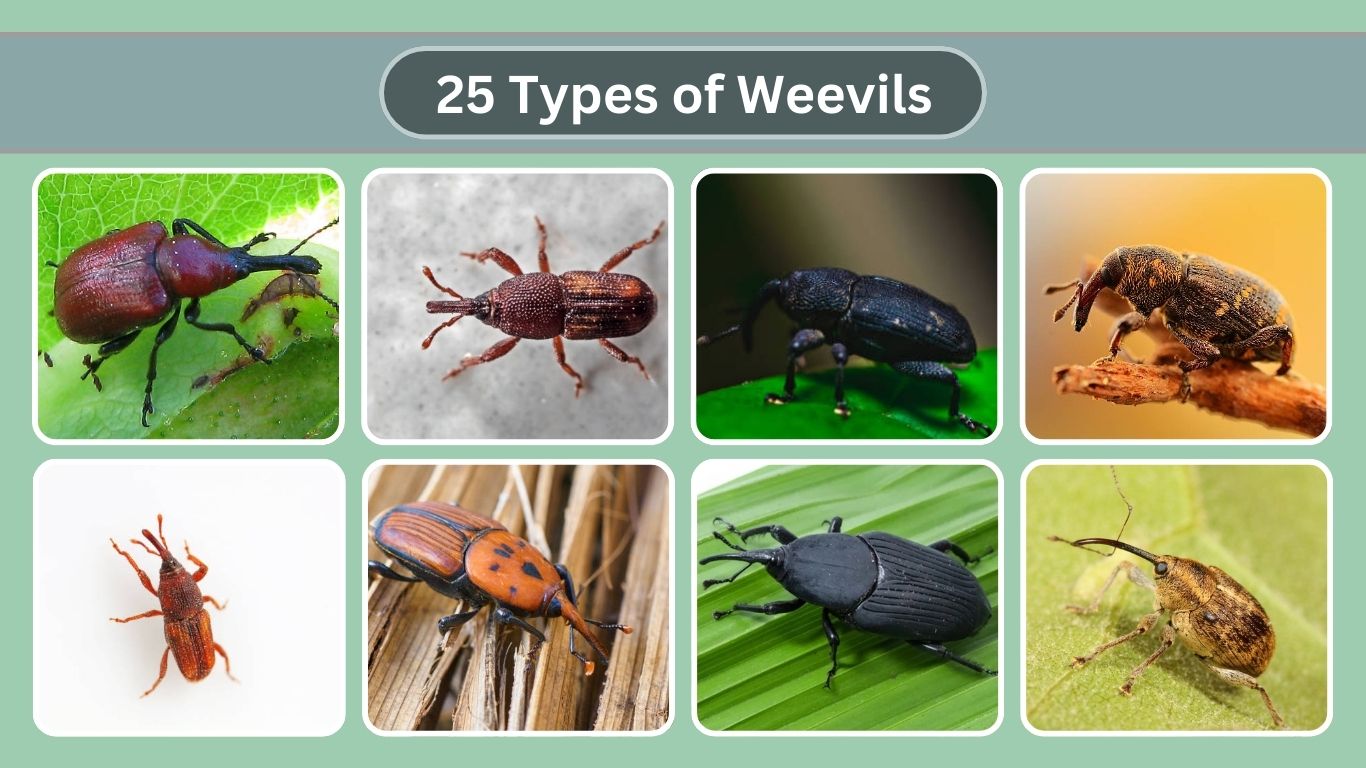
Weevils are a diverse group of beetles belonging to the family Curculionidae, known for their characteristic long snouts and ability to damage crops, trees, and stored products. With thousands of species worldwide, they are among the most economically significant pests, affecting agriculture, forestry, and household food storage. From the infamous boll weevil that devastated cotton fields to the banana and mango seed weevils that threaten tropical crops, each species has unique habits, habitats, and impacts. This list explores 25 types of weevils, highlighting their identification, preferred environments, and the damage they cause.
1. Boll Weevil

The boll weevil (Anthonomus grandis) is one of the most infamous agricultural pests in history, especially in the United States. Originally from Central America, it spread across cotton-growing regions in the late 19th century and caused devastating damage to the cotton industry.
Identification
- Small beetle, about 6 mm (¼ inch) long
- Grayish-brown to reddish in color
- Distinctive long snout (rostrum)
- Antennae bent at right angles
- Adult weevils often covered with tiny hairs
Habitat
Boll weevils are strongly associated with cotton fields. They thrive in warm climates and overwinter in leaf litter, weeds, or nearby wooded areas before moving back into cotton plants when the growing season begins.
Behavior and Damage
- Females lay eggs inside cotton flower buds (squares) or bolls.
- Larvae hatch and feed within the cotton boll, destroying fibers and seeds.
- Heavy infestations can wipe out entire cotton harvests.
Economic Impact
The boll weevil caused billions of dollars in losses to the cotton industry during the 20th century. Entire farming communities were forced to diversify crops due to weevil destruction.
2. Rice Weevil

The rice weevil (Sitophilus oryzae) is a common stored grain pest found worldwide. It attacks rice, wheat, corn, and other cereals, often causing significant post-harvest losses.
Identification
- Small beetle, about 2–3 mm long
- Dark brown to black with four reddish or yellowish spots on wing covers
- Long snout (rostrum) with chewing mouthparts
- Capable of flight, unlike some other weevil species
Habitat
They are primarily found in grain storage facilities, warehouses, and household pantries. Rice weevils prefer warm, humid conditions where grains are stored in bulk.
Behavior and Damage
- Females bore into individual grains to lay eggs
- Larvae develop inside the kernel, consuming it entirely
- Infested grains show round exit holes after adults emerge
- Heavy infestations lead to reduced grain weight, quality, and germination ability
3. Maize Weevil

The maize weevil (Sitophilus zeamais) closely resembles the rice weevil but is often more destructive in maize-growing regions. It infests corn, rice, sorghum, and other cereals.
Identification
- Slightly larger than the rice weevil, about 3–4 mm
- Dark brown to black coloration with faint yellowish markings
- Distinct long snout
- Strong flyer, spreads easily between storage areas and fields
Habitat
Common in cornfields and grain storage facilities, especially in tropical and subtropical regions. Maize weevils thrive in both harvested crops and standing corn.
Behavior and Damage
- Females lay eggs inside kernels of maize and other grains
- Larvae feed internally, hollowing out the grain
- Infestations continue across multiple generations in stored grain
- Causes major economic losses, particularly in developing countries where storage protection is limited
4. Granary Weevil

The granary weevil (Sitophilus granarius) is a well-known pest of stored grains. Unlike its close relatives, the rice and maize weevils, it cannot fly, but it is highly destructive in granaries and storage bins.
Identification
- About 3–5 mm long, cylindrical body
- Dark reddish-brown to black in color
- Long, narrow snout with chewing mouthparts
- Wing covers lack the characteristic spots seen in rice and maize weevils
- Unable to fly due to fused wing covers
Habitat
Granary weevils are primarily found in grain storage environments. They infest wheat, barley, rye, oats, and maize stored in silos, bins, or warehouses. Since they cannot fly, their spread depends on human transportation of infested grain.
Behavior and Damage
Female granary weevils bore holes into whole kernels and deposit eggs inside. The larvae remain concealed within the grain, feeding and developing until adulthood. Infestation weakens grain quality, reducing both weight and germination ability. Unlike other weevils, granary weevils cannot survive outdoors in the wild and are completely dependent on stored grain for survival.
5. Palm Weevil

The palm weevil (Rhynchophorus palmarum), also known as the South American palm weevil, is a large species that attacks various palm trees. It is considered a major pest in coconut and oil palm plantations.
Identification
- Large beetle, ranging from 3–5 cm in length
- Black or dark reddish-brown body
- Long curved snout, stronger than many smaller weevils
- Robust body shape, adapted for boring into palm tissues
Habitat
Palm weevils thrive in tropical and subtropical regions, especially in areas with extensive palm cultivation. They are found in coconut palms, date palms, and oil palms, where they seek decaying or weakened tissues for breeding.
Behavior and Damage
Adult palm weevils bore into the trunks of palm trees to lay eggs. The larvae hatch and tunnel extensively within the trunk, feeding on soft tissues and weakening the structural integrity of the tree. Infestation often leads to collapse or death of the palm. Additionally, the species is a known vector of the red ring nematode (Bursaphelenchus cocophilus), which causes lethal red ring disease in palms, amplifying the economic damage caused by this insect.
6. Red Palm Weevil

The red palm weevil (Rhynchophorus ferrugineus) is one of the most destructive pests of palm trees worldwide. Native to South Asia, it has spread to the Middle East, Africa, Europe, and even parts of the Americas.
Identification
- Large beetle, typically 2–5 cm long
- Reddish-brown coloration with dark markings
- Long, curved snout adapted for boring into plant tissue
- Strong, robust body and capable of flight
Habitat
This species primarily infests date palms, coconut palms, and ornamental palms. It prefers warm climates and is especially problematic in regions where palms are cultivated for commercial or decorative purposes.
Behavior and Damage
Adult females bore into the soft tissue at the base or crown of palm trees to deposit eggs. The larvae develop inside, tunneling extensively and feeding on plant tissue, which causes severe internal damage. Infested palms often show wilting, yellowing, and eventually collapse. The red palm weevil is considered one of the most invasive pests of palms due to its ability to spread quickly and destroy entire plantations.
7. Black Vine Weevil

The black vine weevil (Otiorhynchus sulcatus) is a widespread pest that affects ornamental plants, nursery crops, and various fruit-bearing shrubs. It is particularly damaging to strawberries, rhododendrons, and yews.
Identification
- Adult weevils measure 8–10 mm in length
- Matte black or dark brown coloration with fine scales on their body
- Distinct short snout compared to grain weevils
- Wing covers fused, making them flightless
Habitat
Black vine weevils are common in gardens, nurseries, and landscapes where ornamental plants are grown. They thrive in moist soils, particularly around plant roots. Both adults and larvae cause damage to different parts of the plant.
Behavior and Damage
Adult weevils feed on the foliage of plants, creating characteristic notched edges on leaves. The larvae, however, are far more destructive; they live in the soil and feed on plant roots, often killing young plants by severing their ability to absorb water and nutrients. This dual-stage damage makes the black vine weevil a major concern for commercial nurseries and home gardeners alike.
8. Strawberry Root Weevil

The strawberry root weevil (Otiorhynchus ovatus) is a common pest in North America that primarily attacks strawberries but also damages other small fruits and ornamental plants.
Identification
- Small, oval-shaped beetle about 4–6 mm long
- Dark brown to black in color, with faint ridges on wing covers
- Short, broad snout
- Wing covers fused, making adults flightless
Habitat
These weevils are typically found in strawberry fields, gardens, and ornamental plantings. They prefer moist soils where host plant roots are abundant. Infestations are often more severe in perennial plantings.
Behavior and Damage
Adult strawberry root weevils feed on foliage, leaving notched patterns along leaf edges. While foliar damage is unsightly, the real threat comes from the larvae, which feed on plant roots underground. Root feeding weakens plants, reduces vigor, and can lead to significant crop loss in strawberry fields.
9. White Pine Weevil

The white pine weevil (Pissodes strobi) is one of the most destructive pests of coniferous trees in North America, particularly affecting white pine, spruce, and other softwoods.
Identification
- About 5–7 mm long
- Reddish-brown body covered with white and tan scales, giving a mottled appearance
- Long snout typical of weevils
- Elongated, slightly curved body shape
Habitat
This species inhabits coniferous forests, plantations, and ornamental tree plantings. It is most active in spring and summer when adults seek out young host trees.
Behavior and Damage
Adult weevils lay eggs in the terminal shoots of host trees. The larvae tunnel downward in the stem, severing vascular tissues and causing the shoot to wilt and die. Affected trees exhibit a distinctive “shepherd’s crook” appearance at the top. Over time, repeated attacks stunt growth and deform trees, severely reducing their commercial value.
10. Bluegrass Weevil

The bluegrass weevil (Listronotus maculicollis) is a serious turfgrass pest in North America, particularly on golf courses and managed lawns. It primarily damages annual bluegrass and creeping bentgrass.
Identification
- Small beetle, 3–4 mm long
- Dark gray to black body with fine scales
- Short snout, less pronounced than grain weevils
- Adults are flightless and disperse by walking
Habitat
These weevils are most commonly found in turfgrass environments. They thrive in areas with intensively managed grass, such as golf greens, tees, and fairways, where moisture and short mowing height support their life cycle.
Behavior and Damage
Adults feed on grass blades, but the most destructive stage is the larvae. Larvae tunnel into stems and crowns of turfgrass, hollowing them out. This leads to yellow patches, thinning, and turf death, which often mimics drought stress. Outbreaks are especially noticeable in spring and early summer, when larval populations peak.
11. Pepper Weevil

The pepper weevil (Anthonomus eugenii) is a significant pest of pepper crops in North America, Central America, and the Caribbean. It is particularly damaging to commercial bell pepper and chili pepper production.
Identification
- Small beetle, about 2–3 mm long
- Shiny dark brown to black body
- Elongated snout with chewing mouthparts
- Compact oval body shape
Habitat
Pepper weevils are found primarily in agricultural fields where peppers are grown, though they may also infest related plants like eggplant. They prefer warm climates and are especially problematic in subtropical and tropical regions.
Behavior and Damage
Female pepper weevils lay eggs inside developing pepper buds and fruits. The larvae feed within the fruit, causing it to become distorted, drop prematurely, or rot on the plant. Infestations reduce both yield and fruit quality. Because larvae remain hidden inside fruits, infestations are difficult to detect early, making the pepper weevil one of the most challenging pests for pepper growers.
12. Sweetpotato Weevil

The sweetpotato weevil (Cylas formicarius) is the most destructive insect pest of sweetpotatoes worldwide. Its ability to infest both in the field and in storage makes it especially harmful to farmers in tropical and subtropical regions.
Identification
- Small beetle, 5–7 mm long
- Distinctive ant-like appearance with a slender body
- Dark bluish-black head and thorax, reddish-orange wing covers
- Long, curved snout characteristic of weevils
Habitat
Sweetpotato weevils are found wherever sweetpotatoes are grown, especially in warm, humid climates. They infest both underground storage roots and above-ground vines, making them a persistent threat throughout the crop cycle.
Behavior and Damage
Females lay eggs inside stems and tubers. The larvae bore tunnels through the tissue, causing internal damage. Infested roots develop a bitter taste and strong odor due to toxic compounds produced by the plant in response. This not only lowers market value but can render sweetpotatoes completely unfit for consumption.
13. Banana Weevil

The banana weevil (Cosmopolites sordidus) is a major pest of banana and plantain crops, causing yield losses in tropical regions worldwide. It primarily targets the underground rhizomes of banana plants.
Identification
- Medium-sized beetle, 10–15 mm long
- Shiny black to dark brown body with ridged wing covers
- Strong, slightly curved snout
- Adults are slow-moving and nocturnal
Habitat
Banana weevils are common in tropical and subtropical banana-growing regions. They shelter in crop residues, soil, and near the base of plants during the day, emerging at night to feed and reproduce.
Behavior and Damage
Adult females deposit eggs in the base of banana pseudostems or rhizomes. The larvae bore into rhizomes and tunnel through the tissue, weakening the plant’s root system. This reduces nutrient uptake, leading to poor growth, lodging, and lower fruit production. Severe infestations may kill young banana plants, making the banana weevil one of the most economically damaging pests for smallholder farmers and commercial plantations alike.
14. Cottonwood Twig Borer Weevil

The cottonwood twig borer weevil (Cryptorhynchus lapathi) is a destructive pest of willows, cottonwoods, and poplars, particularly in North America and Europe. It is often referred to simply as the poplar-and-willow borer.
Identification
- Medium-sized beetle, about 6–9 mm long
- Dark brown to black body with patches of white or gray scales
- Strongly curved snout typical of true weevils
- Robust, oval-shaped body adapted for boring into wood
Habitat
This species thrives in riparian zones, plantations, and ornamental landscapes where willows and poplars are common. It targets young and stressed trees, especially in areas with dense stands of host plants.
Behavior and Damage
Adult females lay eggs in bark crevices of twigs and branches. After hatching, larvae bore into the woody tissues, tunneling extensively and disrupting nutrient flow. Infested twigs wilt, break, or die back, often stunting growth and reducing timber or ornamental value. Repeated infestations can eventually kill entire trees.
15. Nut Weevil

Nut weevils belong to the genus Curculio and are notorious pests of acorns, chestnuts, and hazelnuts. These weevils play a dual role in ecosystems: they damage nut crops but also help disperse forest seeds.
Identification
- Typically 6–10 mm long, though some species are larger
- Brown to gray mottled coloration for camouflage
- Extremely long snout, often longer than the body in females
- Strong legs adapted for clinging to nuts and twigs
Habitat
Nut weevils are found in woodlands, orchards, and nut plantations across North America, Europe, and Asia. They are closely tied to the distribution of oak, chestnut, and hazelnut trees.
Behavior and Damage
Females use their elongated snout to bore into developing nuts and deposit eggs inside. The larvae feed on the nut kernel, hollowing it out as they develop. Infested nuts often fall prematurely from trees. In forests, this behavior influences seed dispersal and regeneration, while in orchards it can result in major crop losses. Nut weevils are especially problematic for chestnut growers, as they can devastate annual harvests if not managed properly.
16. Oak Weevil

The oak weevil (Orchestes quercus) is a small but significant pest of oak trees, commonly found across Europe and parts of Asia. It is known for damaging oak leaves and affecting the overall health of forests and ornamental oaks.
Identification
- Tiny beetle, only 2–3 mm long
- Brownish-gray body with fine scales
- Short, curved snout
- Compact, oval shape, well camouflaged against bark and leaves
Habitat
This species inhabits oak woodlands, mixed forests, and urban landscapes where oak trees are planted. It primarily targets young shoots and leaves, making it more harmful to saplings and regenerating trees.
Behavior and Damage
Adult oak weevils feed on leaves, creating small feeding holes. The larvae are leaf miners, burrowing into the tissue of oak leaves and forming winding galleries. While damage to individual leaves may seem minor, heavy infestations can cause significant defoliation, reducing tree vigor and growth. Over time, repeated infestations weaken trees, leaving them more vulnerable to secondary pests and diseases.
17. Pine Weevil

The pine weevil (Hylobius abietis) is one of the most destructive pests of conifer seedlings in Europe. It is especially damaging in reforestation sites where young pines, spruces, and firs are planted after logging.
Identification
- Large weevil, 8–14 mm long
- Dark brown to black with irregular yellow or light patches on wing covers
- Strong, elongated snout
- Stout, oval body adapted for chewing through bark
Habitat
Pine weevils thrive in coniferous forests and are strongly associated with logging areas. They are attracted to freshly cut stumps, where adults breed, and nearby seedlings, which they attack for food.
Behavior and Damage
Adult pine weevils feed on the bark of young conifer seedlings, girdling the stems and often killing the plants. They can destroy entire reforested plots if populations are high. Larvae develop inside stumps and roots of dead or cut trees, making logging residues a breeding ground for new generations. Their presence delays forest regeneration and increases replanting costs, making them one of the most economically significant forestry pests in Europe.
18. Clover Weevil

The clover weevil (Sitona lepidus), also called the root-feeding clover weevil, is a pest of forage crops such as clover and alfalfa. It is particularly damaging in Europe, New Zealand, and parts of North America.
Identification
- Small beetle, 3–5 mm long
- Grayish-brown body with lighter mottled patterns
- Short, blunt snout
- Elytra covered with fine scales, aiding in camouflage
Habitat
Clover weevils are found in grasslands, pastures, and agricultural fields where clover is cultivated for hay or grazing. They thrive in temperate climates and often occur in high densities in managed forage systems.
Behavior and Damage
Adults feed on clover foliage, producing characteristic U-shaped notches on leaf edges. Larvae are the more serious threat, living underground and feeding on root nodules. This disrupts nitrogen fixation, leading to poor plant growth, reduced yields, and lower forage quality. In heavily infested pastures, productivity can decline sharply, impacting both dairy and livestock systems.
19. Cabbage Seedpod Weevil

The cabbage seedpod weevil (Ceutorhynchus obstrictus) is a major pest of canola and other brassica crops. Native to Europe, it has become invasive in North America, where it is a significant agricultural concern.
Identification
- Medium-sized weevil, about 3–4 mm long
- Dark gray body with fine scales
- Slender snout adapted for boring into pods
- Compact, oval body shape
Habitat
This species is commonly found in agricultural fields where canola, mustard, or other cruciferous crops are grown. It prefers warm, dry climates and tends to peak in activity during crop flowering and pod development stages.
Behavior and Damage
Adult weevils feed on buds and flowers, but the primary damage comes from larvae. Females deposit eggs inside developing seedpods, and larvae consume the seeds within. Infested pods are often smaller, deformed, or fall prematurely, resulting in significant yield loss. In regions where the pest has established, growers may face widespread crop infestations without effective monitoring and management practices.
20. Cranberry Weevil

The cranberry weevil (Anthonomus musculus) is a pest of cranberries and blueberries, primarily found in North America. It is a serious concern for commercial cranberry growers due to its impact on flower buds and fruit set.
Identification
- Small beetle, about 2.5–3 mm long
- Dark reddish-brown to black body
- Distinctive elongated snout
- Compact oval body, similar in appearance to other Anthonomus species
Habitat
Cranberry weevils are found in bogs, marshes, and cultivated fields where cranberries and related crops are grown. They are most active in spring when plants begin producing flower buds.
Behavior and Damage
Adults feed on flower buds, often causing them to wither and drop before pollination. Females also lay eggs inside buds, where larvae feed internally, destroying reproductive tissues. Heavy infestations can reduce fruit set dramatically, leading to major yield losses. Because they target buds before flowering, infestations are often difficult to detect until crop damage becomes apparent.
21. Alfalfa Weevil

The alfalfa weevil (Hypera postica) is a widespread and destructive pest of alfalfa crops. Native to Eurasia, it has spread across North America, where it is one of the most economically important forage crop pests.
Identification
- Small beetle, 3–5 mm long
- Brownish-gray body with darker markings on wing covers
- Short, slightly curved snout
- Adults often have a mottled, dusty appearance due to fine scales
Habitat
Alfalfa weevils are found in agricultural fields where alfalfa is cultivated for hay and forage. They thrive in temperate regions and are most active in spring and early summer, coinciding with the first alfalfa growth cycle.
Behavior and Damage
Adult weevils feed on leaves, but larvae are the most destructive stage. Larvae skeletonize foliage by consuming green tissue between veins, leaving behind a lacy, whitish appearance. Heavy infestations can defoliate entire fields, reducing hay quality and yield. Repeated outbreaks also weaken plants, lowering stand longevity and increasing costs for farmers dependent on alfalfa as livestock feed.
22. Rose Weevil

The rose weevil (Merhynchites bicolor) is a small pest that attacks ornamental roses and related plants. It is especially damaging in gardens and nurseries where roses are cultivated for decorative purposes.
Identification
- Small beetle, about 3–4 mm long
- Distinctive metallic blue-green or reddish coloration
- Long slender snout used for piercing flower buds
- Compact oval body with fine scales giving a shiny appearance
Habitat
Rose weevils are typically found in gardens, parks, and ornamental landscapes where roses are common. They thrive in warm, sunny environments and are most active during the flowering season.
Behavior and Damage
Adult rose weevils puncture flower buds and petals to feed, leaving small round holes. Females lay eggs inside buds, and developing larvae consume the internal tissues, causing buds to wilt and fail to open. Infestations are most damaging in nurseries, where they reduce the aesthetic and commercial value of rose plants.
23. Bark Weevil

The bark weevil (Pissodes spp.) refers to a group of species that infest coniferous trees by feeding on their bark and inner tissues. They are common in both North America and Europe, particularly in forested areas.
Identification
- Medium-sized beetles, 4–8 mm long
- Brown to black body, often with mottled yellow or gray patches
- Elongated snout with chewing mouthparts
- Cylindrical body well suited for boring into bark
Habitat
Bark weevils inhabit coniferous forests, plantations, and logging sites. They are strongly associated with spruce, pine, and fir trees, particularly in areas where trees are stressed or freshly cut.
Behavior and Damage
Adult bark weevils feed on bark and phloem tissues, while larvae tunnel beneath the bark, disrupting nutrient flow. This leads to resin exudation, weakened stems, and in severe cases, tree mortality. Their damage often predisposes trees to secondary infections by fungi and other pests, making them an important forestry concern.
24. Avocado Weevil

The avocado weevil (Heilipus lauri) is a specialized pest of avocado trees, primarily found in Central America and parts of Mexico. It poses a serious risk to avocado cultivation due to its destructive larval tunneling.
Identification
- Large beetle, 10–12 mm long
- Shiny black to dark brown body
- Elongated, strong snout adapted for boring
- Robust oval body with slightly ridged wing covers
Habitat
Avocado weevils are closely associated with avocado orchards. They thrive in warm, humid climates and are most active during the fruiting season when avocado trees are developing seeds and pulp.
Behavior and Damage
Females lay eggs in developing avocado seeds and pulp. After hatching, larvae bore tunnels within the seed, disrupting development and often causing premature fruit drop. Infested fruits are unsuitable for consumption or market sale. In heavily infested orchards, crop losses can be severe, making this weevil one of the most significant threats to avocado production.
25. Mango Seed Weevil

The mango seed weevil (Sternochetus mangiferae) is a pest of mango trees, native to South and Southeast Asia but now found in many mango-growing regions worldwide. It targets the seed inside mango fruits, reducing crop quality and posing quarantine concerns for exporters.
Identification
- Medium-sized beetle, 8–10 mm long
- Dark brown to black with mottled gray or whitish scales
- Short, strong snout
- Compact, oval body built for boring into fruits
Habitat
This species is found exclusively on mango trees, in both wild and cultivated environments. It thrives in tropical and subtropical climates and is active during fruiting seasons.
Behavior and Damage
Adult females deposit eggs on young mango fruits. Upon hatching, larvae burrow through the pulp and into the seed, where they feed and develop. Although external fruit damage is minimal, the internal tunneling ruins the seed and compromises fruit quality. Infested fruits often drop early, and because larvae remain hidden, infestations are difficult to detect until fruits are cut open. This pest is particularly important in international trade, as infested shipments are often rejected to prevent further spread.