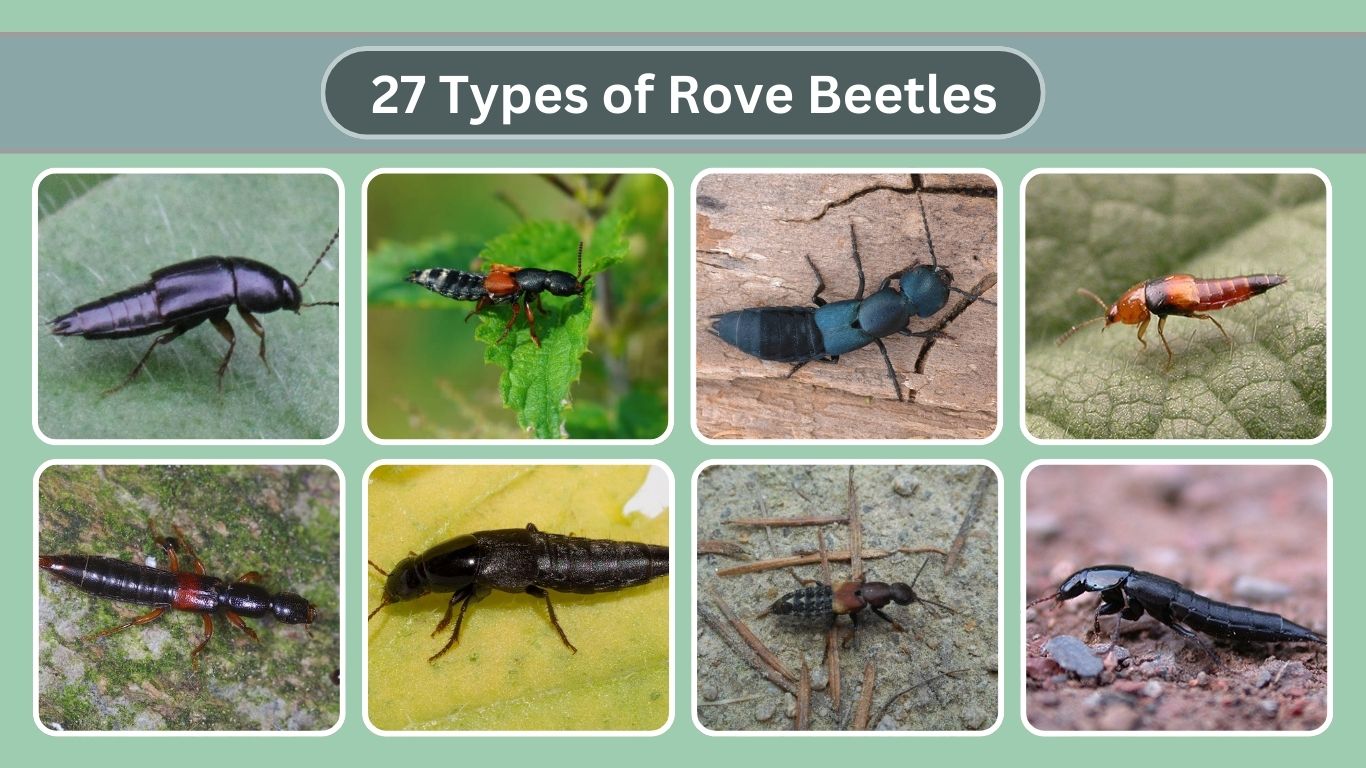
Rove beetles (Staphylinidae) are one of the largest beetle families, with thousands of species worldwide. Known for their slender bodies, short wing covers, and exposed abdomens, these beetles play vital roles in ecosystems as predators, scavengers, and decomposers. Some are striking in appearance, while others are medically important due to toxins. Below, you’ll find 27 fascinating types of rove beetles, each with unique traits, habitats, and ecological roles.
1. Devil’s Coach Horse Beetle (Ocypus olens)

The Devil’s Coach Horse Beetle is one of the most striking and well-known rove beetles in Europe. Its menacing appearance, defensive posture, and nocturnal habits have made it a subject of folklore for centuries. Despite its fearsome look, it plays an important role in natural pest control by feeding on various invertebrates.
Identification
- Large body size, around 20–30 mm long
- Shiny black coloration
- Short elytra (wing covers) leaving abdomen exposed
- Long, flexible abdomen often curled upwards like a scorpion when threatened
- Strong mandibles for predation
Habitat
This beetle is widespread across Europe and is commonly found in gardens, woodlands, hedgerows, and fields. It prefers moist environments with plenty of leaf litter or soil where prey can be found.
Behavior
Primarily nocturnal, the Devil’s Coach Horse hunts at night and hides during the day. When disturbed, it raises its abdomen like a scorpion and emits a foul-smelling secretion as a defense mechanism.
Diet
A carnivorous beetle, it feeds on slugs, worms, small insects, and larvae. Its strong mandibles allow it to tear through tough prey, making it an effective natural predator in gardens.
2. Aleochara bilineata

Aleochara bilineata is a small rove beetle well known for its role as a biological control agent against agricultural pests. It is especially valued for parasitizing the pupae of flies, making it an ally in farming and compost environments.
Identification
- Small body, about 4–6 mm long
- Dark brown to black coloration
- Short elytra exposing much of the abdomen
- Slender body shape with well-developed antennae
- Legs are lighter in color compared to the body
Habitat
This beetle is commonly found in agricultural fields, compost heaps, and manure piles. It thrives in environments where flies breed, as it relies on their pupae for reproduction.
Behavior
Aleochara bilineata is both a predator and a parasitoid. Adults feed on small insects and decaying organic matter, while females lay eggs near fly pupae. The beetle larvae then invade and consume the host pupae.
Diet
Adults feed on fly eggs, small insects, and decomposing matter, while the larvae are parasitic, feeding exclusively on the pupae of various fly species.
3. Aleochara bipustulata

Aleochara bipustulata is another important member of the rove beetle family, closely related to A. bilineata. It plays a similar role in biological control but is also recognized for its distinct appearance with tiny markings on its body.
Identification
- Measures around 3–5 mm in length
- Dark-colored body with reddish or yellowish spots near the elytra
- Exposed flexible abdomen typical of rove beetles
- Antennae relatively short and thick compared to body size
Habitat
Found across Europe, North America, and other regions, it inhabits decaying vegetation, manure heaps, and areas where flies are abundant. It often occurs alongside A. bilineata.
Behavior
This species is an active scavenger and predator, frequently searching for fly pupae. Like other Aleochara beetles, it combines parasitic reproduction with predatory feeding habits, making it highly beneficial in reducing fly populations.
Diet
Adults consume decomposing organic matter and insect eggs, while larvae act as parasitoids on fly pupae, helping control fly outbreaks in farming environments.
4. Paederus littoralis

Paederus littoralis is a striking species of rove beetle known not only for its ecological role but also for its medical importance. This beetle contains a toxin called pederin, which can cause severe skin irritation when humans come into contact with it. Despite its small size, its impact on humans has made it well-studied in many regions.
Identification
- Small to medium size, about 7–10 mm long
- Distinctive coloration: shiny black head and abdomen with bright orange thorax and elytra
- Slender, elongated body with short elytra exposing the abdomen
- Long legs and antennae that help with fast movements
- Often confused with ants due to its shape and activity
Habitat
This species is widespread in tropical and subtropical regions, especially near wetlands, riverbanks, and agricultural fields. It thrives in moist environments with plenty of vegetation where prey insects are abundant.
Behavior
Paederus littoralis is nocturnal and highly active. When disturbed, it releases hemolymph containing pederin, which causes Paederus dermatitis in humans. This beetle does not bite or sting, but accidental crushing on the skin leads to blistering and burns.
Diet
It is a beneficial predator, feeding on soft-bodied insects like aphids, mites, and small larvae. By controlling these pests, it helps maintain agricultural balance despite being hazardous to humans.
5. Paederus fuscipes

Paederus fuscipes is another toxic rove beetle from the Paederus genus. It is sometimes referred to as the “Nairobi fly” in East Africa, where outbreaks of dermatitis caused by this insect are common. It plays a dual role: beneficial to agriculture but dangerous to human skin.
Identification
- Size ranges between 6–8 mm
- Elongated slender body with shiny black head and abdomen
- Thorax and part of elytra are reddish-orange, creating a two-toned appearance
- Short elytra exposing much of the abdomen, a common rove beetle trait
- Rapid movement makes it easy to mistake for ants
Habitat
This species prefers humid tropical and subtropical regions. It is often found in rice paddies, wetlands, and grassy fields. Human settlements near agricultural zones frequently encounter this beetle, especially during rainy seasons when populations rise.
Behavior
Like other Paederus beetles, it does not bite but causes contact dermatitis when accidentally brushed or crushed on the skin. Its pederin toxin leads to painful blisters, redness, and itching that can last days to weeks.
Diet
Paederus fuscipes feeds mainly on crop pests such as aphids and caterpillars, making it useful for natural pest control. Farmers value its predatory behavior, but caution is necessary to avoid skin contact.
6. Paederus melanurus

Paederus melanurus is another rove beetle in the Paederus group that carries the potent toxin pederin, making it a medically important insect. Although small in size, its presence near human habitats can cause widespread skin irritation outbreaks, especially during the wet season.
Identification
- Medium size, around 7–10 mm long
- Characteristic elongated body with exposed flexible abdomen
- Black head and abdomen with orange-red thorax and part of elytra
- Elytra short and glossy, typical of rove beetles
- Moves quickly, resembling ants in behavior
Habitat
This beetle is mostly found in humid areas such as wetlands, riverbanks, and rice fields. It is common in tropical and subtropical climates where moisture and vegetation support high insect populations.
Behavior
Paederus melanurus is nocturnal and often attracted to artificial lights at night, leading to accidental contact with humans. Crushing or brushing it against skin releases its pederin toxin, causing severe dermatitis with blistering.
Diet
Predatory in nature, it feeds on small insects such as aphids, caterpillars, and mites. It plays an important ecological role by reducing pest populations in agricultural areas.
7. Staphylinus erythropterus

Staphylinus erythropterus is a large and impressive rove beetle belonging to the genus Staphylinus. Unlike the smaller Paederus beetles, it is less dangerous to humans but stands out due to its size and predatory behavior.
Identification
- Large rove beetle, typically 15–25 mm long
- Shiny black body with reddish elytra (wing covers)
- Elongated form with exposed abdomen segments
- Prominent mandibles used for hunting
- Long legs suited for rapid movement on the ground
Habitat
It inhabits woodlands, grasslands, and gardens, often found under stones, logs, or leaf litter. Prefers moist soil conditions that harbor prey insects and larvae.
Behavior
This beetle is an active ground predator. It is fast-moving and aggressive when hunting or threatened. Unlike Paederus beetles, it does not pose medical risks to humans, though it can emit a foul odor when disturbed.
Diet
Staphylinus erythropterus is carnivorous, feeding on earthworms, insect larvae, slugs, and other small invertebrates. Its strong mandibles allow it to overpower prey easily.
8. Staphylinus caesareus

Staphylinus caesareus is a striking rove beetle, notable for its large size and metallic sheen. It is one of the more eye-catching species in its genus, making it easily recognizable in its natural habitats. Though fierce-looking, it is harmless to humans and valued as a predator of soil-dwelling pests.
Identification
- Large beetle, 15–20 mm in length
- Shiny metallic blue or greenish elytra with an exposed abdomen
- Pronotum and head often darker, with strong mandibles
- Long, segmented antennae
- Strong legs adapted for fast crawling
Habitat
Found across Europe in forests, meadows, and gardens. It often hides under leaf litter, logs, or stones during the day, emerging at night to hunt prey.
Behavior
This species is highly active at night and quick to defend itself when threatened. It raises its abdomen in a scorpion-like fashion and can secrete an unpleasant odor as a defense mechanism.
Diet
Feeds on a variety of small invertebrates, including insect larvae, worms, and soft-bodied pests, contributing to natural pest control in gardens and agricultural settings.
9. Philonthus politus

Philonthus politus is a medium-sized rove beetle recognized for its glossy body and adaptability. Unlike the large and metallic Staphylinus beetles, Philonthus species are more slender but equally effective as predators in soil and decaying habitats.
Identification
- Size ranges from 7–12 mm
- Glossy black or dark brown elongated body
- Elytra short, leaving abdomen segments exposed
- Slender build with long antennae and legs
- Smooth and shiny surface compared to other rove beetles
Habitat
Widely distributed in Europe and North America. Found in compost heaps, manure piles, woodlands, and gardens, where organic material is abundant.
Behavior
It is a fast-moving, nocturnal beetle. Known for its predatory nature, it hunts actively at night, while during the day it hides under logs, soil, or leaf litter.
Diet
Feeds mainly on fly larvae, small insects, and decomposing organic matter. Its presence in manure and compost heaps helps reduce fly populations naturally.
10. Philonthus cognatus

Philonthus cognatus is a common member of the Philonthus genus, often encountered in compost heaps and manure piles. Like other rove beetles, it plays an important role in natural pest control by preying on fly larvae and other soft-bodied insects.
Identification
- Medium-sized beetle, about 8–12 mm long
- Elongated, glossy black body with short elytra
- Abdomen segments exposed and flexible
- Slender antennae with a slightly thickened tip
- Legs usually reddish-brown, contrasting with the dark body
Habitat
This beetle thrives in decomposing organic material, particularly animal dung, compost, and decaying vegetation. It is widespread across Europe and North America.
Behavior
Philonthus cognatus is very active, often seen moving quickly through manure or leaf litter in search of prey. It has a defensive behavior of raising its abdomen and can emit a pungent smell when disturbed.
Diet
Predominantly feeds on fly eggs and larvae found in dung and compost. By reducing fly populations, it helps farmers and gardeners naturally manage pests.
11. Ontholestes murinus

Ontholestes murinus, also known as the golden-haired rove beetle, is one of the most attractive rove beetles due to its distinctive golden hairs. It is larger than many Philonthus species and often found around carrion or decaying matter.
Identification
- Large beetle, around 13–20 mm long
- Shiny dark body with golden-yellow hairs covering much of the thorax and abdomen
- Strong mandibles suited for predation
- Exposed abdomen with visible segments
- Long legs allowing fast crawling
Habitat
This beetle prefers carrion, manure heaps, and compost piles where prey insects gather. It is found across Europe, Asia, and North America in both natural and agricultural habitats.
Behavior
Ontholestes murinus is an aggressive predator, often seen hunting around carrion where fly larvae are abundant. It is fast-moving and will raise its abdomen when threatened.
Diet
Feeds primarily on maggots, fly pupae, and other insects associated with decaying organic matter. By targeting fly larvae, it helps limit fly outbreaks in the environment.
12. Ocypus brunnipes

Ocypus brunnipes is a large rove beetle that stands out for its aggressive predatory behavior and striking appearance. Like other Ocypus species, it has a long, exposed abdomen and strong mandibles, making it an efficient hunter of soil-dwelling invertebrates.
Identification
- Large beetle, measuring about 15–22 mm in length
- Shiny black or very dark brown body
- Distinct reddish-brown legs (a key identification feature)
- Short elytra with a flexible, exposed abdomen
- Prominent mandibles for predation
Habitat
Found in woodlands, fields, and gardens across Europe. It prefers damp environments under logs, stones, or leaf litter where prey insects are common.
Behavior
This species is nocturnal and emerges at night to hunt. When disturbed, it raises its abdomen like a scorpion and may release a foul-smelling defensive secretion. Despite its intimidating posture, it is harmless to humans.
Diet
Carnivorous, feeding mainly on small insects, larvae, slugs, and earthworms. Its predatory habits make it a valuable natural controller of garden pests.
13. Ocypus ophthalmicus

Ocypus ophthalmicus is a robust rove beetle recognized for its size and glossy body. Like its close relatives, it is an active predator that plays an important role in keeping insect populations under control in woodland and grassland habitats.
Identification
- Medium to large beetle, about 15–20 mm long
- Shiny black body with metallic blue or violet reflections in good light
- Exposed, flexible abdomen due to short elytra
- Strong mandibles and long antennae
- Legs dark brown to black, adapted for rapid movement
Habitat
Widely distributed in Europe and found in forest edges, meadows, and gardens. It shelters under leaf litter, stones, and fallen logs during the day, emerging at night to hunt.
Behavior
Ocypus ophthalmicus is nocturnal and very agile. It raises its abdomen in a defensive scorpion-like pose when threatened and can emit a strong-smelling secretion to deter predators.
Diet
Predatory, feeding on insects, larvae, slugs, and other soil-dwelling invertebrates. It is an efficient hunter that helps regulate pest populations naturally.
14. Ocypus mus

Ocypus mus is another member of the large and predatory Ocypus genus of rove beetles. It resembles its close relatives in body form and behavior but is slightly smaller and less commonly encountered. Despite this, it plays the same vital role as a natural predator in soil ecosystems.
Identification
- Medium to large beetle, usually 12–18 mm long
- Glossy black body with short elytra and exposed abdomen
- Abdomen flexible, capable of arching upward when disturbed
- Strong mandibles adapted for capturing prey
- Legs sturdy and well-suited for fast crawling
Habitat
This species inhabits woodlands, hedgerows, and grasslands across parts of Europe. It prefers moist environments with plenty of ground cover such as leaf litter, stones, and rotting wood.
Behavior
Ocypus mus is nocturnal, spending the day hidden under debris and emerging at night to hunt. When threatened, it raises its abdomen in a scorpion-like pose and may release a strong odor as a defense mechanism.
Diet
Carnivorous, feeding on a wide variety of small invertebrates including insects, larvae, worms, and slugs. It contributes to the balance of natural ecosystems by helping control pest species.
15. Creophilus maxillosus (Hairy Rove Beetle)

Creophilus maxillosus, commonly known as the Hairy Rove Beetle, is one of the most recognizable rove beetles due to its distinct hairy body and association with carrion. It plays an important ecological role by helping decompose animal remains while also preying on other insects found around carcasses.
Identification
- Large rove beetle, measuring 12–20 mm in length
- Body mostly black with dense grayish-white hairs on the elytra
- Short wing covers, leaving much of the abdomen exposed
- Strong mandibles for feeding and hunting
- Antennae moderately long, slightly thickened toward the tip
- Easily distinguished from other rove beetles by its “hairy” appearance
Habitat
Found across Europe, North America, and Asia, usually near carrion, compost heaps, and manure piles. It prefers open fields, grasslands, and forest edges where animal remains or decaying matter are present.
Behavior
Creophilus maxillosus is often seen on carrion within hours of an animal’s death. While scavenging, it also preys on fly maggots and larvae competing for the same resource. When threatened, it raises its abdomen and can secrete a foul-smelling substance as defense. It is diurnal and active in both daylight and night, making it easier to spot than some other rove beetles.
Diet
Omnivorous in feeding habits:
- Primary food: Fly larvae (maggots) around carrion
- Secondary food: Carrion itself and other small insects found in decaying organic matter
This dual feeding role helps reduce fly populations while also accelerating the decomposition process.
16. Platydracus stercorarius

Platydracus stercorarius is a large and impressive rove beetle, sometimes referred to as the big dung rove beetle. It is well-known for inhabiting manure heaps and compost piles, where it preys on insects associated with decaying organic matter.
Identification
- Large beetle, often reaching 20–26 mm in length
- Glossy black body with reddish-brown elytra
- Exposed, segmented abdomen typical of rove beetles
- Strong jaws for seizing prey
- Robust legs designed for rapid crawling through soil and manure
Habitat
Common in manure piles, compost heaps, and decaying vegetation across Europe and Asia. It thrives in areas where livestock are present due to the abundance of dung and associated fly populations.
Behavior
Platydracus stercorarius is an active predator, especially in dung-rich environments. It is quick-moving and aggressive when hunting. During the day, it hides under manure crusts or compost, emerging later to hunt actively.
Diet
Feeds mainly on fly larvae and pupae, along with other insects that thrive in manure. By targeting these pests, it helps reduce fly infestations naturally in agricultural settings.
17. Platydracus chalcocephalus

Platydracus chalcocephalus is a striking rove beetle notable for its metallic coloration and large size. Like its close relatives, it is a ground-dwelling predator that thrives in moist habitats where insect prey is abundant.
Identification
- Large body, typically 18–24 mm long
- Shiny metallic green or bronze sheen on the head and pronotum
- Darker elytra, leaving a segmented abdomen exposed
- Long legs and antennae adapted for active hunting
- Strong mandibles for seizing prey
Habitat
This species is distributed across Europe and parts of Asia. It prefers damp environments such as woodland floors, meadows, and riverbanks where it hides under logs, stones, or leaf litter during the day.
Behavior
Platydracus chalcocephalus is nocturnal, emerging at night to hunt. It is fast-moving and can be aggressive when disturbed, often raising its abdomen in a defensive display and releasing a foul secretion.
Diet
Primarily predatory, feeding on insect larvae, worms, and other soft-bodied invertebrates. Its presence helps regulate soil-dwelling pest populations in natural ecosystems.
18. Tachyporus hypnorum

Tachyporus hypnorum is a small but distinctive rove beetle often found in vegetation and leaf litter. Unlike the larger predatory Ocypus or Platydracus beetles, this species is more closely associated with fungi and plant material.
Identification
- Small beetle, about 3–5 mm long
- Orange to reddish-brown body with darker head and elytra
- Elytra short, leaving abdomen partly exposed
- Slender legs and antennae proportionally long for its size
- Often appears shiny under light
Habitat
This species is widely distributed in Europe and North America. It is frequently encountered in grasslands, forest floors, and hedgerows, particularly in areas rich in decaying plant material.
Behavior
Unlike many rove beetles, Tachyporus hypnorum is often diurnal and can be found moving across foliage and soil surfaces. It is less aggressive than larger species but still highly active and agile.
Diet
Feeds on small invertebrates such as mites and springtails, as well as fungal spores. Its diet makes it ecologically important in decomposing leaf litter and balancing micro-arthropod populations.
19. Tachyporus obtusus

Tachyporus obtusus is a small but widespread rove beetle, often encountered in leaf litter and grassy habitats. Like other Tachyporus species, it is an important micro-predator that thrives in moist environments.
Identification
- Small beetle, measuring about 3–4.5 mm long
- Reddish-brown body with darker head and elytra
- Elytra short, leaving a portion of the abdomen visible
- Antennae long and slender, lighter at the base
- Compact build, with legs adapted for fast crawling
Habitat
Common throughout Europe and also found in parts of Asia. It inhabits grasslands, woodlands, and hedgerows, especially in damp soil and areas with thick vegetation.
Behavior
This species is active both day and night, often seen moving quickly on low vegetation and within soil litter. It prefers cooler, damp microhabitats and is sensitive to habitat disturbance.
Diet
Feeds mainly on small arthropods such as mites, springtails, and insect eggs. It plays an ecological role in regulating populations of micro-invertebrates.
20. Tachinus marginellus

Tachinus marginellus is a medium-sized rove beetle that is commonly found in decaying organic matter. Its adaptability allows it to thrive in both natural habitats and human-influenced environments such as compost heaps.
Identification
- Size ranges from 6–9 mm
- Shiny dark body with reddish-brown margins on the pronotum and elytra
- Exposed abdomen typical of rove beetles
- Antennae relatively short compared to other genera
- Strong legs suitable for digging and crawling in soil and compost
Habitat
Found across Europe, often associated with decaying matter, manure piles, and forest litter. It is also commonly encountered in agricultural areas where organic decomposition is frequent.
Behavior
Tachinus marginellus is highly active and can be found in large numbers where decomposing organic material is abundant. It is most active at dusk and night, often foraging in groups.
Diet
Omnivorous—feeds on decaying organic matter, fungi, and small soil invertebrates such as fly larvae. It contributes to the decomposition process and natural recycling of nutrients.
21. Tachinus rufipes

Tachinus rufipes is a widespread rove beetle often associated with decaying organic matter. Its reddish legs give it its name, and it is one of the more recognizable members of the Tachinus genus. Like many rove beetles, it plays an ecological role in breaking down organic waste and regulating insect populations.
Identification
- Medium-sized beetle, 6–8 mm long
- Shiny black to dark brown body
- Characteristic reddish legs and sometimes reddish-brown antennae
- Elytra short, leaving abdomen segments exposed
- Compact body shape with smooth, glossy surface
Habitat
This species is common throughout Europe and North America. It inhabits woodland litter, compost heaps, manure piles, and other decaying organic matter. It thrives in both rural and urban environments where decomposition is active.
Behavior
Tachinus rufipes is highly mobile and often seen running rapidly when disturbed. It hides under debris during the day and becomes active at night. When threatened, it raises its abdomen in a defensive posture typical of rove beetles.
Diet
Feeds on decaying organic material, fungi, and small invertebrates such as fly larvae and mites. By reducing fly populations, it indirectly benefits livestock and agricultural management.
22. Lathrobium elongatum

Lathrobium elongatum is a slender and elongated rove beetle, well adapted to life in leaf litter and soil. Unlike the stockier Tachinus beetles, it has a more narrow and elongated form, giving it a distinct appearance among rove beetles.
Identification
- Elongated, narrow body, 8–11 mm long
- Dark brown to black coloration
- Elytra very short, leaving much of the abdomen exposed
- Antennae long and thin, well-suited for sensing prey
- Legs long and delicate compared to its slim body
Habitat
Found across Europe, particularly in damp forests, meadows, and marshy areas. It hides under moss, leaf litter, and stones where moisture levels are high.
Behavior
This beetle is primarily nocturnal, remaining hidden during the day and becoming active at night. It is an agile hunter, moving quickly through soil and vegetation. When disturbed, it can emit a strong odor as a deterrent to predators.
Diet
Carnivorous, feeding on small invertebrates such as mites, springtails, and insect larvae. Its slender form helps it navigate tight spaces within soil and leaf litter to hunt effectively.
23. Lathrobium longulum

Lathrobium longulum is another elongated species within the Lathrobium genus. It is closely related to Lathrobium elongatum but tends to be slightly larger and more robust in body form. Its long and narrow appearance, combined with its nocturnal habits, makes it a stealthy predator in soil ecosystems.
Identification
- Body length about 9–12 mm
- Elongated, slim body with a shiny dark brown to black coloration
- Elytra very short, leaving a majority of the abdomen exposed
- Long, threadlike antennae
- Legs slender but strong, allowing quick movements in litter and soil
Habitat
Distributed across Europe and Asia, primarily in damp woodland habitats. It prefers areas rich in moss, rotting wood, and decaying vegetation, often hiding under logs and stones.
Behavior
Mostly nocturnal, Lathrobium longulum is secretive and rarely seen in the daytime. When disturbed, it quickly retreats into litter or soil. Like many rove beetles, it raises its abdomen defensively and may secrete an unpleasant odor.
Diet
Feeds on mites, springtails, insect larvae, and other tiny soil-dwelling organisms. Its slim body makes it highly effective at infiltrating small spaces in search of prey.
24. Quedius fuliginosus

Quedius fuliginosus is a robust and moderately large rove beetle from the diverse Quedius genus. It is well known for its shiny, dark appearance and preference for decomposing habitats, where it acts as a predator and scavenger.
Identification
- Medium to large beetle, 10–15 mm long
- Glossy black or very dark brown body
- Short elytra with a long, exposed abdomen
- Antennae fairly thick, with lighter bases compared to darker tips
- Strong legs adapted for crawling through soil and decaying matter
Habitat
Found in a wide range of environments across Europe and Asia. It inhabits compost heaps, dung piles, rotting logs, and decaying vegetation, often in close proximity to fly populations.
Behavior
Quedius fuliginosus is an active nocturnal beetle. It emerges after dusk to forage, moving swiftly over soil and litter. It is aggressive in hunting and will defend itself by releasing a foul-smelling chemical if disturbed.
Diet
Primarily predatory, consuming fly larvae, small insects, and other invertebrates in decomposing matter. It may also scavenge decaying organic material when prey is scarce, making it both a predator and a recycler.
25. Quedius mesomelinus

Quedius mesomelinus is a fairly large rove beetle commonly found around decaying organic matter. It is well adapted to both rural and urban environments and is frequently observed in compost heaps and stables. Its glossy appearance and strong predatory instincts make it an important natural controller of fly populations.
Identification
- Large body, typically 11–15 mm long
- Glossy black head and pronotum
- Elytra dark brown to black, leaving a segmented abdomen exposed
- Antennae dark, sometimes with slightly lighter basal segments
- Sturdy legs, well-suited for digging and crawling in organic debris
Habitat
This species is widely distributed across Europe and North America. It thrives in manure heaps, compost piles, decaying logs, and other habitats rich in organic matter. It is particularly associated with livestock areas where flies are abundant.
Behavior
Quedius mesomelinus is highly nocturnal and prefers to remain hidden during daylight. At night, it becomes an active hunter, moving quickly through compost and dung in search of prey. When disturbed, it raises its abdomen and can release a foul-smelling secretion as defense.
Diet
Predatory, feeding mainly on fly larvae and other small insects within manure and compost. It helps regulate fly populations, making it beneficial for agriculture and livestock management.
26. Quedius levicollis

Quedius levicollis is another member of the Quedius genus, notable for its slightly smaller size compared to Q. mesomelinus but still a strong predator in soil and decaying habitats. It is often overlooked due to its resemblance to other Quedius species.
Identification
- Medium to large beetle, 9–12 mm long
- Shiny black body with short, dark elytra
- Abdomen long and flexible with a segmented appearance
- Antennae moderately long, with reddish-brown bases
- Pronotum smooth and rounded, lacking heavy punctures (a distinguishing feature)
Habitat
Found across Europe, especially in woodland edges, grasslands, and decaying vegetation. It also inhabits manure piles and compost heaps, particularly in damp, shaded environments.
Behavior
This species is a fast-moving predator that remains mostly hidden during the day. It becomes active at night, foraging for prey. Like other rove beetles, it uses a defensive posture and can release a chemical odor when threatened.
Diet
Feeds mainly on fly larvae, mites, and small insects found in decomposing matter. It may also consume decaying plant material when prey is scarce, giving it both carnivorous and scavenging tendencies.
27. Xantholinus linearis

Xantholinus linearis is a slender rove beetle that differs from the bulkier Quedius species by its narrow body and streamlined form. It is widespread and often found in soil-rich habitats where it preys on small invertebrates.
Identification
- Slender beetle, 7–10 mm long
- Dark brown to black coloration with a slightly glossy surface
- Elytra very short, leaving most of the abdomen exposed
- Antennae long and thin, suited for sensing prey
- Narrow pronotum and elongated body give it a distinctive shape
Habitat
Found across Europe and Asia, typically in grasslands, forest floors, and agricultural fields. It hides under stones, bark, and leaf litter during the day.
Behavior
Xantholinus linearis is nocturnal and very agile, quickly disappearing into soil or vegetation when disturbed. It does not form groups and is mostly solitary, focusing on hunting small prey.
Diet
Feeds on springtails, mites, insect larvae, and other micro-arthropods in soil and litter. Its slim form allows it to move into tight spaces to locate prey efficiently.