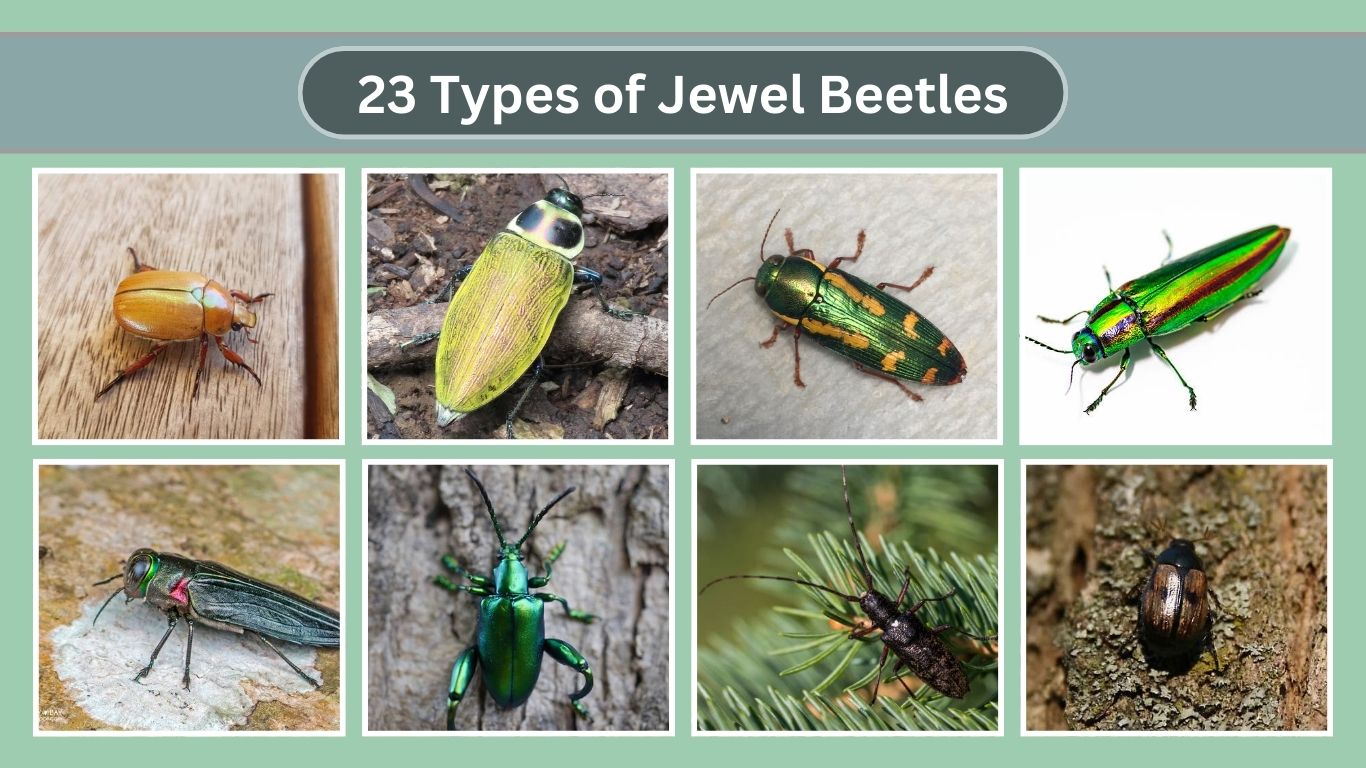
Jewel beetles (family Buprestidae) are among the most stunning insects in the world, celebrated for their iridescent metallic colors and intricate patterns. With thousands of species worldwide, they play vital ecological roles while captivating collectors and nature lovers alike. This article explores 23 remarkable types of jewel beetles, highlighting their identification, habitat, behavior, and impact. From tiny flower visitors to giant wood-borers, each species showcases the dazzling diversity of these brilliant beetles.
1. Emerald Ash Borer (Agrilus planipennis)

The Emerald Ash Borer is one of the most notorious jewel beetles, native to Asia but now widespread in North America and Europe. It is famous for its metallic green color and for causing devastating damage to ash trees. Since its accidental introduction, this beetle has killed millions of trees, making it both ecologically and economically significant.
Identification
- Metallic emerald-green body with a coppery or purple abdomen
- Elongated body shape, about 8.5–14 mm long
- Distinctive flat-headed larvae that tunnel beneath bark
- Adults have large, black compound eyes
Habitat
Emerald Ash Borers thrive in forests, urban landscapes, and anywhere ash trees (Fraxinus species) grow. They are commonly found on trunks and branches where they feed, mate, and lay eggs.
Behavior
Adults feed on ash tree foliage, causing minor damage, but the larvae are highly destructive. They bore into the tree’s inner bark and cambium layer, disrupting water and nutrient flow, which eventually kills the tree.
Damage
This beetle is a major invasive pest. Infested trees show canopy dieback, bark splitting, and D-shaped exit holes. In heavily affected areas, entire populations of ash trees have been wiped out within a decade.
2. Red Buprestid (Dicerca tenebrica)

The Red Buprestid is a striking jewel beetle known for its reddish to coppery metallic sheen. Belonging to the Buprestidae family, it is commonly found across North America. Though not as infamous as the Emerald Ash Borer, this species still plays an important role in forest ecosystems, often associated with stressed or dying trees.
Identification
- Metallic reddish to coppery-brown body
- Elongated, slightly flattened shape, 12–20 mm long
- Elytra (wing covers) often display faint longitudinal ridges
- Antennae are serrated and short compared to body length
Habitat
Red Buprestids inhabit forests, woodlands, and areas with decaying or weakened hardwood trees. They prefer to lay eggs in stressed trees, especially birch, oak, and poplar.
Behavior
Adults are strong fliers and are usually active during warm, sunny days. They feed on leaves and bark, while the larvae bore into tree trunks, helping break down weakened wood.
Damage
Although generally less destructive than invasive jewel beetles, the larvae of Red Buprestids can cause structural damage to already weakened trees. They are considered secondary pests that take advantage of stressed or dying hosts rather than killing healthy trees.
3. Flat-headed Apple Tree Borer (Chrysobothris femorata)

The Flat-headed Apple Tree Borer is a common jewel beetle in North America, known for attacking fruit trees and shade trees. It primarily targets stressed or injured trees, making it a frequent pest in orchards and gardens. Its larvae are flat-headed borers that can severely weaken or kill young trees.
Identification
- Metallic bronze to dark brown body with faint patterns
- Flattened head and elongated body, 8–18 mm long
- Elytra often with lighter patches or irregular markings
- Larvae are creamy white with distinctly flattened, broad heads
Habitat
This beetle prefers orchards, suburban landscapes, and forest edges where apple, cherry, peach, and other fruit trees grow. It often attacks weakened trees with bark wounds or sunscald injuries.
Behavior
Adults are active during hot summer days, feeding on bark and foliage. Females lay eggs in bark crevices, and larvae tunnel beneath the bark, disrupting nutrient flow. The life cycle may take one to two years depending on conditions.
Damage
The larvae cause significant damage by girdling young trees. Infested trees show dieback, reduced growth, and sometimes death. In commercial orchards, this beetle can result in serious economic losses if not managed.
4. Two-lined Chestnut Borer (Agrilus bilineatus)

The Two-lined Chestnut Borer is a jewel beetle that historically attacked American chestnut trees before the chestnut blight. Today, it is best known for infesting oaks, particularly in stressed or drought-affected forests. Its name comes from the two pale lines running along its wing covers.
Identification
- Slender, metallic dark brown to black body
- Two pale yellow to white longitudinal lines on the elytra
- Adult size ranges from 6–13 mm in length
- Larvae are flat-headed, cream-colored borers typical of Agrilus species
Habitat
This beetle is primarily found in oak forests, woodlands, and areas with stressed hardwoods. It prefers trees weakened by drought, disease, or poor growing conditions.
Behavior
Adults feed on oak leaves but cause minimal damage. The larvae are the primary threat, tunneling beneath bark and cambium layers. Infestation often begins in the upper crown of the tree, progressing downward as the tree weakens.
Damage
The Two-lined Chestnut Borer causes extensive dieback in oak trees. Infested trees develop thinning crowns, yellowing leaves, and eventual death if the infestation is severe. It is a serious forest pest during drought years.
5. Gold-dust Beetle (Buprestis aurulenta)

The Gold-dust Beetle is one of the most beautiful jewel beetles in North America, admired for its metallic green body covered with golden speckles. Often found in forests, this beetle plays a role in breaking down weakened coniferous trees. Its shimmering appearance makes it a sought-after specimen among collectors.
Identification
- Bright metallic green body with golden specks (“dust”) across the elytra
- Elongated, robust body, about 12–20 mm long
- Elytra smooth and shiny with subtle ridges
- Larvae are typical flat-headed borers, pale cream in color
Habitat
Gold-dust Beetles are commonly found in coniferous forests, especially in areas with Douglas fir, pine, spruce, and hemlock. They prefer weakened, dying, or recently felled trees as hosts for their larvae.
Behavior
Adults are diurnal and often seen basking in sunlight on logs or tree trunks. They feed minimally, while larvae bore into the wood of host trees. Development may take one to three years depending on environmental conditions.
Damage
This species is not typically a serious pest but can contribute to wood degradation. Larval feeding weakens timber, which may reduce its commercial value. It is more of an ecological decomposer than an aggressive tree killer.
6. Metallic Wood-boring Beetle (Chalcophora fortis)

The Metallic Wood-boring Beetle is a large jewel beetle recognized for its bronze to dark metallic coloration. It is found mainly in North America, where it inhabits pine forests and other coniferous areas. Known for its size and strength, this beetle’s larvae bore deep into wood, sometimes causing significant damage to timber.
Identification
- Large, elongated body measuring 15–28 mm long
- Metallic bronze, coppery, or dark brown sheen
- Elytra often sculptured with grooves and ridges
- Larvae are robust flat-headed borers with widened thoracic segments
Habitat
This beetle thrives in coniferous forests, particularly pine, fir, and spruce stands. It targets weakened, recently felled, or fire-damaged trees, which provide ideal conditions for egg-laying and larval development.
Behavior
Adults are strong fliers and are most active during sunny summer days. They often rest on tree trunks where females deposit eggs. Larvae tunnel deep into sapwood and heartwood, creating winding galleries that weaken the structure of trees.
Damage
While primarily affecting stressed or damaged trees, infestations can cause economic losses in forestry due to reduced lumber quality. The deep tunnels left by larvae can compromise timber strength, making this beetle significant in commercial wood industries.
7. Blue Jewel Beetle (Sternocera aequisignata)

The Blue Jewel Beetle is one of the most dazzling members of the Buprestidae family, famous for its vibrant metallic blue-green coloration. Found mainly in Southeast Asia, it is highly prized by collectors and is sometimes used in traditional crafts and jewelry due to its shimmering beauty.
Identification
- Brilliant metallic blue-green body with a glossy finish
- Medium to large size, ranging from 25–40 mm in length
- Elytra smooth, reflecting iridescent hues under sunlight
- Larvae are typical flat-headed borers, creamy white with broad heads
Habitat
This species inhabits tropical and subtropical forests, often associated with acacia and other leguminous trees. Adults are commonly seen on leaves and branches during warm sunny days.
Behavior
Adults feed lightly on foliage and are strong fliers, easily spotted due to their vivid color. Females deposit eggs in bark crevices, and larvae bore into the wood, feeding on inner tissues until pupation.
Damage
Though striking in appearance, the larvae can cause damage to host trees by weakening branches and trunks. However, they are not usually considered major pests compared to other jewel beetles.
8. Golden Jewel Beetle (Sternocera ruficornis)

The Golden Jewel Beetle is a spectacular species known for its shimmering golden-green coloration. Native to Southeast Asia, it is one of the largest and most admired jewel beetles. Like its close relatives, it is sometimes used in decorative crafts because of its iridescent shell, which retains its brilliance even after the beetle’s life.
Identification
- Metallic golden-green body with a bright, reflective sheen
- Large size, ranging from 30–40 mm long
- Elytra smooth, often showing golden to emerald hues under light
- Antennae reddish (ruficornis means “red-horned”)
Habitat
This beetle inhabits tropical forests and wooded areas across Thailand, Laos, Cambodia, and surrounding regions. It is often found on host trees, especially acacias and other legumes.
Behavior
Adults are diurnal and active on sunny days, often resting on leaves where they feed. Females lay eggs in bark crevices, and larvae develop by boring into the wood, completing their life cycle within one to two years.
Damage
While not usually a major pest, larvae can weaken host trees by tunneling through wood. In natural ecosystems, they mostly target older or stressed trees, contributing to wood decomposition.
9. Western Cedar Borer (Trachypteris picta)

The Western Cedar Borer is a jewel beetle species known for its association with cedar and other coniferous trees. Though less colorful than some of its relatives, it still displays a subtle metallic sheen. It plays a role in forest ecosystems by targeting weakened or freshly cut cedar trees.
Identification
- Elongated, somewhat flattened body, 12–20 mm long
- Metallic brown to bronze with patterned or mottled wing covers
- Elytra often ridged with fine textures
- Larvae are pale, flat-headed borers with enlarged thoracic segments
Habitat
This beetle inhabits western North American forests, especially where cedar and juniper trees are present. It prefers stressed, fire-damaged, or freshly felled trees as breeding hosts.
Behavior
Adults are usually active during the warmest part of the day, flying strongly and resting on tree trunks. Females deposit eggs in bark crevices, and larvae bore into the sapwood, leaving winding tunnels as they feed.
Damage
Larval feeding weakens tree structure and can reduce the quality of cedar lumber. Although not usually a primary pest, it is a concern in forestry and lumber industries where cedar is commercially valuable.
10. Green Jewel Beetle (Julodis viridipes)

The Green Jewel Beetle is a vibrant species that stands out for its brilliant emerald coloration. Belonging to the Julodis genus, it is admired for its beauty and is often found in arid and semi-arid regions. This beetle is one of the most recognizable jewel beetles in its range, frequently collected for its dazzling appearance.
Identification
- Bright metallic green body with shimmering iridescence
- Medium to large size, 20–35 mm in length
- Elytra robust and slightly ridged
- Legs often display a greenish tint, matching the body (hence viridipes, meaning “green-footed”)
Habitat
This beetle inhabits dry woodlands, savannas, and scrublands. It is particularly common in regions with sparse vegetation and scattered host trees, often in Africa and parts of the Middle East.
Behavior
Adults are diurnal and often found resting on flowers or leaves. They are strong fliers, actively seeking out nectar and foliage. Females lay eggs on suitable host trees, where larvae bore into wood and complete development.
Damage
The larvae feed within the wood of host trees, sometimes weakening smaller trees or branches. However, they are generally not considered a serious pest, serving more as natural recyclers of weakened vegetation.
11. Coppery Wood-borer (Agrilus cuprescens)

The Coppery Wood-borer is a slender jewel beetle with a striking metallic copper or bronze sheen. It is widely distributed across Europe, North America, and parts of Asia, where it primarily infests small trees and shrubs. This beetle is well-known among gardeners and foresters for its association with ornamental plants and hedges.
Identification
- Slender, elongated body, 5–7 mm in length
- Metallic copper, bronze, or greenish sheen depending on light
- Elytra smooth with faint striations
- Larvae are flat-headed borers, pale and slender with widened thoracic segments
Habitat
The species thrives in gardens, hedgerows, orchards, and forest edges. It particularly favors rose bushes, hawthorn, elm, and various fruit trees as hosts.
Behavior
Adults are active in warm weather, feeding lightly on leaves and stems. Females lay eggs in bark crevices, and larvae bore beneath the bark into cambium tissue. The lifecycle is usually one year but may extend under cooler conditions.
Damage
The Coppery Wood-borer is considered a pest of ornamental plants. Larval feeding can cause branch dieback, reduced vigor, and even death of young shrubs or trees. Infestations often become noticeable by wilted foliage and exit holes.
12. Australian Jewel Beetle (Temognatha alternata)

The Australian Jewel Beetle is a large and colorful species native to Australia, admired for its bright metallic stripes. It belongs to the Temognatha genus, which includes some of the largest and most spectacular jewel beetles in the world. Its bold colors make it a favorite among beetle collectors.
Identification
- Large body size, ranging from 30–45 mm in length
- Metallic green base color with alternating yellow or orange transverse bands
- Elytra elongated and smooth with iridescent reflections
- Larvae are robust flat-headed borers with creamy white bodies
Habitat
This species is found across woodlands and forests in Australia, especially where eucalyptus trees dominate. Adults are frequently seen resting or feeding on flowers and leaves of native trees.
Behavior
Adults are diurnal and strong fliers, often visiting blossoms to feed on nectar and pollen. Females lay eggs in the bark of eucalyptus and other hardwood trees. The larvae bore deeply into timber, where they can remain for several years before emerging as adults.
Damage
While visually striking, the larvae can cause significant damage to eucalyptus trees by tunneling into their wood. In some cases, infestations weaken branches, though they are usually part of natural forest cycles rather than major pests.
13. Flame Jewel Beetle (Temognatha splendida)

The Flame Jewel Beetle is one of the most brilliantly colored jewel beetles, native to Australia. Its fiery red and orange markings over a metallic green body make it look like a living flame, which is how it earned its name. It is a large species, highly admired by beetle enthusiasts and collectors.
Identification
- Large beetle, typically 40–50 mm in length
- Metallic green body with vivid red and orange transverse bands
- Elytra elongated and glossy, reflecting bright iridescence
- Larvae are flat-headed borers, thick-bodied, and creamy white
Habitat
This beetle is widespread in Australian forests and woodlands, especially where eucalyptus trees are abundant. Adults are frequently found visiting flowering trees.
Behavior
Flame Jewel Beetles are diurnal, often seen flying in bright sunlight. They are strong fliers and spend much of their time feeding on nectar and pollen from eucalyptus flowers. Females lay eggs in tree bark, where larvae bore deep into the timber.
Damage
Larvae tunnel into eucalyptus wood, weakening branches and trunks over time. Although they may cause some damage to host trees, they are generally part of the natural ecosystem and not considered a severe pest.
14. Bronze Birch Borer (Agrilus anxius)

The Bronze Birch Borer is a destructive jewel beetle native to North America, notorious for attacking birch trees. It is especially damaging to ornamental birches planted in landscapes, where it often becomes a lethal pest. Its metallic bronze sheen makes it visually striking, but its impact on tree health is severe.
Identification
- Slender, metallic bronze to copper-colored body
- Adults measure 6–12 mm in length
- Elytra smooth with faint striations and tapering ends
- Larvae are pale, flat-headed borers with widened thoracic segments
Habitat
This species is found throughout birch forests, suburban landscapes, and ornamental plantings. It thrives in areas where birch trees are stressed by drought, poor soil, or other environmental pressures.
Behavior
Adults are active during warm summer months, feeding lightly on birch leaves. Females lay eggs in bark crevices, and larvae bore under the bark into cambium tissue, disrupting the tree’s nutrient and water transport system.
Damage
The Bronze Birch Borer is considered one of the most serious pests of birch trees in North America. Infested trees show canopy thinning, branch dieback, and eventual death within a few years. The D-shaped exit holes left by emerging adults are a telltale sign of infestation.
15. Japanese Jewel Beetle (Chrysochroa fulgidissima)

The Japanese Jewel Beetle, also known as Tamamushi in Japan, is one of the most famous and culturally significant jewel beetles. Its dazzling iridescent green and rainbow-like hues have made it a symbol of beauty in Japanese art and history, even used as ornamentation in shrines and crafts.
Identification
- Brilliant metallic green body with shifting rainbow reflections (purple, blue, gold)
- Large and elongated, typically 30–40 mm in length
- Elytra smooth and glossy, reflecting multiple colors under sunlight
- Larvae are flat-headed borers, pale white and cylindrical
Habitat
This beetle is found throughout Japan, Korea, and parts of East Asia. It inhabits deciduous forests, gardens, and shrines, often associated with zelkova, willow, and oak trees.
Behavior
Adults are diurnal and strong fliers, often seen during hot summer days. They feed lightly on foliage and are highly visible due to their shimmering coloration. Females lay eggs in tree bark, and larvae develop in the wood, taking up to two years to mature.
Damage
Although visually stunning, larvae bore into the wood of host trees, occasionally causing weakening or dieback. However, they are not generally considered serious pests and are more valued for their cultural and aesthetic significance.
16. Giant Metallic Ceiba Borer (Euchroma gigantea)

The Giant Metallic Ceiba Borer is one of the largest jewel beetles in the world, found in Central and South America. Its spectacular size and brilliant metallic colors make it a prized species among collectors. Despite its beauty, its larvae are powerful wood-borers capable of tunneling deep into large tropical trees.
Identification
- Very large size, ranging from 50–80 mm in length
- Metallic green or bronze body with yellow and red iridescent markings
- Elytra often patterned with irregular spots or bands
- Larvae are thick-bodied flat-headed borers, creamy white with broad thoraxes
Habitat
This beetle inhabits tropical rainforests of Central and South America. It is closely associated with Ceiba (silk-cotton trees) and other large hardwoods, where it lays its eggs and larvae develop.
Behavior
Adults are strong fliers and can be seen on sunny days resting on tree trunks or foliage. They are attracted to freshly felled or weakened trees. Females lay eggs in bark crevices, and larvae tunnel deep into the heartwood, where they may remain for several years before emerging.
Damage
The larvae bore large galleries through hardwood, which can weaken trees and reduce the quality of harvested timber. While they contribute to natural decomposition in forests, they may cause damage when infesting economically important hardwoods.
17. Splendid Jewel Beetle (Chrysochroa buqueti)

The Splendid Jewel Beetle is one of the most visually stunning species in the Chrysochroa genus, native to Southeast Asia. Its vibrant coloration and large size make it highly sought after by collectors. True to its name, it is considered one of the most splendid jewel beetles in the world.
Identification
- Large beetle, usually 30–50 mm in length
- Metallic body with vivid stripes of green, red, yellow, and purple
- Elytra smooth, reflecting brilliant iridescence under sunlight
- Larvae are pale flat-headed borers with enlarged thoracic segments
Habitat
This beetle is commonly found in tropical forests of Thailand, Malaysia, Cambodia, and surrounding regions. It inhabits areas with abundant hardwood trees, where it completes its life cycle.
Behavior
Adults are diurnal and very active on hot sunny days, often flying between trees. They feed lightly on foliage and nectar. Females deposit eggs in bark crevices, and larvae bore deep into the wood, sometimes taking two years to fully develop.
Damage
Although strikingly beautiful, larvae can damage hardwood trees by tunneling through trunks and branches. However, in natural ecosystems, they mainly infest weakened or dying trees rather than healthy ones.
18. Dark Green Jewel Beetle (Ovalisia viridipennis)

The Dark Green Jewel Beetle is a striking species recognized for its deep emerald coloration. It belongs to the genus Ovalisia and is distributed across parts of Asia and Europe. Its iridescent green wings and compact body shape make it one of the more eye-catching jewel beetles in its range.
Identification
- Medium-sized beetle, typically 12–18 mm in length
- Metallic dark green body and elytra with a glossy finish
- Compact, slightly oval body shape compared to elongated relatives
- Larvae are pale flat-headed borers that develop under bark
Habitat
This beetle is found in temperate and subtropical forests, often associated with hardwood trees such as ash, elm, and oak. It prefers areas with weakened or stressed trees where its larvae can thrive.
Behavior
Adults are diurnal and strong fliers, often resting on sunlit leaves or trunks. They feed lightly on foliage. Females deposit eggs beneath bark, and larvae tunnel into cambium layers, feeding on nutrient-rich tissues.
Damage
The larvae weaken host trees by disrupting water and nutrient flow. Infested trees may show crown dieback, bark splitting, and eventual decline. In forestry, it is considered a minor pest but can cause noticeable damage in stressed woodland environments.
19. Lesser Jewel Beetle (Anthaxia quadripunctata)

The Lesser Jewel Beetle is a small but attractive species, widely distributed across Europe and parts of Asia. Despite its smaller size, it displays the metallic sheen characteristic of jewel beetles, making it an easily recognized member of the Anthaxia genus.
Identification
- Small beetle, typically 5–9 mm in length
- Metallic green, bronze, or blue coloration depending on region
- Elytra often show four small pale or reddish spots (hence quadripunctata, meaning “four-spotted”)
- Larvae are pale flat-headed borers that live under bark
Habitat
This beetle inhabits coniferous and mixed forests, particularly areas with spruce, pine, and other softwoods. It often colonizes weakened or recently dead trees and branches.
Behavior
Adults are active during sunny spring and summer days, often seen on flowers where they feed on pollen and nectar. Females lay eggs in bark cracks, and larvae bore beneath the bark, feeding on the cambium tissue.
Damage
While not considered a serious pest, infestations can contribute to dieback in stressed conifers. Larval tunneling under bark may weaken smaller branches, but the species mainly plays a role in the decomposition of deadwood.
20. Red-legged Jewel Beetle (Anthaxia nitidula)

The Red-legged Jewel Beetle is a small, brightly colored species widespread across Europe and parts of Asia. Its combination of metallic hues and distinctive reddish legs makes it stand out among the Anthaxia beetles. It is often seen on flowers, where adults feed and play a role in pollination.
Identification
- Small beetle, usually 5–8 mm in length
- Metallic green to blue body with a shiny surface
- Distinctive reddish to orange legs, giving the species its name
- Larvae are flat-headed borers, creamy white, living beneath bark
Habitat
This beetle inhabits meadows, forest edges, and woodland clearings. It is strongly associated with flowering plants and host trees such as fruit trees, willows, and oaks.
Behavior
Adults are diurnal and highly active during warm, sunny days. They are commonly found on flowers, feeding on pollen and nectar. Females lay eggs in tree bark, and larvae bore into the cambium layer, completing their development within a year.
Damage
While larvae can weaken branches of host trees, they are generally considered minor pests. Their ecological role leans more toward aiding decomposition of weakened trees and contributing to pollination during adulthood.
21. Great Spruce Borer (Chalcophora virginiensis)

The Great Spruce Borer is one of the larger jewel beetles native to North America. Known for its dark, metallic sheen and wood-boring larvae, it primarily targets coniferous trees, especially spruce and pine. Its deep burrowing makes it a concern in forestry where it reduces the quality of harvested lumber.
Identification
- Large beetle, typically 18–30 mm in length
- Dark metallic brown to bronze body with coarse sculpturing on the elytra
- Elongated, somewhat flattened shape typical of Chalcophora species
- Larvae are pale, flat-headed borers with widened thoracic segments
Habitat
This beetle inhabits coniferous forests across North America. It prefers stressed, fire-damaged, or recently felled spruce and pine trees as larval hosts.
Behavior
Adults are strong fliers and are most active in summer, resting on sunlit trunks or logs. Females lay eggs in bark crevices, and larvae tunnel deep into sapwood and heartwood, feeding for multiple years before pupating.
Damage
Larval galleries weaken timber and reduce its commercial value. While usually targeting weakened or dying trees, heavy infestations can contribute to forest decline, especially in stressed spruce stands.
22. Shining Leaf Borer (Lamprodila festiva)

The Shining Leaf Borer is a jewel beetle admired for its vivid metallic green coloration and occasional bluish or golden reflections. Native to Europe and parts of Asia, it is often associated with ornamental plants and hardwood trees, where it can sometimes become a garden pest.
Identification
- Medium-sized beetle, usually 10–15 mm in length
- Bright metallic green body with iridescent reflections of blue or gold
- Compact and elongated shape with smooth, glossy elytra
- Larvae are creamy white flat-headed borers, slender with widened thoracic segments
Habitat
This species inhabits parks, gardens, and forest edges, particularly in regions with oaks, fruit trees, and ornamental shrubs. It thrives in sunny environments where host plants are available.
Behavior
Adults are diurnal and can often be seen on leaves and flowers during hot summer days. They feed on foliage and blossoms, while females lay eggs in bark crevices. Larvae bore into cambium tissue, where they spend most of their development.
Damage
The Shining Leaf Borer is considered a pest of ornamental plants and fruit trees. Its larvae weaken branches by tunneling beneath the bark, leading to dieback and reduced vitality. Infested plants often show wilted leaves and visible exit holes.
23. Golden Buprestid (Buprestis aurulenta)

The Golden Buprestid is one of the most spectacular jewel beetles of North America, famous for its brilliant metallic green body covered with golden or coppery highlights. Known for its remarkable beauty and long life cycle, it is a prized species among collectors and naturalists.
Identification
- Medium to large beetle, typically 14–20 mm long
- Metallic green body with golden or coppery iridescence
- Elytra smooth with faint sculpturing and bright reflections
- Larvae are pale flat-headed borers with elongated, widened thoracic regions
Habitat
Golden Buprestids inhabit coniferous forests, especially areas with Douglas fir, pine, spruce, and fir. They are usually found on fallen logs, tree trunks, or fire-damaged timber.
Behavior
Adults are diurnal and strong fliers, often seen resting on sunlit logs. They feed lightly on foliage and bark. Larvae tunnel deep into wood, sometimes taking decades to complete development—a unique trait among jewel beetles.
Damage
The larvae are capable of surviving and developing within seasoned wood for many years, occasionally emerging from structural timbers in buildings long after construction. While not a major pest in forests, they are occasionally problematic in lumber industries and wooden structures.