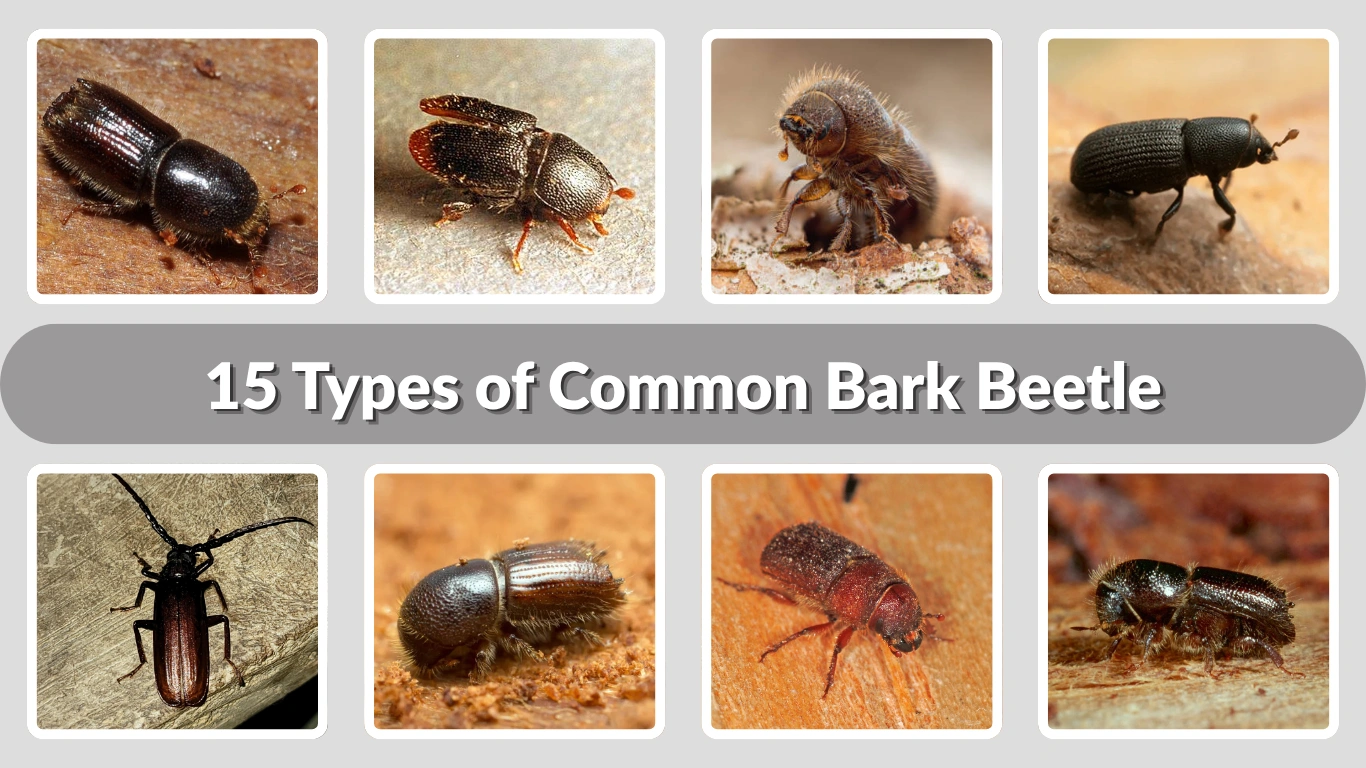
Bark beetles are small yet powerful forest insects that play both beneficial and destructive roles in nature. While they help decompose dead trees, their massive outbreaks can devastate entire forests. Found worldwide, these beetles primarily infest pine, spruce, and fir trees. This article explores 15 common types of bark beetles, their key characteristics, habitats, behaviors, diets, and fascinating life cycles.
1. Mountain Pine Beetle

The Mountain Pine Beetle (Dendroctonus ponderosae) is a small but destructive bark beetle native to the forests of western North America. Despite its tiny size, this beetle has caused widespread devastation to pine forests, especially during outbreaks. It primarily targets lodgepole, ponderosa, and white pines.
Identification
- Color: Dark brown to black
- Size: About 1/8 inch (3–5 mm) long
- Shape: Cylindrical body with rounded ends
- Wings: Hard wing covers with tiny pits and fine hairs
- Larvae: White, legless grubs with brown heads that tunnel beneath bark
Habitat
Mountain Pine Beetles thrive in pine forests at elevations between 3,000 and 10,000 feet. They prefer mature or stressed trees with thick bark. Infestations often occur in dense forests where tree competition is high, creating ideal conditions for beetle population growth.
Behavior
Adults bore through the bark to lay eggs, releasing pheromones that attract other beetles to the same tree. This mass attack overwhelms the tree’s defenses. The beetles also carry a blue-stain fungus that blocks the tree’s nutrient transport system, accelerating its death.
Diet
Both larvae and adults feed on the inner bark (phloem) of pine trees. This feeding disrupts the flow of nutrients and water, leading to tree death. The beetles depend entirely on pine species for sustenance and reproduction.
Lifecycle
The life cycle lasts one year in most regions. Females lay eggs beneath the bark in summer, and larvae feed through fall before overwintering. Pupation occurs in spring, and adults emerge in midsummer to find new hosts. During outbreaks, populations can devastate vast forest areas within a few seasons.
2. Southern Pine Beetle

The Southern Pine Beetle (Dendroctonus frontalis) is one of the most destructive bark beetles in the southeastern United States. Despite its small size, it can decimate vast pine forests by attacking healthy trees in coordinated mass infestations. It primarily targets loblolly, shortleaf, and pitch pines.
Identification
- Color: Reddish-brown to black
- Size: About 1/8 inch (2–4 mm) long
- Shape: Cylindrical with a rounded posterior
- Wings: Smooth and shiny with tiny punctures
- Larvae: Cream-colored, legless grubs that tunnel under bark in S-shaped galleries
Habitat
Southern Pine Beetles inhabit pine forests across the southeastern U.S., Mexico, and Central America. They prefer warm, humid climates and attack densely populated pine stands, especially those weakened by drought, storms, or disease.
Behavior
These beetles use pheromones to coordinate attacks, overwhelming a tree’s resin defenses. They burrow beneath bark, creating intricate galleries where eggs are laid. The beetles also carry fungi that disrupt the tree’s vascular system, hastening death within weeks.
Diet
Adults and larvae feed on the inner bark and cambium layers of pine trees. This feeding interrupts the tree’s ability to transport water and nutrients, effectively girdling it. They rely entirely on pine tissue for nutrition throughout their lifecycle.
Lifecycle
The Southern Pine Beetle completes multiple generations per year, depending on temperature. Females bore into trees to lay eggs, larvae develop beneath the bark, and adults emerge to infest new hosts. During outbreaks, populations can explode rapidly, killing thousands of trees in a single season.
3. Western Pine Beetle

The Western Pine Beetle (Dendroctonus brevicomis) is a major pest of ponderosa and Coulter pine trees throughout western North America. Known for its distinctive galleries beneath bark and its role in large-scale forest die-offs, this beetle thrives in warm, dry climates and often targets stressed or mature trees.
Identification
- Color: Dark brown to black
- Size: Approximately 1/8 inch (3–5 mm) long
- Shape: Cylindrical body with rounded ends
- Wings: Smooth elytra with shallow punctures
- Larvae: Creamy white, legless grubs with brown heads, forming winding galleries under bark
Habitat
Western Pine Beetles are found in pine forests from British Columbia to Mexico. They prefer low- to mid-elevation areas and are particularly abundant in forests experiencing drought or overcrowding. Trees weakened by age, fire, or environmental stress are prime targets.
Behavior
Adults bore through bark, releasing aggregation pheromones that attract thousands of beetles to the same tree. They create galleries in the inner bark, where females lay eggs. The combined feeding and introduction of blue-stain fungi block water transport, leading to rapid tree death.
Diet
Adults and larvae feed on the phloem tissue of pines, disrupting the tree’s nutrient flow. The larvae’s feeding patterns form serpentine tunnels, which are characteristic of infestation. Their dependence on living pine tissue makes them one of the most destructive bark beetles in western forests.
Lifecycle
The Western Pine Beetle produces two to three generations annually in warmer regions. Eggs hatch beneath bark, and larvae feed through winter before pupating. Adults emerge in spring or summer to infest new hosts. During outbreaks, these beetles can devastate entire pine stands within months.
4. Spruce Beetle

The Spruce Beetle (Dendroctonus rufipennis) is a primary killer of spruce trees across North America, particularly in Alaska and the Rocky Mountains. It’s responsible for extensive forest mortality, especially during warm summers that accelerate its reproduction cycle.
Identification
- Color: Dark brown to black with reddish tones
- Size: 1/8 to 1/4 inch (3–6 mm) long
- Shape: Cylindrical and compact
- Wings: Hard, shiny elytra with fine punctures
- Larvae: White grubs with curved bodies and brown heads, found beneath spruce bark
Habitat
Spruce Beetles inhabit boreal and montane forests, where Engelmann, white, and Sitka spruces grow. They prefer cool, moist environments but thrive during warm periods that speed up their development. Fallen or windthrown trees often serve as breeding sites before live trees are attacked.
Behavior
Adults first infest downed or weakened spruce before spreading to healthy ones during outbreaks. They burrow beneath the bark, forming distinctive galleries. Pheromones attract others, leading to mass infestations. Blue-stain fungi introduced by the beetles contribute to rapid tree death.
Diet
Both adults and larvae feed on the inner bark and phloem tissue of spruce trees. This feeding disrupts nutrient transport, causing tree death. The larvae’s extensive tunneling leaves visible patterns under the bark, often used for identification.
Lifecycle
Typically, the lifecycle takes one to two years. Eggs are laid in summer, and larvae feed through fall before overwintering. Pupation occurs in late spring, and adults emerge during early summer. In warm years, shortened life cycles can cause explosive population growth and widespread forest damage.
5. Ips Engraver Beetle

The Ips Engraver Beetle (Ips pini) is a common bark beetle species found across North America, particularly in pine forests. Known for its distinctive gallery patterns that resemble engravings, this beetle primarily attacks stressed or recently felled pine trees but can also infest healthy ones during outbreaks.
Identification
- Color: Reddish-brown to dark brown
- Size: Around 1/8 inch (3–5 mm) long
- Shape: Cylindrical with a scooped-out rear end and small spines
- Wings: Elytra covered in fine punctures and short hairs
- Larvae: Creamy white, legless grubs forming star-shaped gallery systems beneath bark
Habitat
Ips Engraver Beetles inhabit pine forests throughout North America, especially in regions with ponderosa, lodgepole, and jack pines. They prefer weakened or drought-stressed trees, logging sites, and slash piles where conditions are ideal for breeding.
Behavior
Males initiate attacks by boring into bark and releasing aggregation pheromones to attract females. Each male typically mates with multiple females, who then create radiating egg galleries. When populations spike, they can attack healthy trees, often in clusters.
Diet
Both larvae and adults feed on the phloem layer of pine trees. This disrupts nutrient flow, eventually killing the tree. Adults may also feed on the bark surface before mating. Their feeding behavior aids in decomposing weakened or dead trees in forest ecosystems.
Lifecycle
Ips Engraver Beetles have multiple generations per year, especially in warm climates. Eggs are laid beneath bark, larvae develop within weeks, and adults emerge to start new infestations. During warm seasons, rapid reproduction can lead to severe forest damage in a short period.
6. Red Turpentine Beetle

The Red Turpentine Beetle (Dendroctonus valens) is one of the largest bark beetles in North America. Unlike many other species, it typically attacks the lower trunk or freshly cut stumps rather than killing healthy trees. However, during drought or stress, it can contribute to pine mortality.
Identification
- Color: Reddish-brown
- Size: 1/4 to 3/8 inch (6–10 mm) long
- Shape: Robust, cylindrical body
- Wings: Shiny elytra with shallow punctures
- Larvae: White, legless grubs found beneath the bark at the tree base
Habitat
The Red Turpentine Beetle inhabits pine forests across North America, from Canada to Mexico. It thrives in dry, sandy soils and frequently infests logging sites, recently burned areas, or trees injured by machinery or fire.
Behavior
Adults bore into the base of trees, creating large pitch tubes that ooze resin. They typically attack stressed or wounded trees but can work in conjunction with other beetle species to kill otherwise healthy ones. Males and females cooperate in gallery building beneath the bark.
Diet
Adults and larvae feed on the phloem of pine trees. Their feeding disrupts nutrient movement but rarely kills trees alone. Instead, they weaken hosts, making them more vulnerable to other bark beetle attacks and fungal infections.
Lifecycle
The lifecycle of the Red Turpentine Beetle lasts one to two years. Eggs are laid beneath bark, larvae feed through summer and overwinter before pupating. Adults emerge in late spring or early summer to infest new hosts. This beetle often acts as an early colonizer in disturbed forest environments.
7. Douglas-Fir Beetle

The Douglas-Fir Beetle (Dendroctonus pseudotsugae) is a destructive bark beetle that primarily attacks Douglas-fir trees across western North America. It’s known for causing widespread tree mortality during outbreaks, especially in forests affected by drought, fire, or wind damage.
Identification
- Color: Dark brown to black
- Size: About 1/4 inch (5–7 mm) long
- Shape: Cylindrical body with rounded ends
- Wings: Hard, shiny elytra with fine punctures
- Larvae: White, legless grubs that create vertical galleries beneath the bark
Habitat
Douglas-Fir Beetles are found in mature coniferous forests from Canada to Mexico, particularly in areas where Douglas-firs dominate. They thrive in cool, moist environments but often increase rapidly after windstorms that create ample breeding material.
Behavior
Adults typically target weakened or recently fallen trees but can attack healthy ones during population surges. They release pheromones to attract other beetles, coordinating mass attacks. Blue-stain fungi carried by the beetles further disrupt the tree’s vascular system, accelerating death.
Diet
Both adults and larvae feed on the phloem of Douglas-fir trees. This feeding disrupts nutrient and water transport, effectively girdling the tree. The larvae’s tunneling leaves characteristic vertical and branching patterns under the bark.
Lifecycle
The Douglas-Fir Beetle has a one-year lifecycle in most regions. Eggs are laid in spring, and larvae feed through summer before overwintering beneath bark. Adults emerge the following spring to infest new hosts. During favorable conditions, populations can grow exponentially, devastating large forest areas.
8. Fir Engraver Beetle

The Fir Engraver Beetle (Scolytus ventralis) is a common pest of true fir trees throughout western North America. Though typically secondary invaders, these beetles can become major forest pests when fir trees are stressed by drought or root disease.
Identification
- Color: Dark brown to black
- Size: Around 1/8 inch (3–4 mm) long
- Shape: Compact and cylindrical
- Wings: Elytra with faint grooves and punctures
- Larvae: Cream-colored, C-shaped grubs found beneath bark of fir trunks and branches
Habitat
Fir Engraver Beetles inhabit mountainous regions with dense fir populations. They are most active in subalpine zones and tend to attack white, red, and grand firs. Infestations usually start in trees already weakened by environmental stressors.
Behavior
Adults bore into bark to lay eggs, creating horizontal galleries. They often attack the upper trunks and large branches of trees. When populations are high, the beetles can cause extensive fir mortality, especially following dry years.
Diet
Larvae and adults feed on the inner bark (phloem) of fir trees. This feeding interrupts the flow of nutrients and water, gradually killing branches or entire trees. Feeding galleries beneath bark often appear as horizontal lines that help identify the species.
Lifecycle
The Fir Engraver Beetle typically produces one generation per year. Adults emerge in late spring or early summer to infest new hosts. Eggs hatch within weeks, and larvae feed through summer before pupating. In warm regions, some populations may complete two generations annually, intensifying outbreaks.
9. Black Turpentine Beetle

The Black Turpentine Beetle (Dendroctonus terebrans) is a large bark beetle species found primarily in the southeastern United States. Unlike many other bark beetles, it attacks the lower trunk and roots of pine trees, especially those stressed by fire, lightning, or mechanical damage.
Identification
- Color: Dark reddish-brown to black
- Size: 1/4 to 1/3 inch (6–9 mm) long
- Shape: Cylindrical and robust
- Wings: Shiny with fine punctures
- Larvae: White, legless grubs that create wide galleries beneath the bark near the base of the tree
Habitat
Black Turpentine Beetles inhabit pine forests throughout the southeastern U.S., including coastal plains and southern Appalachians. They prefer loblolly, slash, and longleaf pines, especially those weakened by drought or damage.
Behavior
Adults bore into the lower trunks of pine trees, producing large pitch tubes filled with resin. They often attack in small groups rather than mass infestations. While typically secondary pests, they can cause significant mortality in stressed stands.
Diet
Both larvae and adults feed on the phloem tissue of pine trees. Their feeding disrupts the transport of water and nutrients, weakening the tree. Though not as aggressive as other bark beetles, their activity often invites other pests and pathogens.
Lifecycle
The life cycle usually lasts one year. Females lay eggs beneath bark in resin-soaked galleries, larvae feed through summer, and pupation occurs in fall. Adults emerge in spring to infest new trees. Populations may persist year-round in warmer climates.
10. European Spruce Bark Beetle

The European Spruce Bark Beetle (Ips typographus) is one of Europe’s most destructive forest pests, known for killing millions of spruce trees across the continent. It has recently spread to new regions due to climate change and timber transport, raising ecological concerns worldwide.
Identification
- Color: Dark brown to black
- Size: 1/8 inch (4–5 mm) long
- Shape: Cylindrical with a scooped-out rear and four spines on each elytral edge
- Wings: Shiny, finely punctured elytra
- Larvae: White, legless grubs forming radiating gallery systems beneath spruce bark
Habitat
This beetle inhabits coniferous forests throughout Europe and parts of Asia. It primarily attacks Norway spruce and other spruce species. Infestations are common in areas affected by storms, drought, or logging, where weakened trees are abundant.
Behavior
European Spruce Bark Beetles attack en masse, coordinated by pheromones. Adults bore into the bark to construct breeding galleries, releasing blue-stain fungi that block the tree’s nutrient flow. Large outbreaks can devastate forests, particularly after windthrow events.
Diet
Adults and larvae feed on the phloem tissue of spruce trees. This feeding girdles the tree, preventing the movement of nutrients and water. The species relies exclusively on spruce hosts for both nourishment and reproduction.
Lifecycle
The beetle typically completes two generations per year but may produce three during warm summers. Eggs are laid under bark in spring, larvae feed through summer, and adults emerge to infest new trees. Favorable weather and ample breeding material often trigger massive outbreaks lasting several years.
11. Eastern Pine Engraver

The Eastern Pine Engraver (Ips calligraphus) is a widespread bark beetle that infests pine species across the eastern United States. It plays an essential ecological role in decomposing weakened trees but can become a serious pest during warm, dry years or following storm damage.
Identification
- Color: Reddish-brown to dark brown
- Size: 1/8 to 1/4 inch (3–6 mm) long
- Shape: Cylindrical with a scooped rear end featuring spines
- Wings: Smooth, shiny elytra with punctures
- Larvae: Cream-colored, legless grubs forming distinctive star-shaped gallery patterns under bark
Habitat
Eastern Pine Engravers inhabit pine forests throughout the eastern U.S., from the Gulf Coast to New England. They prefer loblolly, longleaf, and shortleaf pines. Logging residues, storm debris, and drought-stressed trees provide ideal breeding grounds.
Behavior
Males start the attack by boring into bark and releasing pheromones to attract females. Each male mates with multiple females, leading to a distinctive starburst gallery pattern beneath the bark. Populations surge after major storms, often spreading to healthy trees.
Diet
Both adults and larvae feed on the phloem tissue of pine trees. This feeding disrupts the tree’s nutrient transport, causing needles to fade from green to reddish-brown. While they primarily infest weakened trees, large populations can kill living pines.
Lifecycle
The Eastern Pine Engraver can complete several generations per year. Eggs are laid beneath the bark, larvae feed for several weeks, and adults emerge to infest new hosts. In warmer climates, overlapping generations can lead to continuous activity year-round.
12. Mediterranean Pine Engraver

The Mediterranean Pine Engraver (Orthotomicus erosus) is an invasive bark beetle native to the Mediterranean region but now found in several parts of the world, including North America. It attacks a wide variety of pine species and can rapidly colonize weakened or freshly cut trees.
Identification
- Color: Dark brown to black
- Size: 1/8 inch (3–4 mm) long
- Shape: Cylindrical with a rounded rear end
- Wings: Elytra with faint grooves and tiny punctures
- Larvae: White, curved grubs forming horizontal and radiating tunnels under bark
Habitat
This beetle thrives in warm, dry regions with abundant pine hosts. It commonly infests stone, Aleppo, and maritime pines. In introduced areas, such as southern Africa and western U.S., it colonizes pine plantations and urban landscapes alike.
Behavior
Mediterranean Pine Engravers prefer weakened or felled trees but can attack healthy ones during outbreaks. They produce aggregation pheromones to coordinate mass attacks. Infested trees show signs of resin exudation and fading needles within weeks.
Diet
Adults and larvae feed on the phloem and cambium of pine trees. Their feeding disrupts nutrient transport, killing trees in heavy infestations. The beetle also aids in decomposing dead wood, playing a natural role in forest recycling.
Lifecycle
The lifecycle typically includes multiple generations annually, depending on temperature. Eggs hatch within days, and larvae feed beneath bark before pupating. Adults emerge in a few weeks to start new infestations. In warmer climates, activity continues nearly year-round, increasing outbreak potential.
13. Walnut Twig Beetle

The Walnut Twig Beetle (Pityophthorus juglandis) is a tiny but destructive bark beetle known for spreading Thousand Cankers Disease in walnut trees. This insect, in association with a pathogenic fungus, poses a severe threat to black walnut populations across North America.
Identification
- Color: Reddish-brown
- Size: About 1/16 inch (1.5–2 mm) long
- Shape: Cylindrical and slender
- Wings: Smooth, with fine punctures
- Larvae: White, legless grubs creating small tunnels beneath twig bark
Habitat
Walnut Twig Beetles inhabit regions where walnut trees grow, particularly in the western and eastern United States. They thrive in urban areas, forests, and orchards where black or Arizona walnut trees are common.
Behavior
These beetles infest small branches and twigs, boring beneath the bark. As they tunnel, they introduce the Geosmithia morbida fungus, which forms multiple cankers that eventually girdle branches and kill trees. Infestations often start in upper branches before spreading downward.
Diet
Adults and larvae feed on the phloem and cambium tissues of walnut trees. While feeding alone causes limited harm, the fungal infection they carry is lethal to host trees. Feeding galleries are typically short and confined to smaller twigs.
Lifecycle
The Walnut Twig Beetle produces two to three generations per year in warm climates. Females lay eggs under bark, larvae develop within weeks, and new adults emerge to infest nearby branches. Continuous reproduction makes management challenging in infested regions.
14. Shothole Borer

The Shothole Borer (Scolytus rugulosus) is a small bark beetle that attacks a wide range of fruit and ornamental trees. Named for the tiny “shot holes” it leaves on trunks and branches, it is a major pest in orchards and landscapes worldwide.
Identification
- Color: Dark brown to black
- Size: 1/10 inch (2–3 mm) long
- Shape: Compact, cylindrical body
- Wings: Dull with shallow grooves
- Larvae: White, curved grubs forming radial galleries beneath bark
Habitat
Shothole Borers are found globally, infesting apple, cherry, plum, peach, and apricot trees. They prefer weakened, stressed, or newly pruned trees, particularly in warm temperate regions.
Behavior
Females bore into bark to lay eggs, leaving small round exit holes. The beetles introduce fungal spores that stain and damage wood. While they primarily attack stressed trees, outbreaks can occur when host trees are abundant and weakened by drought.
Diet
Adults and larvae feed on the inner bark and cambium layers of fruit and ornamental trees. This feeding disrupts water flow and weakens the host. They often attack in clusters, creating multiple holes per branch or trunk.
Lifecycle
The Shothole Borer completes several generations per year in warm climates. Eggs hatch quickly, larvae feed under bark, and adults emerge within weeks. Continuous breeding throughout the growing season allows populations to build rapidly in favorable conditions.
15. Pinyon Ips Beetle

The Pinyon Ips Beetle (Ips confusus) is a bark beetle species that primarily infests pinyon pines across the southwestern United States. It plays a natural role in forest recycling but can become a serious pest during drought conditions, leading to widespread tree mortality in pinyon woodlands.
Identification
- Color: Reddish-brown to dark brown
- Size: About 1/8 inch (3–4 mm) long
- Shape: Cylindrical with a scooped-out rear end featuring small spines
- Wings: Smooth elytra with shallow punctures
- Larvae: Cream-colored, legless grubs forming star-shaped galleries beneath bark
Habitat
Pinyon Ips Beetles are native to arid and semi-arid regions of the American Southwest, including Arizona, New Mexico, Utah, and Colorado. They prefer drought-stressed or damaged pinyon pines and often infest areas affected by fire or logging.
Behavior
Males initiate attacks by boring into bark and releasing pheromones to attract females. Each male mates with several females, leading to radiating gallery patterns beneath the bark. During droughts, their populations increase rapidly, allowing them to overwhelm even healthy trees.
Diet
Adults and larvae feed on the inner bark (phloem) of pinyon pines. This feeding disrupts the transport of nutrients and water, leading to branch dieback and, eventually, tree death. Infested trees often exhibit reddish-brown needles and visible pitch tubes.
Lifecycle
The Pinyon Ips Beetle produces multiple generations per year, depending on temperature. Eggs are laid beneath bark, larvae develop within weeks, and new adults emerge to attack nearby trees. In warmer climates, continuous breeding can lead to persistent infestations lasting several years.