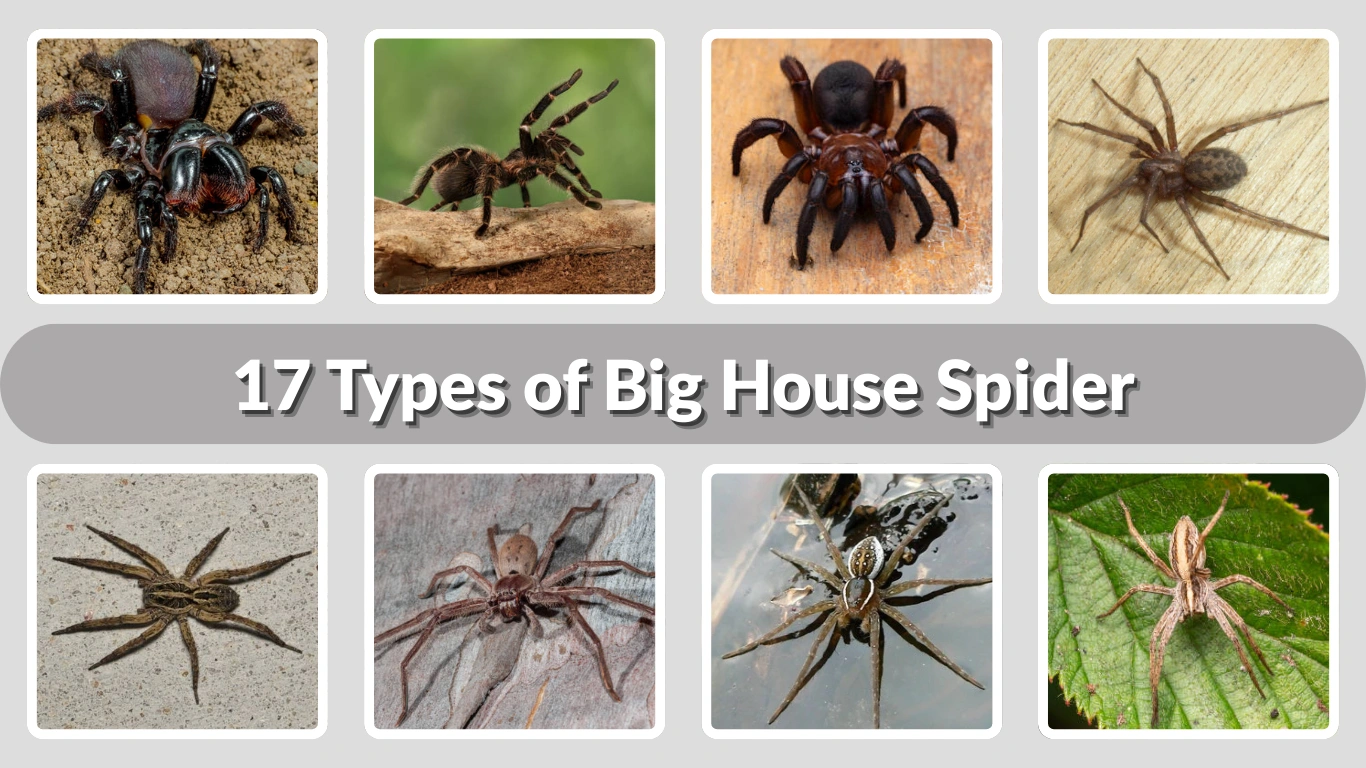
Large house spiders often appear indoors during seasonal changes, searching for shelter, prey, or mates. Although their size may seem intimidating, most of these species are harmless and play an important role in controlling insects. This guide introduces 17 types of big house spiders, explaining their key traits, habits, and preferred environments so you can better understand the large spiders you may encounter in basements, garages, and home corners.
1. Giant House Spider (Eratigena atrica)

The giant house spider is one of the largest and fastest spiders found indoors. Known for its long legs and rapid movements, it often appears during late summer and fall when males wander in search of mates. Despite its intimidating size, it is harmless and helps control household pests.
Identification
- Large body with very long legs
- Brown or dark reddish-brown coloration
- Hairy legs and body
- Builds large funnel-shaped webs in corners
Habitat
Giant house spiders prefer cool, dark indoor areas such as basements, garages, attics, cupboards, and under furniture. Outdoors, they live under rocks, logs, sheds, and garden structures. They often enter homes during autumn as temperatures drop and mating season begins.
Behaviors
These spiders are fast runners and can move quickly across walls and floors. Males roam widely in search of females, while females remain near their funnel webs. They are shy and avoid confrontation, usually fleeing when disturbed. They rely on their webs and speed to capture prey.
Lifecycle
Females build egg sacs within their webs, where spiderlings hatch and remain briefly before dispersing. The species matures over the course of a year, with adults typically living one to two years. Males have shorter lifespans, often dying soon after mating.
2. Hobo Spider (Eratigena agrestis)

The hobo spider is a large, fast-moving funnel weaver often found in basements, garages, and lower levels of homes. Although once thought dangerous, it is now considered harmless to humans. Its size and speed often startle people, but it is shy and avoids contact.
Identification
- Medium to large brown spider
- Oblong abdomen with subtle chevron patterns
- Long legs covered in fine hairs
- Builds horizontal sheet webs with a funnel retreat
Habitat
Hobo spiders prefer cool, dark environments such as basements, crawl spaces, garages, storage rooms, and ground-floor corners. Outdoors, they live under rocks, logs, garden debris, and building foundations. They often enter homes while searching for mates or prey.
Behaviors
These spiders are active runners and rely on both speed and web structure to catch prey. Males wander widely during mating season, often appearing indoors. They are non-aggressive and typically retreat when disturbed. They remain close to the ground and rarely climb high surfaces.
Lifecycle
Females create egg sacs within their funnel retreats, producing multiple sacs during warm months. Spiderlings hatch and stay in the web before dispersing to find new habitat. Hobo spiders mature in about one year, with adults usually living one to two years. Males have shorter lifespans, especially after mating.
3. Yellow Sac Spider (Cheiracanthium inclusum / C. mildei — Larger House Species)

The yellow sac spider is a moderately large house spider known for its pale coloration and habit of roaming walls and ceilings at night. While smaller than some giants, it is one of the larger true hunting spiders found indoors and is noted for its quick movements.
Identification
- Pale yellow, cream, or light tan body
- Elongated abdomen with smooth appearance
- Long front legs adapted for fast movement
- Creates tiny silk sacs for daytime shelter
Habitat
Yellow sac spiders prefer warm indoor spaces such as high wall corners, ceilings, closets, curtain folds, and behind picture frames. Outdoors, they hide under leaves, bark, and garden debris. They frequently enter homes during cooler seasons seeking shelter.
Behaviors
These spiders are active nighttime hunters that stalk prey along walls and ceilings. They do not build webs for catching prey but construct small silk sacs where they rest during the day. They move quickly when approached and may drop on silk lines to escape danger.
Lifecycle
Females lay small egg sacs inside their silk retreats and guard them until spiderlings emerge. Young spiders disperse shortly after hatching. Yellow sac spiders grow through several molts and typically live one year, with some females surviving longer in stable indoor environments.
4. Huntsman Spider (Heteropoda spp.)

The huntsman spider is one of the largest spiders that may occasionally enter homes. Known for its long legs, flattened body, and incredible speed, it is an impressive but harmless visitor. Huntsman spiders rarely bite and generally avoid human contact.
Identification
- Very large, flat body shape
- Long, laterally extended legs giving a “crab-like” stance
- Brown, gray, or tan coloration with subtle patterns
- Fast-moving and capable of climbing walls with ease
Habitat
Huntsman spiders prefer warm, sheltered environments such as garages, sheds, attics, and behind furniture. Outdoors, they hide under loose bark, rocks, logs, and leaf litter. In warmer regions, they may wander indoors seeking insects or cooler spaces during hot weather.
Behaviors
These spiders are active hunters that rely on speed and stealth rather than webs. They climb walls, ceilings, and surfaces effortlessly. When disturbed, they may dash quickly to escape. Despite their intimidating size, huntsman spiders are shy and non-aggressive toward humans.
Lifecycle
Females create flat, circular egg sacs and may guard them until hatching. Spiderlings stay with the mother briefly before dispersing. Huntsman spiders grow through several molts and can live two to three years, with females typically living longer than males.
5. Barn Funnel Weaver (Tegenaria domestica)

The barn funnel weaver is a large, long-legged spider commonly found in barns, sheds, garages, and older homes. It builds classic funnel-shaped webs and often stays hidden inside its retreat until prey approaches. Though big and fast, it is harmless to humans.
Identification
- Medium to large brown spider
- Long legs with fine hairs
- Oblong abdomen with faint stripe or pattern
- Builds a flat web leading into a funnel retreat
Habitat
Barn funnel weavers prefer cool, shaded structures such as barns, basements, garages, storage rooms, and crawl spaces. Outdoors, they live under logs, stones, and building foundations. They choose places where their funnel webs can anchor securely and remain undisturbed.
Behaviors
These spiders rely on their sheet web to detect prey through vibrations. They hide inside the funnel and rush out when insects land on the web surface. They are quick runners but timid, retreating instantly when disturbed. Males may wander around during mating season.
Lifecycle
Females produce egg sacs within their funnel retreats. Spiderlings hatch and stay near the web before dispersing. Barn funnel weavers mature in about a year and may live one to two years indoors. Males often die shortly after mating, while females survive longer.
6. Wolf Spider (Family: Lycosidae – Large House Visitors)

The wolf spider is a robust, fast-moving spider that occasionally wanders indoors while hunting. Known for its excellent eyesight and strong legs, this spider does not build webs for catching prey and instead relies on ambush and speed. Despite its size and intimidating appearance, it is harmless.
Identification
- Large, sturdy, hairy body
- Brown, gray, or black with stripe or mottled patterns
- Long, powerful legs
- Reflective eyes arranged in three distinct rows
Habitat
Wolf spiders prefer ground-level areas such as basements, garages, sheds, and cluttered storage spaces when indoors. Outdoors, they thrive in leaf litter, grass, soil, rocks, and garden beds. They occasionally enter homes seeking shelter or prey, especially in cooler seasons.
Behaviors
These spiders are active nighttime hunters and roam rather than spin webs. They attack prey using speed and strength. Females are known for carrying egg sacs attached to their abdomen and later carrying spiderlings on their back—a unique behavior among house spiders.
Lifecycle
Wolf spiders produce egg sacs that females protect aggressively. Spiderlings hatch and climb onto the mother’s back for safety until they disperse. They grow through several molts and typically live one to two years, with some large species living even longer.
7. Fishing Spider (Dolomedes spp.)

The fishing spider is a large, semi-aquatic spider that sometimes wanders indoors, especially in homes near ponds, lakes, or wooded areas. Its size rivals that of a small tarantula, making it one of the biggest house visitors, though it is completely harmless.
Identification
- Large body with long, powerful legs
- Brown, gray, or dark coloration with bold stripes
- Legs often have banded patterns
- Eyes arranged in two rows typical of nursery web spiders
Habitat
Fishing spiders prefer damp environments such as basements, bathrooms, laundry rooms, and ground-floor corners when indoors. Outdoors, they live near water—ponds, streams, marshes—and in wooded areas under bark and logs. They may enter houses while searching for food or mates.
Behaviors
These spiders are excellent hunters capable of running on water and even diving below the surface to escape predators. They catch prey by ambush rather than webs. Indoors, they roam quietly and retreat when disturbed. Despite their size, they are non-aggressive and avoid confrontation.
Lifecycle
Females create large egg sacs and carry them in their jaws until ready to hatch. They then build a nursery web where spiderlings emerge and stay briefly before dispersing. Fishing spiders grow steadily through molts and typically live one to two years.
8. Nursery Web Spider (Pisaurina mira – Large House Visitor)

The nursery web spider is a sizeable, long-legged hunting spider occasionally found indoors, especially in homes near wooded or grassy areas. It is known for its maternal care, building protective nursery webs for its young.
Identification
- Medium to large slender body
- Brown, tan, or gray coloration with a dark central stripe
- Long legs positioned outward like a fishing spider
- Eyes arranged in two horizontal rows
Habitat
Nursery web spiders prefer rooms near doors, windows, and basements when indoors. Outdoors, they inhabit tall grasses, shrubs, forests, and gardens. They enter homes in search of shelter or prey, especially during warm seasons.
Behaviors
These spiders are active hunters that rely on stealth and speed rather than webs. Females carry their egg sacs in their jaws until the young are ready to hatch. Once prepared, the female builds a protective silk nursery where the spiderlings emerge safely.
Diet
Their diet includes flies, moths, beetles, gnats, and other crawling insects. They ambush prey using quick lunges and powerful bites, subduing insects before consuming them.
Lifecycle
Females guard their nursery webs until the spiderlings disperse. Young spiders mature over multiple molts and typically reach adulthood in one year. Adults generally live one to two years, with females surviving longer due to their protective role.
9. Brown Recluse (Loxosceles reclusa – Larger Individuals)

The brown recluse is a medium-to-large house spider known for its violin-shaped marking and secretive nature. While most individuals are modest in size, some grow larger indoors due to stable temperatures and steady food sources. They are shy, solitary, and avoid confrontation.
Identification
- Light to dark brown body
- Distinct violin-shaped marking on the cephalothorax
- Long, thin legs with fine hairs
- Uniform abdomen without patterns
Habitat
Brown recluses prefer dry, undisturbed indoor spaces such as attics, basements, closets, behind furniture, storage boxes, and inside shoes or clothing left on the floor. Outdoors, they hide under bark, rocks, and wood piles. They thrive in cluttered areas where hiding spaces are abundant.
Behaviors
These spiders are nocturnal hunters that roam for prey at night. They avoid contact with humans and usually retreat when disturbed. Brown recluses build small, irregular silk retreats rather than webs for catching insects. They spend most of their time hidden, emerging only to feed.
Lifecycle
Females produce several egg sacs each year, each containing dozens of spiderlings. Young recluses grow slowly and may take up to a year to mature. Adults can live two to three years indoors, with females typically outliving males.
10. Southern House Spider (Kukulcania hibernalis)

The southern house spider is a large, gentle species commonly found around homes in warm regions. Despite its size and dark appearance, it is harmless and often mistaken for more dangerous spiders. Females build messy webs, while males wander in search of mates.
Identification
- Large, dark brown to black body
- Females are robust with velvety texture
- Males are slimmer with long legs and paler coloration
- Builds irregular web retreats in cracks and crevices
Habitat
Southern house spiders prefer warm, sheltered areas such as window frames, doorways, attics, porches, eaves, garages, and wall crevices. Outdoors, they hide in cracks of brick walls, wood siding, and under roof tiles. They often stay close to man-made structures year-round.
Behaviors
Females remain inside their web retreats and rarely leave except to feed. Males wander widely and may enter homes during mating season, often alarming people by their size. These spiders are docile and non-aggressive, typically freezing or retreating when approached.
Lifecycle
Females produce multiple egg sacs within their retreats, each containing dozens of spiderlings. Young spiders disperse slowly, often staying near the mother for a time. Southern house spiders can live several years, with females living significantly longer than males.
11. European House Spider (Tegenaria / Eratigena duellica group)

The European house spider is a large, long-legged species frequently found in homes across Europe and many other regions. Known for its funnel-shaped webs and quick movements, it is harmless and prefers to stay hidden in quiet indoor spaces.
Identification
- Large brown or reddish-brown body
- Long legs with fine hairs
- Oblong abdomen with subtle stripe or mottling
- Builds a funnel-shaped web in corners or crevices
Habitat
European house spiders thrive in attics, basements, garages, stairwells, and under furniture. Outdoors, they hide in sheds, wood piles, stone walls, and building foundations. They prefer dark, cool, undisturbed areas where their webs can remain undisturbed.
Behaviors
These spiders build large funnel webs and wait inside the retreat for prey to touch the web’s surface. When disturbed, they may dash quickly for cover. Males frequently wander indoors during mating season, often appearing in sinks, bathtubs, or on floors.
Lifecycle
Females lay egg sacs within their funnel retreats, sometimes producing several in a season. Spiderlings hatch and stay near the web until they disperse. European house spiders mature over the course of a year and may live 2–3 years, with females living the longest.
12. Grass Spider (Agelenopsis spp.)

The grass spider is a swift, long-legged funnel weaver that occasionally enters homes, especially during late summer and fall. Known for its distinctive funnel webs outdoors, it sometimes wanders indoors in search of shelter or prey. Despite its size and speed, it is harmless.
Identification
- Medium to large brown spider
- Two dark stripes running down the cephalothorax
- Long legs built for speed
- Creates sheet webs with a deep funnel retreat
Habitat
Grass spiders typically live outdoors in lawns, shrubs, fences, and garden beds where they build large funnel webs. Indoors, they may appear in basements, garages, corners of rooms, or near doorways. They prefer cool, dry areas with minimal disturbance.
Behaviors
These spiders rely on their speed to catch prey, rushing out from their funnel retreat when insects land on their sheet web. Indoors, they may wander without building webs. Grass spiders are shy and flee quickly when approached, avoiding any interaction with humans.
Lifecycle
Females produce egg sacs in late summer or fall, attaching them within vegetation or protected crevices. Spiderlings hatch and disperse in spring. Grass spiders grow rapidly through several molts and live about one year, with the largest adults appearing late in the season.
13. Long-Legged Sac Spider (Cheiracanthium spp. — Larger Variant)

The long-legged sac spider is a slender, agile species that roams walls and ceilings in search of prey. Larger individuals can appear quite big indoors, especially due to their long front legs. These spiders are fast, alert, and active hunters.
Identification
- Slender body with very long front legs
- Pale yellow, tan, or gray coloration
- Smooth abdomen with no strong markings
- Builds small silk sacs for resting, not for hunting
Habitat
Long-legged sac spiders prefer indoor areas such as ceilings, wall corners, window frames, basements, and behind furniture. Outdoors, they hide under bark, stones, leaves, and garden structures. They frequently enter homes during cooler months seeking warmth.
Behaviors
These spiders are nocturnal, patrolling walls and ceilings while hunting for insects. They do not rely on webs to capture prey. Instead, they use speed and precision to ambush targets. When threatened, they drop on a silk line or flee quickly.
Diet
Their diet consists of flies, gnats, small beetles, ants, and other house-dwelling insects. They seize prey with a fast bite, using venom to immobilize it before feeding.
Lifecycle
Females lay eggs within protective silk sacs and may guard them for a short time. Spiderlings emerge and disperse soon after hatching. Long-legged sac spiders mature within several months and typically live one year indoors.
14. Orb-Weaver Spider (Araneidae – Large House Species)

The orb-weaver spider includes several large species that occasionally enter homes, especially near windows, porches, and ceiling corners. Known for spinning classic circular webs, these spiders are gentle giants and pose no threat to humans.
Identification
- Large rounded abdomen
- Distinct patterns or banding on the body
- Long legs suited for web-building
- Creates large, circular “orb” webs
Habitat
Orb-weavers prefer outdoor areas such as gardens, porches, balconies, and window frames where flying insects are abundant. Indoors, they may wander into entryways, ceiling corners, or areas near open windows. They prefer quiet, undisturbed places to anchor their large webs.
Behaviors
These spiders build intricate orb-shaped webs, often reconstructing them each evening. They usually sit at the center or hide nearby, waiting for vibrations from trapped insects. Orb-weavers are mild-mannered and avoid confrontation, often dropping from their web if disturbed.
Lifecycle
Females lay egg sacs attached to sheltered surfaces such as eaves, corners, or plant stems. Spiderlings hatch in spring and disperse by ballooning. Most orb-weavers live for one season, with adults appearing in late summer and fall before dying after reproduction.
15. Trapdoor Spider (Family: Ctenizidae / Idiopidae – Large House Visitor)

The trapdoor spider is a stout, powerful species known for its underground burrows topped with a hinged “trapdoor.” Although it rarely enters homes, larger individuals may wander indoors during heavy rains or mating season. Their bulky appearance often startles people, but they are harmless and avoid conflict.
Identification
- Large, thick-bodied spider
- Shiny dark brown or black coloration
- Short, strong legs
- Stocky build resembling a miniature tarantula
Habitat
Trapdoor spiders live in underground tunnels lined with silk. They prefer moist, compact soil in gardens, forested areas, and near building foundations. Indoors, they may appear in basements, bathrooms, or ground-floor rooms after being displaced from their burrows.
Behaviors
These spiders are ambush predators. They wait inside their burrow with the trapdoor slightly open, lunging out to catch passing insects. When indoors, they behave timidly, exploring slowly and retreating from disturbance. They do not build webs indoors.
Lifecycle
Females may live many years, maintaining the same burrow. They lay eggs inside silk chambers within the tunnel. Spiderlings stay with the mother briefly before dispersing to dig their own burrows. Males wander in search of mates and typically live much shorter lives.
16. Tarantula (Accidental Indoor Entry – Various Species)

The tarantula is one of the largest spiders that may occasionally wander indoors, especially in warm regions. Although their size can be intimidating, tarantulas are generally calm, slow-moving, and non-aggressive. Indoor encounters typically happen by accident.
Identification
- Very large, heavy-bodied spider
- Thick, hairy legs and abdomen
- Brown, black, or reddish coloration depending on species
- Slow, deliberate movements
Habitat
Tarantulas prefer outdoor environments such as burrows, leaf litter, rocky areas, and dry scrublands. Indoors, they may enter garages, basements, ground-floor rooms, or doorways—usually while seeking shelter, cooler temperatures, or mates. They do not live or reproduce inside homes.
Behaviors
Tarantulas are nocturnal hunters that rely on ambush rather than webs. When indoors, they tend to move slowly and avoid confrontation. If threatened, they may raise their front legs or, in New World species, flick urticating hairs. Biting is rare and typically a last resort.
Lifecycle
Females lay eggs in silk sacs and guard them in their burrows. Spiderlings disperse after several molts. Tarantulas grow slowly and can live many years—females often 10–20+, while males survive only a few years after maturity. They never complete their life cycle indoors.
17. Mouse Spider (Missulena spp. – Large House Visitor)

The mouse spider is a sturdy, thick-bodied mygalomorph known for its glossy appearance and powerful fangs. Though primarily outdoor spiders, larger individuals may occasionally wander indoors during mating season or after heavy rains. Despite their formidable look, they are generally shy.
Identification
- Large, shiny black or dark brown body
- Thick legs and robust cephalothorax
- Smooth, rounded abdomen resembling a “mouse”
- Strong fangs typical of mygalomorph spiders
Habitat
Mouse spiders prefer burrows in firm soil, often found in gardens, forest edges, riverbanks, and scrublands. Indoors, they may appear in basements, garages, or ground-floor rooms after being displaced or while searching for mates. They do not build webs inside homes.
Behaviors
These spiders are solitary ambush hunters. They wait near the entrance of their burrow to catch prey and usually remain hidden during the day. When indoors, they move slowly and retreat when disturbed. They are not aggressive and rarely attempt to bite unless handled roughly.
Lifecycle
Females may live many years in the same burrow, producing several egg sacs over their lifespan. Spiderlings stay with the mother briefly before dispersing to dig their own burrows. Males mature faster and wander widely during mating season, often being the individuals seen indoors.
FAQs
1. Why do large house spiders come indoors?
Large spiders often enter homes seeking shelter, mates, or stable temperatures. Seasonal changes—especially cooler weather or heavy rains—drive them indoors. Many wandering males appear during mating season, while others simply follow prey or enter through cracks, doors, and windows.
2. Are big house spiders dangerous to humans?
Most large house spiders are harmless. Species like giant house spiders, wolf spiders, and fishing spiders rarely bite and typically flee from humans. Even spiders with stronger venom, such as mouse spiders or recluses, avoid confrontation and only bite when directly threatened.
3. Why do big spiders move so fast?
Many large spiders are active hunters. Speed helps them capture prey and escape predators quickly. Spiders like wolf spiders, hobo spiders, and grass spiders rely on rapid bursts of movement instead of webs, making their agility essential for survival.
4. How can I prevent large spiders from entering my home?
Seal gaps around doors, windows, and foundations. Reduce clutter, especially in basements and garages. Keep outdoor lights minimized, as they attract insects (spider food). Regular cleaning and removing old webs also discourage spiders from settling indoors.
5. Do big house spiders reproduce inside homes?
Some species—like giant house spiders, southern house spiders, and European house spiders—can reproduce indoors if conditions are stable. Others, such as tarantulas or trapdoor spiders, cannot complete their life cycle inside. Even when reproduction occurs, spiderlings usually disperse quickly and remain unnoticed.