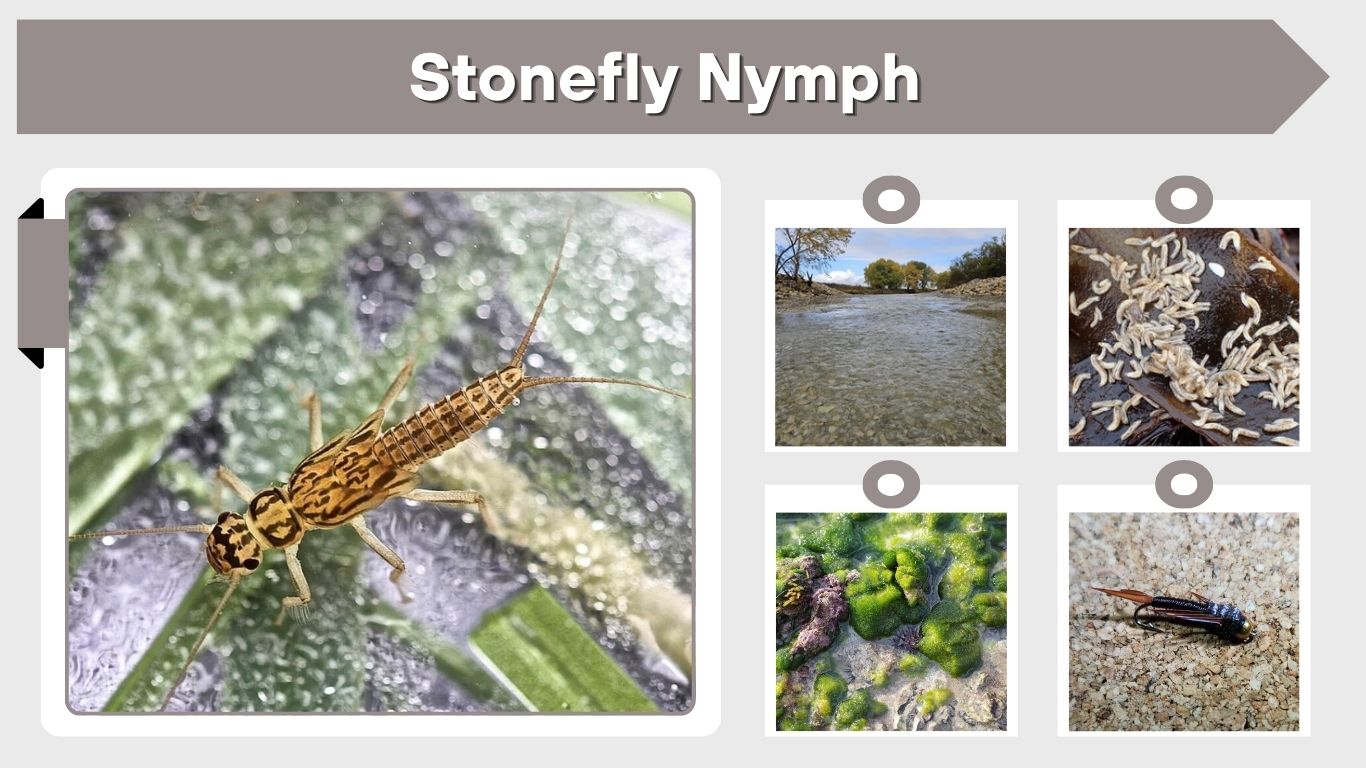
Stonefly nymphs are one of the most important aquatic insects for trout, especially in clean, rocky rivers and streams. Anglers value them because they are large, protein-rich, and available to fish for much of the year. Whether you want to identify a real stonefly nymph, understand its habitat, or choose the best stonefly nymph fly pattern, this guide covers the essentials.
What Is a Stonefly Nymph?
A stonefly nymph is the immature aquatic stage of a stonefly. Stoneflies belong to the insect order Plecoptera, and they spend most of their life underwater before emerging as winged adults. Unlike some aquatic insects that live only briefly as nymphs, many stoneflies remain in streams for one to three years, depending on the species and water conditions.
Stonefly nymphs are especially common in cold, oxygen-rich water. They are usually found around rocks, gravel, logs, and fast-flowing riffles. Because they are sensitive to pollution, their presence often indicates good water quality.
For fly anglers, stonefly nymphs matter because trout recognize them as a dependable food source. Larger species, such as golden stoneflies and giant black stoneflies, can produce some of the most effective nymph fishing opportunities of the year.
Stonefly Nymph Identification
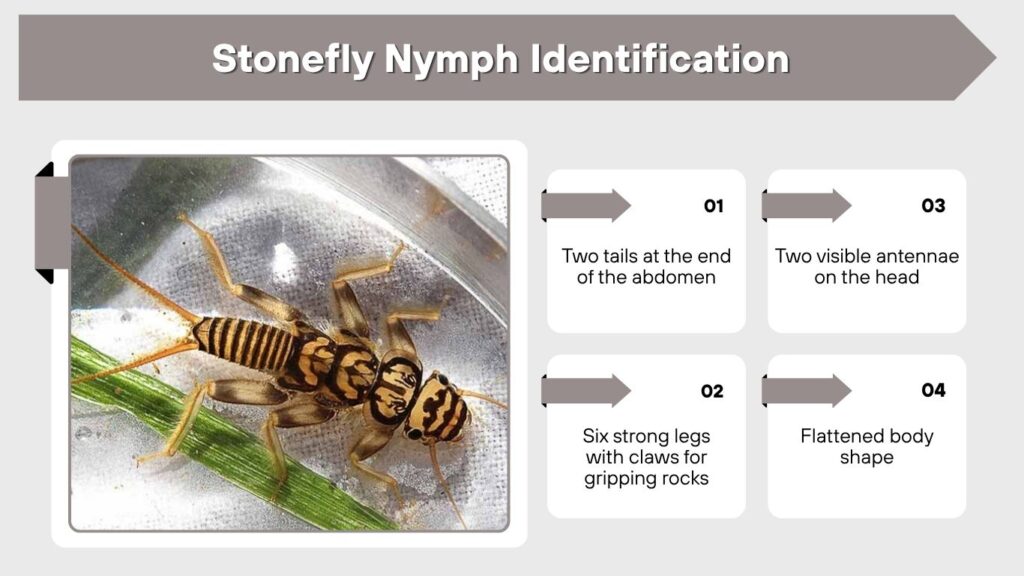
Identifying stonefly nymphs becomes easier when you know their main body features. They have a long, flattened body, strong legs, two tails, and visible wing pads as they mature. Their shape helps them cling to rocks in fast water.
Key Body Features
Stonefly nymphs usually have a rugged, crawler-like appearance. Most are brown, black, golden, olive, or yellowish, depending on the species and habitat. They do not swim as gracefully as mayfly nymphs, but they crawl well along the streambed.
Look for these signs:
- Two tails at the end of the abdomen
- Two visible antennae on the head
- Six strong legs with claws for gripping rocks
- Flattened body shape
- Wing pads on older nymphs
- Segmented body with a tough appearance
Stonefly Nymph Size
Stonefly nymph size varies widely. Small black stonefly nymphs may be under half an inch long, while giant stonefly nymphs can grow over two inches. This size range is one reason fly anglers carry several stonefly nymph patterns in different hook sizes.
| Stonefly Nymph Type | Common Size Range | Typical Color | Fishing Use |
| Little black stonefly nymph | Small | Black or dark brown | Winter and early spring fishing |
| Golden stonefly nymph | Medium to large | Golden brown or tan | Productive in spring and summer |
| Yellow Sally stonefly nymph | Small to medium | Yellow or olive-yellow | Useful near summer hatches |
| Giant black stonefly nymph | Large | Black or dark brown | Excellent big-trout pattern |
| Skwala stonefly nymph | Medium | Olive-brown or dark tan | Popular during early-season hatches |
Stonefly Nymph Habitat
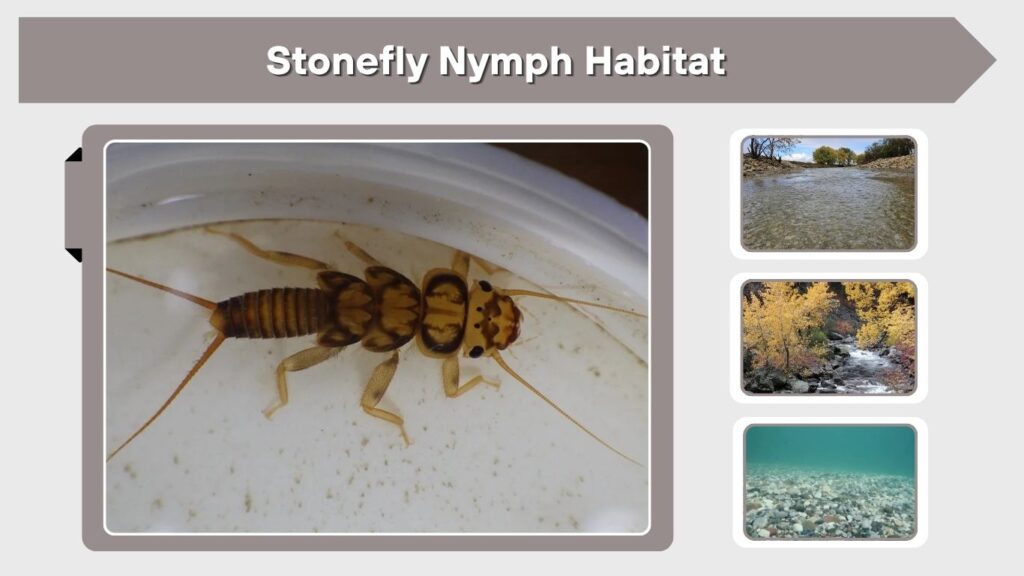
Stonefly nymphs live mainly in clean, moving freshwater. They prefer rivers and streams with high oxygen levels, rocky bottoms, and steady current. You are more likely to find them in riffles, pocket water, runs, and areas where water flows over stones.
Where They Live in Streams
Most stonefly nymphs cling to the undersides of rocks or hide between gravel and submerged wood. Their bodies are built for current, so they are less common in muddy ponds or slow, warm water.
Good habitat often includes:
- Rocky riffles
- Cold mountain streams
- Gravel-bottom rivers
- Fast runs beside boulders
- Clean water with strong oxygen flow
- Undercut banks near current seams
Why Clean Water Matters
Stoneflies are often used as indicators of healthy aquatic ecosystems. Many species cannot tolerate low oxygen or heavy pollution. When stonefly nymphs are abundant, the stream usually supports a strong food chain, including trout, aquatic insects, and other small organisms.
For anglers, this means stonefly nymphs are not only baitfish-sized meals for trout but also a sign that the water may hold active fish.
What Do Stonefly Nymphs Eat?
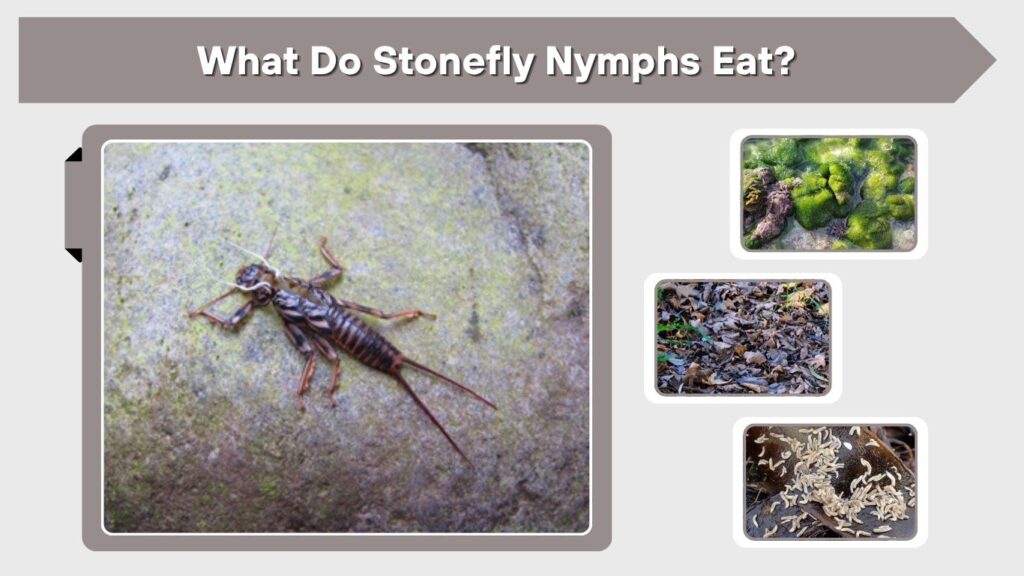
Stonefly nymph diets vary by species and age. Some are predators, while others feed on plant matter, algae, and decaying organic material. Larger nymphs may eat smaller aquatic insects, including mayfly nymphs, midge larvae, and caddis larvae.
Common Food Sources
Stonefly nymphs may feed on:
- Algae growing on rocks
- Decaying leaves and plant matter
- Small aquatic insects
- Midge larvae
- Mayfly nymphs
- Caddis larvae
- Organic material carried by the current
This varied diet helps explain why stoneflies thrive in streams with stable habitat, clean water, and plenty of structure.
Stonefly vs Mayfly Nymph
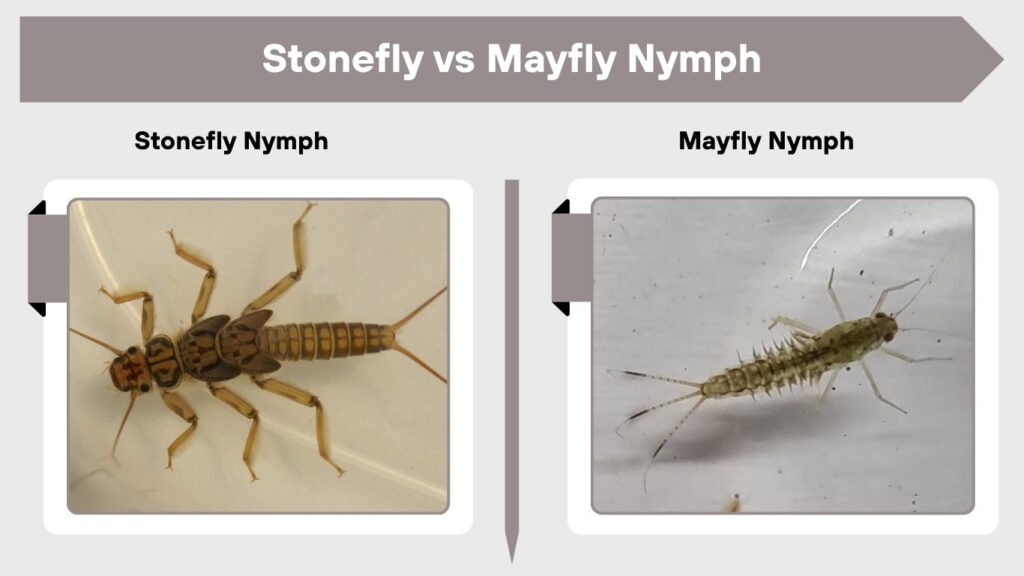
Stonefly and mayfly nymphs are often confused because both live underwater and are important trout foods. However, they are easy to separate once you compare their tails, body shape, and movement.
Stonefly nymphs have two tails, while most mayfly nymphs have three. Stoneflies usually look flatter and stronger, with thicker legs and a crawler-like body. Mayfly nymphs are often slimmer and may swim more actively.
Main Differences
Stonefly nymphs:
- Usually have two tails
- Crawl along rocks
- Have strong legs and claws
- Often live in faster, colder water
- Can be large and bulky
Mayfly nymphs:
- Usually have three tails
- May swim or crawl depending on species
- Often have a slimmer body
- Can live in a wider range of water types
- Are commonly imitated with smaller flies
For fly fishing, this difference matters because the imitation should match the insect’s shape and behavior. A stonefly nymph fly is usually heavier, larger, and more rugged than a mayfly nymph pattern.
Fly Fishing Stonefly Nymphs
Stonefly nymphs are among the best flies for trout because they imitate a large natural food source. They work especially well in rivers with rocky bottoms and strong current. Trout often feed on stonefly nymphs when the insects become dislodged and drift downstream.
When to Fish Stonefly Nymphs
Stonefly nymph flies can work year-round, but they are especially useful before and during stonefly hatches. Many anglers fish them in winter, spring, and early summer, depending on the local species.
Good times to use them include:
- Before a known stonefly hatch
- During high but fishable water
- In cold water when trout want a larger meal
- Around rocky riffles and pocket water
- After rain when insects get knocked loose
- In deep runs where large trout hold
How to Fish Stonefly Nymphs
The most common method is dead drifting. This means allowing the fly to move naturally with the current near the bottom. Since real stonefly nymphs crawl and often drift close to rocks, your fly should usually be weighted enough to reach deeper water.
Effective methods include:
- Indicator nymphing through deep runs
- Euro nymphing with a heavy stonefly pattern
- Fishing a stonefly as the point fly in a two-fly rig
- Adding a smaller mayfly or midge dropper
- Casting near boulders, seams, and pocket water
- Letting the fly tick near the bottom without dragging too much
Best Stonefly Nymph Patterns
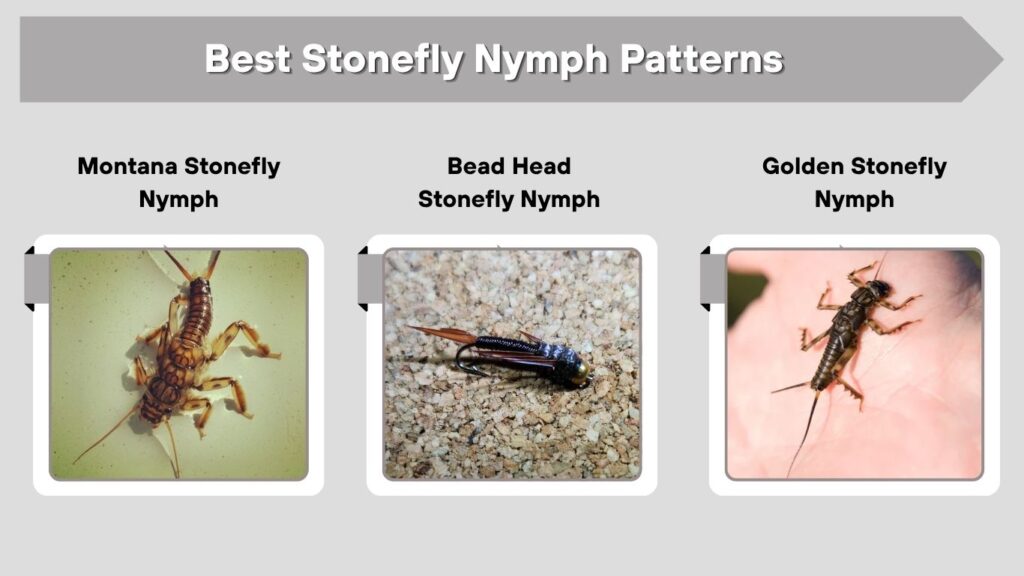
Stonefly nymph patterns come in many styles, from simple rubber-leg flies to realistic fly tying designs. The best choice depends on water depth, current speed, trout behavior, and the size of natural stoneflies in the stream.
Popular Stonefly Nymph Flies
Some well-known patterns include:
- Pat’s Rubber Legs
- Kaufmann’s Stonefly
- Montana Stonefly Nymph
- Bead Head Stonefly Nymph
- Golden Stonefly Nymph
- Black Stonefly Nymph
- Double Bead Stonefly
- Tungsten Stonefly Nymph
- Euro Stonefly Nymph
- Realistic Stonefly Nymph
Pat’s Rubber Legs is one of the most popular choices because it is simple, durable, and effective. Its moving legs and bulky profile make it a strong searching pattern in fast water.
Golden Stonefly Nymph Pattern
A golden stonefly nymph pattern imitates medium to large golden stonefly species. These flies are usually tied in tan, amber, brown, or golden colors. They often include rubber legs, a dubbed body, a bead or weighted underbody, and a darker wing case.
Golden stonefly nymphs are excellent in spring and summer, especially in Western trout streams. They can be fished deep before hatches or as a searching pattern in rocky water.
Black Stonefly Nymph Pattern
A black stonefly nymph pattern is useful in winter, early spring, and in streams with dark-bodied stonefly species. These flies are often tied in black, dark brown, or charcoal colors. Smaller versions imitate little black stonefly nymphs, while larger versions imitate giant black stoneflies.
Black stonefly nymphs are especially effective in cold water because they offer trout a larger meal when other insect activity may be limited.
How to Tie a Simple Stonefly Nymph
Fly tying stonefly nymphs can be as simple or detailed as you want. A basic pattern does not need to be perfectly realistic. It only needs the right size, color, weight, and movement.
Basic Materials
A simple stonefly nymph pattern may use:
- Nymph hook
- Black, brown, or golden thread
- Bead head or lead-free wire
- Goose biots or rubber tail
- Dubbing for the body
- Ribbing wire
- Rubber legs
- Thin skin or feather wing case
- Dark marker or head cement
Simple Tying Idea
Start with a weighted hook, then build a tapered body. Add two tails, rib the abdomen, tie in rubber legs near the thorax, and finish with a darker wing case. The fly should look strong and segmented rather than delicate.
For fishing, durability is more important than perfection. Stonefly patterns often bump rocks, scrape gravel, and get pulled through heavy current, so strong thread wraps and secure materials matter.
Choosing the Right Stonefly Nymph Fly
The best stonefly nymph fly depends on the stream and season. If the water is high and fast, use a heavier tungsten stonefly nymph or bead head stonefly nymph. If the water is clear and shallow, use a smaller and more natural pattern.
Match Size and Color
Choose your fly by matching the natural insects in the water. Turn over a few stream rocks carefully and observe the size and color of the nymphs you find. Then pick a fly that closely matches the general profile.
Helpful matching tips:
- Use black patterns in winter and early spring
- Use golden brown patterns during golden stonefly activity
- Use yellow or olive-yellow patterns for Yellow Sally nymphs
- Use large flies in high water or deep runs
- Use smaller flies in clear or pressured water
Weight Matters
A stonefly nymph fly often needs weight because trout usually eat these insects near the bottom. Tungsten beads, lead-free wire, and double-bead designs help the fly sink quickly.
However, too much weight can cause constant snagging. The goal is to occasionally touch the bottom, not drag heavily through every rock.
Stonefly Nymphs for Trout
Trout eat stonefly nymphs because they are large, available, and rich in energy. Even when trout are not rising, they may feed actively below the surface on drifting nymphs. This makes stonefly patterns excellent searching flies.
Large trout often hold in places where stonefly nymphs naturally drift, such as current seams, deep pockets, and boulder edges. A well-presented stonefly nymph can reach fish that ignore dry flies or smaller nymphs.
Stonefly nymphs are also useful in two-fly rigs. Many anglers use a heavy stonefly as the anchor fly and tie a smaller mayfly, caddis, or midge pattern behind it. This setup covers multiple food sources while helping the smaller fly sink.
FAQs
What is a stonefly nymph?
A stonefly nymph is the underwater juvenile stage of a stonefly. It lives in rivers and streams before emerging as a winged adult. Stonefly nymphs are important in fly fishing because trout eat them often, especially in clean, rocky, oxygen-rich water where these insects naturally thrive.
How can you identify a stonefly nymph?
You can identify a stonefly nymph by its two tails, two antennae, strong legs, and flattened body. Mature nymphs also show wing pads on the back. They usually crawl on rocks rather than swim smoothly, which helps separate them from many mayfly nymphs.
What is the best stonefly nymph pattern?
There is no single best pattern for every stream, but Pat’s Rubber Legs, Kaufmann’s Stonefly, Golden Stonefly Nymph, and Black Stonefly Nymph are reliable choices. The best fly usually matches the local stonefly size, color, water depth, and current speed.
When should I fish stonefly nymphs?
Stonefly nymphs can work throughout the year, but they are especially effective before hatches, during spring runoff, in winter, and in fast rocky rivers. Fish them near the bottom in riffles, deep runs, pocket water, and current seams where trout expect drifting nymphs.
What is the difference between stonefly and mayfly nymphs?
Stonefly nymphs usually have two tails, strong legs, and a flattened body built for crawling in current. Mayfly nymphs usually have three tails and often look slimmer. In fly fishing, stonefly imitations are commonly larger, heavier, and more rugged than mayfly nymph patterns.