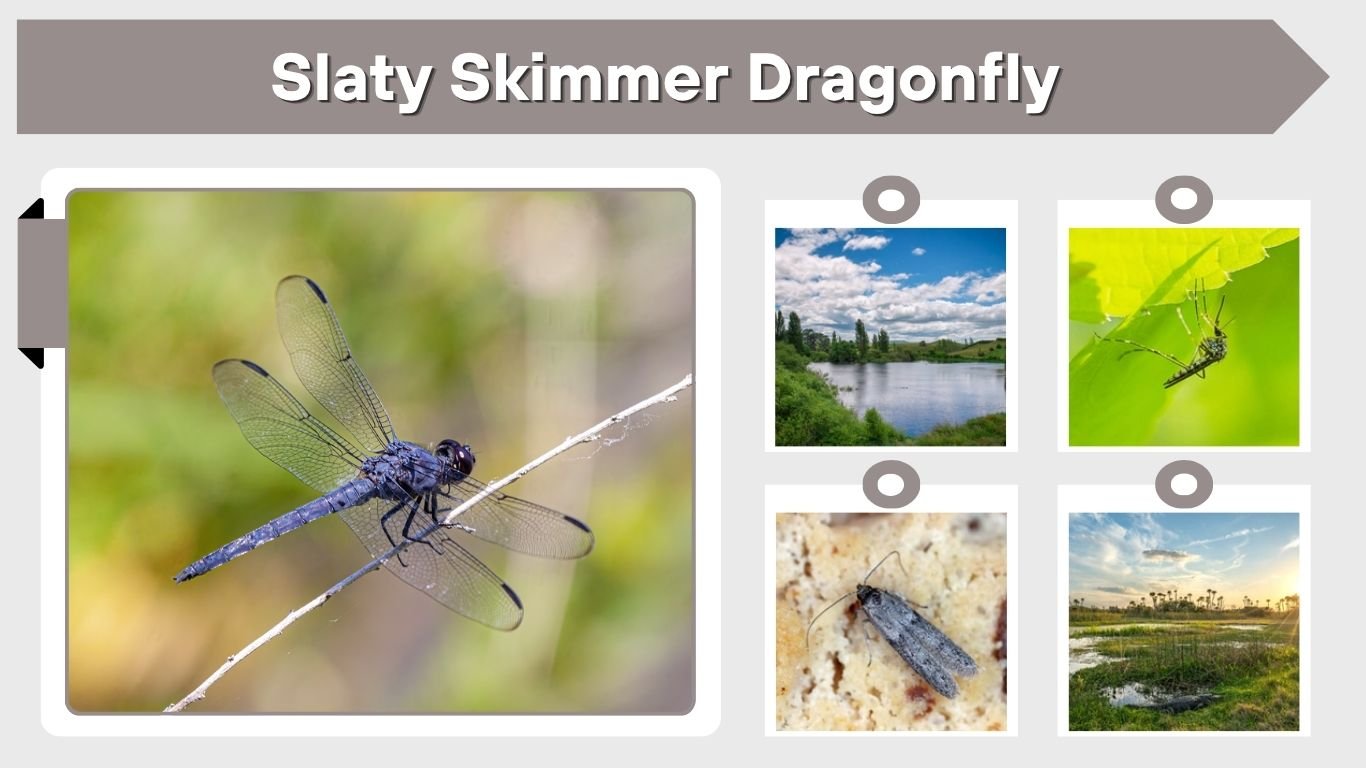
The Slaty Skimmer (Libellula incesta) is a medium-sized dragonfly native to eastern North America. Mature males are especially distinctive, with dark slate-blue to nearly black bodies, dark faces, and clear wings. Females and immature individuals look quite different, usually appearing yellowish-brown or brown with darker abdominal markings. Slaty Skimmers are commonly seen around ponds, lakes, slow streams, and wooded wetlands. They are powerful aerial predators that help control mosquitoes, flies, and other flying insects while serving an important role in freshwater ecosystems.
What Is a Slaty Skimmer?
The Slaty Skimmer is a member of the skimmer dragonfly family Libellulidae. Its scientific name is Libellula incesta. The common name comes from the dark slate or bluish-black coloration developed by mature males. It is a fairly common dragonfly across much of its range and can tolerate suburban ponds as well as more natural wetlands.
Scientific Classification
- Common name: Slaty Skimmer
- Scientific name: Libellula incesta
- Order: Odonata
- Suborder: Anisoptera
- Family: Libellulidae
- Genus: Libellula
- Type: True dragonfly
- Native range: Eastern North America
Slaty Skimmer Identification
Adult Slaty Skimmers have relatively stout bodies and four transparent, heavily veined wings. Mature males are particularly easy to recognize because the thorax and abdomen develop a dark slate-blue coating.
Their dark coloration can sometimes make males appear almost black when viewed in shade.
Male vs Female Slaty Skimmer
Male and female Slaty Skimmers look noticeably different, especially when young. This sexual dimorphism sometimes causes observers to mistake them for separate species.
Male Slaty Skimmer
Mature males are dark slate-blue to bluish-black. The face becomes black, and the eyes are dark brown or nearly black. Their legs are also black.
Males often perch prominently on twigs or vegetation overlooking water. They repeatedly return to favored perches while watching for females and competing males.
Female Slaty Skimmer
Young females are much lighter than mature males. They may have a cream, yellowish, or brown body with a broad dark stripe running along the upper surface of the abdomen.
As females age, they become darker and can develop grayish or bluish pruinosity. Their legs, especially the femora, are useful identification features when distinguishing them from female Great Blue Skimmers.
Immature Slaty Skimmer
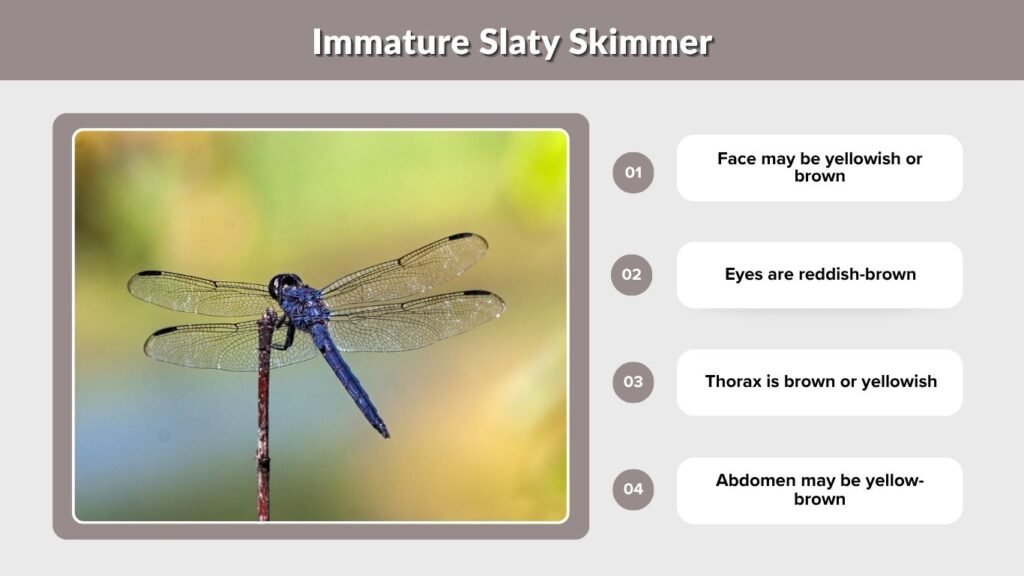
Immature Slaty Skimmers can look surprisingly different from fully mature males. Young males initially resemble females before gradually developing the characteristic dark coloration.
Immature Identification
- Face may be yellowish or brown
- Eyes are reddish-brown
- Thorax is brown or yellowish
- Abdomen may be yellow-brown
- Broad dark stripe runs along the abdomen
- Wings are mostly transparent
- Dark wing tips may sometimes be visible
As young males mature, a waxy coating called pruinosity spreads across the body, eventually producing the slate-blue appearance for which the species is named.
Slaty Skimmer Size
The Slaty Skimmer is a medium-sized but strongly built dragonfly. Its long wings and sturdy abdomen make it appear relatively large when flying over a pond.
How Big Is a Slaty Skimmer?
Adults are generally about 4.5–5.6 cm (1.8–2.2 inches) long. Individual measurements vary according to sex and geographic population.
Despite their size, they are lightweight insects capable of rapid acceleration, hovering, and abrupt changes in flight direction.
Slaty Skimmer Habitat and Range
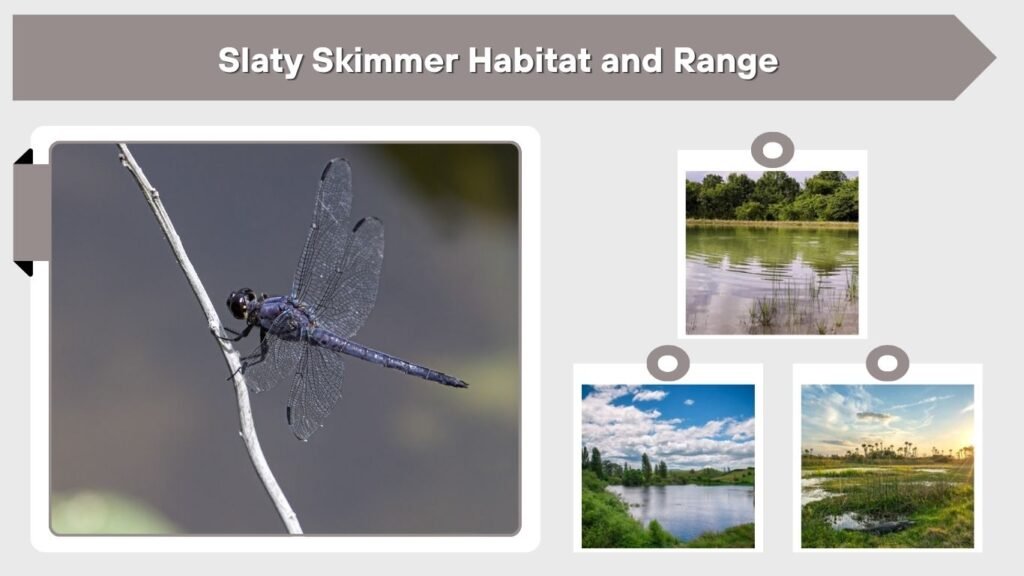
Slaty Skimmers are closely associated with freshwater habitats, particularly locations surrounded by woodland. They often prefer relatively quiet water with muddy or silty bottoms.
Where Do Slaty Skimmers Live?
Typical habitats include:
- Ponds
- Small lakes
- Reservoirs
- Slow-moving streams
- Swamps
- Woodland wetlands
- Suburban ponds
- Forest edges near water
They often perch on branches, shrubs, or tall vegetation close to the shoreline.
Slaty Skimmer Range
The species occurs across eastern North America. The current North American checklist places its range from Nebraska, Wisconsin, Ontario, and New Brunswick south to Texas and Florida, with an isolated Minnesota record.
This means Slaty Skimmers can be found across a substantial portion of the eastern United States and into southeastern Canada.
Is the Slaty Skimmer Native to Florida?
Yes. The Slaty Skimmer is native to Florida, but it is not a species found only in Florida.
Florida lies near the southern part of its broader eastern North American range. Because of the state’s warm climate, adults may be observed through much of the warmer part of the year. Farther north, the adult flight season is shorter and concentrated mainly in summer.
Slaty Skimmer Behavior
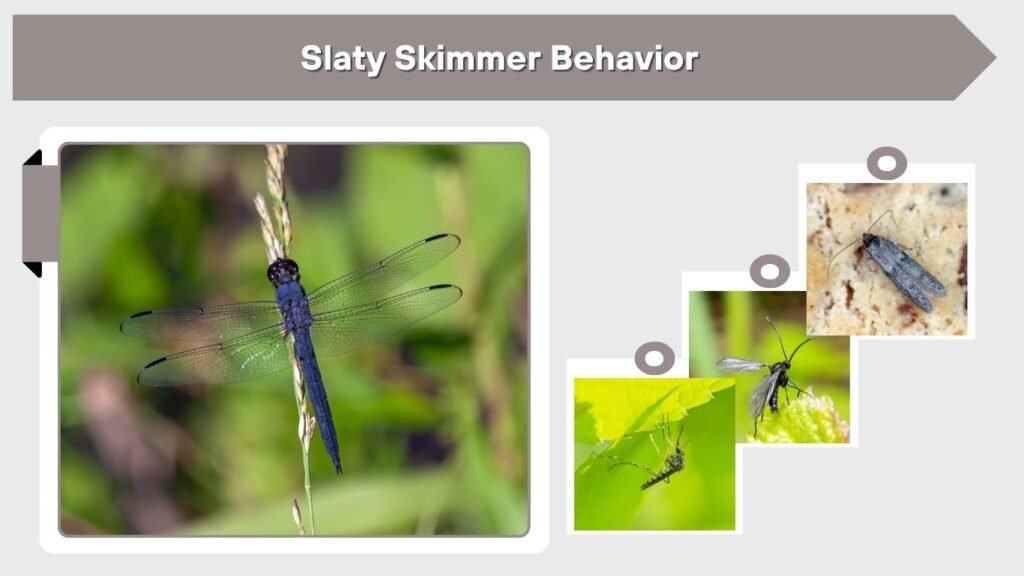
Slaty Skimmers are active predators and territorial dragonflies. Mature males often claim sections of shoreline where they wait for females and chase away competing males.
Territorial Behavior
Males typically perch on vegetation overlooking the water. When another dragonfly approaches, the resident male may launch into the air and chase it away before returning to its perch.
Territorial behavior is often strongest during the morning.
What Do Slaty Skimmers Eat?
Adults hunt flying insects, including:
- Mosquitoes
- Midges
- Small flies
- Gnats
- Moths
- Other small flying insects
- Occasionally other dragonflies
They capture prey in flight using their legs to form a basket around the insect.
Slaty Skimmers commonly hunt along woodland edges and around ponds where flying insect numbers are high.
Slaty Skimmer Life Cycle
Like all dragonflies, the Slaty Skimmer spends the immature part of its life underwater. The aquatic nymph is an effective predator long before becoming a winged adult.
Eggs and Nymphs
After mating, females fly over suitable water and deposit eggs. Rather than remaining attached to the female, the male commonly patrols nearby and guards her from competing males.
Eggs hatch into aquatic nymphs, also called naiads. These nymphs live underwater and prey on small aquatic animals.
Emergence Into Adults
The nymph grows through repeated molts. When development is complete, it climbs out of the water onto vegetation or another exposed object.
Its outer skin splits, and the adult dragonfly emerges. The wings expand and harden before the new adult begins flying.
Slaty Skimmer vs Great Blue Skimmer
The Great Blue Skimmer (Libellula vibrans) is one of the species most easily confused with the Slaty Skimmer.
| Feature | Slaty Skimmer | Great Blue Skimmer |
| Mature male body | Dark slate-blue | Lighter blue |
| Male face | Dark/black | White |
| Male eyes | Dark brown/blackish | Blue |
| Female legs | Femora largely black | Different leg coloration |
| Habitat | Ponds and slow water | Wooded ponds and wetlands |
| Northern range | Reaches Canada | Does not extend as far north |
The dark face of a mature male Slaty Skimmer is one of the easiest field clues separating it from the pale-faced Great Blue Skimmer.
Slaty Skimmer vs Bar-Winged Skimmer

The Bar-Winged Skimmer (Libellula axilena) can also resemble a Slaty Skimmer.
The easiest distinction is in the wings. Bar-Winged Skimmers have noticeable dark markings near the wing bases, while male Slaty Skimmers lack those prominent basal wing bars.
Range can also help with identification because Bar-Winged Skimmers have a more limited distribution.
Are Slaty Skimmers Dangerous?
No. Slaty Skimmers are not dangerous or venomous to humans.
Dragonflies do not have stingers and do not seek out people to bite. A large dragonfly may use its mouthparts defensively if roughly handled, but it cannot deliver a medically significant bite.
Their presence is generally beneficial because both adults and aquatic nymphs prey on other small animals.
Interesting Slaty Skimmer Facts
- Mature males become slate-blue to almost black.
- Young males initially resemble females.
- Females become darker as they age.
- Males aggressively defend shoreline territories.
- Adults capture insects while flying.
- The juvenile stage is entirely aquatic.
- They can tolerate some suburban and moderately disturbed ponds.
- Their range extends from Canada to Florida and Texas.
FAQs
1. What color is a male Slaty Skimmer?
A mature male is dark slate-blue or bluish-black with a dark face, dark eyes, black legs, and mostly transparent wings.
2. What does a female Slaty Skimmer look like?
Young females are cream to yellow-brown with a prominent dark stripe along the abdomen. Older females become darker and may develop a grayish coating.
3. Where are Slaty Skimmers found?
They occur across eastern North America, from parts of southeastern Canada south through the eastern United States to Texas and Florida.
4. Are Slaty Skimmers found in Florida?
Yes. Florida is within the natural range of the Slaty Skimmer, and adults may remain active through much of the state’s warm season.
5. What do Slaty Skimmers eat?
Adults capture mosquitoes, flies, midges, gnats, moths, and other flying insects, while aquatic nymphs prey on small freshwater animals.