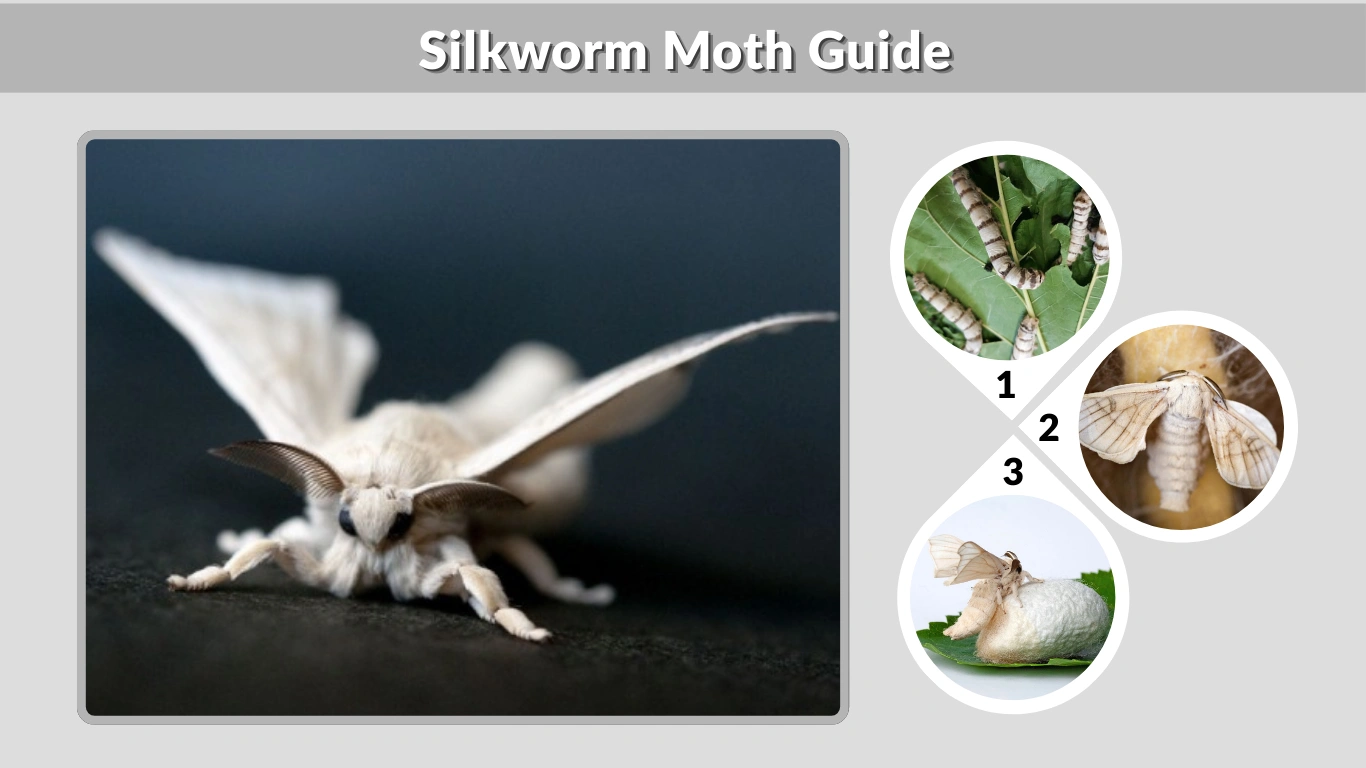
The silkworm moth (Bombyx mori) is one of the most important insects ever raised by humans. Known for producing the world’s finest silk, this fully domesticated species can no longer survive in the wild and depends entirely on people for reproduction and care. From its easily recognized white, fuzzy wings to its unusual flightless behavior, the silkworm moth raises many questions—what it eats, how long it lives, where it lives, and how it differs from the silkworm itself. This guide explains everything using a structured, science-based approach.
What Is a Silkworm Moth?
The silkworm moth is the adult stage of the domesticated silkworm, a species cultivated for thousands of years in China, India, Japan, and beyond. These moths belong to the family Bombycidae and are fully dependent on humans due to centuries of selective breeding. Today, they are central to global silk production and remain valuable in genetics, agriculture, and pheromone research.
Domestication has dramatically changed them. Their wings are present but functionally useless, and their bodies hold no working mouthparts. These adaptations reflect centuries of breeding focused only on increasing silk quality and cocoon size.
Species & Regional Variants

Although Bombyx mori is the primary silk moth species used in farming, several regional or related varieties appear in research, hobbyist circles, and wild ecosystems.
Common Silkworm Moths
- Domestic silkworm moth (Bombyx mori) – flightless, completely domesticated.
- Chinese & Indian silkworm moths – regional strains bred for durability and cocoon quality.
- Mulberry silkworm moth – standard form that feeds on mulberry leaves as larvae.
- Eri silkworm moth (Samia ricini) – produces eri silk; larvae feed on castor leaves.
- Wild silkworm moth – related species like Bombyx mandarina, ancestor of domestic silk moths.
Giant Silkworm Moths (Not the Same Species)
These often cause confusion due to similar names:
- Lonomia obliqua – known for medically dangerous caterpillar stings.
- Columbia giant silkworm moth – large wild species with striking colors.
- Royal and American silkworm moths – various Saturniidae family members.
These giants are visually stunning but biologically different—they do not produce commercial silk and are not domesticated.
Physical Identification

The silkworm moth is easy to recognize thanks to its pale coloring and “cute,” rounded appearance. Most adults are white to creamy ivory, with thick, fuzzy thoraxes and soft wings that appear powdery.
General Features
- Fuzzy white body
- Soft, rounded wings
- Wing span typically 3–5 cm
- Large, bead-like eyes
- Thick, leaf-like antennae (especially in males)
Male vs. Female Identification
- Male antennae are broader and more feathered, designed to detect female pheromones (bombykol) from long distances.
- Females are larger and heavier, their abdomens packed with eggs.
- Females tend to stay still, while males flutter their wings during mate-seeking behavior.
Overall, males look more delicate and ornate, while females are bulkier and slower.
Silkworm vs. Silk Moth: What’s the Real Difference?
A common misunderstanding is that “silkworm” and “silk moth” refer to different animals. In reality, they’re simply two life stages of the same species.
Key Differences
- Silkworm = larva (caterpillar)
- Silk moth = adult stage
- Silkworms eat; adult moths do not
- Silkworms spin cocoons; moths emerge from them
- Only larvae produce silk
In short, the silkworm is the silk-producing caterpillar, while the silk moth is the final, reproductive stage.
Life Cycle of the Silkworm Moth

The life cycle follows complete metamorphosis with distinct stages:
1. Egg
Females lay hundreds of tiny pin-sized eggs, each capable of overwintering depending on temperature.
2. Larva (Silkworm)
This is the most important stage economically. The caterpillar eats mulberry leaves constantly, growing rapidly through five molts.
3. Cocoon
Over 2–3 days, the silkworm spins a continuous strand of silk up to 900 meters long, forming a protective cocoon.
4. Pupa
Inside the cocoon, the larva transforms into a moth. Under natural conditions, this phase lasts about two weeks.
5. Adult Silkworm Moth
The emerged moth focuses solely on reproduction—its lifespan averages 5–10 days.
Caterpillars & Larvae

The larval stage of the silkworm moth is the most recognizable and economically significant. Domestic silkworm larvae are plump, soft-bodied caterpillars ranging from creamy white to light gray. As they develop, they pass through five growth stages called instars, each requiring heavy feeding to support rapid enlargement.
Domestic Silkworm Larvae
- Feed primarily on mulberry leaves, their exclusive natural diet
- Grow from a few millimeters to several centimeters in length
- Spin dense silk cocoons at the end of the larval stage
- Are completely harmless and do not bite or sting
Because domesticated silkworms have been selected for silk yield rather than survival traits, they rely fully on human care and controlled environments.
Giant Silkworm Caterpillars
The term “giant silkworm caterpillar” usually refers to unrelated species in the Saturniidae family. These larvae are often brightly colored and far larger than Bombyx mori.
The most infamous is Lonomia obliqua, a South American species whose venomous spines can cause severe reactions or bleeding disorders in humans. These caterpillars look dramatically different from domestic silkworm larvae, with segmented spines and intricate patterns.
Cocoon, Metamorphosis & Eggs

Cocoon production is the silkworm’s most valuable contribution to humans. The caterpillar spins its cocoon by secreting liquid silk through specialized glands, creating a dense, layered chamber around itself.
Cocoon Development
- Constructed over 2–3 days
- Made of one continuous filament
- Thickness varies by strain
- Silk color can range from white to yellow or gold
Inside, the larva enters the pupal stage, undergoing complete transformation. Farmers often protect the cocoons from moisture and pests to ensure high-quality silk.
Egg-Laying Behavior
After emerging from the cocoon, a female silkworm moth mates and lays up to 300–500 eggs. The eggs are tiny, round, and slightly flattened.
- Females cannot fly, so they lay eggs in clusters where they were placed.
- Males are guided by pheromones, locating females with their highly sensitive antennae.
- Once egg-laying is complete, the female’s life cycle ends naturally within a few days.
This pattern ensures stable silk production cycles throughout the year.
Behavior, Habitat & Flight Ability

Silkworm moth behavior reflects centuries of domestication. They are gentle insects with predictable movement patterns.
Key Behaviors
- Males flutter wings rapidly while searching for mates
- Females remain mostly stationary
- Adults are phototropic and move toward light
- Mating can last several hours
- After mating, females detach and begin laying eggs
Habitat
Domesticated silkworm moths live almost exclusively:
- In silk farms,
- Controlled indoor rearing rooms,
- Small hobbyist enclosures.
Wild relatives live in forests, mulberry groves, and temperate woodlands, but Bombyx mori no longer survives outside human care.
Can Silkworm Moths Fly?
Domestic silkworm moths are completely flightless. Their wings are too weak, and their bodies too heavy to lift. Wild ancestral species can fly, but selective breeding eliminated this ability to keep moths near the rearing area.
Diet & Feeding
Larval Diet
Silkworm larvae consume:
- Fresh mulberry leaves (primary food)
- Artificial mulberry-based diets used in some farms
- Castor leaves (eri silkworm species only)
The larval phase is the only feeding stage of the entire life cycle.
Adult Diet
Adult silkworm moths have no functional mouthparts.
This means:
- They cannot eat
- They do not drink
- They survive on stored energy
Do Silkworm Moths Eat Clothes?
No. They are fully harmless adults with no ability to chew or digest anything. Confusion arises because clothes moths, a completely different species, feed on fabrics containing keratin.
Dangers, Myths & Safety
Are Silkworm Moths Dangerous?
Domestic silkworm moths and their larvae are entirely harmless.
They:
- Do not sting
- Do not bite
- Cannot fly into hair or food
- Do not damage clothes
Dangerous Look-Alikes
Some giant silkworm caterpillars, especially Lonomia obliqua, can be dangerous due to venomous spines. These species are unrelated to domestic silkworms despite similar naming.
Common Myths
- Myth: Silkworm moths can infest clothing.
- Truth: Only clothes moths do this.
- Myth: Adult silkworm moths can eat or chew.
- Truth: They lack mouthparts entirely.
- Myth: Silkworm moths survive long after laying eggs.
- Truth: Adults live 5–10 days.
Uses, Benefits & Human Interaction
Silkworm moths are central to global silk production, but they also play roles in science, culture, and education.
Human Uses
- Silk production: One cocoon yields long, continuous silk fibers.
- Biological research: Bombykol pheromone receptors are used in chemical signaling studies.
- Traditional medicine: Extracts like male silkworm moth extract or nourishing oral liquids appear in herbal practices.
Pets & Pop Culture
Silkworms and silk moths are used for:
- Classroom biology demonstrations
- Hobbyist breeding projects
- Plush toys, artworks, and “cute insect” culture
- Interest sparked by Chinese silkworm-themed Pokémon
Their gentle nature makes them beginner-friendly for insect enthusiasts.
FAQ
How long does a silkworm moth live?
Adult silkworm moths live only 5–10 days. Their short lifespan is due to their inability to feed, as they emerged solely for reproduction.
How many eggs does a female silkworm moth lay?
A female can lay 300–500 eggs in one reproductive cycle. These eggs are typically glued in clusters to the surface where the moth rests after mating.
Do adult silkworm moths eat?
No. Adults have no functioning mouthparts. Their entire energy supply comes from reserves stored during the larval and pupal stages.
Can bearded dragons eat silkworm moths?
Bearded dragons can safely eat silkworm larvae, but adult moths offer little nutrition and may flutter unpredictably. Larvae are the recommended feeder stage.
What’s the difference between a silkworm and a silk moth?
A silkworm is the caterpillar that spins the silk cocoon. The silk moth is the adult stage that emerges from the cocoon to reproduce. They are two life phases of the same species.