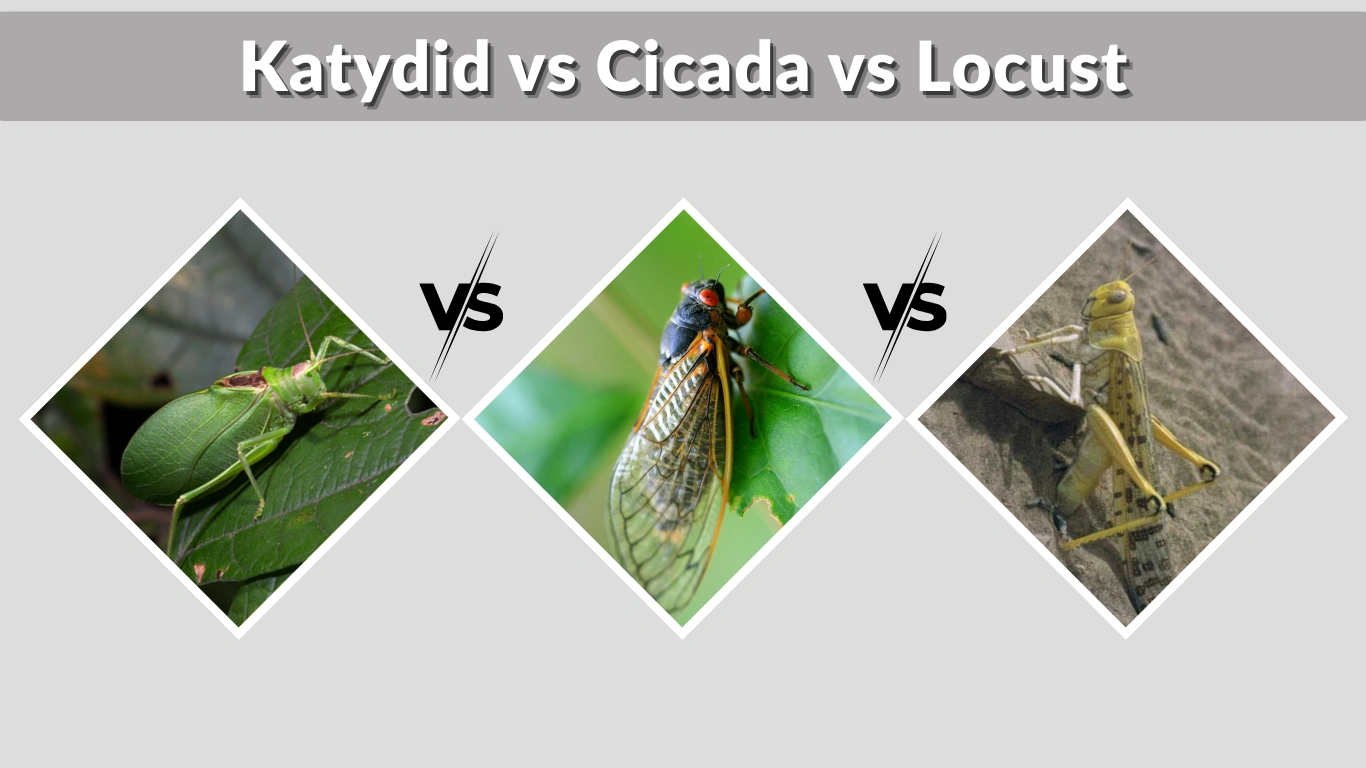
Katydids, cicadas, and locusts are three of the most commonly confused insects in warm seasons. Their sounds fill summer days and nights, their shapes overlap with grasshoppers or crickets, and their sudden appearances can puzzle even seasoned nature observers. Though all three belong to the order Orthoptera (katydids and locusts) or Hemiptera (cicadas), they differ sharply in looks, sound, behavior, and ecological impact. This guide breaks down the seven major differences—especially the highly searched topic of katydid vs cicada sound—and shows exactly how to identify each insect in the field.
7 Key Differences
These are the seven areas where katydids, cicadas, and locusts differ most clearly:
- Sound Type & Rhythm – chirping vs droning vs rattling
- Body Shape & Appearance – leaflike vs chunky vs grasshopperlike
- Color & Wing Structure
- Antennae Length
- Behavior & Active Time – night vs day
- Life Cycle Patterns
- Diet & Environmental Impact
Each difference is explored in depth below.
Identification

Katydid Identification
Katydids are distinct for their near-perfect leaf-mimic appearance. These features make them easy to recognize:
- Bright green or yellow-green coloration
- Wings shaped like real leaves with veins
- Slender, laterally flattened bodies
- Extremely long antennae—often longer than their body
- Primarily nocturnal
- Usually found in shrubs, tree branches, and garden vegetation
Cicada Identification
Cicadas look nothing like katydids even if people confuse their sounds. They have:
- Thick, stout bodies
- Clear or smoky wings held tent-like over the body
- Prominent bulging eyes
- Short antennae
- Green, brown, black, or patterned exoskeletons
- A loud daytime buzzing call
Locust Identification
Locusts resemble typical grasshoppers but can transform under certain conditions:
- Grasshopperlike shape with powerful jumping legs
- Short antennae
- Brown, tan, green, or patterned bodies
- Built for walking, jumping, and flying
- Known for “swarm phase” when populations explode
Sound Differences: The Most Important Distinction

Sound is the number-one way people tell these insects apart. Since many of your keywords focus on katydid vs cicada sound, this section covers rhythm, tone, and timing.
Katydid vs Cicada Sound
- Katydids produce rhythmic chirps, clicks, or raspy “katy-did, katy-didn’t” patterns.
- Cicadas generate loud drone-like buzzing that can resemble electrical static or a vibrating powerline.
Activity Time
- Katydids sing at night.
- Cicadas call during the day.
If you hear a loud buzzing in full daylight, that’s a cicada.
If you hear clicking or rhythmic chirps after dark, that’s a katydid.
Cicada vs Locust vs Katydid Sound Table
| Insect | Sound Type | Rhythm | Volume | Active Time |
| Katydid | Chirps, clicks | Rhythmic / stop-start | Medium | Night |
| Cicada | Buzz, drone, whirr | Continuous | Very loud | Day |
| Locust | Wing-rattle, chirp | Irregular | Medium | Day |
Cicada vs Cricket vs Katydid Sound

- Crickets: steady, rapid chirping
- Katydids: slower, raspier, rhythmic patterns
- Cicadas: continuous electric buzz
Nighttime Sound Identification
If the environment is filled with sharp, repeating ticks or “katy-did” phrases, you’re hearing katydids.
Cicadas rarely sing at night, making nocturnal sound ID straightforward.
Body Shape & Appearance
Katydids, cicadas, and locusts are all sizable insects, but their body structures are dramatically different.
Katydids
Katydids look like living leaves. Their wings have detailed vein patterns, curved edges, and green camouflage that blends perfectly into foliage. Their bodies are slender, and their long antennae add to their delicate appearance.
Cicadas
Cicadas look heavy and almost beetle-like. Their wings are transparent and appear “glassy,” while their abdomen is thick and rounded. Their eyes are large and set wide apart, giving them an alienlike appearance. They lack the leaf-mimic features of katydids.
Locusts
Locusts resemble robust grasshoppers with muscular back legs, thick bodies, and strong wings for long-distance travel. They do not mimic leaves or bark and instead sport neutral browns, greens, or banded colors. Their shape is suited for jumping and, in swarms, sustained flight.
Color & Wing Structure
Coloration and wings help with quick field identification.
Katydids
- Almost always bright green
- Wings mimic leaf shape
- Veins create natural-looking leaf patterns
- Camouflage specialists
Cicadas
- Wing membranes are transparent with dark veins
- Bodies range from green to brown to patterned black
- Some species show orange markings or red eyes (e.g., periodical cicadas)
Locusts
- Colors vary widely: brown, tan, green, yellow, or striped
- Wings are opaque and may show loud coloration during flight
- Swarming locusts often show different coloration than solitary individuals
Behavior & Activity Timing
Behavior strongly separates the three insects.
Katydids
- Nocturnal
- Spend most time among leaves
- Excellent climbers
- Mild, solitary, non-aggressive
Cicadas
- Diurnal
- Spend long periods singing in trees
- Emerge in mass numbers during warm seasons
- Nymphs live underground feeding on tree roots
Locusts
- Day-active
- Can undergo a dramatic change from solitary to “gregarious” mode
- Swarms can travel miles and devastate crops
- Highly mobile jumpers and fliers
Life Cycle
Katydids, cicadas, and locusts all follow egg → nymph → adult development, but their timelines and transformations are remarkably different. Katydids typically complete their life cycle within a single year. Eggs overwinter in plant material or soil, hatch in spring, and develop through several nymph stages before maturing in summer. Their nymphs look like miniature adults but lack fully formed wings and often display brighter coloration.
Cicadas, in contrast, are famous for their unusually long and dramatic life cycles. While some species emerge annually, the periodical cicadas of North America spend 13 or 17 years underground as nymphs. They feed on tree root sap until they emerge en masse, shed their exoskeletons, and fill forests with their iconic buzzing. Adults live only a few weeks, during which they mate, lay eggs, and die, restarting the cycle.
Locusts follow a more typical grasshopper-like cycle but show one unique trait: the ability to transform from solitary individuals into gregarious swarmers. When population density increases, locusts change color, behavior, and physiology, becoming capable of forming massive swarms that travel great distances. This transformation—called phase change—is triggered by environmental stress and crowding, making locust life cycles highly sensitive to climate and food availability.
Diet & Ecological Impact

Diet is one of the strongest differences between these insects, and it determines their role in ecosystems.
Katydids are mainly herbivorous, feeding on leaves, petals, buds, and soft plant tissues. Some larger species occasionally eat small insects, making them opportunistic omnivores. Their ecological impact is generally mild, and they rarely cause noticeable crop damage.
Cicadas feed on plant fluids using strawlike mouthparts. Nymphs drink sap from tree roots, while adults sip from branches and stems. Although large emergences can stress young trees, cicadas are not considered pests. In fact, they enrich soil after dying, provide food for wildlife, and help aerate the ground when nymphs emerge.
Locusts, however, have a reputation for destructive feeding behavior. They are voracious plant-eaters whose swarms can devastate farms, grasslands, and entire regions. A large swarm can consume the same amount of food as tens of thousands of people in one day. While solitary locusts behave like typical grasshoppers, swarming locusts create major agricultural disasters.
Detailed Comparison Tables
Katydid vs Cicada
| Feature | Katydid | Cicada |
| Appearance | Leaflike green body | Thick, heavy body |
| Wings | Leaf-mimic | Clear glassy wings |
| Antennae | Very long | Short |
| Sound | Rhythmic “katy-did” chirps | Loud buzzing drone |
| Active Time | Night | Day |
| Life Cycle | Annual | Annual or 13/17-year |
| Diet | Leaves & flowers | Sap-feeding |
Cicada vs Locust vs Katydid
| Feature | Cicada | Locust | Katydid |
| Body Type | Stout | Grasshopperlike | Leaflike |
| Wing Type | Clear, veined | Opaque, strong | Leaf-patterned |
| Antennae | Short | Short | Long |
| Sound | Drone/buzz | Chirp/rattle | Rhythmic chirp |
| Behavior | Solitary | Solitary or swarming | Solitary |
| Diet | Sap | Plant-eating | Plants & insects |
| Timing | Day | Day | Night |
Habitat & Distribution
Katydids, cicadas, and locusts overlap in some regions but have very different habitat preferences.
Katydids thrive in leafy environments: forests, shrubs, grasslands, and gardens. Their camouflage depends on abundant foliage. They are most common in warm temperate and tropical climates across North America, Europe, Australia, Asia, and Africa.
Cicadas inhabit wooded areas where trees provide both food and a place for singing. They are widespread in the U.S., especially in the eastern and central states, and occur globally wherever tree-rich environments exist. Their emergences are seasonal and highly predictable.
Locusts live primarily in arid and semi-arid regions. The deserts and grasslands of Africa, the Middle East, and Asia are the world’s primary locust zones. They prefer open landscapes where they can feed freely and migrate long distances during swarming phases.
Which Insect Are You Hearing?
- Daytime electric buzzing? → Cicada
- Nighttime rhythmic “katy-did” clicking? → Katydid
- Dry rattling or whirring wings during flight? → Locust
- Fast chirping near ground level? → Cricket, not one of the three
This quick guide works almost everywhere in the world due to strict differences in timing and sound structure.
Symbolism & Cultural Meaning
Across cultures, these insects carry distinct symbolic associations:
- Katydids symbolize intuition, communication, and heightened awareness due to their delicate appearance and nighttime calls.
- Cicadas represent renewal, rebirth, longevity, and spiritual awakening, thanks to their dramatic re-emergence cycles and ancient cultural histories in Asia.
- Locusts symbolize warning, transformation, or upheaval, reflecting their ability to appear suddenly in devastating swarms.
These meanings appear frequently in folklore, literature, and spiritual traditions.
FAQ
How can I tell a cicada from a katydid by sound?
Cicadas produce a continuous buzzing or droning sound during the day, often compared to electrical static. Katydids create rhythmic, stop-start chirps or “katy-did, katy-didn’t” patterns at night. If it’s dark and you hear clicking or rasping, it’s almost always a katydid.
Are locusts the same as grasshoppers?
Locusts are a type of grasshopper, but they undergo a special transformation called phase change. When triggered by environmental factors, they become more social, change color, and form destructive swarms. Regular grasshoppers remain solitary and never exhibit swarming behavior.
Do katydids or cicadas bite?
Katydids can bite if handled, but their bite is harmless. Cicadas cannot bite at all—they have mouthparts only for drinking sap. Both insects are non-aggressive and pose no danger to humans.
Why are cicadas so loud?
Male cicadas have specialized structures called tymbals that rapidly flex to create extremely loud soundwaves. Their calls can exceed 90 decibels, helping them attract mates and communicate over long distances. Their unique anatomy makes them one of the loudest insects on Earth.
Which insect makes noise at night?
Katydids dominate nighttime soundscapes. Their repetitive chirps and clicks fill warm evenings, while cicadas are almost entirely daytime callers. Locusts and crickets may chirp at night, but katydids remain the primary source of nocturnal insect sounds.