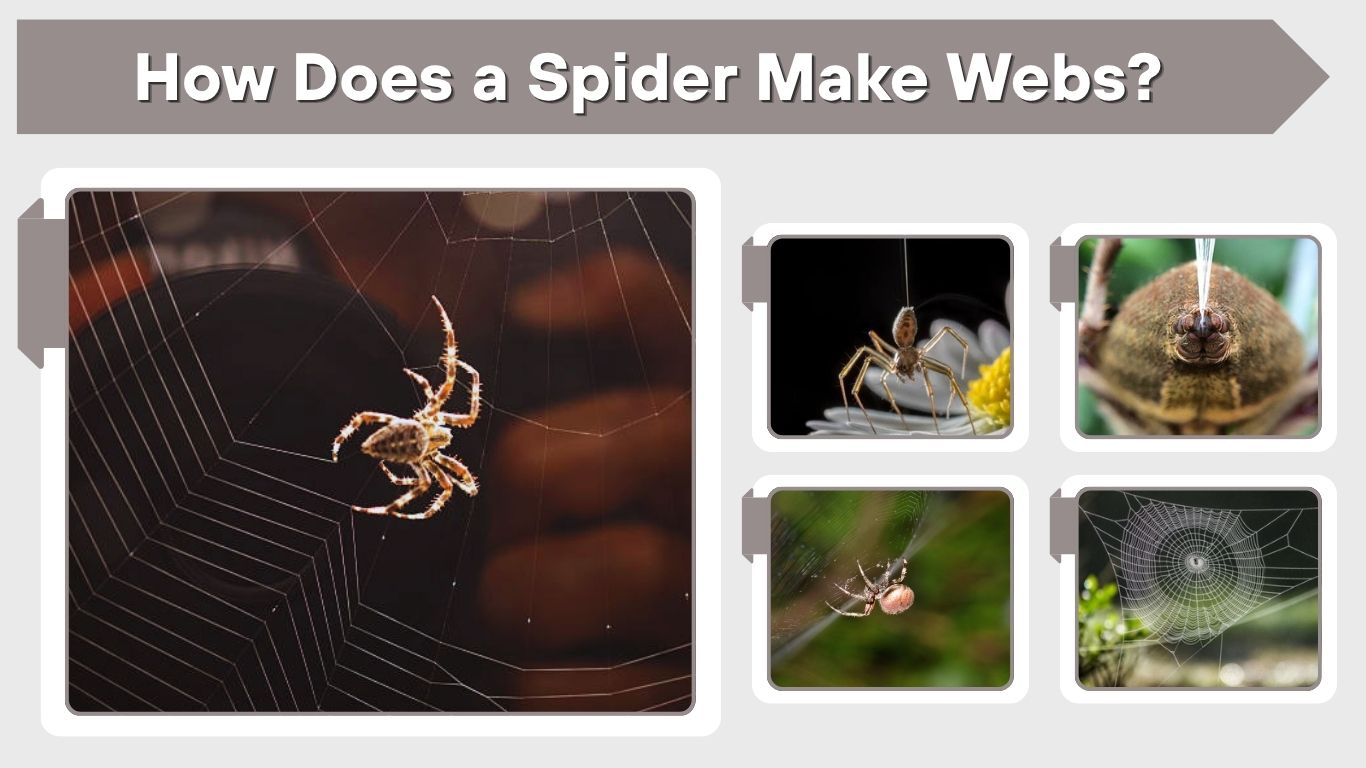
How does a spider make webs from nothing but its own body? The answer is a mix of biology, instinct, silk chemistry, and careful movement. A spider produces liquid silk inside special glands, pulls it out through tiny openings called spinnerets, and uses its legs to place each thread. Some spiders build neat circular webs, while others make sheets, funnels, tangled cobwebs, retreats, or no prey-catching web at all.
Quick Answer: How Does a Spider Make Webs?
A spider makes webs by producing silk from glands inside its abdomen. The silk comes out through spinnerets as a liquid protein that hardens into a strong thread when pulled into the air. The spider anchors the first thread to a surface, stretches silk between support points, builds a frame, adds spokes or support lines, and then places sticky silk where prey will be caught.
The exact method depends on the spider species. Orb-weaving spiders make the classic round webs. Funnel weavers make sheet-like webs with a tunnel. Cobweb spiders make messy three-dimensional webs. Jumping spiders and wolf spiders do not usually make prey-catching webs, but they still use silk for safety lines, egg sacs, retreats, and movement.
Where Does Spider Silk Come From?
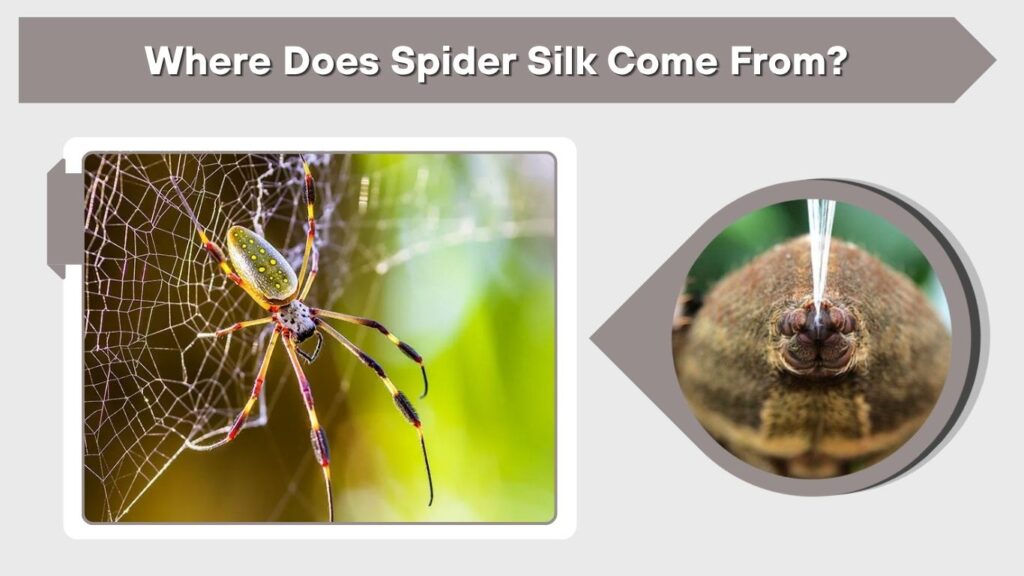
Spider silk comes from silk glands inside the spider’s abdomen. These glands produce silk proteins in liquid form. When the spider pulls the silk through spinnerets, the liquid changes into a solid thread. Spinnerets are small silk-spinning organs located at the rear of the spider’s body.
A spider can make different types of silk for different jobs. Some silk is strong and dry. Some is stretchy. Some is sticky. Some is used for wrapping prey, making egg sacs, building retreats, or creating draglines.
What Are Spinnerets?
Spinnerets are the spider’s silk-release organs. They act like tiny nozzles. A spider does not simply “spray” a finished web into place. Instead, it carefully pulls silk from the spinnerets and places it using its legs and body movements.
Spinnerets help control:
- Where the silk goes
- How thick the thread is
- What type of silk is released
- Whether the silk is sticky or dry
- How the thread attaches to a surface
This is why spider webs can look so organized. The spider is not throwing silk randomly. It is placing threads in a pattern.
How Does a Spider Make a Web Step by Step?
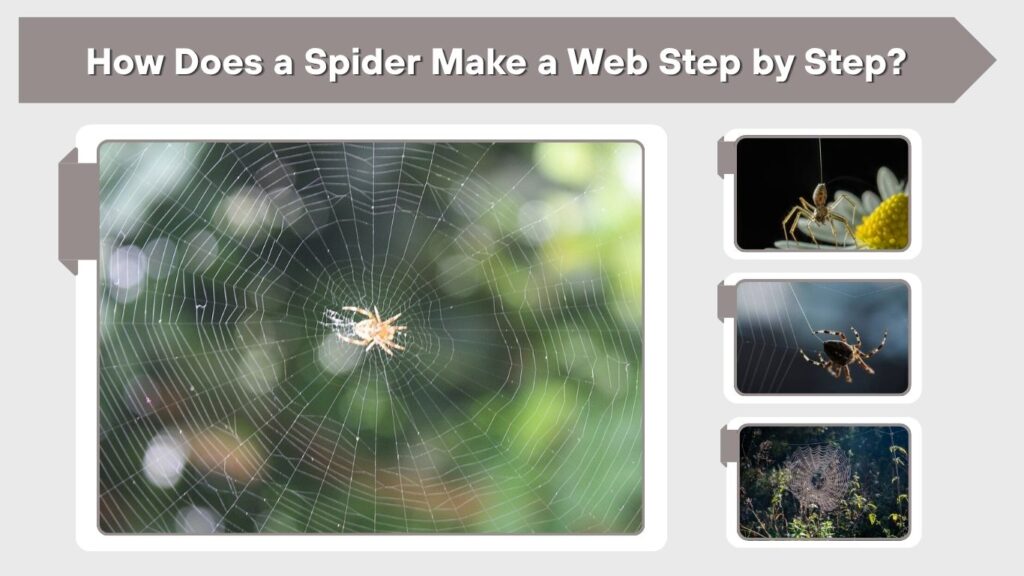
The classic example is an orb web, the round web often seen in gardens, trees, and porches. Not every spider builds this type of web, but it is the best model for understanding web construction.
Step 1: The Spider Releases a First Thread
The spider starts by releasing a silk thread into the air. Wind or air movement may carry the thread until it sticks to another surface, such as a branch, wall, fence, or plant stem. This first thread is called a bridge line.
If the thread lands successfully, the spider pulls it tight. If it does not land well, the spider may eat the silk and try again.
Step 2: It Strengthens the Bridge Line
Once the first thread is attached, the spider often walks across it and lays down more silk. This makes the line stronger. The bridge line becomes the top support for the web.
This step helps explain how a spider can make a web between two trees or across a gap. The spider does not jump across with a finished web. It lets a light silk thread drift across first, then reinforces it.
Step 3: It Builds the Frame
Next, the spider creates the outer frame. It attaches silk to nearby supports and forms the basic shape of the web. The frame holds the entire structure in place.
The frame may connect to branches, leaves, walls, grass stems, window frames, or porch rails. The spider chooses anchor points that can support tension.
Step 4: It Adds Radial Lines
After the frame is ready, the spider builds lines from the center to the outside edge. These are called radial lines. They look like spokes on a bicycle wheel.
Radial lines help the spider sense vibration. When an insect hits the web, movement travels along the silk to the spider, letting it know where the prey is.
Step 5: It Makes a Temporary Spiral
The spider then adds a temporary spiral. This non-sticky spiral helps the spider move around while building. It also helps space the final sticky spiral evenly.
The temporary spiral is like a guide. The spider may later remove or eat parts of it as it finishes the web.
Step 6: It Adds the Sticky Capture Spiral
Finally, the spider adds sticky silk, usually working from the outside inward. This sticky spiral is the part that catches insects. The spider carefully steps on the dry radial lines while placing sticky silk between them.
The result is a finished orb web with a strong frame, dry support lines, and sticky prey-catching threads.
How Does a Spider Make a Web Across Long Distances?
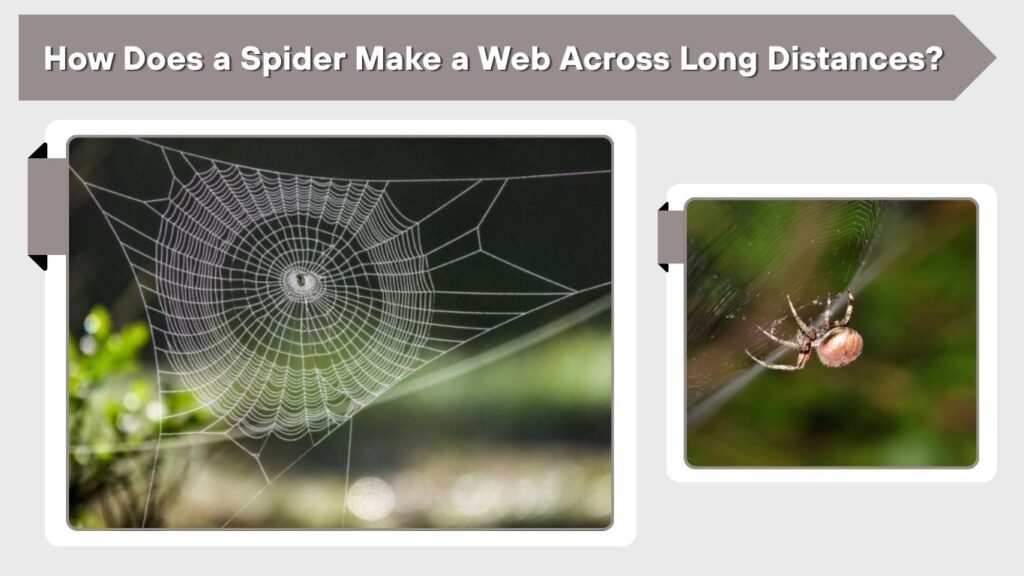
One of the most amazing questions is how does a spider make a web across long distances, such as between two trees or across a wide doorway. The spider uses air movement and silk.
It releases a very light thread, and the breeze carries it. If the thread touches another object, it sticks. The spider then tightens the line and walks across it. After that, it adds more silk to strengthen the connection.
This is how spiders build webs between two branches, two trees, porch posts, or other separated objects. The first line is not heavy. It is light enough to float. Once it catches, the spider turns it into a stronger bridge.
How Does a Spider Make a Web in Mid Air?
A spider does not truly build a web in empty air without anchor points. It needs supports. The web may appear to float in mid air because the anchor lines are thin and hard to see. Look closely and you will usually find silk attached to branches, walls, grass, fences, or other nearby objects.
How Does a Spider Know How to Make a Web?
Spiders know how to make webs mostly through instinct. They do not need a teacher. Young spiders can produce silk and build species-typical web structures without watching an adult spider first.
However, web building is not completely robotic. A spider responds to its surroundings. It adjusts the size, angle, anchor points, and shape of the web based on available space, wind, obstacles, prey activity, and damage.
A spider may rebuild part of a web if it breaks. It may choose a new location if the web catches little food. It may also change web size depending on hunger, age, or weather.
How Long Does a Spider Take to Make a Web?
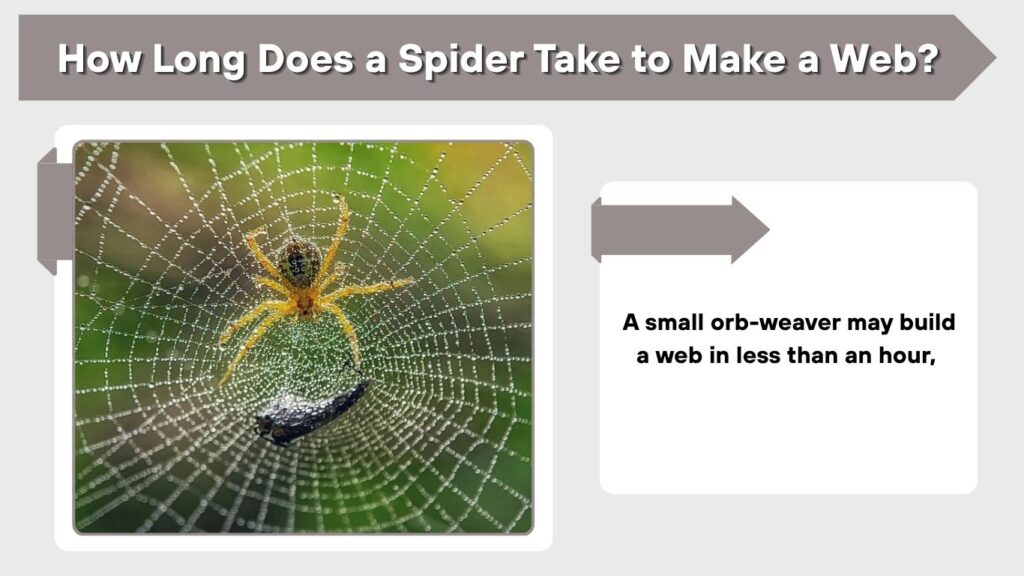
The time depends on the spider species and the type of web. A small orb-weaver may build a web in less than an hour, while some larger or more complex webs may take longer. Many orb-weaving spiders build or repair webs daily, especially when the web is damaged or no longer sticky enough.
| Web Type | Common Builder | Approximate Building Pattern |
| Orb web | Garden spiders, orb-weavers | Often built or repaired daily |
| Funnel web | Grass spiders, funnel weavers | Built as a sheet with a retreat tunnel |
| Cobweb | House spiders, cobweb spiders | Built gradually in corners |
| Sheet web | Sheet-web spiders | Layered over vegetation or surfaces |
| Retreat silk | Jumping spiders, many spiders | Built as a small shelter |
| Egg sac | Female spiders | Built when protecting eggs |
The answer to “how long does it take a spider to make a web” is usually: from minutes to a few hours, depending on web size, species, and conditions.
How Often Does a Spider Make a Web?
Some spiders rebuild webs often. Orb-weavers may make a new web every night or repair the same web repeatedly. Other spiders keep a web for longer and add to it over time. House spiders may keep messy cobwebs in corners and expand them gradually.
A spider may make a new web when:
- The old web is damaged
- The sticky silk dries out or loses effectiveness
- Prey is scarce in the current spot
- Wind or rain breaks the web
- The spider molts or changes behavior
- The spider needs a better hunting location
Some spiders recycle silk by eating old web threads. This helps them recover proteins and use them again.
How Many Webs Does a Spider Make in Its Lifetime?
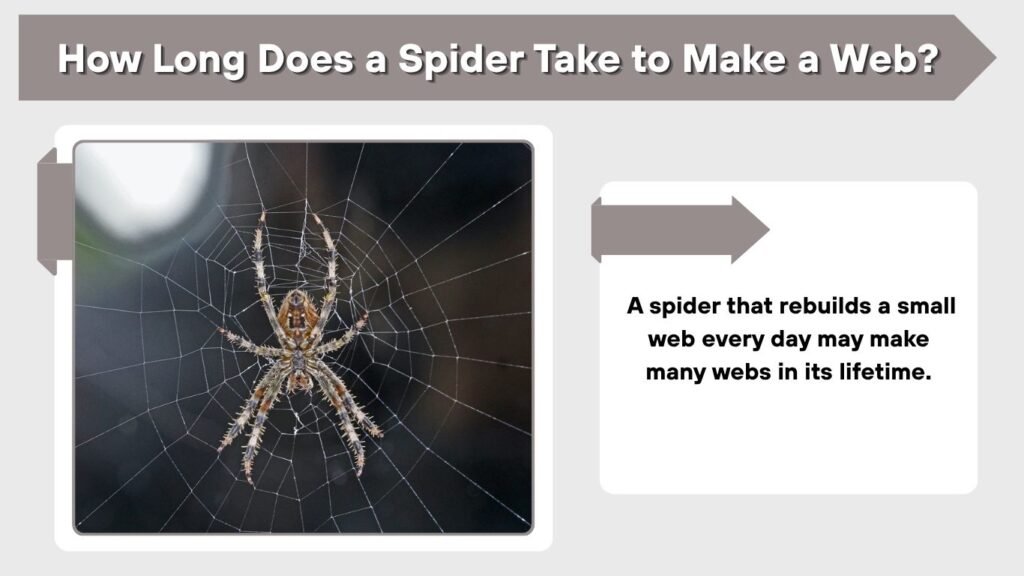
There is no single number because spiders vary widely. A spider that rebuilds a small web every day may make many webs in its lifetime. A spider that lives in a burrow, funnel, or retreat may make fewer complete webs but continue adding silk over time.
A web-building spider may create dozens, hundreds, or even more silk structures during its life, depending on lifespan, species, weather, food, and habitat. Even spiders that do not build prey-catching webs still produce silk many times for safety lines, egg sacs, retreats, or movement.
Do All Spiders Make Webs?
All spiders can produce silk, but not all spiders make prey-catching webs. This is an important difference. Some spiders use webs as traps, while others use silk for different purposes.
Spiders That Make Catching Webs
These spiders use silk to trap prey:
- Orb-weavers
- Cobweb spiders
- Funnel weavers
- Sheet-web spiders
- Cellar spiders
- Bowl-and-doily spiders
Spiders That Usually Do Not Make Catching Webs
These spiders may hunt actively instead:
- Wolf spiders
- Jumping spiders
- Fishing spiders
- Crab spiders
- Huntsman spiders
Wolf spiders, for example, do not usually make a web to catch prey. They hunt on foot. However, female wolf spiders use silk to make egg sacs, and some may line shelters with silk.
How Does a Garden Spider Make a Web?
A garden spider, often an orb-weaver, makes a web using the classic orb-building method. It starts with a bridge line, strengthens it, builds a frame, adds radial spokes, lays a temporary spiral, and finishes with sticky capture silk.
Garden spider webs are often seen in sunny gardens, tall grass, shrubs, and between plants. These webs are designed to catch flying insects. The spider may sit in the center or hide nearby with a signal line attached to the web.
Why Are Spider Webs Sticky?
Spider webs are sticky because many species add adhesive silk to the prey-catching parts of the web. In orb webs, the radial lines are usually dry, while the spiral capture thread is sticky. This allows the spider to walk on safe lines while insects get trapped on sticky ones.
Sticky silk may have tiny droplets of glue-like material. These droplets help grab insects when they touch the web. The web also vibrates when prey struggles, telling the spider where to go.
Why Don’t Spiders Get Stuck in Their Own Webs?
Spiders avoid getting stuck because they know where to step. In many orb webs, not every thread is sticky. The spider walks mostly on dry support threads and radial lines. Spiders also move carefully and have specialized leg structures that help reduce sticking.
This does not mean a spider can never get tangled. But in its own web, it is adapted to move safely and efficiently.
How Strong Is Spider Silk?
Spider silk is famous for being strong, light, and flexible. It can stretch without breaking and absorb energy well. Different silk types have different properties. Dragline silk, for example, is especially strong and is used for safety lines and web frames.
The strength of silk helps webs survive wind, prey impact, and daily wear. At the same time, silk is light enough for spiders to carry, release, and recycle.
How Do Spiders Repair Webs?
When a web is damaged, a spider may cut away broken sections and replace them. Some spiders eat damaged silk before rebuilding. This recycling saves energy because silk proteins are valuable.
A spider may repair only one section if the damage is small. If the web is badly damaged, the spider may abandon it and build a new one in a better location.
Why Do Spiders Make Webs?
Spiders make webs for many reasons, not just catching food. Silk is one of the most useful tools in a spider’s life.
Spiders use silk to:
- Catch prey
- Build shelters
- Protect eggs
- Create safety lines
- Wrap prey
- Travel short distances
- Line burrows
- Sense vibration
- Support molting
- Protect spiderlings
For many spiders, silk is like a tool kit. The web is only one use of that tool kit.
How Does a Spider Make Webs for Kids?
For kids, the simplest explanation is this: a spider has tiny silk-making parts at the back of its body. It pulls out silk like thread. The silk starts as liquid inside the spider, then becomes strong string. The spider attaches the string to things like branches or walls and walks around to make a pattern.
The spider does not need a ruler. It follows instincts and uses its legs to measure space. It builds lines, circles, and sticky parts so bugs get caught for food.
FAQs
How does a spider make webs?
A spider makes webs by producing liquid silk inside its abdomen and pulling it through spinnerets. The silk hardens into thread. The spider attaches the thread to surfaces, builds support lines, and adds sticky silk where prey will be caught.
How does a spider make a web between two trees?
A spider releases a light silk thread into the air. Wind carries it until it sticks to another tree or branch. The spider tightens and strengthens that first bridge line, then uses it as the foundation for the rest of the web.
How long does a spider take to make a web?
Many orb-weaving spiders can build a web in less than an hour, though timing varies by species, size, weather, and web type. Some spiders repair or rebuild webs daily, while others keep adding to the same web over time.
How does a spider know how to make a web?
Spiders know how to build webs mostly through instinct. Young spiders do not need lessons from adult spiders. Still, they adjust their webs based on space, weather, prey, damage, and available anchor points.
Do all spiders make webs?
All spiders can make silk, but not all spiders build prey-catching webs. Orb-weavers, cobweb spiders, and funnel weavers use webs to catch prey. Jumping spiders and wolf spiders usually hunt actively but still use silk for egg sacs, shelters, and safety lines.