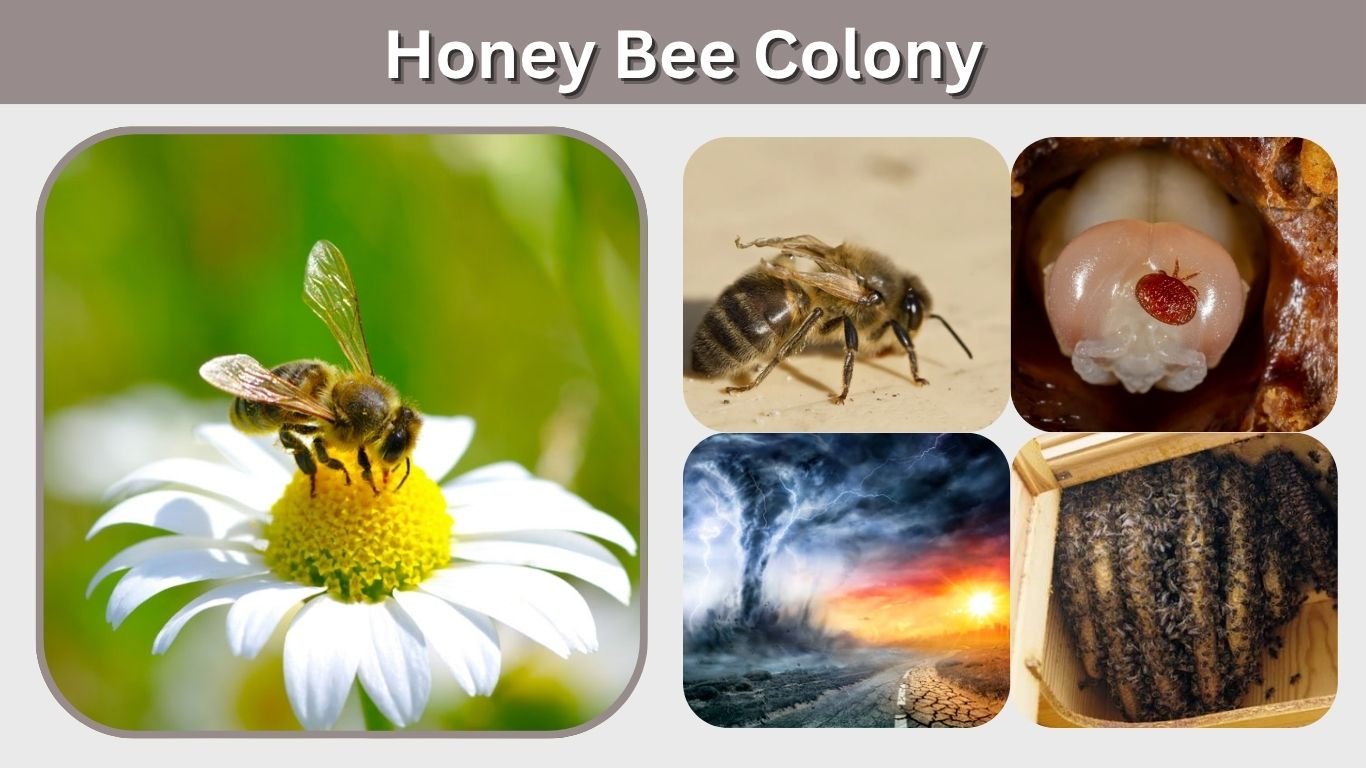
A honey bee colony is a highly organized community that functions almost like one living organism. It normally contains one queen, thousands of female workers, and seasonal male drones. Together, these bees raise young, regulate temperature, defend their nest, collect food, and store honey. Colony population changes throughout the year, often rising above 50,000 bees during summer. Starting and maintaining a healthy colony requires suitable equipment, a productive queen, adequate forage, and regular disease monitoring—especially for destructive Varroa mites and the viruses they transmit.
Honey Bee Colony Organization
Every honey bee colony contains three adult castes with specialized roles. Individual bees cannot maintain a nest alone; the colony survives through cooperation. Workers complete most daily duties, the queen produces eggs, and drones provide reproductive genetic material. Their combined activities allow the colony to grow, reproduce by swarming, survive food shortages, and maintain stable internal conditions.
Members of a Honey Bee Colony
- Queen: The colony’s primary reproductive female
- Workers: Non-reproductive females that perform most tasks
- Drones: Males whose principal role is mating with virgin queens
- Brood: Developing eggs, larvae, and pupae
- Nurse bees: Young workers that feed larvae
- Foragers: Older workers collecting nectar, pollen, water, and resin
- Guard bees: Workers protecting the hive entrance
A healthy colony generally contains only one functioning queen. However, temporary exceptions can occur during queen replacement, swarming, or certain management procedures.
The Queen’s Role
The queen can lay approximately 1,500–2,000 eggs daily during favorable spring conditions. Fertilized eggs develop into females, becoming workers or queens depending largely on larval nutrition. Unfertilized eggs become male drones.
Her pheromones help coordinate colony behavior and suppress worker reproduction. However, the queen does not command individual workers. Colony organization emerges through pheromones, food exchange, vibrations, age-related behavior, and environmental signals.
Worker and Drone Roles
Workers clean cells, feed larvae, attend the queen, process nectar, build comb, remove waste, defend the hive, regulate temperature, and gather resources. Their duties generally change as they age.
Drones do not gather food, build comb, or defend the colony. Those that mate die immediately afterward. When food becomes scarce, workers may expel surviving drones to conserve resources.
How Many Honey Bees Live in a Colony?
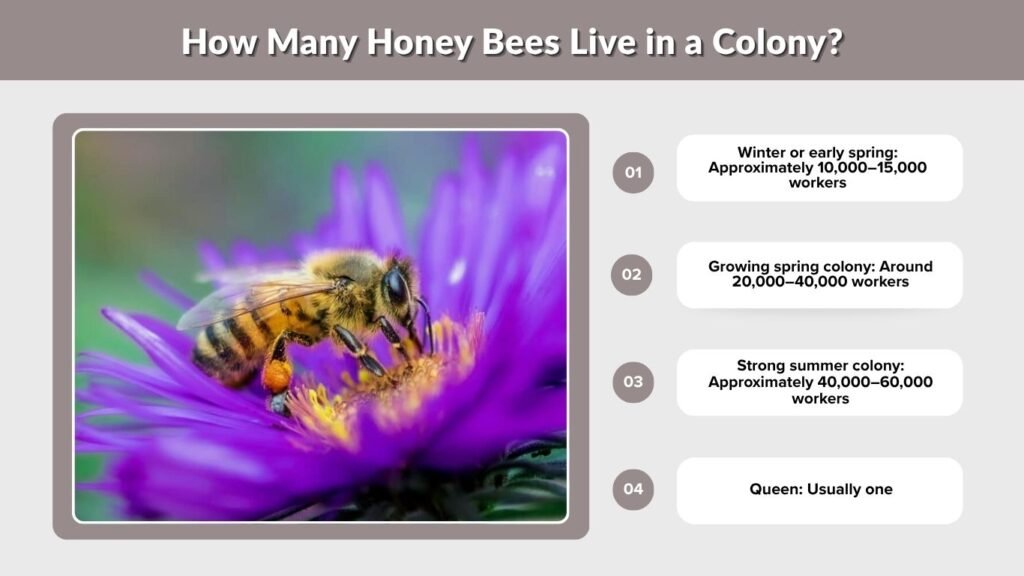
Honey bee colony size changes continuously. Brood production increases before major flowering periods and declines when forage disappears. Population also depends on queen quality, climate, food availability, parasites, diseases, pesticides, swarming, and beekeeping management.
Average Colony Size
- Winter or early spring: Approximately 10,000–15,000 workers
- Growing spring colony: Around 20,000–40,000 workers
- Strong summer colony: Approximately 40,000–60,000 workers
- Queen: Usually one
- Drones: Several hundred to a few thousand during breeding season
A strong colony can reach approximately 50,000–60,000 workers by midsummer. Drones may represent roughly 5% of the adult population during their seasonal peak.
Colony Population Changes
As spring flowers appear, the queen increases egg laying, and workers raise more brood. The population expands to take advantage of incoming nectar and pollen. If the nest becomes crowded, the colony may prepare to swarm.
During late summer and fall, brood production generally decreases. Long-lived winter workers replace short-lived summer workers, drones are removed, and the colony concentrates on conserving honey and maintaining warmth.
Honey Bee Colony Structure and Frames
Managed colonies usually live inside movable-frame hives. The frames allow beekeepers to examine brood, food, pests, diseases, and queen performance without destroying the nest. The most common arrangement separates the brood area from boxes intended for harvestable honey.
Parts of a Managed Colony
- Bottom board: Forms the floor and entrance
- Brood boxes: Hold the queen, brood, pollen, and essential honey
- Frames: Support removable wax comb
- Honey supers: Additional boxes where surplus honey is stored
- Inner cover: Provides insulation and access
- Outer cover: Protects the colony from weather
- Entrance reducer: Helps control access and improve defense
- Queen excluder: Optional barrier keeping the queen from honey supers
A typical brood frame contains brood near the center, surrounded by stored pollen and honey. A solid pattern of capped worker brood usually indicates a productive queen.
Natural and Feral Colonies
Feral honey bees commonly nest inside hollow trees, wall spaces, chimneys, utility boxes, and other protected cavities. They build several parallel wax combs, leaving narrow spaces through which workers move.
A temporary cluster hanging from a branch is generally a swarm searching for a new home, not an established colony. Swarms are often less defensive because they have no brood or stored honey to protect.
Honey Production by a Colony
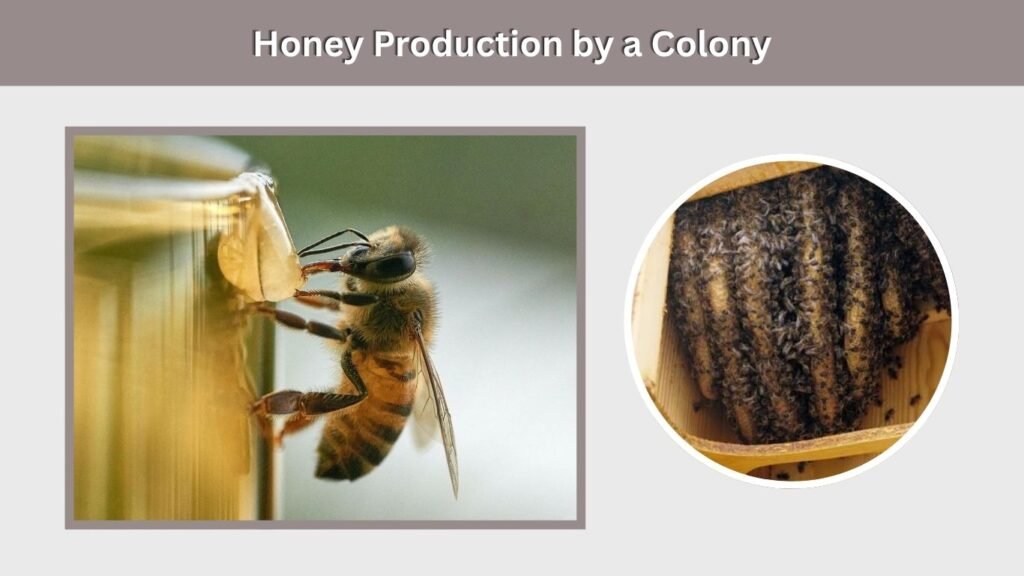
Honey production varies widely according to colony strength, weather, plant diversity, nectar flow, hive space, diseases, and competition. The bees must retain enough honey for their own survival, so harvestable surplus should never be confused with total production.
How Much Honey Can One Colony Produce?
A productive colony may yield approximately 30–60 pounds of surplus honey in an average season. Exceptional colonies in highly productive areas may produce much more, while new or struggling colonies may produce no harvestable surplus.
USDA reported an average harvested yield of 48 pounds per producing colony in 2025, but state averages ranged widely. This number excludes colonies from which no honey was harvested and should not be treated as a guaranteed backyard-hive yield.
Why Production Varies
- Strength and age of the queen
- Number of active foragers
- Length of the nectar flow
- Rainfall and temperature
- Distance to flowering plants
- Availability of empty comb
- Swarming during the season
- Varroa and virus levels
- Amount of honey needed for winter
- Local competition among colonies
A first-year nucleus colony often uses most incoming nectar to raise brood and build comb. New beekeepers should prioritize colony establishment rather than expecting a large immediate harvest.
Starting a Honey Bee Colony
Beginners can start with a nucleus colony, a package of bees, or an established hive. A nucleus colony—commonly called a nuc—is often the easiest option because it already contains a drawn comb, brood, food, workers, and a laying queen.
What You Need to Start
- Complete hive with removable frames
- Protective veil and suitable clothing
- Smoker and hive tool
- Nucleus colony or bee package
- Reliable water source
- Sunny, well-drained hive location
- Nearby pollen and nectar plants
- Feeding equipment when necessary
- Varroa monitoring and treatment plan
- Local beekeeping education or mentorship
Check local registration, zoning, and property requirements before installing bees. Begin with healthy stock from a reputable local supplier rather than collecting an unknown colony.
Nucleus Colony Versus Package Bees
A nuc usually includes four or five established frames containing brood, honey, pollen, workers, and an accepted queen. It can expand quickly after transfer into a full-sized hive.
A package contains loose workers and a separately caged queen but no comb or brood. Packages may cost less, but the bees must build their nest and establish the queen from the beginning.
For U.S. operations surveyed by USDA, average 2025 prices were approximately $130 for a nuc, $110 for a package, and $22 for a queen. Actual retail prices vary by region, breed, delivery, and availability.
Honey Bee Colony Management
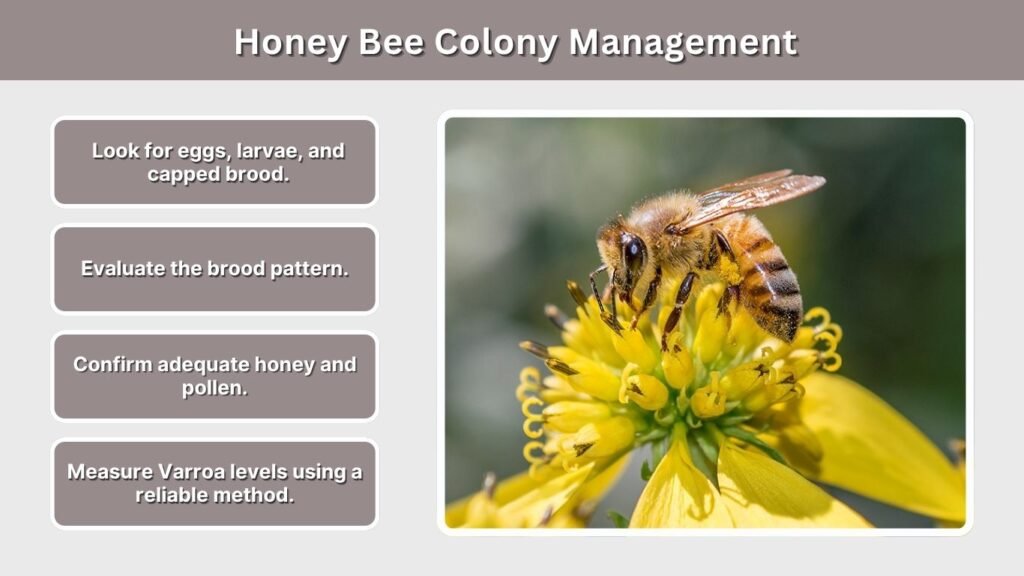
Regular inspections allow beekeepers to detect problems before the colony becomes weak. Opening a hive too frequently can be disruptive, but ignoring it for long periods allows queen failure, swarming, starvation, or mite populations to develop unnoticed.
Colony Health Checklist
- Look for eggs, larvae, and capped brood.
- Evaluate the brood pattern.
- Confirm adequate honey and pollen.
- Measure Varroa levels using a reliable method.
- Watch for deformed wings or abnormal brood.
- Provide more space before severe crowding.
- Control moisture and maintain ventilation.
- Replace damaged equipment.
- Record inspection findings.
- Follow all treatment labels precisely.
A queen does not need to be seen during every inspection. Fresh eggs and healthy young broods usually demonstrate that she was present recently.
How to Split a Honey Bee Colony
Splitting creates another colony and may reduce swarming pressure. Only divide a strong, healthy colony with sufficient brood, adults, and food.
Move frames containing eggs or young larvae, capped brood, honey, pollen, and adhering workers into another hive. Ensure each colony has a queen or the resources to raise one. Adding a purchased mated queen normally produces faster, more predictable results than waiting for queenless workers to rear a replacement.
Honey Bee Colony Removal
Removal methods depend on whether the bees form an exposed swarm or occupy a cavity. A swarm can often be collected easily by a beekeeper. An established wall colony requires the removal of adult bees, brood, wax, and honey.
Safe Removal Steps
- Keep people and animals away from the area.
- Do not spray or disturb the colony.
- Photograph the bees from a safe distance.
- Contact an experienced beekeeper or removal specialist.
- Confirm whether the insects are honey bees.
- Repair and seal the cavity after complete removal.
Never seal an active colony inside a wall. Trapped bees may enter living spaces, while abandoned honey and brood can attract ants, beetles, moths, and rodents.
Colony Collapse Disorder and Colony Losses
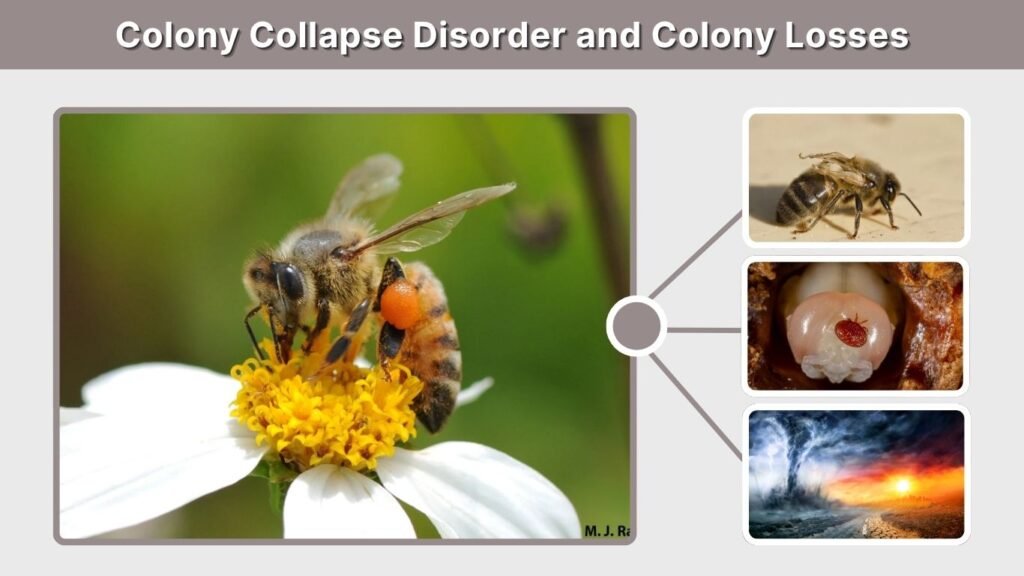
Colony Collapse Disorder, or CCD, describes a specific set of symptoms in which most adult workers disappear, leaving the queen, brood, food stores, and relatively few adult bees behind. It gained widespread attention during 2006–2007 but is not the correct name for every dead or weak colony.
What Causes Colony Losses?
- Varroa mites
- Deformed wing and other viruses
- Queen failure
- Starvation
- Poor nutrition
- Pesticide exposure
- Severe weather
- Nosema and brood diseases
- Management and transportation stress
- Interactions among multiple stressors
USDA states that classical CCD has waned, although high colony losses continue. Varroa remains the leading reported stressor and spreads damaging viruses throughout colonies.
Current U.S. Colony Losses
The 2025–2026 U.S. Beekeeping Survey estimated a 39.9% annual managed-colony loss between April 2025 and April 2026, down from the record 55.6% estimated for the previous survey year.
These loss rates do not mean the same percentage permanently disappears from the national inventory. Beekeepers replace colonies through splits, nucs, packages, and new queens. USDA counted 2.81 million colonies among operations with five or more colonies on January 1, 2026—6% more than one year earlier—even while substantial losses and replacements occurred.
FAQs
Honey bee colonies change with the seasons and cannot be understood from population numbers alone. Queen quality, brood pattern, food, pests, and worker behavior collectively reveal colony condition. The following answers address common questions about colony members, starter colonies, honey production, and collapse.
How Many Honey Bees Are in a Colony?
A colony may contain 10,000–15,000 workers during winter and approximately 40,000–60,000 during its summer peak.
What Is a Honey Bee Nucleus Colony?
A nucleus colony is a small established colony containing several frames of brood, food, workers, and a queen. It is commonly used to start or strengthen a hive.
How Much Honey Does a Colony Make?
Harvested surplus commonly ranges from none to more than 60 pounds. USDA’s 2025 average was 48 pounds for U.S. colonies from which honey was harvested.
What Are Drones in a Honey Bee Colony?
Drones are male honey bees produced from unfertilized eggs. Their principal role is mating with virgin queens from other colonies.
Is Every Dead Colony a Case of CCD?
No. Colonies frequently die from Varroa, viruses, starvation, queen failure, weather, pesticides, or other identifiable problems. CCD refers to a particular disappearance pattern rather than all colony deaths.