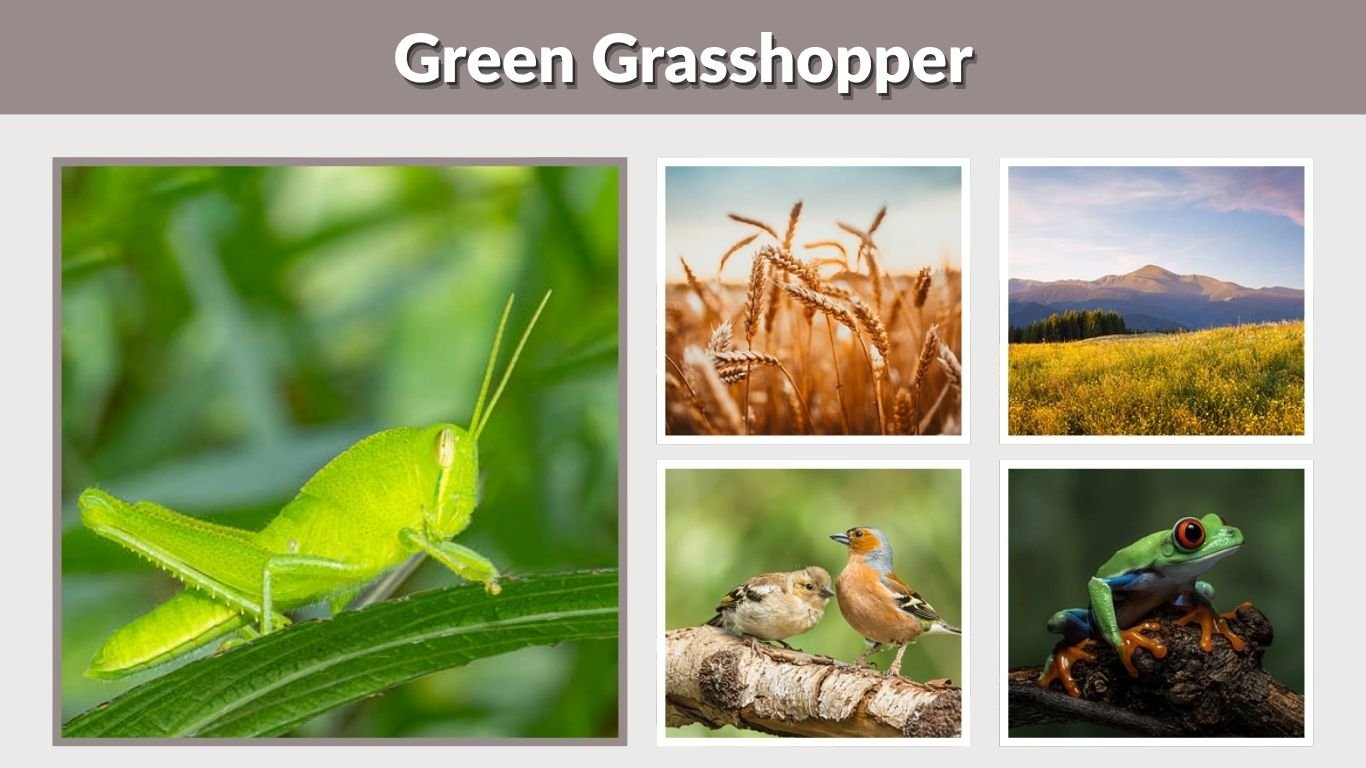
A green grasshopper is one of the most noticeable insects found in gardens, lawns, meadows, farms, and other areas filled with vegetation. Its bright green coloration provides excellent camouflage among leaves and grass, while powerful hind legs allow it to jump impressive distances when disturbed.
However, not every green insect that looks like a grasshopper is actually a grasshopper. Katydids, crickets, and even some locusts can look remarkably similar. Green grasshoppers also vary greatly in size, markings, wing length, and body shape. This guide explains how to identify green grasshoppers, common species, their behavior, lifecycle, lookalikes, and what it may mean when you find one around your home.
What Is a Green Grasshopper?
A green grasshopper is generally any grasshopper whose body is primarily green. Grasshoppers belong to the order Orthoptera, which also includes crickets and katydids.
Green coloration is especially useful for species living among grasses, shrubs, crops, and leafy plants. Their color allows them to blend into vegetation and avoid birds, reptiles, spiders, and other predators.
There is no single species officially called simply the “green grasshopper.” Many different grasshopper species can appear green, while some species occur in both green and brown forms.
Green Grasshopper Identification
Look for the following characteristics:
- Green, yellow-green, lime-green, or olive body
- Large and muscular hind legs
- Short antennae compared with katydids
- Two pairs of wings in most adults
- Large compound eyes on the sides of the head
- Strong chewing mouthparts
- Cylindrical or slightly flattened body
- Adults commonly measuring around 0.5–3 inches depending on species
- Ability to jump rapidly when approached
Some green grasshoppers have black, yellow, brown, or red markings rather than being completely green.
What Does a Green Grasshopper Look Like?
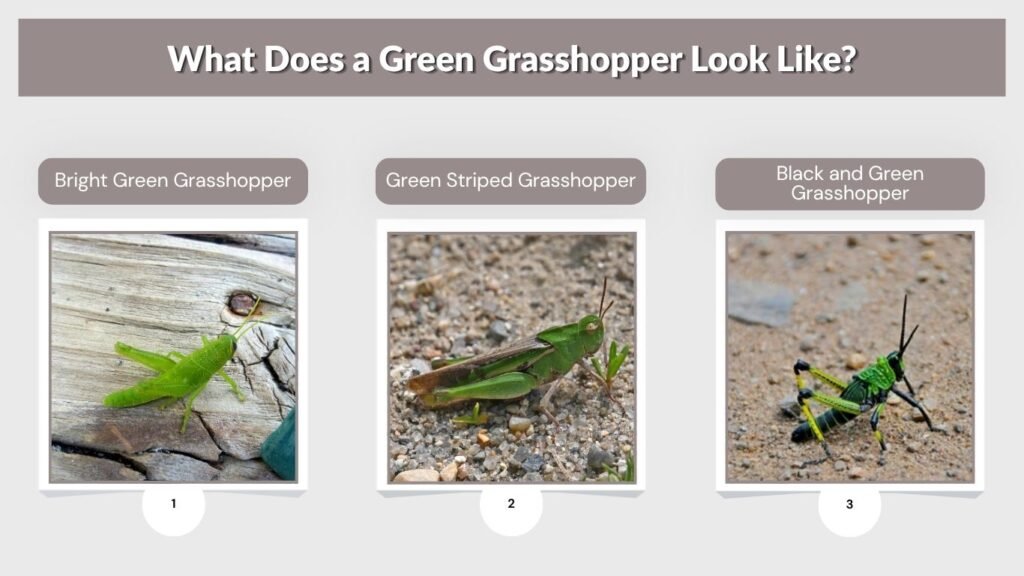
The typical green grasshopper has an elongated body with three clearly defined sections: the head, thorax, and abdomen. Its hind legs are much larger than the front and middle legs.
The body may be pale green, grass green, bright lime green, or dark olive. Some individuals have stripes running along their back or sides.
Their coloration often closely resembles the plants where they live.
Bright Green Grasshopper
A bright green grasshopper may appear almost neon when sitting in sunlight. This coloration is especially common among insects living in fresh vegetation.
Young grasshoppers, known as nymphs, can also appear particularly bright because they lack the darker coloration that sometimes develops as adults mature.
Green Striped Grasshopper
Some species have noticeable longitudinal stripes. A green grasshopper with a yellow stripe, black stripe, or pale stripe may belong to one of several different species.
Color alone usually isn’t enough for exact identification. Wing shape, antenna length, body proportions, geographic location, and markings should also be considered.
Black and Green Grasshopper
A black and green grasshopper may have green wings or legs combined with black markings on its thorax or abdomen.
Juveniles of some species can look dramatically different from adults, meaning a black-and-green insect may eventually develop a different coloration.
How Big Can Green Grasshoppers Get?
Green grasshoppers range from tiny nymphs only a fraction of an inch long to large adults several inches in length.
| Type | Approximate Appearance |
|---|---|
| Tiny green grasshopper | Usually a young nymph |
| Small green grasshopper | Roughly 0.5–1 inch |
| Medium green grasshopper | Around 1–2 inches |
| Large green grasshopper | Around 2–3 inches |
| Giant-looking species | Can approach or exceed 3 inches |
Exact size depends heavily on species, sex, age, and environmental conditions.
Big Green Grasshopper
A big green grasshopper is often an adult female because females are commonly larger than males.
Large species may appear intimidating because of their powerful legs and large wings. Nevertheless, they are primarily plant-eating insects and are not aggressive toward people.
Tiny Green Grasshopper
A tiny green grasshopper found in spring or summer is frequently a nymph.
Nymphs resemble miniature adults but have either no visible wings or only small developing wing pads. They molt repeatedly before reaching adulthood.
Common Types of Green Grasshoppers
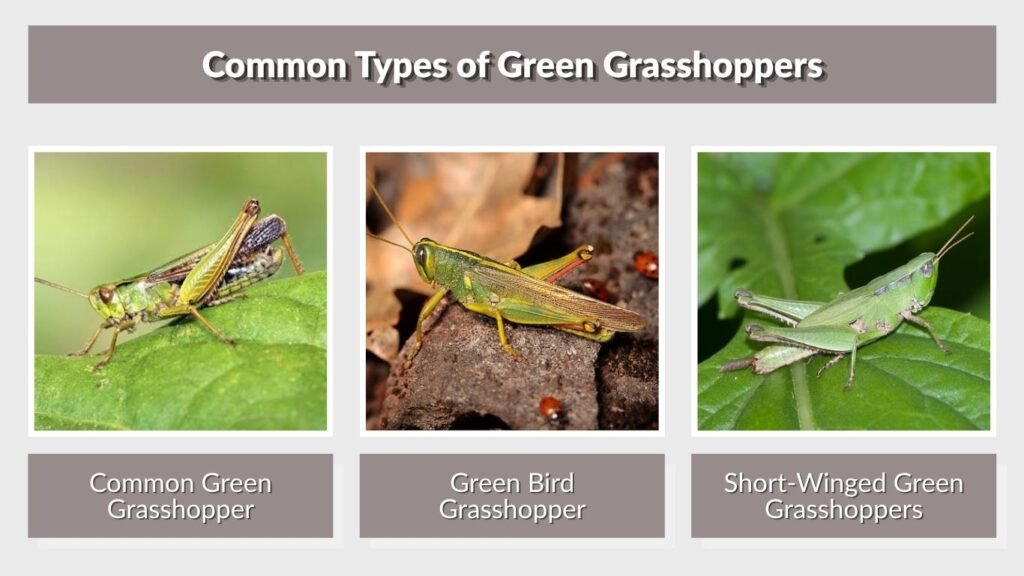
Many grasshopper species may appear partially or completely green. Exact identification can be difficult because coloration varies within individual species.
Some recognizable green grasshopper groups include:
Common Green Grasshopper
The common green grasshopper (Omocestus viridulus) is widely recognized for its green coloration. Individuals may show different combinations of green and brown.
It typically inhabits grassy areas such as meadows, roadsides, pastures, and other open habitats.
Green Bird Grasshopper
The green bird grasshopper is a relatively large grasshopper capable of strong flight.
Its elongated body and green coloration help it disappear among foliage. Large individuals are sometimes mistaken for katydids because of their size.
Short-Winged Green Grasshoppers
Some grasshopper species naturally have shorter wings than others.
A short-winged green grasshopper may therefore appear unable to fly even as an adult. Wing length varies between species and sometimes between populations.
Green Bug That Looks Like a Grasshopper
One of the most common identification problems involves finding a green bug that looks like a grasshopper.
Several closely related insects have nearly identical body shapes.
Katydid vs Green Grasshopper
Katydids are probably the insects most frequently mistaken for large green grasshoppers.
| Feature | Green Grasshopper | Katydid |
| Antennae | Relatively short | Extremely long |
| Body | Usually sturdy | Often leaf-like |
| Wings | Narrower | Frequently resemble leaves |
| Color | Green, brown, mixed | Commonly bright green |
| Sound | Short chirps/buzzes | Loud repetitive calls |
If the insect has antennae longer than its entire body, it is probably a katydid rather than a grasshopper.
Green Cricket vs Grasshopper
Crickets also belong to Orthoptera.
Green crickets usually have longer antennae than grasshoppers and different body proportions. Crickets are also commonly more active at night, whereas many grasshoppers are active during sunny daytime hours.
Green Locust vs Grasshopper
The difference between a locust and grasshopper is unusual because locusts are grasshoppers.
Certain grasshopper species can enter a behavioral and physical state that causes huge numbers to gather and migrate together. When these swarm-forming grasshoppers enter this phase, they are called locusts.
Therefore, seeing one green grasshopper does not automatically mean it is a locust.
Green Grasshopper That Looks Like a Leaf
Some green insects have evolved extraordinary camouflage.
A grasshopper resting along the edge of a leaf may almost disappear because its body coloration closely matches surrounding vegetation.
However, insects described as a green grasshopper that looks exactly like a leaf are often katydids.
Why Leaf Camouflage Helps
Leaf-like coloration helps these insects avoid:
- Birds
- Lizards
- Frogs
- Spiders
- Predatory insects
- Small mammals
Some species even have wing veins resembling the veins of real leaves.
This camouflage can make them extremely difficult to notice until they suddenly jump or fly.
Can Green Grasshoppers Fly?
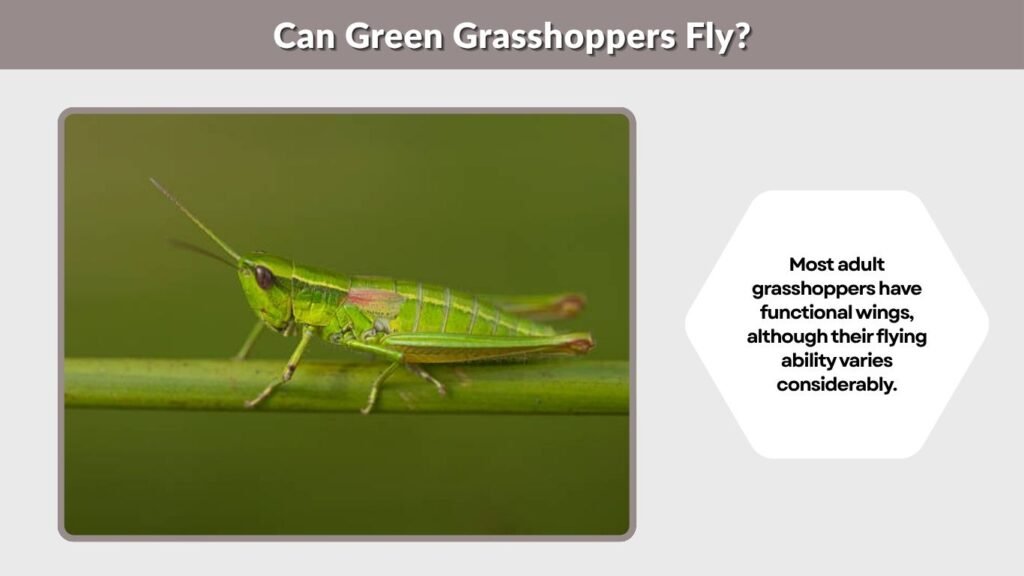
Most adult grasshoppers have functional wings, although their flying ability varies considerably.
A green flying grasshopper typically uses its wings when jumping alone isn’t enough to escape danger or move between feeding locations.
Green Grasshopper With Wings
Adult grasshoppers generally have two pairs of wings.
The leathery front wings protect the thinner flight wings underneath. When the insect takes off, the inner wings spread to produce lift.
Some species are strong flyers capable of traveling considerable distances, while others make only short flights.
Young nymphs cannot fly because their wings have not fully developed.
Do Green Grasshoppers Have Stingers?
A green grasshopper does not have a true stinger.
What looks like a stinger at the end of the abdomen is often part of the female reproductive system.
Green Grasshopper With a “Stinger”
Female grasshoppers possess structures used to deposit eggs into soil or other suitable material. These structures can look sharp but are not designed for injecting venom into people.
A similar confusion occurs with female katydids, whose long blade-like ovipositor can look particularly intimidating.
It is an egg-laying organ rather than a defensive stinger.
Can Green Grasshoppers Bite?
Grasshoppers possess strong chewing mouthparts designed for eating vegetation.
A grasshopper could theoretically pinch human skin if handled roughly, but defensive bites are uncommon and normally minor.
They do not hunt humans, suck blood, or inject venom.
For this reason, finding a large green grasshopper around your home generally isn’t something to fear.
What Do Green Grasshoppers Eat?
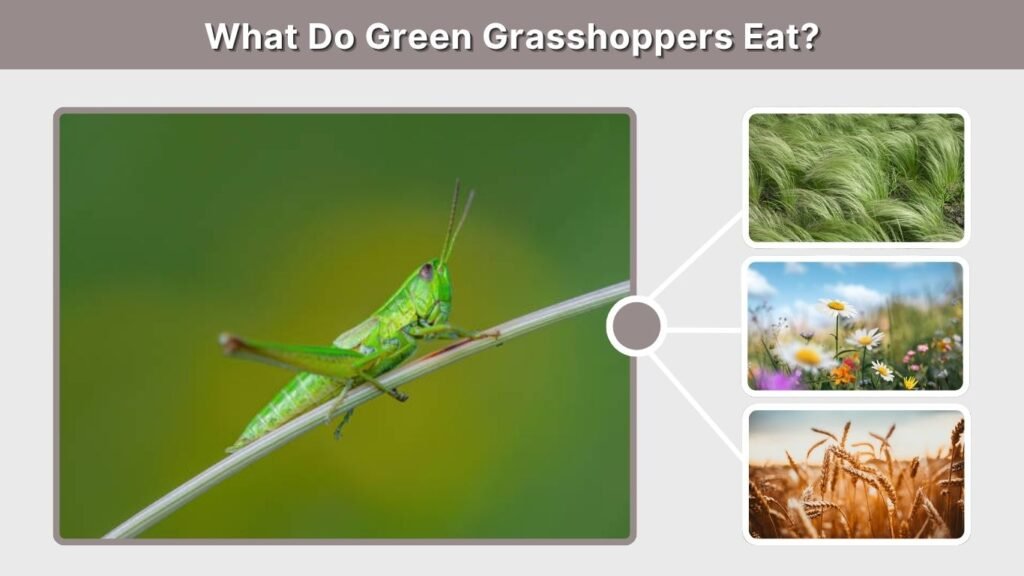
Most grasshoppers are herbivores and consume plant material.
Their diet may include:
- Grass
- Leaves
- Plant stems
- Flowers
- Seedlings
- Agricultural crops
- Weeds
- Grains
Some species are generalist feeders, while others prefer particular plants.
Are Green Grasshoppers Harmful to Gardens?
One grasshopper rarely causes meaningful damage.
Problems can occur when large populations develop. Numerous grasshoppers feeding together may damage vegetables, seedlings, ornamental plants, grass, or agricultural crops.
They chew irregular sections from leaves rather than piercing plants and sucking sap.
Where Do Green Grasshoppers Live?
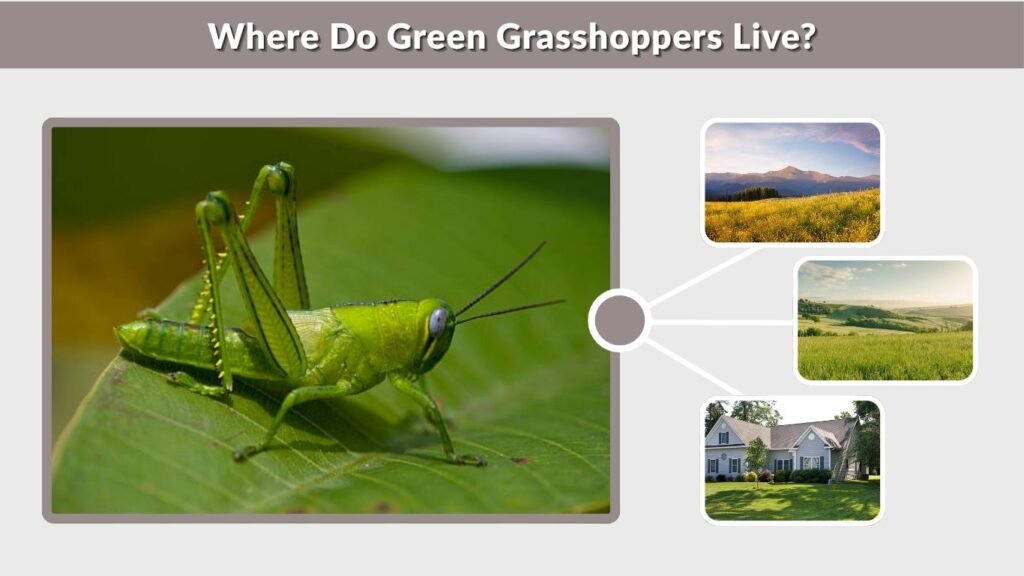
Green grasshoppers prefer environments containing abundant vegetation.
Typical habitats include:
- Lawns
- Meadows
- Grasslands
- Gardens
- Agricultural fields
- Forest edges
- Roadsides
- Wet grassy areas
- Shrublands
Their green coloration is particularly effective in lush environments.
Green Grasshoppers in Washington State
Washington State supports numerous grasshopper species because its landscapes include grasslands, agricultural regions, forests, and dry environments.
Green individuals are most easily noticed during warmer months when vegetation and grasshopper activity increase.
Species identification should be based on several physical characteristics rather than color alone.
Green Grasshopper Lifecycle
Green grasshoppers undergo incomplete metamorphosis, which means there is no caterpillar or pupal stage.
Their lifecycle contains three main stages:
Egg → Nymph → Adult
Eggs
Females commonly deposit groups of eggs into soil using structures at the tip of the abdomen.
Depending on species and climate, the eggs may remain dormant through unfavorable weather.
Nymph
A newly hatched grasshopper resembles a miniature wingless adult.
Nymphs grow by repeatedly shedding their exoskeleton. With every molt, their body becomes larger and their wings become increasingly developed.
Adult
After the final molt, the grasshopper becomes an adult with fully developed reproductive organs and, in most species, functional wings.
Adults mate, females lay eggs, and the cycle begins again.
What Does a Pregnant Green Grasshopper Look Like?
People sometimes describe a female carrying mature eggs as a pregnant green grasshopper, although entomologists generally describe her as gravid.
A gravid female may have:
- A noticeably swollen abdomen
- A heavier overall appearance
- Reduced activity
- Increased interest in suitable egg-laying soil
It is difficult to confirm that a grasshopper is carrying eggs merely by looking at it because well-fed females can also have enlarged abdomens.
Why Do Green Grasshoppers Turn Different Colors?
Not every individual remains completely green throughout its life.
Color may vary according to species, genetics, developmental stage, environmental conditions, and natural variation.
You might encounter:
- Light green grasshopper
- Lime green grasshopper
- Neon green grasshopper
- Yellow-green grasshopper
- Green and yellow grasshopper
- Green and black grasshopper
- Green and red grasshopper
These colors don’t necessarily represent separate species.
Green Grasshopper With Red Eyes
Eye color can also vary.
Some grasshopper species naturally have reddish or brownish eyes, while lighting can make dark eyes appear red in photographs.
Identifying an insect solely because it has a green body and red eyes can therefore be unreliable.
Why Is There a Green Grasshopper in My House?
A green grasshopper inside a house usually entered accidentally.
It may have:
- Flown through an open window
- Entered through an open door
- Followed indoor lighting
- Been carried inside on plants
- Entered through a small gap
Grasshoppers generally prefer outdoor vegetation and usually cannot establish indoor infestations.
How to Remove It
Place a container over the insect, carefully slide paper or cardboard underneath, and release it outdoors.
Avoid grabbing the hind legs because grasshoppers can lose limbs when handled roughly.
Are Green Grasshoppers Good or Bad?
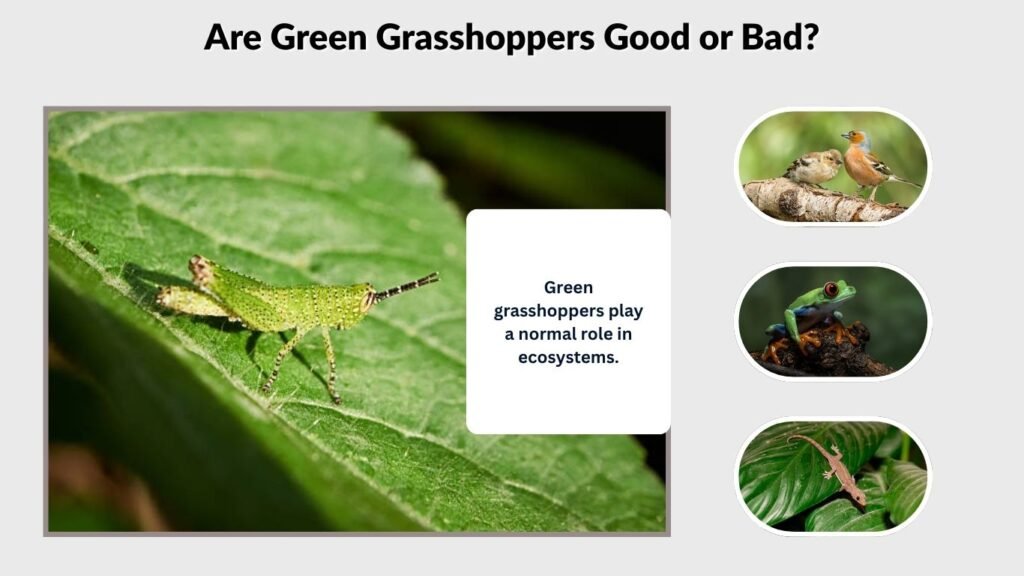
Green grasshoppers play a normal role in ecosystems.
They consume vegetation and are themselves important food for many animals, including:
- Birds
- Frogs
- Lizards
- Spiders
- Praying mantises
- Small mammals
Moderate populations are usually harmless.
Large grasshopper populations can become agricultural pests when feeding pressure becomes excessive.
Green Grasshopper Spiritual Meaning and Symbolism
Grasshoppers have symbolic meanings in many traditions, but these interpretations are cultural rather than scientific.
A green grasshopper is commonly associated with ideas such as:
- Growth
- Good fortune
- Opportunity
- Progress
- Renewal
- Taking a leap forward
- Prosperity
- Positive change
The green color is often linked symbolically with nature, abundance, and new beginnings.
Seeing a Green Grasshopper Meaning
Some people interpret seeing a green grasshopper as encouragement to move forward confidently or take advantage of an approaching opportunity.
These meanings vary considerably among cultures and individuals and should be understood as symbolism rather than predictions.
Green Grasshopper in the House Spiritual Meaning
In symbolic interpretations, finding a green grasshopper inside the house is sometimes associated with good luck, prosperity, or positive changes entering one’s life.
From a biological perspective, however, the explanation is much simpler: the insect probably wandered or flew indoors accidentally.
Interesting Green Grasshopper Facts
Green grasshoppers have several fascinating adaptations.
Their enormous hind legs operate almost like compressed springs, allowing sudden powerful jumps. Their coloration helps them blend with vegetation, while their compound eyes provide a broad field of vision.
Grasshoppers can also produce sounds through stridulation, usually by rubbing body structures together. These sounds can help individuals communicate during courtship and territorial interactions.
Although jumping is their most recognizable ability, many adults can also fly surprisingly well.
Green Grasshopper vs Katydid vs Cricket
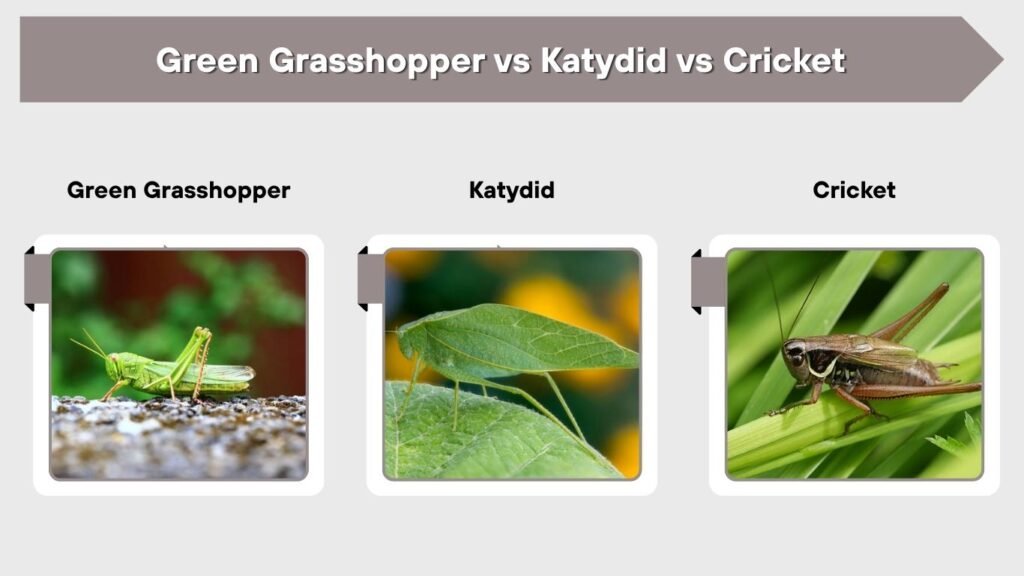
When you encounter a long green insect and aren’t sure what it is, check the antennae first.
| Characteristic | Grasshopper | Katydid | Cricket |
| Antennae | Short | Very long | Very long |
| Typical color | Green or brown | Usually green | Brown, black, or green |
| Hind legs | Very large | Large | Large |
| Body shape | Thick, elongated | Often leaf-like | More compact |
| Activity | Mostly daytime | Often evening/night | Often nighttime |
| Wings | Usually present in adults | Usually present | Often present |
Among these insects, a large green bug that looks like a grasshopper and has extremely long antennae is most likely a katydid.
FAQs
Are green grasshoppers rare?
No. Green coloration occurs in numerous grasshopper species, particularly those living in grassy or leafy environments. Their camouflage can make them seem less common because they are surprisingly difficult to notice while resting among vegetation.
Are big green grasshoppers dangerous?
Large green grasshoppers may look intimidating, but they are generally harmless to humans. They don’t have venomous stingers and aren’t aggressive. Their main defenses are camouflage, jumping, flying, and occasionally using their chewing mouthparts if severely disturbed.
What is the large green insect that looks like a grasshopper?
A large bright green grasshopper-like insect may actually be a katydid. Look closely at its antennae. Katydids have extremely long threadlike antennae, while true grasshoppers generally have much shorter antennae.
Can a green grasshopper fly?
Most adult grasshoppers have wings and many can fly. Some make only brief flights after jumping, while stronger-flying species can cover considerably greater distances. Young green grasshopper nymphs cannot fly because their wings are still developing.
What does it mean when you see a green grasshopper?
Biologically, seeing one usually means suitable grasshopper habitat is nearby. In traditional symbolism, green grasshoppers are sometimes associated with growth, luck, prosperity, new opportunities, and positive change, although these interpretations have no scientific predictive meaning.