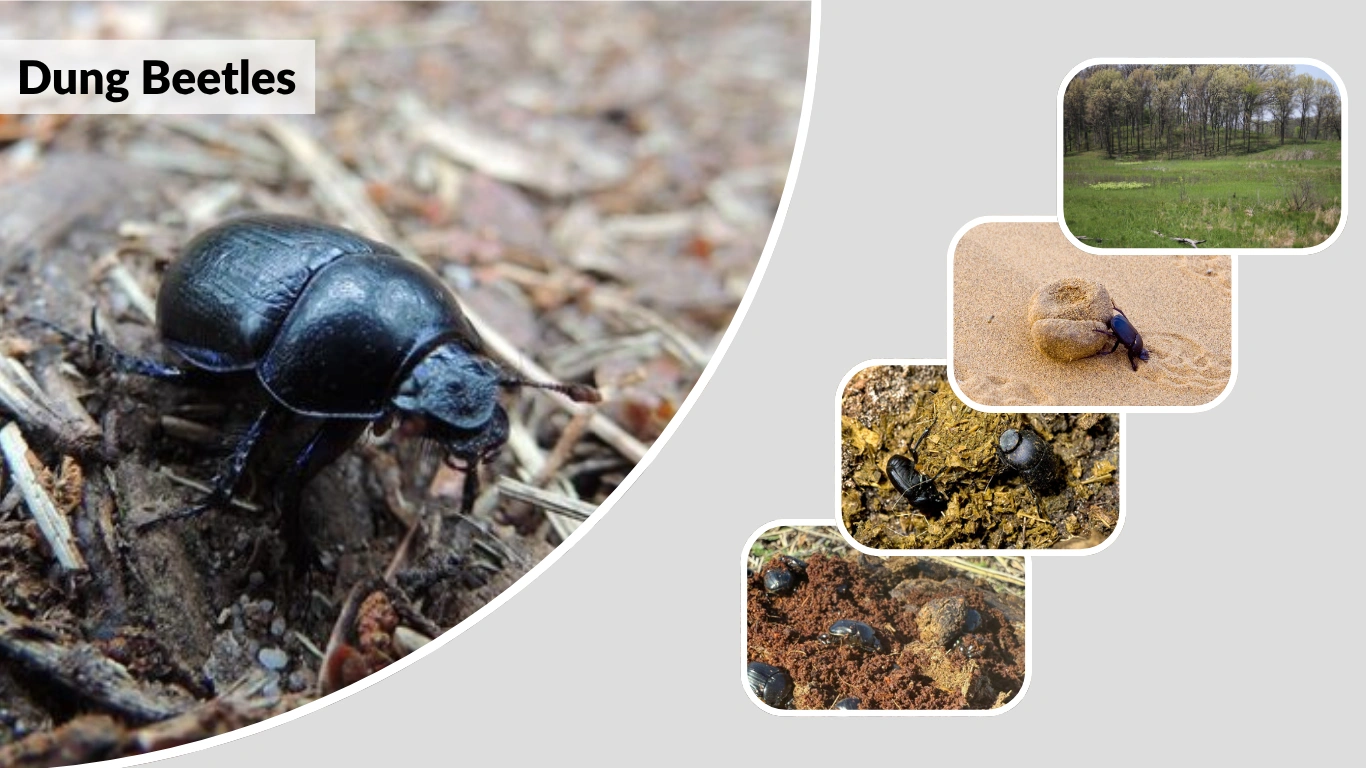
At first glance, dung beetles might not seem like the most glamorous insects in nature. After all, they spend most of their lives pushing, burying, and feeding on animal feces. But behind their unassuming appearance lies one of the most fascinating and ecologically valuable creatures on Earth.
Dung beetles are nature’s clean-up crew — recycling nutrients, improving soil health, and preventing the spread of disease. Found on nearly every continent, these insects play a vital role in ecosystems, farmlands, and even human history. Ancient Egyptians worshiped them as sacred symbols of rebirth, while modern scientists admire their strength and intelligence.
In this guide, we’ll explore what dung beetles eat, where they live, why they roll dung, and why they’re far more impressive than their name might suggest.
What Is a Dung Beetle?

Scientific Classification and Overview
The dung beetle belongs to the Scarabaeidae family, the same group as scarab beetles. Scientists estimate there are over 6,000 species of dung beetles worldwide, divided into several genera including Scarabaeus, Onthophagus, and Canthon.
Their scientific diversity is vast, but all share a common behavior — their dependence on animal waste for survival. They are often referred to as “scarabs” or “manure beetles,” and they come in a variety of shapes and colors, from dull black to shimmering green and gold.
Perhaps the most famous of them all is Scarabaeus sacer, the Egyptian dung beetle, revered by ancient civilizations as a divine symbol.
Appearance and Characteristics
- Size: Ranges from 0.2 to 2 inches (5–50 mm), depending on species.
- Color: Black, brown, bronze, metallic green, or iridescent rainbow hues.
- Body Shape: Compact and rounded — ideal for rolling and digging.
- Legs: Strong, spade-like front legs adapted for burrowing and pushing dung.
- Antennae: Club-shaped, used for detecting the scent of dung from afar.
- Horns: Males of some species (like Onthophagus taurus) have horns for combat and mating displays.
- Exoskeleton: Hard and smooth, protects against soil abrasion and predators.
- Strength: Can roll dung balls up to 50 times their body weight.
Habitat and Distribution

Where Do Dung Beetles Live?
Dung beetles are cosmopolitan insects, found on every continent except Antarctica. They thrive anywhere there are mammals to supply their favorite resource — dung.
You can find them in:
- Grasslands and savannas, where large grazers roam (Africa, Australia).
- Forests and woodlands, where deer, elephants, or monkeys leave droppings.
- Deserts, where even camel dung supports survival.
- Farmlands and ranches, where cows and horses provide ample food.
In the United States, they are especially common in Texas, Florida, and southern states, where warm weather and livestock farming create perfect conditions.
Habitat Facts
Dung beetles are adaptable and industrious. They follow grazing animals and can detect fresh manure from up to half a mile away using their keen sense of smell.
- Soil preference: soft, sandy soil that’s easy to dig.
- Lifestyle: some species live underground, while others remain above the surface.
- Temperature: most prefer warm, humid climates but can adapt to cooler areas.
Their presence indicates a healthy environment, as they rely on the waste of herbivores that feed on natural vegetation.
What Do Dung Beetles Eat?

Primary Diet
As their name suggests, dung beetles primarily eat animal feces. But they’re not interested in the waste itself — they feed on the nutrients and microorganisms within it.
They prefer herbivore dung (from cows, horses, elephants, or deer) because it’s rich in partially digested plant matter. Carnivore dung is rarely used since it contains fewer nutrients and more harmful bacteria.
So, when people ask, “Do dung beetles eat poop?” the answer is yes — but it’s more accurate to say they recycle nutrients from waste rather than simply consuming it.
Why Do Dung Beetles Roll Dung?
One of the most recognizable behaviors of dung beetles is their dung-rolling ritual — a process that’s both practical and fascinating.
Here’s why they do it:
- To transport food: Rolling dung away from the main pile prevents competition from other beetles and scavengers.
- To store nourishment: Once rolled into a ball, the beetle buries it underground as a long-term food source.
- For reproduction: Females lay eggs inside dung balls, ensuring that the larvae have food immediately after hatching.
This process also benefits the ecosystem — it aerates the soil, speeds up nutrient recycling, and prevents flies from breeding in exposed manure.
It’s not an exaggeration to say that without dung beetles, the world would literally drown in waste.
Types of Dung Beetles
There are three main behavioral groups of dung beetles, classified by how they use dung:
- Rollers (telecoprids) – Roll dung into balls and push them away to bury underground.
- Tunnelers (paracoprids) – Dig tunnels directly beneath dung piles and store portions below ground.
- Dwellers (endocoprids) – Live inside the dung pile itself and feed where they are.
Each group contributes uniquely to soil health. For example, tunnelers are excellent soil aerators, while dwellers rapidly break down waste on the surface.
Extraordinary Strength
A study once observed a male horned dung beetle (Onthophagus taurus) pulling 1,141 times its body weight — equivalent to a human dragging six double-decker buses.
This strength is what allows them to move heavy dung balls quickly, often over long distances.
Life Cycle of a Dung Beetle

Like many beetles, dung beetles go through complete metamorphosis, meaning they develop from egg to larva to pupa and finally to adult. Each stage plays a crucial role in their survival and ecological function.
Four Stages of Life
- Egg Stage
After a male and female pair find and roll a suitable dung ball, the female buries it underground. She then lays one egg per dung ball, ensuring each larva has its own private food supply. This buried ball also keeps the egg safe from predators and harsh weather. - Larval Stage (Grub)
Once the egg hatches, the larva—a soft, white, C-shaped grub—feeds on the nutrient-rich dung. The larva grows rapidly, consuming all the material inside its dung chamber. During this period, it contributes to soil aeration and decomposition. - Pupal Stage
After feeding, the larva enters the pupal stage, forming a protective casing in the soil. Inside this shell, it undergoes metamorphosis, transforming into an adult beetle over several weeks or months, depending on temperature and moisture. - Adult Stage
When fully developed, the adult beetle emerges from the soil, ready to begin rolling dung, feeding, and reproducing. The average adult lives for 3 to 6 months, though some species can live up to 3 years in favorable conditions.
Behavior and Strength
Dung beetles aren’t just survivors—they’re athletes of the insect world. Studies show that they can roll a dung ball up to 10 times their body length per second, sometimes moving it in a perfectly straight line even across uneven terrain.
To navigate, dung beetles use the stars and the Milky Way, an ability once thought unique to birds and humans. Researchers found that when deprived of a view of the night sky, dung beetles struggled to roll their balls in a straight line.
Male beetles of some species are also known for dramatic battles, using their horns to fight rivals for access to mates or dung resources—tiny gladiators armed with natural armor.
Ecological Role and Importance

Nature’s Clean-Up Crew
Dung beetles are among the most important insects on the planet when it comes to maintaining ecological balance. Their waste-management skills provide a host of benefits:
- Nutrient Recycling: By burying manure, they return nitrogen and phosphorus to the soil, enriching plant life.
- Pest Control: They reduce fly populations by removing dung before flies can lay eggs in it.
- Disease Prevention: Rapid waste burial minimizes the spread of parasites and pathogens.
- Soil Health: Their digging loosens compacted soil, improving water absorption and root growth.
Without dung beetles, pastures and grasslands would accumulate waste rapidly, choking out vegetation and attracting harmful pests.
Agricultural Benefits
Farmers, especially in cattle-producing regions like Texas, Florida, and Australia, rely on dung beetles to naturally manage manure. A healthy population of beetles can bury an entire cow pat in less than 24 hours.
This process:
- Prevents manure buildup and reduces greenhouse gas emissions.
- Saves billions annually in waste cleanup and pest control.
- Improves grazing conditions for livestock.
Dung beetles are truly free farm laborers, working tirelessly beneath our feet to maintain healthy ecosystems.
Can Dung Beetles Fly?

Yes, dung beetles are surprisingly good fliers. They can travel long distances to locate fresh dung piles, guided by their sensitive antennae that detect the scent of manure from up to half a mile away.
They typically take flight shortly after sunset or during cooler times of the day, using thermal air currents to glide efficiently. Their wings are protected under tough wing covers called elytra, allowing them to land safely and start rolling immediately upon arrival.
Species and Global Diversity

Common Species
Dung beetles are incredibly diverse, with species adapted to almost every environment. Some of the most famous include:
- African Dung Beetle (Scarabaeus spp.) – Found across Africa’s grasslands, renowned for their strength and teamwork.
- Egyptian Dung Beetle (Scarabaeus sacer) – The sacred scarab of ancient Egypt, symbolizing rebirth.
- Rainbow Dung Beetle (Phanaeus vindex) – Found in North America, known for its dazzling iridescent colors.
- Horned Dung Beetle (Onthophagus taurus) – A fierce fighter with curved horns used in mating battles.
- Earth-Boring Dung Beetle (Geotrupes spp.) – Digs deep tunnels and buries dung for larval development.
Strength and Adaptation
Some dung beetles are so strong they can pull over 1,000 times their body weight—proportionally stronger than any mammal on Earth. Their ability to adapt allows them to thrive in deserts, forests, and tropical grasslands alike.
Dung Beetles in Culture and Media
Ancient Egyptian Symbolism
In ancient Egypt, the scarab beetle (Scarabaeus sacer) held deep spiritual meaning. Egyptians saw the beetle’s dung-rolling behavior as a symbol of the sun god Ra pushing the sun across the sky.
Scarabs represented rebirth, immortality, and transformation, often featured in jewelry, amulets, and hieroglyphics. To this day, scarab motifs remain popular in art and tattoos.
Modern Pop Culture Appearances
Dung beetles have also rolled their way into modern culture:
- Ark: Survival Evolved: A tameable creature that converts feces into fertilizer and oil — useful for resource management.
- Animal Crossing: New Horizons (ACNH): Players can catch dung beetles pushing snowballs, mirroring their real-world behavior.
- Pokémon Universe: Several Pokémon designs, such as Rellor and Rabsca, are based on dung beetles and scarab symbolism.
These appearances highlight how even the humblest insects can inspire creativity across cultures and media.
Predators, Threats, and Conservation
While dung beetles are resilient, they face increasing challenges:
- Predators: Birds, reptiles, and mammals often dig up their dung balls to feed on larvae.
- Parasites: Certain wasps lay eggs inside dung balls, and their larvae consume beetle grubs.
- Human Activity: Deforestation, pesticides, and loss of large mammals reduce available dung sources, threatening populations.
Conservationists emphasize the need to protect grazing animals and natural habitats, as dung beetles are vital indicators of ecosystem health.
Interesting Facts About Dung Beetles
- Dung beetles can bury up to 250 times their body weight in dung every night.
- A group of dung beetles is called a “ball of beetles.”
- They can move dung faster than a person can shovel it.
- Some species navigate using moonlight and polarized light, not just stars.
- Their existence dates back over 30 million years, making them ancient ecological engineers.
FAQs
Why do dung beetles roll poop?
They roll dung to transport food and bury it underground for feeding and egg-laying.
Are dung beetles dangerous?
No — they’re harmless to humans and essential for the environment.
How strong are dung beetles?
They can move over 1,000 times their body weight — the strongest insect relative to size.
Can dung beetles fly?
Yes, they fly long distances to locate fresh dung using their sense of smell.
How long do dung beetles live?
Most live between 3 months and 3 years, depending on species and habitat.
Are dung beetles decomposers?
Yes — they’re one of the most important decomposers in the animal kingdom.