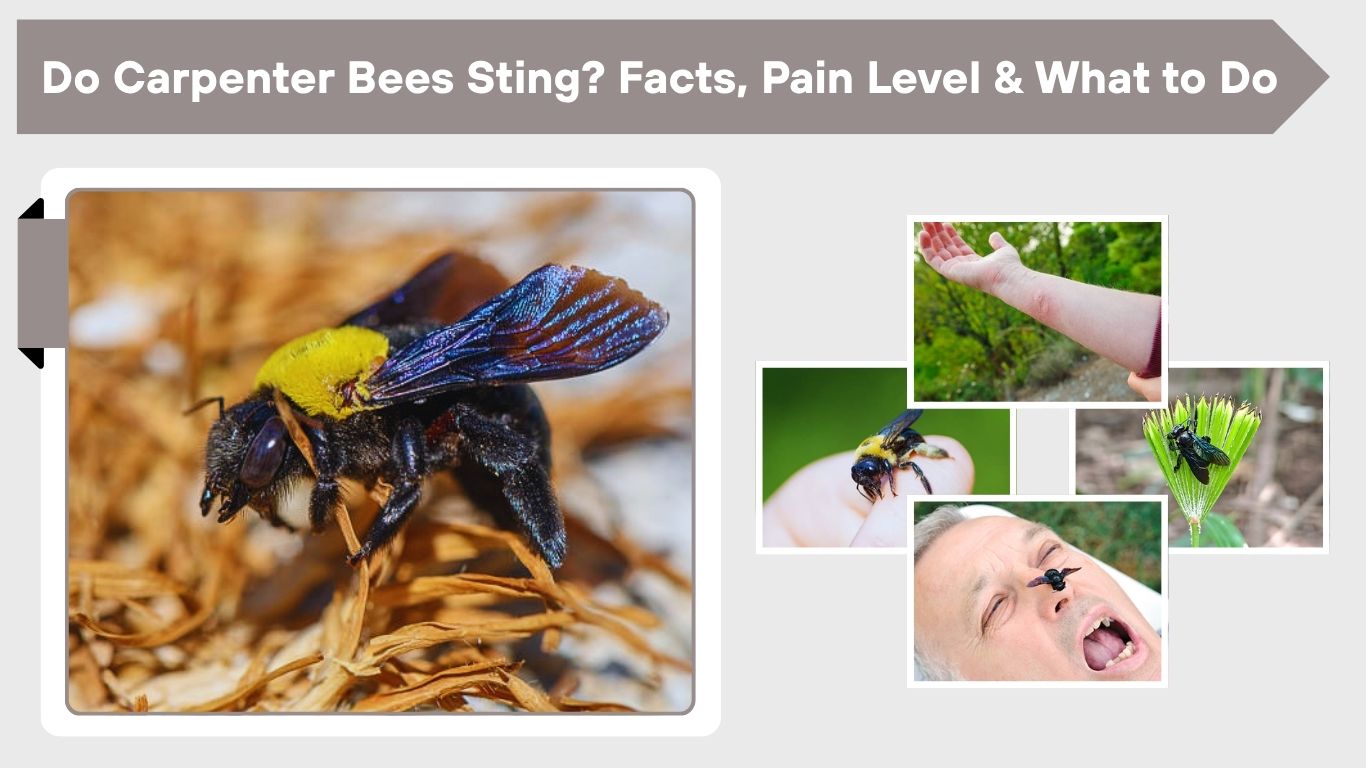
Carpenter bees are large, buzzing insects that often catch people’s attention, especially when they hover near wooden structures or fly close to humans. Their size and behavior can make them seem intimidating, leading many people to wonder: do carpenter bees sting?
The short answer is yes—but it’s not as concerning as it sounds. Carpenter bees are generally non-aggressive and rarely sting humans. Understanding which bees can sting, how they behave, and what to expect can help you feel more confident and less worried around them.
Do Carpenter Bees Sting? (Quick Answer)
Yes, carpenter bees can sting—but only female carpenter bees have stingers. Male carpenter bees, which are often the ones people notice hovering around, cannot sting at all.
Even though females can sting, they rarely do so. Carpenter bees are not aggressive insects and usually sting only when they feel directly threatened, such as when handled or trapped.
For most people, the chance of being stung by a carpenter bee is very low.
Do Male or Female Carpenter Bees Sting?

This is one of the most common questions about carpenter bees, and the answer is simple once you understand the difference.
Do Male Carpenter Bees Sting?
Male carpenter bees do not have stingers, so they cannot sting under any circumstances.
However, they are often mistaken for being aggressive because they:
- Hover around people
- Fly close to faces
- Guard nesting areas
This behavior is purely territorial. They are trying to scare away intruders but are completely harmless.
Do Female Carpenter Bees Sting?
Female carpenter bees can sting, but they are very unlikely to do so.
They typically sting only when:
- They are picked up or handled
- Their nest is disturbed
- They feel trapped
Even then, stinging is a last resort. Most of the time, they will simply fly away.
Do Carpenter Bees Bite or Sting Humans?

Carpenter bees do not bite humans. They use a stinger (only females) for defense, not for hunting or feeding.
This means:
- They do not attack or bite like some insects
- Stings are defensive, not aggressive
- Most encounters with humans are harmless
If you see carpenter bees flying around, they are usually focused on nesting or patrolling their territory—not on people.
Are Carpenter Bees Aggressive?
Carpenter bees may appear aggressive, but in reality, they are not dangerous or hostile.
Male bees are the main source of confusion. Their hovering behavior can seem threatening, especially when they fly close to your face. However, since they cannot sting, this is simply a bluff.
Female bees are more reserved and focused on their work. They prefer to avoid humans and will not attack unless provoked.
Overall, carpenter bees are considered low-risk insects when it comes to human interaction.
Do Carpenter Bees Sting Often?
Carpenter bees rarely sting, and most people will never experience a sting from them.
There are several reasons for this:
- They are solitary bees (no hive to defend)
- They avoid confrontation
- They focus on nesting and gathering food
Unlike social insects such as wasps or honeybees, carpenter bees do not protect a colony, which greatly reduces aggressive behavior.
As long as they are left alone, they will not pose a threat.
Do Carpenter Bees Sting More Than Once?
Yes, female carpenter bees can sting multiple times.
This is because:
- Their stinger is smooth, not barbed
- It does not get stuck in the skin
Unlike honeybees, which die after stinging once, carpenter bees can sting again if necessary. However, since they rarely sting in the first place, multiple stings are extremely uncommon.
Do Carpenter Bees Die After Stinging?
No, carpenter bees do not die after stinging.
This is a common misconception based on honeybee behavior. Honeybees have barbed stingers that get stuck in the skin, causing them to die after a sting.
Carpenter bees are different:
- Their stinger is smooth
- It remains intact after use
- They can survive and sting again if needed
This ability does not make them more dangerous—it simply reflects a different biological structure.
Do All Types of Carpenter Bees Sting?

There are several types of carpenter bees, including:
- Eastern carpenter bees
- Black carpenter bees
- Blue or violet carpenter bees
- California carpenter bees
Across all species, the rule is the same:
- Females can sting
- Males cannot sting
The behavior is also similar. Regardless of the species, carpenter bees are generally calm and unlikely to sting humans.
What Does a Carpenter Bee Sting Feel Like?
If a carpenter bee does sting, the pain is usually mild to moderate and short-lived. Many people describe it as similar to a honeybee sting, though often less intense.
Common sensations include:
- A quick, sharp pain at the moment of the sting
- Mild burning or throbbing
- Temporary discomfort that fades within a few hours
For most people, the pain is manageable and does not cause serious problems.
What Does a Carpenter Bee Sting Look Like?

A carpenter bee sting typically results in a small, localized reaction on the skin.
Common symptoms include:
- A small red bump at the sting site
- Mild swelling around the area
- Slight itching or irritation
- Warmth or tenderness
These symptoms usually go away within a few hours to a day. In rare cases, people may experience stronger reactions, especially if they are sensitive to insect stings.
What to Do If a Carpenter Bee Stings You
If you are stung by a carpenter bee, simple first aid is usually enough to relieve symptoms.
Immediate First Aid
- Wash the area with soap and water to prevent infection
- Apply a cold compress or ice pack to reduce swelling
- Keep the area clean and avoid touching it
Pain and Itch Relief
- Use an antihistamine to reduce itching
- Apply hydrocortisone or anti-itch cream
- Avoid scratching, as it can worsen irritation
When to Seek Medical Help
- If there is severe swelling or pain
- Signs of an allergic reaction (difficulty breathing, dizziness)
- Multiple stings at once
Serious reactions are rare, but it’s important to act quickly if symptoms become severe.
Do Carpenter Bees Sting Dogs or Pets?
Carpenter bees can sting pets, but it is very uncommon. Most pets are stung only if they try to catch or disturb the bee.
In most cases:
- The reaction is mild (similar to humans)
- There may be slight swelling or discomfort
- Symptoms usually go away quickly
However, if your pet shows signs of an allergic reaction—such as excessive swelling, vomiting, or difficulty breathing—you should contact a veterinarian immediately.
Why Carpenter Bees Rarely Sting

Carpenter bees are naturally non-aggressive insects, and their behavior explains why stings are so rare.
Key reasons include:
- They are solitary bees, not colony defenders
- They do not swarm or attack in groups
- Their main focus is nesting and gathering food
- They prefer to avoid humans rather than confront them
Because they have no hive to protect, they have little reason to sting unless directly threatened.
How to Avoid Getting Stung by Carpenter Bees
Although stings are rare, you can further reduce the risk by following simple precautions.
Helpful tips include:
- Avoid touching or handling bees
- Stay calm if a bee hovers nearby
- Do not block or disturb nesting holes
- Wear gloves when working with wood or near nests
Giving carpenter bees space is usually enough to prevent any problems.
Are Carpenter Bees Dangerous?
Carpenter bees are not considered dangerous to most people.
While female bees can sting, the risk is very low. They are not aggressive and do not attack humans. In fact, their biggest impact is usually on wooden structures, not human health.
For homeowners, they may be a nuisance due to drilling damage. But from a safety perspective, they are far less threatening than wasps or hornets.
FAQs
Do carpenter bees sting aggressively?
No, carpenter bees are not aggressive. Even though males may hover around people, they cannot sting. Females rarely sting unless they are directly threatened or handled.
Do carpenter bees sting at night?
Carpenter bees are not active at night, so stings during nighttime are extremely unlikely. They are daytime insects and typically return to their nests after sunset.
Do carpenter bees sting when you walk by?
No, carpenter bees do not sting when you simply walk by. They may hover nearby out of curiosity or territorial behavior, but they will not attack or sting without provocation.
Do carpenter bees sting inside houses?
It is rare for carpenter bees to sting indoors. If they enter a house, they are usually disoriented and trying to escape, not attack people.
Do carpenter bees sting if you touch them?
Yes, a female carpenter bee may sting if you try to touch or handle it. They sting only as a defensive response when they feel threatened.