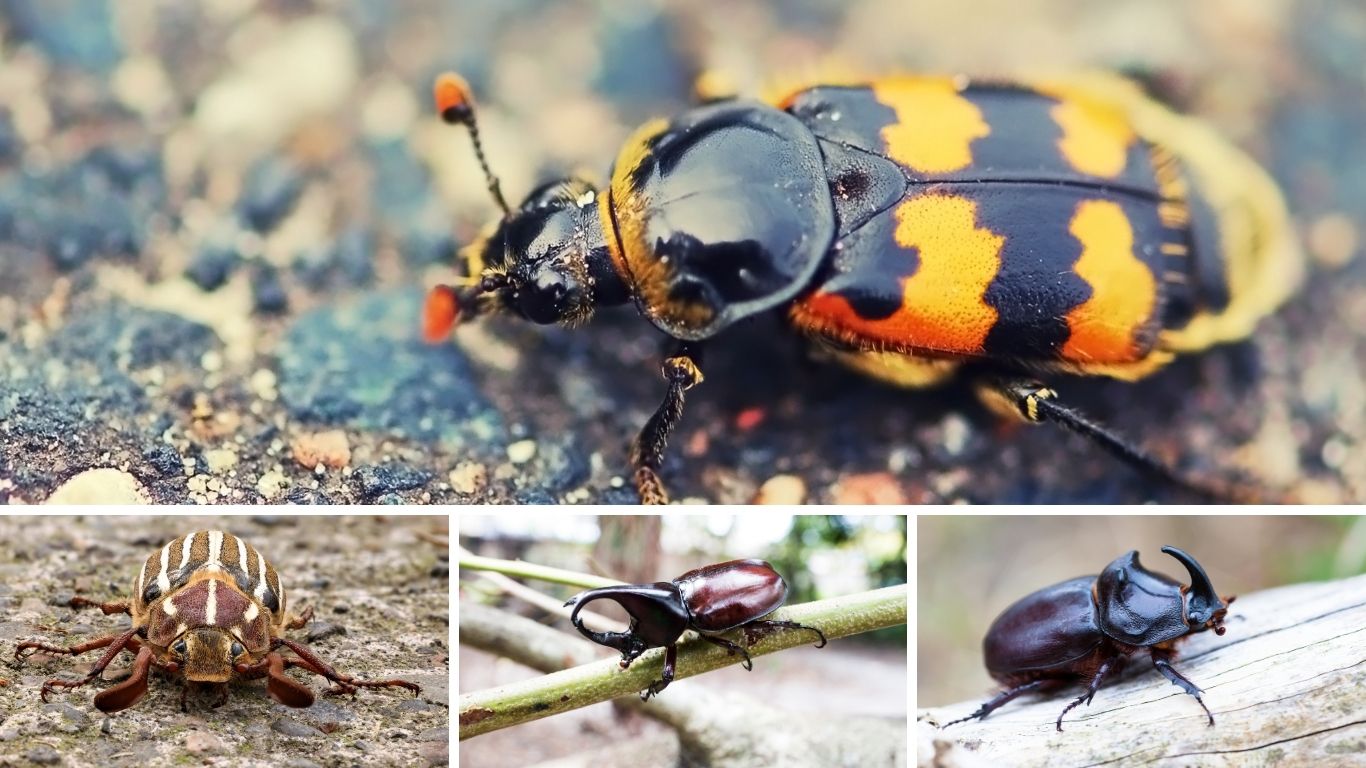
Beetles are everywhere—from your backyard garden to the pantry shelf. With over 350,000 species worldwide, they come in all shapes, sizes, and behaviors. In this guide, you’ll discover 25 common types of beetles, learn how to identify them, and explore where they live, what they eat, and what makes each one unique, plus answers to common beetle questions.
1. Ladybug (Ladybird Beetle)

Ladybugs, also known as ladybird beetles, are among the most recognized and beloved beetles in the world. Known for their bright red or orange bodies with black spots, they are beneficial insects in gardens and farms. These beetles help control aphid populations and are seen as symbols of good luck in many cultures.
Identification
- Color: Bright red, orange, or yellow with black spots
- Size: About 0.3 to 0.4 inches (7–10 mm)
- Shape: Dome-shaped, round body
- Wings: Hardened forewings (elytra) covering the soft flight wings
- Legs: Six short black legs
- Head: Often black with white markings near the eyes
Habitat
Ladybugs are commonly found in gardens, meadows, and agricultural fields. They prefer areas with abundant plant life where aphids and other soft-bodied insects are present.
Diet
They primarily feed on aphids, scale insects, and mites. Some species may also consume pollen and nectar.
Behavior
Ladybugs are active during the day and often gather in large groups during colder months for hibernation. They emit a foul-smelling fluid from their legs when threatened.
2. Japanese Beetle

The Japanese beetle is a metallic green and bronze-colored insect notorious for damaging a wide variety of plants. Native to Japan, it has become a major pest in North America due to its feeding habits in both the larval and adult stages.
Identification
- Color: Metallic green body with bronze wing covers
- Size: Around 0.6 inches (15 mm) long
- Shape: Oval-shaped and robust
- Legs: Six legs with spines on the tibia
- Special Feature: White tufts of hair along the sides and back of the abdomen
Habitat
Japanese beetles thrive in warm, sunny areas with well-watered turfgrass, gardens, and ornamental landscapes. Larvae develop in soil, especially in lawns, while adults are commonly found on flowering and fruit-bearing plants.
Diet
Adults feed on over 300 plant species including roses, grapes, corn, and linden trees. They skeletonize leaves by eating the tissue between veins. Larvae, known as white grubs, feed on grass roots and organic matter in the soil, often causing lawn damage.
Behavior
These beetles are active during the day, especially in the heat of the afternoon. Adults often feed in groups and are attracted to strongly scented flowers and ripe fruits. They are strong fliers and can migrate to new feeding areas quickly.
3. June Bug (June Beetle)

June bugs are large, brown beetles commonly seen flying around lights on warm evenings in late spring and early summer. Despite their name, they are not limited to the month of June. These beetles belong to the Scarabaeidae family and are mostly harmless to humans.
Identification
- Color: Reddish-brown or dark brown
- Size: 0.5 to 1 inch (13–25 mm)
- Shape: Oval and stout with a hard shell
- Legs: Six legs with strong claws for gripping
- Antennae: Clubbed, with fan-like segments
Habitat
June bugs are typically found in grassy areas, gardens, forests, and around outdoor lights at night. The larvae (white grubs) live underground and are commonly found in lawns, pastures, and cultivated soils.
Diet
Adult June bugs feed on leaves of trees and shrubs, especially oak, apple, and rose plants. Larvae feed on the roots of grasses and other plants, often causing visible patches of dead grass in lawns.
Behavior
They are nocturnal and often clumsy in flight. At night, they are strongly attracted to lights and may bump into windows or porch lights. Their underground larvae can live for up to three years before pupating into adults.
4. Click Beetle

Click beetles are slender beetles known for their ability to “click” and flip into the air when lying on their backs. This clicking mechanism helps them escape predators and right themselves. While the adults are generally harmless, some larvae (called wireworms) can be agricultural pests.
Identification
- Color: Usually dark brown or black; some are metallic
- Size: 0.5 to 1 inch (13–25 mm)
- Shape: Elongated, narrow body with a tapered rear
- Distinctive Feature: Clicking hinge between thorax and abdomen
- Legs: Six legs; long antennae
Habitat
Click beetles are found in forests, gardens, meadows, and agricultural fields. They prefer moist environments and are often found under logs, stones, or leaf litter. Larvae live in the soil and are especially common in crop-growing areas.
Diet
Adult click beetles typically feed on nectar, pollen, and sometimes leaves. Larvae (wireworms) are more destructive; they feed on the roots, seeds, and stems of various crops like corn, potatoes, and grains, causing damage to young plants and reducing yields.
Behavior
Click beetles are mostly nocturnal and are attracted to lights at night. Their unique click-and-flip behavior is a defensive mechanism. Larvae can live in soil for several years before emerging as adults.
5. Stag Beetle

Stag beetles are large, striking beetles known for the oversized mandibles (jaws) of the males, which resemble deer antlers. These beetles are generally not aggressive toward humans and are more impressive than dangerous.
Identification
- Color: Shiny black or reddish-brown
- Size: 1 to 3 inches (25–75 mm), with males being larger
- Shape: Robust body with prominent jaws in males
- Antennae: Elbowed with comb-like tips
- Legs: Thick and strong
Habitat
Stag beetles prefer wooded areas, especially places with abundant decaying wood, fallen logs, and old tree stumps. Larvae live inside rotting wood and can take several years to mature. Adults are most often seen during warm summer evenings.
Diet
Adult stag beetles primarily feed on tree sap and overripe or fallen fruit. They do not eat solid food. The larvae feed on decaying wood and help decompose it, playing a vital role in forest ecosystems.
Behavior
Males use their large mandibles to wrestle rivals during mating season but are not harmful to humans. They are mostly active at dusk and are weak fliers despite their size. Adults live for only a few weeks, just long enough to mate.
6. Dung Beetle

Dung beetles are fascinating insects known for feeding on animal feces. They play a vital ecological role by recycling waste, aerating soil, and reducing parasite loads in pastures. Some species are known for rolling dung into balls and burying it for later use.
Identification
- Color: Typically black, brown, or metallic green
- Size: 0.2 to 1.2 inches (5–30 mm), depending on species
- Shape: Oval or rounded with a compact body
- Legs: Strong and spiny, adapted for digging and rolling
- Feature: Some have horn-like projections on their heads
Habitat
Dung beetles are found worldwide, in deserts, forests, grasslands, and farms—wherever animal droppings are available. They thrive in warm climates and prefer open habitats with abundant mammal activity.
Diet
Their diet consists primarily of animal dung, which they consume and use to nourish their young. Some species bury dung directly below where they find it, while others roll it away to a different location. The nutrients in dung help support both adults and larvae.
Behavior
Dung beetles are industrious and efficient. Some are rollers, others tunnelers, and some dwell directly in dung. They are often seen rolling balls of dung across the ground. Their behavior helps fertilize the soil and supports decomposition processes.
7. Carpet Beetle

Carpet beetles are small insects that can be pests in homes, damaging natural fibers like wool, silk, leather, and even stored food. While adults are harmless pollinators, the larvae cause most of the damage by feeding on organic materials.
Identification
- Color: Black, brown, or mottled with white, yellow, and orange scales
- Size: 1/16 to 1/8 inch (1.5–3.5 mm)
- Shape: Oval and compact
- Larvae: Fuzzy, carrot-shaped with bristly hairs
- Wings: Adults have smooth, hard elytra
Habitat
Carpet beetles are commonly found in homes, especially in dark, undisturbed areas like closets, under furniture, and in air ducts. Outdoors, they are found on flowering plants, where adults feed on pollen and nectar.
Diet
Larvae feed on materials of animal origin such as wool, fur, feathers, hair, silk, and leather. They can also infest stored food items. Adults feed on pollen and nectar, especially from outdoor flowers.
Behavior
Carpet beetles can go unnoticed until damage is visible. The larvae are most active and destructive in dark spaces. Adults often enter homes through open windows and doors in spring. Regular cleaning and proper storage of natural fibers help control infestations.
8. Weevil

Weevils are a type of beetle easily recognized by their elongated snouts. There are thousands of species, many of which are serious agricultural pests. Some infest stored grains, while others target live plants. Despite their small size, they can cause extensive damage.
Identification
- Color: Usually brown, black, or gray
- Size: 0.1 to 0.5 inches (2.5–13 mm), depending on species
- Shape: Small, oval or cylindrical with a long, curved snout
- Antennae: Often elbowed and attached to the snout
- Legs: Six short legs; compact body
Habitat
Weevils are found in both indoor and outdoor environments. Grain weevils and rice weevils infest pantries, while root and vine weevils live in gardens and fields. They prefer dark, undisturbed areas for breeding and laying eggs.
Diet
Weevils feed on plants, seeds, and stored grain products. Species like the rice weevil and granary weevil bore into whole grains, where they lay eggs. Plant-based weevils target stems, roots, leaves, or flower buds, depending on the species.
Behavior
Weevils are slow-moving but reproduce rapidly. Infestations in stored food can grow quickly if not detected early. Some species play dead when disturbed, a behavior called thanatosis. They are mostly active in low-light environments.
9. Blister Beetle

Blister beetles are soft-bodied insects that secrete a toxic chemical called cantharidin, which can cause blisters on human skin. While their appearance varies widely, they are often long and narrow. Despite their danger to livestock and humans, they also help control grasshopper populations.
Identification
- Color: Usually black, gray, or striped; some are metallic
- Size: 0.3 to 1.2 inches (8–30 mm)
- Shape: Narrow body, long legs, and flexible neck
- Texture: Soft-bodied with leathery elytra
- Head: Prominent, with threadlike antennae
Habitat
Blister beetles are found in grasslands, crop fields, gardens, and along roadsides. They prefer areas with lots of flowering plants and are especially common in warm, dry climates.
Diet
Adults feed on the flowers and foliage of various plants including alfalfa, potatoes, and tomatoes. The larvae of some species are beneficial, feeding on grasshopper eggs and bee larvae.
Behavior
When threatened, blister beetles excrete cantharidin, a defensive chemical that can cause skin irritation. They often gather in large numbers during late summer and fall. Livestock can be poisoned if blister beetles are accidentally baled into hay.
10. Longhorn Beetle

Longhorn beetles are named for their impressively long antennae, which can be longer than their bodies. These beetles vary widely in color and size and are often found on trees and decaying wood. While adults are mostly harmless, their larvae bore into wood and can damage trees and timber.
Identification
- Color: Varies—black, brown, yellow, or patterned
- Size: 0.5 to 3 inches (13–75 mm)
- Shape: Elongated, cylindrical body
- Antennae: Extremely long, often longer than body length
- Legs: Long and slender
Habitat
Longhorn beetles are found in forests, wooded areas, and sometimes in wooden structures. They prefer environments rich in decaying or dead wood, where females lay their eggs in bark crevices or exposed wood.
Diet
Adults feed on leaves, bark, or nectar, depending on the species. The larvae (also called roundheaded borers) bore into tree trunks, branches, or logs, feeding on wood and sometimes causing structural damage to trees or lumber.
Behavior
These beetles are most active in warm months and are often seen resting on tree bark or flowers. They are strong fliers and often drawn to lights at night. Some species make audible sounds by scraping their body parts together.
11. Ground Beetle

Ground beetles are fast-moving, mostly nocturnal insects that live on or near the soil surface. Many are beneficial predators, feeding on pests like caterpillars, aphids, and slugs. They are commonly found in gardens and crop fields.
Identification
- Color: Usually black or dark brown, sometimes iridescent green or blue
- Size: 0.2 to 1 inch (5–25 mm)
- Shape: Flattened, elongated body
- Legs: Long legs for running
- Wings: Elytra may have ridges or grooves
Habitat
Ground beetles inhabit soil, leaf litter, under rocks, logs, and garden mulch. They are widespread in forests, grasslands, agricultural fields, and urban gardens. Most are active at night and hide during the day.
Diet
They are carnivorous and feed on a wide range of soil-dwelling pests like larvae, snails, ants, aphids, and even other beetles. Some species are scavengers and may also consume decaying plant matter.
Behavior
Ground beetles are excellent runners and hunters. They do not fly often and prefer to stay close to the ground. Many release a foul-smelling liquid from their abdomen when threatened. They are beneficial to gardeners for natural pest control.
12. Leaf Beetle

Leaf beetles are a diverse group of plant-eating beetles known for their bright colors and patterns. They are often found on foliage, where both adults and larvae feed. Some species are agricultural pests, while others are harmless or even helpful in controlling invasive plants.
Identification
- Color: Bright green, yellow, orange, red, or metallic; often patterned
- Size: 0.1 to 0.6 inches (2.5–15 mm)
- Shape: Rounded or oval body
- Legs: Short with visible claws
- Antennae: Medium-length, filiform (thread-like)
Habitat
Leaf beetles are found in gardens, fields, forests, and wetlands—wherever host plants are available. They live on leaves, stems, and flowers of a wide variety of plants, including vegetables, trees, and ornamentals.
Diet
Both adults and larvae feed on plant material, including leaves, stems, and flowers. Some species target specific plants (e.g., asparagus beetles, flea beetles), while others are generalists. Heavy infestations can cause defoliation and crop loss.
Behavior
Leaf beetles are active during the day and tend to stay on the plants they feed on. Some species jump like fleas when disturbed. Their life cycles are often closely tied to their host plants, and they may lay eggs on the undersides of leaves.
13. Tiger Beetle

Tiger beetles are fast, agile hunters known for their metallic sheen and impressive speed. They have strong jaws and are highly predatory, feeding on other insects. Their quick movements and excellent vision make them effective daytime hunters.
Identification
- Color: Metallic green, blue, bronze, or patterned
- Size: 0.4 to 0.8 inches (10–20 mm)
- Shape: Slender with long legs and large eyes
- Legs: Long and built for speed
- Mandibles: Large, curved, and powerful
Habitat
Tiger beetles prefer sunny, open habitats such as sandy paths, trails, riverbanks, and dry fields. They often rest on bare soil or patches of ground with little vegetation.
Diet
They are carnivorous and feed on ants, flies, spiders, and other small insects. Both adults and larvae are predators. Larvae live in vertical burrows in the soil and ambush prey from below.
Behavior
Tiger beetles are extremely fast—some species are among the fastest running insects. They rely on speed and excellent eyesight to chase and capture prey. When approached, they often fly a short distance and land again on bare ground.
14. Rove Beetle

Rove beetles are slender, fast-moving beetles with short elytra (wing covers) that leave much of their abdomen exposed. They are often mistaken for earwigs but are harmless to humans. Many species are beneficial predators in soil and decomposing organic matter.
Identification
- Color: Usually black or brown; some metallic or reddish
- Size: 0.08 to 1 inch (2–25 mm)
- Shape: Long, flexible body with a visible segmented abdomen
- Elytra: Very short, exposing most of the abdomen
- Antennae: Thread-like and segmented
Habitat
Rove beetles are commonly found in soil, compost piles, rotting logs, under stones, and in leaf litter. They thrive in moist environments rich in decaying matter and insect prey. Some are even found in fungi or carrion.
Diet
Most species are predators of small insects, mites, maggots, and larvae found in decaying organic material. A few feed on fungi or scavenge dead animal matter. They help control pest populations naturally.
Behavior
Rove beetles are quick and agile, often curling their abdomens upward when threatened. Some species release a chemical defense with a strong odor. They are usually nocturnal and prefer damp, shaded environments.
15. Bark Beetle

Bark beetles are tiny beetles that tunnel into the bark of trees, often in large numbers. While small in size, they can be devastating to forests, especially when trees are stressed or diseased. Some species carry fungi that further weaken or kill trees.
Identification
- Color: Dark brown, black, or reddish
- Size: 0.08 to 0.25 inches (2–6 mm)
- Shape: Cylindrical and compact body
- Antennae: Clubbed and elbowed
- Texture: Hard-bodied with smooth or slightly ridged elytra
Habitat
Bark beetles live inside the bark and cambium layer of trees, especially conifers like pine and spruce. They prefer weakened, drought-stressed, or recently felled trees. Infested trees often show pitch tubes (resin leaks) and bark dust.
Diet
Adults and larvae feed on the inner bark and phloem tissue of trees. Some species introduce blue-stain fungi that block the tree’s water transport system, accelerating its death. They prefer stressed or dying trees but may attack healthy ones during outbreaks.
Behavior
Bark beetles use pheromones to coordinate mass attacks on trees. Once inside, they create tunnels for egg-laying, which can disrupt nutrient flow in the tree. They often go unnoticed until the tree shows signs of decline, such as browning needles or canopy dieback.
16. Darkling Beetle

Darkling beetles are a diverse group of beetles often found in dry habitats. Some species are well-known in agriculture, such as the mealworm beetle. While most are harmless, large populations can become pests in grain storage or poultry operations.
Identification
- Color: Usually black or dark brown
- Size: 0.2 to 1 inch (5–25 mm)
- Shape: Oval to elongated, smooth or slightly ridged body
- Wings: Elytra are fused in some species (flightless)
- Legs: Sturdy with well-developed claws
Habitat
These beetles inhabit deserts, fields, barns, granaries, and homes. They thrive in dry, warm environments, often hiding under rocks, leaf litter, or wood. Indoors, they may infest stored grain products or animal bedding.
Diet
Darkling beetles feed on decaying plant material, grain, cereal, flour, and animal feed. Larvae (mealworms) consume grain-based products and are also raised as food for pets and reptiles.
Behavior
They are primarily nocturnal and slow-moving. When disturbed, some species emit a foul-smelling chemical from glands near their abdomen. They avoid moisture and are often found in dark, dry crevices.
17. Firefly (Lightning Bug)

Fireflies, also called lightning bugs, are beetles famous for their bioluminescence. These nocturnal insects produce light to attract mates or prey. Despite their name, they are not flies but true beetles belonging to the Lampyridae family.
Identification
- Color: Black or dark brown with orange/yellow markings
- Size: 0.2 to 1 inch (5–25 mm)
- Shape: Elongated and soft-bodied
- Elytra: Flexible with concealed wings beneath
- Light Organ: Located on the underside of the abdomen
Habitat
Fireflies are found in gardens, forests, wetlands, and meadows—especially in warm, humid regions. They thrive in areas near water sources such as ponds, rivers, and marshes, where moisture supports their development.
Diet
Adult fireflies may feed on nectar, pollen, or not at all. Some species are predatory and consume other fireflies. Larvae, often called glowworms, feed on soft-bodied insects, snails, and slugs.
Behavior
Fireflies communicate through light signals, which vary by species. Males flash in specific patterns to attract females. Larvae and adults can glow, and some species use their light to lure prey. They are most visible during warm summer evenings.
18. Deathwatch Beetle

Deathwatch beetles are wood-boring insects known for the ticking sound males make to attract females. Historically, this sound was considered an omen of death in quiet, candlelit rooms. These beetles infest old, decaying hardwood and are often found in historic wooden structures.
Identification
- Color: Reddish-brown to dark brown
- Size: 0.2 to 0.3 inches (5–8 mm)
- Shape: Short, cylindrical body with a slightly humped back
- Elytra: Covered in fine hairs or scales
- Antennae: Short and clubbed
Habitat
Deathwatch beetles prefer old, damp hardwood—especially oak and chestnut. They infest beams, floorboards, antique furniture, and church woodwork. Larvae bore deep into timber and are most active in humid environments.
Diet
The larvae feed on decaying hardwood, breaking down cellulose and tunneling through structural wood. Adults do not feed and live only to reproduce. Infestations can take years to become noticeable due to the slow larval development.
Behavior
Males tap their heads or jaws against the wood to produce a distinctive ticking sound, often heard at night. This sound is part of their mating behavior. The larvae remain hidden inside wood for several years before emerging as adults.
19. Ten-lined June Beetle

The Ten-lined June beetle is a large, eye-catching beetle native to North America. It gets its name from the ten distinct white stripes running down its back. Though their size and hissing sound can be intimidating, they are harmless to humans.
Identification
- Color: Brown with ten vertical white lines on the elytra
- Size: 1 to 1.3 inches (25–33 mm)
- Shape: Broad, oval body
- Eyes: Large and prominent
- Antennae: Large, fan-like with layered segments
Habitat
These beetles are typically found in the western United States, especially in sandy or loose soils near pine forests, fields, and gardens. Larvae live underground, feeding on plant roots.
Diet
Adults feed on tree leaves and fruit tree foliage, while larvae (grubs) feed on the roots of shrubs and trees, including pines and fruit trees. This can lead to stunted plant growth and root damage.
Behavior
They are mostly active at night and are attracted to lights. When handled or threatened, they produce a loud hissing noise by forcing air out of their spiracles. Though intimidating in appearance, they are not aggressive or harmful.
20. Burying Beetle

Burying beetles, also known as sexton beetles, are notable for their role in decomposing dead animals. These beetles bury small carcasses to use as food sources for their developing larvae, displaying advanced parental care uncommon in insects.
Identification
- Color: Black with bright orange or red markings on the elytra
- Size: 0.5 to 1.0 inch (12–25 mm)
- Shape: Oval and stout with a slightly flattened body
- Antennae: Clubbed, with knobs at the end
- Legs: Strong for digging
Habitat
They are found in woodlands, meadows, gardens, and places where small animal carcasses are available. They prefer moist, loose soil for easier burrowing and are most active at night.
Diet
Burying beetles feed on decaying animal matter. Adults locate dead animals by scent, bury them, and use the remains as food for their larvae. Some adults also feed on maggots and other insects competing for the carcass.
Behavior
Burying beetles exhibit parental care, preparing carcasses by removing fur or feathers and burying them underground. Both male and female beetles guard the brood and feed their larvae by regurgitation. They use specialized bacteria to slow decomposition.
21. Drugstore Beetle

Drugstore beetles are small pests that infest dried goods, spices, books, and pharmaceutical products—hence the name. They can chew through packaging and are known for their persistence in stored pantry items.
Identification
- Color: Reddish-brown
- Size: 0.1 to 0.14 inches (2.5–3.5 mm)
- Shape: Oval with a humped thorax, giving a compact appearance
- Elytra: Fine ridges running lengthwise
- Antennae: End in a three-segmented club
Habitat
Commonly found in homes, grocery stores, libraries, and warehouses, especially in warm and humid conditions. They prefer dark, enclosed areas and can thrive in pantries, spice racks, and medicine cabinets.
Diet
They infest a wide variety of dry food products including flour, cereals, spices, dried herbs, and even prescription pills. They can also feed on paper, cardboard, leather, and glue in book bindings.
Behavior
Drugstore beetles are strong fliers and often spread by infesting new food packages. They are capable of boring through cardboard, foil, and plastic. Infestations can be difficult to control without discarding affected items and thorough cleaning.
22. Cigarette Beetle

The cigarette beetle is a common pest of stored products, especially tobacco, dried herbs, spices, and foodstuffs. It resembles the drugstore beetle but has smoother elytra and no longitudinal ridges. It is widely distributed in warm environments.
Identification
- Color: Light brown to reddish-brown
- Size: 0.08 to 0.12 inches (2–3 mm)
- Shape: Oval, compact, with a downward-bent head
- Elytra: Smooth and glossy, no ridges
- Antennae: Saw-like with 11 segments
Habitat
Cigarette beetles are typically found in warehouses, kitchens, pantries, and storage areas. They thrive in warm, humid conditions and prefer undisturbed areas with access to dried goods.
Diet
They infest tobacco products (cigarettes, cigars), as well as dried herbs, spices, flour, pet food, cereals, and dried flowers. Both adults and larvae feed on these materials, with larvae doing the most damage.
Behavior
Cigarette beetles are active fliers and are attracted to light. Females lay eggs directly in food sources. Infestations often go unnoticed until adult beetles emerge from packaging or damage is observed in stored items.
23. Hercules Beetle

The Hercules beetle is one of the largest beetles in the world and is easily recognized by the large horn-like structures on the males. Native to Central and South America, it belongs to the rhinoceros beetle group and is known for its impressive strength.
Identification
- Color: Olive-green to gray with black spots (males); females usually darker
- Size: 1.5 to 7 inches (38–180 mm) including horns
- Shape: Thick, robust body; males have two large horns
- Elytra: Hard and smooth
- Legs: Strong with claws for gripping
Habitat
Found in tropical rainforests, particularly in Central and South America. They live in rotting logs, leaf litter, and under fallen wood. Larvae develop in decaying wood and leaf matter.
Diet
Adult Hercules beetles feed on rotting fruit, sap, and decaying plant material. Larvae consume decaying wood and organic debris in forest floors, playing a role in nutrient recycling.
Behavior
Hercules beetles are mostly nocturnal and non-aggressive. Males use their horns to fight for mates, pushing and flipping rivals. Despite their massive size, they can fly, though somewhat clumsily. Their strength is legendary—they can lift over 80 times their own weight.
24. Rhinoceros Beetle

Rhinoceros beetles are large, horned beetles belonging to the scarab family. Males are known for the prominent horn on their heads, which resembles a rhinoceros horn. Despite their fierce appearance, they are harmless and play a beneficial role in ecosystems.
Identification
- Color: Dark brown to black, often glossy
- Size: 1 to 2.5 inches (25–65 mm)
- Shape: Thick-bodied with a curved horn on the male’s head
- Elytra: Hard, smooth, and dome-shaped
- Antennae: Short and clubbed
Habitat
These beetles are found in forests, gardens, palm plantations, and compost heaps—anywhere decaying plant matter is available. They prefer warm, humid climates and often hide under logs and debris.
Diet
Adults feed on nectar, fruit juices, and sap from trees and palms. Larvae live underground and consume decaying wood, compost, and organic matter, helping break down and recycle nutrients.
Behavior
Rhinoceros beetles are nocturnal and slow-moving. Males use their horns to fight over mates by lifting and throwing rivals. They are strong fliers and make a loud buzzing noise in flight. Larvae take several months to develop into adults.
25. Soldier Beetle

Soldier beetles are soft-bodied beetles often mistaken for fireflies due to their shape, but they do not produce light. They are beneficial insects, known for feeding on aphids and pollinating flowers. Their bright colors serve as a warning to predators.
Identification
- Color: Red, orange, or yellow with black markings
- Size: 0.3 to 0.6 inches (8–15 mm)
- Shape: Narrow, flat, and soft-bodied
- Elytra: Flexible and leathery, not hard like most beetles
- Legs: Long and thin
Habitat
Found in meadows, gardens, and near flowering plants during summer. They are active during the day and are often seen crawling on flowers or hunting small insects.
Diet
Adults feed on aphids, small caterpillars, nectar, and pollen. Larvae live in leaf litter and soil, preying on insect eggs and soft-bodied insects. They help control pest populations naturally.
Behavior
Soldier beetles are active fliers and beneficial in gardens. They do not bite or sting and are attracted to flowering plants. Their bright coloration deters predators by suggesting they may be toxic or unpalatable.
FAQs
What is the most common beetle found in homes?
The carpet beetle is one of the most common beetles found indoors. Its larvae feed on natural fibers like wool, feathers, and leather, often causing unnoticed damage until infestation is visible.
Are all beetles harmful to humans or property?
No, most beetles are harmless or even beneficial. For example, ladybugs and ground beetles eat pests, while dung beetles help recycle waste. Only a few, like powderpost beetles or weevils, are considered pests.
Can beetles fly?
Yes, many beetles can fly, though not all do it frequently. Species like the Japanese beetle and firefly are strong fliers, while some, like darkling beetles, may have fused wing covers and are flightless.
How can I identify a beetle species?
Beetles can be identified by their shape, size, coloration, antennae structure, and habitat. Using a field guide or insect identification app can help, or you can compare to reliable online resources or consult an entomologist.
What attracts beetles to homes or gardens?
Beetles are attracted by food sources, moisture, lights, and organic matter. Stored grains, decaying wood, flowering plants, or outdoor lights can bring different species indoors or to your garden. Keeping areas clean and sealed helps prevent infestations.