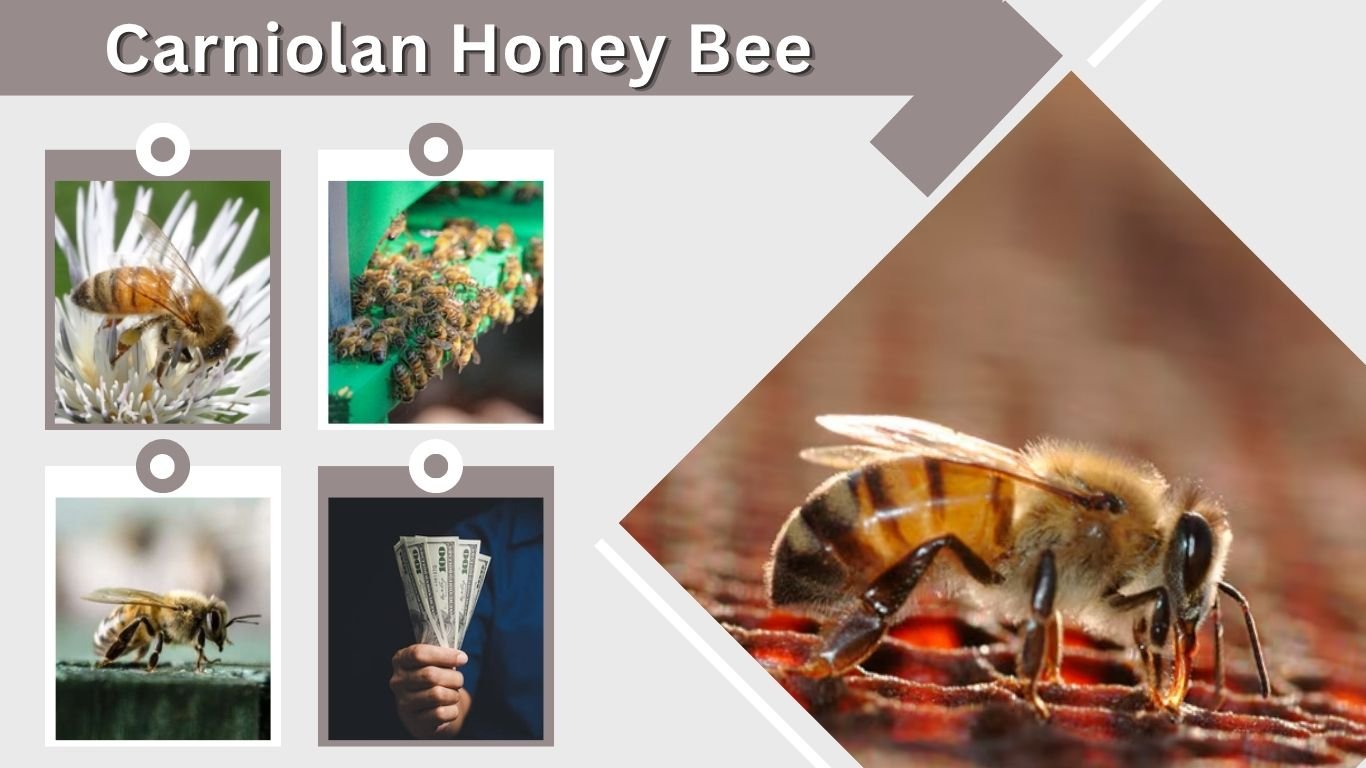
The Carniolan honey bee (Apis mellifera carnica) is a gentle, dark-colored subspecies valued for rapid spring growth, efficient overwintering, and strong honey production. Originating in Central and southeastern Europe, it adjusts brood production according to available pollen and nectar. This helps colonies conserve winter stores but can also create a strong swarming impulse during spring. Carniolans are popular with beginners and experienced beekeepers, especially in cooler climates, although their performance depends on queen genetics, local weather, forage availability, disease management, and beekeeping practices.
What Is a Carniolan Honey Bee?
The Carniolan is a subspecies of the western honey bee. Its scientific name is Apis mellifera carnica. The name comes from Carniola, a historical region covering much of present-day Slovenia. It is commonly called the Carniolan bee, Carnica bee, or gray honey bee.
Origin and Natural Range
Carniolan honey bees are native to Slovenia and surrounding areas of Central and southeastern Europe. Their historical range includes parts of Austria, Croatia, Bosnia and Herzegovina, Serbia, Hungary, Romania, Montenegro, and neighboring regions.
The combination of cold winters, warm summers, and changing seasonal forage helped shape their distinctive colony cycle. They maintain relatively small winter populations and expand rapidly when pollen and nectar become available in spring.
Carniolans were first imported into the United States from Dalmatia, in modern Croatia, in 1877. Additional introductions occurred during the late nineteenth century.
Carniolan Honey Bee Identification
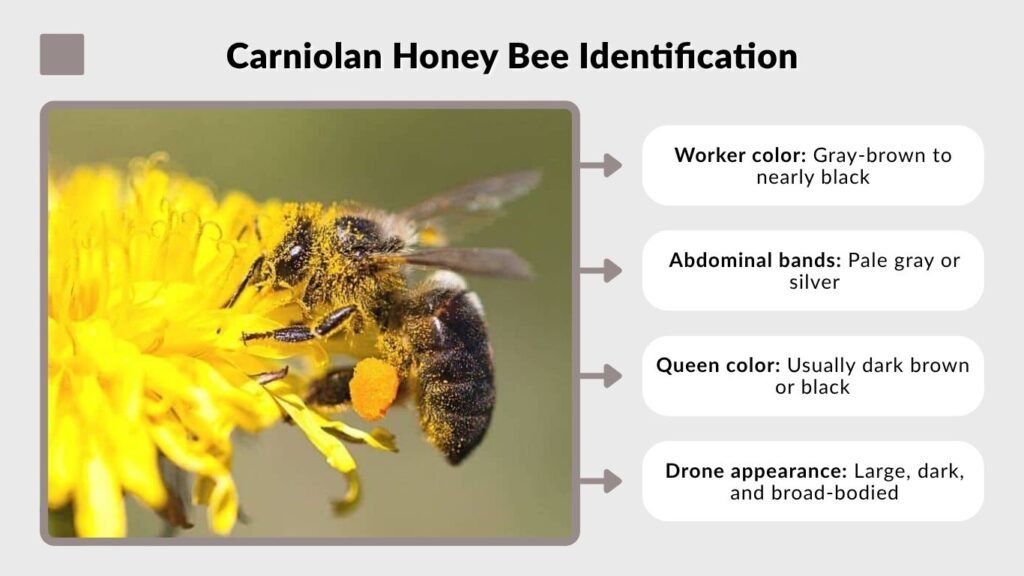
Carniolan workers are generally darker than Italian honey bees. Their bodies range from gray-brown to nearly black and are covered with short gray or silvery hairs. Pale bands may appear across the abdomen, but bright yellow bands are uncommon in traditional Carniolan lines.
Physical Characteristics
- Worker color: Gray-brown to nearly black
- Abdominal bands: Pale gray or silver
- Queen color: Usually dark brown or black
- Drone appearance: Large, dark, and broad-bodied
- Body size: Similar to most European honey bees
- Hair color: Short gray or silvery hairs
- Scientific name: Apis mellifera carnica
Workers are typically around 12–15 millimeters long, while queens have longer abdomens and may reach approximately 18–20 millimeters. Measurements vary, and size alone cannot reliably identify a subspecies.
Can Carniolan and Italian Bees Be Distinguished?
Typical Carniolans are dark gray, while Italian bees are usually more golden or yellow. However, appearance is not always dependable because commercial colonies frequently contain mixed ancestry.
A queen’s appearance also does not guarantee that all her offspring are pure Carniolan. If she mates naturally with drones from surrounding colonies, the workers may display a mixture of colors and behaviors. Reliable identification requires breeding records or genetic analysis.
Characteristics and Temperament
Carniolan honey bees are widely known for their calm behavior on the comb. Well-bred colonies can often be inspected with relatively little smoke. Nevertheless, every colony can become defensive when queenless, disturbed, exposed to predators, or inspected during poor weather.
Desirable Traits
- Gentle temperament
- Rapid spring population growth
- Efficient winter clustering
- Relatively low winter food consumption
- Strong response to seasonal forage
- Good honey-production potential
- Reduced brood rearing during shortages
- Good orientation around the apiary
- Generally limited robbing behavior
- Low-to-moderate propolis production
Temperament is affected by queen genetics, drone ancestry, local hybridization, weather, colony condition, and management. A colony sold as Carniolan should not be assumed to remain permanently gentle.
Possible Disadvantages
The principal disadvantage is a strong spring swarming tendency. A small winter colony can expand quickly, filling the brood nest before the beekeeper expects it.
Other possible challenges include:
- Frequent spring inspections
- Need for early hive expansion
- Queen cells developing rapidly
- Reduced brood production during a nectar shortage
- Variable traits in open-mated queens
- Difficulty identifying the dark queen
- Performance differences between breeding lines
Swarming is a natural method of colony reproduction, not evidence that the bees are unhealthy. However, an unmanaged swarm can reduce the population available for honey production.
Carniolan Honey Production
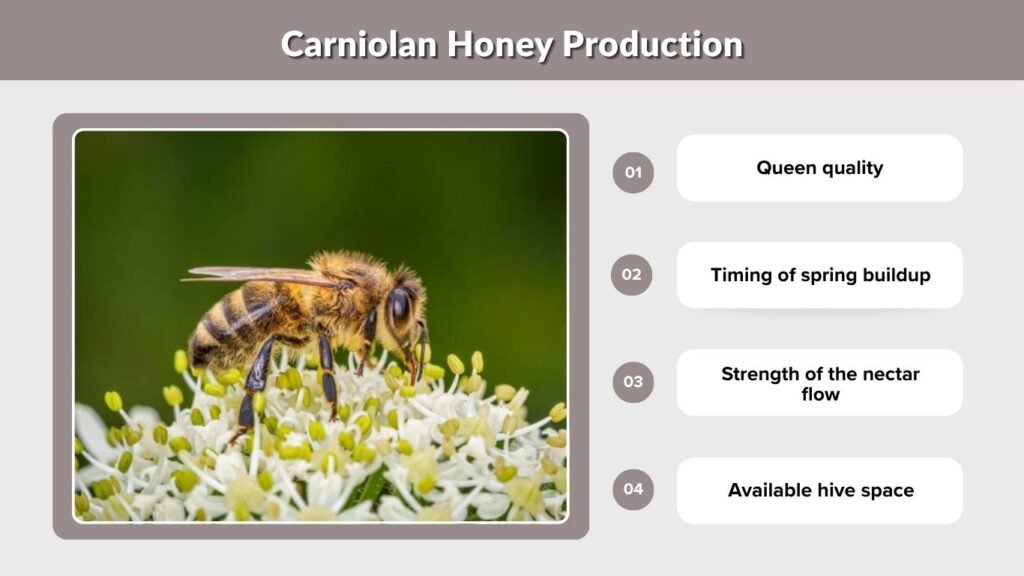
Carniolans can be excellent honey producers when their spring population peak matches the main local nectar flow. Their rapid buildup provides a large workforce capable of collecting nectar from fruit trees, clover, acacia, oilseed crops, and other early or midsummer flowers.
Factors Affecting Honey Yield
- Queen quality
- Timing of spring buildup
- Strength of the nectar flow
- Available hive space
- Swarm prevention
- Varroa mite control
- Colony nutrition
- Weather conditions
- Length of the foraging season
Carniolans are not automatically more productive than Italian or Russian bees. Local adaptation and management can matter more than the name of the stock.
If a colony swarms shortly before the main nectar flow, its honey harvest may be substantially reduced. Providing supers and managing congestion before swarm cells appear helps preserve the workforce.
Seasonal Hive Management
Carniolans respond quickly to seasonal changes. The queen may increase egg laying rapidly when fresh pollen becomes available, then reduce brood production when forage declines. This responsiveness helps the colony conserve resources but requires attentive spring management.
Spring Management
Inspect colonies early enough to detect rapid expansion. Important tasks include:
- Checking queen performance
- Providing additional brood space
- Adding honey supers before congestion develops
- Monitoring swarm cells
- Making controlled splits when appropriate
- Ensuring adequate food during sudden cold periods
- Monitoring Varroa mites
Simply destroying queen cells does not permanently remove the conditions causing swarming. The beekeeper must address congestion, queen condition, ventilation, and the colony’s reproductive impulse.
Winter Management
Carniolans usually form smaller winter clusters than Italian bees and may consume fewer stored resources. This makes them attractive for climates with long winters.
A small cluster still requires adequate honey, ventilation, and protection from excessive moisture. Beekeepers should check hive weight because no genetic line can survive after its accessible food is exhausted.
Carniolans in Warm Climates
Carniolans can live in warm areas such as California, but they may not be the ideal choice for every location. In regions with continuous forage and mild winters, Italian or locally selected stocks may maintain larger productive populations for longer periods.
Carniolans perform particularly well where winters are cool and spring nectar flows begin rapidly. They can also work in USDA Zone 7a if the colony receives adequate winter stores and early swarm management.
Carniolan Queens and Drones
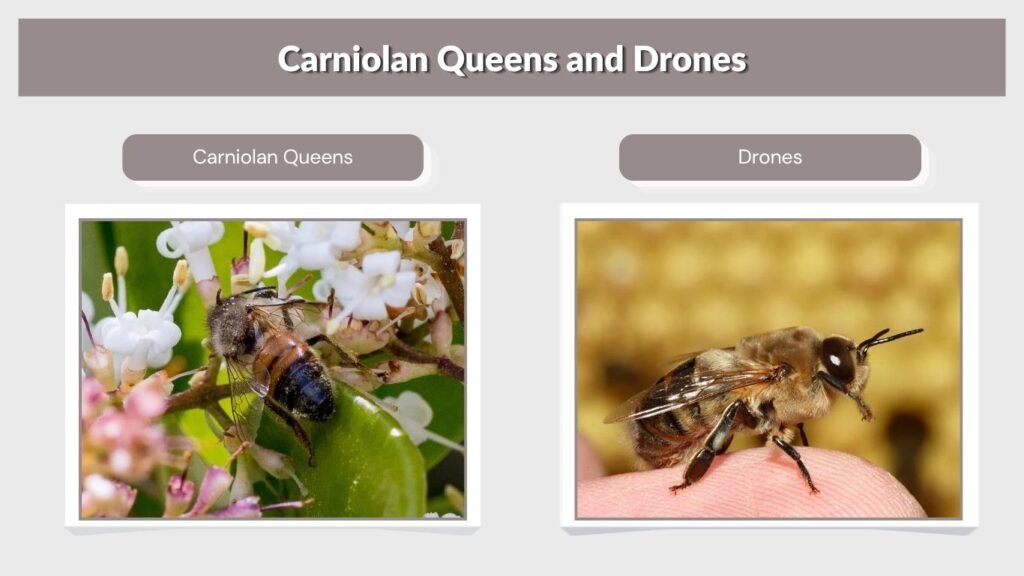
A Carniolan queen controls colony genetics only partly. Her daughters inherit genes from both the queen and the drones with which she mated. Because a queen mates with multiple drones, workers within one hive can belong to several paternal families.
Buying a Carniolan Queen
A queen may be sold as:
- Open-mated: Mated naturally with drones of uncertain ancestry
- Controlled-mated: Mated in an isolated area containing selected drones
- Instrumentally inseminated: Inseminated using semen from selected drones
- Production queen: Selected mainly for colony performance
- Breeder queen: Intended for producing future queens
Controlled-mated and instrumentally inseminated queens offer more predictable genetics. Open-mated queens may still produce excellent colonies, especially when purchased from a respected regional breeder.
After requeening, allow approximately six weeks before judging the new colony. The previous queen’s workers must gradually be replaced by daughters of the new queen.
New World Carniolan Bees
New World Carniolan is a selected breeding population developed in North America, not a separate honey bee subspecies. The program was established by Susan Cobey and Tim Lawrence and used controlled breeding to maintain Carniolan characteristics while selecting for colony performance.
Desired qualities have included gentleness, winter survival, productivity, brood quality, and manageable swarming. Performance still varies among breeders and individual queens.
Carniolan vs Italian vs Russian Honey Bees
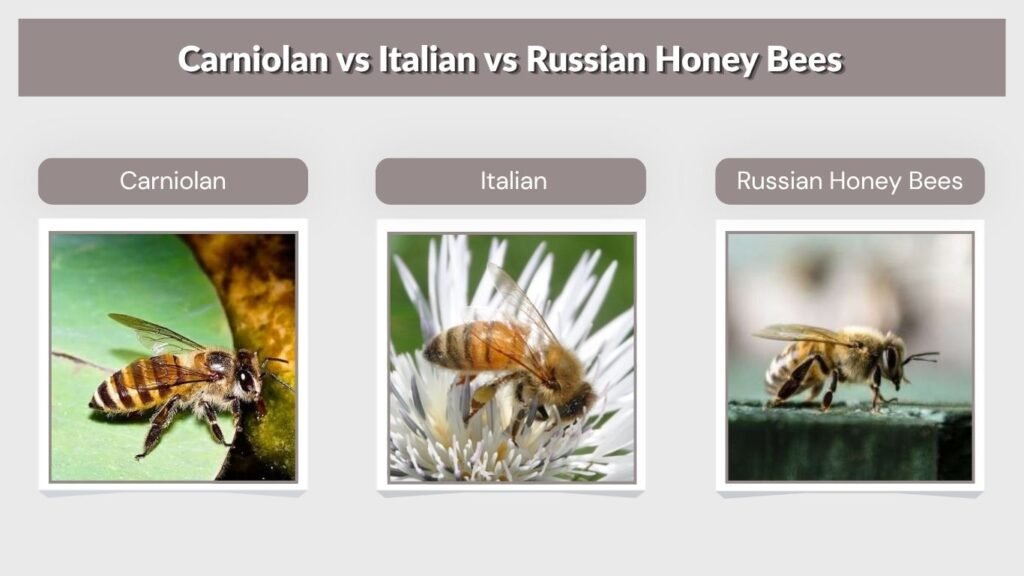
All three can produce healthy, productive colonies. Choosing among them should depend on climate, forage schedule, disease pressure, and the beekeeper’s management style.
| Trait | Carniolan | Italian | Russian |
| Typical color | Gray to dark brown | Yellow to golden | Dark brown to black |
| Temperament | Usually gentle | Usually gentle | Variable |
| Spring buildup | Very rapid | Steady and strong | Closely tied to forage |
| Swarming tendency | Relatively high | Moderate | Moderate to high |
| Winter population | Smaller | Larger | Smaller |
| Winter food use | Usually efficient | Often higher | Usually efficient |
| Robbing tendency | Generally lower | Often higher | Variable |
| Varroa resistance | Line-dependent | Usually limited | Generally stronger |
| Best climate | Cool or seasonal | Warm or long-season | Cold or mite-challenged |
Russian bees should not be confused with Carniolans. Russian stock was developed from bees collected in Russia’s Primorsky region and selected for resistance to Varroa and tracheal mites. Carniolans should still receive regular mite monitoring and treatment when thresholds require it.
Carniolan Bees for Sale
Carniolans are commonly sold as queens, packages, and nucleus colonies. Availability and price vary by season, breeder, shipping distance, and genetic certification.
Queen, Package, or Nuc?
- Queen: Suitable for changing the genetics of an existing colony.
- Package: Usually contains about three pounds of workers and a caged queen but no comb or brood.
- Nucleus colony: Contains a queen, workers, brood, food, and several established frames.
- Full colony: Provides an established hive but is more expensive and difficult to transport.
Workers in a package may not be daughters of the included queen. The colony will become more characteristically Carniolan as those workers die and are replaced by the queen’s offspring.
Buying Checklist
Choose a seller who provides:
- The queen’s breeding or mating information
- A health certificate where required
- Clear arrival and replacement policies
- Pickup or shipping dates
- Varroa and disease-management information
- Instructions for installing the queen or package
- Confirmation of state or regional shipping rules
Local pickup can reduce shipping stress. A locally raised nuc may also be better adapted to regional weather and forage than a package shipped from a distant climate.
FAQs
Are Carniolan honey bees good for beginners?
Yes. Their gentle temperament and winter efficiency can suit beginners, but rapid spring buildup requires careful swarm management.
Do Carniolan bees produce a lot of honey?
They can produce excellent harvests when colony growth matches the local nectar flow. Honey yield depends heavily on forage, weather, hive health, and swarm prevention.
Are Carniolan bees resistant to Varroa mites?
Carniolan ancestry alone does not guarantee meaningful Varroa resistance. Every colony requires regular mite testing and appropriate control.
How can you identify a Carniolan queen?
Carniolan queens are usually dark brown or black with a long abdomen. A numbered or painted queen is easier to locate, but breeding records provide better identification than color.
Do Carniolan honey bees swarm frequently?
They can have a strong swarming tendency because their colonies expand rapidly in spring. Early inspections, timely supers, young queens, and planned splits can help manage it.