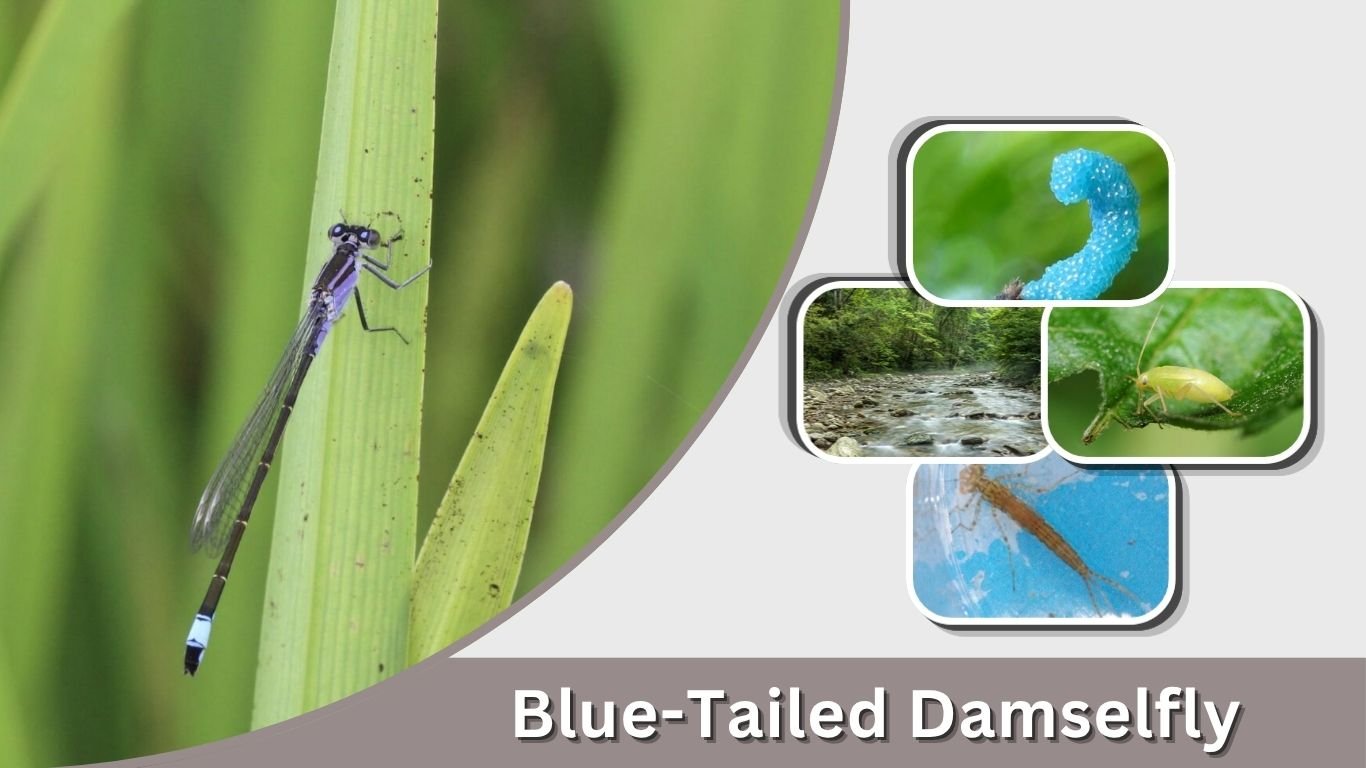
The Blue-tailed Damselfly (Ischnura elegans) is a small but distinctive freshwater insect recognized by its mostly dark abdomen and bright blue “tail-light” near the tip. It is one of the most widespread damselflies in Britain and occurs around ponds, lakes, canals, ditches, and slow-flowing rivers. Males are relatively easy to recognize, while females occur in several striking color forms, including violet and reddish-orange. This guide covers Blue-tailed Damselfly identification, females, habitat, diet, life cycle, larvae, mating, distribution, and differences from the Scarce Blue-tailed Damselfly.
What Is a Blue-Tailed Damselfly?
The Blue-tailed Damselfly belongs to the family Coenagrionidae and genus Ischnura. Its scientific name is Ischnura elegans. Although the insect has “blue-tailed” in its name, most of a mature male’s abdomen is actually metallic black. The vivid blue eighth abdominal segment creates the small bright patch near the tip that gives the species its common name.
Scientific Classification
- Common name: Blue-tailed Damselfly
- Scientific name: Ischnura elegans
- Family: Coenagrionidae
- Order: Odonata
- Suborder: Zygoptera
- Alternative name: Common Bluetail
- Adult length: About 30–34 mm
- Lifestyle: Predatory freshwater insect
Blue-Tailed Damselfly Identification
Adult males have a predominantly bronze-black abdomen with bright blue on abdominal segment eight. The sides of the thorax become blue as the male matures, and the wing spots, called pterostigmata, are distinctly two-colored. Immature males begin greener and gradually develop their mature blue coloration.
Male vs Female Blue-Tailed Damselfly
Sexing this species can be surprisingly challenging because females are highly variable. Males follow a relatively predictable color transition as they mature, whereas females occur in several inherited color forms and change appearance with age. This variety explains why photographs of female Blue-tailed Damselflies can look like completely different species.
Male Blue-Tailed Damselfly
- Mostly metallic black or bronze-black abdomen
- Entire eighth abdominal segment bright blue
- Blue sides to the thorax when mature
- Blue eyes in mature individuals
- Two-toned wing spots
- Immature males have a greener thorax
- Slender body typical of damselflies
The blue eighth segment resembles a tiny colored lamp at the end of an otherwise dark abdomen, sometimes described by observers as a “tail-light.”
Female Blue-Tailed Damselfly
Females can be violet, pinkish-orange, blue, olive-green, or brown depending on their color form and age. Researchers recognize several named stages and morphs.
One immature form, violacea, has violet or lilac coloration. It can mature into either a blue male-like form often called typica, or the olive-green infuscans form. Another immature form, rufescens, has orange-pink coloration and develops into the browner rufescens-obsoleta form.
What Is the Rufescens Blue-Tailed Damselfly?
Rufescens is not a separate species. It is an immature female color form of Ischnura elegans. These females can look salmon-pink, orange, or reddish around the thorax while retaining a blue spot on abdominal segment eight.
As they mature, their bright reddish coloration becomes duller and browner, producing the mature rufescens-obsoleta appearance.
Blue-Tailed Damselfly Habitat
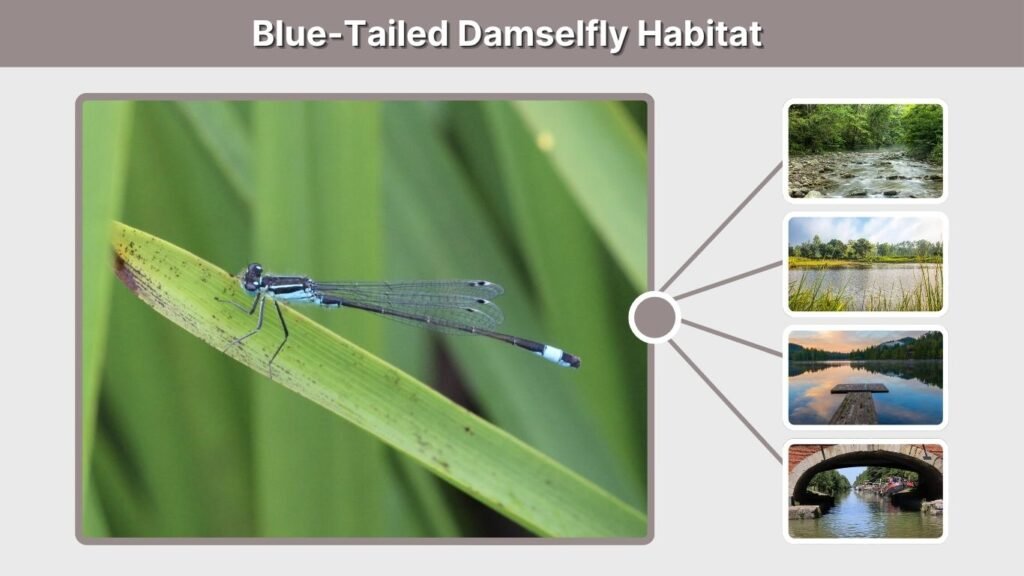
One reason the Blue-tailed Damselfly is so successful is its tolerance of many freshwater conditions. It can breed in natural wetlands as well as artificial water bodies and is more tolerant of moderately polluted or slightly saline water than many other damselflies.
Common Habitats
- Ponds
- Lakes
- Canals
- Drainage ditches
- Slow-flowing rivers
- Streams
- Gravel pits
- Marshes
- Vegetated pools
- Slightly brackish water
- Moderately polluted freshwater
Adults are frequently seen among grasses, reeds, rushes, and other vegetation along the margins of the water.
Distribution in the UK and Ireland
The Blue-tailed Damselfly is widespread throughout Britain and reaches northern Scotland. It also occurs widely in Ireland. Its ability to colonize new habitats helps make it one of the more familiar damselflies around lowland freshwater.
Adults may be encountered from spring into early autumn, with the exact flight period varying according to climate and location.
What Do Blue-Tailed Damselflies Eat?
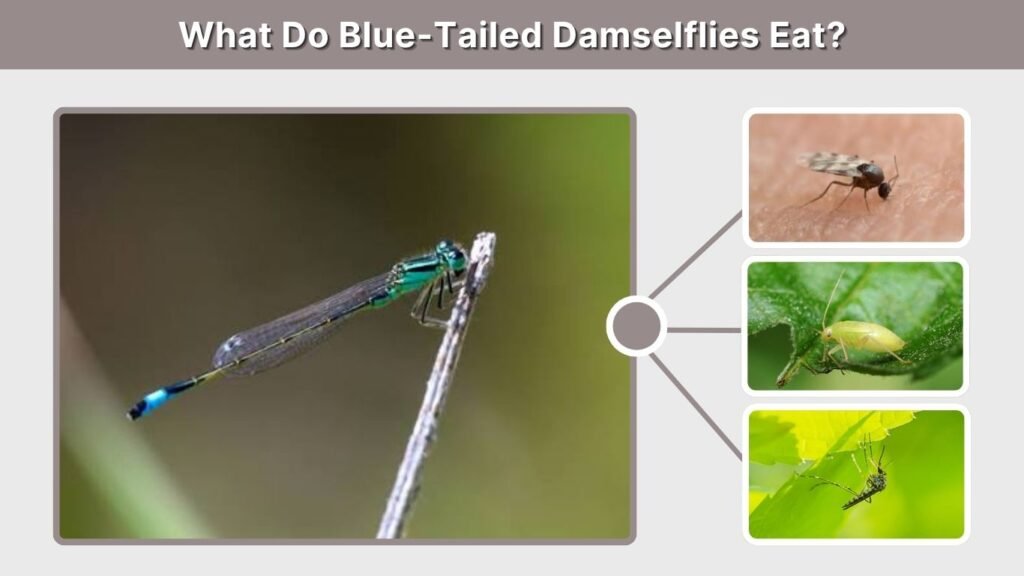
Both adults and larvae are predators. Adults hunt tiny insects around vegetation and water, while aquatic nymphs capture small animals beneath the surface. Their diet makes them part of the natural predator community around ponds and wetlands.
Adult Diet
- Midges
- Mosquitoes
- Small flies
- Aphids
- Tiny moths
- Other small flying insects
Adult damselflies often fly from a perch, intercept prey, and return to vegetation. Their legs can help form a basket around airborne prey.
Blue-Tailed Damselfly Larvae Diet
Nymphs feed on small aquatic invertebrates, including insect larvae and other organisms they can overpower. Like other damselfly larvae, they possess an extendable lower mouthpart that rapidly shoots forward to grab prey.
They remain active predators throughout much of their aquatic development.
Blue-Tailed Damselfly Life Cycle
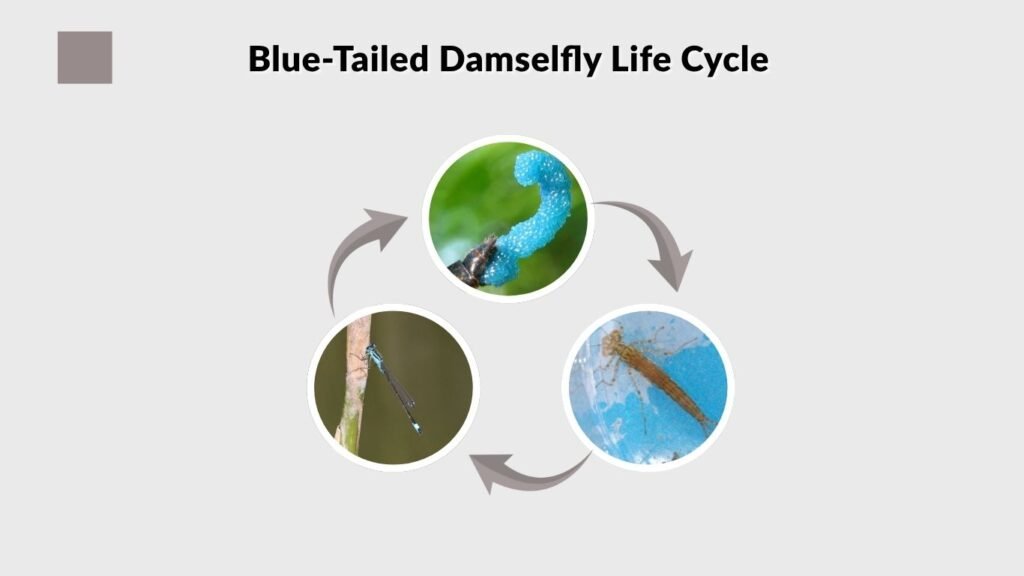
The species undergoes incomplete metamorphosis, so there is no pupal stage. Its life cycle consists of egg, aquatic nymph, and winged adult. Most of its life is spent underwater, with the familiar flying damselfly representing only the reproductive adult phase.
Eggs and Mating
During mating, the male clasps the female behind her head using appendages at the tip of his abdomen. The female then bends her abdomen forward, creating the characteristic heart- or wheel-shaped mating posture seen in damselflies.
Females use an ovipositor to insert eggs into aquatic vegetation. Damselflies commonly lay eggs directly within plant tissue rather than simply dropping them into open water.
Blue-Tailed Damselfly Nymph
After hatching, the young damselfly lives completely underwater. It feeds, grows, and molts repeatedly.
Blue-tailed Damselfly larvae live among aquatic vegetation in ponds, lakes, canals, ditches, and slow rivers. In much of England the life cycle can be completed in about one year, whereas northern populations may require two years.
Emergence Into an Adult
When the nymph is fully developed, it climbs out of the water onto a stem or other support. Its skin splits, allowing the adult damselfly to emerge.
The newly emerged adult, known as a teneral, initially has soft tissues, pale colors, and weak flight. Its wings and body gradually harden, and mature coloration appears during the following days.
How Long Do Blue-Tailed Damselflies Live?
The aquatic phase accounts for most of the animal’s lifespan. Development commonly takes around one year in warmer parts of its range but can extend to two years in cooler northern areas.
Adult Lifespan
Once emerged, an individual has a much shorter period as a flying adult. During this stage it must feed, mature sexually, find a partner, and reproduce.
Weather, predators, food availability, and habitat quality all affect how long an individual adult survives.
Blue-Tailed vs Scarce Blue-Tailed Damselfly
The Scarce Blue-tailed Damselfly (Ischnura pumilio) is the species most likely to cause identification problems. Both are small, predominantly black damselflies with a bright blue patch near the end of the abdomen.
Main Differences
| Feature | Blue-tailed | Scarce Blue-tailed |
| Scientific name | I. elegans | I. pumilio |
| Distribution in Britain | Widespread | Localized |
| Blue male marking | Mainly segment 8 | Mainly segments 8–9 |
| Male wing spots | Two-toned | Two-toned, unequal in size |
| Immature female | Violet or reddish forms | Distinctive bright orange |
| Typical habitat | Wide range of waters | Shallow, disturbed wetlands |
Scarce Blue-tailed Damselflies favor shallow pools, seepages, boggy areas, and recently disturbed wetlands with relatively open vegetation. They are much more localized in Britain than I. elegans.
Scarce Blue-Tailed Female
Immature females I. pumilio can be spectacularly orange, a stage known as the aurantiaca phase. This orange female is one of the easiest stages of the Scarce Blue-tailed Damselfly to recognize.
Mature individuals become considerably less conspicuous and can more easily be confused with the common species.
Blue-Tailed Damselfly vs Common Blue Damselfly
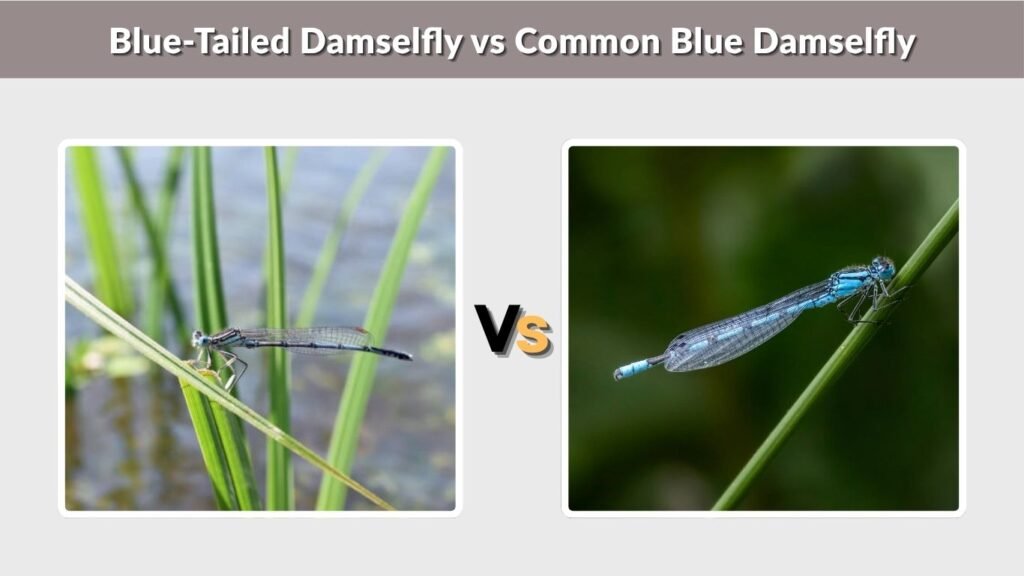
Despite their similar names, these are different species. The Common Blue Damselfly is Enallagma cyathigerum, while the Blue-tailed Damselfly is Ischnura elegans.
A male Common Blue is extensively bright blue and black across the abdomen. A male Blue-tailed Damselfly is mostly dark, with blue concentrated on segment eight near the tail. The color pattern therefore provides a useful first clue.
Are Blue-Tailed Damselflies Dangerous?
Blue-tailed Damselflies are harmless to humans. They cannot sting and have no reason to attack people.
Their small jaws are adapted for catching tiny insects. They are useful wetland predators and provide food for birds, frogs, fish, larger dragonflies, and other animals.
Blue-Tailed Damselfly Spiritual Meaning
There is no scientific or species-specific spiritual meaning associated with Ischnura elegans. However, damselflies more generally are sometimes used symbolically to represent change, adaptability, calmness, or transformation because they develop underwater before becoming flying adults.
These interpretations belong to personal or cultural symbolism rather than the biology of the species.
FAQs
1. Why is it called a Blue-tailed Damselfly?
A mature male has an otherwise mostly dark abdomen with a vivid blue eighth abdominal segment near its tip, creating the appearance of a bright blue tail-light.
2. What color is a female Blue-tailed Damselfly?
Females are highly variable. Depending on age and form, they can appear violet, salmon-pink, orange, blue, olive-green, or brown.
3. Where do Blue-tailed Damselflies live?
They live around ponds, lakes, canals, ditches, marshes, and slow-flowing rivers. They tolerate a wider range of water conditions than many damselflies, including moderately polluted water.
4. What do Blue-tailed Damselflies eat?
Adults capture midges, mosquitoes, flies, and other tiny insects. Their aquatic nymphs prey on small freshwater invertebrates.
5. Is the Scarce Blue-tailed Damselfly the same species?
No. The common Blue-tailed Damselfly is Ischnura elegans, while the Scarce Blue-tailed Damselfly is Ischnura pumilio. The scarce species is smaller, more localized, and favors shallow, early-stage wetland habitats.