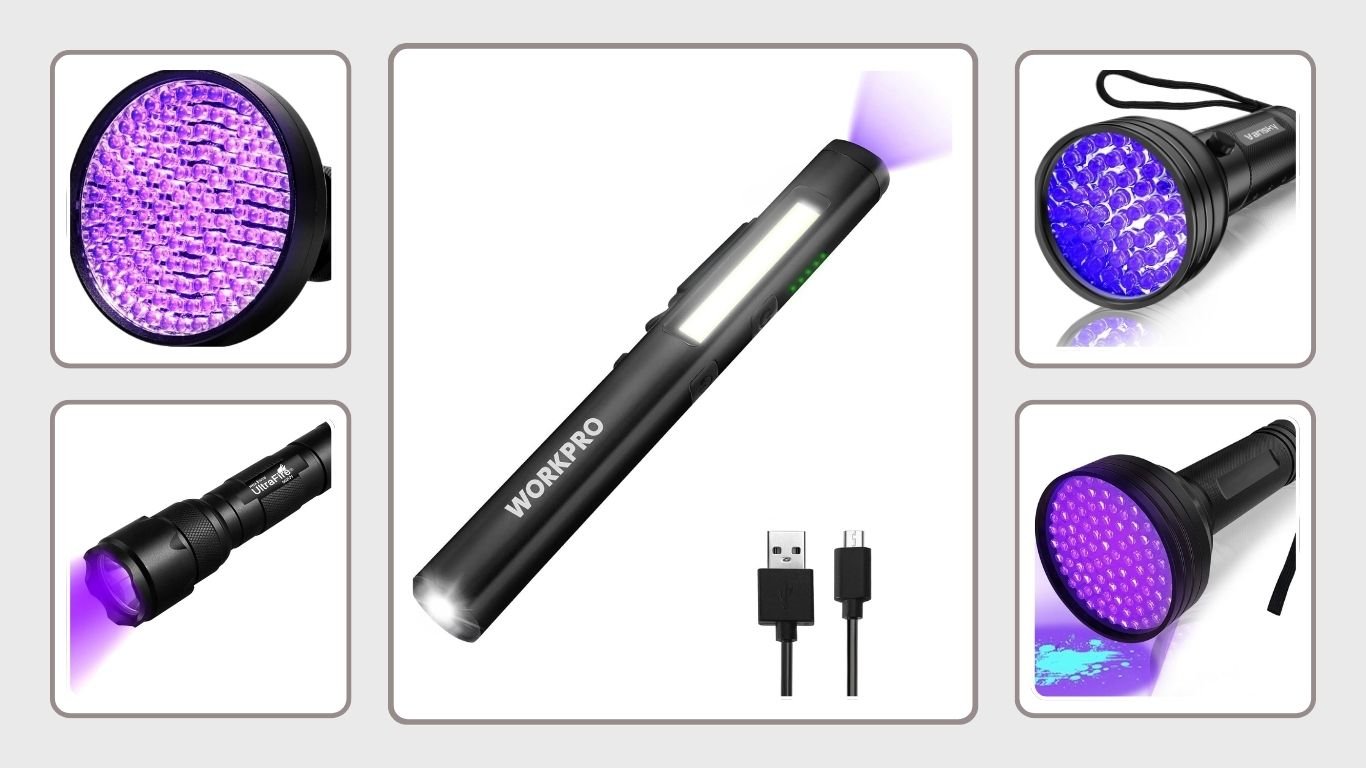
Choosing the best pest inspection flashlight can make it easier to spot insects, droppings, stains, entry points, and other signs of pest activity in dark or hard-to-reach areas. Some models use bright white LEDs for general inspection, while others add UV or blacklight technology to reveal certain stains and hidden evidence more clearly. A good inspection light should be compact, bright, durable, and easy to handle. In this guide, we review 10 practical pest inspection flashlights for home, professional, and routine property checks.
1. Vansky UV Flashlight Black Light for Pest Inspection
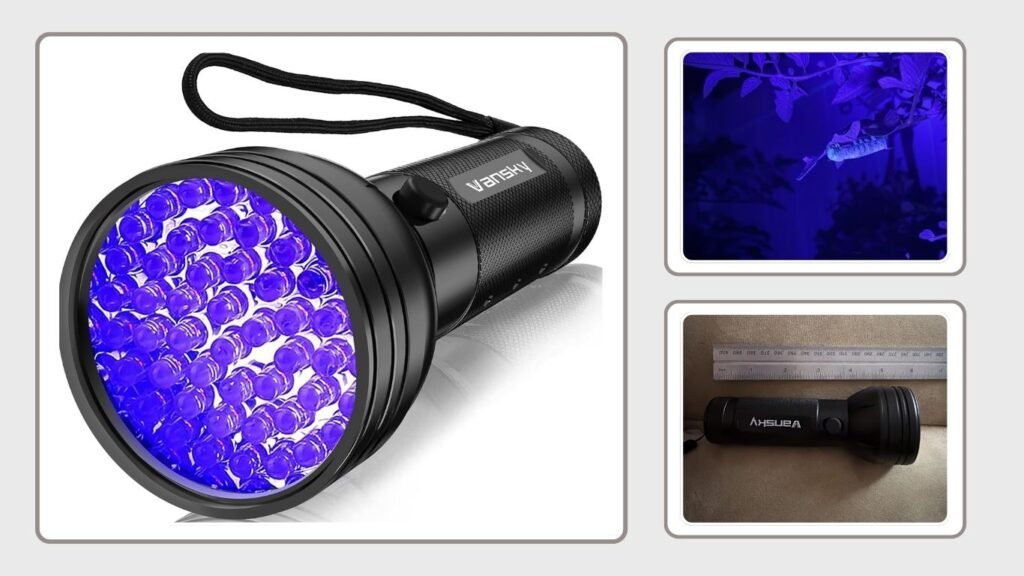
The Vansky UV Flashlight Black Light is a practical inspection tool for homeowners, pest technicians, and property inspectors who need ultraviolet illumination in dark spaces. It uses 51 UV LEDs with a wavelength around 395 nm and is compact enough to carry between rooms or inspection sites. While UV light should not be treated as a guaranteed detector for every pest, it can reveal fluorescent stains, scorpions, residues, and other clues that may support a more detailed pest inspection.
Key Features
- 51 UV LEDs
- Approximately 395 nm ultraviolet output
- Compact handheld design
- Durable aluminum body
- Powered by three AA batteries
- Useful for stain and scorpion detection
- Suitable for dark-room inspections
- Easy single-button operation
Why It’s Best for UV Pest Inspection
The Vansky works particularly well when a normal white flashlight cannot reveal enough surface detail. UV-reactive materials can become much easier to notice in dim conditions, making the light useful for inspecting carpets, upholstery, bathrooms, hotel rooms, garages, and other areas where hidden stains or biological residue may be present.
Its wide 51-LED head also provides more coverage than a small single-LED UV penlight, so users can scan larger surfaces without constantly moving the beam.
Performance & Durability
The aluminum construction gives the Vansky a solid feel while keeping it reasonably lightweight. Its pocket-friendly dimensions make it easy to carry in an inspection bag or toolbox. Three AA batteries power the unit, so replacement batteries are easy to find even when working away from a charger.
For strongest fluorescence, the inspection area should be as dark as practical. Bright ambient light can reduce contrast and make faint evidence harder to notice.
Pros, Cons & Overall Verdict
Pros: Broad UV coverage, simple operation, sturdy aluminum body, portable size, and excellent versatility for stain and scorpion inspections.
Cons: Batteries are not included, and UV alone cannot reliably identify every insect, dropping, egg, or infestation.
Overall Verdict: The Vansky 51-LED UV flashlight is a strong general-purpose option for pest inspectors who want broad ultraviolet coverage at close range. Its combination of portability and wide illumination makes it especially useful as a secondary inspection light alongside a conventional white flashlight.
2. Lepro LED Penlight Flashlight for Pest Inspection
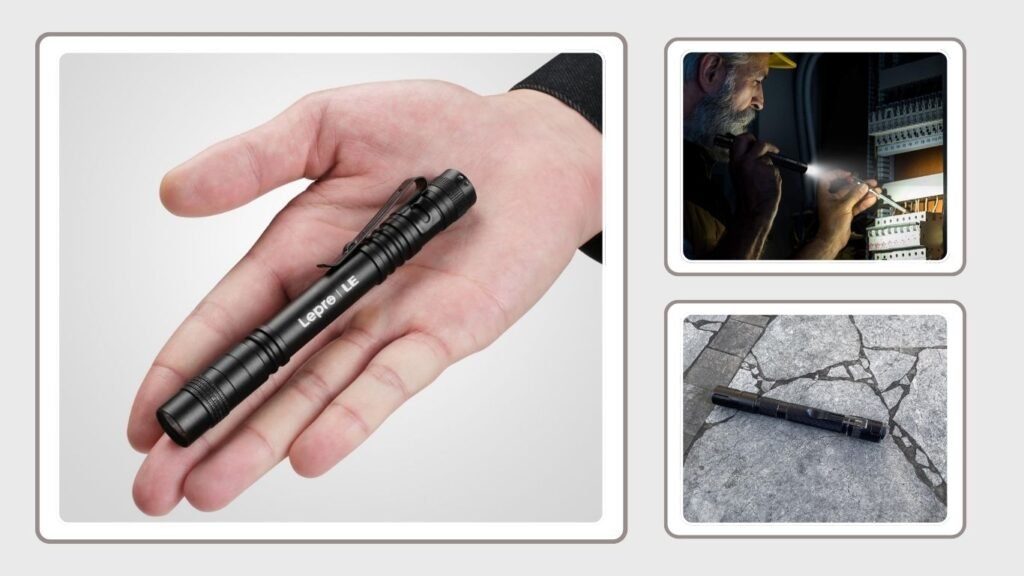
The Lepro LED Penlight Flashlight is a compact white-light option designed for close inspection work rather than ultraviolet detection. This two-pack provides up to 120 lumens per light, three lighting modes, and a slim aluminum body with a pocket clip. For pest inspections, its narrow profile is especially useful when checking cracks, cabinets, plumbing areas, furniture edges, wall gaps, and other locations where a larger flashlight can be awkward to position.
Key Features
- Up to 120 lumens
- Three lighting modes
- Compact pen-style design
- Aluminum construction
- IPX4 water resistance
- Pocket clip
- Two flashlights per pack
- Powered by two AAA batteries each
Why It’s Best for Tight Inspection Areas
The strongest advantage is portability. A penlight can be held close to narrow cracks and directed beneath cabinets, behind appliances, around plumbing, or along mattress seams without the bulk of a full-size flashlight.
White light is also useful for examining physical evidence such as insects, shed skins, droppings, webbing, frass, damage, and entry gaps because it shows natural colors more accurately than UV illumination.
Having two lights in the package is another practical benefit for technicians who want one in a tool bag and another in a vehicle or backup kit.
Performance & Durability
The focused LED beam is designed for close-range inspection and can reach significantly farther when necessary. The aluminum body improves durability, while IPX4 resistance provides protection against splashes and light rain during routine work.
Because the unit uses standard AAA batteries, there is no waiting for a built-in battery to recharge. That can be useful during long inspection days.
Pros, Cons & Overall Verdict
Pros: Lightweight, compact, bright enough for detailed inspection, water-resistant, inexpensive battery system, and supplied as a two-pack.
Cons: No UV function and less overall brightness than larger inspection flashlights.
Overall Verdict: The Lepro penlight is best for inspectors who prioritize precision and portability. It is particularly effective for checking tight spaces and physical pest evidence where a compact white beam is more useful than broad UV illumination.
3. WORKPRO Rechargeable UV Inspection Penlight
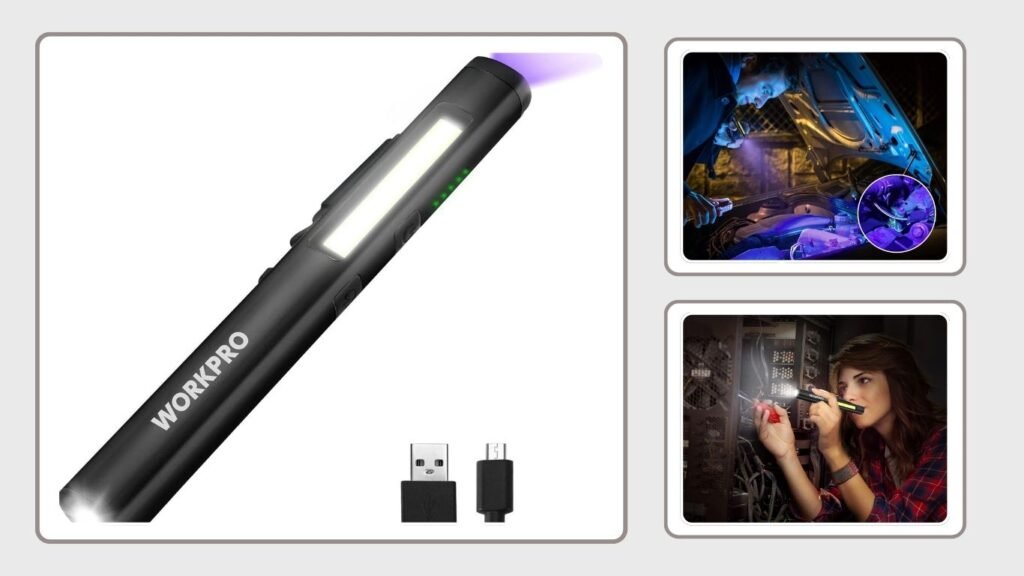
The WORKPRO Rechargeable Penlight is one of the most versatile inspection flashlights in this roundup because it combines standard white illumination with a dedicated 365 nm UV light. It provides a 450-lumen COB floodlight, a 120-lumen spotlight, USB Type-C charging, and a magnetic rotating clip. That combination makes it suitable for both routine visual pest inspections and specialized UV checks without carrying two separate flashlights.
Key Features
- 450-lumen COB floodlight
- 120-lumen spotlight
- 365 nm UV black light
- USB Type-C rechargeable design
- Magnetic mounting
- Rotatable pocket clip
- Lightweight aluminum body
- Approximately 6.5 inches long
Why It’s Best for All-in-One Pest Inspection
The WORKPRO stands out because inspectors can switch between normal illumination and UV inspection depending on what they are examining.
The bright COB floodlight is useful when searching larger cabinets, basements, utility rooms, or wall areas, while the focused spotlight helps with cracks and smaller structural details. The 365 nm UV mode can increase contrast when examining fluorescent stains or other UV-reactive evidence.
Its magnetic clip also allows hands-free positioning on compatible metal surfaces, which can be particularly useful when moving objects or inspecting plumbing and equipment.
Performance & Durability
A maximum 450-lumen floodlight gives this compact tool significantly more illumination than many traditional penlights. The rechargeable battery reduces dependence on disposable cells, while pass-through charging allows the light to operate while connected to power.
The aluminum body keeps weight to about 2.8 ounces, so it remains comfortable for repeated use. Its compact size also makes it easy to carry on a pocket clip throughout an inspection.
Pros, Cons & Overall Verdict
Pros: White and UV lighting in one tool, powerful COB output, USB-C charging, magnetic mounting, rotatable clip, and excellent portability.
Cons: Smaller than a full-size inspection floodlight and may require charging during extended heavy use.
Overall Verdict: The WORKPRO is arguably the most balanced choice of the first five for professional-style pest inspection. Its combination of bright white light, 365 nm UV capability, rechargeable power, and hands-free mounting provides excellent technical versatility.
4. Kobra 128-LED UV Blacklight Inspection Flashlight
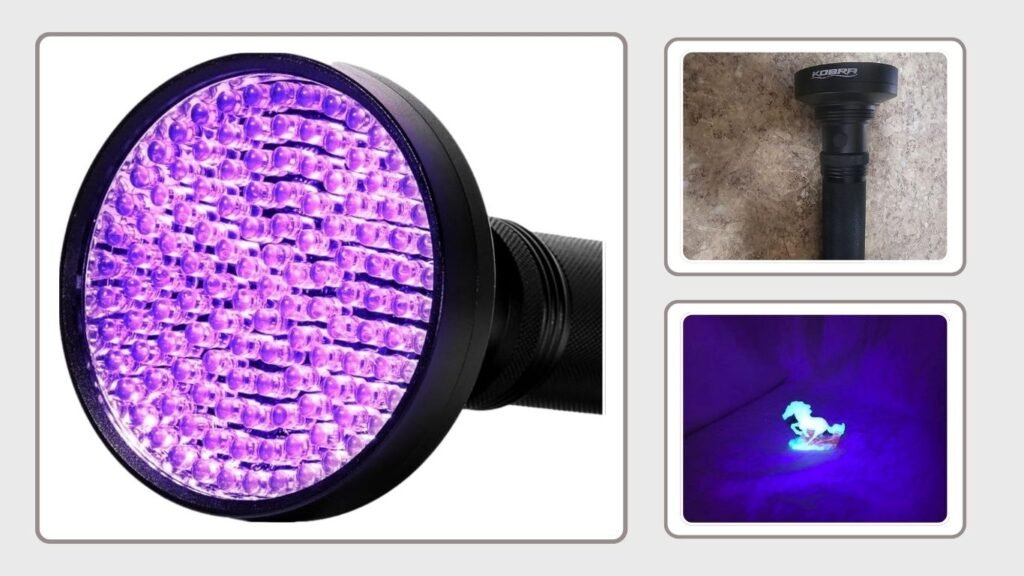
The Kobra UV Blacklight Flashlight is built for inspections that require broad ultraviolet coverage. Its large head contains 128 UV LEDs operating around the 385–395 nm range, creating a wide beam for scanning larger surfaces more quickly than a compact penlight. For pest-related work, this can be useful when checking floors, carpets, walls, hotel rooms, basements, garages, and other broad areas for fluorescent stains or signs that deserve closer examination.
Key Features
- 128 UV LEDs
- Approximately 385–395 nm wavelength
- Wide-area UV illumination
- Aluminum construction
- Battery-powered operation
- Uses six AA batteries
- Suitable for stain and leak detection
- Designed for home and professional inspection
Why It’s Best for Large Inspection Areas
The Kobra’s main advantage is coverage. A technician scanning an entire room with a small UV penlight may need many passes, while the larger 128-LED array illuminates a much broader area at once.
That makes it especially useful for hotel inspections, rental-property checks, garages, storage rooms, and other places where quickly identifying suspicious fluorescent spots can save time.
It is important to remember that glowing material is only a clue. UV fluorescence does not automatically prove the presence of a specific pest.
Performance & Durability
The aluminum housing is designed to withstand regular handling, while battery operation makes the flashlight completely cordless. Six AA batteries provide the power required for its large LED array, though this also makes it heavier than pocket-sized models.
Its broad UV beam is most effective in darkened rooms where fluorescent evidence can stand out clearly.
Pros, Cons & Overall Verdict
Pros: Very wide UV coverage, 128 LEDs, strong inspection-focused design, sturdy housing, and efficient scanning of large surfaces.
Cons: Bulkier than penlights, requires six AA batteries, and does not provide the same natural-color inspection ability as a white flashlight.
Overall Verdict: The Kobra is best for users who need to scan large spaces quickly with UV light. It is less pocket-friendly but technically more efficient when broad fluorescent inspection coverage is the priority.
5. ULTRAFIRE 502UV Zoomable UV Inspection Flashlight
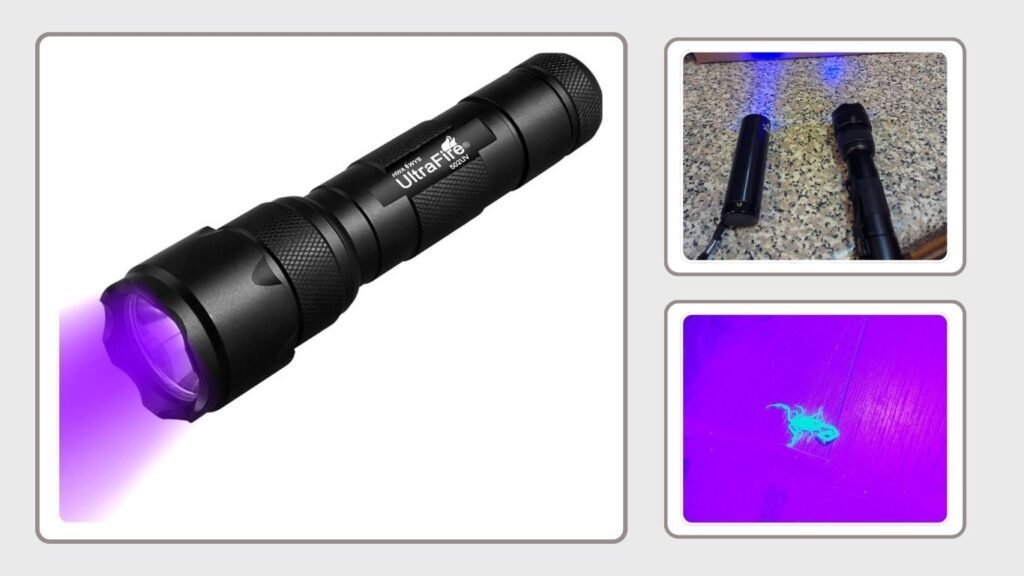
The ULTRAFIRE 502UV combines a compact tactical-style body with an adjustable UV beam. This model produces 395–405 nm ultraviolet light and allows the beam to be zoomed from wider illumination to a tighter spot. That adjustability is particularly useful for pest inspection because users can first scan an area broadly and then narrow the beam to examine a specific stain, crack, surface, or suspicious location more closely.
Key Features
- 395–405 nm UV output
- Zoomable beam
- Maximum beam distance around 60 meters
- Approximately four-hour runtime on high
- IPX7 waterproof rating
- Compact aluminum-style flashlight body
- Multiple compatible lithium battery options
- Designed for UV inspection tasks
Why It’s Best for Adjustable UV Inspection
The zoom function is what separates the ULTRAFIRE 502UV from fixed-beam blacklights.
A wider beam can be used to sweep floors, walls, furniture, and outdoor areas, while the focused setting provides more concentrated illumination for close examination. This makes the flashlight adaptable to both property-wide searching and precision inspection.
Its compact form also makes it easier to carry than large multi-LED blacklights while still providing useful beam reach.
Performance & Durability
ULTRAFIRE lists a maximum beam distance of about 60 meters, approximately four hours of high-mode runtime, and an IPX7 waterproof rating. The light can operate with compatible 18650, 16340, or CR123A lithium batteries depending on the configuration.
That water resistance is valuable for outdoor pest inspections around foundations, sheds, landscaping, and damp structures where weather exposure is possible.
Pros, Cons & Overall Verdict
Pros: Adjustable beam, good UV reach, compact construction, strong water resistance, and useful for both close and wider inspection.
Cons: Battery compatibility requires more attention than standard AA-powered models, and UV light should still be paired with a normal flashlight for complete pest identification.
Overall Verdict: The ULTRAFIRE 502UV is a technically capable choice for inspectors who value adjustable UV coverage. Its zoom function and weather resistance make it particularly useful for mixed indoor and outdoor pest inspection work.
6. Vansky 100 LED UV Blacklight Inspection Flashlight
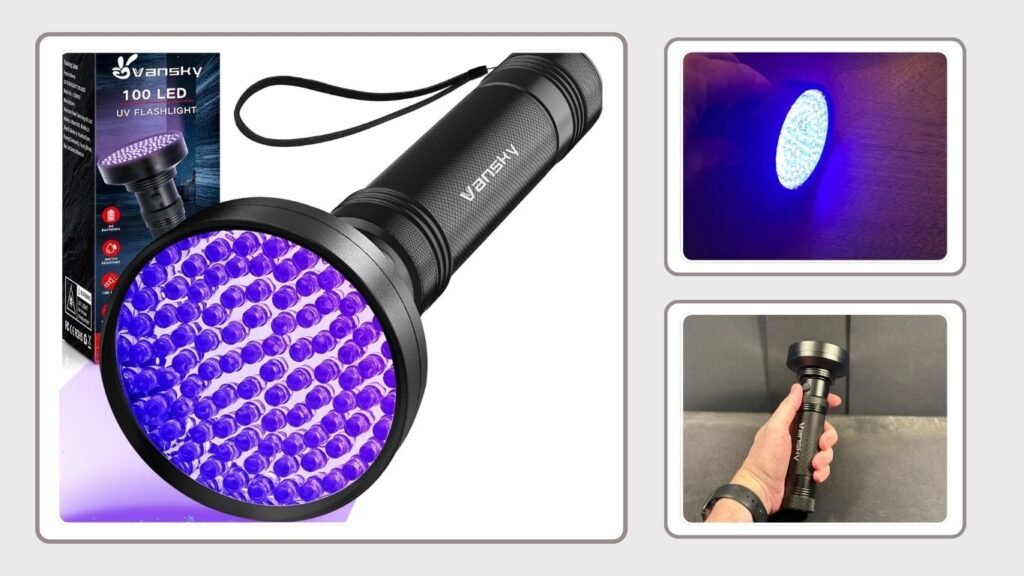
The Vansky 100 LED UV Blacklight Flashlight is built for users who want wider ultraviolet coverage than a compact penlight can provide. Its 100 LEDs emit around 395 nm UV light, making it useful for detecting fluorescent stains, scorpions, residues, and other inspection clues across larger surfaces. The aluminum body and handheld design make it suitable for home inspections, pest-control work, hotel checks, garages, and outdoor searches where a broad UV beam is more practical.
Key Features
- 100 UV LEDs
- 395 nm ultraviolet wavelength
- Wide inspection coverage
- Aluminum construction
- IP44 splash resistance
- Uses six AA batteries
- Up to about 20 hours of listed runtime
- Lanyard included
- Suitable for indoor and outdoor inspection
Why It’s Best for Wide-Area UV Scanning
The key advantage is the large LED array. Rather than checking carpets, walls, flooring, or exterior areas with a very narrow beam, the 100-LED head covers more surface in each pass.
That makes it especially useful when inspecting larger rooms, hotel spaces, basements, storage areas, or outdoor locations for fluorescent evidence.
For pest work, UV findings should be treated as clues rather than definite proof of a particular insect species.
Performance & Durability
Vansky lists a durable aluminum housing, splash resistance, and a battery-powered design that avoids waiting for recharging. Six standard AA batteries also make replacements relatively easy to find.
The flashlight performs best in dark or dim surroundings, where fluorescence becomes easier to distinguish from the surrounding surface.
Its larger head is less pocket-friendly than a penlight, but the extra coverage can significantly improve inspection efficiency.
Pros, Cons & Overall Verdict
Pros: Wide 100-LED coverage, durable housing, 395 nm UV output, long listed runtime, and versatile inspection applications.
Cons: Requires six AA batteries and is larger than compact penlights.
Overall Verdict: The Vansky 100 LED model is an excellent option for inspectors who prioritize broad UV coverage. It is particularly useful for scanning larger rooms and surfaces before moving in for closer examination.
7. Lepro Lightweight Waterproof Inspection Flashlight
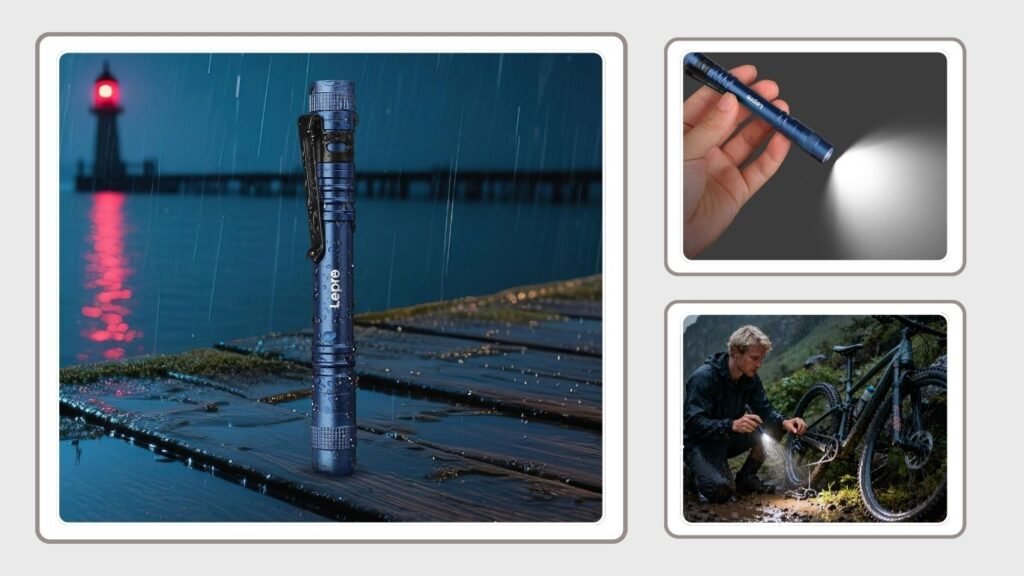
The Lepro Lightweight Waterproof Inspection Flashlight provides bright conventional white illumination rather than relying solely on UV detection. That makes it particularly useful for examining droppings, cracks, damaged wood, insect bodies, webbing, entry gaps, and other evidence where accurate natural-color visibility matters. Its handheld construction and weather-resistant design make it suitable for both indoor inspection work and exterior checks around foundations, sheds, attics, and garages.
Key Features
- Bright LED white-light output
- Lightweight handheld design
- Weather-resistant construction
- Suitable for indoor and outdoor inspection
- Useful for cracks and structural gaps
- Portable enough for tool bags
- Simple handheld controls
- Works well as a primary visual inspection light
Why It’s Best for General Pest Inspection
UV light is valuable for certain specialized checks, but most pest inspections still depend heavily on bright white light.
The Lepro allows users to see actual color, shape, movement, droppings, insect damage, and structural details more naturally. That makes it particularly useful when searching under sinks, behind appliances, inside cabinets, around baseboards, or along foundations.
A bright standard flashlight also complements UV tools well because suspicious fluorescent areas can immediately be rechecked under normal illumination.
Performance & Durability
Lepro’s current tactical flashlight line emphasizes bright LED output, adjustable illumination, handheld portability, and water resistance, which are all valuable characteristics for inspection work.
For technicians moving between indoor and exterior areas, a rugged white-light flashlight is often easier to rely on throughout an entire inspection than a specialized UV-only model.
Its simpler illumination also helps preserve natural surface detail.
Pros, Cons & Overall Verdict
Pros: Strong general-purpose illumination, useful natural-color viewing, portable construction, and suitable for indoor and outdoor inspection.
Cons: Does not provide specialized UV fluorescence detection.
Overall Verdict: The Lepro is best for inspectors who need a dependable everyday white-light tool. It works especially well as the primary flashlight in a kit, with a UV model added when specialized detection is required.
8. UV Blacklight Inspection Flashlight & Detector
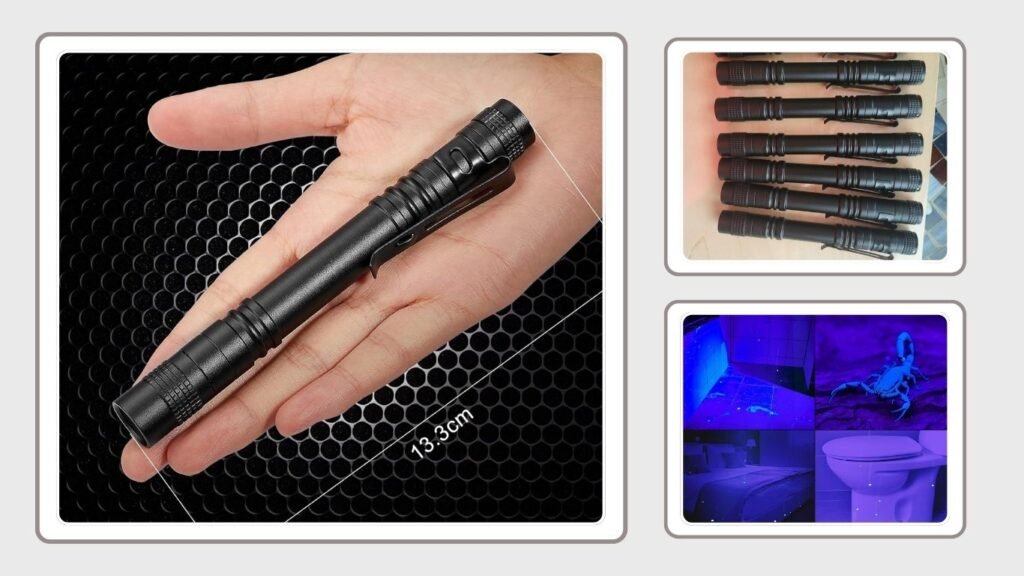
The UV Blacklight Inspection Flashlight & Detector is designed for users who want a compact ultraviolet tool for examining hidden stains and fluorescent evidence in areas that are difficult to inspect under normal lighting. Its portable form makes it suitable for bedrooms, hotel rooms, furniture, carpet edges, garages, storage spaces, and other locations where close-range UV inspection can reveal details that ordinary white light may miss.
Key Features
- Ultraviolet blacklight illumination
- Portable handheld design
- Suitable for close-range inspection
- Useful for stains and fluorescent residues
- Fits easily into inspection kits
- Simple on/off operation
- Useful around furniture and flooring
- Suitable as a secondary pest-inspection tool
Why It’s Best for Focused Detection
The biggest advantage of this style of flashlight is concentration. Instead of flooding an entire room with UV light, a smaller inspection detector can be positioned close to seams, flooring, furniture, walls, or other suspicious areas.
That helps inspectors work methodically after first identifying a likely problem zone.
It is particularly useful when checking hotel rooms, pet areas, storage spaces, or locations where biological residue may fluoresce under UV light.
Performance & Durability
Compact UV flashlights are generally most effective in low ambient light. Bringing the beam close to the surface can make weak fluorescence easier to distinguish.
The smaller design also means less weight during prolonged inspection work and easier access to confined spaces.
However, UV fluorescence should always be confirmed visually with normal light when pest identification is important, since many unrelated materials can glow.
Pros, Cons & Overall Verdict
Pros: Compact, portable, useful for focused UV checks, easy to handle, and suitable for concealed areas.
Cons: Smaller coverage area than large multi-LED models and limited value for identifying evidence that does not fluoresce.
Overall Verdict: This UV inspection detector is best suited to detailed close-range checks. It makes a useful secondary light for inspectors who already carry a strong conventional flashlight.
9. GearLight S100 UV Black Light Flashlight – 2 Pack
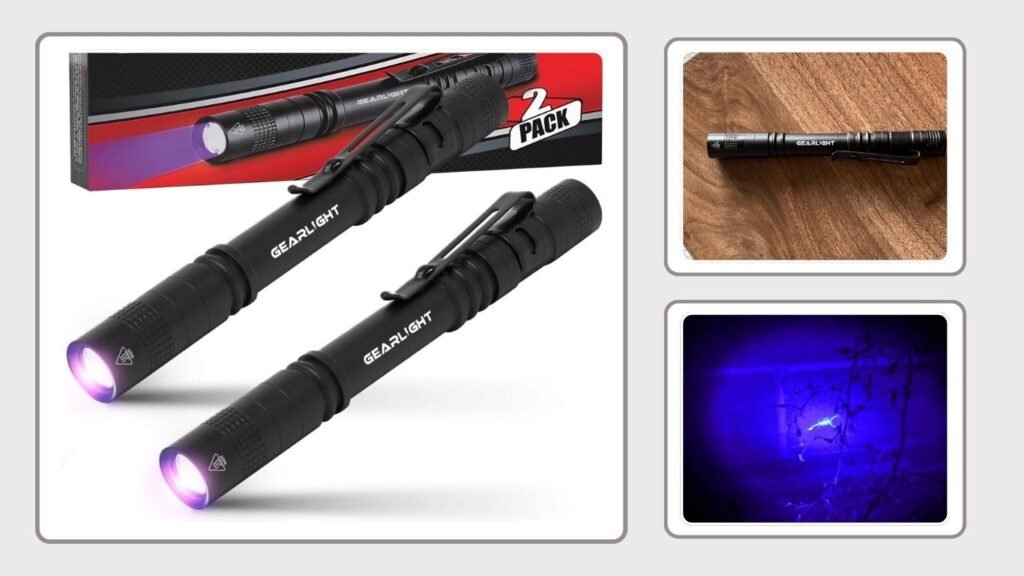
The GearLight S100 UV Black Light Flashlight comes as a convenient two-pack of slim pen-style UV lights. Each flashlight is approximately 5.25 inches long and uses two AAA batteries, making it easy to carry in a pocket, tool pouch, or inspection bag. The compact format is especially useful when checking tight spaces, furniture, hotel rooms, flooring, or other areas where a large UV flashlight would be unnecessarily bulky.
Key Features
- Two UV flashlights included
- Slim pen-style construction
- Approximately 5.25 inches long
- Powered by two AAA batteries each
- Removable pocket clip
- Aluminum body
- Water-resistant construction
- Useful for stains, scorpions, dyes, and inspection work
- Easy to carry throughout the day
Why It’s Best for Pocket-Sized Inspections
The GearLight S100 is particularly useful for technicians who want a UV light available at all times without carrying a large flashlight.
Its narrow shape fits easily into pockets and reaches locations where wide flashlight heads can be inconvenient. The removable clip also allows one light to stay attached to a shirt, tool pouch, or bag.
Because two are included, one can be kept as a backup or assigned to a second inspection kit.
Performance & Durability
The aluminum construction gives these small lights better durability than disposable plastic designs. Each flashlight operates from common AAA batteries, so there is no charging downtime.
The UV beam is better suited to concentrated areas than broad room scanning. That makes the S100 ideal for checking individual stains, seams, furniture sections, or suspicious spots identified during a larger inspection.
Pros, Cons & Overall Verdict
Pros: Two-pack value, extremely portable, durable aluminum body, convenient clip, and simple battery system.
Cons: Narrower coverage than large UV lights and requires separate AAA batteries.
Overall Verdict: The GearLight S100 is one of the strongest options for inspectors who prioritize portability. Its two-pack design makes it easy to keep a capable UV penlight available in multiple locations.
10. Collgene 100 LED 390 nm UV Inspection Flashlight
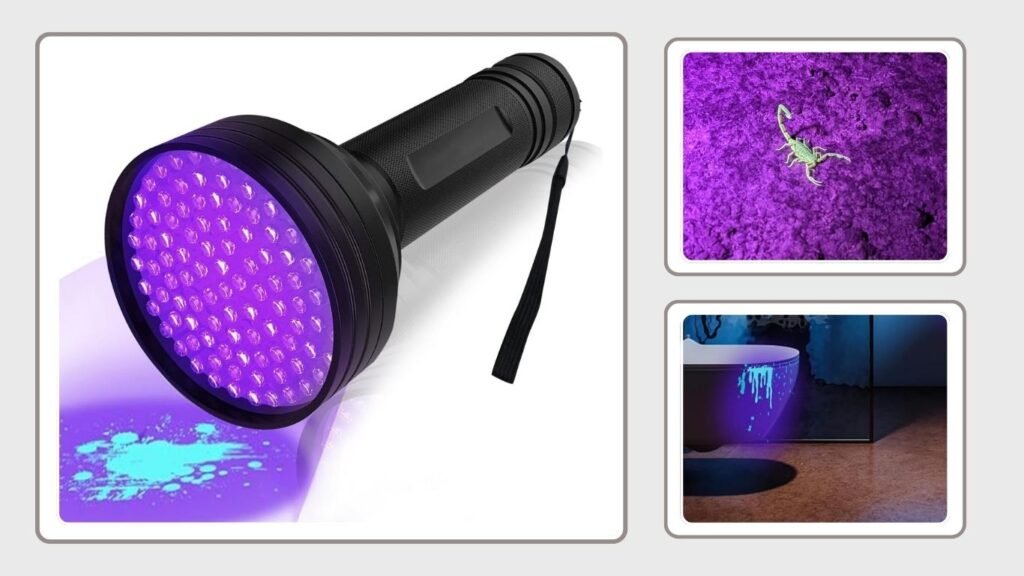
The Collgene 100 LED UV Blacklight Flashlight offers a large UV array designed for broad stain and inspection coverage. It uses approximately 390 nm ultraviolet light and is marketed for applications such as dry-stain detection, scorpion searches, fluorescence inspection, and pest-related checks. Its 100-LED head and durable aluminum construction make it a good fit for larger indoor spaces where a small penlight would require considerably more scanning time.
Key Features
- 100 UV LEDs
- Approximately 390 nm wavelength
- Large-area blacklight coverage
- Aluminum construction
- Uses six AA batteries
- Up to about 15 hours of listed illumination
- Suitable for dry stains and inspection work
- Useful for scorpion and fluorescent-material detection
- Portable handheld design
Why It’s Best for Large-Surface Detection
The 100-LED configuration is ideal when a technician needs to inspect floors, carpets, furniture, or wall areas quickly.
Instead of using a narrow UV beam to check every inch individually, the wider illumination helps locate suspicious fluorescent areas first. Those areas can then be inspected more closely with white light or other tools.
This approach can make larger property inspections much more efficient.
Performance & Durability
Product information lists an aluminum body designed to tolerate routine handling and a battery runtime of up to approximately 15 hours. Six AA batteries power the large LED array.
The UV output is most effective when ambient light is reduced. Using the flashlight in darkness or dim lighting can significantly improve contrast.
Because the head contains many LEDs, it is larger than a pocket penlight but provides correspondingly wider coverage.
Pros, Cons & Overall Verdict
Pros: 100 LEDs, broad inspection area, approximately 390 nm UV output, durable aluminum body, and strong suitability for room-scale scanning.
Cons: Requires six AA batteries and is bulkier than compact UV pens.
Overall Verdict: The Collgene 100 LED flashlight is best for broad UV scanning. It offers a technically useful balance of coverage, portability, and durability for larger inspection areas.
FAQs
What type of flashlight is best for pest inspection?
A bright white LED flashlight is best for general pest inspection because it shows insects, droppings, damage, webbing, and structural gaps in natural color. A UV flashlight is useful as a secondary tool for fluorescent stains, scorpions, and certain residues. Carrying both provides the most complete inspection setup.
Is a UV flashlight good for detecting bed bugs?
A UV flashlight can sometimes make certain stains, residues, or shed material easier to notice, but it should not be relied on as a guaranteed bed bug detector. Confirm suspected evidence with bright white light and look for actual bugs, fecal spots, eggs, shed skins, or other established signs.
Is 365 nm or 395 nm better for pest inspection?
A 365 nm UV light often produces stronger fluorescence with less visible purple light, making subtle residues easier to see. A 395 nm light is usually more affordable and can still work well for general stain, scorpion, and inspection applications. The best choice depends on how specialized the inspection needs to be.
How many lumens should a pest inspection flashlight have?
For general white-light inspections, several hundred lumens can be useful for rooms, basements, and exterior checks, while lower-output penlights work well at close range. Adjustable brightness is especially valuable because inspectors may need both broad illumination and controlled light for tight spaces.
Can pest inspection flashlights identify every infestation?
No. A flashlight is an inspection aid rather than a complete diagnostic tool. UV fluorescence can come from many substances, while some pest evidence does not fluoresce at all. Reliable identification should combine lighting with visual examination of insects, droppings, damage, nests, shed skins, entry points, and other physical evidence.