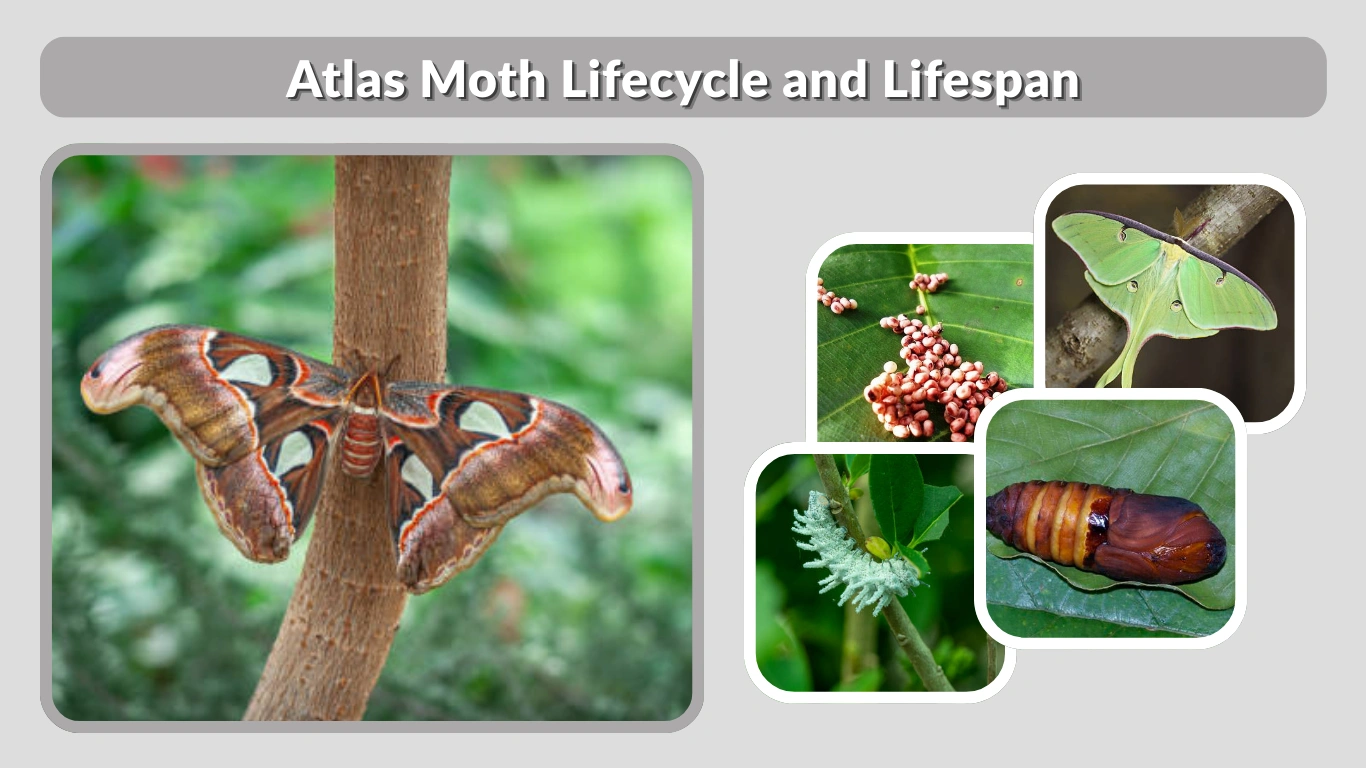
The Atlas moth is one of the largest and most visually stunning insects on Earth. Famous for its impressive wingspan and striking patterns, this moth undergoes a dramatic transformation from egg to adult. Despite its enormous size, the adult Atlas moth lives only a few days, making its lifecycle both fascinating and fleeting. This guide explores each stage of the Atlas moth’s development, offering insight into how it grows, behaves, and survives in the wild.
Identification

- Wingspan of 10–12 inches
- Rusty brown wings with white, black, and pink markings
- Wing tips shaped like snake heads
- Large, pale green caterpillars with waxy projections
- Silken cocoons attached to branches
These features make the Atlas moth one of the most easily recognized species in tropical and subtropical forests.
Atlas Moth Overview
Physical Appearance
The Atlas moth is known for its immense wings, which span up to a foot across, making it one of the largest moth species in the world. Its wings are a mix of rust-red, brown, black, and white, creating a bold mosaic that helps camouflage it among leaves and tree bark.
The forewings feature a distinctive “snake head” shape—an evolutionary defense that makes predators hesitate. This illusion is especially effective against birds and lizards that rely heavily on visual cues. The adult moth’s body is thick and hairy, built more for warmth and energy conservation than flight efficiency.
Despite its large size, the Atlas moth is a surprisingly weak flyer. Adults tend to rest for long periods during the day and become more active at night when predators are less likely to notice them.
Geographic Range
- Southeast Asia
- India and Sri Lanka
- Indonesia, Malaysia, Singapore
- Tropical rainforests and humid woodlands
Atlas moths thrive in warm, moist environments where dense vegetation provides ideal shelter for larvae and adults.
Lifecycle of the Atlas Moth

The Atlas moth moves through four key developmental stages:
- Egg Stage
- Larval (Caterpillar) Stage
- Pupal (Cocoon) Stage
- Adult Stage
Each stage plays a critical role in its survival, with the larval and pupal phases controlling most of the insect’s growth and transformation.
Egg Stage
The lifecycle begins when a female Atlas moth lays clusters of small, rounded eggs on the undersides of leaves. Each egg is about the size of a pinhead, white or creamy in color, and sometimes speckled with darker pigments. Females typically deposit eggs on host plants that will serve as food for the soon-to-emerge caterpillars.
Incubation lasts roughly 10 to 14 days, depending on temperature and humidity. Warmer conditions accelerate development, while cooler environments slow it down. During this time, the embryo develops rapidly, absorbing nutrients stored within the egg.
Just before hatching, the eggs may darken slightly as the caterpillar inside becomes visible. The tiny larvae emerge by chewing through the eggshell, immediately seeking out fresh leaves to begin feeding.
Larval Stage (Caterpillar)
Appearance
Atlas moth caterpillars are pale green with a distinctive waxy coating that helps protect them from predators and environmental stress. They grow extremely quickly, reaching several inches in length before pupation. Their bodies feature short, curved spines and raised bluish tubercles along the segments, giving them a robust, armored appearance.
Behavior
The larval stage is the most active feeding period in the Atlas moth’s lifecycle. After hatching, caterpillars consume large amounts of foliage from host plants such as citrus trees, guava, cinnamon, and evergreen shrubs. Their appetite is enormous—fuel required for growing their massive adult bodies.
As they grow, larvae pass through several molts, shedding their skin to accommodate their expanding size. These molts occur regularly over four to six weeks. Atlas caterpillars are generally solitary feeders and prefer to remain on the same plant unless food becomes scarce.
By the end of the larval stage, the caterpillar has stored enough energy to create its cocoon and undergo metamorphosis. This phase ends when the larva stops eating and begins searching for a suitable spot to spin its pupal casing.
Pupal Stage (Cocoon)
Once the caterpillar completes its final molt, it begins constructing a large, teardrop-shaped cocoon using strong silk threads. The cocoon is typically tan or light brown, blending well with surrounding vegetation. It is usually attached to a branch, twig, or sturdy leaf where it can safely hang throughout metamorphosis.
Inside the cocoon, the larva transforms into a pupa—a stage that lasts roughly three to four weeks, though environmental conditions such as humidity and temperature can extend or shorten this period. During pupation, the caterpillar’s tissues break down and reorganize into the adult moth’s wings, antennae, and reproductive structures.
The cocoon is exceptionally tough and durable, helping protect the vulnerable pupa from predators and rainfall. In some regions, Atlas moth cocoons are even harvested and used in purse-making due to their natural strength and texture.
Adult Stage
Appearance
Adult Atlas moths emerge with enormous wings spanning 10–12 inches, often larger in females. Their wings display a beautiful palette of rusty brown, orange, pink, and black, featuring translucent windows that reduce visibility from predators. The snake-head tips of the forewings act as an evolutionary defense, mimicking reptiles to deter birds and small mammals.
The adult’s body is thick, covered in dense hair-like scales that help insulate it during night flights. Females tend to be larger and heavier, while males have feathery antennae that allow them to detect pheromones from great distances.
Behavior
Adult Atlas moths do not eat—they lack functional mouthparts entirely. Instead, they rely solely on energy stored during the larval stage. Their purpose is singular: mate and reproduce before their energy supply runs out.
Males are highly active fliers, seeking out females by tracking airborne pheromones. Females, on the other hand, typically remain stationary after emerging, releasing pheromones to attract potential mates.
Adults are mostly nocturnal, avoiding predators by emerging and flying at night. Once mating and egg-laying are complete, their short adult lifespan comes to an end.
Lifespan

Stage Lengths
- Eggs: 10–14 days
- Larvae: 4–6 weeks
- Pupa: 3–4 weeks
- Adult: 5–14 days
Atlas moths spend the majority of their lives in the larval and pupal stages. The adult stage is remarkably brief—typically between one and two weeks—because adults cannot feed and survive only on stored fat reserves.
Factors Affecting Lifespan
Climate is a major influence on the Atlas moth’s development. Warm, humid conditions accelerate growth, while cooler temperatures delay metamorphosis. Predators such as birds, lizards, and parasitic insects can shorten lifespan significantly by targeting larvae or pupae. Human activity, habitat loss, and pesticides also impact survival in some regions.
In captivity, controlled environments can extend pupal development or slightly increase adult longevity, but adults still remain short-lived due to their biology.
Habitat & Behavior
Atlas moths inhabit dense tropical forests, where moisture, shade, and abundant plant life create ideal conditions for larvae to thrive. They prefer host plants that provide consistent foliage, allowing caterpillars to feed without traveling long distances.
Adults spend most of their time resting during the day, camouflaged against tree trunks and branches. Their wing patterns help break their outline, reducing visibility to predators. At night, adults become more active, seeking mates and suitable egg-laying locations.
The species plays a significant role in forest ecosystems, contributing to nutrient cycling and serving as prey for larger wildlife.
Atlas Moth vs Luna Moth

| Feature | Atlas Moth | Luna Moth |
| Wingspan | 10–12 inches | 4–5 inches |
| Color | Rusty brown with patterns | Pale green |
| Adult Feeding | Does not eat | Does not eat |
| Range | Southeast Asia | North America |
| Cocoon | Tough, enclosed | Loose, paper-like |
FAQs
How long does an Atlas moth live?
Most of an Atlas moth’s lifespan is spent as a larva or pupa, totaling several weeks. The adult moth, however, survives only 5–14 days. During this short period, its sole purpose is reproduction, as it cannot feed or replenish energy.
Why do adult Atlas moths not eat?
Atlas moths emerge as adults with no functional mouthparts. Evolution shaped them to rely on energy stored during the caterpillar stage. This adaptation prioritizes reproduction over feeding, allowing the species to thrive despite a brief adult lifespan.
How large do Atlas moth caterpillars get?
Atlas moth caterpillars can grow several inches long—often up to 4–5 inches. Their large size is necessary for storing enough nutrients to support the transformation into one of the world’s biggest moths.
What plants do Atlas larvae feed on?
Larvae feed on citrus, guava, cinnamon, evergreen shrubs, and various tropical host plants. They prefer vegetation with soft, ample foliage that supports rapid growth throughout the larval stage.
How long does metamorphosis take?
Metamorphosis inside the cocoon usually takes three to four weeks but may be longer in cooler climates. The duration depends on temperature, humidity, and environmental conditions.