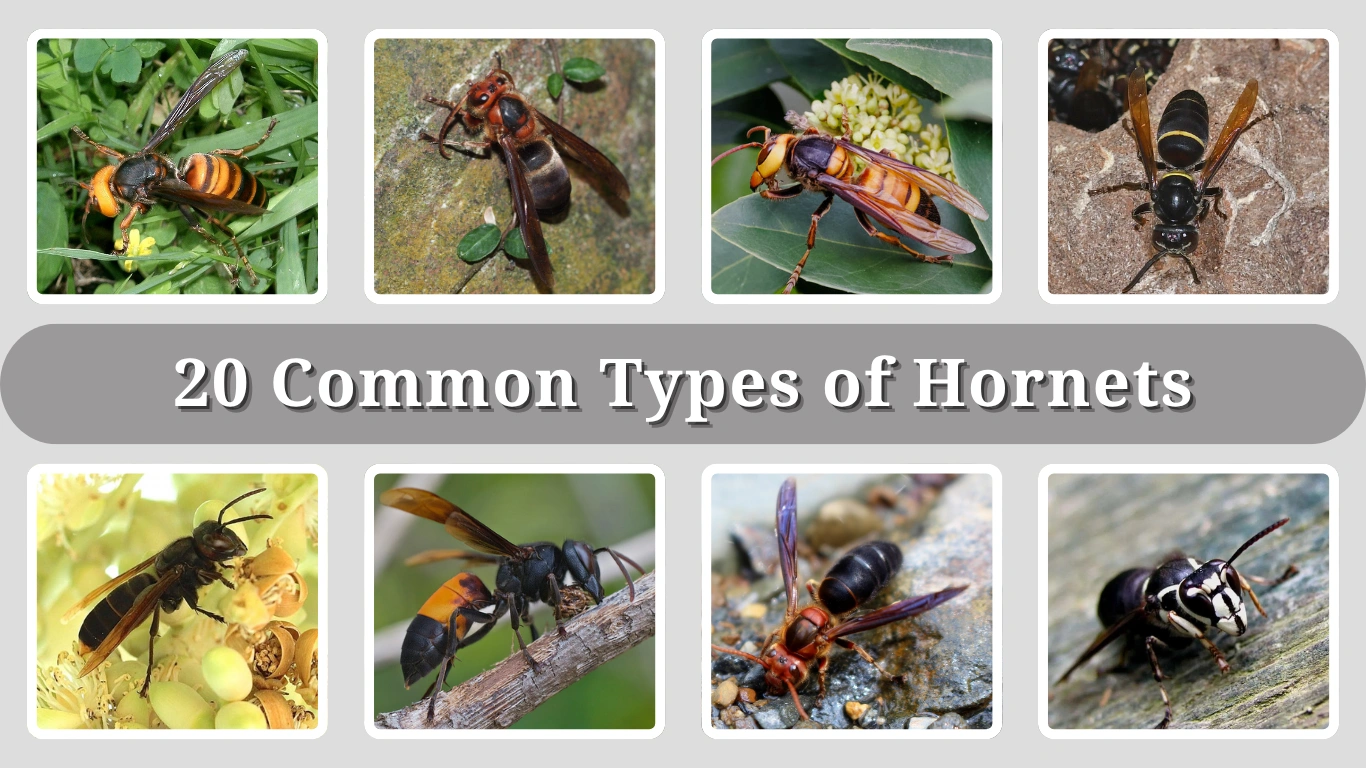
Hornets are among the largest and most powerful members of the wasp family, known for their social structure, distinct markings, and potent stings. Found across Europe, Asia, and North America, these insects play a crucial ecological role as predators, pollinators, and scavengers. Each species exhibits unique behaviors, nesting habits, and adaptations suited to its environment—from the massive Asian Giant Hornet to the smaller but equally fierce Bald-faced Hornet.
This guide explores 20 common hornet species from around the world, detailing their identification traits, habitats, behaviors, nesting styles, and diets to help you recognize and understand these remarkable insects more closely.
1. European Hornet (Vespa crabro)

The European Hornet is one of the largest and most well-known hornet species native to Europe but now also found in North America. Despite its intimidating size, it is generally less aggressive than smaller wasps when unprovoked and plays an important ecological role as a predator of pest insects.
Identification
- Size: Workers are typically 25–35 mm long; queens up to 40 mm.
- Color: Yellow and brown abdomen with reddish-brown thorax and head.
- Wings: Transparent brownish wings.
- Antennae: Brownish with orange tones.
- Distinctive Markings: Yellow face with reddish-brown behind the eyes.
Habitat
European Hornets prefer wooded areas, forests, and rural gardens. They commonly build their nests in hollow trees, wall cavities, attics, or barns. They are most active during late spring through early autumn.
Behaviors
This species is primarily nocturnal compared to other wasps, often foraging at night. They are social insects with a clear hierarchy — the queen starts the nest and lays eggs, while workers handle foraging and defense. Though capable of stinging, European Hornets are less aggressive unless their nest is disturbed.
Nesting
Their nests are made from chewed wood pulp, forming a paper-like structure. The nests are enclosed and multilayered, often hidden in sheltered spots. Each colony lasts only one season, with new queens overwintering to start fresh colonies the following year.
Diet
European Hornets are predatory and omnivorous. They feed on flies, bees, caterpillars, and other insects, as well as tree sap and overripe fruit. Adults chew prey to feed larvae a protein-rich paste, while they consume sugary liquids for energy.
2. Asian Giant Hornet (Vespa mandarinia)

The Asian Giant Hornet, often called the “murder hornet,” is the world’s largest hornet species, native to East and Southeast Asia. It is known for its massive size, potent venom, and ability to decimate honeybee colonies within hours.
Identification
- Size: Queens up to 50 mm; workers about 35–40 mm.
- Color: Orange-yellow head with dark brown eyes.
- Abdomen: Alternating yellow and dark brown bands.
- Wings: Brown-tinted and strong for fast flight.
- Distinctive Feature: Large, powerful mandibles used to kill prey and defend nests.
Habitat
The Asian Giant Hornet is found in low mountains, forests, and rural areas. It avoids high altitudes and urban centers. Nests are often built underground in abandoned rodent burrows or near tree roots.
Behaviors
Highly aggressive when threatened, this hornet species uses coordinated attacks to defend its colony. It preys on other hornet species and especially honeybees, decapitating them to feed larvae. Colonies have a strong social structure, and individuals communicate through pheromones.
Nesting
Their nests are subterranean, with intricate paper-like layers and chambers. Colonies are typically annual, with new queens hibernating through winter and founding nests in spring.
Diet
Adults feed on tree sap, nectar, and fruit, while larvae receive chewed-up insects and honeybees. They are also known to scavenge for meat and sugary substances in human areas.
3. Bald-faced Hornet (Dolichovespula maculata)

The Bald-faced Hornet, native to North America, is technically a wasp but commonly called a hornet due to its size and nesting habits. Recognizable by its black-and-white coloring, it is a fierce defender of its nest.
Identification
- Size: Workers 12–20 mm; queens up to 25 mm.
- Color: Black body with white markings on the face, thorax, and abdomen tip.
- Wings: Smoky, translucent wings.
- Shape: Rounded body with a distinctive white “bald” face.
Habitat
This hornet prefers forests, meadows, and suburban gardens. It often nests in trees, shrubs, or under building eaves, typically 2–10 meters above ground.
Behaviors
Bald-faced Hornets are highly territorial and aggressive when defending their nests. They are daytime foragers and help control insect populations by hunting flies and caterpillars. Despite their aggression, they serve an ecological role in pollination and pest regulation.
Nesting
Their nests are aerial and football-shaped, made of chewed wood fibers that form a gray papery texture. Each colony can contain hundreds of workers and lasts a single season.
Diet
They feed primarily on nectar, fruit, and tree sap, but they also hunt insects to feed larvae. Adults prefer sugary liquids, making them frequent visitors to fallen fruit and outdoor food sources.
4. Oriental Hornet (Vespa orientalis)

The Oriental Hornet is a medium-sized hornet species native to Southern Europe, Africa, and parts of Asia. It is unique for its reddish coloration and ability to generate energy from sunlight, thanks to specialized pigments in its exoskeleton.
Identification
- Size: Workers 25–30 mm; queens up to 35 mm.
- Color: Reddish-brown body with yellow bands on the abdomen.
- Head: Yellow face with reddish-brown eyes.
- Wings: Amber-tinted and slightly transparent.
- Distinctive Feature: Bright yellow stripes that help convert sunlight into usable energy.
Habitat
Oriental Hornets prefer warm, dry climates and are often found in Mediterranean regions, deserts, and urban areas. They typically nest in underground burrows, walls, or tree hollows.
Behaviors
They are diurnal, most active in the middle of the day when sunlight is strongest. Oriental Hornets display strong social organization and are known to be territorial, especially around their nests. They communicate using pheromones and can become aggressive when disturbed.
Nesting
Their nests are built underground or in cavities, made of a paper-like material created from chewed plant fibers. Colonies are seasonal, with new queens overwintering and starting fresh colonies each spring.
Diet
They are omnivorous, feeding on sugary liquids, nectar, tree sap, and prey insects like bees and flies. Adults consume sweet substances, while larvae receive protein-rich insect paste.
5. Black-bellied Hornet (Vespa basalis)

The Black-bellied Hornet is a large and striking species native to Southeast Asia. It is recognized for its dark abdomen and contrasting reddish head, and it is both a predator and a scavenger in forest ecosystems.
Identification
- Size: Workers 25–33 mm; queens up to 38 mm.
- Color: Reddish-brown head and thorax with a shiny black abdomen.
- Wings: Dark amber with a smoky tint.
- Antennae: Black with reddish bases.
- Distinctive Feature: Entirely black abdomen that gives it its name.
Habitat
Found in tropical and subtropical forests, particularly in Southeast Asia and parts of Southern China. They prefer tree trunks, cliffs, or human structures for nesting.
Behaviors
The Black-bellied Hornet is aggressive when threatened and often hunts in groups. It preys on other wasps, bees, and caterpillars, helping to balance insect populations. It is most active during the daytime and avoids cold or wet conditions.
Nesting
Their nests are aerial and oval-shaped, constructed from chewed wood pulp. They are usually suspended from tree branches or building eaves and contain several hundred individuals per colony.
Diet
These hornets feed on insects, nectar, sap, and ripe fruit. They also scavenge on carrion and human food waste. Larvae are fed a diet of chewed-up prey, while adults primarily seek carbohydrates for energy.
6. Yellow Hornet (Vespa simillima)

The Yellow Hornet is a medium-sized species native to East Asia, particularly Japan, Korea, and China. It is often confused with other hornets due to its bright yellow coloration but is known for being relatively docile compared to larger species.
Identification
- Size: Workers 20–28 mm; queens up to 32 mm.
- Color: Bright yellow head and thorax with dark brown or black bands on the abdomen.
- Wings: Transparent with a light brown tint.
- Distinctive Feature: Overall yellow appearance with a darker midsection.
Habitat
Yellow Hornets prefer forests, gardens, and suburban areas. They commonly build nests in tree branches, shrubs, or under eaves of buildings. They thrive in temperate climates and avoid high-altitude environments.
Behaviors
They are active during the day and are generally less aggressive than other hornet species unless their nest is disturbed. Yellow Hornets help control pest populations by hunting flies and other insects. They are also social and maintain a clear hierarchy within colonies.
Nesting
Their nests are aerial, typically round and made from paper pulp derived from chewed plant fibers. Colonies are annual, with new queens overwintering and starting new nests in spring.
Diet
They feed on nectar, fruit juice, tree sap, and insects. Workers hunt small insects to feed larvae a protein-rich diet, while adults prefer carbohydrate sources for quick energy.
7. Vespa tropica (Greater Banded Hornet)

The Greater Banded Hornet, also known as Vespa tropica, is a widespread tropical species found across South and Southeast Asia. It is recognizable by its bold yellow band and is a powerful predator of other wasps and bees.
Identification
- Size: Workers 26–30 mm; queens up to 35 mm.
- Color: Black or dark brown body with a prominent yellow band across the abdomen.
- Head: Reddish-brown with dark eyes.
- Wings: Dark, smoky-brown appearance.
- Distinctive Feature: Bright yellow band on the second abdominal segment.
Habitat
They inhabit lowland forests, plantations, and rural areas, often near human settlements. Nests are found in tree hollows, underground burrows, or man-made structures such as sheds and roofs.
Behaviors
Vespa tropica is aggressive when threatened and is known for attacking other wasp species’ nests to capture larvae. They are day-active hunters and are vital for controlling local pest populations. Their flight is fast and direct, and they defend their colonies fiercely.
Nesting
Their nests are either aerial or subterranean, depending on location. The outer layers are made from chewed wood fibers, forming a papery shell. Colonies are seasonal, with a single queen establishing new nests each year.
Diet
They are carnivorous and omnivorous, feeding on flies, bees, caterpillars, and sugary substances. Adults often drink nectar and fruit sap, while larvae receive masticated insects as a protein source.
8. Vespa affinis (Lesser Banded Hornet)

The Lesser Banded Hornet, or Vespa affinis, is a widespread tropical hornet found across South and Southeast Asia, known for its distinctive orange band and aggressive nature when provoked.
Identification
- Size: Workers 22–28 mm; queens up to 32 mm.
- Color: Dark brown to black body with a wide orange band on the second abdominal segment.
- Head: Reddish-orange with black mandibles.
- Wings: Transparent brown.
- Distinctive Feature: Orange or yellow abdominal band varying by regional subspecies.
Habitat
They thrive in tropical lowlands, urban areas, and forest edges. Commonly found near human dwellings, gardens, and plantations, they adapt easily to disturbed environments.
Behaviors
Vespa affinis is highly defensive near its nest but otherwise non-aggressive during foraging. They are day-active hunters, preying on flies, bees, and other insects. Their colonies are moderately sized and follow a clear social structure.
Nesting
They build aerial nests, usually attached to tree branches, shrubs, or building eaves. The nests are made of chewed plant fibers, forming smooth, papery walls with multiple layers inside. Colonies are annual, with new queens emerging in autumn to overwinter.
Diet
Their diet includes nectar, fruit juices, and tree sap, as well as insects used to feed larvae. Adults prefer carbohydrates, while larvae rely on protein-rich prey.
9. Vespa analis (Black-tailed Hornet)

The Black-tailed Hornet, or Vespa analis, is a large species native to East and Southeast Asia. It is often confused with the Asian Giant Hornet but is smaller and distinguished by its black-tipped abdomen.
Identification
- Size: Workers 25–30 mm; queens up to 35 mm.
- Color: Yellow head with black eyes and thorax; abdomen black-tipped with yellow bands.
- Wings: Brownish and semi-transparent.
- Distinctive Feature: Black end of the abdomen differentiates it from similar species.
Habitat
They inhabit forested hills, gardens, and mountain regions across Japan, China, Korea, and Thailand. Nests are typically found in tree hollows, underground burrows, or building crevices.
Behaviors
The Black-tailed Hornet is territorial and aggressive near its nest but otherwise a solitary forager. They are known to hunt bees, flies, and other wasps, helping regulate insect populations. They are also drawn to sugary liquids and fruit.
Nesting
Their nests can be aerial or subterranean, depending on the environment. The structure is built from pulp made of chewed wood fibers, with protective layers forming a papery envelope. Colonies typically last one season, and new queens emerge in late autumn.
Diet
They feed on nectar, fruit, tree sap, and prey insects like honeybees. Adults mainly consume sugars, while larvae are given a protein paste made from chewed prey.
10. Vespa simillima xanthoptera (Japanese Yellow Hornet)

The Japanese Yellow Hornet is a subspecies of Vespa simillima, native to Japan, Korea, and eastern Russia. It is common in both rural and suburban areas and is known for its bright yellow coloration and quick, agile flight.
Identification
- Size: Workers 20–27 mm; queens up to 32 mm.
- Color: Bright yellow with black bands on the abdomen.
- Head: Yellow with black eyes and mandibles.
- Wings: Transparent with a light brown tint.
- Distinctive Feature: More vivid yellow tones compared to other Vespa simillima subspecies.
Habitat
They prefer woodlands, gardens, and city parks, often nesting in tree branches, under roofs, or eaves. They adapt easily to human environments and are frequently found near buildings.
Behaviors
Japanese Yellow Hornets are active during the day and are less aggressive than larger hornets like Vespa mandarinia. They are strong fliers, patrolling wide areas for food. They play an important role in controlling pest populations by preying on small insects.
Nesting
Their nests are aerial and oval-shaped, constructed from chewed wood pulp. Colonies are seasonal, with new queens overwintering to establish fresh nests the following spring.
Diet
They feed on nectar, tree sap, fruit juice, and insects such as flies and caterpillars. Larvae receive a protein-based paste, while adults prefer sugary substances.
11. Vespa velutina (Asian Hornet)

The Asian Hornet, or Vespa velutina, is an invasive species originally from Southeast Asia, now found across Europe and parts of East Asia. It is a significant predator of honeybees and a growing environmental concern in introduced regions.
Identification
- Size: Workers 20–25 mm; queens up to 30 mm.
- Color: Dark brown or black body with a single yellow-orange band on the abdomen.
- Head: Orange face with dark antennae.
- Wings: Smoky brown and semi-transparent.
- Distinctive Feature: Yellow-tipped legs, giving it the nickname “yellow-legged hornet.”
Habitat
Vespa velutina prefers urban areas, forests, and river valleys. It builds nests in tree canopies, under roofs, and in sheds. Its adaptability allows it to thrive in various climates.
Behaviors
It is highly predatory, often targeting honeybee colonies. Workers hover near hive entrances to capture bees midair. Though defensive of their nests, they are less aggressive toward humans unless disturbed. They are active hunters during daylight hours.
Nesting
Their nests are large, spherical, and aerial, constructed from chewed plant fibers. Nests can house thousands of hornets and are often located high in trees or man-made structures. Colonies are annual, dying off in winter except for new queens.
Diet
The Asian Hornet feeds on honeybees, flies, butterflies, and sugary substances like fruit and nectar. Adults consume carbohydrates, while larvae are fed a protein paste made from captured insects.
12. Vespa ducalis (Black Shield Hornet)

The Black Shield Hornet, or Vespa ducalis, is a large hornet native to Asia, particularly in China, Japan, India, and Southeast Asia. It is named for the distinctive black patch (“shield”) on its abdomen and is known for its powerful build and predatory behavior.
Identification
- Size: Workers 25–30 mm; queens up to 38 mm.
- Color: Black and orange-yellow with a broad black band across the abdomen.
- Head: Orange with dark eyes and strong mandibles.
- Wings: Brownish and transparent.
- Distinctive Feature: Wide black “shield” marking on the second abdominal segment.
Habitat
Found in forests, farmlands, and mountain areas, Vespa ducalis often nests in hollow trees, ground burrows, or abandoned structures. It thrives in both tropical and temperate regions.
Behaviors
The species is aggressive toward other hornets but usually avoids humans unless threatened. It is a voracious predator, especially targeting other wasp and hornet larvae. It is also active during the day and hunts over wide ranges.
Nesting
Their nests are typically subterranean or located in protected cavities. Built from wood pulp, these nests are multilayered and house hundreds of workers. Colonies are annual, dying out in winter except for fertilized queens.
Diet
They primarily consume larvae of other wasps and hornets, along with tree sap, nectar, and fruit. Adults often feed on sweet substances, while larvae receive protein from chewed insect prey.
13. Vespa dybowskii (Black Hornet / Dybowski’s Hornet)

The Dybowski’s Hornet, or Vespa dybowskii, is a rare and unusual species found in East Asia, especially Japan, Korea, and China. It is notable for its parasitic behavior, often taking over colonies of other hornet species.
Identification
- Size: Workers 22–28 mm; queens up to 33 mm.
- Color: Mostly black with narrow yellow bands on the abdomen.
- Head: Black with yellow face markings.
- Wings: Dark brown and translucent.
- Distinctive Feature: Black body with subtle yellow patterning; parasitic tendencies.
Habitat
They live in temperate forests and wooded hills, favoring areas with abundant hornet nests to exploit. Nests are usually found in tree cavities or soil burrows previously occupied by other species.
Behaviors
Vespa dybowskii is unique among hornets for its social parasitism — queens invade and usurp nests of other species like Vespa crabro or Vespa simillima, killing the resident queen and using the workers to raise their own brood. They are solitary outside of these invasions and relatively secretive.
Nesting
They do not build independent nests; instead, the female infiltrates and takes over a host colony. The new brood is raised by the existing workers until they die off. Colonies remain small compared to other hornet species.
Diet
Their diet consists mainly of insects, nectar, and tree sap. As parasites, they rely on the host colony’s foraging workers for much of their food supply. Adults consume carbohydrates, while larvae receive proteins from captured prey.
14. Vespa binghami (Bingham’s Hornet)

The Bingham’s Hornet, or Vespa binghami, is a relatively rare hornet species distributed across Southeast Asia and parts of China and Myanmar. It is known for its striking color contrast and preference for forested environments.
Identification
- Size: Workers 22–30 mm; queens up to 35 mm.
- Color: Black body with bright orange or reddish markings on the head and abdomen.
- Head: Orange-red with dark eyes.
- Wings: Transparent with a brownish tint.
- Distinctive Feature: Strong contrast between the dark thorax and the orange abdomen tip.
Habitat
They are primarily found in tropical forests, hilly regions, and bamboo groves. Bingham’s Hornets often choose tree hollows or ground cavities for nesting. They prefer humid environments but avoid densely urbanized areas.
Behaviors
This species is moderately aggressive and active during the day, particularly in the early morning. It preys on smaller insects and is important in controlling local pest populations. Males and workers are strong fliers, capable of covering long distances while foraging.
Nesting
Their nests are usually subterranean or located in natural cavities, made from chewed wood fibers that form layered paper walls. Colonies are seasonal, with only fertilized queens surviving the winter to establish new nests.
Diet
Vespa binghami feeds on flies, bees, caterpillars, nectar, fruit juice, and tree sap. Adults primarily seek carbohydrates, while larvae are given protein-based food from captured insects.
15. Vespa fervida (Indonesian Hornet)

The Indonesian Hornet, or Vespa fervida, is native to Indonesia, Malaysia, and the Philippines. It is a tropical hornet known for its dark coloration and strong predatory instincts.
Identification
- Size: Workers 23–30 mm; queens up to 34 mm.
- Color: Dark brown to black body with faint orange bands on the abdomen.
- Head: Black or reddish with yellowish antenna bases.
- Wings: Smoky brown and translucent.
- Distinctive Feature: Uniformly dark body with minimal markings.
Habitat
They inhabit tropical rainforests, plantations, and rural areas, often building nests in trees, cliffs, or roof spaces. They thrive in humid and warm climates.
Behaviors
Vespa fervida is territorial and defensive of its nest but less likely to attack when foraging. It is an active hunter, preying on a wide variety of insects. Colonies are social and well-organized, with strong communication via pheromones.
Nesting
Their nests are aerial and ovoid, typically attached to tree branches or man-made structures. Made from wood pulp, the nests have layered combs for brood development. Colonies are annual, disbanding after the breeding season.
Diet
They feed on insects, nectar, fruit sap, and tree resin. Adults seek sugary liquids for energy, while larvae are given a diet of chewed-up prey insects captured by the workers.
16. Vespa soror (Greater Asian Hornet)

The Greater Asian Hornet, or Vespa soror, is a large and powerful species closely related to the Asian Giant Hornet (Vespa mandarinia). Native to Southeast Asia and southern China, it is known for its cooperative hunting strategies and formidable strength.
Identification
- Size: Workers 30–37 mm; queens up to 45 mm.
- Color: Orange head and thorax with dark brown or black abdomen and yellow bands.
- Wings: Amber-brown and semi-transparent.
- Distinctive Feature: Robust body with a bright orange face similar to Vespa mandarinia but slightly smaller in size.
Habitat
They inhabit tropical and subtropical forests, hillsides, and wooded valleys. They prefer to nest in tree cavities, underground burrows, or protected forest areas.
Behaviors
Vespa soror is highly social and aggressive, particularly when defending its nest. It exhibits coordinated group attacks against honeybee colonies, often decapitating bees to feed their larvae. They are also known for marking prey locations with pheromones to recruit other workers for mass raids.
Nesting
Their nests are subterranean or hidden within natural cavities, made of chewed wood fibers forming a durable papery texture. Colonies are annual, peaking in size during late summer and early autumn.
Diet
They are predatory and omnivorous, consuming bees, wasps, flies, caterpillars, nectar, and tree sap. Adults prefer carbohydrate-rich food, while larvae receive protein from chewed prey.
17. Vespa luctuosa (Philippine Hornet)

The Philippine Hornet, or Vespa luctuosa, is native to the Philippines and is recognized for its dark coloration and extremely potent venom, among the most toxic of all hornets. Despite its small size, it is one of the most dangerous species to humans.
Identification
- Size: Workers 22–25 mm; queens up to 30 mm.
- Color: Glossy black body with narrow white or yellow bands.
- Head: Black with pale yellow facial markings.
- Wings: Dark brown and opaque.
- Distinctive Feature: Entirely dark, shiny body and high venom potency.
Habitat
They are found in tropical lowland forests, rural areas, and plantations throughout the Philippines. They usually nest in tree trunks, underground holes, or roof spaces near human habitation.
Behaviors
Vespa luctuosa is highly defensive and aggressive if its nest is threatened. It is diurnal, actively hunting during daylight hours. Despite its small colonies, it exerts strong territorial control over its nesting area.
Nesting
Their nests are aerial or semi-subterranean, constructed from chewed bark pulp forming a multi-layered paper structure. Each colony typically contains hundreds of individuals, and colonies last only a single breeding season.
Diet
They feed on nectar, fruit sap, and various insects, including flies and bees. Adults consume sugary substances for energy, while larvae are fed protein-rich insect paste prepared by workers.
18. Vespa basalis (Black Shield Wasp / Greater Banded Hornet)

The Vespa basalis, also known as the Black Shield Wasp or Greater Banded Hornet, is a large, striking species native to Southeast Asia, including Malaysia, Indonesia, and southern China. It is known for its distinctive black and yellow coloration and powerful sting.
Identification
- Size: Workers 25–33 mm; queens up to 38 mm.
- Color: Jet-black head and thorax with a wide yellow band on the second abdominal segment.
- Head: Black with reddish or dark brown eyes.
- Wings: Smoky brown and semi-transparent.
- Distinctive Feature: Broad yellow band across a dark abdomen, giving it a “shielded” look.
Habitat
Vespa basalis inhabits tropical forests, rural plantations, and garden areas. They often nest in trees, under roofs, or inside hollow logs. This species prefers humid, warm climates and avoids high-altitude regions.
Behaviors
They are aggressive defenders of their nests and capable of multiple stings. However, during foraging, they are generally non-hostile. They are daytime predators, feeding on other insects, and are particularly active in the early morning and late afternoon.
Nesting
Their nests are aerial and oval, built from masticated wood fibers to create a gray, papery structure. Nests are often suspended from tree branches or building eaves. Colonies are annual, with only new queens surviving the winter to establish new colonies.
Diet
Vespa basalis feeds on flies, bees, caterpillars, fruit juice, tree sap, and nectar. Adults consume carbohydrate-rich food, while larvae are fed chewed insect prey.
19. Vespa tropica nigrans (Black Subspecies of Greater Banded Hornet)

The Vespa tropica nigrans is a black subspecies of the Greater Banded Hornet (Vespa tropica), found primarily in the Philippines and surrounding islands. It is darker than the main species and adapted to the tropical island climate.
Identification
- Size: Workers 26–30 mm; queens up to 35 mm.
- Color: Predominantly black with a faint yellow or orange band on the abdomen.
- Head: Black with reddish-brown highlights near the mandibles.
- Wings: Dark brown and opaque.
- Distinctive Feature: Almost entirely black body, distinguishing it from other Vespa tropica populations.
Habitat
They inhabit coastal forests, plantations, and rural areas of the Philippine archipelago. Nests are often found in tree hollows, abandoned burrows, or beneath roofs in shaded areas.
Behaviors
Vespa tropica nigrans is highly territorial and defensive of its nests. It is a strong flier and a skilled predator of bees and wasps. Colonies tend to be smaller than those of other hornet species but are tightly organized.
Nesting
Nests are aerial or subterranean, built from chewed plant fibers and forming a papery gray structure. They prefer shaded and concealed locations. Colonies are annual, starting in spring and dying off by late autumn.
Diet
Their diet includes honeybees, flies, caterpillars, fruit juices, nectar, and tree sap. Adults focus on sugary liquids, while larvae receive a protein-rich paste made from captured insects.
20. Vespa mandarinia japonica (Japanese Giant Hornet)

The Japanese Giant Hornet, a subspecies of the Asian Giant Hornet (Vespa mandarinia), is the largest hornet in Japan and one of the most formidable insect predators in the world. It is both feared and respected for its size, strength, and efficiency as a hunter.
Identification
- Size: Workers 35–40 mm; queens up to 50 mm.
- Color: Orange head with prominent dark brown compound eyes.
- Abdomen: Alternating orange and dark brown bands, with a sharp stinger at the tip.
- Wings: Amber-colored and strong, suited for long-distance flight.
- Distinctive Feature: Enormous head, powerful mandibles, and thick thorax; larger than most hornets worldwide.
Habitat
Found throughout Japan’s low mountains, rural areas, and forests, this hornet prefers temperate and subtropical regions. Nests are usually built underground, in abandoned rodent burrows, or within rotting tree roots.
Behaviors
The Japanese Giant Hornet is highly social and extremely defensive of its nest. It is known for organizing group raids on honeybee hives, decapitating bees and carrying the thoraxes back to feed larvae. Despite its intimidating reputation, it rarely attacks humans unless provoked. Its sting, however, is intensely painful and venomous.
Nesting
Nests are subterranean, consisting of layered combs made from chewed wood pulp. Colonies are seasonal, with a single queen founding the nest in spring and producing hundreds of workers by summer. By late autumn, only new queens survive to hibernate and restart the cycle.
Diet
Their diet includes honeybees, other hornets, beetles, and tree sap. Adults consume carbohydrate-rich liquids, such as sap and fruit juice, while larvae are fed protein paste made from dismembered insects. This predation makes them both formidable hunters and important ecosystem regulators in their native range.