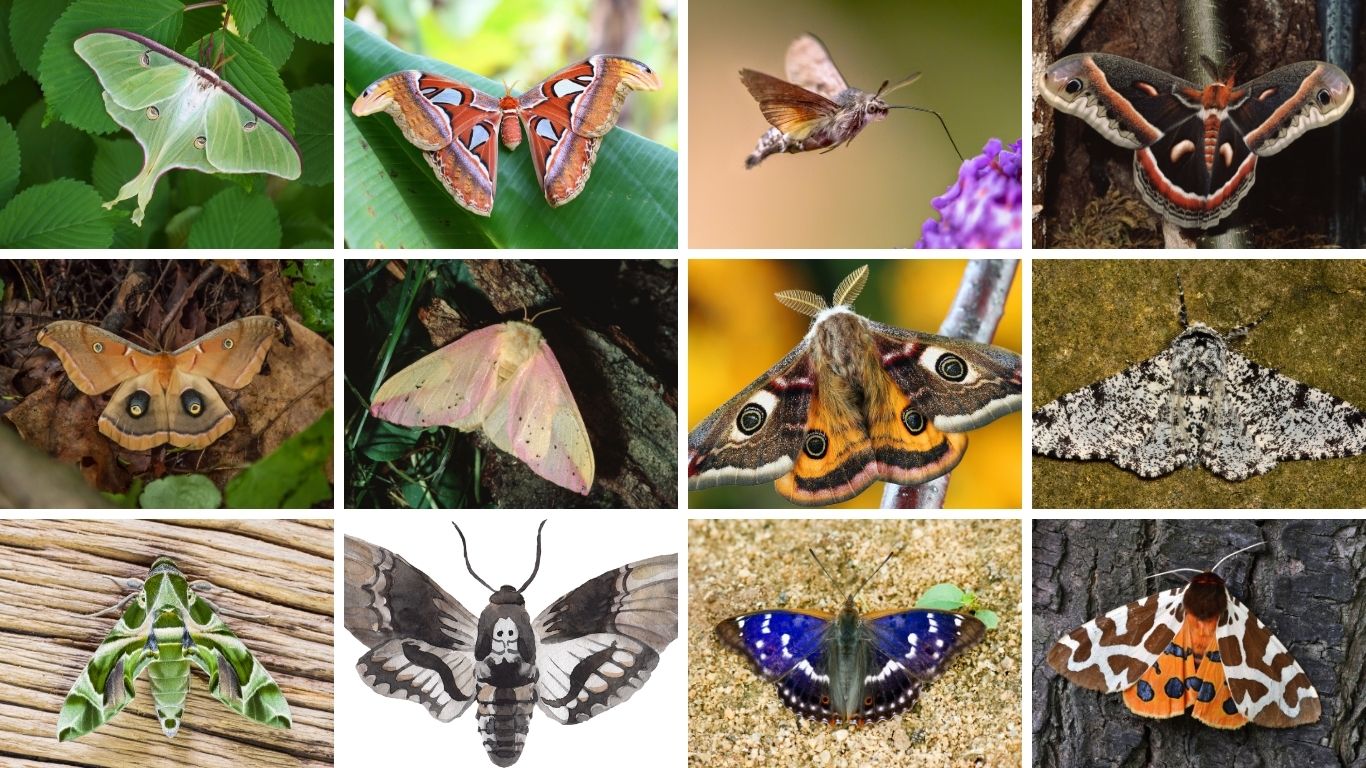
Moths are often overlooked compared to butterflies, but they’re just as fascinating—if not more so. From the massive Atlas Moth to the tiny pantry-invading Indian Meal Moth, these creatures come in all shapes, sizes, and colors. In this guide, I’ve listed 30 unique moth species, each with its own look, behavior, and story. Whether you’re a nature lover or a casual observer, you’ll find something intriguing here.
1. Luna Moth

The Luna Moth (Actias luna) is one of the most enchanting moths in North America, known for its pale green wings and long, elegant tails. Despite its large size and striking beauty, it’s rarely seen due to its nocturnal habits and short adult lifespan.
Identification
- Wingspan: 4.5 to 7 inches
- Color: Pale lime green wings with translucent eyespots
- Markings: Two large eyespots on forewings, two smaller on hindwings
- Tails: Long and curved on hindwings
- Caterpillar: Bright green with red spots and faint yellow lines
Habitat
Found in deciduous woodlands and forested areas, especially near hickory, walnut, and sweetgum trees—the preferred host plants for larvae.
Diet
Adult Luna Moths do not eat; they rely on fat reserves stored during the larval stage. Caterpillars feed on leaves of a variety of hardwood trees, including hickory, birch, and persimmon.
Behavior
Luna Moths are nocturnal and are drawn to lights at night. They’re solitary and silent, often spotted near forest edges during the evening.
Life Cycle
Luna Moths live for about a week as adults. After emerging from the cocoon, they focus solely on mating and reproduction. Females lay eggs on host plants, and caterpillars go through five molts before pupating in leaf litter.
2. Atlas Moth

The Atlas Moth (Attacus atlas) is one of the largest moths in the world, native to the tropical forests of Southeast Asia. Its sheer size and detailed wing pattern make it a showstopper in any collection or observation.
Identification
- Wingspan: Up to 10 to 12 inches
- Color: Reddish-brown with intricate black, white, pink, and purple markings
- Wing Shape: Forewings are curved and resemble snake heads at the tips
- Caterpillar: Pale green with spiny projections and waxy coating
- Sex difference: Females are generally larger and heavier
Habitat
Typically found in tropical and subtropical forests, gardens, and plantations. They thrive in warm, humid climates.
Diet
Like the Luna Moth, adult Atlas Moths do not feed. Their mouthparts are vestigial. Caterpillars feed on leaves of citrus, guava, cinnamon, and other tropical trees.
Behavior
Nocturnal and slow-moving, Atlas Moths are mainly active during dusk and early evening. Their wing tips mimic snake heads to scare off predators.
Life Cycle
Females lay up to 300 eggs. Caterpillars grow rapidly, then spin a silken cocoon. The pupal stage can last several weeks before the adult moth emerges, ready to mate and begin the cycle anew.
3. Hummingbird Hawk-Moth

The Hummingbird Hawk-Moth (Macroglossum stellatarum) is a fascinating moth often mistaken for a hummingbird due to its ability to hover and feed on nectar mid-air. It’s active during the day, making it a rare diurnal moth.
Identification
- Wingspan: 1.6 to 1.8 inches
- Color: Grayish-brown forewings, orange hindwings
- Markings: Black and white bands on the body resembling a bumblebee
- Antennae: Short and feathery
- Caterpillar: Green with diagonal white stripes and a tail-like horn
Habitat
Found in gardens, meadows, and sunny open fields across Europe, North Africa, and Asia. They are migratory and often travel long distances.
Diet
Adults feed on nectar from flowers like petunias, honeysuckle, and lavender. They use a long proboscis to feed while hovering. Caterpillars feed on bedstraw and related plants.
Behavior
These moths are fast and agile fliers, known for hovering like hummingbirds. They are most active during daylight and early evening.
Life Cycle
Eggs are laid on host plants. Caterpillars feed and pupate in the soil or leaf litter. Several generations may occur annually in warm climates.
4. Cecropia Moth

The Cecropia Moth (Hyalophora cecropia) is North America’s largest native moth and belongs to the Saturniidae family. Its massive size, red body, and intricate wing patterns make it a stunning sight in woodlands and suburban areas.
Identification
- Wingspan: 5 to 7 inches
- Color: Dark brown wings with crescent-shaped white spots and reddish borders
- Body: Thick, hairy, and reddish with white bands
- Caterpillar: Bright green with blue and orange tubercles
- Antennae: Large and feathery, especially in males
Habitat
Common in deciduous forests, wooded suburbs, and gardens where trees like maple, birch, and cherry are present.
Diet
Adults do not eat; they live only a few days to mate and lay eggs. Caterpillars feed on leaves of hardwood trees such as maple, apple, and cherry.
Behavior
Cecropia Moths are nocturnal and are attracted to lights. Males can detect female pheromones from miles away using their large antennae.
Life Cycle
Eggs are laid in clusters on host plants. Caterpillars grow to impressive sizes before spinning silken cocoons and pupating. There is typically one generation per year, with adults emerging in late spring to early summer.
5. Polyphemus Moth

The Polyphemus Moth (Antheraea polyphemus) is a large and majestic silk moth named after the giant cyclops in Greek mythology—thanks to the prominent eye spots on its hindwings. It’s widespread across North America and often spotted near porch lights at night.
Identification
- Wingspan: 4 to 6 inches
- Color: Brown to tan wings with large blue and black eye spots on hindwings
- Markings: Transparent spots in the center of each wing
- Body: Thick, hairy, and rust-colored
- Caterpillar: Bright green with yellow stripes and red-orange knobs
Habitat
Found in deciduous forests, suburban areas, and fields. They favor areas with a wide range of host trees such as oak, maple, and willow.
Diet
Adult Polyphemus Moths do not feed. Their caterpillars feed on a variety of trees including oak, birch, walnut, and hickory.
Behavior
They are nocturnal and often fly at night during spring and early summer. Males actively seek out females using scent, often flying long distances.
Life Cycle
Females lay eggs on the leaves of host trees. The caterpillars grow large before spinning brown silk cocoons in leaf litter. Adults emerge after pupation, ready to reproduce.
6. Rosy Maple Moth

The Rosy Maple Moth (Dryocampa rubicunda) is known for its vibrant and fluffy appearance. With a blend of pink and yellow coloring, it looks almost like candy and is one of the most colorful moths in North America.
Identification
- Wingspan: 1.25 to 2 inches
- Color: Bright pink and yellow wings with a fuzzy yellow body
- Markings: Pink bands across forewings, yellow hindwings
- Caterpillar: Known as the greenstriped mapleworm—green with white lines and a red head
- Antennae: Short and comb-like
Habitat
Found in eastern North America, especially in areas with maple trees. They live in forests, suburban neighborhoods, and city parks.
Diet
Adult moths do not eat. Caterpillars feed primarily on the leaves of red, silver, and sugar maple trees.
Behavior
Rosy Maple Moths are nocturnal and are often seen at lights during late spring and summer. Despite their bright colors, they are relatively shy and short-lived.
Life Cycle
Eggs are laid in clusters on maple leaves. Caterpillars pass through several stages before pupating in soil or leaf litter. One to two generations occur each year, depending on the region.
7. Gypsy Moth (Lymantria dispar)

The Gypsy Moth is an invasive species originally introduced to North America from Europe. Known for its destructive caterpillars, it has become a serious pest, defoliating millions of acres of forest annually.
Identification
- Wingspan: 1.5 to 2 inches (males), up to 3.5 inches (females)
- Color: Males are brown with dark markings; females are white with black zigzag patterns
- Caterpillar: Hairy, grayish with blue and red dots along the back
- Sex difference: Females are larger and cannot fly; males are smaller and fly actively
- Antennae: Feathered in males, threadlike in females
Habitat
Gypsy Moths thrive in hardwood forests, urban parks, and residential areas. Oaks are their preferred host, but they feed on over 300 species of trees and shrubs.
Diet
Caterpillars feed aggressively on the leaves of oak, birch, willow, and other deciduous trees. Adults do not feed.
Behavior
Males fly during the day, searching for pheromones released by flightless females. Large outbreaks can occur, causing severe defoliation.
Life Cycle
Eggs are laid in masses on tree trunks, furniture, or outdoor surfaces. Caterpillars hatch in spring, feed heavily, and pupate in hidden areas. Adults emerge in summer.
8. Peppered Moth (Biston betularia)

The Peppered Moth is a famous example of natural selection and industrial melanism. It comes in two main forms—light and dark—which helped it survive changing environments during the Industrial Revolution in England.
Identification
- Wingspan: 1.8 to 2.5 inches
- Color: Light form is pale with black speckles; dark (melanic) form is nearly black
- Caterpillar: Brown or green with twig-like appearance for camouflage
- Markings: Speckled pattern helps it blend into lichen-covered bark
- Sex difference: Not prominent
Habitat
Common in woodlands, parks, and gardens. It prefers areas with birch, oak, and willow trees, especially where air pollution levels vary.
Diet
Caterpillars feed on leaves of birch, willow, oak, and other deciduous trees. Adult moths do not feed.
Behavior
Nocturnal and well-camouflaged against tree bark. The dark morph became dominant during heavy industrial pollution when trees were darkened by soot.
Life Cycle
Eggs are laid on host trees. After feeding, the caterpillars pupate in the soil, and adults emerge in summer. One or two generations may occur each year.
9. Oleander Hawk-Moth

The Oleander Hawk-Moth (Daphnis nerii) is a stunningly beautiful moth with green camouflage-like patterns. Native to Africa and Asia, it occasionally migrates to Europe. Its size, coloration, and smooth flight often draw comparisons to hummingbirds.
Identification
- Wingspan: 3.5 to 5 inches
- Color: Olive green with cream, pink, and dark green swirled patterns
- Body: Streamlined and robust
- Caterpillar: Green with eye-like spots and a blue horn at the tail end
- Forewings: Narrow and angled for fast flight
Habitat
Found in warm regions, gardens, and subtropical areas with oleander plants. Prefers places with dense vegetation.
Diet
Adults feed on nectar from jasmine and other night-blooming flowers. Caterpillars feed mainly on oleander but may also eat periwinkle and desert rose.
Behavior
This moth is crepuscular and nocturnal, flying at dusk or night. It is strong and swift, hovering while feeding on flowers.
Life Cycle
Females lay eggs on oleander leaves. Caterpillars develop rapidly and pupate in the soil. Several generations can occur yearly in warm climates.
10. Death’s-head Hawkmoth

The Death’s-head Hawkmoth (Acherontia atropos) is instantly recognizable by the skull-shaped mark on its thorax. Known for its eerie appearance and ability to squeak when threatened, this moth has long been surrounded by superstition.
Identification
- Wingspan: 3.5 to 5 inches
- Color: Dark brown or black with yellow-orange bands on the abdomen
- Thorax: Marked with a pale, skull-like pattern
- Caterpillar: Large, yellow or green with blue stripes and a curved horn
- Underside: Yellow-orange with black patches
Habitat
Found in Africa and southern Europe, sometimes reaching as far north as Britain. Prefers gardens, farmland, and areas near beehives.
Diet
Adults can raid beehives for honey, using their tough cuticle and chemical mimicry. They also feed on nectar and tree sap. Caterpillars feed on plants like potato, tomato, and nightshade.
Behavior
They fly mostly at night and are strong, fast fliers. The moth can emit a loud squeak when disturbed, which helps deter predators.
Life Cycle
Eggs are laid on host plants. Caterpillars grow large before burrowing to pupate underground. Adults emerge after several weeks and live for a short time, focused on reproduction.
11. Emperor Moth

The Emperor Moth (Saturnia pavonia) is a striking species native to Europe, admired for its bold eye spots and vibrant patterns. It is the only member of the Saturniidae family native to the British Isles.
Identification
- Wingspan: 2 to 3 inches (males), up to 3.5 inches (females)
- Color: Males are orange-brown; females are grayish with black, white, and pink patterns
- Markings: Prominent eye spots on all four wings
- Caterpillar: Green with black bands and yellow tufts of hair
- Sex difference: Males are smaller and more colorful with feathery antennae
Habitat
Found in heathlands, moorlands, and open woodland areas throughout Europe, especially in the UK.
Diet
Adult moths do not feed. Caterpillars eat leaves of heather, bramble, hawthorn, and blackthorn.
Behavior
Males are active during the day and fly swiftly in search of females, who are mostly nocturnal. They are often seen in spring, especially April and May.
Life Cycle
Eggs are laid on host plants. After feeding, the caterpillar pupates in a silken cocoon attached to plant stems. Adults emerge in early spring for a single generation per year.
12. Garden Tiger Moth

The Garden Tiger Moth (Arctia caja) is known for its vibrant colors and striking wing patterns, which serve as a warning to predators. It’s widespread across Europe and parts of North America.
Identification
- Wingspan: 1.8 to 2.5 inches
- Forewings: Brown with cream-colored bands
- Hindwings: Bright orange with bold black spots
- Caterpillar: Known as “woolly bear,” covered in long, brown and black hairs
- Defense: Displays bright hindwings to deter predators
Habitat
Common in gardens, meadows, woodlands, and coastal areas. Prefers moist environments with plenty of vegetation.
Diet
Adults feed on nectar occasionally but are not reliant on it. Caterpillars feed on a wide range of herbaceous plants including nettle, dock, and dandelion.
Behavior
Primarily nocturnal, Garden Tiger Moths are attracted to lights at night. They rely on their bold coloration to warn predators of their toxicity.
Life Cycle
Eggs are laid in clusters on host plants. Caterpillars overwinter as fully grown larvae and pupate in spring. Adults emerge in summer, with typically one generation per year.
13. Io Moth

The Io Moth (Automeris io) is a vibrant North American moth known for its large, intimidating eye spots on the hindwings. These eyes serve as a defense mechanism to startle predators when the moth is threatened.
Identification
- Wingspan: 2.5 to 3.5 inches
- Male color: Bright yellow with large black and blue eye spots on hindwings
- Female color: Brownish with the same hindwing eyespots
- Caterpillar: Green with venomous spines that can cause skin irritation
- Antennae: Males have bushier antennae than females
Habitat
Found in woodlands, fields, and gardens across the eastern and southern United States.
Diet
Adults do not feed. Caterpillars feed on a variety of plants including willow, corn, roses, clover, and hackberry.
Behavior
Nocturnal and short-lived, Io Moths are primarily active in late spring and summer. When disturbed, they flash their hindwings to scare off predators.
Life Cycle
Females lay eggs in clusters on host plants. Caterpillars grow quickly, pupate in leaf litter or shallow soil, and emerge as adults after several weeks or months depending on climate.
14. White Ermine Moth

The White Ermine Moth (Spilosoma lubricipeda) is a beautiful European moth with silky white wings marked by distinctive black spots. Despite its delicate appearance, the caterpillar is hardy and fuzzy, often called the “woolly bear.”
Identification
- Wingspan: 1.2 to 1.6 inches
- Color: White wings with varying numbers of black spots
- Body: Fuzzy and creamy white
- Caterpillar: Brown to black and covered in bristles
- Variation: Some individuals have many spots; others have very few or none
Habitat
Common in grasslands, gardens, and woodland edges throughout Europe and parts of Asia. Attracted to light in suburban and rural areas.
Diet
Adults may occasionally feed on nectar. Caterpillars feed on dandelion, dock, nettle, and various low-growing plants.
Behavior
Primarily nocturnal and drawn to artificial light. The adult’s white color and bold patterning can serve as a mild warning to predators.
Life Cycle
Eggs are laid in clusters. Caterpillars feed, then pupate in cocoons spun in low vegetation. One to two generations per year depending on location.
15. Six-spot Burnet

The Six-spot Burnet (Zygaena filipendulae) is a day-flying moth known for its metallic blue-black wings and six vivid red spots. Its bright coloration warns predators of its unpalatability due to the toxic cyanide compounds it contains.
Identification
- Wingspan: 1.2 to 1.6 inches
- Color: Metallic bluish-black forewings with six red spots
- Hindwings: Bright red with a black border
- Caterpillar: Yellow-green with black spots and sparse hairs
- Flight: Slow and fluttery, even in full sunlight
Habitat
Found in meadows, grasslands, and coastal areas across Europe, especially in wildflower-rich environments.
Diet
Adults feed on nectar from knapweed, thistles, and scabious. Caterpillars primarily feed on bird’s-foot trefoil and other legumes.
Behavior
Active during the day, often in warm, sunny conditions. Their slow flight and bright coloring make them easy to spot and identify.
Life Cycle
Eggs are laid on the undersides of host plant leaves. Caterpillars overwinter in a cocoon, pupating in early summer. Adults emerge and are visible from June to August.
16. Sphinx Moth

The Sphinx Moth, also known as the Hawk Moth (family Sphingidae), includes many species known for their powerful flight and hummingbird-like behavior. These moths can hover while feeding, making them standout night pollinators.
Identification
- Wingspan: 2 to 6 inches (varies by species)
- Color: Usually brown, gray, or olive, with streamlined bodies and narrow wings
- Caterpillar: Large, green or brown with a signature tail-like “horn”
- Flight: Fast, strong, and capable of hovering mid-air
Habitat
Found worldwide in forests, gardens, deserts, and grasslands. They prefer areas rich in flowering plants.
Diet
Adults feed on nectar using a long proboscis, visiting flowers like petunias, honeysuckle, and jasmine. Caterpillars feed on plants like tomato, tobacco, and evening primrose.
Behavior
Mostly nocturnal or crepuscular, they are known for hovering and rapid darting flight. Some species mimic bumblebees or hummingbirds.
Life Cycle
Eggs are laid on host plants. Caterpillars grow large and pupate underground or in leaf litter. Many species have multiple generations per year in warm regions.
17. Cinnabar Moth

The Cinnabar Moth (Tyria jacobaeae) is a vividly colored day-flying moth native to Europe and parts of Asia, introduced in other regions for biological control of ragwort. Its red and black wings serve as a warning to predators of its toxicity.
Identification
- Wingspan: 1.2 to 1.7 inches
- Color: Black forewings with red stripes; red hindwings with black edges
- Caterpillar: Bright yellow with black bands (very distinctive)
- Body: Black with red markings
- Flight: Day-active, especially in warm weather
Habitat
Common in grasslands, heathlands, meadows, and places with plenty of ragwort—their main host plant.
Diet
Adults feed on nectar occasionally but are not strongly dependent on it. Caterpillars feed almost exclusively on ragwort, ingesting toxic alkaloids that make them distasteful to predators.
Behavior
Diurnal and slow-flying, they are easily seen during summer days. Their striking coloration acts as a defense against birds and other predators.
Life Cycle
Eggs are laid in clusters on ragwort leaves. Caterpillars develop rapidly and may defoliate entire patches. Pupation occurs in the soil, with adults emerging the following spring or summer.
18. Leopard Moth

The Leopard Moth (Zeuzera pyrina) is named for its striking black-spotted white wings, resembling a leopard’s coat. While beautiful as an adult, its caterpillars are known wood-borers and can be damaging to trees.
Identification
- Wingspan: 2 to 2.8 inches
- Color: White wings with irregular black spots across the forewings
- Body: Thick, white with faint blue tinge and black markings
- Caterpillar: Pinkish-white with a brown head, burrows into wood
- Sex difference: Females are larger and more robust
Habitat
Found in woodlands, orchards, and parks across Europe, North Africa, and introduced areas in North America.
Diet
Adult moths do not feed. Caterpillars bore into trees such as apple, ash, elm, walnut, and willow, feeding on inner bark and wood.
Behavior
Nocturnal and attracted to lights. Adults are strong fliers but short-lived. The larvae stay hidden inside trees for up to two years before pupating.
Life Cycle
Eggs are laid in bark crevices. The caterpillars bore into trunks and branches, causing potential structural damage. Pupation occurs inside the tree before adults emerge in summer.
19. Bagworm Moth

The Bagworm Moth (Psychidae family) is a unique group of moths whose larvae build protective cases—or “bags”—from silk and surrounding materials like twigs, leaves, and sand. Some adult females remain wingless and never leave their bags.
Identification
- Wingspan: 1 to 1.5 inches (males); females are often wingless
- Color: Males are dark brown or black with transparent wings
- Caterpillar (larva): Lives inside a silk bag camouflaged with plant material
- Adult female: Wingless, grub-like, and remains inside the bag
- Adult male: Winged, with feathery antennae
Habitat
Found in forests, gardens, and ornamental landscapes, particularly on evergreens and hardwood trees.
Diet
Caterpillars feed on a wide variety of plants including juniper, arborvitae, spruce, and oak. Adult moths do not feed.
Behavior
The larvae drag their protective bags as they feed. Males emerge and fly to find mates, while females remain in their bags, even during mating and egg-laying.
Life Cycle
Females lay eggs inside the bag before dying. Eggs hatch within the bag, and new larvae disperse via silk threads carried by the wind (ballooning). One generation occurs annually.
20. Tussock Moth

Tussock Moths (Lymantriinae subfamily) are known for their highly distinctive, hairy caterpillars—often with bright tufts or “tussocks” of hair. While adults can be plain in appearance, the larvae are easily recognized and can cause skin irritation.
Identification
- Wingspan: 1.2 to 2 inches
- Color (adult): Gray, brown, or white; females of some species are flightless
- Caterpillar: Brightly colored with dense tufts of hair and often long, bristly spines
- Markings: Varies widely among species
- Antennae: Males have feathered antennae
Habitat
Found in forests, orchards, gardens, and urban areas—especially where hardwood trees grow.
Diet
Caterpillars feed on the leaves of oaks, maples, willows, birch, and many garden plants. Adults do not feed.
Behavior
Caterpillars are active feeders and may defoliate entire trees during outbreaks. The hairs can cause allergic reactions or skin irritation in humans and animals.
Life Cycle
Eggs are laid in clusters and covered with hairs from the female’s body. Larvae hatch and feed voraciously before pupating in silk cocoons. Multiple generations may occur annually in warm regions.
21. Brown-tail Moth

The Brown-tail Moth (Euproctis chrysorrhoea) is an invasive species originally from Europe, now established in parts of North America. It’s known for its toxic caterpillar hairs, which can cause severe skin irritation and respiratory issues in humans.
Identification
- Wingspan: 1.4 to 1.8 inches
- Color: Adults are pure white with a distinctive brown tuft at the end of the abdomen
- Caterpillar: Dark with white markings, two orange spots near the rear, and covered in venomous hairs
- Sex difference: Females and males appear similar
Habitat
Common in coastal areas, suburban gardens, and hardwood forests. Especially abundant in regions with oak, apple, and birch trees.
Diet
Caterpillars feed on leaves of a wide variety of deciduous trees and shrubs. Adult moths do not feed.
Behavior
Nocturnal and attracted to lights. Caterpillars form communal silk nests and feed together. Their hairs break off easily and can become airborne, causing allergic reactions.
Life Cycle
Eggs are laid on the undersides of leaves in midsummer. Caterpillars overwinter in silken nests and resume feeding in spring before pupating.
22. Pink-spotted Hawkmoth

The Pink-spotted Hawkmoth (Agrius cingulata) is a large and fast-flying moth found in the Americas. It’s known for its powerful flight and striking pink bands on its abdomen.
Identification
- Wingspan: 4 to 6 inches
- Color: Brownish-gray wings with lighter veins; abdomen features vivid pink and black bands
- Body: Streamlined and thick
- Caterpillar: Green or brown with diagonal stripes and a curved horn at the tail
- Flight: Fast, hovering similar to hummingbirds
Habitat
Occurs in tropical and subtropical regions, gardens, agricultural fields, and forest edges throughout the Americas.
Diet
Adults feed on nectar from deep-throated flowers like moonflower and petunia using a long proboscis. Caterpillars feed on sweet potato, morning glory, and related plants.
Behavior
Nocturnal and attracted to lights. Strong fliers, often seen hovering while feeding like hummingbirds.
Life Cycle
Eggs are laid on host plant leaves. Larvae grow rapidly and pupate in the soil. Multiple generations occur yearly in warm regions.
23. Angle Shades Moth

The Angle Shades Moth (Phlogophora meticulosa) is a well-camouflaged species known for its unique, angular wing shape and leaf-like appearance. It blends seamlessly with dead leaves and bark, making it difficult to spot during the day.
Identification
- Wingspan: 1.6 to 2 inches
- Color: Mottled pinkish-brown and olive green with sharp angular patterns
- Markings: V-shaped angles along the forewings; folded wing shape mimics dead leaves
- Caterpillar: Green or brown with light stripes
- Antennae: Filiform in both sexes
Habitat
Found throughout Europe, parts of Asia, and North Africa in gardens, woodland edges, hedgerows, and meadows.
Diet
Caterpillars feed on a wide range of herbaceous plants including nettle, dock, and bramble. Adults occasionally feed on flower nectar or rotting fruit.
Behavior
Nocturnal and often attracted to light. The resting posture with wings folded at sharp angles adds to its excellent camouflage.
Life Cycle
Multiple generations per year in warm areas. Eggs are laid on host plants, and larvae may overwinter as caterpillars before pupating in the soil.
24. Black Witch Moth

The Black Witch Moth (Ascalapha odorata) is one of the largest moths in the Americas and is often surrounded by folklore and superstition. With its bat-like appearance, it is commonly associated with omens and mystery.
Identification
- Wingspan: 5 to 7 inches
- Color: Dark brown to black with intricate wavy patterns
- Markings: Males are darker; females have a pinkish or white band across the wings
- Caterpillar: Brown or green with small white spots
- Flight: Strong, bat-like with slow, gliding movement
Habitat
Found in Central and South America, the Caribbean, and as far north as the southern U.S. during migration. Prefers tropical forests and shaded areas.
Diet
Adults feed on overripe fruit, sap, and nectar. Caterpillars feed on acacia, mesquite, and other legumes.
Behavior
Primarily nocturnal and migratory. It is attracted to light and often rests under eaves, inside sheds, or in dark corners during the day.
Life Cycle
Females lay eggs on host plant leaves. Larvae develop quickly in warm climates. The species can breed year-round in tropical areas.
25. Indian Meal Moth

The Indian Meal Moth (Plodia interpunctella) is a small but notorious pantry pest found in households worldwide. It infests stored grains, cereals, nuts, and dried fruits, making it a common concern in kitchens and food storage areas.
Identification
- Wingspan: 0.5 to 0.75 inches
- Color: Forewings are bicolored—pale gray near the base and reddish-bronze on the outer half
- Caterpillar: Cream-colored with a brown head, sometimes tinged with pink or green
- Flight: Weak fliers, often seen fluttering near food storage
Habitat
Commonly found in kitchens, warehouses, grocery stores, and anywhere dry food is stored.
Diet
Caterpillars feed on stored grains, flour, rice, cereal, pet food, nuts, dried fruits, and chocolate. Adults do not feed.
Behavior
Nocturnal and attracted to light. The larvae produce webbing over infested food, which is often the first sign of their presence.
Life Cycle
Females lay eggs directly on food sources. The larvae feed and spin silk, then pupate in cracks or corners. The full cycle may take 30–300 days depending on temperature.
26. Fall Armyworm Moth

The Fall Armyworm Moth (Spodoptera frugiperda) is an agricultural pest whose larvae are known to destroy crops like corn, rice, and sorghum. Native to the Americas, it has recently spread to Africa and Asia, causing global concern.
Identification
- Wingspan: 1.2 to 1.6 inches
- Male color: Mottled gray and brown with distinct white patches
- Female color: Duller, plain light brown
- Caterpillar: Green to brown with a white stripe and a distinctive inverted Y on the head
- Flight: Strong and migratory
Habitat
Fields, farmlands, and grassy areas—especially those with crops like maize, cotton, and wheat.
Diet
Larvae feed on more than 80 types of plants, primarily cereals and grasses. Adults feed minimally, usually on nectar.
Behavior
Highly migratory, adults can travel long distances. Larvae feed in groups and can quickly strip plants of foliage, especially during outbreaks.
Life Cycle
Eggs are laid in clusters on the undersides of leaves. Larvae pass through multiple stages before pupating in soil. Several generations can occur each year, especially in warm climates.
27. Puss Moth

The Puss Moth (Cerura vinula) is a European species known for its soft, cat-like appearance as an adult and its bizarre, alien-looking caterpillar. Despite the adult’s fluffy charm, the larva is a master of defense with a striking appearance and behavior.
Identification
- Wingspan: 2 to 3 inches
- Color: Pale gray or white with fine black lines and soft, furry body
- Caterpillar: Bright green with a split tail and red-and-black “face” markings
- Markings: Forewings have dark gray veins and a wavy outline
- Body: Heavily furred, resembling a puff of cotton or a cat (hence the name)
Habitat
Common in woodlands, gardens, and parks across Europe and parts of Asia, especially where willow and poplar trees are present.
Diet
Caterpillars feed on leaves of willow, poplar, and aspen trees. Adults do not feed.
Behavior
Nocturnal and attracted to lights. The caterpillar rears up and displays its red “face” when threatened, sometimes spraying formic acid as a defense.
Life Cycle
Eggs are laid singly or in small groups on leaves. Caterpillars grow quickly and pupate in a hard, woody cocoon attached to tree bark or branches. One generation per year is typical.
28. Magpie Moth

The Magpie Moth (Abraxas grossulariata) is a visually striking day- and night-flying moth known for its bold black-and-white pattern and orange accents. It’s commonly seen in gardens and hedgerows across Europe.
Identification
- Wingspan: 1.4 to 2 inches
- Color: White wings with scattered black spots and orange markings along the body
- Caterpillar: Black and white striped with yellow markings and spiny appearance
- Body: Slender with alternating black-and-white banding
Habitat
Found in gardens, woodland edges, hedgerows, and open countryside—especially where currant and gooseberry bushes grow.
Diet
Caterpillars feed on currants, gooseberries, and other shrubs in the rose family. Adults may sip nectar but are not strong feeders.
Behavior
Diurnal and also active at dusk. Its bold coloration serves as a warning to predators, as both the caterpillar and adult can be distasteful.
Life Cycle
Eggs are laid on host plants in summer. Caterpillars overwinter in bark crevices or leaf litter and resume feeding in spring before pupating. One generation per year is most common.
29. Light Brown Apple Moth

The Light Brown Apple Moth (Epiphyas postvittana) is a small, invasive moth originally from Australia that has become a significant pest in horticulture and agriculture across other regions like New Zealand, Europe, and parts of the United States.
Identification
- Wingspan: 0.6 to 1 inch
- Color: Light brown forewings with darker brown markings; females are more variable and paler
- Caterpillar: Green with a light brown head and a smooth body
- Sex difference: Males tend to be darker and more distinctly marked than females
Habitat
Found in orchards, vineyards, gardens, nurseries, and greenhouses. Thrives in mild climates with abundant host plants.
Diet
Caterpillars feed on over 500 plant species, including apples, grapes, strawberries, and ornamental plants. Adults do not feed.
Behavior
Larvae spin silken shelters on leaves and fruit, causing damage by feeding and contaminating crops. The moths are nocturnal and are attracted to lights.
Life Cycle
Females lay eggs in flat masses on foliage. Larvae feed and pupate within leaf rolls or debris. Multiple generations may occur each year, depending on climate.
30. Corn Earworm Moth

The Corn Earworm Moth (Helicoverpa zea), also known as the Tomato Fruitworm or Cotton Bollworm, is a widespread agricultural pest that causes major damage to corn, tomato, cotton, and other crops.
Identification
- Wingspan: 1.2 to 1.6 inches
- Color: Forewings are light brown with dark spots and wavy lines; hindwings are pale with a dark border
- Caterpillar: Varies in color (green, brown, pink), with light stripes and a rough texture
- Sex difference: Not visually prominent
Habitat
Common in agricultural fields, gardens, and meadows across North and South America.
Diet
Larvae feed on corn, tomatoes, peppers, cotton, beans, and other crops. Adults feed on flower nectar.
Behavior
Nocturnal and migratory, with adults flying long distances. Larvae feed at night and often burrow into fruit or cobs, making them hard to detect early.
Life Cycle
Eggs are laid singly on leaves or silks. Larvae develop rapidly and pupate in soil. Several generations may occur yearly in warm climates, making control difficult in infested regions.