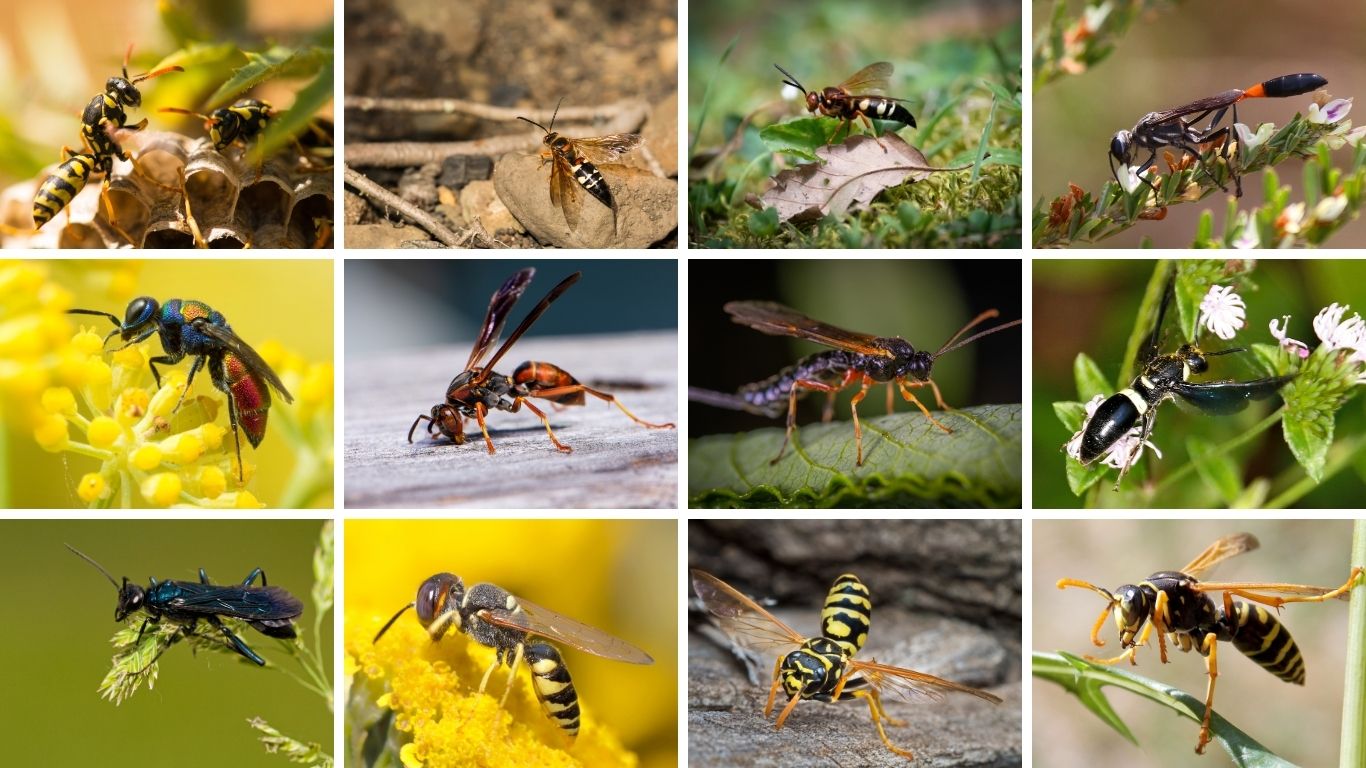
Wasps are more than just buzzing insects that show up at picnics. With their unique colors, behaviors, and roles in nature, these flying insects are actually fascinating and helpful in many ways. From hunting pests to pollinating plants, wasps come in many types—each with its own lifestyle. In this guide, you’ll explore 26 common wasps, how to identify them, and what makes each one special.
1. Paper Wasp

Paper wasps are one of the most recognizable wasp species due to their long legs, narrow waists, and reddish-brown or black bodies with yellow markings. They typically measure between 0.7 to 1 inch in length. Their wings fold lengthwise when at rest, giving them a sleek appearance. Unlike bees, they have a more elongated body and fly with their legs hanging down.
These wasps are named after the papery nests they build using chewed wood fibers mixed with saliva. The nests are often found hanging under eaves, porch ceilings, or tree limbs. Unlike hornets, their nests are open and umbrella-shaped, with visible cells. Each colony is led by a queen and contains a few dozen workers.
Paper wasps are not highly aggressive and will usually sting only when they or their nest is disturbed. They feed on caterpillars and other soft-bodied insects, as well as flower nectar. This diet makes them useful natural pest controllers in gardens.
They are commonly found in warm to temperate climates across North America, Europe, and Asia. In colder seasons, fertilized queens hibernate in sheltered spots like attics or tree bark. In spring, they emerge to establish new colonies, repeating the cycle each year.
2. Yellowjacket Wasp

Yellowjackets are small but bold wasps. They are about 0.5 to 0.75 inches long. Their bodies are shiny black with bright yellow bands. They look like bees but are slimmer and faster. Yellowjackets fold their wings lengthwise and fly quickly in zigzags.
They build large paper nests, often underground or inside walls. Some nests can have thousands of wasps. They are very protective and will sting if you come close. Their sting is painful and can be dangerous for people with allergies.
Yellowjackets eat meat, sweets, and sugary drinks. In summer, they hunt insects. In late summer, they look for sweet foods and often show up at picnics or trash bins.
They live across North America and are most active in warm months. In winter, only the queen survives by hiding in safe places. She starts a new nest in spring.
3. Hornet

Hornets are big and strong wasps. They can grow up to 1.5 inches long. Their color is usually black with white or yellow markings. They have wide heads and thick bodies. They look more powerful than other wasps.
Hornets build big nests high in trees, on walls, or under roofs. The nest looks like a gray paper ball. It has layers inside and can house hundreds of wasps. Hornets defend their nest fiercely. They can sting many times and chase threats away.
They eat flies, bees, and other insects. They also drink tree sap and fruit juice. Hornets are useful because they help control pests. But their sting is strong, so it’s best to stay away.
Hornets live in forests, gardens, and near homes. They are most active from late spring to fall. In cold seasons, only the queen survives and starts a new nest the next year.
4. Cicada Killer Wasp

Cicada killers are large wasps, about 1.5 to 2 inches long. They have black bodies with yellow bands and reddish wings. They may look scary, but they are not aggressive to humans. Males don’t sting, and females rarely do unless handled.
These wasps dig tunnels in sandy or loose soil. They live alone, not in colonies. The female catches cicadas, stings them, and brings them to her burrow. She lays an egg on the paralyzed cicada, and her larva feeds on it.
Cicada killers help control cicada numbers. They don’t bother people or pets unless provoked. Their size often makes people nervous, but they are gentle by nature.
They are found in sunny areas like gardens, lawns, and forest edges. They appear in midsummer when cicadas are active. By early fall, their life cycle ends, and new adults emerge the next summer.
5. Mud Dauber

Mud daubers are thin wasps with a long “waist.” They are about 1 inch long and often black or metallic blue. Some have yellow markings. They are easy to spot by their shiny, smooth bodies and slow flight.
They build small tube-like nests from mud. These nests are stuck to walls, ceilings, or rocks. Each tube holds paralyzed spiders and one wasp egg. The larva feeds on the spiders inside.
Mud daubers are not aggressive. They rarely sting and usually fly away if disturbed. They are helpful because they hunt spiders, including black widows.
You can find them around buildings, sheds, and quiet outdoor areas. They prefer dry places to build their nests. After the young wasps grow and leave the mud tubes, the nests are often left behind and can be removed easily.
6. Potter Wasp

Potter wasps are small, about 0.5 to 0.75 inches long. They are black with yellow or white markings. Their bodies are shiny and narrow, with a noticeable waist. They fly slowly and are not aggressive.
These wasps build tiny pot-shaped nests from mud. The nests look like small clay jars and are often stuck to walls, twigs, or rocks. Inside each pot, the female places one egg and a few paralyzed caterpillars or beetle larvae.
Potter wasps are helpful for gardens. They control pests by hunting soft-bodied insects. They do not sting unless handled and are calm in nature.
They are found in gardens, forests, and sunny open areas. You may spot their small mud pots in quiet, dry places. After the young wasp grows, it chews its way out and leaves the empty pot behind.
7. Tarantula Hawk Wasp

Tarantula hawks are large wasps, reaching 2 inches in length. They have black bodies and bright orange wings. Their long legs have hooked claws. They look bold and move with slow, confident flight.
These wasps hunt tarantulas. The female finds one, stings it, and drags it to a burrow. She lays an egg on the spider, which stays alive but paralyzed. The larva feeds on it until it’s ready to pupate.
Tarantula hawks rarely sting humans, but if they do, the sting is extremely painful. Thankfully, they are not aggressive unless provoked.
They live in deserts, grasslands, and warm areas, mostly in the southwestern U.S. and Central America. You may see them flying low over the ground in search of spiders or nectar from flowers.
8. Bald-Faced Hornet

Bald-faced hornets are black with white markings on their face and body. They are about 0.75 inches long and have thick bodies. Though called hornets, they are actually a type of yellowjacket.
They build large, round, gray paper nests in trees or on buildings. These nests can be as big as a football and house hundreds of wasps. Bald-faced hornets are very protective and will sting if their nest is disturbed.
They eat flies, caterpillars, and nectar. They are useful for pest control but can be aggressive. Their sting is painful and can be repeated.
You’ll find them in wooded areas, gardens, and parks across North America. They are active in warm months, and only the queen survives winter to build a new nest in spring.
9. European Paper Wasp

European paper wasps are about 0.6 to 0.8 inches long. They have black and yellow stripes, which make them look like yellowjackets. However, they are slimmer and have orange antennae.
They build small umbrella-shaped nests, often in sheltered spots like attics, under decks, or outdoor furniture. They are social wasps and live in small colonies.
These wasps feed on insects and nectar. They are helpful in gardens because they eat pests. They are less aggressive than yellowjackets but will sting if their nest is disturbed.
Native to Europe, they are now common in North America. They prefer warm, dry places to build nests and are often seen near human homes in summer.
10. Red Paper Wasp

Red paper wasps are reddish-brown in color with black wings and some yellow markings. They are about 0.8 to 1 inch long and have long legs that hang while flying.
They build open, umbrella-shaped nests from chewed wood pulp. These nests are usually found under roof eaves, decks, or tree branches. Colonies are small, with a queen and a few dozen workers.
Red paper wasps are helpful predators of caterpillars and other garden pests. They also feed on nectar. They are calm but will sting to defend their nest.
They live in southern parts of the U.S., especially in warm states like Texas and Florida. They are most active from spring to early fall and avoid cold temperatures.
11. Blue Mud Dauber

Blue mud daubers are shiny metallic blue or blue-black wasps. They are about 0.5 to 1 inch long, with long, thin bodies and narrow waists. Their wings are dark and slightly smoky.
They build mud nests in cracks, corners, or sheds. Each nest has several small chambers filled with paralyzed spiders. The female lays one egg in each chamber before sealing it with mud.
These wasps are solitary and very gentle. They rarely sting and are helpful because they hunt spiders, especially black widows.
You can find blue mud daubers near homes, barns, and wooded areas. They are active in warm weather and prefer quiet places to build their nests.
12. Great Golden Digger Wasp

The great golden digger wasp is large, around 1 to 1.5 inches long. It has a black head and thorax with golden hairs and an orange-and-black striped abdomen. Its legs are orange and strong for digging.
It nests in sandy soil, digging tunnels for its young. The female catches crickets or katydids, paralyzes them, and places them in the tunnel with an egg.
These wasps are non-aggressive and rarely sting. They are solitary and important for controlling pest insects in gardens and fields.
They are found in meadows, gardens, and open sandy areas across North America. You’ll often see them flying low over the ground in summer.
13. Four-Toothed Mason Wasp

The four-toothed mason wasp is about 0.5 to 0.75 inches long. It is black with white bands on the abdomen and a smooth, shiny body. Its wings are dark and folded over its back when resting.
It uses old beetle holes or hollow stems to nest. It fills each hole with paralyzed caterpillars and lays one egg per chamber. The larva feeds on the stored prey.
This wasp is solitary and calm. It rarely stings and helps control pests by hunting garden caterpillars.
You can find it in gardens, fields, and forests. It is most active during the summer months and prefers sunny, open areas for nesting.
14. Common Thread-Waisted Wasp

The common thread-waisted wasp has a long, narrow waist that connects its body segments. It is about 1 to 1.5 inches long and usually black with a red or orange abdomen. Its shape is very slender and easy to recognize.
These wasps dig small burrows in sandy soil. The female catches caterpillars or other insects, paralyzes them, and brings them to the nest as food for her larvae.
They are solitary and non-aggressive. They rarely sting and help control garden pests naturally.
You’ll find them in gardens, dry fields, and near dirt paths in warm months. They prefer sunny areas with loose soil for nesting.
15. Eastern Cicada Killer

The Eastern cicada killer is one of the largest wasps in North America. It grows up to 2 inches long. It has a black body with yellow bands and reddish wings. Despite its size, it is gentle.
The female digs a burrow in sandy soil and hunts adult cicadas. She stings and paralyzes the cicada, drags it into the tunnel, and lays an egg on it. The larva eats the cicada when it hatches.
Cicada killers may look scary but are not aggressive. Males can’t sting, and females do so only if handled.
They live in sandy yards, parks, and gardens. You can spot their tunnels in dry soil during midsummer when cicadas are active.
16. Northern Paper Wasp

Northern paper wasps are slim, dark brown or black with yellow markings. They grow up to 0.8 inches long and have long legs and smoky wings.
They build small, open paper nests under eaves, decks, or tree branches. These nests are umbrella-shaped and hold several cells for raising young.
Northern paper wasps are calm unless their nest is disturbed. They feed on caterpillars, flies, and nectar, making them useful in gardens.
They are found in the northern United States and southern Canada. They are active in warm weather and often seen flying slowly near their nests or flowers.
17. Metric Paper Wasp

Metric paper wasps are medium-sized, around 0.7 to 0.9 inches long. They have reddish-brown bodies with black wings and some yellow markings. Their long legs hang down when they fly.
They build open, umbrella-shaped paper nests, often under eaves, balconies, or tree limbs. The nests have exposed cells and are usually home to a few dozen wasps.
These wasps are helpful predators of caterpillars and other insects. They also feed on nectar. They are calm and rarely sting unless their nest is threatened.
Metric paper wasps are found mostly in southern parts of the U.S., especially in warmer states. They are active during the spring and summer months.
18. Guinea Paper Wasp

Guinea paper wasps are colorful, with black bodies and bright yellow markings. Some also have reddish or orange tones. They are about 0.6 to 0.8 inches long and look slim and graceful in flight.
They build paper nests with open cells, usually hanging from plants, walls, or beams. These nests are small and built by a group of female wasps working together.
Guinea wasps are gentle and usually avoid humans. They hunt caterpillars and other soft-bodied insects to feed their young.
They are native to Central and South America but are also seen in warm parts of North America. They prefer sunny spots with shelter for nesting.
19. Ichneumon Wasp

Ichneumon wasps are very slender with long antennae and can range from 0.5 inches to over 1 inch. Some species have a long, thin tail-like structure, which is actually an egg-laying organ.
They do not sting humans. Instead, they lay eggs inside or on insect larvae like caterpillars or beetle grubs. The larva hatches and feeds on the host.
These wasps are helpful in controlling garden pests. They are solitary and fly from plant to plant looking for insect hosts.
Ichneumon wasps are found worldwide in forests, gardens, and meadows. They are most active during the warmer months and often seen on flowers.
20. Braconid Wasp

Braconid wasps are small, usually only 0.1 to 0.5 inches long. They are slender, with black or brown bodies and sometimes orange markings. Their wings are clear with dark veins.
These wasps are parasitic. The female lays eggs inside insect hosts like caterpillars or aphids. The larvae grow inside and eventually kill the host. Some species leave their cocoons attached to the outside of the host.
Braconid wasps do not sting humans and are very beneficial for pest control. They are commonly used in farming and gardening to reduce harmful insect populations.
You can find them in gardens, fields, and forests. They are attracted to flowers and host insects and are most active in spring and summer.
21. Cuckoo Wasp

Cuckoo wasps are easy to recognize because of their bright metallic blue or green color. They are small, about 0.2 to 0.6 inches long, with a hard, shiny body.
They are called “cuckoo” wasps because they lay their eggs in the nests of other wasps or bees. The larva hatches and eats the host’s egg or food supply. They are solitary and sneaky in behavior.
Cuckoo wasps rarely sting and roll into a ball when threatened. Their strong shell protects them from attacks by the host.
They live in sunny areas like gardens, meadows, and dry hillsides. They are active in summer and often seen visiting flowers for nectar.
22. Spider Wasp

Spider wasps are large and slim, usually 0.5 to 1.5 inches long. They are black or dark blue with long legs and orange or smoky wings. Some have a metallic sheen.
They hunt spiders, especially large ones like wolf spiders. The female stings the spider, drags it to a burrow, and lays an egg on it. The larva feeds on the spider as it grows.
Spider wasps are solitary and avoid humans. Their sting can be painful but is used mostly for hunting. They don’t sting unless provoked.
They live in fields, forests, and gardens, nesting in the ground or cracks. You may see them searching the ground or flowers on hot summer days.
23. Velvet Ant (Cow Killer Wasp)

Velvet ants are actually wasps, not true ants. The females are wingless and covered in bright red or orange hair. Males have wings but don’t sting. These wasps are about 0.5 to 1 inch long and have very strong bodies.
They lay their eggs in the nests of ground-dwelling bees or wasps. The larva eats the host’s larva and food supply. They are solitary and move quickly on the ground.
The female’s sting is extremely painful, earning them the nickname “cow killer.” Luckily, they sting only when threatened and are not aggressive.
They live in dry, sandy areas, open fields, and along paths. They’re active in summer, especially during hot, sunny days.
24. Fig Wasp

Fig wasps are tiny, usually only 1–2 mm long. They are often brown or yellowish and hard to see with the naked eye. These wasps have a short life span and are very specialized.
They live inside fig fruits, where they help pollinate the fig trees. The female enters the fig through a small hole, lays eggs, and pollinates the flowers inside. The larvae grow within the fig, continuing the life cycle.
They do not sting or interact with humans. Their entire life happens inside the fig. Without them, many fig trees couldn’t produce fruit.
They are found in tropical and warm regions where fig trees grow. They are rarely seen outside the fruit.
25. Gall Wasp

Gall wasps are small, usually only a few millimeters long. They are brown or black and not easy to notice. What makes them special is the “gall” — a bump or swelling they cause on plants.
The female lays eggs inside plant tissues, often on oak trees. The plant reacts by forming a gall around the egg. The larva lives and grows safely inside this gall.
Gall wasps don’t sting people and are harmless to humans. Some galls may damage plants, but many are just part of nature.
They live in forests, parks, and gardens with oak or rose plants. Galls are often seen on leaves, stems, or branches.
26. Sand Wasp

Sand wasps are medium-sized, around 0.5 to 1 inch long. They are usually black with white or yellow bands and have clear wings. Their legs are strong for digging.
They dig tunnels in sandy or loose soil to build their nests. Each tunnel is used to raise one larva. The female hunts flies or bees, stings them, and places them inside the tunnel as food.
Sand wasps are solitary and rarely sting humans. They are very active flyers and often seen hovering over sandy paths or bare ground.
They are found in dry, sunny areas like beaches, fields, and open yards during the warmer months.
FAQs
1. Are all wasps aggressive?
No, not all wasps are aggressive. Many wasps, like mud daubers and cicada killers, are solitary and avoid humans. Social wasps like yellowjackets and hornets can be more defensive, especially near their nests.
2. Do wasps sting more than once?
Yes, most wasps can sting multiple times because their stingers are not barbed like a honeybee’s. They use their sting to defend or hunt, depending on the species.
3. What do wasps eat?
Wasps eat a variety of foods. Some hunt insects like caterpillars or spiders, while others feed on nectar, fruit, or even human food like meat and sweets during picnics.
4. Where do wasps usually build nests?
It depends on the species. Some build paper nests in trees or under roofs, others dig tunnels in the ground, and a few use mud to create nests on walls or rocks.
5. Are wasps beneficial to the environment?
Yes, many wasps help control pest insects and pollinate flowers. Though some can be a nuisance, they play important roles in natural ecosystems and gardens.