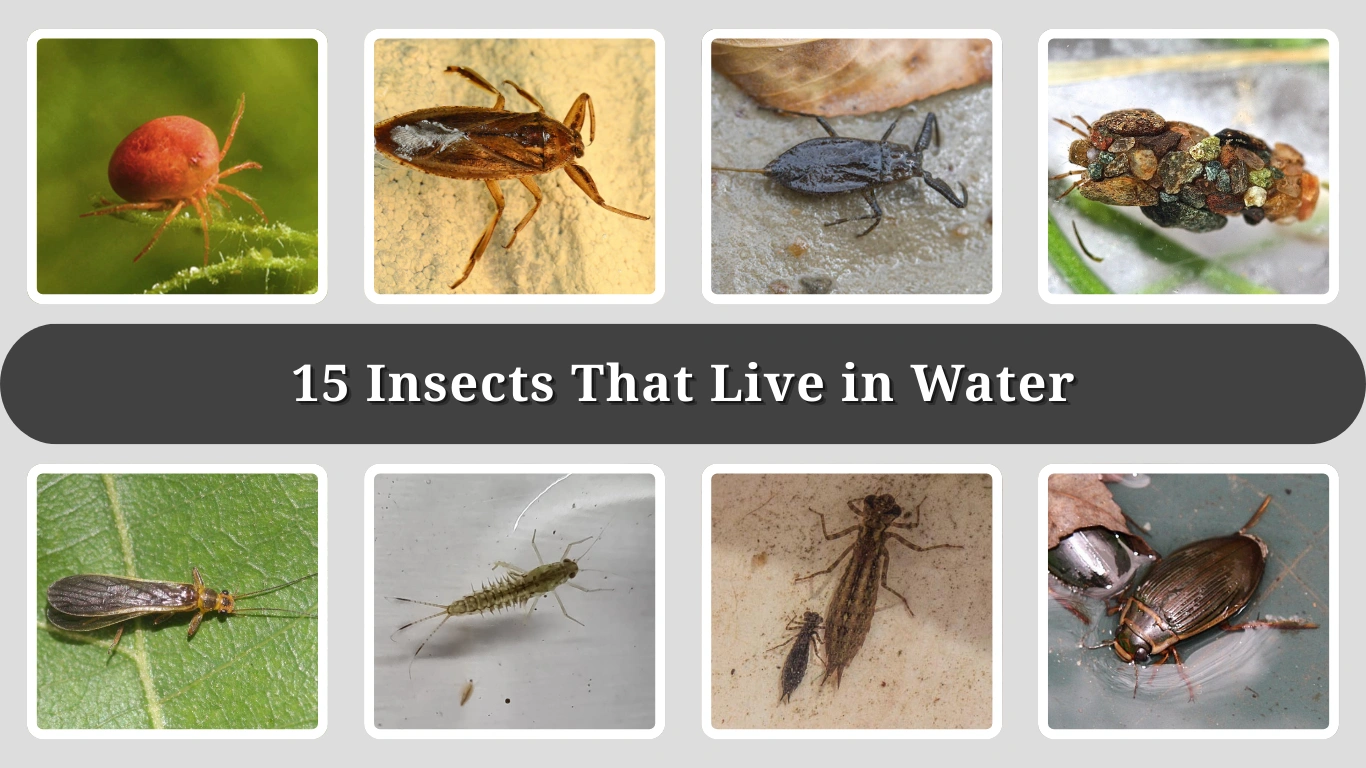
Freshwater habitats are home to a wide variety of insects, many of which spend part or all of their lives in water. These aquatic insects play essential roles in ecosystems by recycling nutrients, controlling pest populations, and serving as food for fish, amphibians, and birds. From surface skaters like water striders to predators such as giant water bugs, each species has unique adaptations that allow it to survive and thrive in watery environments.
1. Water Striders

Water striders are fascinating insects that live in water, often seen gliding effortlessly across the surface of ponds, lakes, and streams. They are specially adapted to move on water without sinking, making them one of the most recognizable aquatic insects. These bugs are excellent hunters, using their speed and sensitivity to vibrations on the water to catch prey.
Identifications
- Long, slender legs adapted for skating on water.
- Covered with tiny water-repellent hairs.
- Brown or dark-colored body.
- Small claws at the tips of legs for gripping prey.
Habitat
Water striders live mainly on the surface of calm freshwater bodies like ponds, lakes, and slow-moving rivers. They prefer still or gently flowing water where their legs can spread evenly and support their weight.
Behavior
They feed on insects trapped on the water surface. By detecting ripples and vibrations, they quickly move toward struggling prey, piercing it with their mouthparts to suck out the juices.
Importance
Water striders help maintain ecological balance by controlling mosquito populations and other small insects that fall into the water. Their presence also indicates a healthy freshwater environment.
2. Whirligig Beetles

Whirligig beetles are unique insects that live in water, often seen spinning rapidly in circles on the surface of ponds and lakes. Their unusual movement helps confuse predators and makes them easy to identify. These beetles are also strong swimmers and can dive when threatened.
Identifications
- Oval, black or dark-colored shiny body.
- Two pairs of compound eyes, one for above water and one for below.
- Short, paddle-like middle and hind legs.
- Often found in groups, swirling on water.
Habitat
They live mostly in freshwater habitats such as ponds, lakes, and slow rivers. Their preference is still or calm waters where they can gather in swarms and move in characteristic circles.
Behavior
Whirligig beetles spin on the surface when disturbed and can dive underwater to avoid predators. They feed on small insects and organic material floating on the water.
Importance
These beetles play a role in cleaning water surfaces by consuming dead or dying insects. Their presence also supports the food web as prey for fish and amphibians.
3. Backswimmers

Backswimmers are active aquatic insects that live in water, well known for swimming upside down. They are agile predators found in ponds, lakes, and slow-moving streams. Their long legs and streamlined bodies make them efficient swimmers and effective hunters.
Identifications
- Slender, elongated body, usually light-colored on the back and dark on the underside.
- Long, oar-like hind legs covered with hairs for paddling.
- Swim upside down, unlike many other water insects.
- Capable of biting humans with a painful prick when handled.
Habitat
Backswimmers thrive in freshwater habitats such as ponds, marshes, and quiet streams. They prefer still or gently moving water where they can easily capture prey.
Behavior
They swim upside down with their ventral side facing upward. Backswimmers are predators, feeding on small insects, tadpoles, and even tiny fish. They use their strong beak to pierce prey and suck out body fluids.
Importance
Backswimmers help regulate populations of other aquatic insects, including mosquito larvae. They also serve as food for fish and birds, making them an important link in the freshwater food chain.
4. Water Boatmen

Water boatmen are common aquatic insects that live in water, easily recognized by their flattened bodies and unique rowing movements. Unlike backswimmers, they swim right-side up and are generally harmless to humans. They are among the most widespread insects in freshwater habitats.
Identifications
- Flattened, oval body, usually brown or greenish in color.
- Long, oar-shaped hind legs adapted for swimming.
- Small, triangular head with piercing mouthparts.
- Swim right-side up, unlike backswimmers.
Habitat
Water boatmen are found in ponds, lakes, ditches, and slow-moving streams. They thrive in freshwater environments with aquatic plants, which provide both food and shelter.
Behavior
They are mostly scavengers and herbivores, feeding on algae, detritus, and tiny microorganisms. Water boatmen use their paddle-like legs to move gracefully through the water. Unlike predatory backswimmers, they rarely bite and are considered harmless.
Importance
Water boatmen help keep freshwater ecosystems balanced by feeding on organic matter and algae. They are also an important food source for fish, amphibians, and birds.
5. Diving Beetles

Diving beetles are powerful aquatic insects that live in water, well adapted to swimming and hunting. They are among the largest water-dwelling beetles and are fierce predators, both as adults and larvae. These beetles carry air bubbles with them when diving, which allows them to stay underwater for long periods.
Identifications
- Smooth, oval, and dark-colored body, often black or brown.
- Long, strong hind legs with hairs for powerful swimming.
- Adults have wings and can fly to new water bodies.
- Larvae are elongated with strong jaws, often called “water tigers.”
Habitat
They are found in ponds, lakes, and slow-moving streams with abundant vegetation. Diving beetles prefer clean freshwater environments where they can easily hunt prey.
Behavior
Diving beetles are active predators, feeding on insects, tadpoles, and even small fish. They surface to trap an air bubble under their wing cases, which they use to breathe while underwater. Both adults and larvae are strong hunters.
Importance
These beetles help control populations of other aquatic organisms and contribute to the balance of freshwater ecosystems. They are also an important food source for fish, amphibians, and water birds.
6. Mosquito Larvae

Mosquito larvae are well-known aquatic insects that live in water during the early stages of their life cycle. Commonly called “wrigglers,” they are easy to spot because of their jerky, wriggling movements just below the surface. They are an essential part of the mosquito’s life history, developing in stagnant or slow-moving waters before maturing into flying adults.
Identifications
- Small, worm-like bodies with a distinct head and abdomen.
- Siphon tube at the tail end for breathing at the water surface.
- Move with quick, wriggling motions when disturbed.
- Usually found in groups in standing water.
Habitat
Mosquito larvae thrive in stagnant water sources such as ponds, puddles, ditches, rain barrels, marshes, and even water-filled containers around homes. They need still or slow-moving water to complete their development.
Behavior
They hang just below the surface to breathe through their siphon tube but dive quickly when disturbed. Mosquito larvae feed on microscopic organisms, algae, and organic matter suspended in the water. After passing through four growth stages (instars), they transform into pupae and then emerge as adult mosquitoes.
Importance
Although larvae play a role in aquatic ecosystems by recycling nutrients and serving as food for fish and insects, they are also the beginning stage of mosquitoes—vectors of diseases like malaria, dengue, and West Nile virus. Controlling mosquito larvae is one of the most effective ways to reduce mosquito populations.
7. Dragonfly Nymphs

Dragonfly nymphs are aquatic insects that live in water during their immature stage. Unlike the graceful adult dragonflies, these nymphs are fierce underwater predators. They spend most of their lives beneath the water’s surface before emerging into their flying adult form.
Identifications
- Stocky, elongated body with a large head.
- Extendable lower jaw (labium) used to snatch prey.
- Brown or greenish coloration for camouflage.
- Wing buds visible on the back as they grow.
Habitat
Dragonfly nymphs inhabit ponds, lakes, marshes, and slow-moving streams. They prefer areas with aquatic vegetation, which provides cover and hunting grounds.
Behavior
These nymphs are ambush predators, lying in wait for prey such as mosquito larvae, tadpoles, and even small fish. They use their extendable jaw to grab and devour prey in an instant. Dragonfly nymphs breathe through gills located in the rectum and can expel water forcefully to propel themselves forward, a form of jet propulsion.
Importance
Dragonfly nymphs are crucial in controlling mosquito populations and maintaining ecological balance in freshwater systems. They also serve as a food source for fish, amphibians, and birds, making them vital players in aquatic food chains.
8. Damselfly Nymphs

Damselfly nymphs are delicate aquatic insects that live in water during their juvenile stage. Closely related to dragonflies, they share many similarities but can be distinguished by their slimmer bodies and external gills. These nymphs spend most of their life underwater before transforming into graceful adult damselflies.
Identifications
- Slender, elongated body compared to dragonfly nymphs.
- Three leaf-like external gills at the end of the abdomen.
- Large eyes and visible wing buds as they mature.
- Camouflaged in shades of brown or green.
Habitat
Damselfly nymphs are found in ponds, lakes, and slow-moving streams. They often inhabit areas with aquatic plants, which provide shelter and hunting spots.
Behavior
They are active hunters, feeding on small aquatic organisms such as mosquito larvae, worms, and tiny crustaceans. Damselfly nymphs use their extendable lower jaw (labium) to snatch prey quickly. They rely on their external gills for breathing and can use them to make short bursts of swimming movements.
Importance
Damselfly nymphs play a crucial role in freshwater ecosystems by controlling populations of smaller aquatic insects. They are also a key food source for fish, amphibians, and birds, making them essential for the balance of aquatic food webs.
9. Mayfly Nymphs

Mayfly nymphs are aquatic insects that live in water throughout most of their lives, spending months or even years underwater before transforming into short-lived adult mayflies. They are highly sensitive to pollution and are often used as indicators of clean water.
Identifications
- Elongated body with three slender tail filaments (sometimes two).
- Gills along the sides of the abdomen, often feathery or plate-like.
- Wing pads are visible on the thorax as they grow.
- Brown, green, or gray coloring that blends with the substrate.
Habitat
Mayfly nymphs inhabit freshwater streams, rivers, and lakes, particularly in areas with clean, oxygen-rich water. They cling to rocks, plants, and debris where they graze and hide from predators.
Behavior
They feed mostly on algae, detritus, and organic matter, scraping food from surfaces. Mayfly nymphs are not strong swimmers; instead, they crawl along the substrate. When disturbed, some species can swim with short, rapid movements.
Importance
Mayfly nymphs are vital for freshwater ecosystems. They recycle nutrients, support aquatic food webs, and serve as food for fish, amphibians, and birds. Their presence is also an important indicator of unpolluted, high-quality water.
10. Stonefly Nymphs

Stonefly nymphs are aquatic insects that live in water, especially in cool, fast-flowing streams and rivers. They are highly sensitive to pollution and require clean, oxygen-rich environments, making them excellent bioindicators of freshwater quality.
Identifications
- Elongated body with two long tail filaments (cerci).
- Gills usually located on the thorax or base of legs.
- Wing pads present on the thorax as they mature.
- Usually brown, black, or green in color, blending with stones.
Habitat
Stonefly nymphs inhabit cold, well-oxygenated streams, rivers, and creeks. They prefer habitats with rocky bottoms and fast currents, where they cling to stones and submerged vegetation.
Behavior
They are mainly herbivores and detritivores, feeding on algae, decaying plant matter, and biofilm. Some species are predators, hunting smaller aquatic invertebrates. Stonefly nymphs are poor swimmers and rely on crawling along the streambed.
Importance
Stonefly nymphs play a key role in breaking down organic material and recycling nutrients in freshwater ecosystems. Their presence signals a clean and healthy water system, while their absence often indicates pollution or poor water quality.
11. Caddisfly Larvae

Caddisfly larvae are aquatic insects that live in water during their early life stages. They are best known for their ability to build protective cases from sand, pebbles, twigs, and other debris, which they carry around as shelter. These cases not only provide camouflage but also protect them from predators.
Identifications
- Soft-bodied larvae with a worm-like appearance.
- Build portable cases from natural materials such as sand, shells, or plant matter.
- Head and thorax are hardened and usually brown.
- Presence of gills along the abdomen for breathing.
Habitat
Caddisfly larvae inhabit streams, rivers, lakes, and ponds with plenty of plant material and debris. They are most common in freshwater with clean, oxygen-rich conditions, where they can find suitable materials for building their cases.
Behavior
They use silk secretions from special glands to bind together bits of sand, leaves, and twigs into a protective case. Caddisfly larvae feed on algae, detritus, and decaying plant matter, though some species are predators that catch small aquatic animals.
Importance
Caddisfly larvae are essential in freshwater ecosystems, contributing to nutrient recycling by breaking down organic matter. They are also widely used as bioindicators of water quality, since their presence usually signals clean, healthy water. Additionally, they serve as a food source for fish, amphibians, and birds.
12. Water Scorpions

Water scorpions are fascinating aquatic insects that live in water, resembling stick insects with their long, slender bodies. Despite their name, they are not true scorpions but get their name from their raptorial forelegs and long breathing tube, which looks like a scorpion’s tail.
Identifications
- Long, stick-like body or flattened leaf-like body (depending on species).
- Raptorial front legs adapted for grasping prey.
- Long breathing tube at the end of the abdomen, used like a snorkel.
- Brown or dark coloration for camouflage.
Habitat
They live in ponds, marshes, and slow-moving streams, often hiding among aquatic plants. Water scorpions prefer shallow waters with vegetation where they can ambush prey while remaining concealed.
Behavior
Water scorpions are ambush predators. They cling to plants, waiting motionless for prey such as insects, tadpoles, and small fish. Using their strong front legs, they quickly snatch and pierce prey to suck out body fluids. They breathe air through their snorkel-like tube, keeping it extended above the surface while their body stays submerged.
Importance
Water scorpions play an important role as predators in freshwater ecosystems. They help regulate populations of smaller aquatic creatures, and their presence indicates a diverse and functioning aquatic habitat.
13. Giant Water Bugs

Giant water bugs are large aquatic insects that live in water and are often nicknamed “toe-biters” because of their strong, painful bite. They are among the largest true bugs found in freshwater and are powerful predators capable of taking down prey much larger than themselves.
Identifications
- Large, flat, oval body, usually brown or dark in color.
- Strong, raptorial front legs for grasping prey.
- Short, sharp beak used for piercing and injecting digestive enzymes.
- Can grow up to 12 cm (5 inches), making them one of the biggest aquatic insects.
Habitat
They live in ponds, lakes, marshes, and slow-moving streams. Giant water bugs often stay hidden among vegetation or debris near the bottom or edges of the water.
Behavior
Giant water bugs are ambush predators. They capture fish, tadpoles, frogs, and even small turtles using their powerful front legs. After seizing prey, they inject saliva that liquefies internal tissues, which they then suck out. Interestingly, in some species, males carry eggs on their backs until hatching.
Importance
These insects are top predators in freshwater ecosystems and play a key role in regulating populations of other aquatic animals. In some cultures, giant water bugs are even considered a delicacy and are consumed as food.
14. Water Mites

Water mites are tiny but diverse aquatic insects that live in water, although they actually belong to the arachnid group (related to spiders and ticks). Despite their small size, they play a surprisingly large role in freshwater ecosystems. They are often brightly colored and can be seen crawling or swimming in ponds and streams.
Identifications
- Very small, usually 1–6 mm in size.
- Rounded body, often red, orange, or brown in color.
- Eight legs (as arachnids), though they resemble tiny insects.
- Move by crawling on plants or swimming with jerky motions.
Habitat
Water mites are common in ponds, lakes, streams, and marshes. They often cling to aquatic plants, sediment, or debris. Some species live as parasites during part of their life cycle, attaching to insects like dragonflies and mosquitoes.
Behavior
Water mites are both predators and parasites. Many feed on small invertebrates, insect larvae, and eggs. Others spend part of their lives parasitizing aquatic insects, later detaching to continue their independent life. They are most active in warm seasons.
Importance
Although small, water mites are important in regulating populations of tiny aquatic organisms. Their parasitic stages also influence the health and numbers of larger aquatic insects. Ecologists use them as indicators of freshwater biodiversity.
15. Water Measurers

Water measurers are slender aquatic insects that live in water, often mistaken for water striders because they also move across the surface. However, they are much longer and thinner, resembling walking sticks adapted to aquatic life. Their slow, deliberate movements give them their name.
Identifications
- Very thin, elongated body, stick-like in appearance.
- Long legs, especially the middle pair, which help them move on water.
- Brown or gray coloration for camouflage.
- Smaller and more delicate than water striders.
Habitat
Water measurers are usually found along the edges of ponds, marshes, and slow-moving streams. They prefer calm, shallow areas with aquatic vegetation, where they can move steadily on the surface film.
Behavior
They walk slowly across the surface of the water, feeding on small insects and organisms trapped there. Unlike water striders that dart quickly, water measurers take cautious, measured steps. They rely on camouflage and stealth rather than speed.
Importance
Water measurers contribute to the balance of freshwater ecosystems by feeding on small invertebrates. Their presence indicates a stable aquatic environment, and they serve as prey for fish, amphibians, and birds.