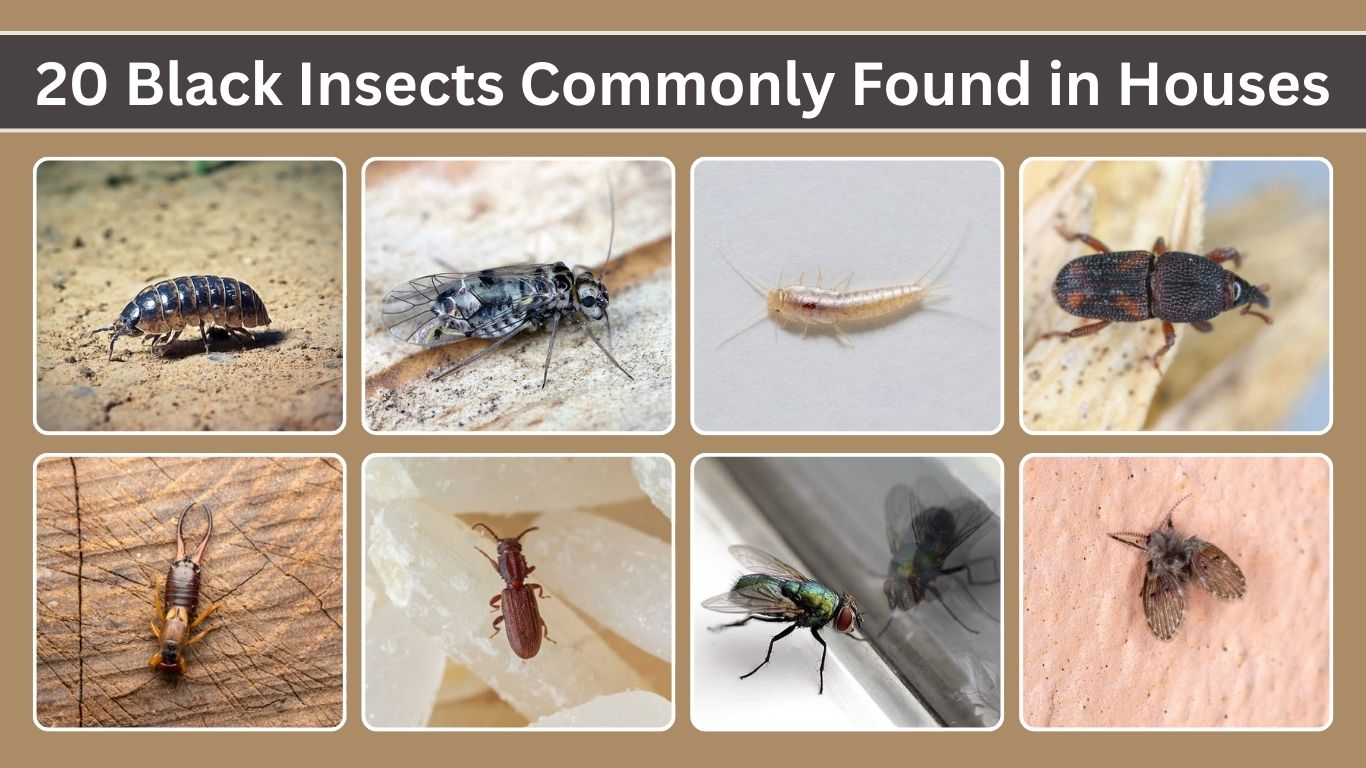
Black insects are among the most frequent household pests, ranging from tiny black crawling insects to small black flying bugs. Many, such as carpet beetles, ants, and cockroach nymphs, invade kitchens and pantries, while others like drain flies, fungus gnats, and cluster flies appear near sinks, plants, or windows. Some species, including earwigs and ground beetles, wander in accidentally from outdoors. Though most are harmless, a few can damage food, fabrics, or wood. This guide highlights 20 common black insects in houses, covering their identification, habitats, behaviors, and control measures.
1. Carpet Beetle (Anthrenus spp.)

The carpet beetle is one of the most common small black insects in houses, belonging to the family Dermestidae. While adults are usually harmless, their larvae are destructive household pests, feeding on natural fibers such as wool, silk, and leather.
Identification
- Size: 2–4 mm long
- Oval, dome-shaped body
- Usually black or dark brown, sometimes mottled with white, yellow, or orange scales
- Adults are round and resemble tiny ladybirds
- Larvae are hairy, brownish, and elongated with bristle-like tufts
Habitat and Range
Carpet beetles are widespread worldwide, thriving in homes, warehouses, and museums. Indoors, they prefer dark corners, carpets, upholstered furniture, stored clothing, and taxidermy specimens. Adults are often found near windows as they are attracted to light.
Behavior and Feeding Habits
Adult carpet beetles feed on pollen and nectar, often entering homes through open windows. The larvae, however, are keratin feeders, consuming natural fibers, stored products, and even dead insects. They are the primary cause of damage to fabrics and carpets.
Notable Facts
- Considered one of the most destructive indoor pests for textiles.
- Infestations are often first noticed by shed larval skins or holes in fabrics.
- Control involves regular vacuuming, dry cleaning, and proper storage of clothes.
- Despite being a nuisance, they play an ecological role outdoors by recycling animal matter.
2. Booklice (Psocoptera)

Booklice are tiny black or gray insects in houses, often mistaken for mites or fleas. Belonging to the order Psocoptera, they are harmless to humans but thrive in damp indoor environments.
Identification
- Size: 1–2 mm long
- Soft-bodied, elongated, and translucent to gray or black
- Some species wingless; others with small, clear wings
- Long, thin antennae
- Move quickly across walls, books, and windowsills
Habitat and Range
Booklice are found worldwide, indoors in humid, poorly ventilated areas such as kitchens, bathrooms, and basements. They are also seen in books, stored papers, and cardboard boxes, where mold spores grow.
Behavior and Feeding Habits
They feed on mold, fungi, starches, and organic debris, not on human food or fabrics. They proliferate in moist conditions and are indicators of high humidity. Though harmless, infestations may become a nuisance.
Notable Facts
- Do not bite or sting humans.
- Often discovered around windowsills and damp books.
- Controlled by reducing humidity with ventilation or dehumidifiers.
- Their presence signals excess moisture in the home.
3. Fungus Gnats (Sciaridae)

Fungus gnats are very tiny black flying insects in houses, often linked to houseplants. Belonging to the family Sciaridae, they are harmless to humans but can damage seedlings and potted plants.
Identification
- Size: 2–4 mm long
- Slender, mosquito-like body, usually black or dark gray
- Long legs and antennae
- Transparent wings with faint venation
- Weak, erratic fliers often seen near soil
Habitat and Range
Fungus gnats are cosmopolitan, commonly found indoors wherever houseplants or moist soil are present. They thrive in overwatered pots and greenhouses.
Behavior and Feeding Habits
Adults feed on organic matter and fungi in soil, while larvae attack roots of young plants, causing wilting or stunted growth. Their presence is most noticeable when swarms hover around potted plants.
Notable Facts
- Attracted to damp soil and organic-rich potting mix.
- Infestations worsen with overwatering.
- Controlled by allowing soil to dry and using sticky traps.
- Though a nuisance indoors, they are harmless to people and pets.
4. Drain Flies (Psychodidae)

Drain flies, also called moth flies, are small blackish flying insects in houses, often found near sinks and drains. Their fuzzy appearance and erratic flight make them easy to recognize.
Identification
- Size: 1.5–5 mm long
- Dark gray to black, moth-like body with fuzzy hairs
- Broad, leaf-shaped wings held roof-like over the body
- Six short legs and long antennae
- Weak fliers, often seen hovering near drains
Habitat and Range
They are found worldwide, preferring moist areas with organic buildup, especially sink drains, shower pipes, and sewage systems. Indoors, they rest on bathroom tiles, walls, or near windows.
Behavior and Feeding Habits
Drain flies feed on organic matter, algae, and bacteria in drain pipes. Adults are harmless, but their larvae may thrive in clogged pipes. Their black fuzzy appearance often causes alarm, though they do not bite.
Notable Facts
- Common in kitchens and bathrooms.
- Overpopulation signals dirty or clogged drains.
- Eliminated by cleaning drains and removing organic debris.
- Sometimes mistaken for tiny moths indoors.
5. Phorid Flies (Phoridae)

Phorid flies, also called humpback flies, are tiny black flying insects in houses known for their distinctive jerky movements. They are often mistaken for fruit flies but are darker and smaller.
Identification
- Size: 0.5–5 mm long
- Black to dark brown body, hump-shaped thorax
- Short wings with few veins
- Six legs, with hind legs adapted for running
- Distinctive erratic running behavior on surfaces
Habitat and Range
Found worldwide, they live in decaying organic matter, garbage, drains, and moist soil. Indoors, they are common near trash bins, plumbing leaks, and rotting food.
Behavior and Feeding Habits
Adults feed on organic waste, while larvae thrive in decaying matter or fungi. They are attracted to unsanitary conditions, making them indicators of hidden leaks or decomposition indoors.
Notable Facts
- Sometimes called “coffin flies” for infesting buried remains.
- Do not bite but are considered hygiene pests.
- Populations controlled by sanitation and moisture reduction.
- Their tiny black dot-like size often causes confusion with fruit flies.
6. Fruit Flies (Drosophila spp. – Dark Morphs)

Fruit flies are among the most common tiny black flying insects in houses, often seen around ripe fruits or fermenting liquids. While usually tan, some dark morphs appear brownish-black, making them easy to confuse with other small flies.
Identification
- Size: 2–4 mm long
- Rounded body, dark brown to black in some morphs
- Red or dark compound eyes
- Transparent wings with distinct venation
- Six short legs and bristle-like antennae
Habitat and Range
They are found globally, thriving in kitchens, pantries, and garbage areas. Indoors, they congregate around ripening fruit, wine bottles, trash bins, and drains.
Behavior and Feeding Habits
Fruit flies feed on fermenting fruit, sugary liquids, and decaying organic matter. They breed rapidly, with females laying eggs in overripe produce. Their presence is strongly linked to poor sanitation and exposed food sources.
Notable Facts
- Lifecycle can be as short as 7–10 days.
- Can carry bacteria from contaminated surfaces to food.
- Controlled by removing breeding sites and sealing produce.
- Sometimes mistaken for fungus gnats or phorid flies.
7. Cockroach Nymphs (Various Species)

Cockroach nymphs are often mistaken for tiny black crawling insects in houses. These are juvenile stages of cockroaches, smaller and darker than adults, commonly found in kitchens and bathrooms.
Identification
- Size: 2–6 mm depending on stage
- Oval, flattened body, typically dark brown to black
- Wingless, unlike adults
- Long antennae and spiny legs
- Quick runners, often seen at night
Habitat and Range
Cockroaches are cosmopolitan pests, infesting homes, restaurants, and food storage areas. Nymphs hide in cracks, crevices, under appliances, and inside cupboards, especially in warm, humid conditions.
Behavior and Feeding Habits
Nymphs feed on crumbs, grease, organic waste, and stored food products. They molt several times before becoming winged adults. Their presence usually indicates a breeding infestation.
Notable Facts
- Signs include droppings, shed skins, and egg casings.
- Major species indoors: German, American, and Oriental cockroaches.
- Known vectors of disease-causing bacteria.
- Effective control requires cleanliness and pest management.
8. Ants (Black Garden Ant, Lasius niger)

The black garden ant is one of the most common small black insects in houses, especially during warm months. Belonging to the family Formicidae, these ants are harmless but can be a nuisance when foraging for food indoors.
Identification
- Size: 3–5 mm for workers, up to 9 mm for queens
- Shiny black, slender body with three main segments
- Elbowed antennae and six legs
- Winged forms (swarmers) appear seasonally
- Often seen in long foraging trails
Habitat and Range
Widespread across Europe, Asia, and North America, black garden ants nest outdoors in soil, pavements, and lawns. Indoors, they invade kitchens, pantries, and food storage areas in search of sugary substances.
Behavior and Feeding Habits
They are highly social insects living in colonies with a queen and workers. Indoors, they target sweets, fruits, and crumbs. Though they do not cause structural damage, infestations can be persistent without proper control.
Notable Facts
- Winged ants emerge in summer for mating flights.
- Attracted to sugary spills and food waste.
- Do not bite or sting humans.
- Controlled by sanitation and sealing entry points.
9. Termite Swarmers (Winged Termites)

Termite swarmers are often mistaken for black winged ants in houses. They are the reproductive caste of termites, emerging in large numbers to form new colonies. Their presence indoors can signal potential structural damage.
Identification
- Size: 6–10 mm long
- Dark brown to black body
- Straight antennae, unlike bent ant antennae
- Four equal-sized wings with a smoky tint
- Soft-bodied, fragile appearance
Habitat and Range
Termites are found worldwide, especially in tropical and subtropical regions, but also in temperate climates. Indoors, swarmers appear near windows, doors, basements, and wooden structures during spring or after rainfall.
Behavior and Feeding Habits
Swarmers do not feed indoors but are signs of a mature colony nearby. Worker termites feed on wood, paper, and cellulose materials, causing serious damage. Their black winged appearance often leads to confusion with flying ants.
Notable Facts
- Key difference: termites have straight antennae and equal wings.
- Swarming usually occurs in spring.
- Presence indoors often requires professional inspection.
- Considered one of the most destructive household pests globally.
10. Cluster Flies (Pollenia rudis)

Cluster flies are large black flying insects in houses, often found near windows in autumn and winter. Belonging to the family Calliphoridae, they are sluggish compared to houseflies and gather in large numbers while overwintering indoors.
Identification
- Size: 6–10 mm long
- Dark gray to black, slightly hairy body
- Wings overlap when at rest
- Golden hairs on thorax visible in sunlight
- Sluggish flight, often circling windows
Habitat and Range
Cluster flies are widespread in Europe, North America, and temperate regions. They enter homes through gaps in roofs, windows, and siding to overwinter in attics, wall voids, and upper rooms.
Behavior and Feeding Habits
Outdoors, adults feed on nectar. Indoors, they do not breed or feed but gather in clusters for hibernation. Their presence is mainly a nuisance, as dead flies accumulate around windows and lofts.
Notable Facts
- Harmless to people and property.
- Controlled by sealing entry points and vacuuming.
- Tend to reappear every year in the same buildings.
- Distinguished from houseflies by sluggish behavior.
11. House Flies (Musca domestica)

The house fly is one of the most widespread black winged insects in houses, belonging to the family Muscidae. These insects are well-known household pests due to their association with food contamination.
Identification
- Size: 6–7 mm long
- Grayish-black body with four dark stripes on thorax
- Red compound eyes and short antennae
- Transparent wings held flat over the body
- Six legs with sticky pads enabling wall-walking
Habitat and Range
House flies are cosmopolitan, thriving in urban, rural, and indoor environments. They breed in garbage, food waste, and decaying organic matter, making them common around kitchens and trash bins.
Behavior and Feeding Habits
Adults feed on liquids or dissolved solids, regurgitating digestive fluids onto food. They are attracted to sugars, proteins, and waste. While harmless physically, they are notorious for spreading bacteria and pathogens.
Notable Facts
- Life cycle completes in just 7–10 days under warm conditions.
- Known carriers of E. coli, Salmonella, and other microbes.
- Controlled with sanitation, screens, and traps.
- Considered one of the most important public health pests.
12. Spider Beetles (Ptinidae)

Overview
Spider beetles are small black crawling insects in houses, often mistaken for spiders due to their round bodies and long legs. Belonging to the family Ptinidae, they are scavengers commonly found in pantries and storage areas.
Identification
- Size: 1.5–3.5 mm long
- Shiny black or dark reddish-brown, globular body
- Long legs and antennae resembling those of spiders
- Winged but rarely fly indoors
- Move slowly compared to ants
Habitat and Range
Spider beetles are cosmopolitan, inhabiting pantries, storage rooms, warehouses, and attics. Indoors, they infest stored grains, flour, spices, fabrics, and even animal matter.
Behavior and Feeding Habits
They are scavengers, feeding on dry organic materials such as grains, wool, feathers, and dead insects. Infestations often go unnoticed until populations increase, as they are nocturnal.
Notable Facts
- Named for their spider-like appearance.
- Harmless to humans but damaging to stored goods.
- Thrive in dark, dry storage environments.
- Signs include damaged packaging and beetle droppings.
13. Drugstore Beetles (Stegobium paniceum)

The drugstore beetle is a common small black beetle in houses, especially in kitchens and pantries. Part of the family Ptinidae, it is a major stored-product pest worldwide.
Identification
- Size: 2–4 mm long
- Cylindrical, dark brown to black body
- Covered with fine hairs, giving a dusty appearance
- Head bent downward, hidden under thorax
- Six legs and short antennae ending in a 3-segmented club
Habitat and Range
Found globally, drugstore beetles infest homes, grocery stores, warehouses, and libraries. They attack stored food, spices, leather, paper, and even pharmaceuticals, hence the name.
Behavior and Feeding Habits
Adults bore small round exit holes in packaging. Larvae feed on dry stored goods, often contaminating large amounts of food. Their tiny black beetle bodies make them hard to notice until infestations spread.
Notable Facts
- Can chew through cardboard, plastic, and tin foil.
- Infestations often detected by pinholes in packaging.
- Life cycle: 1–3 months depending on temperature.
- Controlled by discarding infested items and deep cleaning.
14. Grain Beetles (Oryzaephilus spp.)

Grain beetles are tiny black or dark brown insects in houses, notorious for infesting pantries and food storage areas. Belonging to the family Silvanidae, they are among the most common stored-product pests.
Identification
- Size: 2.5–3 mm long
- Narrow, flat, elongated body
- Dark brown to black in color
- Distinct ridges along thorax edges
- Six legs and long antennae
Habitat and Range
Found worldwide, grain beetles thrive in kitchens, warehouses, and food processing facilities. Indoors, they infest cereals, rice, flour, dried fruits, nuts, and processed foods.
Behavior and Feeding Habits
Adults and larvae feed on stored grains and packaged food. Their flattened bodies allow them to slip into sealed containers. Infestations spread quickly due to their small size and ability to survive in low-moisture foods.
Notable Facts
- Cannot digest whole grains but thrive on processed products.
- One of the fastest-reproducing pantry pests.
- Signs include crawling beetles in cupboards and contaminated food.
- Controlled by cleaning and discarding infested goods.
15. Weevils (Rice/Flour Weevils)

Weevils are common tiny black beetles in houses, especially found in pantry goods. Belonging to the family Curculionidae, they are characterized by their long snouts and destructive feeding on stored grains.
Identification
- Size: 2–4 mm long
- Dark brown to black, slender body
- Long snout with chewing mouthparts
- Six legs and elbowed antennae
- Winged, but usually not strong fliers indoors
Habitat and Range
Weevils are cosmopolitan pests of rice, flour, pasta, beans, and grains. They infest food cupboards, pantries, and warehouses, thriving in warm, dry indoor environments.
Behavior and Feeding Habits
Female weevils bore into grains to lay eggs. The larvae develop inside the kernels, hollowing them out. Adults emerge by chewing exit holes. Infestations are often detected by damaged grain and small crawling beetles.
Notable Facts
- Known as one of the most destructive pantry pests.
- Rice and granary weevils are the most common household species.
- Infested grains often contain both larvae and adults.
- Control involves discarding infested food and deep-cleaning storage areas.
16. Earwigs (Dermaptera)

Earwigs are long, slender black or dark brown insects in houses, recognized by the pincers at the end of their abdomen. Though they look intimidating, they are mostly harmless and occasionally wander indoors.
Identification
- Size: 12–25 mm long
- Dark brown to black elongated body
- Distinctive cerci (pincers) at rear end
- Short forewings, membranous hindwings folded underneath
- Six legs and long antennae
Habitat and Range
Earwigs are distributed worldwide, commonly inhabiting gardens, soil, mulch, and damp outdoor areas. Indoors, they are usually found in basements, bathrooms, and kitchens, especially during warm or rainy weather.
Behavior and Feeding Habits
They are omnivores, feeding on decaying plant matter, fungi, and small insects. Indoors, they cause little harm but may become a nuisance when seeking moisture or shelter. Their pincers are used for defense and mating displays.
Notable Facts
- Despite myths, they do not crawl into ears.
- Attracted indoors by dampness and lights.
- Females show maternal care, guarding eggs.
- Easily controlled by reducing moisture indoors.
17. Crickets (House Cricket, Acheta domesticus)

House crickets are medium-sized black or dark brown insects in houses, known for their loud chirping at night. They belong to the family Gryllidae and are often attracted indoors by warmth and light.
Identification
- Size: 16–21 mm long
- Cylindrical, brownish-black body
- Long hind legs adapted for jumping
- Antennae longer than body length
- Males produce chirping sounds by rubbing wings together
Habitat and Range
Native to Asia but now cosmopolitan, house crickets thrive in warm, damp areas such as basements, kitchens, and near heating appliances. They are common in both rural and urban homes.
Behavior and Feeding Habits
They are omnivorous scavengers, feeding on crumbs, fabrics, paper, and even other insects. At night, they become active, with males chirping to attract mates. While not dangerous, they can be a nuisance.
Notable Facts
- Known for their distinctive chirping calls.
- Can damage fabrics and stored items when infestations grow.
- Kept as feeder insects for reptiles and amphibians.
- Presence indoors often indicates nearby warmth and moisture.
18. Ground Beetles (Carabidae)

Ground beetles are fast-moving black crawling insects in houses, usually entering accidentally while searching for prey. Belonging to the family Carabidae, they are beneficial predators outdoors but can alarm homeowners indoors.
Identification
- Size: 5–25 mm long (varies by species)
- Shiny black or metallic dark body
- Flattened, elongated shape with strong mandibles
- Long legs for running quickly
- Striated wing covers (elytra), though most species rarely fly
Habitat and Range
Ground beetles are distributed worldwide, commonly inhabiting gardens, forests, and farmlands. Indoors, they are found near basements, garages, and ground-level entry points, especially in damp conditions.
Behavior and Feeding Habits
They are predators, feeding on slugs, caterpillars, and other insects. Indoors, they do not reproduce and usually wander accidentally. Their black shiny bodies and rapid crawling make them highly noticeable.
Notable Facts
- Beneficial in controlling garden pests.
- No threat to humans, pets, or property.
- Attracted indoors by lights at night.
- Best controlled by sealing entry points.
19. Silverfish (Lepisma saccharinum)

Silverfish are small, thin, blackish-gray crawling insects in houses, known for their metallic sheen and fast, wriggling movements. Belonging to the order Zygentoma, they are among the most ancient insect groups.
Identification
- Size: 10–15 mm long
- Flattened, elongated, carrot-shaped body
- Dark gray to black scales give metallic appearance
- Long antennae and three bristle-like tails at rear
- Six short legs, rapid, darting motion
Habitat and Range
Silverfish are cosmopolitan, thriving in damp, dark indoor environments such as bathrooms, kitchens, basements, and attics. They prefer humid areas and hide in cracks, behind wallpaper, or under flooring.
Behavior and Feeding Habits
They feed on starches, sugars, and proteins, including paper, glue, fabrics, cereals, and book bindings. While they cause no structural damage, infestations can ruin stored goods.
Notable Facts
- Active mainly at night, elusive during the day.
- Can live for years with minimal food.
- Do not bite or spread disease.
- Controlled by reducing humidity and sealing cracks.
20. Woodlice (Pillbugs, Oniscidea)

Woodlice, often mistaken for insects, are actually black or dark gray crustaceans that occasionally wander into houses. Commonly called pillbugs or sowbugs, they belong to the order Isopoda and thrive in damp environments.
Identification
- Size: 5–15 mm long
- Oval, segmented body with a hard black or dark gray shell
- Seven pairs of legs
- Two prominent antennae
- Some species roll into a ball when disturbed (pillbugs)
Habitat and Range
Woodlice are distributed worldwide, preferring moist outdoor habitats such as soil, compost heaps, and leaf litter. Indoors, they are usually found in basements, bathrooms, and kitchens, especially in damp corners.
Behavior and Feeding Habits
They are detritivores, feeding on decaying plant matter, fungi, and organic debris. Inside homes, they do not damage food or property but indicate excess moisture problems.
Notable Facts
- Breathe through gill-like structures, requiring damp conditions.
- Not true insects but terrestrial crustaceans.
- Harmless to humans and pets.
- Populations indoors can be controlled by fixing leaks and improving ventilation.