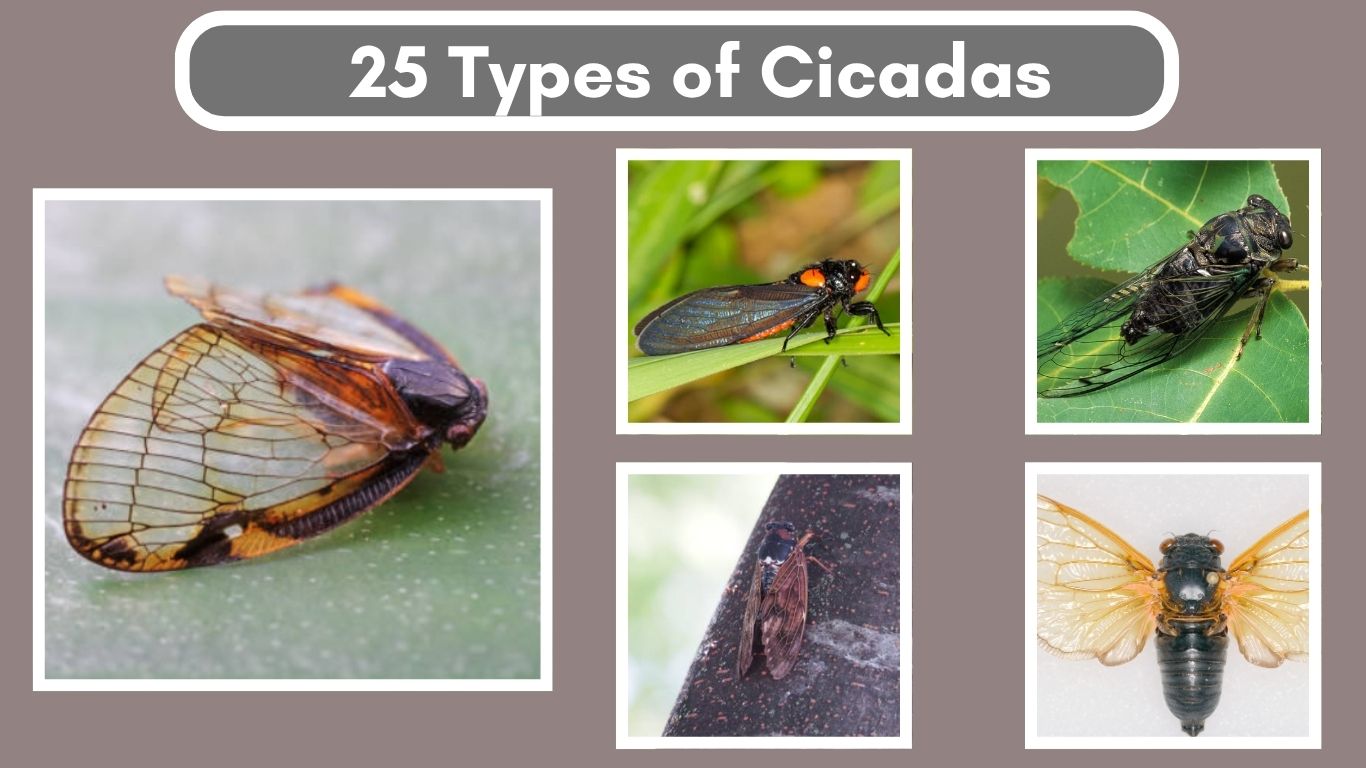
Cicadas are fascinating insects known for their loud, distinctive songs and unusual life cycles. Found across forests, deserts, and cities worldwide, these creatures range from annual singers to mysterious 17-year brooders. In this list, you’ll discover 25 different types of cicadas—from the giant Quesada gigas to the musical Magicicada septendecim—each with its own unique appearance, habitat, and behavior
1. Magicicada septendecim

Magicicada septendecim is one of the most well-known periodical cicadas in North America, famous for its 17-year life cycle. This species is part of the Magicicada genus, which includes several cicadas that emerge en masse after more than a decade underground. Known for their loud, high-pitched “pharaoh” song, these cicadas appear in overwhelming numbers during their emergence years, often covering trees, shrubs, and even sidewalks.
They play an essential ecological role, aerating soil and providing a feast for birds and other predators.
Identification
- Size: About 1.5 inches long
- Color: Black body, orange-red eyes, and orange veins on transparent wings
- Song: A distinct, whirring call that resembles “Pharaoh!”
Habitat and Distribution
Magicicada septendecim is native to the eastern United States, typically found in deciduous forests, suburban areas, and open woodlands. While underground, nymphs feed on the xylem fluids of tree roots. After 17 years, they emerge synchronously by the millions, mate, and die within weeks.
Life Cycle and Behavior
These cicadas spend 17 years underground as nymphs, emerging once the soil temperature reaches about 64°F (usually in late spring). Adults climb onto vegetation, molt into their winged form, and begin their brief but noisy mating season. Females lay eggs in tree twigs, and after hatching, the new nymphs drop to the ground to burrow and begin the cycle again.
2. Magicicada cassini

Magicicada cassini is another fascinating 17-year periodical cicada species found in the eastern United States. It is smaller than Magicicada septendecim and is best known for its synchronized chorusing and sudden silence, which can happen when the entire swarm stops singing at once. This species often emerges in overwhelming densities, especially in forests and rural areas.
Its shorter and more mechanical song helps distinguish it from other Magicicada species.
Identification
- Size: Slightly smaller than M. septendecim, around 1.2 to 1.3 inches
- Color: Black body, red-orange eyes, transparent wings with orange veins
- Song: High-pitched, repetitive “tick-tick-tick” that builds into a rapid buzz
Habitat and Distribution
M. cassini is found in hardwood forests, parks, and open wooded areas across the Midwest and Eastern U.S. Like its relatives, it lives underground for most of its life, feeding on tree root fluids before emerging in huge numbers during its 17-year cycle.
Life Cycle and Behavior
This species emerges at the same time as other 17-year cicadas but tends to prefer younger trees and lower branches for laying eggs. Its synchronized mating displays and mass die-offs help overwhelm predators and ensure survival of the next generation. After mating, females lay hundreds of eggs, and the nymphs return underground to restart the cycle.
3. Magicicada septendecula

Magicicada septendecula is a lesser-known but equally remarkable 17-year cicada. Compared to M. septendecim and M. cassini, it is rarer and typically occurs in smaller, scattered populations. It is more difficult to identify due to its subtle song and quieter behavior but still plays an essential role in the synchronized emergence events of periodical cicadas.
This species is often found co-emerging with other Magicicada species.
Identification
- Size: Similar to M. cassini, about 1.2–1.3 inches
- Color: Black body, reddish eyes, with more muted wing vein coloring
- Song: Softer, irregular buzz with short pulses, often difficult to distinguish
Habitat and Distribution
M. septendecula is scattered across parts of the Appalachian region, Midwest, and southeastern U.S., favoring mixed hardwood forests. It may prefer slightly higher elevations or more secluded habitats than its more dominant relatives.
Life Cycle and Behavior
Just like other 17-year cicadas, M. septendecula spends 17 years underground, feeding on xylem fluids from tree roots. It emerges synchronously, though in lower numbers, and participates in the same mating frenzy during peak emergence. Eggs are deposited in twigs, and the life cycle restarts underground.
4. Magicicada tredecim

Magicicada tredecim is one of the few 13-year periodical cicadas, making it distinct from most other Magicicada species that follow a 17-year cycle. It is primarily found in the southern United States, especially in areas like Arkansas, Mississippi, Louisiana, and Tennessee. M. tredecim is the largest of all Magicicada species and is easily recognized by its deep, resonant song and slightly different coloration.
Its emergence occurs in massive broods, blanketing forests in a sea of red-eyed, black-bodied insects every 13 years.
Identification
- Size: Largest among Magicicadas, about 1.6 inches long
- Color: Black body with bright orange on the underside of the abdomen
- Song: A loud, droning “weeeee-oh” that rises and falls slowly
Habitat and Distribution
This species inhabits southern woodlands, forest edges, and suburban treescapes in states like Texas, Arkansas, Georgia, and others where 13-year broods are active. It favors deciduous hardwood trees, especially oaks, hickories, and maples.
Life Cycle and Behavior
Magicicada tredecim spends 13 years underground, emerging when soil temperatures reach about 64°F. Once above ground, they molt, mate, and lay eggs in tree twigs. After hatching, the tiny nymphs fall to the ground and burrow to begin the next 13-year cycle. Their mass emergence serves as a survival strategy—predator satiation—to ensure species survival.
5. Magicicada neotredecim

Magicicada neotredecim is a close relative of M. tredecim and also follows a 13-year life cycle. It was recognized as a distinct species relatively recently and is often found co-emerging with M. tredecim in the southern U.S. The key difference lies in its genetic makeup, abdominal coloration, and song pitch, which is slightly higher than that of M. tredecim.
This cicada plays a crucial role in the biodiversity of the 13-year broods in the Southeast.
Identification
- Size: Slightly smaller than M. tredecim, around 1.4 inches
- Color: Black body with variable orange or brown abdominal tint
- Song: Similar to M. tredecim but with a higher pitch “weeeee-ooo”
Habitat and Distribution
M. neotredecim is found primarily in Mississippi, Louisiana, Georgia, and Alabama, often inhabiting deciduous woodlands and suburban neighborhoods with mature trees. It typically overlaps with M. tredecim in both time and space, though they use different songs to attract mates of the same species.
Life Cycle and Behavior
Following a 13-year underground development, M. neotredecim emerges in enormous numbers. Males sing from treetops to attract females, then the cycle proceeds with mating, egg-laying in twigs, and nymphs falling to the ground to burrow. Their synchronized emergence and acoustic separation from closely related species help maintain their genetic identity.
6. Magicicada tredecassini

Magicicada tredecassini is a 13-year periodical cicada species that closely resembles its 17-year counterpart, Magicicada cassini. It is found primarily in the southern and central United States, often emerging alongside M. tredecim and M. neotredecim during the massive broods of 13-year cicadas. This species is known for its coordinated chorusing and sudden group silences, behaviors that help in both mate attraction and predator avoidance.
Despite its similar appearance to other Magicicadas, it can be identified by its distinct acoustic signature and life cycle.
Identification
- Size: Medium-sized; around 1.2 to 1.3 inches
- Color: Black body with reddish eyes and orange wing veins
- Song: Rapid ticking sound that builds into a mechanical-sounding buzz
Habitat and Distribution
M. tredecassini is found in southern and central U.S. states such as Arkansas, Mississippi, Tennessee, and Missouri, often in deciduous forests and wooded neighborhoods. Like other drywood-preferring cicadas, it favors oaks, elms, and maples.
Life Cycle and Behavior
This species spends 13 years underground, emerging in enormous, synchronized numbers when conditions are right. After molting, males sing in groups from treetops, competing for mates. Once eggs are laid in twigs, the life cycle begins again as nymphs drop to the soil to burrow. Colonies rely on mass emergence to overwhelm predators and ensure reproduction.
7. Magicicada tredecula

Magicicada tredecula is another 13-year periodical cicada, typically emerging with M. tredecim and M. tredecassini during southern brood events. It is smaller and less widespread than other Magicicadas but plays a key role in the diverse broods found in southeastern states. It is often confused with other species due to its size and coloration but can be distinguished by its distinct, buzzy mating call.
It is considered one of the less common periodical cicadas.
Identification
- Size: Slightly smaller; around 1.1 to 1.2 inches
- Color: Black body, red eyes, with light orange wing veins
- Song: Continuous, soft buzz with a pulsating rhythm
Habitat and Distribution
This species lives in southern and southeastern U.S., especially in forested or lightly wooded areas of Mississippi, Alabama, Georgia, and eastern Texas. It prefers older hardwoods and is often less noticeable due to its quieter call and lower numbers.
Life Cycle and Behavior
Magicicada tredecula remains underground for 13 years, feeding on xylem fluids from tree roots. It emerges in late spring, mates quickly, and lays eggs in small tree branches. The nymphs hatch, fall to the ground, and burrow to begin another 13-year cycle. Though less prominent than other Magicicadas, it contributes to the acoustic diversity and genetic complexity of 13
8. Neotibicen pruinosus

Neotibicen pruinosus, also known as the Scissor Grinder Cicada, is a large annual cicada found throughout the central and eastern United States. Unlike periodical cicadas, this species emerges every year during the late summer months and is commonly heard in open woodlands, parks, and residential neighborhoods. Its name comes from the unique, buzzing call that sounds like scissors being sharpened on a grinder.
It is a familiar summer presence, especially in areas with plenty of mature trees.
Identification
- Size: About 1.5 to 2 inches long
- Color: Greenish-black body with white pruinose (powdery) patches on the abdomen
- Song: A long, mechanical-sounding buzz followed by a rhythmic clicking
Habitat and Distribution
Neotibicen pruinosus inhabits open forests, suburban areas, and river valleys, particularly where hardwood trees are abundant. It is commonly found in states like Kansas, Missouri, Illinois, Arkansas, and Indiana.
Life Cycle and Behavior
This cicada follows a 2–5 year development cycle, but generations overlap so adults appear annually. Nymphs live underground, feeding on tree root fluids. After maturing, they emerge in late summer, climb nearby trees, molt, and begin calling. Males attract females with their song, and mating occurs quickly. Females lay eggs in twigs, and the cycle repeats.
9. Neotibicen linnei

Neotibicen linnei, or Linne’s Cicada, is a widespread annual cicada species native to the eastern United States. It is often heard in urban neighborhoods and forests during the hot summer months. This cicada is named in honor of Carl Linnaeus, the father of modern taxonomy. Its song is a steady, pulsating buzz that starts slow and intensifies before fading.
It is well-adapted to human-modified environments and is often seen resting on tree trunks or fences.
Identification
- Size: Approximately 1.5 inches long
- Color: Olive green and black body with green wing veins
- Song: A high-pitched, pulsating buzz that rises and falls smoothly
Habitat and Distribution
N. linnei thrives in deciduous woodlands, backyards, and city parks, especially where large shade trees like oaks and maples are common. It is widely distributed in states such as Pennsylvania, Virginia, Ohio, and Kentucky.
Life Cycle and Behavior
Like other Neotibicen species, N. linnei has a multi-year life cycle, but adults appear annually due to overlapping generations. The nymphs live underground for 2–5 years, feeding on root sap. Adults emerge in midsummer, sing during the day, and mate high in the tree canopy. After egg-laying, the female dies, and the eggs hatch into new nymphs that fall to the soil.
10. Neotibicen canicularis

Neotibicen canicularis, commonly known as the Dog-Day Cicada, is one of the most familiar annual cicadas in the northern United States and southern Canada. Its name comes from its emergence during the hottest days of summer, often referred to as the “dog days.” This species is known for its distinct, high-pitched whine, which can last for several seconds and fades in and out like a siren.
It is active during the day and can often be seen clinging to tree trunks or large branches.
Identification
- Size: Around 1.5 inches long
- Color: Black body with green markings and transparent wings
- Song: A high-pitched, rising and falling whine that sounds like a distant buzz saw
Habitat and Distribution
Dog-Day Cicadas are found in open woodlands, residential areas, parks, and meadows, especially where large deciduous trees like elm, oak, and maple grow. They are common in states like Michigan, New York, Pennsylvania, and Minnesota.
Life Cycle and Behavior
Although each individual may have a 2–3 year underground development, overlapping generations ensure annual emergence. After surfacing, nymphs climb tree trunks, molt, and begin their adult life. Males sing from high branches to attract females, and after mating, eggs are laid in twigs. The young nymphs drop to the ground and burrow to start the cycle again.
11. Neotibicen lyricen

Neotibicen lyricen, also called the Lyric Cicada, is a large and loud annual cicada found in the eastern and southeastern United States. It is well known for its distinct musical song, which is slower and more lyrical than the harsh buzzes of other cicadas. This species prefers heavily wooded areas, often staying high in the tree canopy.
Its unique call makes it a favorite among insect song recorders and naturalists.
Identification
- Size: About 1.75 to 2 inches long
- Color: Dark green to black with light green wing veins and white patches on the sides
- Song: A slow, melodic buzz that rises and falls in pitch—more musical than mechanical
Habitat and Distribution
This species prefers dense hardwood forests, forest edges, and mature wooded suburbs. It is widespread in Georgia, Alabama, Tennessee, and the Carolinas, often heard during the late afternoon and evening hours.
Life Cycle and Behavior
Neotibicen lyricen nymphs live underground for 2–4 years, feeding on the sap of tree roots. Adults emerge every summer due to overlapping broods. Males produce their unique song to attract mates, usually while perched high in tall trees. After mating, females lay eggs in thin branches, and the life cycle continues underground.
12. Neotibicen robinsonianus

Neotibicen robinsonianus, commonly known as Robinson’s Cicada, is a large and robust annual cicada native to the southeastern United States. It is often confused with similar species like N. lyricen, but it can be distinguished by its slightly different song and more extensive white markings on the abdomen. It typically sings during the hottest parts of the day, especially in late summer.
This cicada adds to the rich acoustic diversity of the southeastern forest canopy.
Identification
- Size: Around 1.75 to 2 inches
- Color: Dark green to black body with pronounced white spots on the sides of the abdomen
- Song: A pulsing, harsh buzz that tapers off at the end
Habitat and Distribution
Neotibicen robinsonianus is commonly found in mature hardwood forests, mixed woodlands, and forest edges. It is especially prevalent in Georgia, South Carolina, Alabama, and Mississippi, favoring trees like oaks, hickories, and sweetgums.
Life Cycle and Behavior
This cicada follows a multi-year underground nymph stage (2–4 years), but adults emerge annually due to overlapping broods. Males perch high on tree trunks or limbs to sing, and after mating, females deposit eggs into the ends of thin branches. Once hatched, nymphs fall to the ground and burrow to begin the cycle again.
13. Neotibicen tibicen

Neotibicen tibicen, also known as the Swamp Cicada or Morning Cicada, is a common annual cicada of the eastern and southeastern U.S. This species gets its name from its habit of calling early in the day, especially in swampy or wetland areas. It’s among the earliest Neotibicen cicadas to sing during the summer months.
It is admired for its glossy, dark appearance and smooth-toned call.
Identification
- Size: Around 1.5 to 1.8 inches
- Color: Shiny black body with light green wing veins and white or tan stripes
- Song: A soft, whirling drone that builds and fades in a wave pattern
Habitat and Distribution
N. tibicen is often found in lowland forests, swamps, riversides, and suburban yards with large, moisture-loving trees. It ranges from Florida and the Gulf Coast up through the Mid-Atlantic states.
Life Cycle and Behavior
Like other Neotibicen cicadas, this species has a 2–5 year subterranean nymphal stage, but adults emerge yearly. Males begin calling shortly after sunrise and continue throughout the morning. After mating, females insert eggs into thin twigs, and newly hatched nymphs drop to the soil to repeat the life cycle.
14. Neotibicen davisi

Neotibicen davisi, commonly called Davis’ Cicada, is a medium-sized annual cicada found primarily in the southeastern United States. It is one of the quieter cicadas in the Neotibicen genus and is often identified more by sight than by sound. This species typically emerges during mid to late summer, favoring pine forests and sandy soils.
It is named after W.T. Davis, an entomologist who studied North American cicadas extensively.
Identification
- Size: About 1.5 inches in length
- Color: Greenish-brown with bold black markings and pale wing veins
- Song: A soft, rattling buzz with a short duration—less intense than other cicadas
Habitat and Distribution
Neotibicen davisi prefers pine woods, scrublands, and dry upland forests, especially in regions like Alabama, Georgia, Mississippi, and Louisiana. It is also occasionally found in sandy coastal areas.
Life Cycle and Behavior
This cicada develops underground for 2–4 years, but like other annual species, adults appear every summer due to overlapping generations. Males sing from low branches, particularly in the heat of the afternoon. Females lay eggs in pine or oak twigs, and the nymphs drop to the ground to begin their subterranean development.
15. Neotibicen superbus

Neotibicen superbus, also known as the Superb Cicada, is a strikingly colored annual cicada native to the southwestern and south-central United States. True to its name, this cicada has a beautiful green and brown pattern and is considered one of the most visually impressive species in its genus. Its song is powerful, high-pitched, and heard mostly in open woodlands and scrubby areas.
It typically becomes active in late summer, especially after rainfall.
Identification
- Size: Roughly 1.75 to 2 inches long
- Color: Green and tan body with bold black and white markings on the underside
- Song: A loud, piercing buzz that builds in intensity and fades suddenly
Habitat and Distribution
This species is common in Texas, Oklahoma, New Mexico, and parts of northern Mexico. It prefers open savannas, mesquite groves, and semi-arid woodlands, where it can easily cling to tree trunks or fence posts.
Life Cycle and Behavior
Nymphs live underground for several years, but adults emerge every summer. They are most vocal in late afternoon and early evening, especially on warm, dry days. After mating, females deposit eggs in tree branches, and the next generation begins its underground journey. Their coloration provides excellent camouflage against the bark of desert trees.
16. Neotibicen dorsatus

Neotibicen dorsatus, commonly known as the Bush Cicada or Giant Grassland Cicada, is a large, loud annual cicada native to the Great Plains of the United States. Unlike many of its tree-dwelling relatives, N. dorsatus prefers grassy or shrubby open areas and is often found calling from low vegetation rather than high tree canopies.
It is well known for its powerful, rattling song that resonates across prairie landscapes.
Identification
- Size: 1.8 to 2 inches long
- Color: Bold black and tan pattern with golden wing veins
- Song: A fast, metallic rattle that rises in pitch, resembling a high-speed zipper
Habitat and Distribution
This species is found in grasslands, prairies, and scrubby plains, particularly in Kansas, Nebraska, Oklahoma, and Texas. It favors open fields with scattered shrubs or trees and is often seen perched on sunflowers or fence posts.
Life Cycle and Behavior
Neotibicen dorsatus spends multiple years underground, but overlapping broods allow adults to appear every summer. Adults are active from late July through September. Males call from shrubs and low plants to attract females. After mating, females lay eggs in the stems of herbaceous plants, and the cycle begins again.
17. Neotibicen dealbatus

Neotibicen dealbatus, or the Plains Cicada, is a large, annual cicada native to the central plains of North America. It is closely related to N. dorsatus but has lighter coloration and a smoother-toned song. This cicada is most active in late summer, especially in grassy habitats with scattered trees or shrubs.
Its presence often marks the peak of summer heat on the Great Plains.
Identification
- Size: 1.6 to 2 inches long
- Color: Pale tan or green with black markings; wings have light veins
- Song: A smooth, high-pitched buzz that gradually fades out
Habitat and Distribution
Neotibicen dealbatus is found in Nebraska, Kansas, Oklahoma, Texas, and parts of Colorado, typically in prairie fields, roadsides, and ranchlands. It prefers areas with sparse tree cover and lots of sun.
Life Cycle and Behavior
Nymphs live underground for several years but emerge annually due to staggered development. Adults are active from mid-July through early September, especially on hot afternoons. Males call from shrubs, tall grasses, or low tree limbs, and females lay eggs in small twigs and herbaceous stems. This species blends well with its dry, grassy surroundings, making it difficult to spot despite its loud call.
18. Okanagana canadensis

Okanagana canadensis, commonly known as the Canadian Cicada, is a smaller, northern cicada species found across Canada and the northern United States. Unlike the louder Neotibicen species, Okanagana cicadas are generally quieter and more secretive. This species thrives in coniferous forests and mixed woodlands, often going unnoticed due to its soft buzzing call and preference for high tree perches.
It is one of the few cicadas adapted to cooler climates.
Identification
- Size: About 1–1.2 inches long
- Color: Black with orange or reddish markings on the thorax and abdomen
- Song: A faint, high-pitched buzz with short, rhythmic pulses
Habitat and Distribution
Found in Canada, the Great Lakes region, New England, and parts of the northern Midwest, this cicada prefers pine forests, spruce stands, and mixed hardwood-conifer areas. It is typically active in June and July, earlier than many other cicadas.
Life Cycle and Behavior
The nymphs live underground for several years but emerge annually due to overlapping broods. Adults are most active during early summer mornings and late afternoons. Males sing quietly from the tops of trees, and females lay eggs in woody stems. The resulting nymphs drop to the ground to burrow and begin the next cycle.
19. Okanagana rimosa

Okanagana rimosa, also known as the Say’s Cicada, is a northern annual cicada species that prefers cooler climates and coniferous forests. It is one of the most widespread Okanagana species in Canada and the northern U.S., known for its short, buzzy song and relatively small size. It often lives at higher elevations or in sandy pine barrens.
It is a key part of the summer insect chorus in northern woods.
Identification
- Size: Around 1 inch
- Color: Black with light orange to yellowish stripes
- Song: A short, rhythmic buzz, often described as a series of fast “zips”
Habitat and Distribution
This species is found in southern Canada, the northeastern U.S., and the upper Midwest, particularly in pine woods, sand dunes, and dry conifer groves. It is active in early to mid-summer, slightly earlier than most Neotibicen cicadas.
Life Cycle and Behavior
O. rimosa follows a multi-year nymphal development, but overlapping broods allow for yearly adult appearances. Males sing from tree trunks or branches, often at dawn or dusk. After mating, females lay eggs in pine twigs or bark. The nymphs drop to the soil to begin their long, quiet development underground.
20. Okanagana bella

Okanagana bella, known as the Beautiful Cicada, is a visually striking cicada species found in western North America, especially in mountainous and dry woodland regions. It is part of the Okanagana genus, known for its early-season emergence and quiet songs compared to louder cicada relatives. Despite its name, it’s not often seen due to its shy nature and preference for high branches.
This species is admired for its elegant markings and subtle presence in pine and oak forests.
Identification
- Size: About 1 inch long
- Color: Black with bold orange or reddish stripes on the thorax and abdomen
- Song: A short, soft buzz with intermittent pulses, often difficult to hear
Habitat and Distribution
Okanagana bella is found in western U.S. states like California, Oregon, Idaho, and Nevada, especially in dry foothills, mountain slopes, and pine-oak woodlands. It typically emerges in late spring to early summer, earlier than most annual cicadas.
Life Cycle and Behavior
It follows a multi-year underground nymphal stage, but due to staggered development, adults are seen annually. Males sing softly from tree branches, and mating occurs quickly. Females lay eggs in woody twigs, and the newly hatched nymphs burrow into the soil to begin their development.
21. Diceroprocta apache

Diceroprocta apache, also known as the Apache Cicada, is a heat-loving annual cicada found in the desert Southwest of the United States. It is particularly active during the monsoon season, filling the air with its loud, sizzling call after summer rains. This species is well-adapted to arid environments and is one of the most common cicadas in Arizona, New Mexico, and west Texas.
Its buzzing chorus is a familiar soundtrack of the Southwestern desert summer.
Identification
- Size: Around 1.2 to 1.4 inches long
- Color: Pale green to tan body with dark markings and greenish wing veins
- Song: A loud, continuous buzz that sounds like static or a sizzling electric wire
Habitat and Distribution
This cicada thrives in deserts, scrublands, and dry canyons, particularly in the Sonoran Desert and Chihuahuan Desert regions. It is often seen on mesquite, palo verde, or creosote bushes.
Life Cycle and Behavior
Diceroprocta apache nymphs live underground for several years, feeding on shrub and tree roots. Adults emerge annually during mid-to-late summer, especially after rainfall. Males sing from low shrubs or small trees, and females lay eggs in desert vegetation. Their emergence is synchronized with the monsoon season, helping avoid desiccation and increasing mating success.
22. Diceroprocta vitripennis

Diceroprocta vitripennis, commonly known as the Green Winged Cicada, is a small to medium-sized annual cicada found in the southeastern United States. It is named for its distinctive transparent wings with greenish veins, which help it blend into the canopy. This species is active during the hot summer months, especially in open, sunny areas with scattered trees.
It’s one of the more camouflaged and less conspicuous cicadas, often heard more than seen.
Identification
- Size: Around 1.1 to 1.3 inches long
- Color: Pale green to light brown with clear wings tinged with green
- Song: A long, steady buzz with a pulsing rhythm—softer than Neotibicen songs
Habitat and Distribution
This species prefers pine flatwoods, oak scrub, and lightly wooded coastal areas, particularly in Florida, Georgia, Alabama, and South Carolina. It’s often found on young trees, palmettos, or low shrubs.
Life Cycle and Behavior
The nymphs remain underground for several years, but adults emerge annually. Activity peaks in July and August, often during the hottest part of the day. Males sing from sunny branches to attract females, and mating occurs shortly afterward. Females lay eggs in small twigs, and the cycle begins again.
23. Quesada gigas

Quesada gigas, also known as the Giant Cicada or Chicharra Grande, is one of the largest cicadas in the Americas. Native to Mexico, Central America, and parts of the southern U.S., especially southern Texas, it is recognized by its huge size and impressive, echoing song. Its sound can carry over long distances and resembles a whistling kettle or siren.
It is often active during the late summer and early fall in tropical and subtropical regions.
Identification
- Size: Up to 2.5 inches long
- Color: Mottled gray or brown with broad wings and heavy veining
- Song: A loud, rising and falling whine that lasts for 10–20 seconds
Habitat and Distribution
Quesada gigas is commonly found in tropical forests, citrus groves, and suburban gardens, especially in southern Texas, Mexico, Guatemala, and Honduras. It prefers moist, warm environments with dense vegetation.
Life Cycle and Behavior
This species has a long underground nymph stage, possibly lasting 4 to 6 years. Adults emerge annually in southern Texas and Mexico during the rainy season, typically in late summer. Males sing from tree trunks and thick branches. After mating, females lay eggs in soft twigs, and nymphs hatch, fall to the soil, and burrow to begin a new cycle.
24. Tanna japonensis

Tanna japonensis is a medium-sized cicada species native to East Asia, particularly Japan, China, and Taiwan. Known for its high-pitched and melodious call, this cicada is commonly heard during the early summer months in urban gardens, forests, and temple grounds across Japan. It is one of the quieter and more peaceful-sounding cicadas, often blending into the background of morning or evening sounds.
It holds cultural significance in Japan and is featured in poems and seasonal songs.
Identification
- Size: Around 1.2 to 1.4 inches long
- Color: Olive-green to brown body with slightly tinted wings
- Song: A continuous, delicate high-pitched whistle, softer than other cicadas
Habitat and Distribution
Tanna japonensis thrives in bamboo forests, shrubby hillsides, and urban tree-lined streets, especially in Japan, eastern China, and parts of Korea and Taiwan. It favors moist, temperate regions and appears earlier in the season than larger cicada species.
Life Cycle and Behavior
Nymphs live underground for several years, then adults emerge annually, typically in early to mid-summer. Males perch quietly on small trees and sing during the morning or dusk. After mating, females lay eggs in twigs or bamboo stems. The small nymphs drop and begin their hidden development underground.
25. Cryptotympana atrata

Cryptotympana atrata, often referred to as the Black Cicada or Large Black Cicada, is a common and iconic summer insect in East Asia, especially in China, Korea, and Japan. It is large, loud, and unmistakable with its shiny black body and thunderous song, frequently heard echoing through city parks and countryside areas alike.
Its sudden loud buzzing often marks the peak of summer in these regions.
Identification
- Size: 2 to 2.3 inches long
- Color: Glossy black with clear wings and brownish veins
- Song: A loud, intense buzzing that starts slow and crescendos into a sharp whine
Habitat and Distribution
This species thrives in urban parks, roadside trees, and wooded hillsides across China, Japan, and the Korean Peninsula. It prefers broadleaf trees and is particularly active during July and August.
Life Cycle and Behavior
The underground nymph stage lasts several years (estimated 3–5), with annual adult emergence due to overlapping development. Males sing from tree trunks and tall branches, often starting in the early morning and continuing until dusk. Females lay eggs in small branches, and newly hatched nymphs fall to the soil to burrow and begin the cycle.