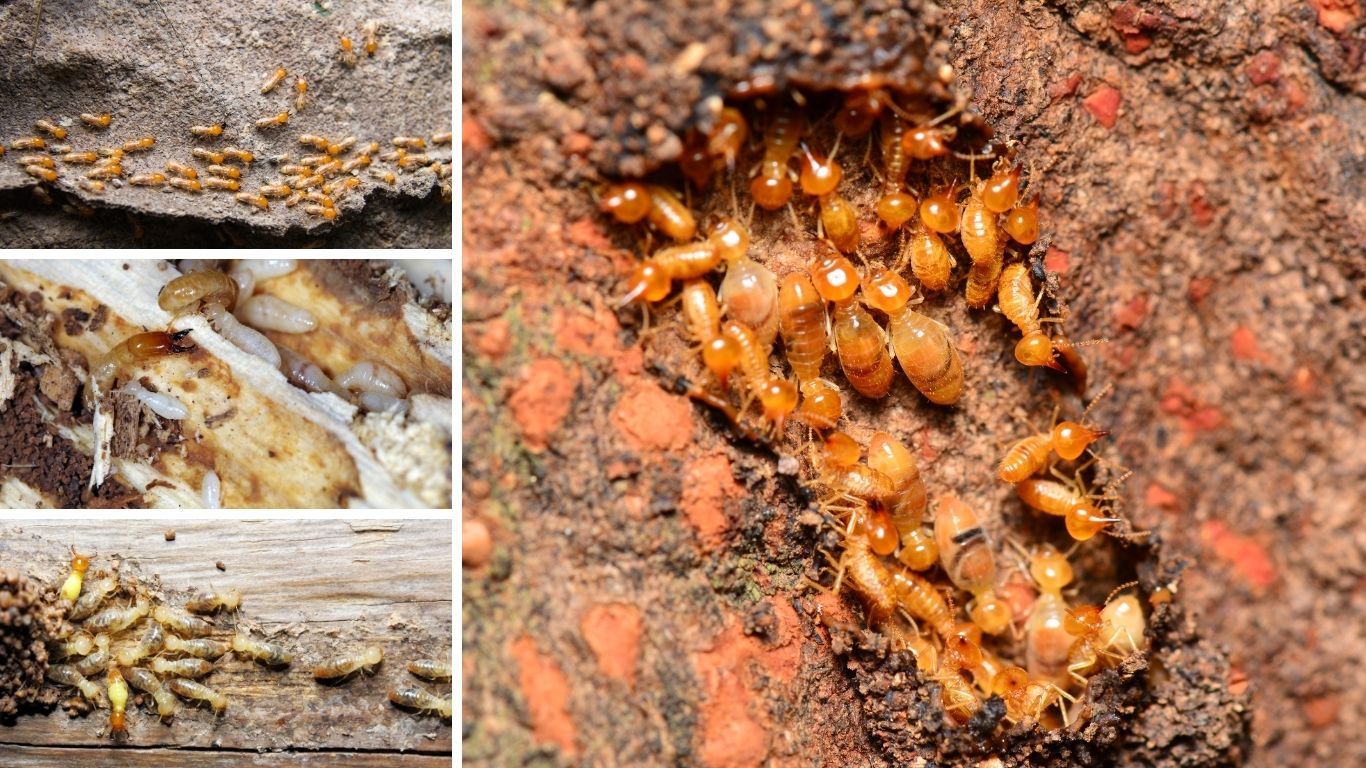
Termites may be small, but their impact on homes and ecosystems is massive. With over 2,000 known species worldwide, only a select few are major pests. This guide covers 20 of the most common types of termites, including how to identify them, where they live, and how they behave. Whether you’re a homeowner or just curious, knowing the differences can help you spot trouble early.
1. Subterranean Termites

Subterranean termites are the most widespread and destructive termite species found across the world. These termites live underground and build large colonies that can severely damage wooden structures. They require moist environments and create mud tubes to access food above ground. Homeowners often discover their presence only after structural damage has begun.
Identification
- Creamy white to dark brown or black in color
- Workers are about ⅛ inch long
- Soldiers have elongated yellow-brown heads with strong mandibles
- Swarmers (reproductives) have dark bodies and translucent wings
- Build visible mud tubes on walls or foundations
Habitat and Nesting
Subterranean termites build their nests in soil and maintain a connection to moisture. They thrive in warm climates and are commonly found near wood-to-ground contact areas, tree stumps, or moist basements.
Behavior
They forage in groups, tunneling through soil to find cellulose-based materials like wood. Their colonies can contain hundreds of thousands to millions of individuals, operating in a highly organized caste system (workers, soldiers, reproductives).
Damage Risk
These termites cause billions of dollars in structural damage each year worldwide. Since they often go undetected for years, they can compromise the integrity of beams, flooring, and foundations before discovery.
Prevention Tips
Keep wood away from soil contact, fix leaks promptly, seal foundation cracks, and consider professional annual inspections—especially in termite-prone regions.
2. Drywood Termites

Drywood termites live directly inside dry wood and do not require contact with soil or moisture sources. Unlike subterranean termites, they infest wooden structures like furniture, flooring, and framing from within.
Identification
- Light brown to dark brown in color
- Around ⅜ inch long
- Soldiers have large mandibles without teeth
- Swarmers have smoky gray to brown wings
- Leave behind dry, pellet-shaped droppings
Habitat and Nesting
Drywood termites establish small colonies inside dry, undecayed wood. They are commonly found in attics, wooden beams, furniture, and hardwood floors.
Behavior
They create smooth galleries in wood without mud tubes. Colonies are smaller than subterranean species but still capable of significant damage over time.
Damage Risk
They weaken wood from the inside out, often without visible external signs. Infestations can go unnoticed until wood sounds hollow or begins to crack.
Prevention Tips
Seal cracks in wooden surfaces, avoid bringing infested furniture indoors, and use treated or varnished wood in termite-prone areas.
3. Dampwood Termites

Dampwood termites infest moist, decaying wood and are most common in coastal or humid regions. They are among the largest termite species.
Identification
- Large bodies, up to 1 inch long
- Light to dark brown coloration
- Swarmers have large, smoky wings
- No visible worker caste; nymphs perform most colony tasks
- Often found in rotting logs or wet structural wood
Habitat and Nesting
These termites require high moisture levels and are typically found in decaying logs, tree stumps, and wood damaged by water leaks.
Behavior
They feed slowly but steadily on moist wood. Colonies are relatively small but persistent, especially where moisture problems remain unaddressed.
Damage Risk
They are less destructive than subterranean termites but can still compromise wood in poorly ventilated or damp spaces.
Prevention Tips
Fix plumbing leaks, improve ventilation, and remove rotting wood near your home to prevent infestation.
4. Conehead Termites

Originally known as “tree termites,” conehead termites are an aggressive, invasive species first discovered in the U.S. in Florida. They get their name from the distinctive cone-shaped heads of their soldier caste. Unlike most termites, they don’t rely on underground tunnels exclusively and can travel above ground freely.
Identification
- Soldiers have dark brown, cone-shaped heads
- Workers are pale white and resemble ants in movement
- Swarmers are dark brown to black with translucent wings
- Move quickly and visibly above ground
- Often confused with ants due to their speed and trail behavior
Habitat and Nesting
Conehead termites nest in trees, shrubs, soil, fences, and even buildings. Their nests are large and dome-shaped, often constructed above ground with a hard surface.
Behavior
These termites are highly aggressive foragers. They do not build mud tubes and can spread rapidly through a landscape, colonizing diverse structures and vegetation. Because of their mobility and surface activity, infestations are easier to spot than with other types.
Damage Risk
Conehead termites can destroy structures quickly and thoroughly due to their aggressive feeding and large colonies. Their tendency to forage openly increases their spread and impact.
5. Desert Termites

Desert termites are native to arid regions, particularly the southwestern United States. While not considered highly destructive to manmade structures, they play an important role in the desert ecosystem by breaking down dry plant material.
Identification
- Pale yellow to light brown coloration
- Small-bodied, about ¼ inch in length
- Soldiers have rounded heads with small mandibles
- Swarmers are rarely seen
- Often seen building surface mud tunnels in open deserts
Habitat and Nesting
They nest in dry soils, grasslands, and deserts. Desert termites create surface tubes that extend across barren ground to reach dry grasses and plant roots.
Behavior
They primarily feed on dead grass and dry plant matter. Colonies are often spread out, and their tunneling helps aerate the soil and improve nutrient recycling.
Damage Risk
Desert termites pose minimal threat to wooden structures but may feed on wooden fence posts or dead vegetation around homes in desert areas.
6. Formosan Termites

Formosan termites are a highly invasive and destructive subterranean species originally from East Asia. Often referred to as “super termites,” their colonies are massive and capable of causing significant structural damage in a short time.
Identification
- Yellow-brown bodies with oval heads
- Swarmers are about ½ inch long with pale, hairy wings
- Soldiers have rounded heads and curved mandibles
- Workers resemble other subterranean types but are slightly larger
- Found in large numbers during nighttime swarms in late spring
Habitat and Nesting
They nest underground but are known to build carton nests inside walls or above ground if moisture is available. These nests are made of chewed wood, soil, and saliva, helping retain humidity.
Behavior
Formosan termites are aggressive foragers and can chew through wood, insulation, and even soft metals. They’re known to infest boats, high-rise buildings, and trees, forming satellite colonies.
Damage Risk
They cause rapid and severe damage to structures and trees. Their massive colonies—often containing millions—make them one of the most destructive termite types globally.
7. Tree Termites

Tree termites are typically found in tropical and subtropical regions. As their name suggests, they inhabit live trees, feeding on heartwood and other internal structures.
Identification
- Medium to large in size
- Workers are creamy white; soldiers have dark heads and strong jaws
- Swarmers are dark-bodied with long, translucent wings
- Build tunnels and chambers within tree trunks
- May leave visible scars or holes in bark
Habitat and Nesting
They create nests inside the trunks and limbs of living or dead trees. In tropical forests, they often build above-ground mud structures connected by foraging tubes.
Behavior
Tree termites feed on the inner wood of trees without killing the plant immediately. Their activity can compromise tree health and increase the risk of collapse or secondary infestations.
Damage Risk
These termites primarily damage trees, but when located near homes, they can serve as a source for further infestations into structures.
8. Arid-Land Subterranean Termites

Arid-land subterranean termites are adapted to dry environments and are commonly found in desert or semi-desert regions. Despite living in arid climates, they still require access to moisture and build mud tubes to retain humidity.
Identification
- Light to dark brown in color
- Workers are pale and about ⅛ inch long
- Soldiers have rectangular heads with straight mandibles
- Swarmers are dark brown to black with slightly veined wings
- Often leave mud tubes along foundation walls or slabs
Habitat and Nesting
They build nests deep in the soil and create mud tubes to connect their colony to wood sources above ground. Their nests may be located beneath rocks, desert plants, or nearby homes.
Behavior
Arid-land subterranean termites forage over long distances in search of cellulose-rich material. They are most active during spring and early summer, especially after rainfall.
Damage Risk
While slower than Formosan termites, they can still cause serious structural damage, especially in wooden components exposed to soil or moisture.
9. Western Drywood Termites

Western drywood termites are a common drywood species found along the Pacific coast and southwestern United States. They thrive in warm, dry environments and infest undecayed wood with little to no moisture.
Identification
- Reddish-brown to light brown in color
- Swarmers are about ½ inch long with clear wings
- Soldiers have enlarged heads with powerful jaws
- No worker caste; nymphs handle labor tasks
- Leave behind dry, granular fecal pellets near infested wood
Habitat and Nesting
They form small, self-contained colonies inside dry wood such as furniture, wall framing, or roof structures. No contact with soil is needed.
Behavior
Western drywood termites eat across the grain of wood and create smooth tunnels. They often remain undetected for years until wood damage becomes visible or pellets are found.
Damage Risk
They can be very destructive over time, especially when infestations occur in hidden areas like wall voids or attic spaces. Multiple colonies may exist within a single structure.
10. Southeastern Drywood Termites

Southeastern drywood termites are native to the southeastern United States, particularly in coastal and humid areas. They are similar to other drywood species but thrive in both natural and man-made wooden structures.
Identification
- Light brown to reddish in color
- Swarmers are about 7⁄16 inch long with smoky-gray wings
- Soldiers have short, blocky heads with strong mandibles
- No distinct worker caste; immature termites do most of the labor
- Fecal pellets are hexagonal and found near infested wood
Habitat and Nesting
They live entirely within dry wood and require no soil contact. Colonies can develop in structural timbers, wood siding, window frames, and even wooden furniture.
Behavior
These termites are slow to expand but can go unnoticed for years. They prefer warm environments and are most active during late summer or early fall when swarming occurs.
Damage Risk
Although colonies are smaller than subterranean types, the damage can be extensive over time, especially in buildings with untreated or exposed wood.
11. Eastern Subterranean Termites

Eastern subterranean termites are among the most common and destructive species in North America. They are responsible for most termite damage reported in the eastern and central U.S.
Identification
- Creamy white workers, about ⅛ inch long
- Soldiers have rectangular, dark yellow-brown heads with prominent jaws
- Swarmers are dark brown to black with milky-white wings
- Build long, thin mud tubes from soil to wood
- Often found in basements or crawl spaces
Habitat and Nesting
They nest in the soil, often near foundations or under slabs. Their mud tubes provide moisture and protection as they move between their nest and food sources.
Behavior
Eastern subterranean termites work silently and steadily, consuming wood 24/7. They prefer softwood but will eat most cellulose materials, including books and insulation.
Damage Risk
They are highly destructive and can compromise entire support structures. Damage is usually hidden until it becomes severe, making early detection crucial.
12. Western Subterranean Termites

Western subterranean termites are common along the western coast of the United States. They thrive in temperate climates and are known for their stealthy behavior and extensive underground colonies.
Identification
- Workers are pale white and about ⅛ inch long
- Soldiers have large, square-shaped heads with black mandibles
- Swarmers are dark brown to nearly black with grayish wings
- Build narrow, brown mud tubes along walls or foundations
- Often found in wood close to soil or moisture sources
Habitat and Nesting
They nest underground and require constant contact with soil moisture. Colonies are usually located below foundations, tree stumps, or damp areas under buildings.
Behavior
Western subterranean termites forage through soil and mud tubes in search of wood. They tend to work slowly but steadily, often damaging structures from the inside out before discovery.
Damage Risk
Though slightly less aggressive than Formosan termites, they are still a significant threat to wooden buildings, especially in coastal and valley regions.
13. Tropical Subterranean Termites

Tropical subterranean termites are found in warm, humid regions such as southern Florida, Hawaii, and the Caribbean. They thrive in high-moisture environments and form expansive underground colonies.
Identification
- Workers are light cream-colored
- Soldiers have long, curved mandibles and dark orange heads
- Swarmers are dark brown to black with smoky wings
- Mud tubes may be seen climbing walls, trees, or foundation posts
- Often found in both natural and man-made wooden structures
Habitat and Nesting
They nest deep in moist soil and maintain mud tubes that stretch to above-ground wood sources. Colonies may also build carton nests in trees or hollow structures.
Behavior
These termites are highly efficient foragers and expand rapidly. They can infest both living trees and structural wood, especially in warm, damp environments.
Damage Risk
Tropical subterranean termites are destructive and can severely damage homes, especially if undetected in humid or coastal areas. Their broad range and fast expansion make them a growing concern in subtropical climates.
14. Neotermes Termites

Neotermes is a genus of large drywood termites commonly found in tropical and subtropical regions, including parts of Florida, California, and Hawaii. Unlike many other termites, they prefer living in damp or high-moisture wood but still do not require soil contact.
Identification
- Larger than most drywood species, up to ½ inch long
- Dark brown to black-bodied swarmers with smoky wings
- Soldiers have large, dark reddish-brown heads with strong mandibles
- No true worker caste; immature termites fulfill labor roles
- Fecal pellets are oval and reddish-brown
Habitat and Nesting
Neotermes termites nest in damp wood found in trees, logs, or structural wood exposed to high humidity. They often infest wood that has been softened by water damage or fungus.
Behavior
They tunnel slowly through damp wood and do not build external mud tubes. Their colonies are smaller but longer-lived, and infestations may remain unnoticed for years.
Damage Risk
While not as destructive as subterranean species, they can cause significant damage to exposed, water-damaged wood over time—especially in humid climates.
15. Cryptotermes Termites

Cryptotermes is another genus of drywood termites that includes some of the most well-known invasive species. They are commonly transported in infested wooden furniture, crates, and building materials.
Identification
- Small, dark-bodied swarmers (¼–⅜ inch long)
- Soldiers have rectangular heads and straight mandibles
- No visible worker caste; young nymphs serve labor roles
- Wings of swarmers are shorter than those of most drywood termites
- Droppings are tiny, hard pellets resembling sand grains
Habitat and Nesting
Cryptotermes termites live entirely inside dry wood with no need for contact with soil or moisture. They often nest in furniture, door frames, and structural timbers.
Behavior
They expand slowly and discreetly, hollowing out wood while leaving the exterior surface intact. Infestations are often discovered by the presence of fecal pellets.
Damage Risk
These termites pose a high risk during international shipping and trade, as they can infest wood products and spread rapidly. Infestations in furniture or structural wood can go unnoticed until significant damage has occurred.
16. Heterotermes Termites

Heterotermes is a genus of subterranean termites found in warm climates, particularly in the southern U.S., Caribbean, and parts of Central and South America. They are known for their persistence and ability to infest both natural and structural wood.
Identification
- Workers are translucent white and about ⅛ inch long
- Soldiers have narrow, rectangular heads with straight mandibles
- Swarmers are dark brown to black with long, smoky wings
- Build visible mud tubes on foundations or trees
- Often mistaken for other subterranean species due to appearance
Habitat and Nesting
They live underground in moist soil and build shelter tubes to reach above-ground wood sources. Nests are usually shallow and may be found beneath stones, tree roots, or building foundations.
Behavior
Heterotermes termites forage widely and attack a variety of wooden materials. They feed on both hardwood and softwood, and can be especially aggressive in drier environments.
Damage Risk
They are considered serious structural pests in many regions and are particularly destructive in urban and coastal areas with sandy soils.
17. Coptotermes Termites

Coptotermes is one of the most destructive termite genera globally, including the infamous Coptotermes formosanus (Formosan termite). They are known for large colonies, high foraging activity, and rapid wood consumption.
Identification
- Workers are pale and about ⅛ inch long
- Soldiers have teardrop-shaped heads and curved mandibles
- Swarmers are yellow-brown with hairy wings
- Emit a milky, sticky fluid when disturbed (from soldiers)
- Found nesting in soil or inside structures where moisture is present
Habitat and Nesting
They build underground nests but also form aerial colonies in buildings if water is available. Carton nests are often found in walls, attics, or trees.
Behavior
Coptotermes termites are highly aggressive, consuming wood rapidly and traveling far from the nest to forage. They also chew through plastic, foam, and soft metals if in their way.
Damage Risk
This genus is among the top causes of termite-related structural damage worldwide, making early detection and control especially important in regions where they are present.
18. Zootermopsis Termites

Zootermopsis is a genus of dampwood termites primarily found in the western United States and parts of Canada. They are typically associated with decaying wood in moist forest environments and are among the largest termite species in North America.
Identification
- Large-bodied termites, up to ¾ inch long
- Workers and nymphs are pale and soft-bodied
- Soldiers have large, dark brown heads with long curved mandibles
- Swarmers are dark brown with long, translucent wings
- Found in rotting logs, stumps, and sometimes wooden structures with water damage
Habitat and Nesting
They nest in moist, decaying logs, dead trees, and wooden structures exposed to consistent humidity. Unlike subterranean termites, they do not build mud tubes or require soil contact.
Behavior
Zootermopsis termites form relatively small colonies and feed slowly. They groom each other frequently and live in highly cooperative social groups.
Damage Risk
While they rarely infest homes, they can damage wooden structures in constant contact with moisture, such as poorly ventilated crawl spaces or outdoor wood in forested areas.
19. Kalotermes Termites

Kalotermes is a genus of drywood termites found in warm coastal regions. They are primitive termites with simple social structures and are best known for nesting in sound, dry wood.
Identification
- Medium to large-sized termites
- Swarmers are brownish with short, pale wings
- Soldiers have rounded, orange-brown heads and strong jaws
- No worker caste—nymphs perform all duties
- Produce dry, hexagonal fecal pellets
Habitat and Nesting
They nest directly in dry wood such as dead tree limbs, fence posts, and structural wood. Colonies remain hidden deep inside the infested material.
Behavior
Kalotermes termites spread slowly and often go undetected for long periods. They do not create external signs like mud tubes or surface damage until the infestation is advanced.
Damage Risk
Though not fast feeders, they can cause significant damage over time, especially in unpainted or untreated wooden materials exposed to dry conditions.
20. Incisitermes Termites

Incisitermes is a well-known genus of drywood termites, with species like Incisitermes minor (the Western drywood termite) being significant structural pests in the United States. These termites are notorious for infesting wooden buildings without needing soil contact.
Identification
- Swarmers are dark brown to black with long, smoky-gray wings
- Soldiers have large, rectangular orange-brown heads with powerful jaws
- Workers are absent; immature nymphs handle labor roles
- Fecal pellets are hard, oval-shaped, and often accumulate near infested wood
- Wings shed by swarmers are commonly found after reproductive flights
Habitat and Nesting
They colonize dry, undecayed wood in attics, walls, window frames, furniture, and hardwood flooring. Their colonies are confined within the wood itself and don’t connect to the soil.
Behavior
Incisitermes termites expand slowly but steadily. They create smooth, clean galleries in wood and are often discovered by spotting pellets or during remodeling.
Damage Risk
Infestations can remain hidden for years, and while colonies grow slowly, multiple colonies in a structure can result in severe internal damage over time.
FAQs
1. What is the most destructive type of termite?
The Formosan termite (Coptotermes formosanus) is considered the most destructive. Known as “super termites,” they form massive colonies and can cause severe structural damage in a short time due to their aggressive foraging and large numbers.
2. How can I tell if I have drywood or subterranean termites?
Drywood termites live inside wood and leave behind dry, pellet-like droppings, with no soil contact or mud tubes. Subterranean termites, on the other hand, build mud tubes for moisture and protection and are usually found in soil or along foundation walls.
3. Are dampwood termites a major threat to homes?
Not usually. Dampwood termites prefer moist, decaying wood and are more common in forested or coastal areas. While they can damage wood in high-humidity structures, they rarely infest dry, modern homes unless there’s a moisture issue.
4. Which termite species infest furniture the most?
Cryptotermes and Kalotermes, both drywood termites, are known to infest wooden furniture. They require no contact with soil and can easily spread through infested furniture transported between homes or buildings.
5. Can termites live above ground?
Yes. While most termites nest underground, some species—like drywood termites and Formosan termites—can establish aerial colonies inside structures if there’s enough moisture, often in walls, attics, or roofs.