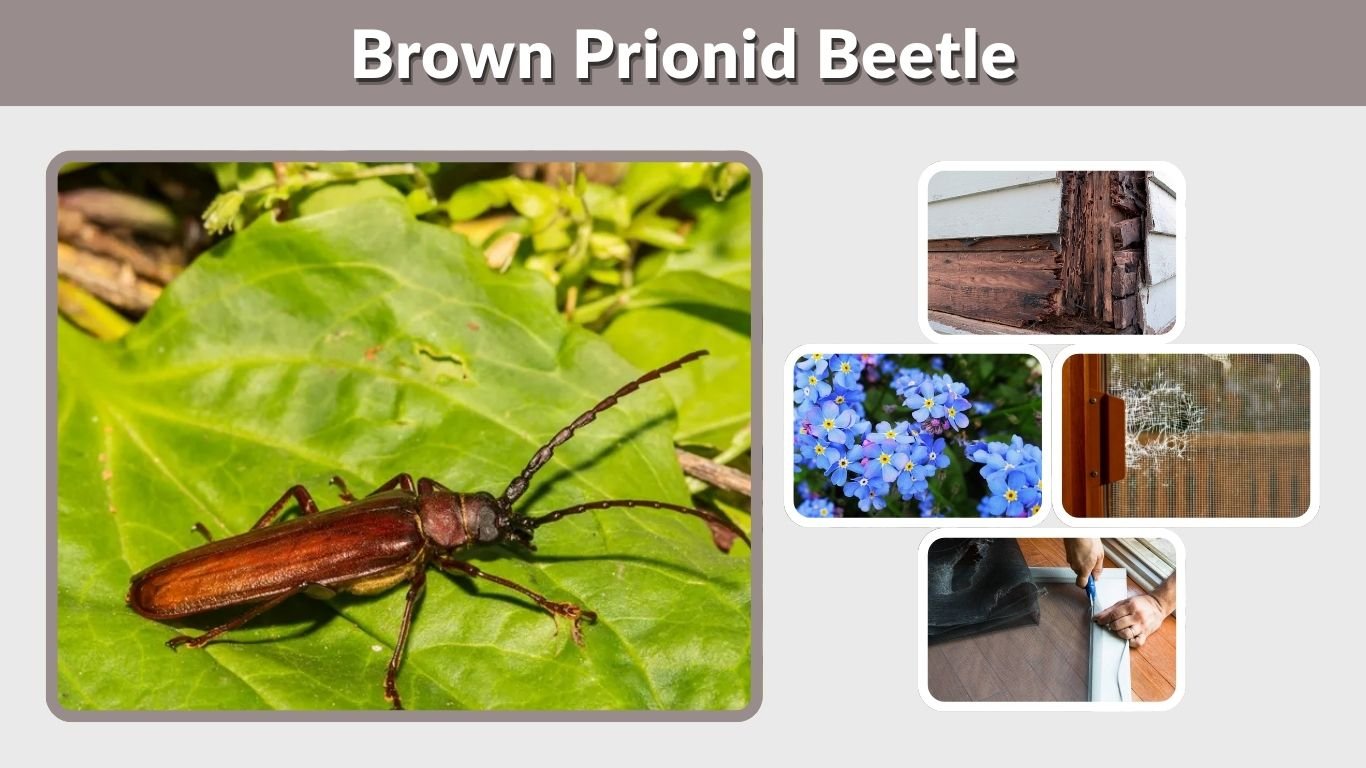
The brown prionid beetle (Orthosoma brunneum) is a large, reddish-brown longhorn beetle commonly found in forests, gardens, and wooded neighborhoods across eastern North America. Its impressive size, long antennae, and strong jaws can make it appear dangerous, especially when it enters a house at night. However, these beetles are generally harmless to humans and play an important role in breaking down decaying wood. Understanding their identification, bite potential, habitat, diet, life cycle, and prevention methods can help homeowners distinguish them from cockroaches and other wood-boring insects.
What Is a Brown Prionid Beetle?
The brown prionid beetle is a native North American longhorn beetle belonging to the family Cerambycidae and subfamily Prioninae. Its scientific name is Orthosoma brunneum.
This species is sometimes called the brown prionid longhorn beetle. It is recognized by its elongated brown body, noticeable antennae, and powerful chewing mouthparts.
Unlike destructive invasive wood-boring beetles, brown prionids primarily develop in dead or decaying wood. Their larvae help break down fallen trees, stumps, and other woody materials.
Adults are mostly active at night and frequently appear around outdoor lighting during warmer months.
Brown Prionid Beetle Identification and Appearance
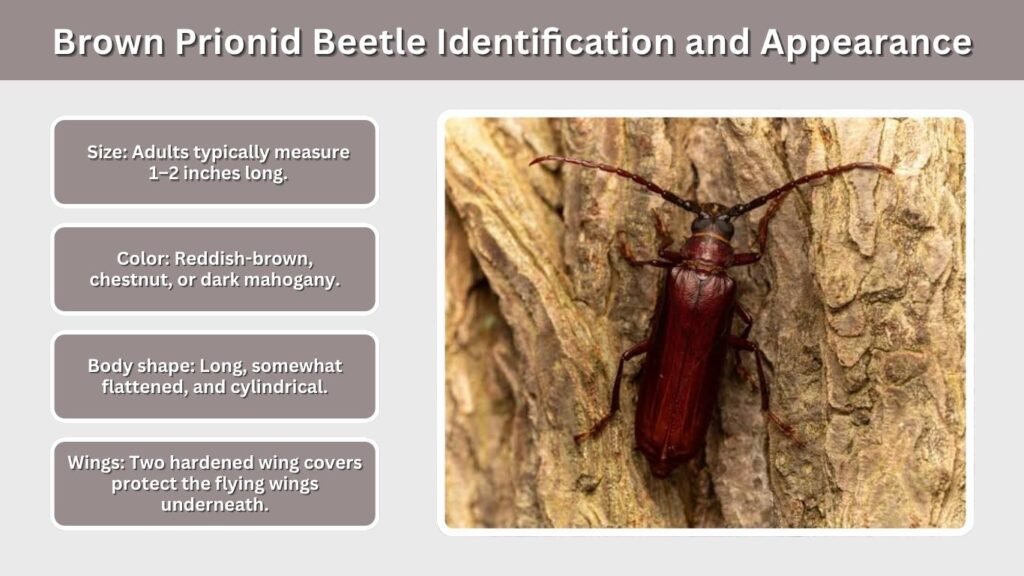
Brown prionid beetles have distinctive physical features that help distinguish them from cockroaches and other large brown insects.
Their elongated bodies, textured wing covers, and spiny thorax are especially useful for identification.
Physical Characteristics
- Size: Adults typically measure 1–2 inches long.
- Color: Reddish-brown, chestnut, or dark mahogany.
- Body shape: Long, somewhat flattened, and cylindrical.
- Antennae: Long, segmented antennae extending outward from the head.
- Wings: Two hardened wing covers protect the flying wings underneath.
- Thorax: Usually has three small, pointed projections along each side.
- Legs: Six strong legs used for climbing and gripping surfaces.
- Jaws: Well-developed mandibles capable of defensive biting.
Male vs. Female Brown Prionid Beetles
Male and female brown prionid beetles have similar body shapes and coloring.
Males generally possess longer antennae relative to their body size. Females tend to have comparatively shorter antennae and may have broader abdomens.
However, determining their sex accurately may require examining additional anatomical features.
Do Brown Prionid Beetles Bite?
Yes, brown prionid beetles can bite if they are grabbed, squeezed, or handled roughly. Their mandibles are strong enough to produce a painful pinch and may occasionally break the skin.
However, these beetles are not aggressive toward humans and do not actively seek opportunities to bite.
Are Brown Prionid Beetle Bites Dangerous?
Brown prionid beetle bites are generally not medically serious. The beetles are not venomous and do not possess stingers.
A bite may cause temporary pain, redness, or minor skin irritation.
If bitten, wash the affected area with soap and water. Seek medical attention if severe swelling, signs of infection, or an unusual allergic reaction develops.
Why Are Brown Prionid Beetles Found in Houses?

Finding a brown prionid beetle inside a house can be alarming because its size and coloring resemble those of some large cockroaches.
However, brown prionid beetles are primarily outdoor insects. Adults frequently enter houses accidentally while flying toward artificial lights at night.
Common Reasons They Enter Homes
- Outdoor lighting: Porch lights and illuminated windows attract flying adults.
- Open doors: Beetles may fly indoors when doors remain open after sunset.
- Damaged window screens: Small openings allow insects to enter.
- Nearby woodlands: Homes surrounded by trees may experience more encounters.
- Decaying wood: Old stumps, logs, and damp wood provide larval habitats.
Do Brown Prionid Beetles Infest Houses?
Brown prionid beetles are not typical indoor pests and generally do not establish populations in dry, maintained household environments.
Their larvae require suitable decaying wood for development.
However, persistently damp, deteriorating wood can sometimes support wood-boring insects. Repeated emergence from the same structural timber should be investigated rather than assumed to be harmless.
Brown Prionid Beetle vs. Cockroach
Brown prionid beetles and large cockroaches can appear similar because both may have reddish-brown bodies and become active at night.
However, their body structures, feeding habits, and importance as household pests are very different.
| Feature | Brown Prionid Beetle | Cockroach |
| Scientific classification | Orthosoma brunneum | Order Blattodea |
| Body shape | Elongated, sturdy | Broad, flattened |
| Typical size | 1–2 inches | Varies by species |
| Antennae | Long and segmented | Usually thin and very long |
| Wings | Hard beetle wing covers | Leathery forewings in winged species |
| Main habitat | Forests and decaying wood | Varies; some species live indoors |
| Indoor infestation | Uncommon | Possible in pest species |
| Main concern | Occasional bite or nuisance | Food contamination and allergens |
The easiest identifying feature is the hardened wing covers of brown prionid beetles. Cockroaches do not have the same rigid beetle-like wing structure.
Where Do Brown Prionid Beetles Live?
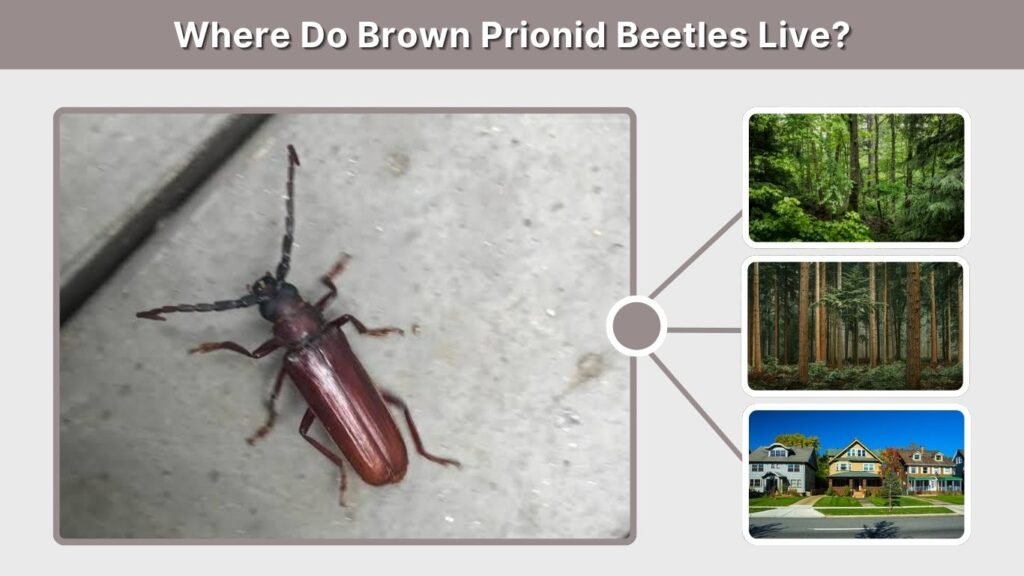
Brown prionid beetles are native to eastern North America, including parts of the United States and southeastern Canada.
They commonly inhabit moist woodlands, forests, suburban neighborhoods, and landscapes containing dead trees or decomposing logs.
Brown Prionid Beetle Distribution
These beetles are found in states such as Pennsylvania, Michigan, Indiana, North Carolina, Ohio, and Maryland.
They may also occur in other eastern and central states where suitable woodland habitats exist.
Brown prionid beetles were not introduced to North America as invasive insects. They are naturally occurring members of native forest ecosystems.
Preferred Habitat
Their preferred habitats include moist forests, decomposing hardwood logs, fallen tree trunks, and rotten stumps.
Larvae develop within deteriorating wood, including both hardwoods and conifers.
Adults commonly fly through forested areas during warm summer evenings.
What Do Brown Prionid Beetles Eat?

The brown prionid beetle’s feeding habits differ between its larval and adult stages.
Larvae consume decaying wood, while adult feeding behavior is less important to the species’ ecological role.
Adult Brown Prionid Beetle Diet
Adult brown prionid beetles have been reported feeding on plant materials, including leaves, flowers, and fruit.
Some adults are also attracted to sugary substances, suggesting that sap or fermenting fruit may provide food.
Their adult diet is less thoroughly documented than their larval feeding habits.
Brown Prionid Beetle Larvae Diet
Brown prionid larvae feed within moist, decomposing wood, including rotten roots, logs, and stumps.
By tunneling through deteriorating timber, they help break down woody material and contribute to nutrient recycling in forest environments.
Brown Prionid Beetle Life Cycle
Brown prionid beetles undergo complete metamorphosis through four developmental stages: egg, larva, pupa, and adult.
Most development occurs inside decaying wood, where immature beetles remain protected from environmental conditions.
Four Stages of Development
- Egg stage: Female beetles lay eggs in suitable decaying wood or nearby soil, providing developing larvae access to food.
- Larval stage: Newly hatched larvae tunnel through damp wood and consume decomposing material. This is the main feeding and growth stage.
- Pupal stage: Mature larvae transform into pupae within protected chambers. Their bodies gradually develop adult structures.
- Adult stage: Fully developed beetles emerge, fly, locate mates, and reproduce during the warmer months.
The duration of development varies with temperature, moisture, and wood condition.
Can Brown Prionid Beetles Fly and Make Sounds?
Brown prionid beetles can fly using membranous wings concealed beneath their hardened wing covers.
Adults are primarily nocturnal and frequently fly toward artificial lights. Their flight may produce a noticeable buzzing sound.
Why Do Brown Prionid Beetles Squeak?
One unusual characteristic of brown prionid beetles is their ability to produce an audible squeaking sound.
This defensive behavior is called stridulation.
The sound occurs when specialized structures on the hind legs rub against the edges of the hardened wing covers.
Beetles typically produce this noise when disturbed or threatened. It is not evidence that the insect is poisonous or preparing to attack.
Are Brown Prionid Beetles Harmful to Trees?
Brown prionid beetles generally do not threaten healthy, living trees.
Their larvae primarily consume wood that is already dead, decaying, or weakened by moisture and fungal activity.
In natural forests, this feeding is beneficial because it contributes to decomposition.
However, larvae can occasionally damage untreated wooden materials that remain damp and in contact with the ground.
This makes moisture management important around outdoor wooden structures.
How to Get Rid of Brown Prionid Beetles

Brown prionid beetles usually do not require chemical control because they rarely establish indoor infestations.
Preventing accidental entry and reducing attractive lighting are often sufficient.
Natural Prevention and Control Methods
- Reduce exterior lighting: Turn off unnecessary porch and garden lights during peak beetle activity.
- Seal entry points: Repair window screens and close gaps around doors.
- Remove decaying wood near foundations: Relocate old logs, deteriorating stumps, and unnecessary wood debris.
- Keep firewood outdoors: Store firewood away from exterior walls and bring it inside only when needed.
- Repair moisture problems: Fix leaks and replace seriously deteriorated timber.
- Remove individual beetles: Capture them with a container and release them outdoors without touching their jaws.
Do Brown Prionid Beetles Need Insecticide Treatment?
Insecticide treatment is generally unnecessary for occasional adult beetles found indoors.
These insects usually enter accidentally and cannot establish populations without suitable larval habitat.
If repeated sightings are accompanied by damaged or decaying structural wood, identify the insect and inspect the affected timber before considering professional pest treatment.
FAQs
1. Are Brown Prionid Beetles Poisonous?
No, brown prionid beetles are not poisonous or venomous. They do not possess stingers or venom-injecting structures. Although their strong jaws can deliver a defensive bite, they generally pose little danger to humans or household pets.
2. Are Brown Prionid Beetles Dangerous to Dogs?
Brown prionid beetles are not considered poisonous to dogs. However, their strong jaws may pinch a curious pet, and swallowing a large beetle could cause digestive discomfort. Preventing pets from chewing or swallowing these insects is advisable.
3. Do Brown Prionid Beetles Fly at Night?
Yes, adult brown prionid beetles are primarily active at night. They can fly and are attracted to artificial lighting around homes, garages, and gardens. Their nighttime movement explains why homeowners sometimes discover these large insects near illuminated windows.
4. Are Brown Prionid Beetles Common in Pennsylvania?
Yes, brown prionid beetles occur naturally in Pennsylvania and other eastern states. They are particularly associated with wooded habitats containing decomposing timber. Adults may appear around outdoor lights during summer, especially in neighborhoods close to forests.
5. How Long Do Brown Prionid Beetles Live?
Brown prionid beetles spend much of their lives developing inside decaying wood. Their larval development can last several years, depending on environmental conditions. Adults survive for a considerably shorter period, during which they disperse, mate, and reproduce.