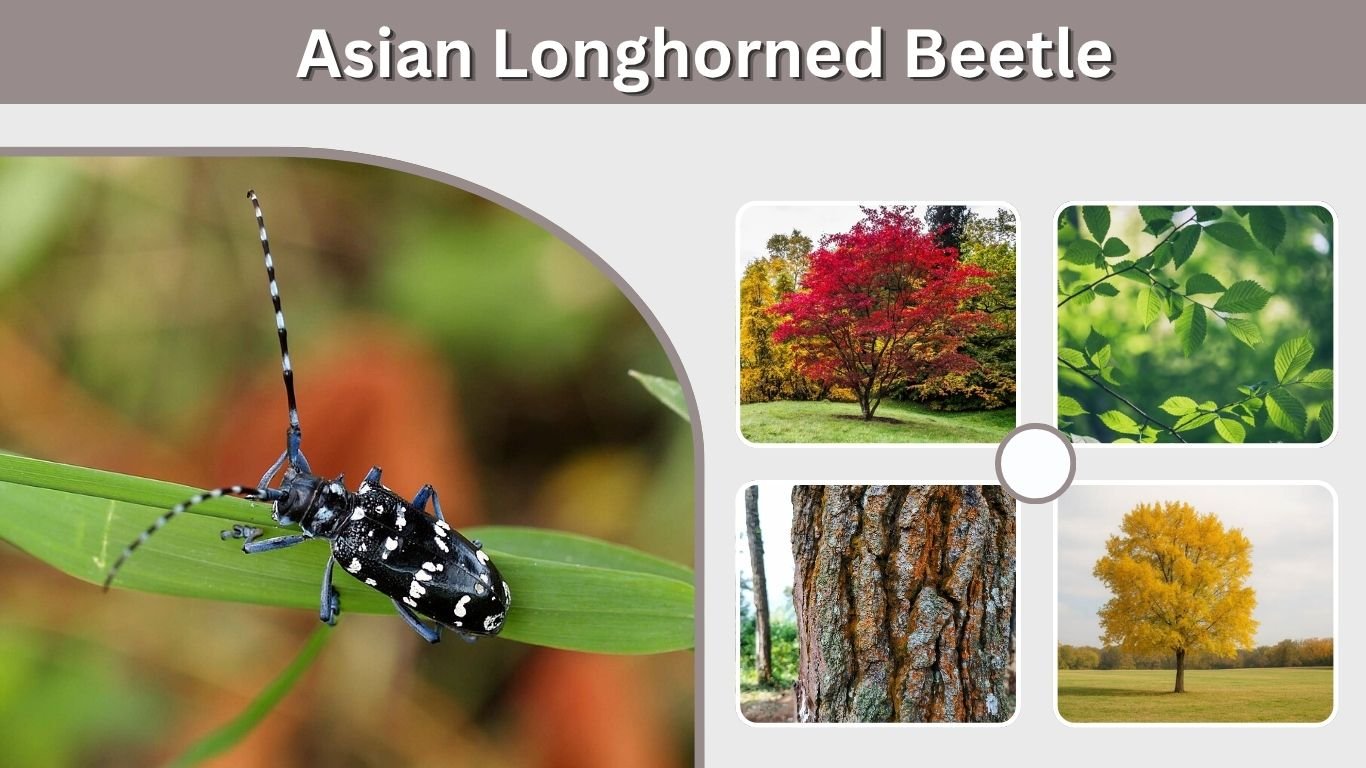
The Asian longhorned beetle (Anoplophora glabripennis) is an invasive wood-boring insect that threatens hardwood trees in the United States. Recognized by its shiny black body, white spots, and unusually long antennae, this beetle can kill maples, birches, elms, and other valuable trees. Its larvae tunnel inside living wood, making early infestations difficult to detect. Learning about Asian longhorned beetle identification, life cycle, habitat, damage, and control helps homeowners recognize warning signs, distinguish native look-alikes, and report suspected infestations before the insect spreads to nearby forests.
What Is an Asian Longhorned Beetle?
The Asian longhorned beetle is a destructive insect belonging to the longhorn beetle family, Cerambycidae. Its scientific name is Anoplophora glabripennis. Unlike many native beetles that develop in dead wood, this invasive species attacks living hardwood trees, making it a serious concern for forests and residential landscapes.
Asian Longhorned Beetle Identification
You can identify an Asian longhorned beetle by examining these characteristics:
- Scientific name: Anoplophora glabripennis
- Family: Cerambycidae
- Size: Approximately 1–1.5 inches long.
- Body color: Shiny black with irregular white spots.
- Antennae: Long, with alternating black and pale bands.
- Legs: Six legs, sometimes appearing bluish.
- Body shape: Elongated and cylindrical.
- Wing covers: Hard, glossy, and spotted.
Male vs. Female Asian Longhorned Beetle
Male Asian longhorned beetles generally have antennae considerably longer than their bodies. Females have relatively shorter antennae and often larger, broader bodies.
Females possess strong chewing mouthparts that help them create depressions in tree bark where they deposit eggs.
Where Did the Asian Longhorned Beetle Come From?
The Asian longhorned beetle originated in eastern Asia, particularly China and the Korean Peninsula. It naturally inhabits forests containing suitable hardwood trees. However, international trade accidentally introduced the species into several countries where it became an invasive pest.
How Did It Get to America?
The Asian longhorned beetle likely entered the United States through untreated wooden shipping materials, including crates and pallets.
Its first confirmed American infestation was discovered in Brooklyn, New York, in 1996.
Since then, authorities have established quarantine and eradication programs to prevent the beetle from spreading throughout North American forests.
Asian Longhorned Beetle Distribution
As of October 2026, active federal eradication efforts continue in Massachusetts, New York, Ohio, and South Carolina.
Previous infestations in places such as Illinois and New Jersey have been eradicated.
Other states, including Michigan, continue monitoring because their hardwood forests contain suitable host trees.
Where Do Asian Longhorned Beetles Live?
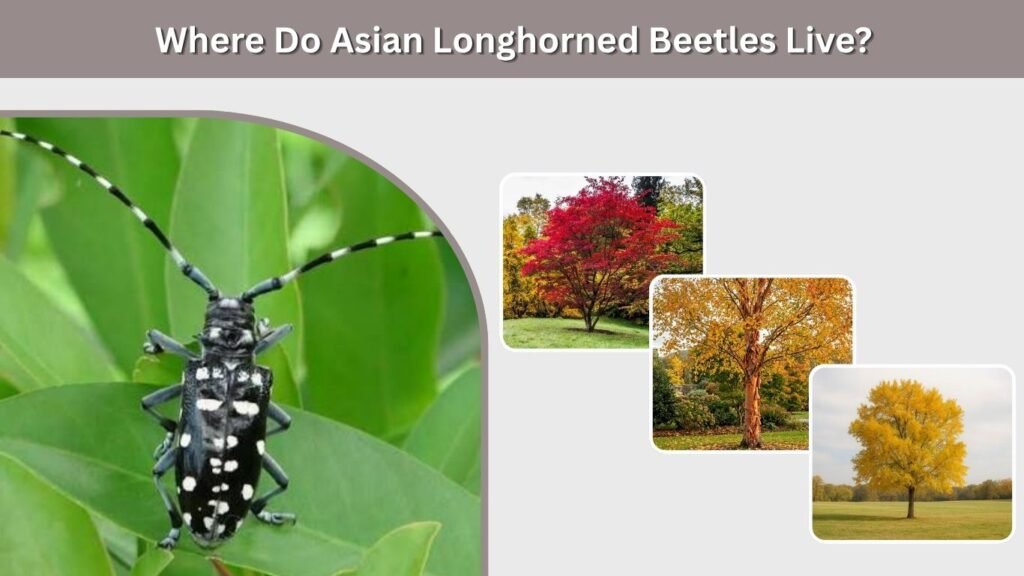
Asian longhorned beetles live in forests, parks, residential neighborhoods, and urban areas containing hardwood trees. Their larvae develop inside trunks and branches, while adults move across bark and foliage. Suitable host trees are essential for their survival and reproduction.
Asian Longhorned Beetle Host Trees
Common host trees include:
- Maple trees
- Birch trees
- Elm trees
- Willow trees
- Poplar trees
- Horse chestnut trees
- Buckeye trees
- Sycamore and London planetrees
Maples are particularly important hosts. However, not every tree species within these groups is equally susceptible.
Preferred Habitat
Adult beetles prefer areas containing healthy hardwood trees with suitable bark for egg-laying.
Females often select branches or trunks where their larvae can develop inside living wood.
Infestations frequently begin in upper branches, making early detection challenging without careful inspection.
Asian Longhorned Beetle Life Cycle
The Asian longhorned beetle undergoes complete metamorphosis, including egg, larva, pupa, and adult stages. Development commonly takes one to three years, depending on temperature and environmental conditions. Most of its life is spent hidden inside trees.
Asian Longhorned Beetle Eggs
Female beetles chew small pits into tree bark and deposit eggs beneath the surface.
The eggs are whitish, elongated, and approximately the size of rice grains.
After hatching, young larvae begin feeding on living tissues beneath the bark.
Asian Longhorned Beetle Larvae
Asian longhorned beetle larvae are cream-colored, legless grubs with dark mouthparts.
They initially feed beneath the bark before tunneling deeper into the tree’s wood.
Mature larvae can reach approximately 2.5 inches long. Their feeding creates extensive tunnels that weaken branches and disrupt the movement of water and nutrients.
Pupa and Adult Stage
Mature larvae develop into pupae inside chambers within the wood.
Once development is complete, adult beetles chew circular exit holes through the bark.
Adults then feed, mate, and reproduce, continuing the infestation cycle.
What Do Asian Longhorned Beetles Eat?
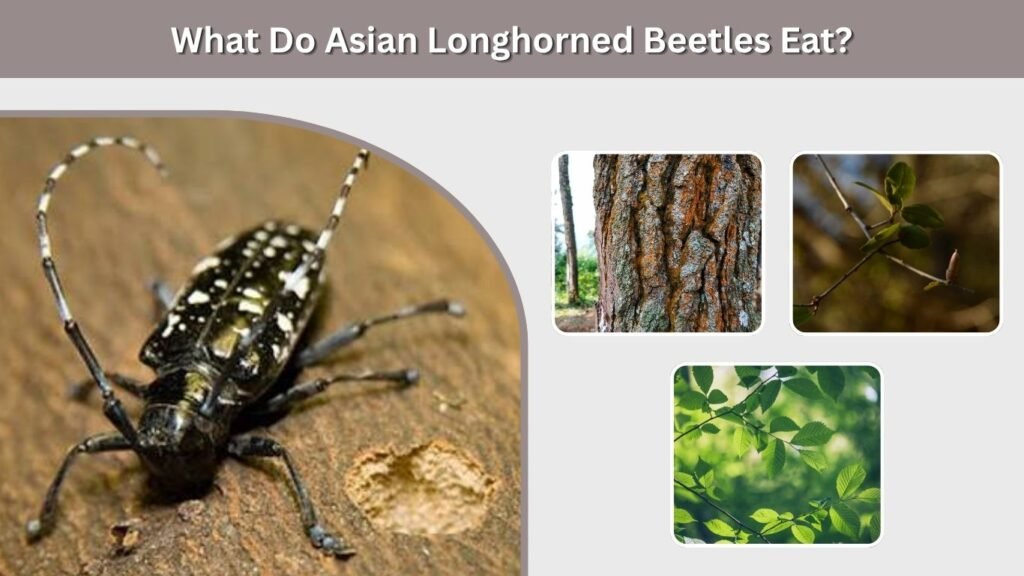
Asian longhorned beetles feed exclusively on plant materials associated with suitable host trees. However, their diet changes between immature and adult stages. Larvae cause the greatest damage because they consume internal tree tissues.
Adult Asian Longhorned Beetle Diet
Adult Asian longhorned beetles consume tender bark, twigs, and leaves.
They frequently feed on young branches after emerging from the wood.
Although adult feeding causes visible damage, it is generally less destructive than larval tunneling.
Asian Longhorned Beetle Larvae Diet
Larvae initially consume tissues beneath the bark before tunneling into deeper wood.
Their feeding creates galleries that damage the tree’s internal structure.
Repeated infestations interfere with tree growth and eventually contribute to branch failure and tree death.
Asian Longhorned Beetle Damage to Trees
Asian longhorned beetle damage is especially dangerous because larvae develop inside living hardwood trees. Infested trees may initially appear healthy while extensive tunneling occurs beneath the bark. Recognizing the earliest symptoms can help prevent additional infestations.
Signs of Asian Longhorned Beetle Infestation
Common warning signs include:
- Round exit holes: Circular openings approximately 6–18 millimeters wide.
- Egg-laying pits: Small depressions chewed into tree bark.
- Sawdust-like material: Wood particles accumulating around branches.
- Leaking sap: Moist areas around damaged bark.
- Branch dieback: Weakening or dying upper branches.
- Yellowing leaves: Declining foliage and reduced growth.
- Broken branches: Structural weakness caused by internal tunneling.
Why Are Asian Longhorned Beetles a Problem?
Asian longhorned beetles can kill otherwise healthy hardwood trees.
Their infestations threaten urban shade trees, forests, wildlife habitats, and timber resources.
Dead or weakened branches may also fall unexpectedly, creating safety hazards for nearby homes, vehicles, and pedestrians.
Asian Longhorned Beetle vs. Look-Alike Species

Several native longhorn beetles resemble the invasive Asian longhorned beetle. Identifying the correct species is important because mistaken identification can cause unnecessary concern or delay reporting a genuine infestation.
Asian Longhorned Beetle vs. Whitespotted Pine Sawyer
The whitespotted pine sawyer (Monochamus scutellatus) is a native beetle associated mainly with conifer trees.
It typically has a duller body and a noticeable pale spot between the wing bases.
Asian longhorned beetles have glossy black bodies with irregular white spots and distinctly banded antennae.
Asian Longhorned Beetle vs. Cottonwood Borer
The cottonwood borer (Plectrodera scalator) also has black-and-white markings.
However, its pale areas often form larger patches rather than scattered spots.
Cottonwood borers primarily use cottonwood and related trees, while Asian longhorned beetles attack a wider variety of hardwood hosts.
How to Get Rid of Asian Longhorned Beetles
Asian longhorned beetle control requires professional intervention because larvae remain protected deep inside living trees. Government eradication programs combine inspections, quarantines, and tree removal to eliminate infestations. Homeowners should report suspected sightings rather than attempt independent treatment.
Asian Longhorned Beetle Control Methods
Official management programs commonly use these approaches:
- Tree inspections: Specialists examine suspected host trees for infestation.
- Infested tree removal: Confirmed infested trees are removed and destroyed.
- Quarantine restrictions: Movement of potentially infested wood is controlled.
- Targeted insecticides: Preventive treatments may protect selected uninfested trees.
- Continued monitoring: Authorities survey surrounding trees for additional beetles.
How to Prevent Asian Longhorned Beetle Spread
Avoid transporting untreated firewood or potentially infested wood between locations.
Inspect hardwood trees regularly, particularly during summer when adult beetles are active.
If you discover a suspicious beetle, photograph it and report the sighting to USDA APHIS at 1-866-702-9938.
Do not move suspected infested tree material before receiving official instructions.
Are Asian Longhorned Beetles Dangerous to Humans?

Asian longhorned beetles are not venomous or poisonous. Their main threat is the damage they cause to trees rather than direct harm to people. However, their strong chewing mouthparts can produce a painful pinch if handled carelessly.
Do Asian Longhorned Beetles Bite?
Asian longhorned beetles do not normally attack or bite humans.
However, they possess powerful jaws designed for chewing bark and plant tissues.
When threatened or handled, an adult beetle may pinch defensively. Avoid unnecessary handling and use a container when capturing a suspected specimen.
FAQs
1. Are Asian Longhorned Beetles Invasive?
Yes, Asian longhorned beetles are invasive in North America. They originated in Asia and were accidentally introduced through international trade. Their larvae attack living hardwood trees, creating serious threats to forests and urban landscapes.
2. Can Asian Longhorned Beetles Fly?
Yes, adult Asian longhorned beetles can fly between trees while searching for food and mates. They often remain near suitable host trees, but longer-distance dispersal is possible. Moving infested wood also contributes to their spread.
3. How Long Do Asian Longhorned Beetles Live?
The complete Asian longhorned beetle life cycle commonly lasts one to three years, depending on environmental conditions. Most development occurs inside trees. Adult beetles generally survive for several weeks after emerging.
4. Can Trees Recover From Asian Longhorned Beetle Damage?
Trees with confirmed Asian longhorned beetle infestations are generally removed because extensive internal tunneling causes structural damage and allows further reproduction. Early reporting helps prevent additional trees from becoming infested and protects surrounding forests.
5. Are Asian Longhorned Beetles Poisonous?
No, Asian longhorned beetles are not poisonous or venomous. They do not have stingers and are not considered a significant direct threat to human health. However, their powerful jaws may pinch when handled.