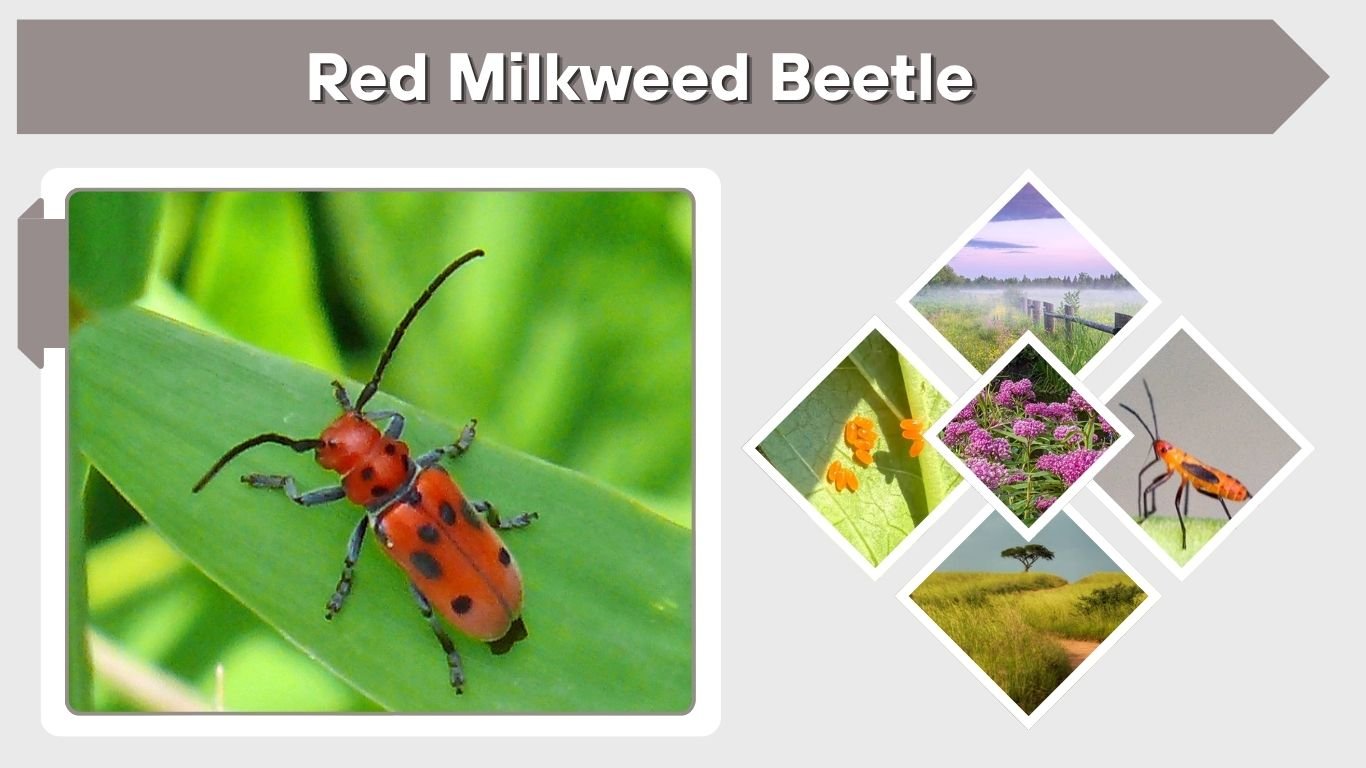
The red milkweed beetle (Tetraopes tetrophthalmus) is a striking red-and-black insect commonly found on milkweed plants across eastern and central North America. Known for its bright coloration, long antennae, and distinctive black spots, this beetle is closely associated with common milkweed. Although adults feed on milkweed leaves, buds, and flowers, they rarely cause serious plant damage. Many gardeners wonder whether red milkweed beetles are good or bad, poisonous, or harmful to monarch butterflies. Understanding their identification, diet, habitat, life cycle, and natural control methods can help you recognize these fascinating native insects.
What Is a Red Milkweed Beetle?
The red milkweed beetle belongs to the longhorn beetle family, Cerambycidae. Its scientific name, Tetraopes tetrophthalmus, refers to its unusual eye structure. The bases of its antennae divide each compound eye into two sections, creating the appearance of four eyes. These beetles spend their lives closely associated with milkweed plants.
Red Milkweed Beetle Identification
You can identify a red milkweed beetle by examining the following characteristics:
- Scientific name: Tetraopes tetrophthalmus
- Family: Cerambycidae
- Size: Approximately 8–15 millimeters long.
- Body color: Bright red or reddish-orange.
- Markings: Distinctive black spots on the wing covers.
- Antennae: Long, curved, and entirely black.
- Legs: Black and relatively slender.
- Body shape: Elongated with hard wing covers.
The combination of red coloration, black spots, and long antennae makes this species relatively easy to identify on milkweed plants.
Why Does It Have Four Eyes?
One of the most interesting red milkweed beetle facts involves its unusual antenna placement.
Each antenna divides a compound eye into upper and lower sections. This creates the appearance of four separate eyes.
Both parts of its scientific name refer to this distinctive feature.
Where Do Red Milkweed Beetles Live?
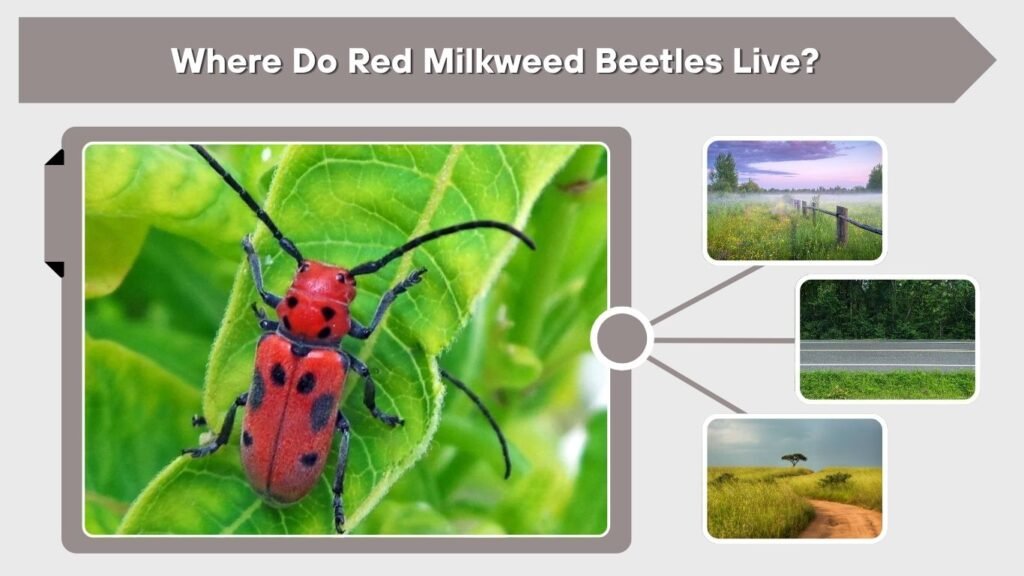
Red milkweed beetles are native to North America, particularly the eastern and central regions. Their distribution closely follows the availability of common milkweed, which provides food and breeding habitat. Adults are most visible during warmer months when milkweed plants produce new leaves and flowers.
Red Milkweed Beetle Native Range
The red milkweed beetle occurs in many eastern and central US states, including Illinois, Wisconsin, Minnesota, Ohio, Pennsylvania, and New York.
Its range also extends into southern Canada, including parts of Ontario.
Because this insect is native to these regions, it is not considered an invasive species within its natural distribution.
Red Milkweed Beetle Habitat
Red milkweed beetles commonly inhabit meadows, grasslands, roadsides, prairies, and gardens containing milkweed.
Adults frequently rest on leaves or flowers, while immature beetles develop underground near milkweed roots.
Areas containing abundant common milkweed often provide suitable conditions for reproduction.
What Do Red Milkweed Beetles Eat?

Red milkweed beetles are herbivorous insects that specialize in feeding on milkweed. Their diet changes during development because adults feed aboveground while larvae consume underground plant tissues. Both stages have adaptations that allow them to survive on plants containing toxic defensive chemicals.
Adult Red Milkweed Beetle Diet
Adult red milkweed beetles primarily consume the leaves, buds, and flowers of common milkweed (Asclepias syriaca).
They occasionally feed on other milkweed species.
To avoid sticky milkweed latex, adults cut leaf veins before feeding. This reduces sap flow to the feeding area and prevents the latex from interfering with their mouthparts.
Red Milkweed Beetle Larvae Diet
Red milkweed beetle larvae feed on underground milkweed roots.
After hatching near the base of a plant, they move into the soil and begin consuming root tissue.
This underground feeding continues through their immature development. Although root feeding can affect plants, small populations rarely cause significant garden damage.
Red Milkweed Beetle Eggs and Larvae
Red milkweed beetles reproduce during the summer after adults emerge and locate suitable host plants. Their eggs are usually deposited near the bases of milkweed stems. The newly hatched larvae are rarely seen because they quickly move underground.
Red Milkweed Beetle Eggs
Female red milkweed beetles generally deposit eggs near the base of milkweed stems.
They may place eggs in small openings or crevices around the lower stem.
After hatching, young larvae move toward nearby roots, where they begin feeding and developing.
Red Milkweed Beetle Larvae
Red milkweed beetle larvae have pale, elongated, segmented bodies.
Unlike adults, they lack bright red coloration and distinctive black spots.
They live underground, feeding on milkweed roots. Because of this hidden lifestyle, gardeners rarely encounter them unless soil around the roots is disturbed.
Red Milkweed Beetle Life Cycle
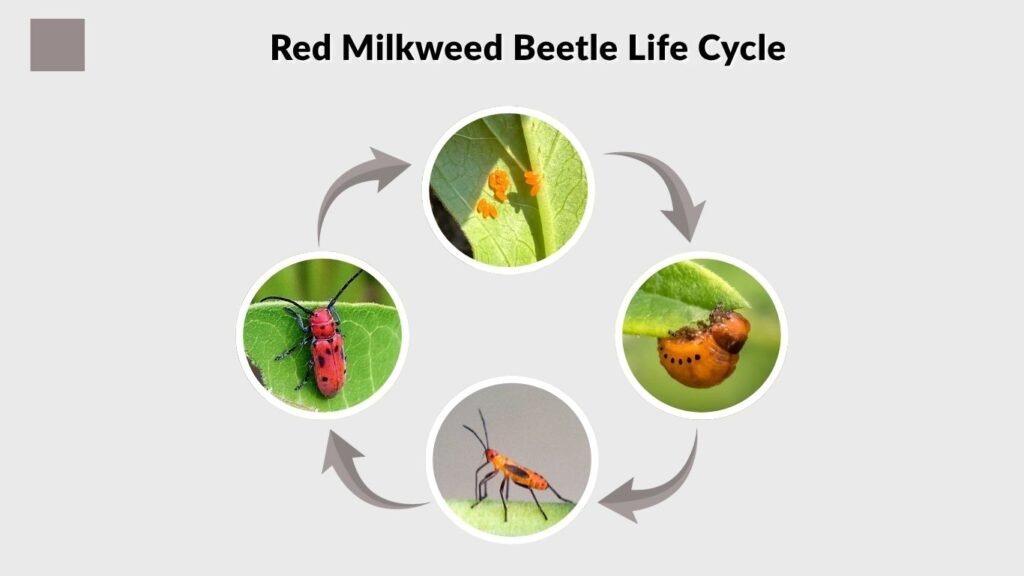
The red milkweed beetle undergoes complete metamorphosis, developing through egg, larva, pupa, and adult stages. Its life cycle is closely synchronized with milkweed growth. In much of its range, the species generally completes one generation annually.
Four Stages of the Life Cycle
- Egg: Female beetles deposit eggs near the bases of milkweed stems during the breeding season.
- Larva: Newly hatched larvae enter the soil and feed on milkweed roots.
- Pupa: After overwintering underground, mature larvae pupate in earthen chambers during spring.
- Adult: Fully developed beetles emerge in early summer and begin feeding and mating.
Red Milkweed Beetle Mating Behavior
Adult red milkweed beetles become active during summer, when they search for suitable mates.
Males and females often remain together on milkweed leaves or stems during mating.
Following successful reproduction, females deposit eggs near host plants, beginning another generation.
Are Red Milkweed Beetles Good or Bad?
Red milkweed beetles are generally considered harmless components of native milkweed ecosystems. Although they feed on plant tissues, their presence usually does not justify control measures. They also coexist with numerous other milkweed-associated insects, including monarch butterflies.
Are Red Milkweed Beetles Harmful to Plants?
Adult beetles create small holes or notches in milkweed foliage.
Their larvae feed on roots, but established plants generally tolerate ordinary beetle populations.
Severe damage is uncommon. Most gardeners can leave these insects undisturbed unless significant feeding affects young or struggling plants.
Do Red Milkweed Beetles Harm Monarchs?
Red milkweed beetles do not normally attack monarch butterflies, eggs, or caterpillars.
Both insects depend on milkweed, but they use the plant differently.
Adult beetles eat foliage and flowers, while monarch caterpillars consume leaves. On small plants, heavy feeding may reduce available foliage, but direct predation is not typical.
Are Red Milkweed Beetles Poisonous or Dangerous?
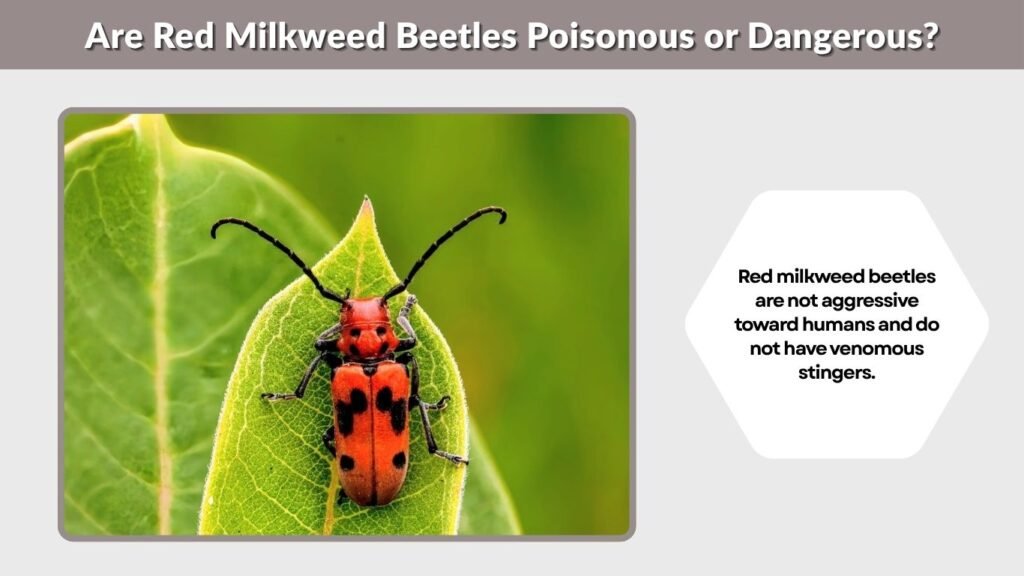
Red milkweed beetles obtain defensive chemicals called cardenolides from milkweed. These substances can make them toxic or unpleasant to certain predators. Their bright red-and-black coloration acts as a warning signal, although the beetles are not generally dangerous to people during ordinary encounters.
Do Red Milkweed Beetles Bite?
Red milkweed beetles are not aggressive toward humans and do not have venomous stingers.
Although beetles possess chewing mouthparts, this species is not known for regularly biting people.
It is best to observe them without handling them unnecessarily.
Are Red Milkweed Beetles Poisonous to Humans?
Red milkweed beetles can contain milkweed-derived defensive toxins, but simply seeing or touching one does not ordinarily create a poisoning risk.
They should not be eaten, and children and pets should be discouraged from putting them in their mouths.
Red Milkweed Beetle vs. Other Red Beetles on Milkweed
Several insects living on milkweed have similar red-and-black patterns. Some are beetles, while others are true bugs belonging to different insect orders. Examining their body shape, antennae, and markings can help distinguish them.
Red Milkweed Beetle vs. Red-Femured Milkweed Beetle
The red-femured milkweed beetle (Tetraopes femoratus) resembles the red milkweed beetle.
However, it usually has partially reddish legs and pale rings on its antennae.
The red milkweed beetle generally has entirely black legs and unbanded black antennae.
Red Milkweed Beetle vs. Milkweed Bug
Large milkweed bugs have a flatter body and distinctive black-and-orange patterns.
Unlike longhorn beetles, milkweed bugs have piercing-sucking mouthparts and primarily consume plant fluids and seeds.
Red milkweed beetles have hard wing covers and chewing mouthparts, making them easy to distinguish upon closer examination.
How to Get Rid of Red Milkweed Beetles

Red milkweed beetle control is usually unnecessary because these native insects rarely cause significant damage. However, gardeners managing small milkweed plantings may occasionally want to reduce excessive feeding. Nonchemical approaches are preferable, particularly in gardens supporting monarch butterflies.
Natural Control Methods
Consider these methods when necessary:
- Hand removal: Gently collect adult beetles from heavily affected plants.
- Monitor feeding damage: Check milkweed leaves and flowers regularly.
- Grow additional milkweed: Provide enough foliage for multiple native insects.
- Protect young plants: Use temporary physical protection where practical.
- Avoid unnecessary pesticides: Protect monarch caterpillars and other beneficial wildlife.
Should You Kill Red Milkweed Beetles?
Killing red milkweed beetles is generally unnecessary.
They are native insects that naturally belong in milkweed habitats and usually cause limited damage.
If their feeding becomes excessive, manual removal is typically preferable to spraying insecticides that could harm monarchs and pollinators.
FAQs
1. Are Red Milkweed Beetles Beneficial?
Red milkweed beetles contribute to native ecosystems and food webs. Although they are not pollinators or predatory pest-control insects in the usual sense, they are part of natural milkweed communities. Their presence rarely requires intervention.
2. Can Red Milkweed Beetles Fly?
Yes, adult red milkweed beetles can fly. They have functional wings beneath their hard wing covers. However, they frequently walk among milkweed leaves, stems, and flowers rather than flying continuously between plants.
3. Do Red Milkweed Beetles Make Sounds?
Yes, red milkweed beetles can produce a squeaking sound when disturbed. This noise is a defensive behavior and may startle potential predators. It does not indicate that the beetle is preparing to sting or attack.
4. What Eats Red Milkweed Beetles?
Red milkweed beetles possess chemical defenses that discourage many predators, particularly insect-eating vertebrates. Some natural enemies may still attack them. Their red-and-black warning coloration helps communicate that they may be unpleasant or toxic to consume.
5. Are Red Milkweed Beetles Invasive?
No, red milkweed beetles are native to eastern and central North America. They naturally inhabit areas containing suitable milkweed plants. Their presence in native gardens is normal and generally does not indicate an invasive insect problem.