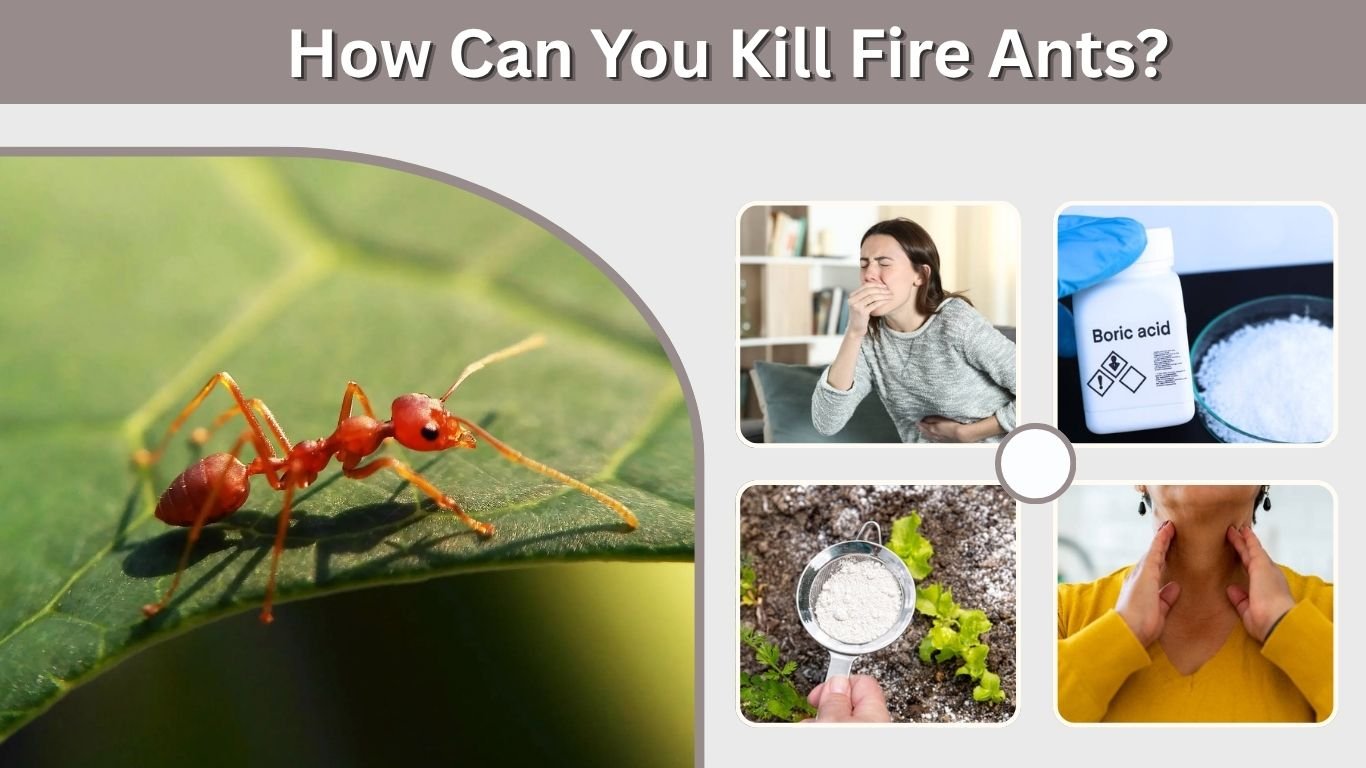
If fire ants are building mounds across your lawn, killing only the workers you can see will not solve the problem. The colony, including the queen, usually remains protected underground. So, how can you kill fire ants effectively? The most dependable strategy is to use slow-acting fire ant bait across the infested area and then treat stubborn individual mounds. Some nonchemical methods can also work, while popular remedies such as grits and vinegar are far less reliable. Here is how to control fire ants safely and effectively.
What Can You Use to Kill Fire Ants?
Several treatments can kill fire ants, but they work in different ways. Some products target an entire colony gradually, while others provide faster control of individual mounds. For widespread infestations, extension specialists commonly recommend a two-step method: broadcast a labeled bait first and then directly treat any remaining nuisance mounds.
Best Fire Ant Killing Methods
Effective options include:
- Fire ant bait: Workers carry slow-acting bait back to the colony and queen.
- Mound drenches: Liquid insecticides penetrate individual nests.
- Granular mound treatments: Applied around a mound and often watered in according to the label.
- Dust treatments: Some products provide relatively fast control of individual colonies.
- Residual lawn treatments: Kill ants as they travel across treated soil.
- Very hot water: Can sometimes eliminate individual colonies without conventional insecticide.
Fire ant bait is especially useful when many colonies are spread throughout a yard because it targets ants beyond the visible mounds.
Why Fire Ant Bait Works So Well
Fire ant bait contains an attractive food carrier combined with a slow-acting insecticide or insect growth regulator. Foraging workers collect the bait and carry it underground, where it is distributed through the colony.
The slow action is intentional. If the treatment killed workers immediately, they could die before bringing it back to the queen and other colony members.
For best results, apply fresh bait when ants are actively foraging, the grass and soil are dry, and rain is not expected shortly after treatment.
How Can You Kill Fire Ant Mounds Fast?
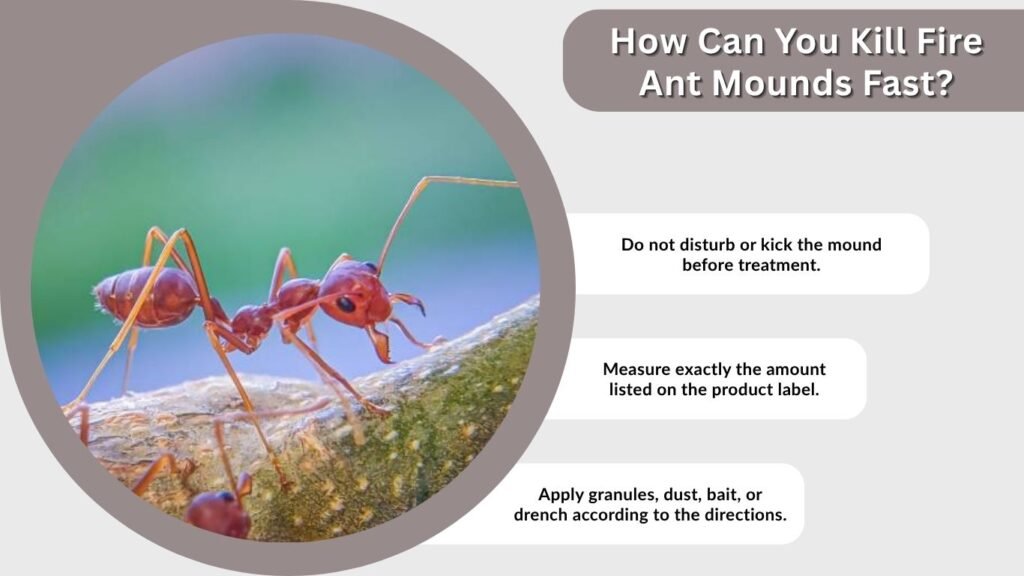
When only one or two dangerous mounds are present, such as beside a doorway, sidewalk, children’s play area, or pet run, an individual mound treatment may provide faster control than waiting for broadcast bait alone. However, treating every visible mound is less practical when the infestation covers a large lawn.
How to Treat an Individual Fire Ant Mound
- Do not disturb or kick the mound before treatment.
- Choose a pesticide specifically labeled for fire ants and mound treatment.
- Measure exactly the amount listed on the product label.
- Apply granules, dust, bait, or drench according to the directions.
- If watering is required, apply water gently rather than flooding the mound violently.
- Keep children and pets away for the period stated on the label.
- Inspect the area later for continued activity.
Liquid mound drenches may work within hours or days depending on the active ingredient, while some granular products require several days.
Can Boiling Water Kill Fire Ants?
Yes, very hot or boiling water can kill fire ants, but it is inconsistent. Texas A&M reports that pouring roughly 2–3 gallons of very hot water onto an individual mound eliminates the colony about 60% of the time.
The water must penetrate deeply enough to reach the queen. If she survives, the colony may recover or move.
Boiling water can also kill grass, damage plant roots, and cause serious burns, so it is not necessarily a safer solution simply because it contains no conventional pesticide.
Can Natural Home Remedies Kill Fire Ants?
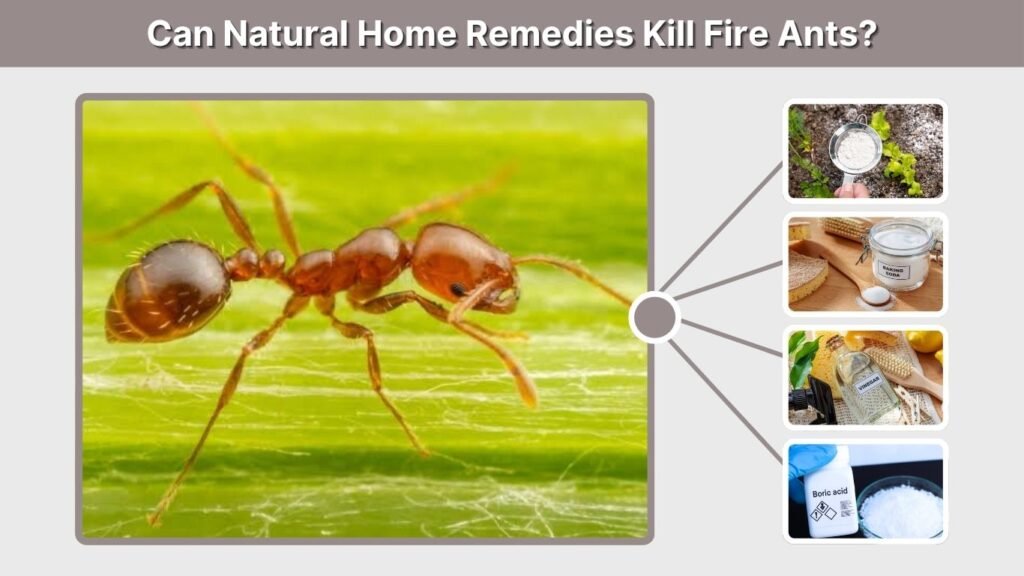
Many household substances are promoted online as natural fire ant killers. Unfortunately, killing a few workers is very different from destroying an underground colony. Research-based extension guidance indicates that several popular remedies either fail to eliminate colonies or have little evidence supporting their effectiveness.
Fire Ant Remedies That Do and Don’t Work
- Diatomaceous earth: Can kill individual ants by damaging their protective outer coating, but ordinary DE does not reliably eliminate an established mound or queen.
- Grits: Do not make fire ants swell or explode and are not an effective colony treatment.
- Baking soda: Not considered a reliable fire ant control method.
- Vinegar: May kill some ants on direct contact but is not a dependable colony treatment.
- Club soda: Does not effectively eliminate fire ant colonies.
- Boric acid or borax: Boric acid can function as an insecticidal stomach poison in properly formulated ant products, but homemade concentrations can make bait unattractive or create unnecessary exposure risks.
- Hot water: Can work on individual mounds but is inconsistent and can damage vegetation.
Why Grits Cannot Kill a Colony
The common claim is that fire ants eat dry grits, the grits expand inside them, and the ants burst. That explanation is incorrect.
Fire ant workers cannot digest ordinary solid food particles in the way the myth suggests. They primarily transport solid foods to larvae, which process them into material the rest of the colony can consume. Texas A&M and Mississippi State Extension both identify grits as ineffective for eliminating fire ant colonies.
What Should You Never Use to Kill Fire Ants?
Trying to create a stronger homemade treatment can introduce far greater risks than the ants themselves. Gasoline, diesel fuel, bleach, ammonia, solvents, and similar chemicals should not be poured into fire ant nests. They may injure people, kill plants, contaminate soil or groundwater, and still fail to reliably eliminate the queen.
Fire Ant Treatments to Avoid
Avoid using:
- Gasoline or diesel fuel
- Kerosene
- Household bleach
- Ammonia
- Battery acid
- Unlabeled pesticide mixtures
- Excessive amounts of registered pesticides
- Pesticides in gardens unless the label specifically allows that use
More pesticide does not mean better control. Apply only the amount stated on the label, particularly around children, pets, wells, ponds, vegetable gardens, and livestock.
Can You Completely Eradicate Fire Ants?
You can eliminate individual colonies and greatly suppress fire ants across a property, but permanent eradication from an open yard is difficult. New queens can establish colonies after mating flights, while ants can also reinvade from neighboring untreated properties.
Long-term control therefore requires monitoring and periodic treatment. Broadcast bait once or several times during the active season, depending on the product and local recommendations, can help prevent populations from rebuilding.
Can Fire Ants Kill You?
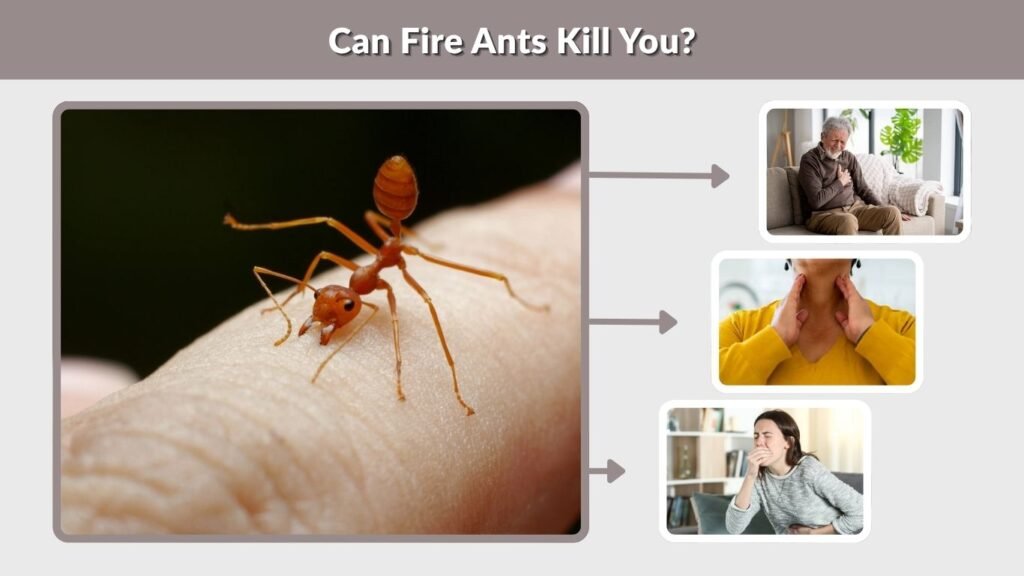
Fire ant stings are usually painful but not life-threatening for most people. However, their venom can trigger severe allergic reactions, including anaphylaxis, in susceptible individuals. Large numbers of stings can also cause more serious systemic symptoms.
Warning Signs After Fire Ant Stings
Emergency symptoms can include:
- Difficulty breathing or wheezing
- Swelling of the tongue, mouth, or throat
- Widespread hives or swelling
- Dizziness or fainting
- Rapid heartbeat
- Vomiting or diarrhea after many stings
- Low blood pressure or shock
A severe allergic reaction requires immediate emergency medical care. If prescribed epinephrine is available for the person, it should be used according to their emergency plan while emergency help is contacted.
How Many Fire Ants Can Kill a Human?
There is no reliable fixed number because individual sensitivity varies dramatically. A highly allergic person can develop a life-threatening reaction after relatively few stings, while someone without an allergy may tolerate many more.
Rather than counting stings, monitor symptoms. Breathing difficulty, throat swelling, fainting, widespread swelling, or other signs of anaphylaxis require urgent medical attention.
FAQs
The most effective fire ant management targets the underground colony instead of only visible workers. The questions below cover common concerns about killing methods, household remedies, natural control, and long-term results.
1. What Kills Fire Ants the Fastest?
An appropriately labeled individual mound drench, dust, or other fast-acting mound treatment generally works faster on a specific colony than broadcast bait. However, bait is usually more practical for controlling numerous colonies across an entire lawn.
2. Can Diatomaceous Earth Kill Fire Ants?
Diatomaceous earth can kill ants that contact it by damaging their protective waxy coating and causing dehydration. However, extension guidance notes that DE alone does not reliably eliminate colonies inside established fire ant mounds.
3. Can Vinegar Kill Fire Ants?
Vinegar may kill some ants that receive direct exposure, but it is not considered a dependable method for destroying an entire fire ant colony. Reaching and killing the queen is the key to lasting mound control.
4. Can Borax Kill Fire Ants?
Boron-based insecticides can kill ants when correctly formulated, but homemade borax recipes are difficult to dose properly. Too much may repel or quickly kill workers before bait reaches the colony. A registered fire ant bait with clear application instructions is more predictable.
5. What Is the Best Way to Kill Fire Ants in a Yard?
For multiple colonies, use the two-step method: broadcast a labeled fire ant bait across the infested area and then treat persistent or hazardous individual mounds. This approach combines colony-wide suppression with faster control where it is most needed.