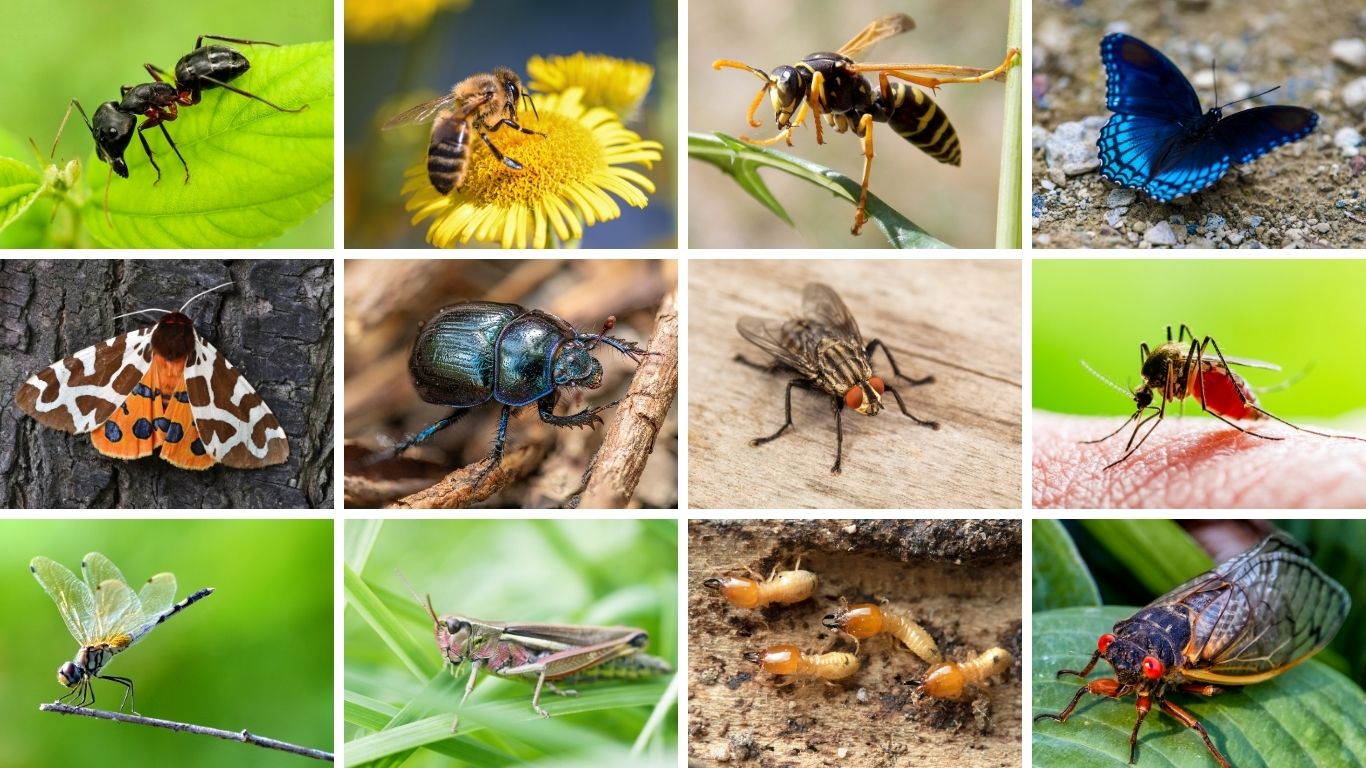
Insects are everywhere—crawling in gardens, buzzing through the air, or hiding in corners of our homes. While some are helpful pollinators or pest controllers, others can be annoying or even destructive. This guide explores 32 common types of insects, from ants and butterflies to bed bugs and beetles, highlighting their roles, diets, lifespans, and behaviors in a simple, easy-to-understand way.
1. Ant

Ants are one of the most organized and intelligent insects found on Earth. These social insects thrive in almost every environment except Antarctica and form structured colonies ranging from a few dozen to millions of individuals.
Type of Insect
Ants belong to the order Hymenoptera, the same group that includes bees and wasps. They fall under the Formicidae family. All ants are social insects and exhibit eusocial behavior—living in cooperative colonies with defined roles.
Species and Variants
There are over 12,000 scientifically classified species of ants, but estimates suggest the actual number could exceed 20,000. Some of the most notable types include:
- Carpenter ants
- Fire ants
- Leafcutter ants
- Pharaoh ants
- Weaver ants
- Bullet ants
Each species has unique traits adapted to specific environments and tasks.
Role in Nature
Ants play a fundamental role in ecosystems. They recycle nutrients by breaking down organic materials, protect plants by preying on pests, and even help in seed dispersal. In tropical forests, ants are among the most dominant animal species in terms of biomass.
They are also a crucial food source for birds, reptiles, amphibians, and mammals, contributing to the food web significantly.
Diet
Ants are omnivores, capable of consuming both plant and animal material. Their diet typically includes:
- Nectar, seeds, fungi
- Small insects and dead animals
- Sugary substances like honeydew secreted by aphids
Leafcutter ants are unique—they don’t eat the leaves they collect. Instead, they use them to cultivate fungus, which becomes their primary food source.
Lifespan
The lifespan of ants varies depending on their role in the colony:
- Queen ants may live up to 30 years.
- Worker ants typically live 1–6 months.
- Male ants (drones) live only for a few weeks, dying shortly after mating.
This stark contrast in lifespan highlights the efficiency of their colony structure and reproductive strategy.
Caste and Colony Structure
Every ant colony operates through a caste system:
- The queen lays all the eggs.
- Workers, sterile females, handle foraging, defense, and nest care.
- Drones, or males, exist solely to mate with new queens.
Some species also include a soldier caste—larger workers built for colony defense. Colonies operate with astonishing coordination, often relocating nests or launching large-scale attacks based on collective decision-making.
Communication and Behavior
Ants use pheromones, touch, and sound to communicate. A forager ant can signal the direction and distance of food to others using scent trails. If the colony is under threat, ants release alarm pheromones to mobilize soldiers.
Their intelligence is visible in their ability to build complex tunnels, farm fungi, or even engage in warfare with rival colonies.
Nesting Habits
Ant nests vary significantly:
- Underground tunnel systems with multiple chambers
- Nests in dead wood or inside plant stems
- Leaf nests sewn together with silk by weaver ants
Some species like army ants don’t have permanent nests—they form living structures with their own bodies to protect the queen and brood.
2. Bee

Bees are flying insects best known for their role in pollination and, in the case of honeybees, producing honey and beeswax. Bees are vital to ecosystems and agriculture, enabling the reproduction of flowering plants and crops.
Type of Insect
Bees also belong to the order Hymenoptera, closely related to ants and wasps. Most bee species are solitary, but some—like honeybees and bumblebees—are eusocial and live in colonies with a division of labor.
Species and Variants
There are over 20,000 known species of bees around the world. The most recognized types include:
- Honeybee
- Bumblebee
- Carpenter bee
- Leafcutter bee
- Mason bee
- Sweat bee
Species differ in nesting behavior, social structure, and pollination methods.
Role in Nature
Bees are considered one of the most important pollinators on Earth. They transfer pollen between flowers while collecting nectar, facilitating the reproduction of plants. This ecosystem service supports biodiversity and the production of fruits, vegetables, and nuts.
Diet
Bees primarily consume:
- Nectar – as an energy source (carbohydrates)
- Pollen – for protein and other nutrients
- Honeybees also consume honey, which they make from nectar and store for energy during colder months
Unlike predatory insects, bees are herbivorous and feed exclusively on floral resources.
Lifespan
- Queen bees live from 1 to 5 years, depending on species and environmental conditions.
- Worker bees live for 5 to 6 weeks during summer and a few months in winter.
- Male bees (drones) live only a few weeks and die after mating.
Caste and Colony Structure
In eusocial bee species:
- The queen lays eggs and is the colony’s only fertile female.
- Workers are sterile females responsible for foraging, cleaning, guarding, and feeding larvae.
- Drones are males born solely to mate with new queens.
Colony size varies—honeybee colonies can reach tens of thousands, while bumblebee colonies remain under a few hundred.
Communication and Behavior
Bees communicate using scent, vibrations, and even body language. A notable example is the waggle dance performed by honeybees to signal the direction and distance of food sources.
Bees are known for their strong memory, complex navigation skills, and ability to recognize human faces through pattern recognition.
Nesting Habits
Bee nesting behavior is diverse:
- Honeybees build wax combs in hives or cavities.
- Bumblebees often nest underground in abandoned rodent burrows.
- Carpenter bees bore into wood.
- Mason bees nest in small holes using mud to create partitions.
3. Wasp

Wasps are a diverse group of insects that include both solitary and social species. They are often mistaken for bees due to their similar shape and behavior but are generally more aggressive and serve different ecological roles.
Type of Insect
Wasps are also part of the Hymenoptera order but differ from bees by having a more defined waist and smoother bodies. They can be parasitic, solitary hunters, or social insects living in colonies.
Species and Variants
There are more than 30,000 identified species of wasps, but the actual number may be closer to 100,000. Major types include:
- Yellowjackets
- Paper wasps
- Hornets
- Cicada killers
- Mud daubers
- Parasitoid wasps
Species range from helpful garden allies to highly aggressive defenders of their nests.
Role in Nature
Wasps play essential roles as:
- Predators of other insects, including many pests
- Pollinators, especially of plants that bees avoid
- Parasitoids, laying eggs in or on other insects, which their larvae consume
This makes them important for natural pest control and ecological balance.
Diet
Adult wasps feed on:
- Sugary substances, such as nectar, honeydew, and rotting fruit
- Protein-rich foods, like insects or carrion
Larvae are often fed chewed-up insects by adult wasps in social species.
Lifespan
- Queen wasps live up to 1 year, surviving through winter to restart the colony.
- Worker wasps live for 12–24 days, depending on species and season.
- Male wasps usually die shortly after mating.
Caste and Colony Structure
Social wasp colonies feature:
- A queen who founds and dominates the colony
- Workers who forage, defend, and care for the brood
- Males for reproduction
Unlike bees, many wasp colonies are seasonal, dying off in winter except for the mated queen.
Communication and Behavior
Wasps communicate using pheromones and aggressive body movements. Alarm pheromones released when a nest is disturbed can alert and mobilize the colony, triggering swarming attacks.
Some wasps are solitary and rely entirely on instinct to find prey, build nests, and reproduce.
Nesting Habits
Nests vary by species:
- Paper wasps create umbrella-shaped nests from chewed plant fibers.
- Hornets and yellowjackets build large, enclosed nests in trees or underground.
- Mud daubers construct tubular nests from mud on sheltered surfaces.
4. Butterfly

Butterflies are brightly colored, day-flying insects celebrated for their scaled wings and graceful flight. They inhabit every continent except Antarctica, thriving in habitats from tropical rainforests to temperate meadows.
Type of Insect
Butterflies belong to the order Lepidoptera, family groupings such as Nymphalidae, Papilionidae, and Pieridae. Unlike their nocturnal relatives, butterflies are primarily diurnal, relying on the sun to warm their bodies for flight.
Species and Variants
- Monarch (Danaus plexippus)
- Swallowtail (Papilio machaon)
- Red Admiral (Vanessa atalanta)
- Painted Lady (Vanessa cardui)
- Blue Morpho (Morpho peleides)
- Common Buckeye (Junonia coenia)
Role in Nature
Butterflies are key pollinators, transferring pollen as they sip nectar. Their caterpillars serve as a major food source for birds, reptiles, and predatory insects, anchoring many terrestrial food webs.
Diet
- Adults: nectar, tree sap, and mineral-rich mud puddles
- Caterpillars: host-plant leaves specific to each species
Lifespan
Most adult butterflies live two weeks to two months. A few, like the overwintering monarch generation, can survive up to nine months.
Life Cycle
Butterflies undergo complete metamorphosis: egg → caterpillar → chrysalis → adult. Each stage is morphologically distinct, enabling specialization in feeding and dispersal.
Communication and Behavior
They use color patterns, ultraviolet markings, and pheromones to attract mates or warn predators. Some species engage in long-distance migration guided by the sun and Earth’s magnetic field.
Habitat and Egg-Laying Habits
Females lay eggs on host plants suited to their larvae, ensuring immediate food upon hatching. Habitats range from forest canopies to backyard gardens, wherever suitable host plants and nectar sources coexist.
5. Moth

Moths are often nocturnal counterparts to butterflies, displaying immense diversity in size, color, and behavior. They outnumber butterflies roughly ten to one, inhabiting every corner of the globe.
Type of Insect
Also within Lepidoptera, moths span families like Noctuidae, Geometridae, and Sphingidae. Many possess drab coloration for nighttime camouflage, though some—such as the Atlas moth—are vividly patterned.
Species and Variants
- Luna Moth (Actias luna)
- Atlas Moth (Attacus atlas)
- Hummingbird Hawk-moth (Macroglossum stellatarum)
- Gypsy Moth (Lymantria dispar)
- Codling Moth (Cydia pomonella)
- Diamondback Moth (Plutella xylostella)
Role in Nature
Moths act as crucial night-time pollinators, reaching flowers that close to daytime visitors. Their caterpillars recycle plant matter and feed countless predators, while some species aid in seed dispersal by inadvertently transporting pollen sacs.
Diet
- Adults: nectar, over-ripe fruit, and in a few cases animal tears or sweat
- Larvae: foliage, grains, wool, or stored products depending on species
Lifespan
Adult lifespans vary from a few days (silk moths that emerge without functional mouthparts) to several months in temperate species that overwinter as adults.
Life Cycle
Moths share the same four-stage metamorphosis. Many spin silk cocoons around their pupae, a trait exploited by humans in sericulture (silk production).
Communication and Behavior
Most moths rely on pheromones detectable over kilometers to locate mates. Some hawk-moths hover like hummingbirds, while tiger moths emit ultrasonic clicks to jam bat echolocation.
Habitat and Egg-Laying Habits
Eggs are laid on host plants, bark, or even fabrics. Habitats include forests, grasslands, human dwellings, and agricultural fields—anywhere larval food sources abound.
6. Beetle

Beetles are the largest group of insects on Earth, known for their hard, shell-like wing covers and incredible diversity. They inhabit nearly every terrestrial and freshwater environment.
Type of Insect
Beetles belong to the order Coleoptera, distinguished by their elytra—a pair of hardened front wings that protect the softer hind wings and abdomen underneath.
Species and Variants
- Ladybug (Coccinellidae)
- Stag beetle (Lucanidae)
- Dung beetle (Scarabaeidae)
- Click beetle (Elateridae)
- Japanese beetle (Popillia japonica)
- Rhinoceros beetle (Dynastinae)
Role in Nature
Beetles are involved in pollination, decomposition, and pest control. Some, like ladybugs, are beneficial predators, while others, such as bark beetles, can become major agricultural or forestry pests.
Diet
- Herbivorous species: leaves, wood, seeds, or fungi
- Carnivorous species: other insects or larvae
Lifespan
Beetles can live from a few months to several years, depending on the species. Some wood-boring beetles may stay in the larval stage for over a decade.
Life Cycle
Beetles undergo complete metamorphosis. The four stages—egg, larva, pupa, and adult—allow them to occupy different ecological niches throughout their lives.
Communication and Behavior
Beetles use vibrations, pheromones, and bioluminescence (in species like fireflies) for communication and mating. Some, like bombardier beetles, have defensive chemical sprays.
Habitat and Egg-Laying Habits
They lay eggs in diverse environments: under bark, in soil, on plants, or within stored food. Larvae often remain hidden, while adults may be seen on flowers, trees, or decomposing materials.
7. Fly

Flies are fast-moving insects known for their short lifespans, rapid reproduction, and adaptability. They are often considered pests but also play critical roles in ecosystems.
Type of Insect
Flies belong to the order Diptera, meaning “two wings.” Unlike other insects, they have a single pair of wings and a pair of halteres—small knob-like structures that help with balance in flight.
Species and Variants
- Housefly (Musca domestica)
- Fruit fly (Drosophila melanogaster)
- Horsefly (Tabanidae)
- Blowfly (Calliphoridae)
- Tsetse fly (Glossinidae)
- Mosquito (Culicidae – a fly sub-group)
Role in Nature
Flies contribute to decomposition, pollination, and disease transmission. While some are vectors for illnesses, others are vital for recycling organic material or used in scientific research.
Diet
- Adult flies: feed on liquids like nectar, decaying matter, or blood (in biting species)
- Larvae (maggots): consume decomposing organic material or live hosts
Lifespan
Adult flies usually live 15 to 30 days, although this can vary by species. Their life cycle is rapid, allowing for quick population growth.
Life Cycle
Flies undergo complete metamorphosis. The maggot stage is legless and highly mobile, ideal for breaking down waste or dead animals before pupating into adults.
Communication and Behavior
Flies rely on visual cues and chemical signals, though their behavior is largely instinctive. Some, like fruit flies, have been widely studied for their genetic and neurological responses.
Habitat and Egg-Laying Habits
Eggs are laid in moist, nutrient-rich environments like garbage, feces, or rotting food. Larvae emerge quickly and develop rapidly, making flies well-suited for urban environments.
8. Mosquito

Mosquitoes are slender, flying insects best known for their itchy bites and role in transmitting diseases. Though often seen as pests, only females bite, and they serve specific roles in ecosystems.
Type of Insect
Mosquitoes belong to the Diptera order (true flies) and fall under the Culicidae family. They have long legs, thin bodies, and a distinctive proboscis used for piercing skin and drawing blood.
Species and Variants
- Aedes aegypti
- Anopheles gambiae
- Culex pipiens
- Aedes albopictus
- Mansonia uniformis
- Toxorhynchites (non-biting species)
Role in Nature
Mosquitoes are pollinators, feeding on nectar from flowers. Their larvae are an essential food source for aquatic organisms like fish and amphibians. Despite their negative reputation, they are woven into many ecological food chains.
Diet
- Females: blood (for egg production) and nectar
- Males: nectar and plant juices only
Lifespan
- Males: live about 1 week
- Females: can live up to a month, depending on species and environment
Life Cycle
Mosquitoes undergo complete metamorphosis: egg → larva (wriggler) → pupa (tumbler) → adult. The aquatic larval stages make standing water a common breeding ground.
Communication and Behavior
Mating often occurs in swarms, with males detecting females by the sound of their wingbeats. Some species are active during dawn and dusk, while others bite during daylight hours.
Habitat and Egg-Laying Habits
Eggs are laid in or near stagnant water—puddles, ponds, containers, or clogged gutters. Larvae remain in water until they mature into flying adults.
9. Dragonfly

Dragonflies are fast-flying insects with large eyes and strong wings. They are agile aerial predators and ancient survivors, with fossil records dating back over 300 million years.
Type of Insect
Dragonflies belong to the order Odonata, suborder Anisoptera. They are characterized by long, slender bodies, two pairs of strong, transparent wings, and large compound eyes that offer nearly 360-degree vision.
Species and Variants
- Common Green Darner (Anax junius)
- Black-tailed Skimmer (Orthetrum cancellatum)
- Emperor Dragonfly (Anax imperator)
- Scarlet Darter (Crocothemis erythraea)
- Globe Skimmer (Pantala flavescens)
- Southern Hawker (Aeshna cyanea)
Role in Nature
Dragonflies are natural pest controllers, consuming large numbers of mosquitoes, gnats, and small flying insects. Their presence is an indicator of healthy freshwater ecosystems.
Diet
- Nymphs (larvae): aquatic insects, tadpoles, and even small fish
- Adults: mosquitoes, flies, bees, butterflies, and other flying insects
Lifespan
The nymph stage may last months to years, depending on species. Adult dragonflies typically live for a few weeks to several months.
Life Cycle
Dragonflies undergo incomplete metamorphosis: egg → nymph → adult. The aquatic nymphs breathe through gills and emerge from water to molt into winged adults.
Communication and Behavior
Dragonflies rely on flight patterns, territory displays, and visual signals. Males often patrol and defend territories near water bodies, where mating and egg-laying take place.
Habitat and Egg-Laying Habits
Eggs are laid in or near freshwater bodies like ponds, streams, or marshes. Nymphs stay submerged, hiding among aquatic plants and feeding until ready to emerge.
10. Grasshopper

Grasshoppers are powerful jumpers and plant-eating insects found in fields, meadows, and grassy areas around the world. Known for their ability to leap long distances, they are often heard before they are seen, thanks to their characteristic chirping.
Type of Insect
Grasshoppers belong to the order Orthoptera, suborder Caelifera. They are equipped with strong hind legs for jumping, short antennae, and tough forewings for protection.
Species and Variants
- Differential grasshopper (Melanoplus differentialis)
- Red-legged grasshopper (Melanoplus femurrubrum)
- Desert locust (Schistocerca gregaria)
- Spur-throated grasshopper (Melanoplus spp.)
- Migratory locust (Locusta migratoria)
- Eastern lubber grasshopper (Romalea microptera)
Role in Nature
Grasshoppers are primary herbivores, feeding on a wide range of plants. They are an important food source for birds, reptiles, and mammals and help maintain plant diversity by selective grazing.
Diet
- Feed on grasses, leaves, stems, and crops
- Some species may eat decaying organic matter or even dead insects in extreme conditions
Lifespan
Most grasshoppers live for a few months, typically dying after reproducing in late summer or early autumn.
Life Cycle
Grasshoppers undergo incomplete metamorphosis: egg → nymph → adult. Nymphs resemble smaller wingless adults and shed their skin several times before reaching maturity.
Communication and Behavior
They produce sound by stridulation—rubbing their hind legs against their wings or abdomen. These sounds are used to attract mates and signal territory.
Habitat and Egg-Laying Habits
Females lay clusters of eggs in soil, often in grassy areas. Eggs overwinter and hatch in spring. Nymphs grow rapidly during warmer months.
11. Cricket

Crickets are nocturnal insects known for their musical chirping sounds. They are often seen near homes, gardens, or fields and are considered symbols of luck in many cultures.
Type of Insect
Crickets also belong to the order Orthoptera, suborder Ensifera. They differ from grasshoppers by having longer antennae and a more rounded body structure.
Species and Variants
- House cricket (Acheta domesticus)
- Field cricket (Gryllus spp.)
- Mole cricket (Gryllotalpa spp.)
- Tree cricket (Oecanthinae)
- Camel cricket (Rhaphidophoridae)
- Snowy tree cricket (Oecanthus fultoni)
Role in Nature
Crickets help in breaking down plant matter and contribute to soil health. They also serve as a key prey species for birds, lizards, amphibians, and spiders.
Diet
- Omnivorous, feeding on plant material, fungi, dead insects, and fabric
- In captivity, they can consume grains, fruits, and vegetables
Lifespan
Crickets typically live for 6 to 8 weeks. Males often die shortly after mating, while females survive long enough to lay eggs.
Life Cycle
They develop through incomplete metamorphosis: egg → nymph → adult. Nymphs molt several times and gain wings in their final molt.
Communication and Behavior
Male crickets chirp by rubbing their forewings together, with different rhythms for mating, aggression, or alarm. Their songs are influenced by temperature and species.
Habitat and Egg-Laying Habits
Eggs are deposited in moist soil or plant matter. Crickets prefer environments with shelter and warmth, often hiding in cracks, under leaves, or near buildings.
12. Cockroach

Cockroaches are hardy, fast-moving insects known for their ability to survive in extreme conditions. They are commonly associated with human dwellings, especially in warm, moist environments.
Type of Insect
Cockroaches belong to the order Blattodea, which they share with termites. They have flattened bodies, long antennae, and a shield-like pronotum covering the head.
Species and Variants
- American cockroach (Periplaneta americana)
- German cockroach (Blattella germanica)
- Oriental cockroach (Blatta orientalis)
- Brown-banded cockroach (Supella longipalpa)
- Smokybrown cockroach (Periplaneta fuliginosa)
- Madagascar hissing cockroach (Gromphadorhina portentosa)
Role in Nature
In natural ecosystems, cockroaches are scavengers, breaking down decaying organic matter. This helps recycle nutrients back into the soil and supports microbial communities.
Diet
- Feed on dead plant material, food waste, paper, glue, and even soap
- Omnivorous and opportunistic, making them adaptable to various environments
Lifespan
Depending on the species, cockroaches can live from 6 months to over a year. Some tropical species may live even longer under stable conditions.
Life Cycle
Cockroaches undergo incomplete metamorphosis: egg → nymph → adult. Females lay egg cases (oothecae) containing multiple embryos, which hatch into nymphs.
Communication and Behavior
Cockroaches rely on chemical signals (pheromones) to locate food and attract mates. They are nocturnal and prefer dark, humid environments, often hiding during the day.
Habitat and Egg-Laying Habits
Eggs are laid in cracks, behind appliances, or inside furniture. Infestations are common in kitchens, bathrooms, and basements where food and moisture are available.
13. Termite

Termites are social insects best known for feeding on wood and causing structural damage. Despite their pest reputation, they are essential decomposers in natural ecosystems.
Type of Insect
Termites also belong to the order Blattodea, closely related to cockroaches. They form large colonies with castes, including workers, soldiers, and reproductive kings and queens.
Species and Variants
- Subterranean termite (Reticulitermes spp.)
- Drywood termite (Cryptotermes spp.)
- Dampwood termite (Zootermopsis spp.)
- Formosan termite (Coptotermes formosanus)
- Conehead termite (Nasutitermes corniger)
- Desert termite (Gnathamitermes spp.)
Role in Nature
Termites are key decomposers, breaking down cellulose in dead trees and plant material. This aids in nutrient cycling and supports healthy forest ecosystems.
Diet
- Feed primarily on wood, plant cellulose, leaf litter, and paper
- Some species cultivate fungi in underground chambers as a food source
Lifespan
- Queens can live 10–25 years, continuously producing eggs
- Workers and soldiers live for 1–2 years depending on caste and species
Life Cycle
Termites undergo incomplete metamorphosis. Fertilized eggs hatch into nymphs that develop into workers, soldiers, or reproductive adults depending on colony needs.
Communication and Behavior
Termites use chemical signals, vibrations, and touch to coordinate colony activities. Soldiers defend with strong mandibles or chemical sprays, while workers handle all maintenance.
Habitat and Egg-Laying Habits
Termites build nests in wood, soil, or within trees, depending on species. Subterranean termites create mud tubes for protection and moisture while traveling to food sources.
14. Aphid

Aphids are small, soft-bodied insects that feed on the sap of plants. They reproduce rapidly and are commonly found in gardens and agricultural fields, often in large colonies.
Type of Insect
Aphids belong to the order Hemiptera, suborder Sternorrhyncha. They are also known as plant lice and are characterized by their pear-shaped bodies and long, thin legs and antennae.
Species and Variants
- Green peach aphid (Myzus persicae)
- Black bean aphid (Aphis fabae)
- Cabbage aphid (Brevicoryne brassicae)
- Rose aphid (Macrosiphum rosae)
- Woolly apple aphid (Eriosoma lanigerum)
- Corn root aphid (Anuraphis maidiradicis)
Role in Nature
Aphids are primary herbivores, but they also serve as prey for ladybugs, lacewings, and parasitic wasps. However, large infestations can stunt plant growth and transmit viruses.
Diet
- Feed on plant sap, especially from soft tissues like buds, leaves, and stems
- Some species have mutualistic relationships with ants, which collect their sugary honeydew
Lifespan
Aphids live around 20 to 40 days, but their rapid reproductive cycles allow colonies to multiply quickly within a few days.
Life Cycle
Aphids can reproduce asexually (parthenogenesis) and give birth to live young. Under certain conditions, they also produce winged individuals to spread to new plants.
Communication and Behavior
They release alarm pheromones when attacked, which cause others to drop off the plant. Some species also develop wings under stress or overcrowding.
Habitat and Egg-Laying Habits
They thrive in gardens, greenhouses, crop fields, and ornamental plants. Eggs are laid on plant surfaces, especially during colder seasons, allowing them to overwinter.
15. Cicada

Cicadas are large, loud insects best known for their seasonal emergence and piercing mating calls. They live most of their lives underground as nymphs, surfacing in dramatic synchronized waves.
Type of Insect
Cicadas also belong to the order Hemiptera, suborder Auchenorrhyncha. They are distinguished by their stout bodies, broad heads, and transparent wings.
Species and Variants
- Periodical cicada (Magicicada septendecim)
- Dog-day cicada (Neotibicen canicularis)
- Greengrocer cicada (Cyclochila australasiae)
- Apache cicada (Diceroprocta apache)
- Australian black prince (Psaltoda plaga)
- Double drummer cicada (Thopha saccata)
Role in Nature
Cicadas are xylem feeders, drawing water and nutrients from plant roots and stems. Their mass emergence provides a food source for birds, mammals, and reptiles, temporarily reshaping predator-prey dynamics.
Diet
- Feed on xylem fluid from tree and shrub roots, branches, and stems
- Nymphs feed underground, while adults feed above ground
Lifespan
- Most of their lives (2 to 17 years) are spent underground as nymphs
- Adults live only 2 to 6 weeks, long enough to mate and lay eggs
Life Cycle
Cicadas undergo incomplete metamorphosis. After years underground, nymphs emerge, molt into adults, and reproduce. Periodical cicadas are famous for their synchronized mass emergence.
Communication and Behavior
Males produce loud, species-specific songs using tymbals—ribbed membranes that vibrate rapidly. These sounds are used to attract females and can reach up to 100 decibels.
Habitat and Egg-Laying Habits
Eggs are laid in tree branches, where nymphs hatch and drop to the soil. They burrow underground and feed on roots until ready to emerge again.
16. Ladybug

Ladybugs, also known as ladybirds or lady beetles, are small, round beetles best known for their bright colors and beneficial role in controlling garden pests. They are a welcome sight among farmers and gardeners.
Type of Insect
Ladybugs belong to the order Coleoptera, family Coccinellidae. Most species are brightly colored with black spots, though some are solid red, yellow, or even orange.
Species and Variants
- Seven-spotted ladybug (Coccinella septempunctata)
- Asian lady beetle (Harmonia axyridis)
- Convergent lady beetle (Hippodamia convergens)
- Twenty-spotted lady beetle (Psyllobora vigintimaculata)
- Mealybug destroyer (Cryptolaemus montrouzieri)
- Two-spotted lady beetle (Adalia bipunctata)
Role in Nature
Ladybugs are natural pest controllers, feeding on aphids, scale insects, and mites. Their presence helps reduce the need for chemical pesticides and supports balanced garden ecosystems.
Diet
- Larvae and adults feed mainly on soft-bodied insects, especially aphids
- Some species may also consume fungal spores or nectar when prey is scarce
Lifespan
Ladybugs live around 1 to 2 years, depending on the species and environment. They may overwinter as adults in leaf litter or crevices.
Life Cycle
They undergo complete metamorphosis: egg → larva → pupa → adult. The larval stage is long and voracious, consuming hundreds of pests before pupating.
Communication and Behavior
Ladybugs use reflex bleeding, releasing a yellow fluid from their legs that contains toxic chemicals to deter predators. Bright colors also serve as a warning.
Habitat and Egg-Laying Habits
Females lay clusters of eggs near aphid colonies. Habitats include gardens, farms, shrubs, and meadows—anywhere prey insects are abundant.
17. Firefly

Fireflies, also called lightning bugs, are beetles famous for their natural bioluminescence. They use flashes of light to attract mates and communicate, lighting up warm summer nights.
Type of Insect
Fireflies belong to the order Coleoptera, family Lampyridae. They are soft-bodied beetles, with light-producing organs located on the lower abdomen.
Species and Variants
- Common eastern firefly (Photinus pyralis)
- Big dipper firefly (Photinus sp.)
- Blue ghost firefly (Phausis reticulata)
- Pennsylvania firefly (Photuris pennsylvanica)
- Winter firefly (Ellychnia corrusca)
- Black firefly (Lucidota atra)
Role in Nature
Fireflies are important insect predators and also play a role in mating communication through their light signals. Their larvae are known to feed on pests such as snails and slugs.
Diet
- Adults: some feed on nectar or pollen, while others may not eat at all
- Larvae: are carnivorous, feeding on small invertebrates like worms and snails
Lifespan
Adult fireflies typically live for a few weeks, long enough to mate and lay eggs. Larval stages can last up to 1–2 years depending on species.
Life Cycle
Fireflies undergo complete metamorphosis. After hatching from eggs, larvae live in the soil before pupating and emerging as light-producing adults.
Communication and Behavior
Fireflies use light flashes in specific patterns to find and recognize mates. Some species mimic other species’ flashes to lure and consume them.
Habitat and Egg-Laying Habits
They prefer moist environments, such as marshes, meadows, and forest edges. Eggs are laid in soil or leaf litter, where larvae develop in concealed, damp conditions.
20. Silverfish

Silverfish are primitive, wingless insects known for their silvery-gray appearance and fish-like movements. They are commonly found in damp, dark indoor areas and are among the oldest insect species still existing.
Type of Insect
Silverfish belong to the order Zygentoma. Unlike many insects, they do not undergo metamorphosis and retain a similar body structure throughout their lives.
Species and Variants
- Common silverfish (Lepisma saccharinum)
- Firebrat (Thermobia domestica)
- Four-lined silverfish (Ctenolepisma lineatum)
- Giant silverfish (Ctenolepisma longicaudata)
- Grey silverfish (Ctenolepisma urbanum)
- Ghost silverfish (Ctenolepisma almeriense)
Role in Nature
Silverfish are decomposers, feeding on organic debris. Indoors, they help break down starchy residues but can also damage paper goods, fabrics, and adhesives.
Diet
- Feed on starches, sugars, glue, paper, textiles, and book bindings
- Can survive long periods without food if moisture is present
Lifespan
Silverfish can live up to 3 years, which is unusually long for insects. They continue to molt throughout their life, even as adults.
Life Cycle
They hatch from eggs into miniature versions of adults. Development is ametabolous (no metamorphosis), and they may molt 20–60 times before reaching full size.
Communication and Behavior
They are nocturnal and secretive, relying on touch and chemical cues rather than sound or sight. Their flattened bodies allow them to slip into tiny crevices.
Habitat and Egg-Laying Habits
Eggs are laid in cracks, crevices, or under flooring. Silverfish thrive in moist, warm environments, such as bathrooms, basements, and attics.
21. Flea

Fleas are tiny, wingless parasites known for their jumping ability and blood-feeding behavior. They commonly infest pets, wildlife, and homes, especially where animals live.
Type of Insect
Fleas belong to the order Siphonaptera. They have laterally compressed bodies, long legs for jumping, and piercing mouthparts to extract blood.
Species and Variants
- Cat flea (Ctenocephalides felis)
- Dog flea (Ctenocephalides canis)
- Human flea (Pulex irritans)
- Rat flea (Xenopsylla cheopis)
- Northern rat flea (Nosopsyllus fasciatus)
- Sticktight flea (Echidnophaga gallinacea)
Role in Nature
Fleas are parasites, primarily feeding on mammals and birds. Though often pests, they are part of predator-prey cycles and can influence host population health.
Diet
- Feed exclusively on blood from mammals or birds
- Larvae feed on organic debris, dried blood, and skin flakes found in host bedding
Lifespan
Adult fleas live 2 to 3 months, though some may survive longer in ideal conditions. Without a host, they can survive a few weeks to months.
Life Cycle
Fleas undergo complete metamorphosis: egg → larva → pupa → adult. The pupal stage may last for weeks until vibrations or heat signal a host’s presence.
Communication and Behavior
They detect heat, vibrations, and carbon dioxide to locate hosts. Fleas are capable of jumping over 100 times their body length to reach them.
Habitat and Egg-Laying Habits
Eggs are laid in animal fur, bedding, or carpets. They fall into the environment, where larvae develop in floor cracks, rugs, or pet resting areas.
22. Louse

Lice are small, wingless parasitic insects that live on the bodies of birds and mammals. They feed on blood, skin, or secretions, and spread mainly through direct contact.
Type of Insect
Lice belong to the order Phthiraptera, which includes both chewing lice and sucking lice. Humans are hosts to specific louse species, such as head lice and body lice.
Species and Variants
- Head louse (Pediculus humanus capitis)
- Body louse (Pediculus humanus corporis)
- Pubic louse (Pthirus pubis)
- Bird louse (Columbicola spp.)
- Dog louse (Trichodectes canis)
- Pig louse (Haematopinus suis)
Role in Nature
Lice are obligate parasites, relying entirely on their hosts for survival. While often pests, they also influence host behavior and can affect wildlife populations.
Diet
- Sucking lice: feed on blood
- Chewing lice: feed on skin flakes, feathers, or hair debris
Lifespan
Lice typically live for 30–40 days on a host. They die within 1–2 days without access to a host’s body heat and blood.
Life Cycle
Lice undergo incomplete metamorphosis: egg → nymph → adult. Eggs (nits) are laid directly on hair or feathers and cemented firmly in place.
Communication and Behavior
Lice rely on body warmth and scent to locate hosts. Their legs are adapted for clinging tightly to hair shafts or feathers, making removal difficult.
Habitat and Egg-Laying Habits
Eggs are laid in host hair or feathers. They live their entire life cycle on the host, preferring warm, moist regions like the scalp, armpits, or groin.
23. Earwig

Earwigs are nocturnal insects recognized by the pincers (cerci) on their abdomen. Though harmless to humans, their appearance often causes alarm.
Type of Insect
Earwigs belong to the order Dermaptera. They have long, narrow bodies and short, leathery forewings that cover membranous hindwings, though many species rarely fly.
Species and Variants
- European earwig (Forficula auricularia)
- Ring-legged earwig (Euborellia annulipes)
- Striped earwig (Labidura riparia)
- Saint Helena earwig (Labidura herculeana)
- Seaside earwig (Anisolabis maritima)
- Little earwig (Labia minor)
Role in Nature
Earwigs are scavengers and predators. They feed on decaying organic matter, small insects, and plant material, helping to break down debris and control pests.
Diet
- Eat dead insects, decaying plant matter, fungi, and soft fruits
- Some may prey on aphids and insect larvae in gardens
Lifespan
Earwigs live for about 1 year, typically overwintering as adults or eggs depending on the climate.
Life Cycle
They undergo incomplete metamorphosis. Eggs hatch into nymphs that molt several times before becoming adults. Mothers show rare parental care, guarding eggs and young.
Communication and Behavior
Earwigs use antennae and body movements to sense surroundings. Their pincers are used for defense, mating, and capturing prey, not harming humans.
Habitat and Egg-Laying Habits
Eggs are laid in burrows or moist soil, and females stay to protect them. Earwigs are found under rocks, bark, mulch, and in household cracks with moisture.
24. Praying Mantis

Praying mantises are predatory insects known for their upright posture and folded front legs that resemble a prayer position. They are ambush hunters and among the few insects known to rotate their heads.
Type of Insect
Praying mantises belong to the order Mantodea. They are characterized by elongated bodies, triangular heads, and strong forelegs adapted for grasping prey.
Species and Variants
- Chinese mantis (Tenodera sinensis)
- European mantis (Mantis religiosa)
- Carolina mantis (Stagmomantis carolina)
- Giant Asian mantis (Hierodula membranacea)
- Orchid mantis (Hymenopus coronatus)
- African twig mantis (Popa spurca)
Role in Nature
Mantises are top insect predators, feeding on pests and helping maintain ecological balance. They’re used in gardens and agriculture for natural pest control.
Diet
- Feed on flies, moths, grasshoppers, crickets, spiders, and even small reptiles or birds
- Use their raptorial legs to snatch and hold prey while consuming it alive
Lifespan
Most mantises live for 6 months to 1 year, though some may survive longer in captivity or favorable climates.
Life Cycle
They undergo incomplete metamorphosis. Females lay eggs in foam-like sacs called oothecae, from which nymphs hatch resembling miniature adults.
Communication and Behavior
Mantises use body language and movement during mating displays. Females are sometimes known to cannibalize males during or after mating.
Habitat and Egg-Laying Habits
Eggs are deposited on branches, leaves, walls, or fences in protective sacs. Mantises inhabit gardens, forests, grasslands, and crops with plenty of prey and vegetation for camouflage.
25. Lacewing

Lacewings are delicate insects with transparent, net-like wings and golden or copper-colored eyes. They are highly valued in agriculture for their pest control abilities.
Type of Insect
Lacewings belong to the order Neuroptera, specifically the family Chrysopidae (green lacewings) and Hemerobiidae (brown lacewings). They are known for their veined wings and soft bodies.
Species and Variants
- Green lacewing (Chrysoperla rufilabris)
- Brown lacewing (Hemerobius humulinus)
- Common green lacewing (Chrysoperla carnea)
- Dusky lacewing (Micromus tasmaniae)
- Mallada signata
- Leucochrysa insularis
Role in Nature
Lacewing larvae, often called aphid lions, are ferocious predators of soft-bodied pests like aphids, thrips, mites, and whiteflies. They’re essential for integrated pest management in farming.
Diet
- Larvae: feed on aphids, scale insects, thrips, and caterpillar eggs
- Adults: some consume nectar, pollen, and honeydew, while others also eat small insects
Lifespan
Adults typically live for 3–6 weeks, while the larval stage lasts about 2–3 weeks, depending on temperature and food availability.
Life Cycle
They undergo complete metamorphosis: egg → larva → pupa → adult. Eggs are laid on the ends of long stalks to protect them from cannibalistic larvae.
Communication and Behavior
Adults may use substrate-borne vibrations for mating communication. Some species release a foul odor when disturbed as a defense mechanism.
Habitat and Egg-Laying Habits
Eggs are laid on leaves near aphid colonies. Lacewings are found in gardens, orchards, crop fields, and forest edges where prey is plentiful.
26. Mayfly

Mayflies are delicate, short-lived insects often seen near freshwater sources. They are best known for their ephemeral adult stage and importance in aquatic ecosystems.
Type of Insect
Mayflies belong to the order Ephemeroptera. They have two or three long tail filaments, delicate transparent wings, and soft elongated bodies. Adults typically live only to mate and lay eggs.
Species and Variants
- Common burrower mayfly (Hexagenia limbata)
- Green drake (Ephemera danica)
- Blue-winged olive (Baetis spp.)
- March brown (Rhithrogena germanica)
- Slate drake (Isonychia bicolor)
- Pale evening dun (Ephemerella dorothea)
Role in Nature
Mayflies play a crucial role in freshwater ecosystems. Their nymphs clean streams by feeding on organic debris and algae, while adults are a food source for fish, birds, and amphibians.
Diet
- Nymphs: feed on algae, plant matter, and detritus
- Adults: do not feed and live only a few hours to a couple of days
Lifespan
- Nymphs: live from several months to 1–2 years, depending on species and water temperature
- Adults: usually live less than 48 hours, some only a few minutes
Life Cycle
Mayflies undergo incomplete metamorphosis but are unique in having a subimago stage—a winged but sexually immature phase before becoming full adults.
Communication and Behavior
Males form swarms over water during dusk. Females fly into the swarm, mate midair, then descend to lay eggs directly on the water’s surface.
Habitat and Egg-Laying Habits
Eggs are laid in streams, lakes, and rivers. The nymphs live underwater among rocks and plants, where they grow and molt until emerging as adults.
27. Stonefly

Stoneflies are aquatic insects associated with clean, well-oxygenated water. They are sensitive to pollution and are commonly used as bioindicators of water quality.
Type of Insect
Stoneflies belong to the order Plecoptera. They have long antennae, two tail filaments, and membranous wings folded flat over the abdomen when at rest.
Species and Variants
- Golden stonefly (Hesperoperla pacifica)
- Giant stonefly (Pteronarcys dorsata)
- Common stonefly (Perla bipunctata)
- Little brown stonefly (Isoperla spp.)
- Winter stonefly (Capnia spp.)
- Green stonefly (Chloroperlidae family)
Role in Nature
Stoneflies are vital to stream ecosystems, contributing to decomposition and serving as food for fish like trout. Their presence often indicates pristine water conditions.
Diet
- Nymphs: eat algae, leaf litter, small invertebrates, or organic detritus
- Adults: may feed on algae or not eat at all, depending on species
Lifespan
- Nymphs: live up to 1–3 years underwater
- Adults: survive for a few days to several weeks, mainly to reproduce
Life Cycle
They undergo incomplete metamorphosis. After maturing, nymphs crawl out of the water to molt into adults, usually on nearby rocks or vegetation.
Communication and Behavior
Stoneflies use substrate drumming or tapping to communicate during mating. Some species are weak fliers and stay close to the water where they emerged.
Habitat and Egg-Laying Habits
Eggs are deposited directly into fast-moving streams or rivers. The nymphs hide under stones, logs, and aquatic vegetation, where they develop slowly in cold, oxygen-rich water.
28. Damselfly

Damselflies are slender, graceful flying insects closely related to dragonflies. They are often seen hovering near ponds, streams, and wetlands, with their wings typically held closed over their body when at rest.
Type of Insect
Damselflies belong to the order Odonata, suborder Zygoptera. They differ from dragonflies by having a thinner body, equal-sized wings, and a weaker flight.
Species and Variants
- Azure damselfly (Coenagrion puella)
- Blue-tailed damselfly (Ischnura elegans)
- Ebony jewelwing (Calopteryx maculata)
- Common blue damselfly (Enallagma cyathigerum)
- Large red damselfly (Pyrrhosoma nymphula)
- Variable damselfly (Coenagrion pulchellum)
Role in Nature
Damselflies are insect predators, feeding on mosquitoes, gnats, and midges. Both larvae and adults help control insect populations and serve as prey for birds, frogs, and fish.
Diet
- Nymphs (larvae): feed on aquatic insects, worms, and tadpoles
- Adults: eat small flying insects, including mosquitoes and gnats
Lifespan
- Nymphs: live from several months to 2 years, depending on species and environment
- Adults: typically live for a few weeks
Life Cycle
They undergo incomplete metamorphosis: egg → nymph → adult. Nymphs are aquatic and emerge from water to molt into winged adults when mature.
Communication and Behavior
Males are territorial, often displaying through flight or color to defend mating areas. Damselflies are agile fliers and often seen gliding close to the water’s surface.
Habitat and Egg-Laying Habits
Eggs are laid in plants near or in water, often submerged stems. Nymphs develop underwater, hiding among aquatic vegetation.
29. Leafhopper

Leafhoppers are tiny, agile insects capable of jumping great distances. They are known for their feeding behavior, which can damage plants and spread plant pathogens.
Type of Insect
Leafhoppers belong to the order Hemiptera, family Cicadellidae. They are wedge-shaped, with strong hind legs for jumping and piercing-sucking mouthparts for feeding on plant sap.
Species and Variants
- Potato leafhopper (Empoasca fabae)
- Glassy-winged sharpshooter (Homalodisca vitripennis)
- Green leafhopper (Nephotettix virescens)
- Grape leafhopper (Erythroneura elegantula)
- Beet leafhopper (Circulifer tenellus)
- Rice green leafhopper (Nephotettix cincticeps)
Role in Nature
While some species are harmless, others are agricultural pests, damaging crops by feeding and transmitting viruses, bacteria, and phytoplasmas that cause plant diseases.
Diet
- Feed on plant sap, especially from leaves and stems
- Excess sap is excreted as honeydew, which can promote sooty mold growth
Lifespan
Leafhoppers generally live a few weeks to a couple of months, depending on species and environmental conditions.
Life Cycle
They undergo incomplete metamorphosis: egg → nymph → adult. Nymphs look like smaller, wingless versions of adults and molt several times.
Communication and Behavior
Leafhoppers use substrate-borne vibrations for communication, especially during courtship. They move quickly and often leap or fly when disturbed.
Habitat and Egg-Laying Habits
Eggs are laid in plant tissue, often on the underside of leaves. Leafhoppers are common in fields, gardens, grasslands, and orchards.
30. Katydid

Katydids are leaf-like insects known for their camouflaged appearance and loud nighttime calls. They are related to grasshoppers and crickets and are mostly active after dark.
Type of Insect
Katydids belong to the order Orthoptera, family Tettigoniidae. They are characterized by long antennae, large hind legs, and wings that often mimic the shape and color of leaves.
Species and Variants
- Common true katydid (Pterophylla camellifolia)
- Broad-winged katydid (Microcentrum rhombifolium)
- Angle-wing katydid (Microcentrum retinerve)
- Giant katydid (Macrolyristes corporalis)
- Spiny bush katydid (Insara spp.)
- Cone-headed katydid (Neoconocephalus spp.)
Role in Nature
Katydids are herbivores and occasional predators, playing a dual role in plant consumption and small insect control. They also serve as prey for birds, bats, and reptiles.
Diet
- Primarily eat leaves, flowers, bark, and fruit
- Some species are omnivorous, feeding on aphids, caterpillars, or other insects
Lifespan
Katydids live for about 2 to 4 months, mostly during warm seasons. They are most active in late summer and early fall.
Life Cycle
They undergo incomplete metamorphosis: egg → nymph → adult. Eggs are usually laid in plant stems, soil, or bark and may overwinter.
Communication and Behavior
Males produce chirping songs by rubbing their forewings together (stridulation). Each species has its own unique song used to attract mates.
Habitat and Egg-Laying Habits
Eggs are laid in vegetation or soil. Katydids are commonly found in forests, grasslands, shrubs, and gardens with dense foliage for hiding.
31. Thrip

Thrips are tiny, slender insects that feed by piercing plant cells and sucking out their contents. Despite their small size, they can cause significant damage to crops and ornamentals.
Type of Insect
Thrips belong to the order Thysanoptera. They have fringed wings, asymmetrical mouthparts, and are usually less than 1.5 mm in length.
Species and Variants
- Western flower thrips (Frankliniella occidentalis)
- Onion thrips (Thrips tabaci)
- Chili thrips (Scirtothrips dorsalis)
- Greenhouse thrips (Heliothrips haemorrhoidalis)
- Rose thrips (Thrips fuscipennis)
- Banded greenhouse thrips (Hercinothrips femoralis)
Role in Nature
Thrips are pests and pollinators. While some damage plants by feeding and transmitting viruses, others contribute to pollination by moving between flowers.
Diet
- Feed on plant cells, pollen, and flower tissue
- Some species prey on mites and other small insects, acting as natural biocontrol agents
Lifespan
Most thrips live for 2 to 4 weeks, though development can vary based on temperature and food availability.
Life Cycle
Thrips undergo intermediate metamorphosis: egg → nymph → two non-feeding pupal stages → adult. Pupation may occur on the plant or in soil.
Communication and Behavior
Thrips often form aggregations and communicate using chemical cues. Their small size allows them to easily hide in plant crevices, making infestations hard to detect early.
Habitat and Egg-Laying Habits
Eggs are inserted into plant tissues, especially flower buds and young leaves. Thrips are common in greenhouses, gardens, fields, and on indoor plants.