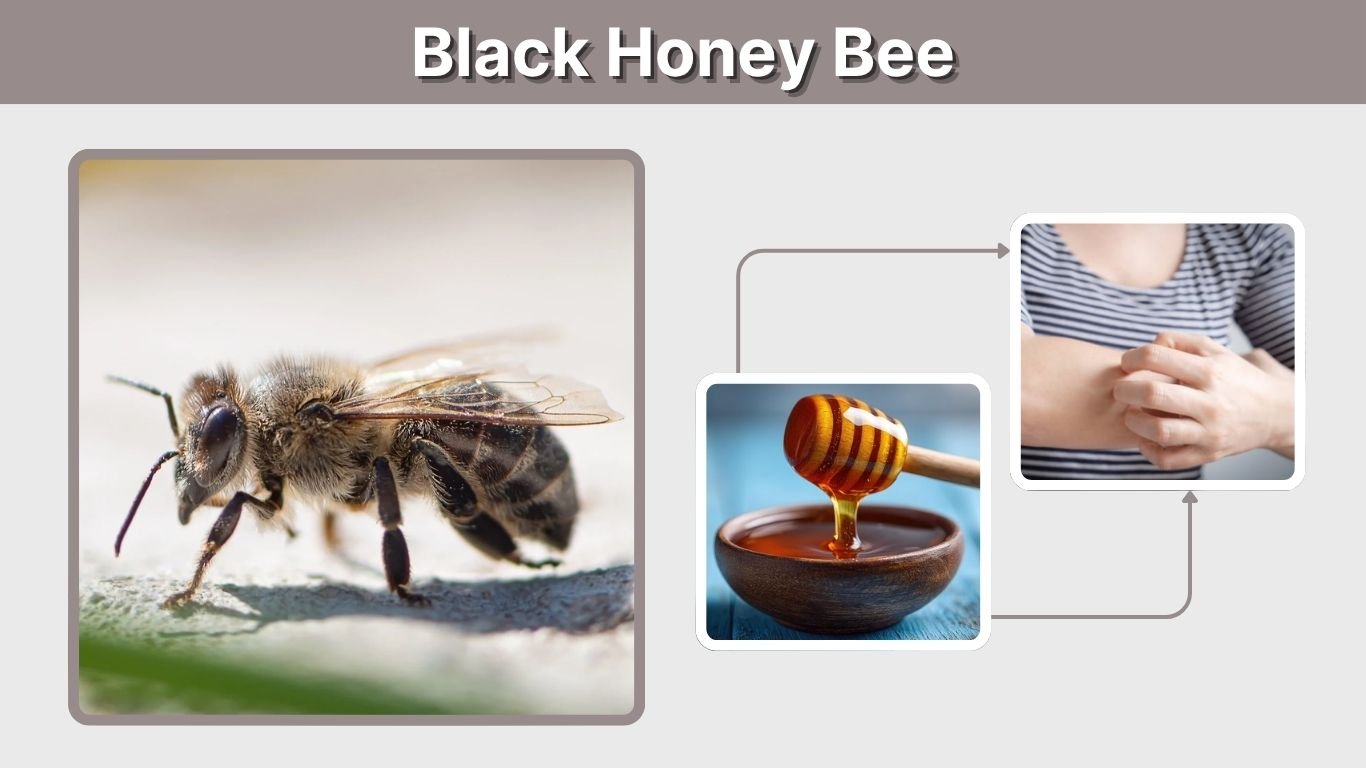
A black honey bee is usually a dark-colored honey bee rather than one specific species. In Europe, the name commonly refers to the European dark bee (Apis mellifera mellifera), also called the German, British, or native black bee. In North America, however, a large solid-black insect may be a carpenter bee rather than a honey bee. Asia also has enormous dark honey bees that build exposed nests. Accurate identification requires examining the bee’s size, hair, markings, location, behavior, and nesting site.
What Is a Black Honey Bee?
“Black honey bee” is an informal name used for several dark bees. The best-known example is the European dark honey bee, a subspecies of the western honey bee. Other searches for small, giant, or solid-black honey bees may refer to entirely different species that do not share the European dark bee’s appearance or behavior.
Common Meanings of Black Honey Bee
- European dark honey bee
- German black bee
- British black bee
- Native Irish black bee
- Cornish black bee
- Himalayan giant honey bee
- Dark-colored western honey bee hybrid
- Carpenter bee mistaken for a honey bee
- Small carpenter or sweat bee
Location is therefore essential for identification. A dark bee in Ireland has different possibilities from a black bee in Texas, India, or Australia.
European Dark Honey Bee
The European dark honey bee (Apis mellifera mellifera) is a northern and western European subspecies of the western honey bee. Its original range extended across much of northern Europe.
These bees generally look dark brown or blackish, with relatively little yellow coloring on the abdomen. They have stocky bodies and brown thoracic hairs. However, appearance alone cannot establish genetic purity because hybrid honey bees may look equally dark.
British, German and Irish Black Bees
The terms British black bee, German black bee, Irish black bee, and European black bee generally describe geographical populations or historical strains associated with Apis mellifera mellifera. They are not normally treated as completely separate honey bee species.
British and Cornish Black Bees
The native dark bee was historically widespread across Britain. Imported subspecies and decades of interbreeding changed the genetic composition of many colonies, but dark-bee characteristics remain in managed and feral populations.
Beekeepers and conservation organizations maintain selected populations adapted to local climates. The term “Cornish black bee” normally refers to dark honey bees maintained or found in Cornwall rather than an independently recognized species.
Native Irish Black Honey Bee
Ireland supports an important population of European dark honey bees. Genetic research involving bees collected across numerous Irish counties found a substantial population belonging to the dark European lineage.
A black appearance does not automatically prove that an Irish bee is genetically pure. Reliable confirmation may require wing measurements, breeding records, or DNA testing rather than photographs alone.
German Black Honey Bee
German black bee is another traditional name associated with Apis mellifera mellifera. The subspecies was historically kept across Germany and neighboring regions before other honey bee stocks became widely imported.
Modern breeders may maintain dark-bee lines for conservation, cold tolerance, local adaptation, or personal preference. Temperament and productivity vary among breeding lines.
How to Identify a Black Honey Bee
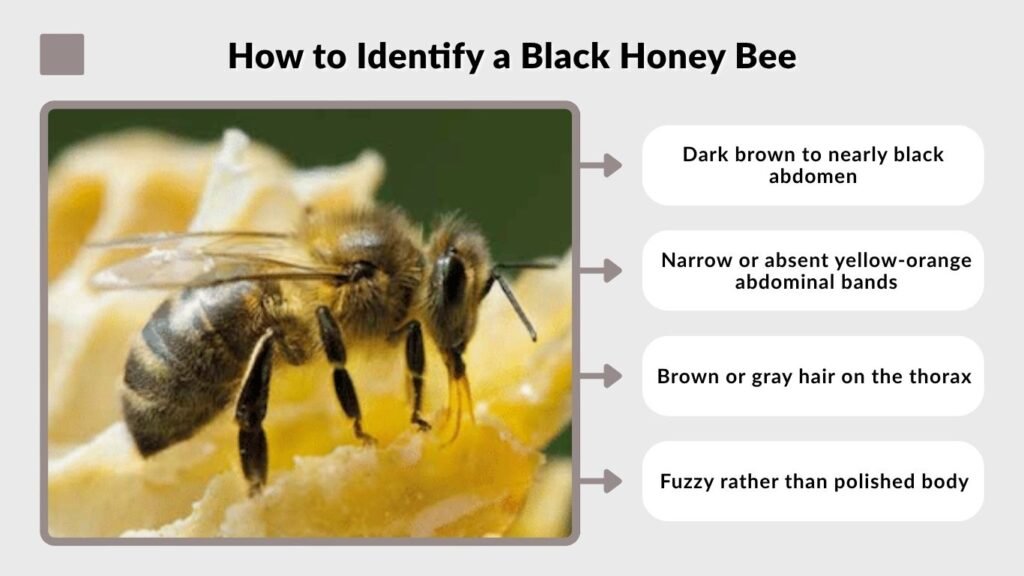
Color provides a useful clue but should never be the only identification feature. Lighting, age, hair loss, genetics, and natural variation can make ordinary honey bees appear much darker than expected. Examine several characteristics and, whenever possible, observe multiple workers from the same colony.
Identification Features
- Dark brown to nearly black abdomen
- Narrow or absent yellow-orange abdominal bands
- Brown or gray hair on the thorax
- Fuzzy rather than polished body
- Approximately ½ inch long
- Pollen baskets on the hind legs of workers
- Social behavior involving many bees
- Nest inside a hive, tree cavity, or wall void
- Wax comb containing brood and honey
A honey bee worker has a fuzzy body and relatively slender shape. The abdomen may look dark, but it normally lacks the smooth, highly polished surface of a carpenter bee.
Black Honey Bee Versus Carpenter Bee
A large solid-black bee in Texas, California, Ohio, Mississippi, or another part of the United States is often a carpenter bee. Female carpenter bees commonly have a shiny, nearly hairless black abdomen and a broad, powerful body.
Carpenter bees are usually solitary and excavate round tunnels in wood. Honey bees live in large colonies and build wax combs. The Texas Apiary Inspection Service notes that carpenter bees are approximately ¾–1 inch long and have shiny black abdomens with few hairs.
Small Black Bees
A small dark bee may be a small carpenter bee, sweat bee, masked bee, mining bee, stingless bee, or dark honey bee worker. Small carpenter bees frequently have metallic blue, green, or black bodies and nest inside hollow or pithy stems.
Many small native bees live alone and do not produce harvestable honey. Close photographs of the face, abdomen, legs, and nest entrance can help an extension office or entomologist identify them.
Giant Black Honey Bees in Asia
“Giant black honey bee” may refer to the Himalayan giant honey bee (Apis laboriosa) or the giant honey bee (Apis dorsata). Both are wild Asian honey bees that create exposed single-comb nests rather than living in standard enclosed beehives.
Himalayan Giant Honey Bee
The Himalayan giant honey bee occurs in mountainous regions of Nepal, India, Bhutan, China, Myanmar, and nearby countries. Adults can approach 1.2 inches in length, making Apis laboriosa the world’s largest living honey bee.
Colonies attach enormous exposed combs to high cliffs and rock overhangs. The bees migrate seasonally and are specially adapted to high-elevation environments.
Giant Honey Bee of India
The giant honey bee (Apis dorsata) is widespread across South and Southeast Asia. It commonly nests beneath tree branches, cliffs, and human structures. A colony constructs one large exposed comb protected by layers of workers.
These bees produce honey, but their defensive colonies should never be approached or disturbed without local expertise. Mass attacks can result in numerous stings.
Black Honey Bee Nests and Honey
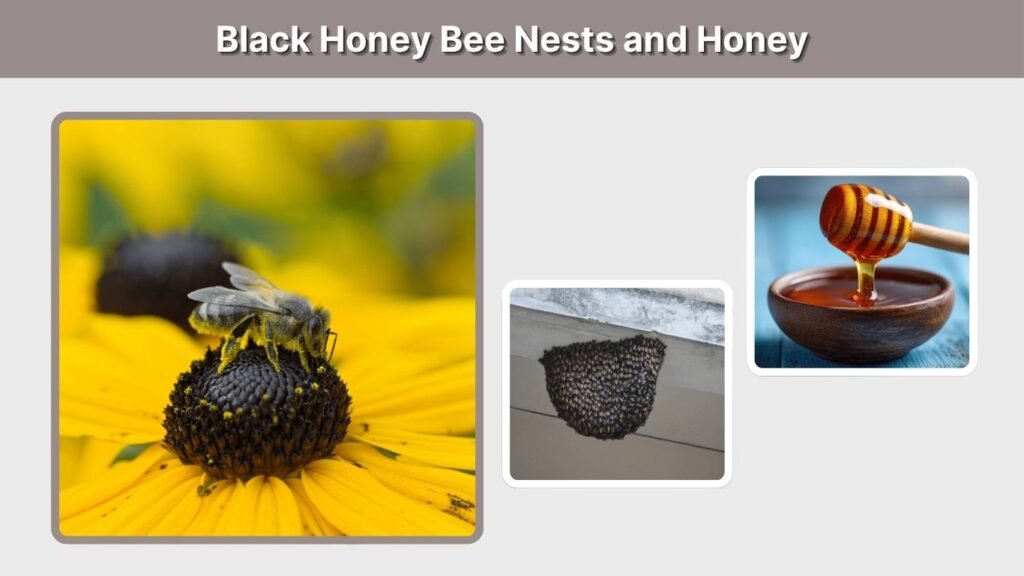
European dark honey bees build parallel wax combs inside protected cavities or managed hives. Their colonies store honey in the upper and outer areas of the nest while maintaining brood closer to the center.
Nest Identification
A black honey bee colony may contain:
- Thousands of adult workers
- One reproductive queen
- Drones during the breeding season
- Multiple vertical wax combs
- Capped and uncapped brood
- Pollen stored in cells
- Capped honey reserves
- Guard bees near the entrance
Carpenter bees create smooth, round holes in wood and divide their tunnels into individual brood chambers. They collect nectar and pollen but do not make jars or combs of honey.
Is Black-Bee Honey Different?
European dark bees produce ordinary honey from available flower nectar. Honey color and flavor depend primarily on floral sources, season, soil, and processing rather than the bee’s dark body color.
Himalayan giant honey bees may collect nectar from rhododendrons. Honey produced from certain rhododendron species can contain grayanotoxins and cause poisoning. Wild Himalayan “mad honey” should not be consumed without understanding its source and associated health risks.
Are Black Honey Bees Dangerous?
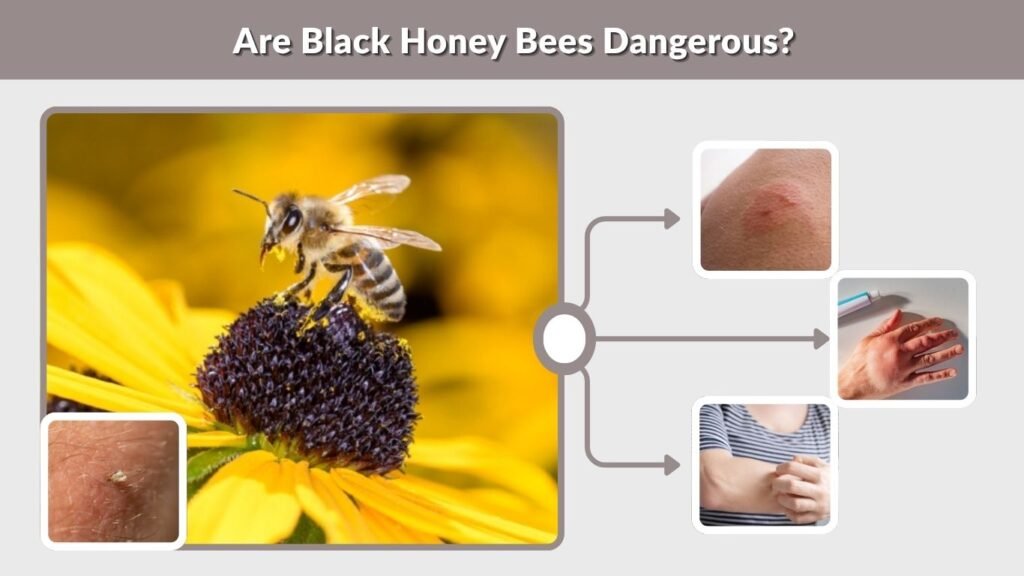
A dark body does not automatically mean a bee is unusually aggressive. Defensive behavior depends on species, colony genetics, weather, food availability, queen condition, disturbance level, and distance from the nest.
Black Honey Bee Sting
Female worker honey bees can sting when defending themselves or their colony. Their barbed stingers often remain embedded in human skin, causing the worker to die afterward. Drones cannot sting.
Common local symptoms include:
- Immediate sharp or burning pain
- Redness
- Itching
- Tenderness
- Swelling around the sting
Wash the site and remove the stinger quickly by scraping or pulling it out. Speed matters more than the removal method.
When a Sting Is an Emergency
Call emergency services immediately if the person develops difficulty breathing, swelling of the tongue or throat, dizziness, widespread hives, vomiting, confusion, or collapse. Numerous stings also require urgent medical evaluation, even in someone without a known allergy.
Large wild honey bee colonies in Asia can attack as a group when disturbed. Never throw objects, spray water, burn material, or climb toward an exposed colony.
Black Honey Bee Queens
A black honey bee queen is usually longer and heavier than the workers surrounding her. Her abdomen extends noticeably beyond her folded wing tips, while workers have shorter, more compact bodies.
Identifying the Queen
- Long, tapered abdomen
- Relatively short-looking wings
- Smooth, deliberate movement
- Attendant workers facing and feeding her
- Located near eggs or young brood
- Few visible pollen-carrying structures
Color is unreliable for identifying a queen’s subspecies. A dark queen may mate with drones from several different genetic backgrounds, producing workers with variable bands and colors.
Benefits of European Dark Honey Bees
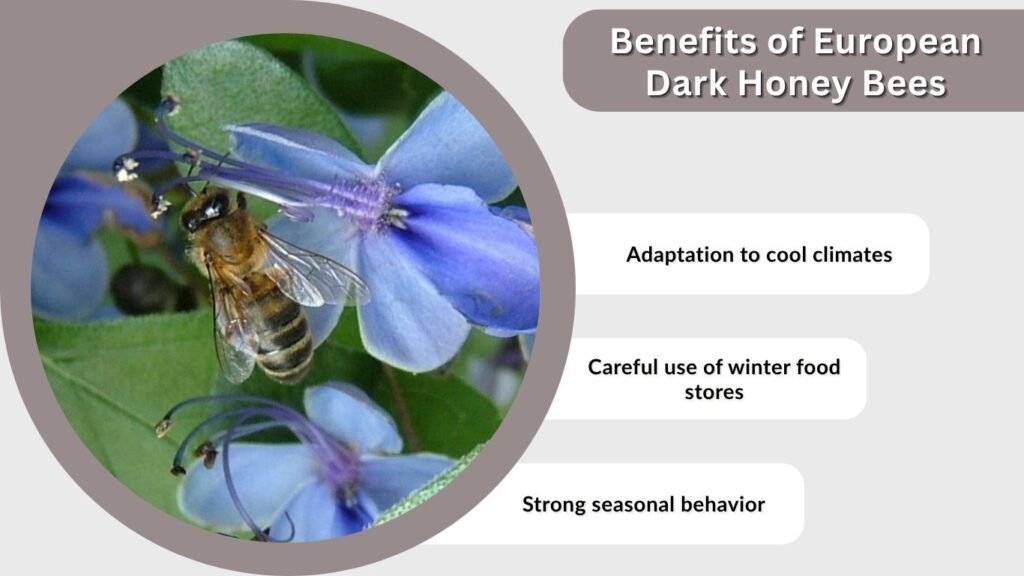
European dark bees are valued for their genetic diversity and association with northern European environments. Locally selected colonies may perform well in cool, wet regions, but characteristics differ among populations and breeding programs.
Potentially Valuable Characteristics
- Adaptation to cool climates
- Careful use of winter food stores
- Strong seasonal behavior
- Local disease-survival traits
- Contribution to honey bee genetic diversity
- Pollination of crops and wild plants
- Honey and wax production
Claims that every dark bee is automatically calmer, healthier, or more productive should be treated cautiously. Colony performance depends on genetics, management, environment, parasites, and forage.
Buying Black Honey Bee Queens
Buyers should request the scientific name, breeding history, queen age, mating method, health records, and evidence supporting claims of dark-bee ancestry. Body color alone is not proof of a pure European dark honey bee.
Before Purchasing
Check local rules governing bee imports and movement. Imported queens can introduce parasites, diseases, or unwanted genetics into local populations. Purchasing from a reputable regional breeder may provide bees better adapted to nearby weather and nectar flows.
Also consider temperament, productivity, swarming tendency, mite resistance, and winter survival rather than choosing a queen solely because she appears black.
FAQs
Black bees can be difficult to identify because unrelated species share similar coloring. Size, hair distribution, nesting habits, and location provide more dependable clues than color alone. These answers address several common questions about their identity and behavior.
Is There a Completely Black Honey Bee?
Some western honey bees can appear almost entirely black, particularly European dark bees and dark hybrids. However, a large glossy-black insect may be a carpenter bee.
Do Black Honey Bees Make Honey?
True honey bees make and store honey. European dark bees produce honey in cavity nests, while giant Asian honey bees store it in exposed single-comb nests.
Are Black Honey Bees More Aggressive?
Not necessarily. Color does not determine aggression. Defensive behavior varies with species, breeding line, colony condition, weather, and disturbance.
What Is a Giant Black Honey Bee?
In Himalayan regions, it may be Apis laboriosa, the Himalayan giant honey bee. In other parts of Asia, it may be Apis dorsata. Both construct large exposed nests.
Can a Black Honey Bee Bite?
Honey bees primarily defend themselves by stinging rather than biting people. Their mandibles can grasp materials, but a painful human encounter is almost always a sting.