
A honey bee’s lifetime depends on whether it is a worker, drone, or queen. Summer workers usually live for only five to seven weeks, while winter workers may survive for several months. Drones generally live for a few weeks or months, and queens can live for several years. During her short adult life, a summer worker contributes only about 1/12 teaspoon of honey to the colony. Although this amount seems tiny, tens of thousands of cooperating workers can produce substantial honey stores.
How Long Does a Honey Bee Live?
Honey bees live in organized colonies containing three adult castes. Each caste has a different function, development period, and expected lifespan. Workers complete most colony tasks, drones exist primarily for reproduction, and the queen lays eggs. Season, workload, nutrition, weather, parasites, disease, pesticides, and predators can all influence how long an individual survives.
Honey Bee Lifespan by Caste
- Summer worker: Approximately 5–7 weeks
- Winter worker: Around 4–6 months
- Drone: Several weeks to a few months
- Queen: Commonly 2–5 years
- Mated drone: Dies immediately after mating
- Foraging worker: Usually forages during the final 2–3 weeks of life
These figures describe typical conditions rather than guaranteed lifespans. Some bees die much earlier because of disease, injury, poisoning, bad weather, or predation.
Why Lifespans Differ
Worker bees change jobs as they age. Young workers clean cells, feed larvae, process nectar, build comb, and guard the entrance. Older workers eventually leave the hive to collect nectar, pollen, water, and plant resins.
Foraging is physically demanding and dangerous. Workers experience worn wings, bad weather, predators, pesticides, and the possibility of becoming lost. Queens remain protected inside the colony, helping them survive much longer.
Worker Bee Lifetime
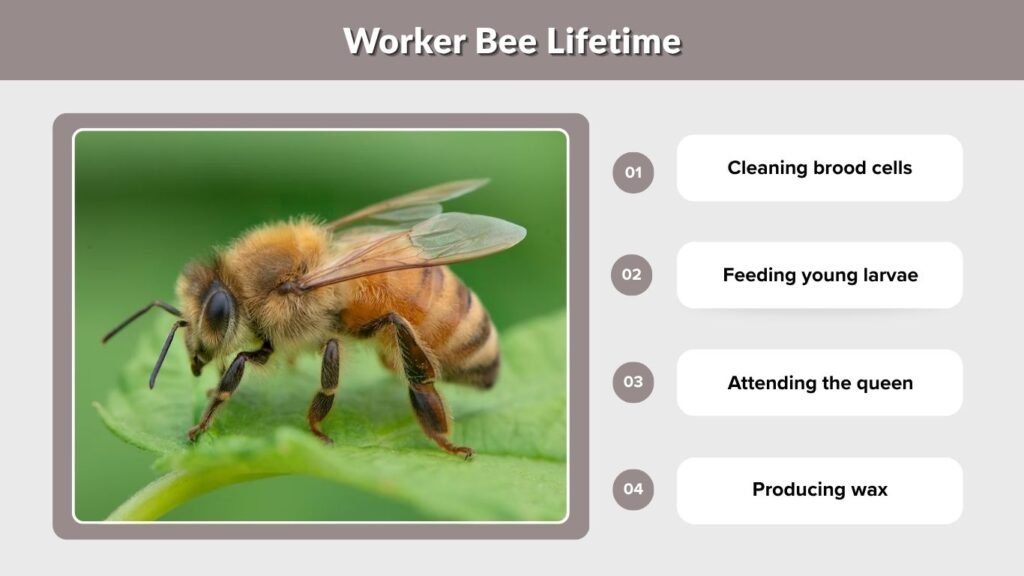
Worker honey bees are non-reproductive females that perform nearly every essential colony task. Their lifetime is closely connected to the season in which they emerge. Workers raised during an active nectar flow have different bodies and responsibilities from those produced for winter survival.
Summer Worker Bees
A spring or summer worker commonly lives for approximately five to seven weeks. During the first half of her adult life, she performs tasks inside the hive. These include:
- Cleaning brood cells
- Feeding young larvae
- Attending the queen
- Producing wax
- Building and repairing comb
- Processing and storing nectar
- Guarding the hive entrance
- Cooling the colony by fanning
At approximately two to three weeks old, she normally becomes a forager. She then makes repeated trips outside until her wings become damaged or she dies from another cause.
Winter Worker Bees
Winter workers may live for four to six months. Penn State Extension reports that winter bees can survive for up to six months, compared with roughly six weeks for summer workers.
These long-lived bees develop larger nutrient reserves in their fat bodies. They form a cluster, consume stored honey, produce heat, and protect the queen until flowers and regular brood production return.
Queen and Drone Lifespans
Queens and drones are reproductive colony members, but their lives follow very different patterns. A productive queen can survive for years inside the hive. Drones live only until they mate, are expelled during a shortage, or die as the colony prepares for winter.
How Long Does a Queen Honey Bee Live?
A queen commonly lives for two to five years, although many beekeepers replace her earlier if egg production declines. She may lay approximately 1,500–2,000 eggs daily during favorable conditions.
Workers constantly feed, groom, and protect her. She usually leaves the hive only for mating flights early in life or when departing with a swarm. This protected existence contributes to her exceptional longevity.
How Long Do Drone Bees Live?
Drones are male honey bees whose primary biological purpose is mating with a virgin queen. They do not collect food, produce wax, defend the colony, or perform normal worker duties.
A drone may live for several weeks or months if he does not mate. Successful mating causes immediate death. When food becomes limited, workers may stop feeding drones and force them out of the colony.
The Complete Honey Bee Life Cycle
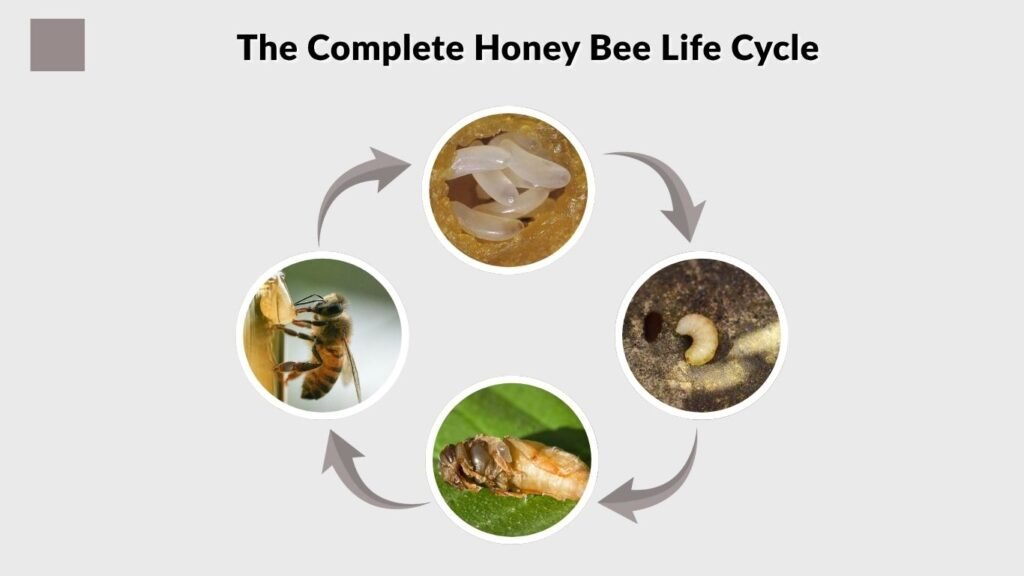
Honey bees experience complete metamorphosis involving egg, larval, pupal, and adult stages. Development time differs between queens, workers, and drones. The queen develops fastest, while the larger drone requires the longest period before emerging from his capped cell.
Development From Egg to Adult
| Honey bee caste | Egg stage | Larval and pupal development | Total development |
| Queen | About 3 days | About 13 days | Around 16 days |
| Worker | About 3 days | About 18 days | Around 21 days |
| Drone | About 3 days | About 21 days | Around 24 days |
The lifespan figures commonly given for honey bees usually refer to adult life after emergence. Adding development inside the cell increases the bee’s total lifetime by approximately 16–24 days.
Diet During Development
All newly hatched larvae receive nutrient-rich glandular food from nurse workers. Future queens continue receiving an abundant royal-jelly diet, while worker and drone larvae later receive different mixtures of brood food, pollen-derived nutrients, and carbohydrates.
Nutrition affects development, adult health, immunity, and longevity. Poor pollen availability or parasite pressure can shorten the lives of newly emerged workers.
How Much Honey Does One Bee Make in Its Lifetime?
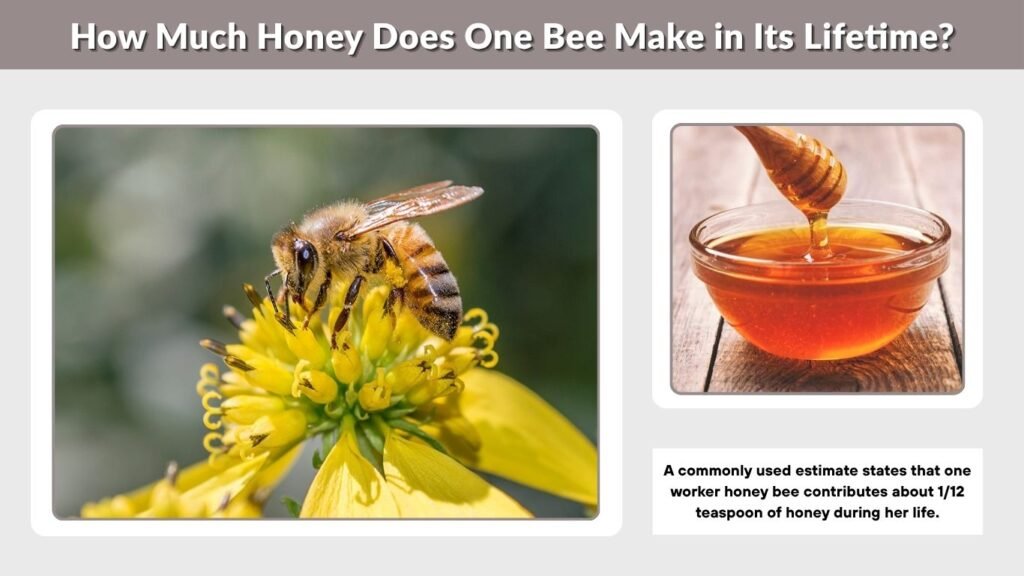
A commonly used estimate states that one worker honey bee contributes about 1/12 teaspoon of honey during her life. That equals roughly 0.5–0.6 grams. A USDA Natural Resources Conservation Service training document also uses the 1/12-teaspoon estimate.
This is a memorable average, not a fixed biological measurement. Actual production changes dramatically with colony needs and environmental conditions.
Factors Affecting Lifetime Honey Production
- Length of the worker’s foraging life
- Distance between flowers and the hive
- Nectar concentration and flower quality
- Weather and temperature
- Strength and health of the colony
- Availability of competing flowers
- Amount of honey consumed during flights
- Need for water, pollen, or propolis collectors
- Nectar used immediately rather than stored
Some workers collect primarily pollen, water, or resin instead of nectar. It is therefore misleading to assume that every worker personally produces exactly the same amount of finished honey.
Honey Is a Colony Product
An individual forager collects nectar, but she does not independently complete the entire honey-making process. Nectar is transferred between workers, mixed with enzymes, spread inside cells, and dehydrated through airflow and evaporation. Other workers eventually cap the mature honey with wax.
The 1/12-teaspoon figure represents an individual’s estimated contribution to a cooperative process. Thousands of worker lifetimes are combined in every jar of honey.
How Bees Produce Honey During Their Lives
A worker’s role in honey production begins before she becomes a forager. Young house bees receive nectar from returning foragers, process it, and place it in comb cells. Later, the same worker may leave the colony and gather nectar herself.
From Nectar to Honey
- A forager draws nectar from a flower using her proboscis.
- She stores it in a specialized crop called the honey stomach.
- The nectar is transferred to house bees after returning.
- Enzymes begin breaking complex sugars into simpler sugars.
- Workers deposit the liquid in open comb cells.
- Air circulation reduces its water content.
- Mature honey is sealed beneath a wax cap.
Bees consume some nectar and honey to power their flights, so not everything collected becomes harvestable stored honey.
How Many Bees Make a Jar of Honey?
Using the 1/12-teaspoon estimate, approximately 12 worker lifetimes contribute one teaspoon. A cup contains 48 teaspoons, representing roughly 576 estimated worker contributions.
This calculation is only illustrative. Honey production occurs at the colony level, and thousands of additional bees support brood care, temperature control, wax production, defense, and food processing.
How Far Does a Honey Bee Fly in Its Lifetime?
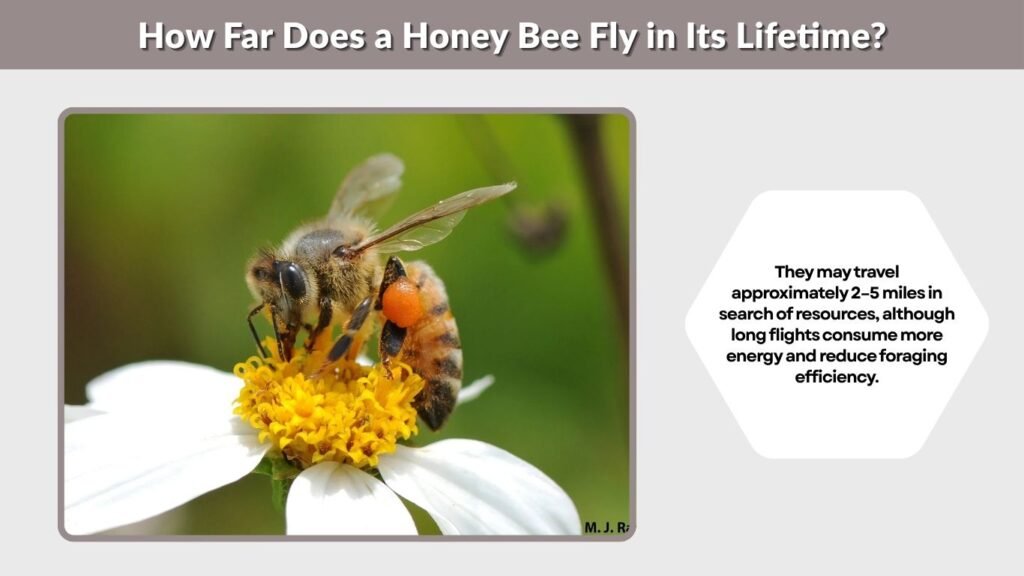
There is no reliable universal lifetime distance. A worker’s total depends on her foraging period, number of daily trips, weather, and distance to flowers. Honey bees prefer efficient nearby sources but can travel several miles when necessary.
Foraging Distance
Workers often forage within one or two miles of their hive when good flowers are available. They may travel approximately 2–5 miles in search of resources, although long flights consume more energy and reduce foraging efficiency.
A single worker can make multiple trips per day during favorable weather. Her cumulative lifetime distance may therefore reach hundreds of miles, but claims assigning one exact total to every bee should be treated as rough estimates.
Factors That Shorten a Honey Bee’s Lifetime
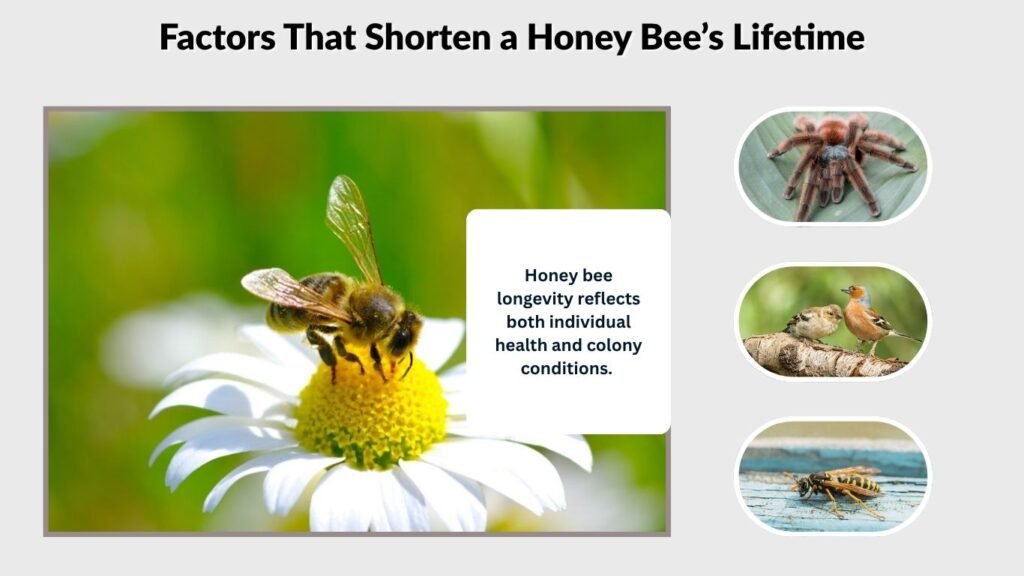
Honey bee longevity reflects both individual health and colony conditions. A worker raised in a well-nourished colony may still die early while foraging, whereas parasite exposure during development can weaken her before she ever leaves the hive.
Common Causes of Early Death
- Varroa mites and transmitted viruses
- Poor nutrition or limited floral diversity
- Pesticide exposure
- Extreme heat, cold, wind, or rain
- Predators such as spiders, birds, and wasps
- Wing wear and exhaustion
- Colony starvation
- Bacterial and fungal diseases
- Becoming lost during foraging
- Stinging a thick-skinned animal
A worker’s barbed stinger usually becomes lodged in human or mammalian skin. When she pulls away, the stinging apparatus tears from her abdomen, and she dies afterward.
FAQs
The term “honey bee lifetime” can describe adult longevity, total development, or lifetime honey production. These measurements change according to caste and season. The following answers summarize the most common questions about worker, queen, and drone lifespans.
How Long Does a Honey Bee Live?
Summer workers generally live five to seven weeks. Winter workers may survive four to six months, while queens commonly live two to five years.
How Much Honey Does One Bee Make in Its Lifetime?
A worker is commonly estimated to contribute approximately 1/12 teaspoon, or about 0.5–0.6 grams, of honey during her lifetime.
Does a Bee Spend Its Whole Life Making Honey?
No. A worker spends her early adult life performing duties inside the hive. She normally becomes a forager only during the final portion of her life.
Which Honey Bee Lives the Longest?
The queen lives longest, commonly surviving for two to five years. She remains protected and fed by workers inside the colony.
Do Honey Bees Die After Making Honey?
Honey production does not kill them. Workers normally die from aging, exhaustion, weather, predators, disease, pesticides, or injuries. A worker also dies after leaving her barbed stinger in a mammal.