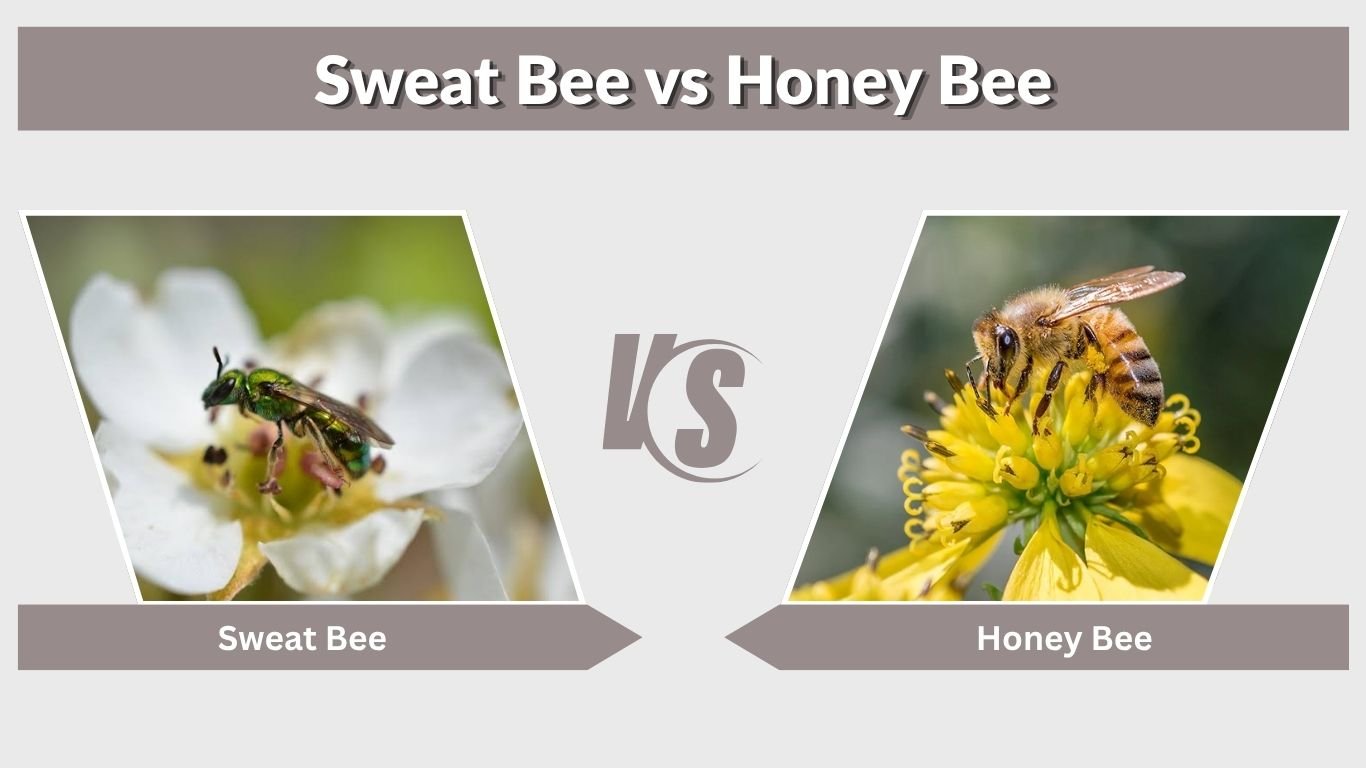
A sweat bee and a honey bee are both important pollinators, but they differ greatly in appearance, nesting habits, social behavior, and honey production. Sweat bees belong to the family Halictidae and are often small, metallic green, black, or striped. Honey bees belong to the genus Apis and live in large, highly organized colonies. One of the biggest differences is that honey bees produce and store substantial amounts of honey, while sweat bees do not produce harvestable honey. Both can sting, although their behavior around people differs.
Sweat Bee vs Honey Bee: Quick Comparison
Sweat bees and honey bees may visit many of the same flowers, so they can sometimes be confused. However, their body size, coloration, colony structure, nesting habits, and relationship with humans make them quite different.
| Feature | Sweat Bee | Honey Bee |
| Family | Halictidae | Apidae |
| Typical size | Small to medium | Medium |
| Color | Metallic green, black, bronze, striped | Golden-brown and black |
| Social behavior | Solitary to social | Highly social |
| Colony size | Often one or few females | Thousands of bees |
| Nest | Usually soil or cavities | Large wax comb colony |
| Makes honey | No harvestable honey | Yes |
| Attracted to sweat | Some species | Occasionally, but less typical |
| Sting | Females can sting | Worker females can sting |
| Main role | Pollination | Pollination and honey production |
What Is a Sweat Bee?
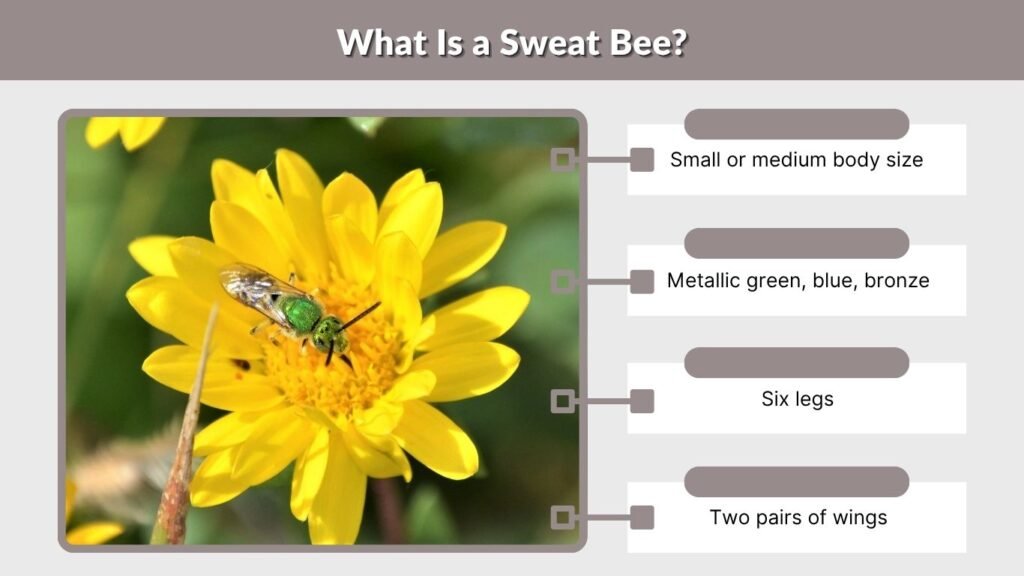
Sweat bees are a large and diverse group of native bees belonging to the family Halictidae. They receive their common name because some species are attracted to salts and moisture in human perspiration.
Many are much smaller than honey bees and can easily go unnoticed.
Sweat Bee Identification
Common features include:
- Small or medium body size
- Metallic green, blue, bronze, or dark coloration
- Six legs
- Two pairs of wings
- Relatively long antennae
- Fine body hairs
- Pollen-carrying hairs on females
- Slender appearance in many species
Some sweat bees are bright emerald green, while others have yellow-and-black abdominal stripes that can resemble other bees.
Sweat Bee Behavior
Most sweat bees spend their time gathering nectar and pollen.
Some species are solitary, meaning one female builds and provisions her own nest. Others have simple social systems involving several females.
They are generally gentle around humans unless trapped or handled.
What Is a Honey Bee?
Honey bees are social bees in the genus Apis. The western honey bee, Apis mellifera, is the species most widely managed by beekeepers.
Honey bees live in large colonies containing a queen, thousands of female workers, and seasonal male drones.
Honey Bee Identification
Typical honey bees have:
- Golden-brown or amber coloration
- Dark abdominal bands
- Hairy thorax
- Medium-sized body
- Pollen baskets on the hind legs of workers
- Two pairs of wings
- Long antennae
- More robust body than many sweat bees
Honey bees usually look less shiny than metallic sweat bees.
Honey Bee Colony
A honey bee colony operates as a highly organized social unit.
The queen lays eggs, worker bees gather food and maintain the hive, and drones primarily participate in reproduction.
A strong colony can contain tens of thousands of individuals.
Sweat Bee vs Honey Bee Size and Appearance
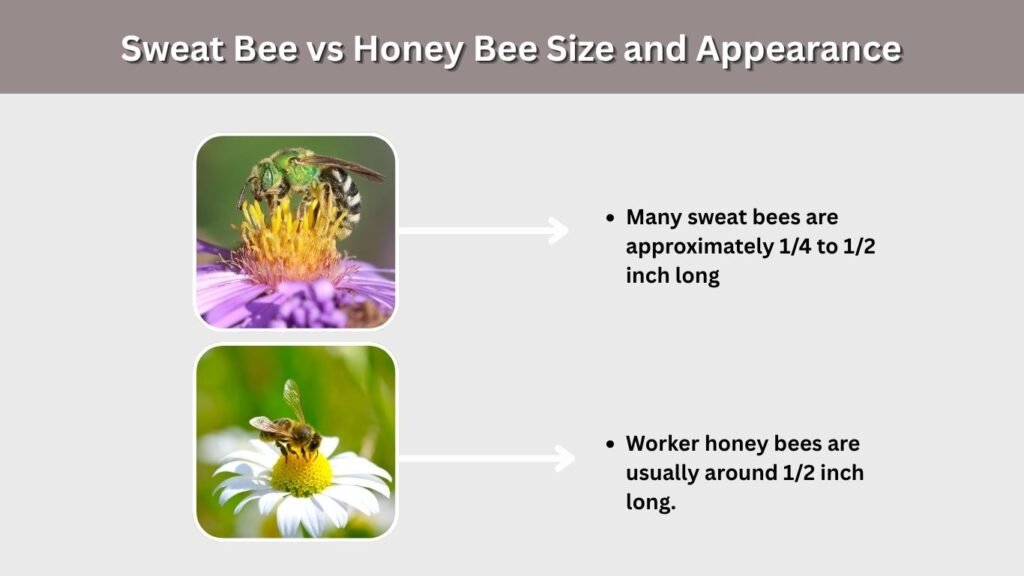
Appearance is usually one of the fastest ways to distinguish the two.
Honey bees tend to have familiar golden-brown coloring, while sweat bees show much greater variation.
Sweat Bee Size
Many sweat bees are approximately:
- 1/4 to 1/2 inch long
- Slim-bodied
- Smaller than honey bees
- Sometimes extremely tiny
Metallic green sweat bees are particularly easy to recognize because honey bees do not have bright green bodies.
Honey Bee Size
Worker honey bees are usually around 1/2 inch long.
They have broader, hairier bodies designed for gathering pollen and moving between flowers.
The queen is larger than the workers, while drones are generally heavier and have larger eyes.
Sweat Bee vs Honey Bee Nest
Their nesting habits are very different.
Most sweat bees nest in the soil, while honey bees construct large wax-comb nests in enclosed cavities.
Sweat Bee Nests
Sweat bees commonly nest in:
- Bare soil
- Sandy ground
- Garden beds
- Lawn edges
- Banks and slopes
- Decaying wood
- Small natural cavities
A ground nest usually consists of a narrow entrance tunnel leading to individual brood cells.
Several sweat bees may nest close together without forming a large colony.
Honey Bee Nests
Honey bees typically establish colonies inside:
- Hollow trees
- Wall cavities
- Beehives
- Roof spaces
- Other protected cavities
Inside, workers build vertical sheets of wax comb containing thousands of hexagonal cells.
These cells hold eggs, larvae, pollen, and honey.
Do Sweat Bees Make Honey?
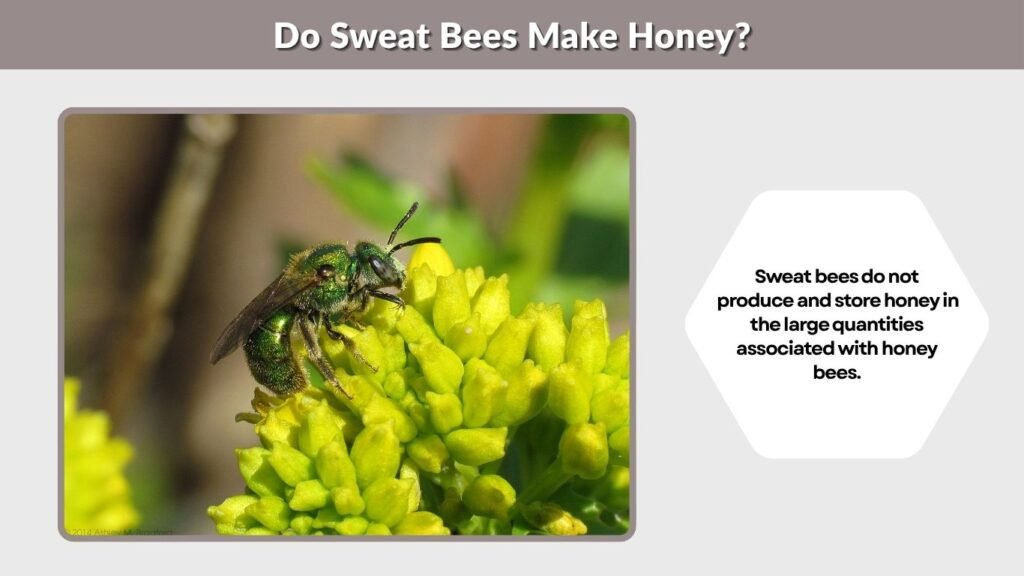
Sweat bees do not produce and store honey in the large quantities associated with honey bees.
Some species may store small amounts of nectar or pollen-related provisions for developing offspring, but this is not the same as maintaining large honey reserves.
Why Honey Bees Make Honey
Honey bees collect nectar and convert it into honey as a long-term food source for the colony.
Workers repeatedly pass and process nectar, place it in wax cells, and reduce its water content.
Stored honey allows the colony to survive periods when flowers are unavailable.
Why Sweat Bees Do Not Make Harvestable Honey
Most sweat bee colonies are far smaller than honey bee colonies.
Many are solitary and only need enough pollen and nectar to provision individual brood cells.
They do not build massive wax combs or maintain large populations through winter in the same way honey bees do.
Therefore, there is no practical product known as sweat bee honey for human harvesting.
Sweat Bee vs Honey Bee Sting
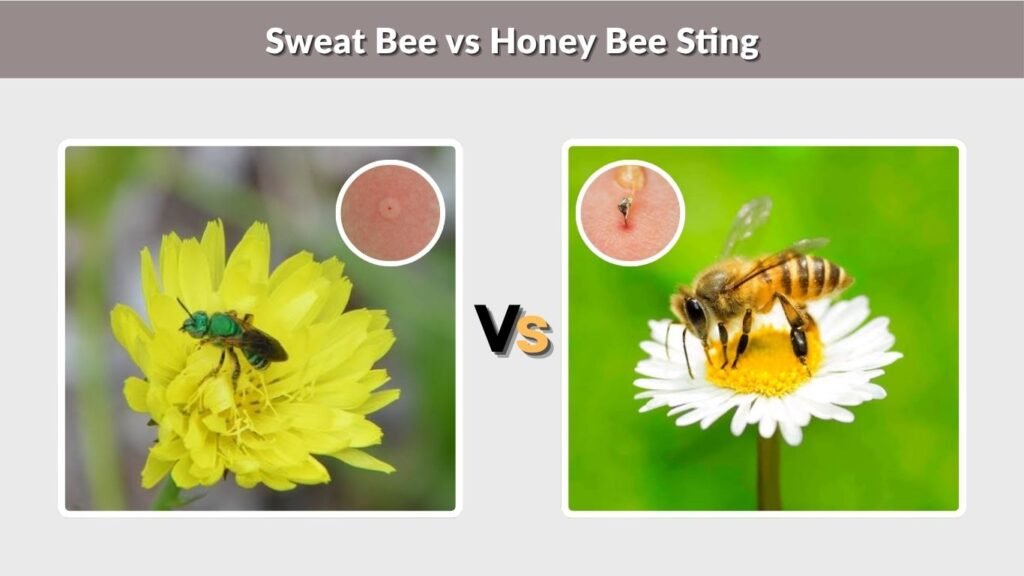
Both sweat bees and honey bees have females capable of stinging, but their defensive behavior differs.
Sweat bees are generally reluctant to sting, while honey bees can become defensive around their colony.
Sweat Bee Sting
A sweat bee may sting if it is:
- Squeezed
- Trapped against the skin
- Caught inside clothing
- Stepped on
- Handled directly
The sting usually causes brief pain, redness, itching, or mild swelling.
Honey Bee Sting
Worker honey bees can sting when they perceive a threat.
A honey bee’s barbed stinger often remains embedded in human skin after the bee flies away.
The sting can cause pain, redness, swelling, and allergic reactions in sensitive individuals.
Are Honey Bees Attracted to Sweat?
Honey bees can sometimes investigate salty water or mineral sources, but they are not as strongly associated with human sweat as certain sweat bees.
Sweat bees are named specifically for their tendency to collect moisture and sodium from perspiration.
Why Sweat Bees Land on People
Sweat contains:
- Sodium
- Potassium
- Water
- Other dissolved minerals
These resources can be valuable to bees, especially during hot weather.
A sweat bee landing on your skin is usually seeking salt rather than preparing to sting.
Sweat Bee vs Honey Bee Diet
Both adult sweat bees and honey bees primarily use nectar and pollen, but they gather and store these resources differently.
Sweat Bee Food
Sweat bees feed on:
- Nectar
- Pollen
- Mineral-rich moisture
- Salt from sweat in some species
Females provision their brood cells with mixtures of pollen and nectar.
Honey Bee Food
Honey bees rely on:
- Nectar
- Honey
- Pollen
- Water
Nectar supplies carbohydrates, while pollen provides protein, fats, vitamins, and minerals.
Honey bees can store large quantities of both honey and pollen inside their colonies.
Sweat Bee vs Honey Bee Pollination
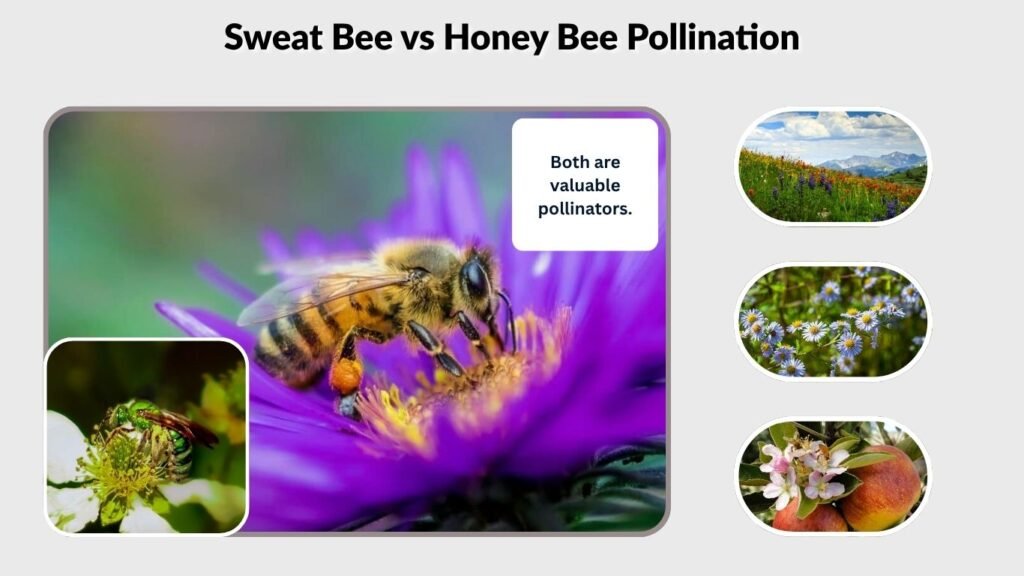
Both are valuable pollinators.
Sweat bees are important native pollinators, while honey bees are widely used commercially for crop pollination.
Sweat Bee Pollination
Sweat bees visit:
- Wildflowers
- Sunflowers
- Asters
- Vegetable blossoms
- Fruit flowers
- Native plants
Their small size lets them access tiny flowers that may receive fewer visits from larger bees.
Honey Bee Pollination
Honey bees visit thousands of flowering plant species and are transported commercially to agricultural areas.
They can recruit large numbers of workers to productive flower patches, making colonies effective pollinators for many crops.
Sweat Bee vs Honey Bee Social Behavior
Honey bees are always highly social, while sweat bees display an unusually wide range of lifestyles.
Some sweat bee species are completely solitary.
Sweat Bee Social Structure
Depending on species, they may be:
- Solitary
- Communal
- Semi-social
- Primitively eusocial
A single nesting area may contain many independent females.
Honey Bee Social Structure
Honey bees have a permanent caste system.
The colony contains a queen, female workers, and male drones. Workers cooperate in brood care, nest construction, food collection, temperature control, and defense.
No individual worker normally survives independently for long outside the colony.
Which Is More Beneficial?

There is no need to choose one over the other.
Both contribute significantly to pollination, but they fill somewhat different ecological roles.
Sweat bees increase native pollinator diversity, while honey bees are important agricultural pollinators and produce honey, beeswax, and other hive products.
Protecting flowering habitat benefits both groups.
FAQs
1. What is the main difference between a sweat bee and a honey bee?
Sweat bees are usually smaller, may be metallic green, and often nest in soil. Honey bees are golden-brown social bees that live in large colonies and build wax combs.
2. Do sweat bees make honey?
No. Sweat bees do not produce large quantities of stored honey that can be harvested like honey bee honey.
3. Are sweat bees smaller than honey bees?
Usually, yes. Many sweat bees are significantly smaller than worker honey bees, although size varies by species.
4. Are honey bees attracted to human sweat?
They may occasionally investigate mineral-rich moisture, but attraction to human perspiration is much more characteristic of certain sweat bee species.
5. Which sting hurts more, a sweat bee or honey bee?
Both can cause pain, but honey bee stings are generally more noticeable and their barbed stinger may remain in the skin. Individual reactions vary, and any bee sting can be serious for someone with a severe allergy.