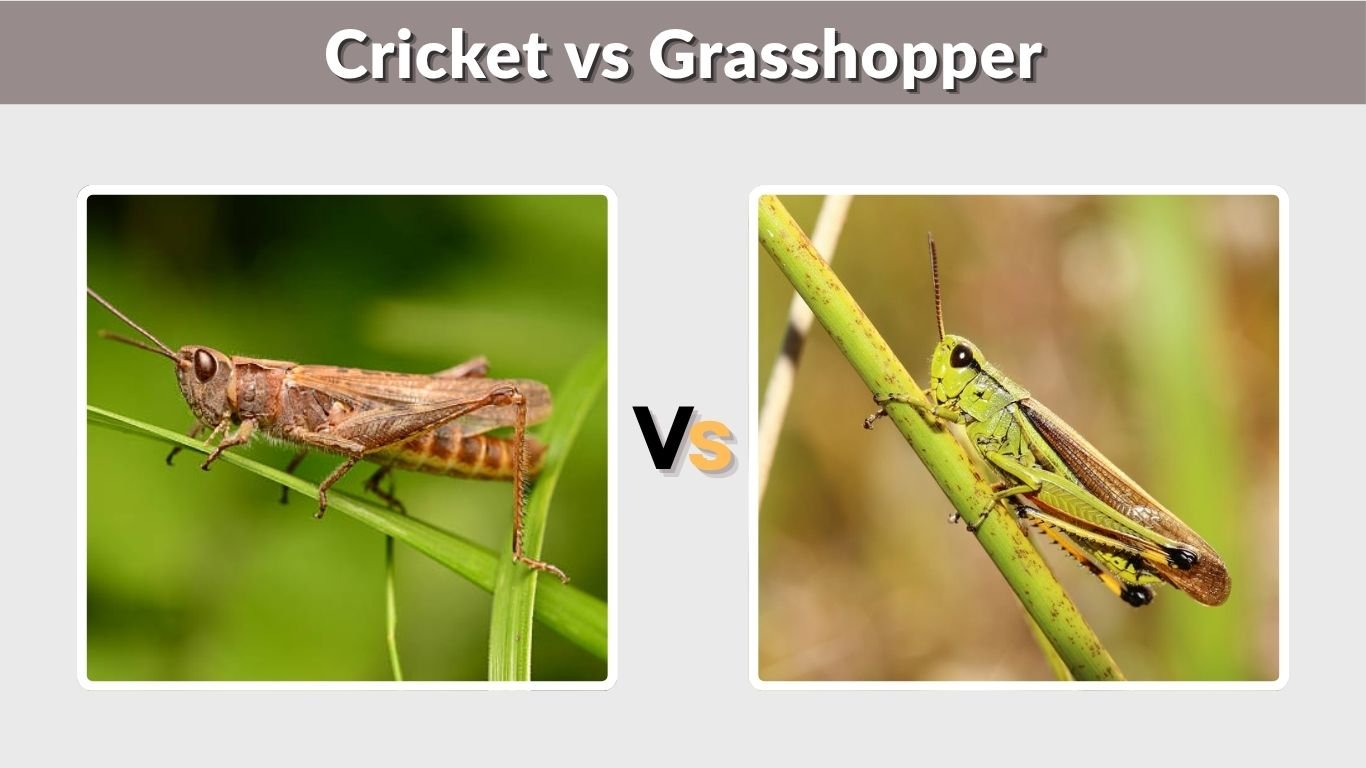
Crickets and grasshoppers can look surprisingly similar because both have powerful hind legs, wings, and strong chewing mouthparts. However, several features make them easy to tell apart once you know what to look for. The biggest differences involve antenna length, body shape, activity time, sound production, diet, and where they are commonly found. In this cricket vs grasshopper comparison, you’ll learn how these insects differ in appearance, size, sound, behavior, life cycle, and their relationship to locusts and katydids.
Cricket vs Grasshopper: Quick Comparison
Crickets and grasshoppers both belong to the insect order Orthoptera, but they belong to different suborders. Grasshoppers are generally short-antennaed insects that are most active during the day, while crickets usually have extremely long antennae and are often more active after sunset. Their characteristic sounds are also produced in different ways.
| Feature | Cricket | Grasshopper |
| Antennae | Very long | Usually short |
| Activity | Mostly evening/night | Mostly daytime |
| Body | Often compact or flattened | Usually elongated |
| Sound | Wings rubbed together | Legs rubbed against wings in many species |
| Diet | Omnivorous or plant-based | Mainly herbivorous |
| Color | Brown, black, green | Green, brown, gray, yellow |
| Hearing organs | Front legs | Abdomen in many species |
| Jumping | Excellent jumper | Excellent jumper |
Cricket vs Grasshopper Appearance
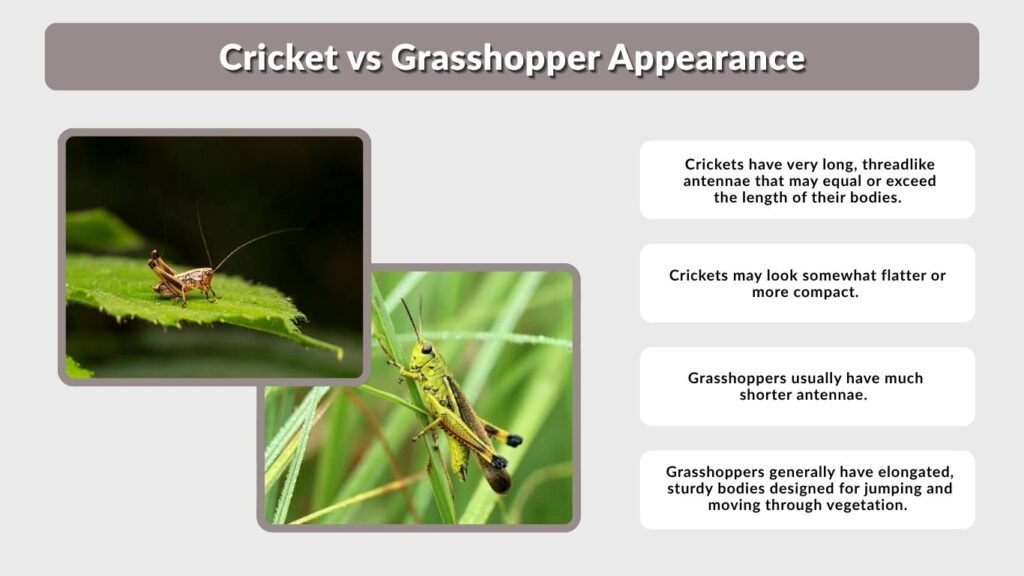
At first glance, both insects have six legs, noticeable hind legs, wings, and segmented bodies. Looking closely at the antennae is usually the quickest way to distinguish them. Color alone is less reliable because both groups can appear green, brown, or other shades depending on the species and habitat.
Antennae
Crickets have very long, threadlike antennae that may equal or exceed the length of their bodies. These sensitive structures help them navigate, locate food, and detect their surroundings, particularly in darkness.
Grasshoppers usually have much shorter antennae. Their antennae typically extend only a relatively short distance beyond the head.
Body Shape
Grasshoppers generally have elongated, sturdy bodies designed for jumping and moving through vegetation. Their large hind legs are especially noticeable.
Crickets may look somewhat flatter or more compact. Their long antennae and, in females, a visible egg-laying structure called an ovipositor can make identification easier.
Cricket vs Grasshopper Size
There is considerable variation in cricket and grasshopper size because thousands of species exist. Consequently, size alone cannot reliably identify an unknown insect. However, grasshoppers often appear larger and heavier-bodied than many common cricket species.
How Big Are Crickets?
Many familiar crickets measure roughly 0.5 to 2 inches long, although some species grow larger. Their extremely long antennae can make their overall appearance seem much longer.
Field crickets are often dark brown or black, while tree and bush-dwelling relatives may be green.
How Big Are Grasshoppers?
Many grasshoppers measure around 1 to 3 inches long, although giant species can become considerably larger.
Their muscular hind legs are proportionally large and provide the explosive power needed for jumping away from predators.
Cricket vs Grasshopper Sound
Sound is one of the most recognizable differences between crickets and grasshoppers. Both groups use sounds primarily for communication, especially when attracting mates, but they often produce those sounds using different body parts.
What Does a Cricket Sound Like?
The familiar nighttime chirping associated with crickets is generally produced through stridulation. Male crickets rub specialized portions of their forewings together to create repeated chirps.
Cricket songs can vary according to species and may include mating calls, territorial signals, and courtship sounds.
What Does a Grasshopper Sound Like?
Many grasshoppers create buzzing, clicking, or rasping sounds by rubbing their hind legs against their wings. Some species also create sound during flight.
Grasshopper calls are often heard during warm daytime conditions, while cricket chirping is particularly associated with evenings and nighttime.
Cricket vs Grasshopper Diet
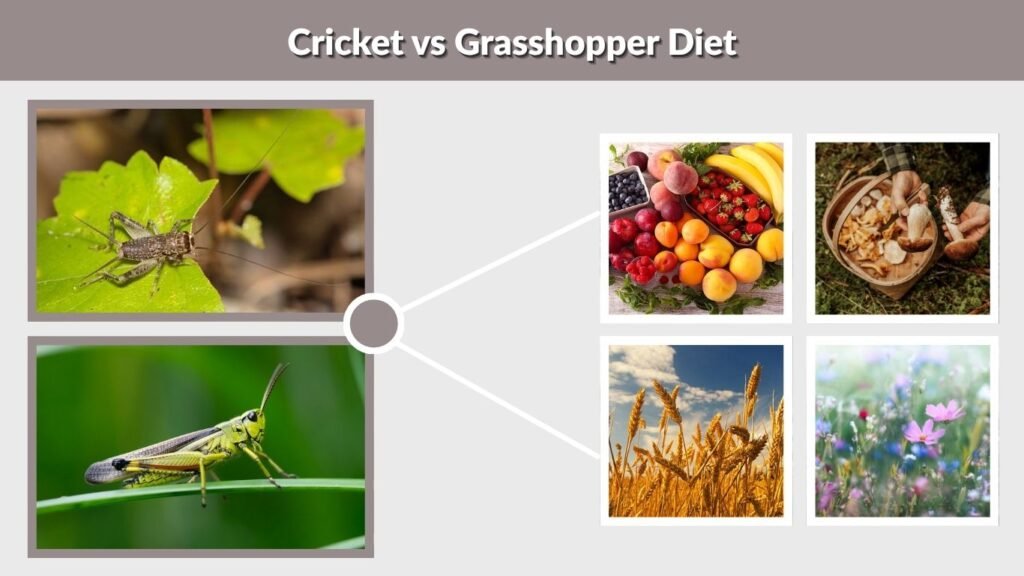
Both insects possess chewing mouthparts, but their diets can be quite different. Grasshoppers are primarily associated with living plants, whereas many crickets consume a broader range of plant and animal materials.
What Do Crickets Eat?
Depending on the species, crickets may eat:
- Leaves and tender vegetation
- Seeds
- Fruits
- Fungi
- Decaying organic matter
- Dead insects
- Small invertebrates
- Food scraps when living near people
This flexible feeding behavior allows some crickets to survive in gardens, forests, grasslands, buildings, and other environments.
What Do Grasshoppers Eat?
Most grasshoppers primarily feed on:
- Grass
- Leaves
- Weeds
- Flowers
- Cereal crops
- Seeds
- Grains
- Garden plants
Grasshoppers can become agricultural pests when large populations consume significant amounts of crops.
Cricket vs Grasshopper Behavior
Behavior provides another useful identification clue. Grasshoppers are often easily spotted jumping through vegetation on sunny days. Crickets tend to remain hidden beneath leaves, rocks, logs, soil cracks, or vegetation until light levels fall.
Day vs Night Activity
Most familiar grasshoppers are diurnal, meaning they are active during daylight. Warm sunny conditions support their feeding, movement, and calling behavior.
Many crickets are nocturnal. Their chirping becomes especially noticeable after sunset when males advertise themselves to females.
Jumping and Flying
Both insects have powerful hind legs and can jump remarkably well.
Many adult grasshoppers also have functional wings and are capable of strong flight. Some crickets can fly, but others have reduced wings or rarely use them.
Cricket and Grasshopper Life Cycle
Crickets and grasshoppers undergo incomplete metamorphosis. They do not have the larval and pupal stages seen in butterflies, moths, beetles, and flies. Instead, young insects look somewhat like miniature versions of adults.
Nymph Cricket vs Nymph Grasshopper
Their life cycle follows three basic stages:
- Egg
- Nymph
- Adult
Cricket nymphs can often be recognized by their long antennae, while grasshopper nymphs generally have shorter antennae and the characteristic grasshopper body shape.
Both molt repeatedly as they grow. Wings develop gradually and become fully functional after adulthood is reached.
Grasshopper vs Cricket vs Locust
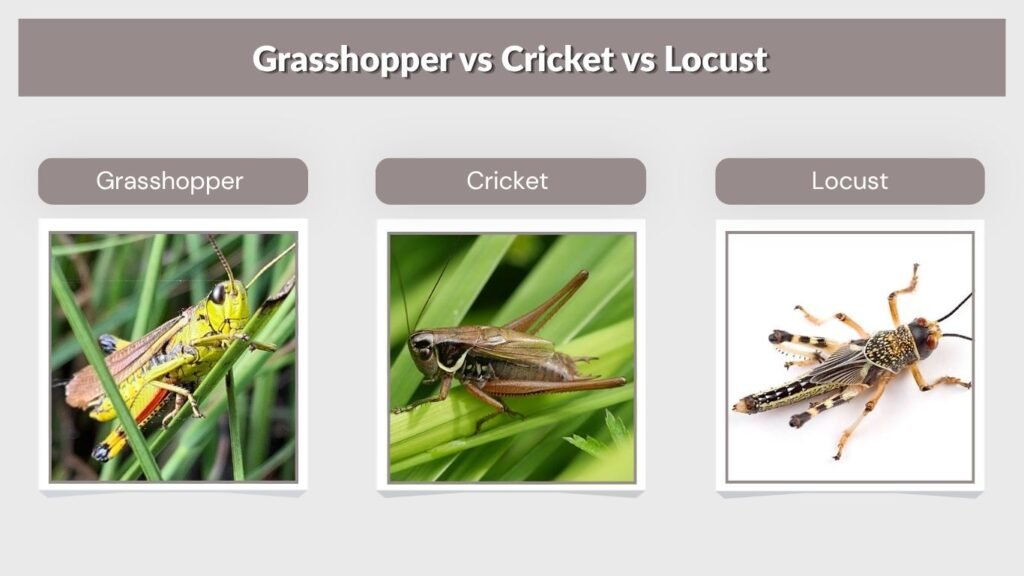
One common source of confusion involves locusts. A locust is not an entirely separate type of insect from a grasshopper. Locusts are particular grasshopper species capable of entering a special gregarious phase under certain environmental conditions.
Locust vs Grasshopper vs Cricket
Grasshoppers generally live individually and feed on vegetation. Certain species can become locusts behaviorally when population density and environmental conditions trigger dramatic changes. They can then form large groups and potentially enormous migrating swarms.
Crickets belong to a different Orthopteran group and do not transform into locusts.
Cricket vs Grasshopper vs Katydid
Katydids can make identification more complicated because many are green like grasshoppers but possess extremely long antennae like crickets. In fact, katydids are more closely related to crickets than to typical short-horned grasshoppers.
How to Tell Them Apart
The easiest clues include:
- Cricket: Very long antennae, often nocturnal and commonly brown or black.
- Grasshopper: Short antennae, large hind legs, commonly active during daylight.
- Katydid: Very long antennae and often a broad, leaflike green body.
- Locust: A type of grasshopper capable of forming swarms.
Bush crickets, a term commonly used for katydids in some regions, can therefore look like a combination of cricket and grasshopper characteristics.
Mormon Cricket vs Grasshopper
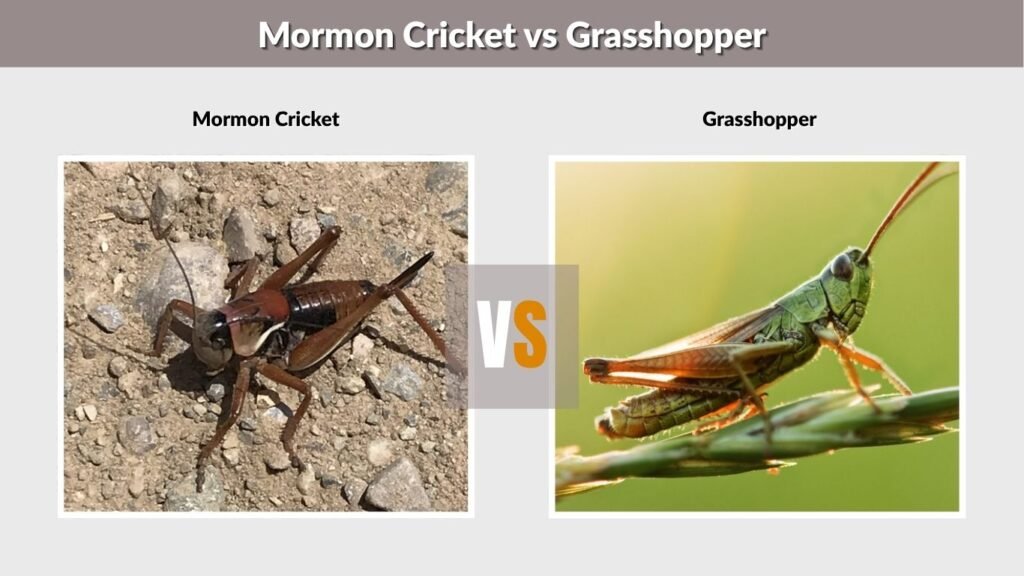
Despite its name, Mormon cricket is not a true cricket. It is a large shield-backed katydid and therefore belongs to the long-horned branch of Orthoptera.
Main Difference
Mormon crickets have long antennae and relatively heavy bodies. They cannot fly effectively, although they can travel considerable distances on the ground when large groups form.
Grasshoppers generally have shorter antennae, and many adult species can fly well.
Are Crickets or Grasshoppers Harmful?
Neither crickets nor ordinary grasshoppers are generally dangerous to people. Both usually attempt to escape when approached. Their main negative impact occurs when populations become high enough to damage plants, gardens, or agricultural crops.
Can They Bite?
Both possess chewing mouthparts and may occasionally pinch when roughly handled. However, neither cricket nor grasshopper normally seeks out humans to bite.
They are much better known for jumping, feeding on vegetation, and producing their distinctive songs.
FAQs
1. What is the main difference between a cricket and grasshopper?
The easiest difference is antenna length. Crickets normally have very long antennae, while grasshoppers usually have noticeably shorter ones.
2. Which is bigger, a cricket or grasshopper?
Grasshoppers are often larger and heavier than common crickets, although size varies greatly among individual species.
3. How can you tell cricket and grasshopper sounds apart?
Crickets usually produce repeated chirping by rubbing their wings together, whereas many grasshoppers create rasping or clicking sounds by rubbing their hind legs against their wings.
4. Are grasshoppers and locusts the same?
Locusts are certain species of grasshoppers capable of changing behavior and forming large swarms. All locusts are grasshoppers, but most grasshoppers are not locusts.
5. Are katydids crickets or grasshoppers?
Katydids are neither true crickets nor typical grasshoppers, although they are more closely related to crickets. Their extremely long antennae and often leaflike bodies help distinguish them from grasshoppers.