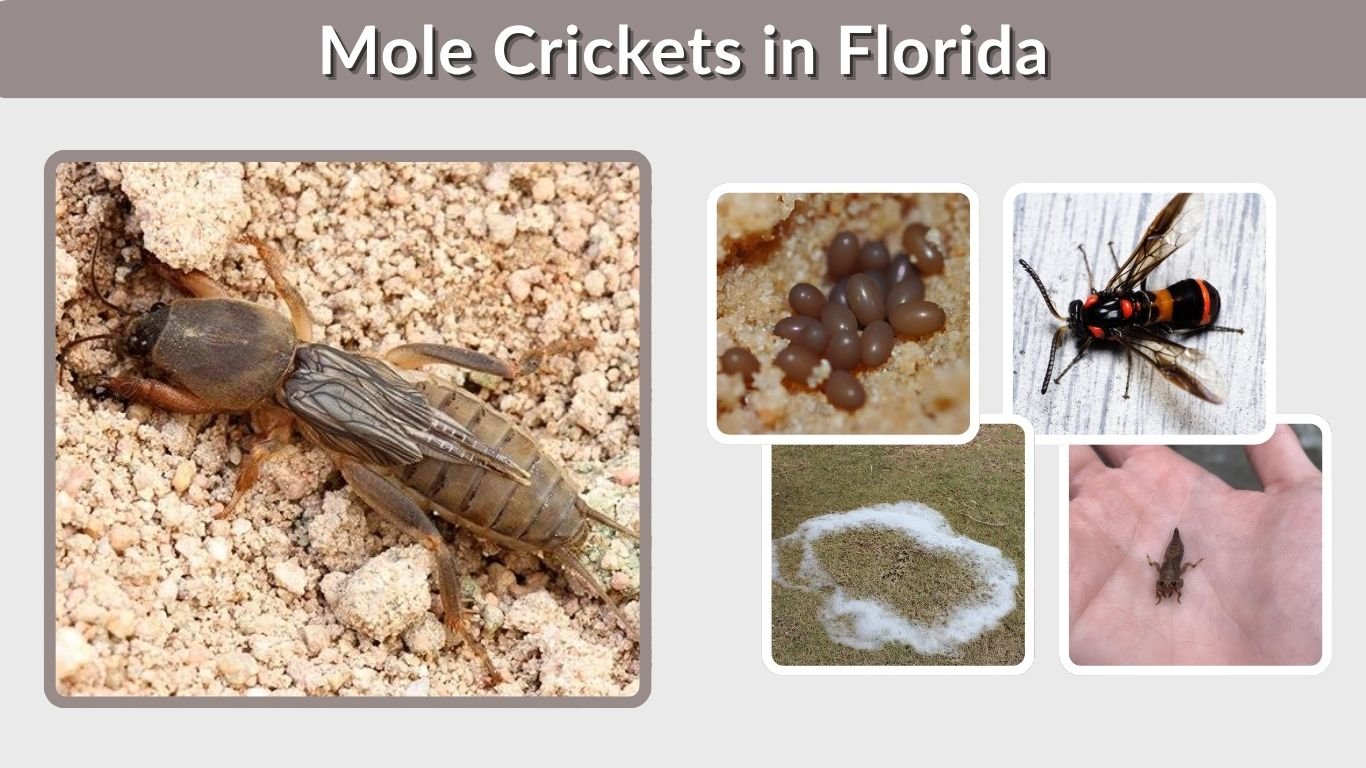
Mole crickets in Florida are underground insects capable of causing noticeable damage to lawns, pastures, and turfgrass. Their powerful front legs allow them to tunnel just beneath the soil surface, disturbing roots and producing patches of thin, brown, or dying grass. Florida has several mole cricket species, including invasive types that are important turf pests. Recognizing their tunnels, understanding their life cycle, and treating infestations at the right time can make control considerably easier while helping prevent unnecessary pesticide use.
What Mole Crickets Are Found in Florida?
Mole crickets spend most of their lives underground and are specially adapted for digging. Several species occur in Florida, but they do not all cause the same amount of turf damage. Three invasive species are considered important pests, while Florida also has a native northern mole cricket that generally is not considered a significant turf pest.
Common Florida Mole Cricket Species
The principal species include:
- Tawny mole cricket (Neoscapteriscus vicinus): A major turf pest that feeds heavily on plant material.
- Southern mole cricket (Neoscapteriscus borellii): Feeds largely on insects but can also damage plants through feeding and tunneling.
- Short-winged mole cricket (Neoscapteriscus abbreviatus): An introduced species particularly associated with turf damage.
- Northern mole cricket (Neocurtilla hexadactyla): A native species that is generally not considered an important Florida lawn pest.
Tawny and southern mole crickets are especially widespread concerns in managed turf.
What Does a Florida Mole Cricket Look Like?
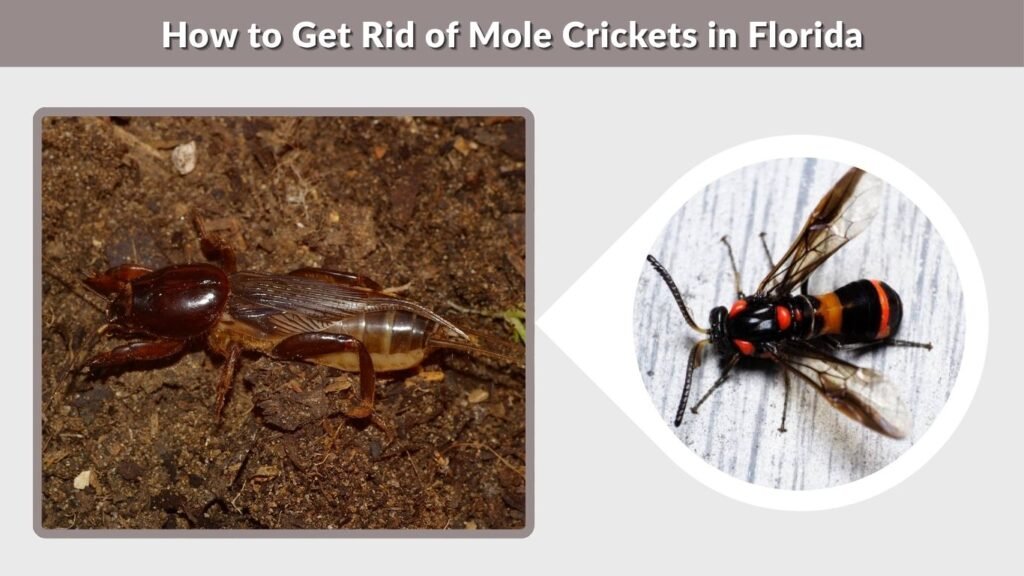
Adults have elongated brown or tan bodies, noticeable antennae, and unusually broad front legs designed for digging. These front legs resemble tiny shovels.
Nymphs resemble smaller adults but do not yet have fully developed wings. Because several species look similar, accurately identifying the exact species can sometimes require expert examination.
What Does Mole Cricket Damage Look Like in Florida?
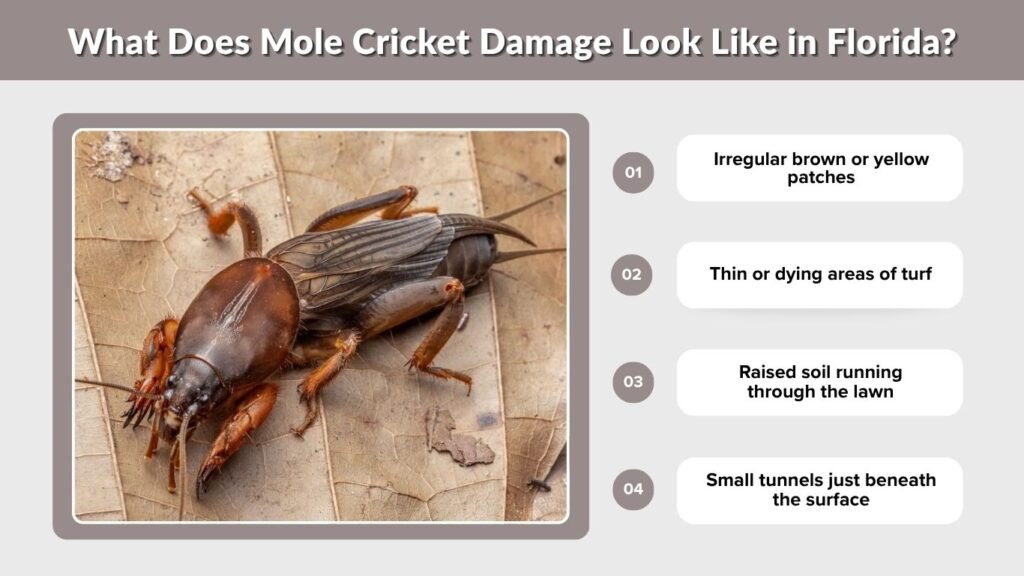
Mole crickets cause damage both by feeding and tunneling. Their shallow underground passages disturb soil and separate grass roots from the surrounding earth. Damaged turf can dry out, become loose, and eventually die. Animals searching for the insects may create additional destruction by digging into already weakened areas.
Signs of Mole Cricket Damage
Watch for:
- Irregular brown or yellow patches
- Thin or dying areas of turf
- Raised soil running through the lawn
- Small tunnels just beneath the surface
- Loose grass that pulls up easily
- Disturbed or damaged roots
- Increased weed growth in damaged areas
- Birds, raccoons, or armadillos digging in the lawn
Severe infestations can make an otherwise healthy lawn appear dry or poorly maintained even when watering is adequate.
What Do Mole Cricket Tunnels Look Like?
Mole cricket tunnels usually occur close to the soil surface. They can produce narrow raised lines or ridges and create patches where soil looks loose or pushed upward.
These tunnels are much smaller than tunnels made by mammalian moles. During active infestations, gently separating grass or inspecting bare patches may reveal narrow passages directly beneath the surface.
Mole Cricket Life Cycle in Florida
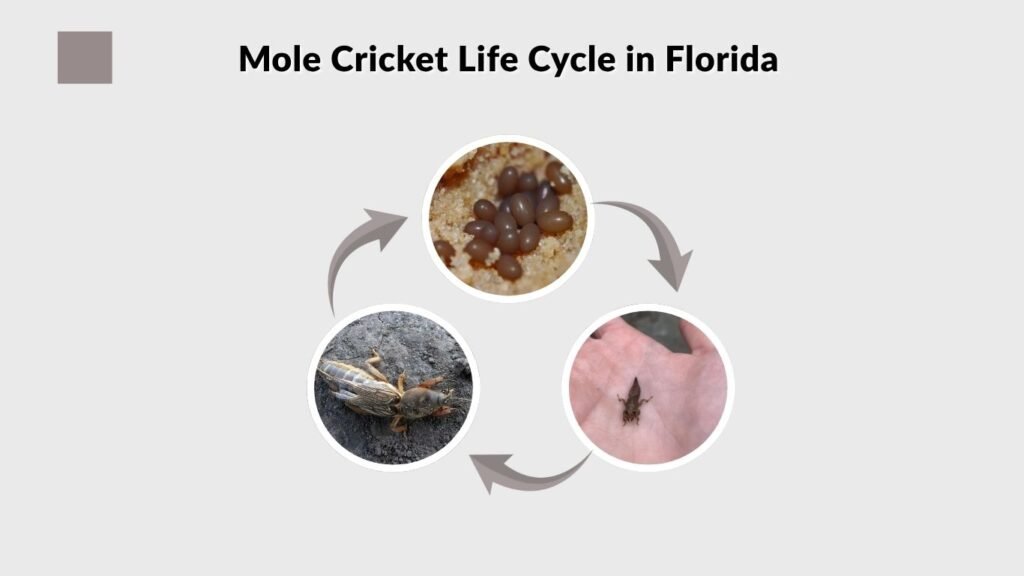
Understanding the mole cricket life cycle in Florida helps determine when treatment is likely to work best. Mole crickets can remain active during much of Florida’s warm weather. Many populations have about one generation annually, although environmental conditions and location can affect development. Eggs are commonly laid in spring, followed by a period when young nymphs become abundant.
Egg and Nymph Stages
Important parts of their development include:
- Females create underground areas for egg laying.
- Eggs are commonly deposited during spring.
- Young mole crickets emerge as small nymphs.
- Nymphs resemble miniature wingless adults.
- Nymphs feed and tunnel while passing through several growth stages.
- Adults and larger nymphs can survive into cooler periods.
Young nymphs are important from a management standpoint because they are generally easier to control than large, mature insects.
Adult Mole Cricket Activity
Adult mole crickets are mainly nocturnal. They tunnel, call, and move around primarily after dark.
Males can call from tunnel entrances to attract females, and some adult species are capable of flying substantial distances. Florida lawns can therefore become reinfested even when a previous population has been reduced.
How to Check a Florida Lawn for Mole Crickets
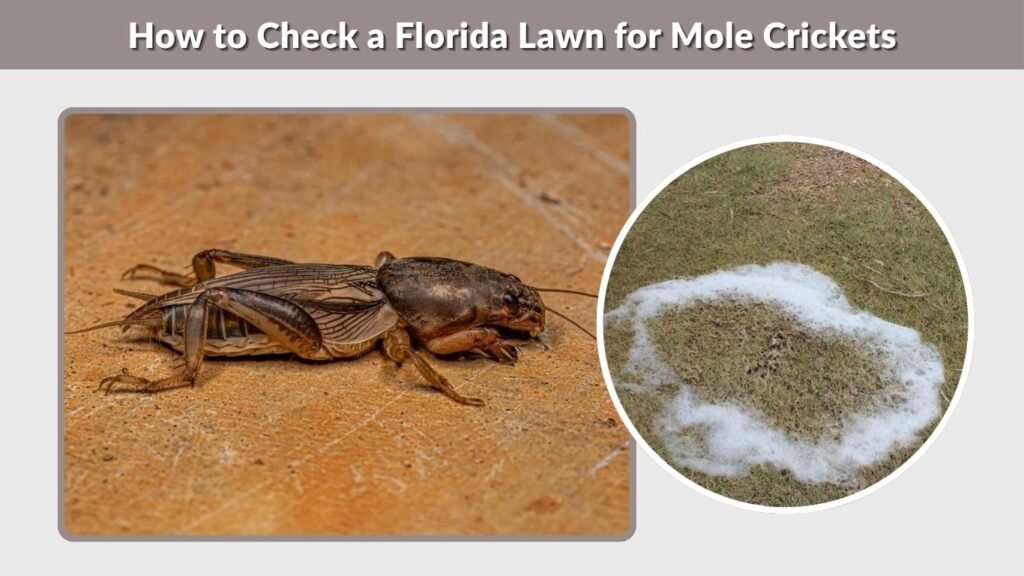
Brown grass alone does not prove that mole crickets are responsible. Drought stress, chinch bugs, disease, poor irrigation, and other lawn problems can produce similar symptoms. Checking for live insects before applying treatment helps avoid unnecessary pesticide applications.
Soap Flush Test
UF/IFAS recommends a simple flushing method for checking suspicious turf:
- Choose approximately 4 square feet of damaged or suspicious lawn.
- Mix about 1.5 fluid ounces of liquid dishwashing soap with 2 gallons of water.
- Pour the solution evenly over the test area.
- Watch the soil surface for about three minutes.
- Mole crickets hiding below should move toward the surface.
UF/IFAS indicates that finding roughly two to four mole crickets within three minutes can justify corrective action.
Check More Than One Area
If damage covers a large lawn, test several locations rather than relying on one patch.
Concentrate on the transition between healthy and damaged grass, where active insects may still be feeding. Old, completely dead areas may no longer contain many mole crickets.
When to Treat Mole Crickets in Florida
Treatment timing can make a significant difference. Large adult mole crickets are more difficult to manage than newly hatched nymphs. Consequently, scouting during the period when young crickets are developing can make treatment more efficient and reduce the amount of corrective work required later.
Best Treatment Timing
For Florida lawns:
- Begin monitoring during spring.
- Watch particularly closely as eggs hatch and small nymphs appear.
- Treat confirmed infestations while nymphs are still small whenever possible.
- Continue checking damaged areas through summer.
- Inspect again if noticeable tunneling returns during late summer or fall.
UF/IFAS notes that mole crickets are active year-round in Florida and that noticeable damage is often associated with spring and late-summer-to-fall activity.
North vs. South Florida
Development can occur somewhat differently across Florida because temperatures vary considerably from north to south.
Instead of relying exclusively on a calendar date, examine your lawn for fresh tunnels and use a soap flush to confirm active insects. Local UF/IFAS Extension guidance can also help determine the appropriate timing for your county.
How to Get Rid of Mole Crickets in Florida
Successful mole cricket control in Florida usually works best as an integrated approach rather than repeated preventive spraying. Proper lawn management, biological controls, monitoring, and targeted treatments can reduce populations while limiting unnecessary effects on beneficial organisms.
Mole Cricket Control Methods
Useful approaches include:
- Confirm activity before treating.
- Maintain healthy turf without excessive irrigation.
- Treat affected areas rather than automatically treating an entire property.
- Target young nymphs when possible.
- Encourage natural enemies.
- Choose products specifically labeled for mole cricket control in your type of turf.
- Follow all pesticide label directions exactly.
- Monitor afterward to determine whether additional control is necessary.
UF/IFAS advises monitoring first and favors targeted treatment rather than routine preventive spraying when pest activity is localized.
Biological Mole Cricket Control
Florida has an important natural enemy called the Larra bicolor wasp. Female wasps locate invasive mole crickets and lay eggs on them. The developing wasp larvae eventually kill their hosts.
UF/IFAS has also used an insect-parasitic nematode in biological control programs. These natural enemies have contributed to long-term suppression of invasive mole cricket populations in Florida.
Mole Cricket Treatment for Florida Lawns
Chemical treatment may be appropriate when a confirmed infestation is causing unacceptable turf damage. However, products, permitted uses, and application directions can change. The pesticide label is therefore the controlling instruction and should always be checked before application.
Using Mole Cricket Insecticides or Baits
Before treating:
- Confirm that mole crickets are present.
- Choose a product labeled for mole crickets and your specific site.
- Check whether irrigation is required before or after application.
- Apply only the labeled amount.
- Keep people and pets away as directed by the label.
- Avoid unnecessary treatment of unaffected areas.
- Never assume that more products will provide better control.
Professional lawn treatment may be useful when infestations are extensive, recurring, or difficult to identify correctly.
Preventing Future Damage
A healthy lawn generally tolerates insect activity better than severely stressed turf. Appropriate mowing, irrigation, fertilization, and grass selection all contribute to stronger roots.
However, no common Florida turfgrass should be considered completely immune. UF/IFAS notes that mole crickets can damage any turfgrass species, although bahiagrass and bermudagrass are particularly favored.
FAQs
Mole crickets can be difficult to diagnose because most of their activity happens underground. Knowing when they are active and how their damage differs from other lawn problems makes management easier.
Are mole crickets common in Florida?
Yes. Mole crickets are widespread turf pests in Florida. Tawny, southern, and short-winged mole crickets are the major invasive pest species, while a native northern mole cricket also occurs in the state but is not generally regarded as an important turf pest.
How do I know if mole crickets are damaging my Florida lawn?
Look for shallow tunnels, raised soil, thinning turf, irregular brown patches, and grass with damaged roots. A soap flush can help confirm their presence by forcing hidden mole crickets to the soil surface.
What is the best time to treat mole crickets in Florida?
Treatment is generally most effective when mole crickets are young nymphs rather than large adults. Begin monitoring during spring and early summer and confirm activity before treating. Exact timing can differ somewhat between North, Central, and South Florida.
What kills mole crickets in Florida lawns?
Mole cricket populations can be managed through biological control, good turf management, and appropriately labeled insecticides or baits when needed. Because pesticide labels and approved uses can change, select a product labeled for your lawn and follow its current directions exactly.
What Florida grass is resistant to mole crickets?
No common Florida lawn grass is completely resistant to mole cricket damage. Mole crickets can affect many turfgrasses, although bahiagrass and bermudagrass are particularly attractive to them. Maintaining healthy turf and detecting infestations early are more dependable strategies than relying only on grass variety.