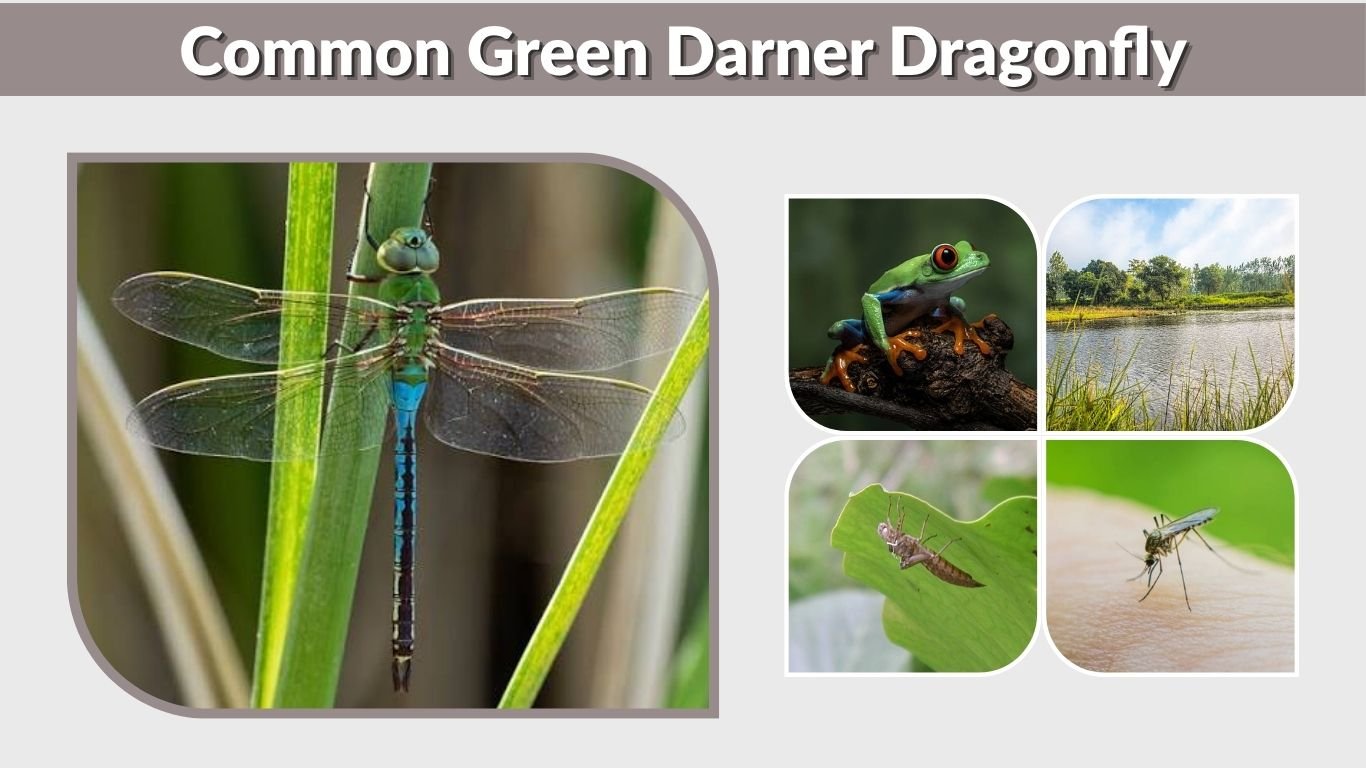
The common green darner dragonfly is one of the most recognizable and widespread dragonflies in North America. Known for its bright green thorax, large size, powerful flight, and long-distance migration, this species is often seen around ponds, lakes, wetlands, and open fields. Its scientific name is Anax junius. Males commonly have a blue abdomen, while females may appear greenish or brownish. This guide covers common green darner identification, size, habitat, diet, migration, nymphs, life cycle, lifespan, predators, and interesting facts.
What Is a Common Green Darner Dragonfly?
The common green darner is a large dragonfly belonging to the family Aeshnidae, commonly known as the darner family. It is named for its bright green coloration and long, slender abdomen. Green darners are exceptional flyers and spend much of their adult lives hunting smaller flying insects in open areas near water.
Common Green Darner Scientific Name
The scientific name of the common green darner is Anax junius.
Its classification includes:
- Order: Odonata
- Family: Aeshnidae
- Genus: Anax
- Species: Anax junius
- Common name: Common green darner
The species is closely related to other large darner dragonflies.
Common Green Darner Identification
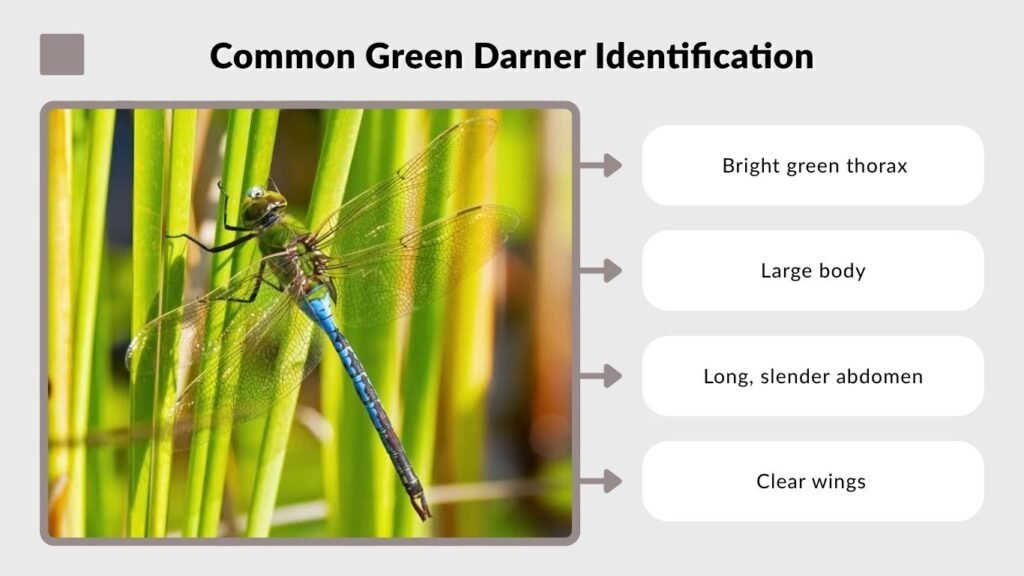
Common green darners are relatively easy to recognize because of their size, green thorax, and distinctive markings near the head.
Both males and females have large compound eyes and four transparent wings that allow them to fly quickly in almost any direction.
What Does a Green Darner Dragonfly Look Like?
Look for these identification features:
- Bright green thorax
- Large body
- Long, slender abdomen
- Clear wings
- Large compound eyes
- Dark marking on the forehead
- Strong, fast flight
- Long legs used for catching prey
The dark marking on the face often resembles a small bull’s-eye or T-shaped mark and is a useful identification clue.
Male vs. Female Green Darner Dragonfly
Male and female green darners share the same general body shape, but their abdomen coloration can make them look noticeably different.
Males are often more colorful, particularly when fully mature.
Male Green Darner
A mature male typically has:
- Green thorax
- Bright blue abdomen
- Dark stripe along the abdomen
- Large bluish or greenish eyes
- Slender body
The blue abdomen can make males look like a combination of blue and green.
Female Green Darner
Female green darners usually have:
- Green thorax
- Green, brownish, or reddish-purple abdomen
- Dark dorsal markings
- Thick body suited to egg production
Some females may look almost entirely green, while others appear considerably darker.
Green Darner Dragonfly Size
The common green darner is among the larger dragonflies encountered across much of North America.
Its large body and broad wings make it highly visible while patrolling wetlands or flying through open fields.
How Big Is a Green Darner Dragonfly?
Typical measurements include:
- Body length: Around 2.5 to 3 inches
- Wingspan: Around 3 to 4 inches
- Abdomen: Long and narrow
- Wing shape: Broad at the base and transparent
Exact size varies among individuals.
Despite their appearance, they are lightweight insects built primarily for speed and maneuverability.
Green Darner Dragonfly Habitat
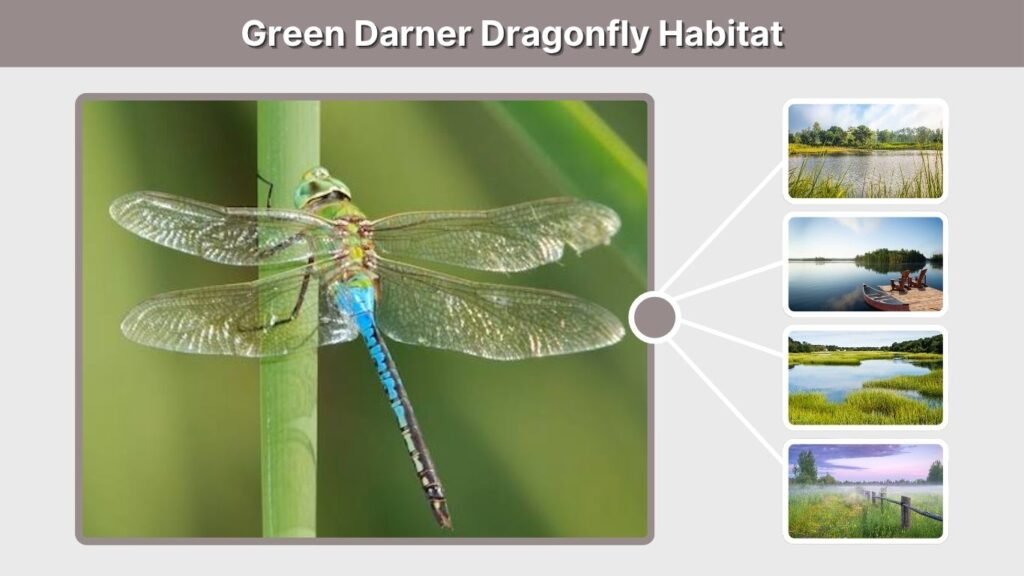
Common green darners are strongly associated with freshwater habitats because their immature stages develop underwater.
Adults may travel far away from water while feeding or migrating.
Where Do Green Darner Dragonflies Live?
Common habitats include:
- Ponds
- Lakes
- Marshes
- Wetlands
- Slow-moving streams
- Temporary pools
- Ditches
- Meadows
- Open fields
They are especially attracted to areas containing shallow water and aquatic vegetation suitable for egg laying.
Green Darner Dragonfly Range
Common green darners occur across much of North America and extend into parts of Central America and the Caribbean.
Their seasonal migration allows them to appear in areas where they may not remain throughout the entire year.
Green Darners in North America
They can be seen in:
- United States
- Canada
- Southern Alaska
- Ontario
- Washington State
- Florida
- Many central and eastern regions
Sightings often increase during seasonal migration.
Green Darner Dragonfly Migration
One of the most fascinating common green darner behaviors is long-distance migration.
These dragonflies can travel hundreds of miles between breeding areas, making them one of the best-known migratory dragonflies in North America.
Where Do Green Darner Dragonflies Migrate?
Many individuals move northward during spring and southward during late summer or fall.
The migration is often multigenerational. One generation may travel north and reproduce, while later generations continue or reverse the journey.
Large groups may sometimes be observed moving through open landscapes.
Why Do Green Darners Migrate?
Migration helps green darners:
- Reach seasonal breeding habitat
- Follow favorable temperatures
- Find productive wetlands
- Avoid freezing conditions
- Take advantage of abundant insect prey
Weather patterns can influence when and where large migrations occur.
Green Darner Dragonfly Nymph
Before becoming an adult, the green darner spends an important part of its life underwater as a nymph, also called a naiad.
Nymphs are strong aquatic predators and look very different from flying adults.
What Does a Green Darner Nymph Look Like?
Green darner nymphs typically have:
- Long bodies
- Brown or greenish coloration
- Large eyes
- Six legs
- Developing wing pads
- Powerful extendable mouthparts
Their muted colors help them blend into mud, plants, and submerged debris.
What Do Green Darner Nymphs Eat?
Nymphs prey on small aquatic animals such as:
- Mosquito larvae
- Aquatic insects
- Small crustaceans
- Tadpoles
- Tiny fish
- Other insect larvae
They are ambush predators and can strike prey rapidly using specialized mouthparts.
Green Darner Dragonfly Life Cycle
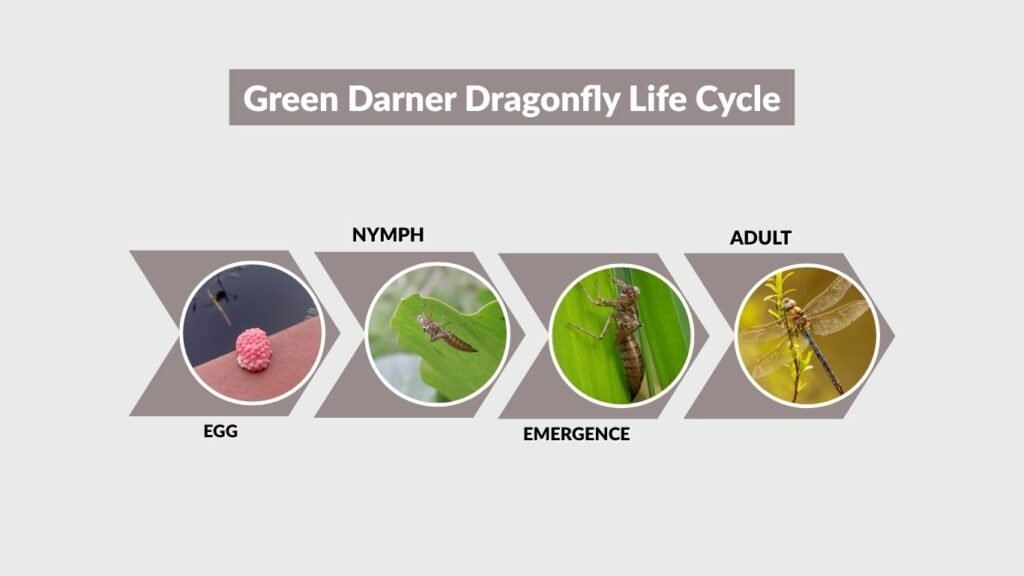
The common green darner undergoes incomplete metamorphosis, meaning there is no pupal stage.
Its development occurs through egg, aquatic nymph, and adult stages.
Main Life Cycle Stages
- Egg – Females place eggs in aquatic plants or vegetation.
- Nymph – Young dragonflies live underwater, molt repeatedly, and hunt prey.
- Emergence – A mature nymph climbs out of the water and sheds its final skin.
- Adult – The winged dragonfly hunts, migrates, mates, and reproduces.
Development time varies according to climate, water temperature, food, and population.
Green Darner Reproduction
Mating commonly takes place near wetlands or other breeding sites.
Male and female green darners may remain attached while the female deposits eggs.
How Do Green Darners Lay Eggs?
Females insert eggs into aquatic vegetation, floating plant material, or stems near the water surface.
Eggs eventually hatch into aquatic nymphs.
Breeding habitat with abundant vegetation offers both food and protection for newly emerged nymphs.
What Do Green Darner Dragonflies Eat?
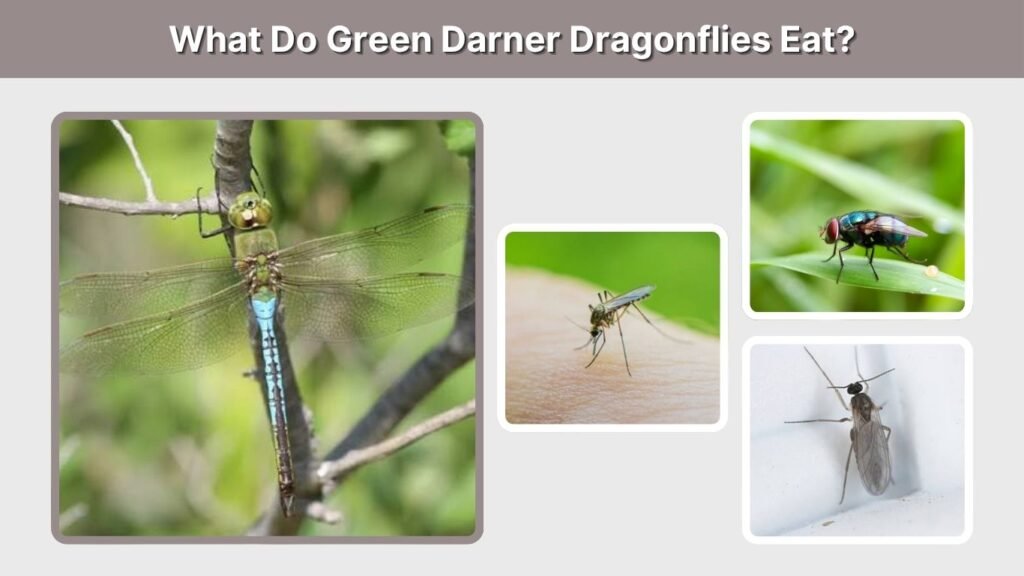
Adult green darners are aerial predators.
They capture prey while flying, often using their legs to create a basket-like structure beneath their bodies.
Common Green Darner Foods
Adults may eat:
- Mosquitoes
- Midges
- Flies
- Small moths
- Gnats
- Flying ants
- Smaller dragonflies
- Other airborne insects
Because they prey on mosquitoes and other nuisance insects, green darners can be beneficial around wetlands and gardens.
Green Darner Dragonfly Predators
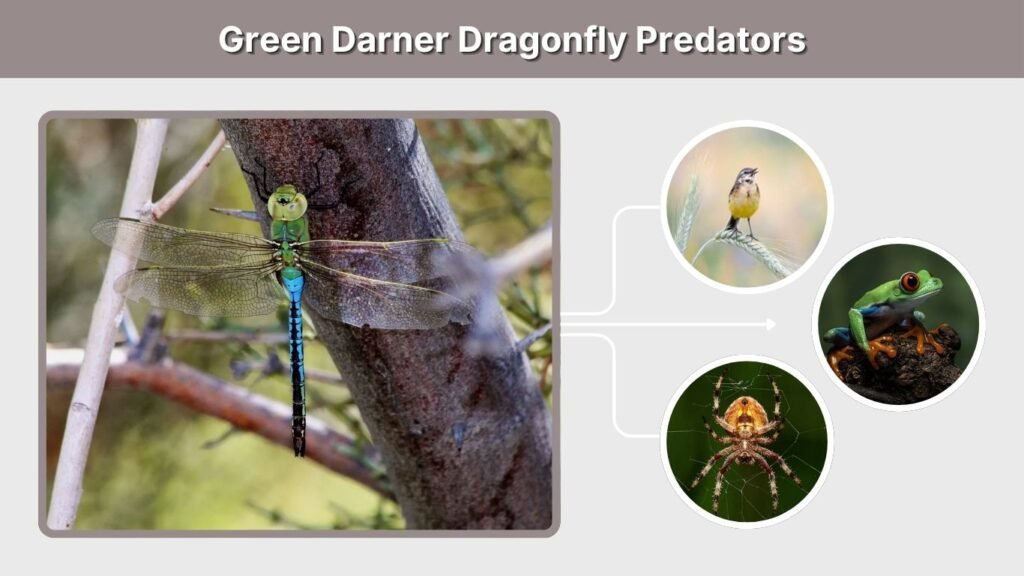
Despite being powerful predators themselves, green darners are eaten by various animals.
Their predators differ between the aquatic nymph and adult stages.
Common Predators
Green darners may be eaten by:
- Birds
- Frogs
- Fish
- Larger dragonflies
- Spiders
- Predatory aquatic insects
- Small mammals in rare situations
Fish can be especially important predators of aquatic nymphs.
How Long Do Green Darner Dragonflies Live?
The lifespan of a common green darner includes both its aquatic and adult stages.
The adult portion is much shorter than the full life cycle.
Green Darner Dragonfly Lifespan
A green darner may spend several months or longer developing before reaching adulthood, depending on the population and climate.
Adults generally live for several weeks to a few months.
Migratory populations can have relatively rapid development, allowing new generations to mature within the same year.
Do Green Darner Dragonflies Bite?
Green darners are large predators with strong mouthparts, but they are not aggressive toward humans.
They do not feed on blood and do not hunt people.
Can a Green Darner Bite Humans?
A green darner may possibly nip if it is captured and handled roughly, but this is uncommon.
Green darners:
- Do not sting
- Are not venomous
- Do not attack humans
- Do not suck blood
- Usually fly away when disturbed
They are considered harmless and beneficial insects.
Why Is the Green Darner Washington’s State Insect?
The common green darner is the official state insect of Washington.
Its selection reflects the species’ widespread presence, recognizable appearance, and ecological importance.
Green Darner in Washington State
Green darners can be found around ponds, marshes, lakes, and other freshwater habitats throughout parts of Washington.
Their large size and bright coloration make them particularly noticeable during warmer months.
Migrating individuals may also pass through the region seasonally.
Common Green Darner vs. Emperor Dragonfly
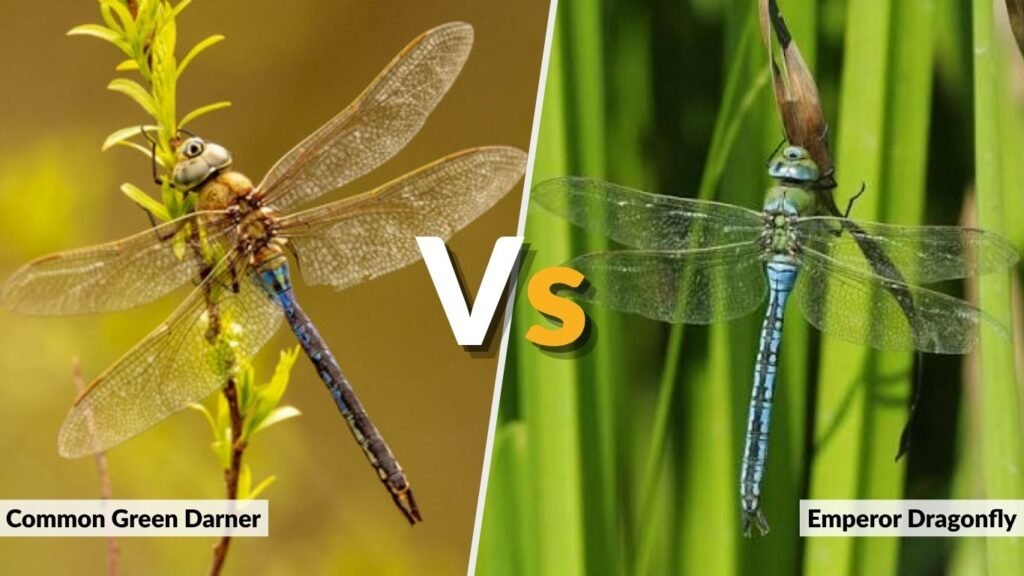
The common green darner and emperor dragonfly can look similar because both belong to the darner family and are large, powerful flyers.
However, they are different species with different geographic distributions.
Main Differences
| Feature | Common Green Darner | Emperor Dragonfly |
| Scientific name | Anax junius | Anax imperator |
| Main range | North America | Europe, Africa and western Asia |
| Thorax | Bright green | Green |
| Male abdomen | Blue | Bright blue |
| Migration | Strongly migratory | Less famous for migration |
Location is often one of the easiest ways to separate them.
Interesting Green Darner Dragonfly Facts
Common green darners have several remarkable characteristics.
Quick Facts
- Their scientific name is Anax junius.
- They are among North America’s largest common dragonflies.
- Mature males often have blue abdomens.
- Females may have green or brown abdomens.
- They migrate long distances.
- Nymphs live underwater.
- Adults hunt insects while flying.
- They eat mosquitoes and flies.
- They do not normally bite humans.
- The common green darner is Washington’s state insect.
FAQs
What Do Green Darner Dragonflies Eat?
Adult green darners eat flying insects such as mosquitoes, midges, gnats, flies, small moths, and other insects. Their aquatic nymphs prey on mosquito larvae, aquatic insects, tadpoles, small crustaceans, and occasionally tiny fish.
How Big Is a Common Green Darner Dragonfly?
A common green darner typically reaches around 2.5 to 3 inches in body length, with a wingspan that can approach 3 to 4 inches. Its size, green thorax, and long abdomen make it relatively easy to recognize.
Are Green Darner Dragonflies Dangerous?
No. Green darners are not dangerous to people. They do not sting, are not venomous, and do not deliberately attack humans. A captured individual could potentially nip defensively, but normally it simply flies away when disturbed.
Where Do Green Darner Dragonflies Live?
Green darners live around freshwater habitats such as ponds, lakes, wetlands, marshes, and slow-moving water. Adults may also be seen far from water in fields and open spaces, particularly while hunting or migrating.
Do Green Darner Dragonflies Migrate?
Yes. Common green darners are famous for long-distance seasonal migration. Many travel north during spring and south during late summer or fall. Their migration can involve multiple generations, with different generations completing different portions of the annual movement.