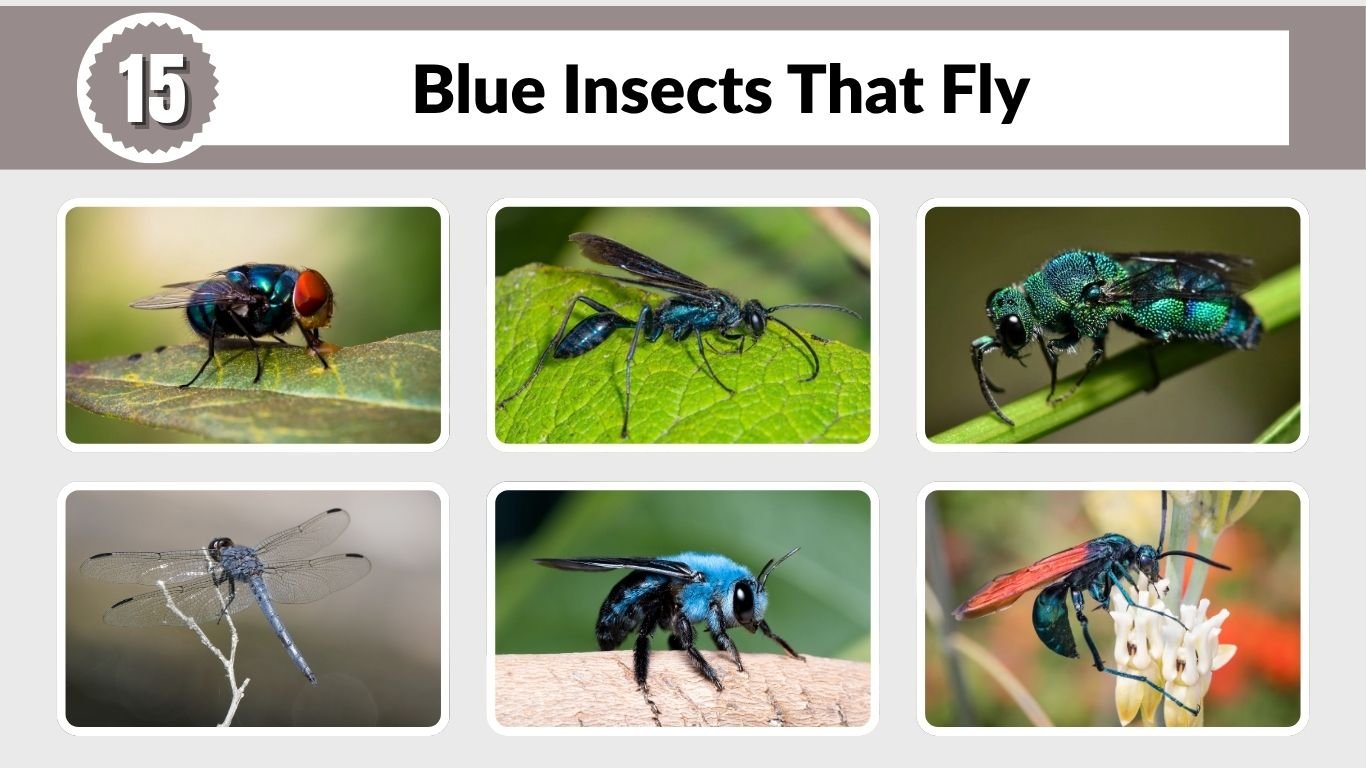
Blue insects that fly are some of the most eye-catching creatures found around gardens, ponds, forests, and homes. Their colors may appear bright blue, metallic blue-green, turquoise, or even blue-black depending on the species and lighting. Some are harmless pollinators, while others are predators or solitary wasps capable of stinging. This guide covers 15 common blue flying insects, including flies, bees, wasps, dragonflies, and damselflies, with simple identification details, habitat information, and interesting facts.
1. Blue Bottle Fly
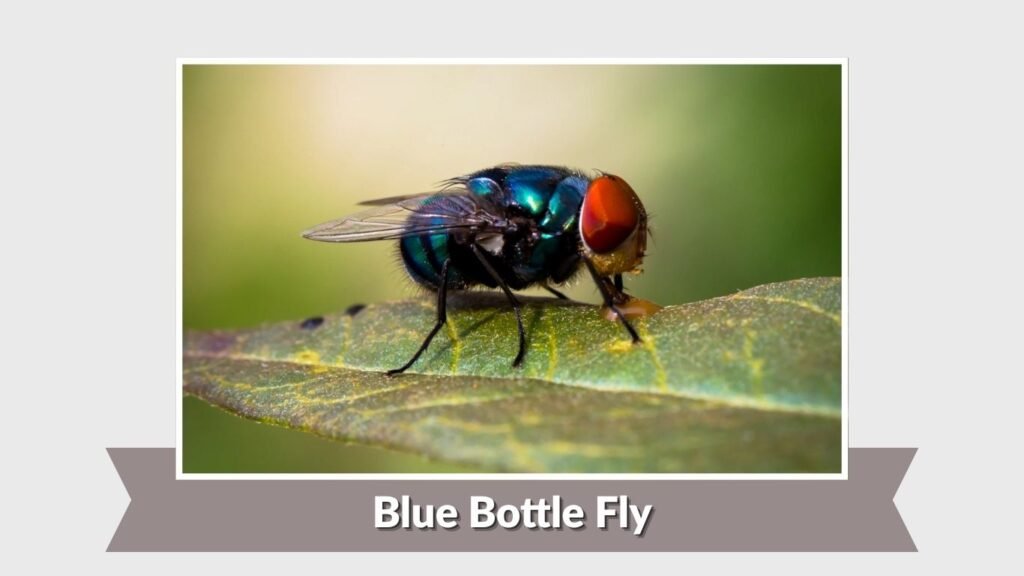
The blue bottle fly is one of the most recognizable blue insects that fly, thanks to its brilliant metallic body. Also called a bluebottle or blow fly, it is commonly found around homes, gardens, garbage, and decaying organic material. Its shiny coloration can range from deep blue to blue-green depending on lighting.
Identification
The blue bottle fly has several noticeable characteristics:
- Metallic blue or blue-green abdomen
- Approximately 1/4 to 1/2 inch long
- Large reddish compound eyes
- Transparent wings
- Dark head and thorax
- Short antennae
- Stout, typical fly-shaped body
Its reflective abdomen makes it a good match when identifying a shiny blue flying insect.
Where Blue Bottle Flies Live
Blue bottle flies are widespread and can occur around homes, farms, gardens, woodland edges, and urban environments. Adults are strongly attracted to decaying meat, animal waste, garbage, and other decomposing organic materials.
They may also visit flowers to feed on nectar. Finding many blue bottle flies indoors can sometimes indicate accessible garbage or another source of decaying organic matter nearby.
Do Blue Bottle Flies Bite or Sting?
Blue bottle flies do not have a stinger and generally do not bite people. Their mouthparts are designed primarily for consuming liquid or softened foods.
Their main concern around homes is sanitation. Because they frequently land on waste and decomposing material, they can mechanically carry microorganisms onto other surfaces.
Behavior and Life Cycle
Females lay eggs on suitable decomposing organic material. The eggs hatch into larvae commonly called maggots, which feed before eventually pupating and developing into adult flies.
Warm conditions can speed up development considerably. Good sanitation, covered garbage containers, window screens, and removal of breeding materials are among the most effective ways to reduce these metallic blue flies around homes.
2. Blue Mud Dauber Wasp
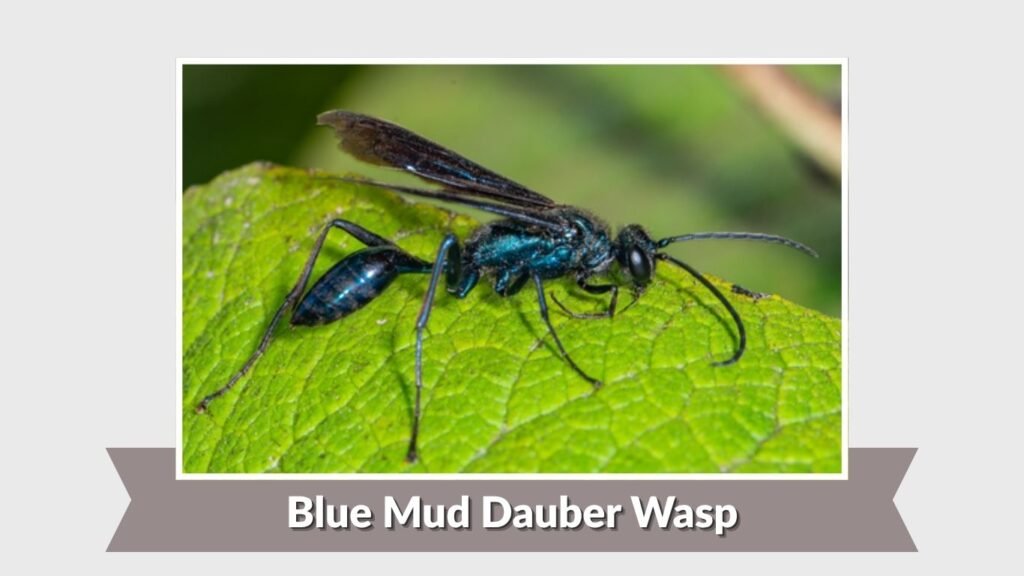
The blue mud dauber is a striking metallic blue flying insect with a slender wasp-like body. Its coloration may appear dark blue, blue-black, or almost violet in sunlight. Despite its intimidating appearance, this solitary wasp is generally nonaggressive and is particularly interesting because it hunts spiders.
Identification
Important identification features include:
- Metallic blue to blue-black body
- Slender body with a narrow waist
- Usually around 1/2 to 1 inch long
- Dark, somewhat iridescent wings
- Long legs
- Smooth, relatively hairless appearance
- Noticeable blue or violet sheen in bright light
It is often mistaken for a black flying insect with blue wings.
Where Blue Mud Daubers Live
Blue mud daubers can be found around gardens, fields, woodland edges, barns, sheds, porches, and buildings. They frequently use existing mud nests originally constructed by other mud-dauber species.
Females search protected structures for suitable nesting chambers rather than living in large colonies.
Do Blue Mud Daubers Sting?
Females have functional stingers but rarely sting humans unless they are handled or trapped. Their stingers are primarily used for immobilizing spiders.
Blue mud daubers are solitary, so they do not have hundreds of workers defending a communal colony like yellowjackets.
What Do Blue Mud Daubers Eat?
Adults commonly feed on flower nectar. Females hunt spiders to provision their nests for developing larvae and are particularly well known for taking widow spiders.
After capturing a spider, the female paralyzes it and places it inside a nest chamber. An egg is deposited with the stored prey, providing food for the developing wasp larva.
3. Cuckoo Wasp
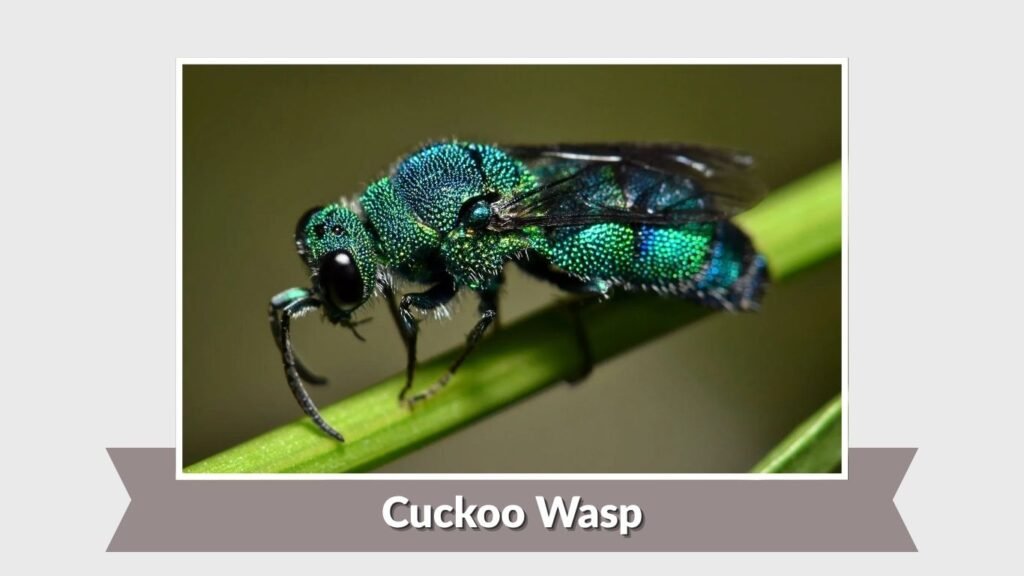
Cuckoo wasps are some of the most colorful blue-green flying insects you may encounter. Their bodies often shine with brilliant combinations of metallic blue, turquoise, green, and occasionally red. Their jewel-like appearance has earned some species the informal name “jewel wasps.”
Identification
Cuckoo wasps can usually be recognized by:
- Brilliant metallic blue or green coloration
- Strong iridescent appearance
- Small to medium body size
- Hard, sculptured outer body
- Shorter body than many slender wasps
- Transparent or slightly darkened wings
- Ability of many species to curl into a defensive ball
They are a likely candidate when someone encounters a metallic blue-green flying insect.
Where Cuckoo Wasps Live
Cuckoo wasps occur in gardens, fields, woodland edges, sandy habitats, and around buildings. Adults may visit flowers for nectar and can sometimes be seen searching walls, soil, or wood for nests belonging to other insects.
They are particularly active during warm, sunny weather.
Do Cuckoo Wasps Sting?
Cuckoo wasps belong to a group of wasps, but most species are not considered a significant stinging threat to people. Their defensive strategy relies heavily on their tough body armor.
Many can curl themselves into a compact ball when attacked, protecting their vulnerable underside.
Why Are They Called Cuckoo Wasps?
Their name comes from their unusual reproductive behavior. Many cuckoo wasps lay their eggs in nests constructed by other solitary bees or wasps.
After hatching, their larvae consume either the host’s stored food or its developing offspring, depending on the species. This behavior resembles the brood-parasitic strategy associated with cuckoo birds.
4. Great Blue Skimmer
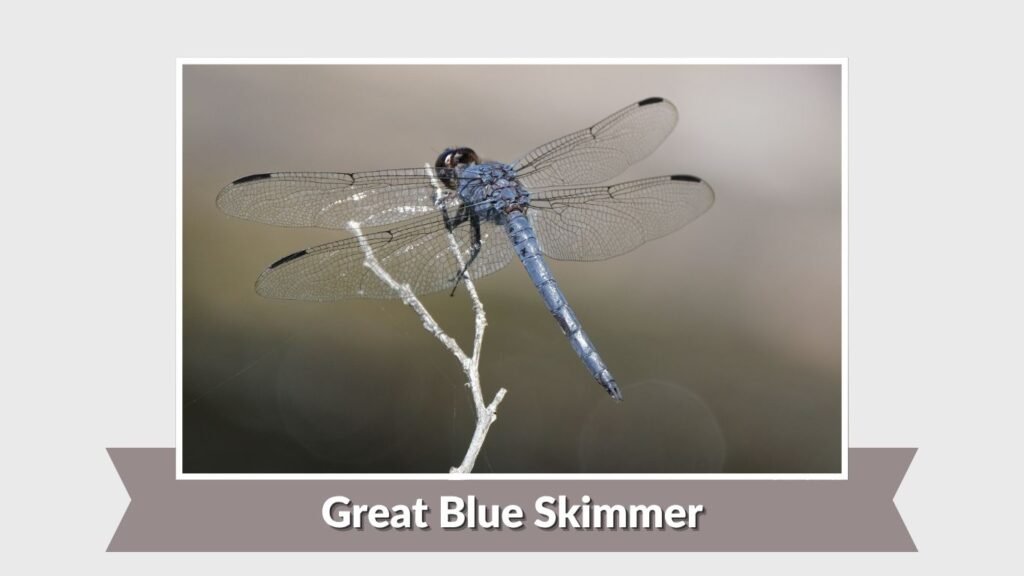
The great blue skimmer is a large dragonfly recognized for the powdery blue appearance of mature males. It is an excellent example of a large blue flying insect commonly encountered around ponds, wooded wetlands, and slow-moving water in parts of North America.
Identification
Great blue skimmers have several distinctive characteristics:
- Large dragonfly body
- Mature males develop a pale or powdery blue appearance
- Females are generally brownish with patterned abdomens
- Four transparent wings
- Large compound eyes
- Long abdomen
- Strong, agile flight
The combination of size and blue coloration makes mature males particularly noticeable.
Where Great Blue Skimmers Live
Great blue skimmers favor ponds, swamps, slow streams, forest pools, and other relatively calm freshwater habitats. They are often associated with wooded areas surrounding water.
Adults may perch on branches, vegetation, fences, or other elevated surfaces before quickly flying after passing prey.
Do Great Blue Skimmers Bite or Sting?
Great blue skimmers cannot sting because dragonflies do not possess stingers. They are also not dangerous to people.
A dragonfly can potentially use its mouthparts defensively if roughly handled, but it normally has no interest in attacking humans.
What Do Great Blue Skimmers Eat?
These dragonflies are aerial predators. Adults capture mosquitoes, flies, midges, and various other small flying insects while in flight.
Their immature aquatic stage, called a nymph or naiad, is also predatory. Nymphs live underwater and feed on small aquatic animals until they are ready to emerge and transform into winged adults.
5. Blue Dasher Dragonfly
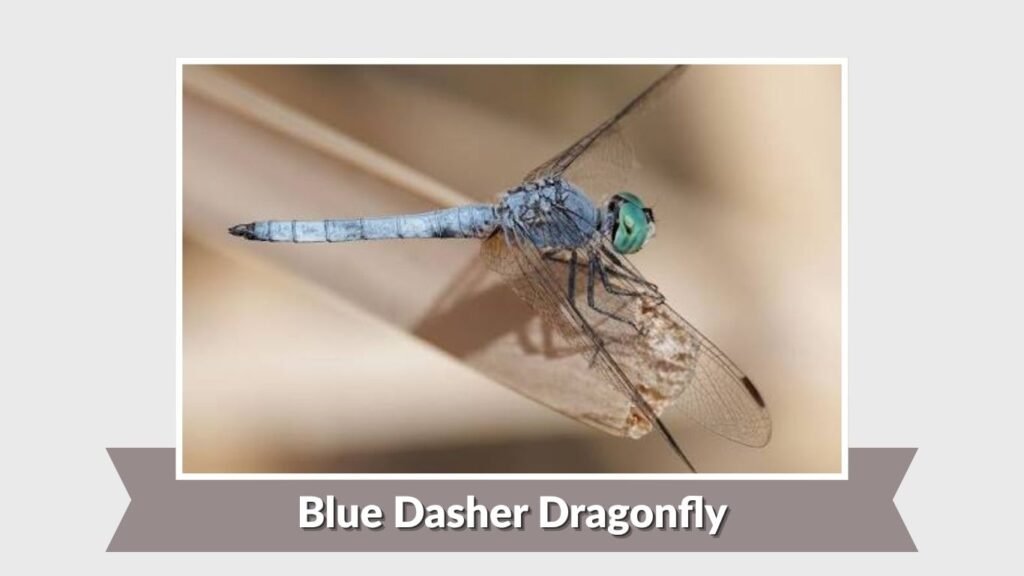
The blue dasher is a relatively small dragonfly frequently observed around ponds, lakes, marshes, and other freshwater habitats. Mature males develop a distinctive bluish abdomen, making this species another likely identification for a small blue flying insect seen near water.
Identification
Look for these characteristics:
- Relatively small to medium dragonfly
- Mature male with a powdery blue abdomen
- Darker tip near the end of the abdomen
- Large greenish or bluish eyes
- Clear wings with darker markings near the tips
- Females generally more yellowish or brownish
- Fast, darting flight
Its long abdomen and four extended wings clearly separate it from blue flies and wasps.
Where Blue Dashers Live
Blue dashers are strongly associated with freshwater environments. They occur around ponds, lakes, marshes, ditches, and slow-moving waterways.
Adults commonly perch on twigs and vegetation near water. They repeatedly leave these perches to capture insects before returning to the same or a nearby location.
Do Blue Dashers Sting?
No. Blue dashers do not have stingers and cannot sting humans. Their appearance sometimes causes confusion because of their long abdomen, but the end of the abdomen is not a stinger.
They are generally harmless and beneficial around gardens and wetlands.
What Do Blue Dashers Eat?
Adult blue dashers prey on mosquitoes, midges, flies, and other small airborne insects. Their excellent eyesight and maneuverable wings allow them to capture prey while flying.
Young blue dashers develop underwater as aquatic nymphs. These nymphs are predators of small aquatic organisms before eventually climbing from the water, shedding their final immature skin, and becoming adult dragonflies.
6. Common Blue Damselfly
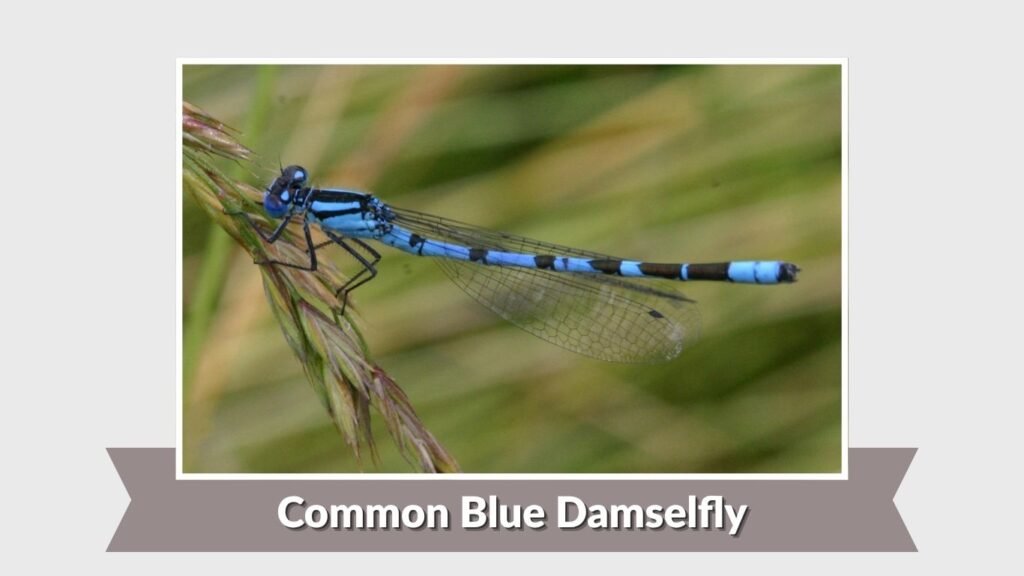
The common blue damselfly is a slender, attractive insect known for the vivid blue-and-black pattern displayed by mature males. It is commonly encountered around ponds, lakes, canals, and slow-moving waterways. Because of its narrow body and bright coloration, it is a good match for people trying to identify a long thin blue flying insect near water.
Identification
Common blue damselflies can be recognized by several characteristics:
- Long, extremely slender abdomen
- Mature males usually bright blue and black
- Two pairs of transparent wings
- Large eyes positioned widely apart
- Females may be blue, greenish, or brownish
- Wings typically held together over the abdomen while resting
- Smaller and more delicate than most dragonflies
Their narrow body makes them noticeably different from blue flies, bees, and wasps.
Where Common Blue Damselflies Live
These damselflies are strongly associated with freshwater. They commonly inhabit ponds, lakes, canals, reservoirs, and relatively slow-moving rivers.
Adults usually remain close to water, resting on grasses, reeds, and other vegetation. Warm, sunny weather often produces the greatest activity.
Do Common Blue Damselflies Bite or Sting?
Common blue damselflies cannot sting. They have no venomous stinger and pose virtually no threat to people.
They possess mouthparts designed for capturing and eating small insects, but they do not normally bite humans. Handling them should still be avoided because their delicate wings and bodies can easily be damaged.
What Do Common Blue Damselflies Eat?
Adults prey on tiny flying insects, including mosquitoes, midges, and small flies. They capture their prey while flying or make short hunting flights from vegetation.
Their aquatic nymphs are also predators, feeding on small organisms beneath the water before eventually emerging and transforming into winged adults.
7. Azure Damselfly
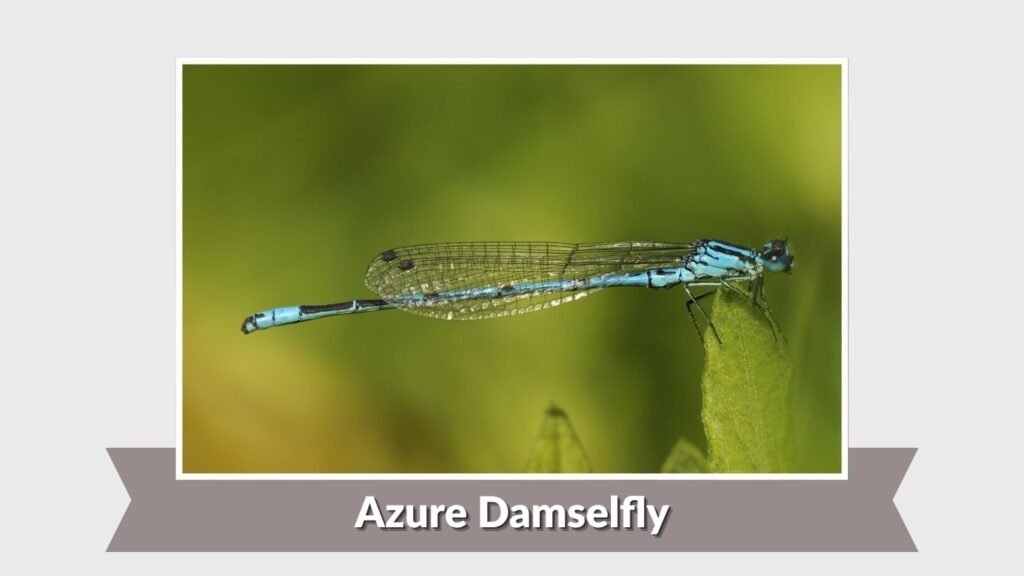
The azure damselfly is a beautiful blue-and-black insect frequently found near freshwater habitats. Mature males display brilliant azure-blue coloration contrasted with black markings. Its delicate appearance and narrow abdomen make it another likely candidate when identifying a bright blue flying insect or a small blue insect around ponds.
Identification
Important identification characteristics include:
- Bright azure-blue coloration in mature males
- Black markings along the abdomen
- Long, narrow body
- Four transparent wings
- Widely separated compound eyes
- Females usually greenish or darker
- Wings folded together when resting
Careful examination of the abdominal markings can help distinguish it from similar blue damselflies.
Where Azure Damselflies Live
Azure damselflies occur around ponds, small lakes, canals, ditches, and slow-flowing streams. They generally prefer freshwater locations containing abundant aquatic and marginal vegetation.
Adults can frequently be seen resting on grasses and low plants near the water’s edge.
Do Azure Damselflies Sting?
No. Despite their long abdomen, azure damselflies do not possess a stinger. They are harmless to humans and generally fly away when approached.
Their jaws are designed for catching tiny insect prey rather than attacking people. They can therefore be safely observed around gardens and wetlands.
What Do Azure Damselflies Eat?
Adults hunt small flies, mosquitoes, midges, and other tiny airborne insects. Their quick flight allows them to capture prey around vegetation and above the water.
The immature nymphs live underwater, where they hunt small aquatic animals. After completing their aquatic development, they climb vegetation and emerge as flying adults.
8. Familiar Bluet
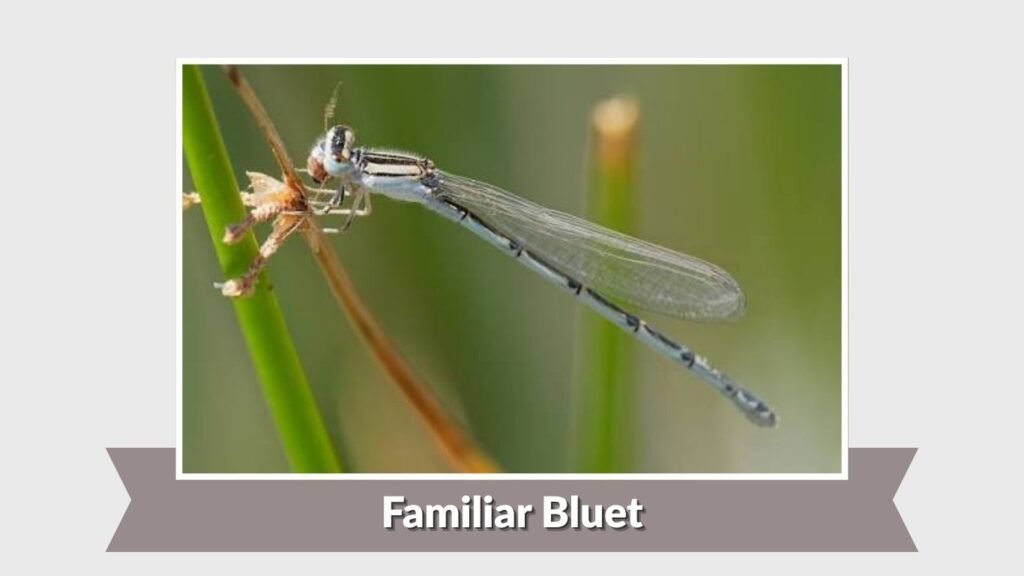
The familiar bluet is a small damselfly known for its attractive blue-and-black coloration. It is widespread across much of North America and is frequently encountered around freshwater habitats. Mature males can appear almost neon blue under favorable lighting, making this species a potential match for a small blue flying insect seen near a pond or lake.
Identification
Look for the following characteristics:
- Small, slender damselfly body
- Bright blue and black abdomen
- Four clear, narrow wings
- Widely separated compound eyes
- Long, delicate legs
- Females may appear brownish, greenish, or blue
- Wings generally held together while resting
Its body pattern can vary somewhat, so identification sometimes requires close observation.
Where Familiar Bluets Live
Familiar bluets are commonly associated with ponds, lakes, reservoirs, marshes, and slow-moving streams. They can sometimes occur in large numbers around suitable freshwater habitats.
Adults frequently rest on shoreline vegetation and may fly over open water while searching for food or mates.
Do Familiar Bluets Bite or Sting?
Familiar bluets cannot sting and are harmless to humans. Like other damselflies, they lack a venomous stinger.
Although they possess small predatory mouthparts, they have no reason to attack people. Their small size and delicate structure make them far more vulnerable to humans than humans are to them.
What Do Familiar Bluets Eat?
Adults feed primarily on small flying insects such as mosquitoes, gnats, midges, and tiny flies. They are agile aerial hunters despite their delicate appearance.
Their young develop underwater as predatory nymphs. These nymphs consume small aquatic organisms before eventually leaving the water and undergoing their final transformation into adults.
9. Steel-Blue Cricket Hunter Wasp
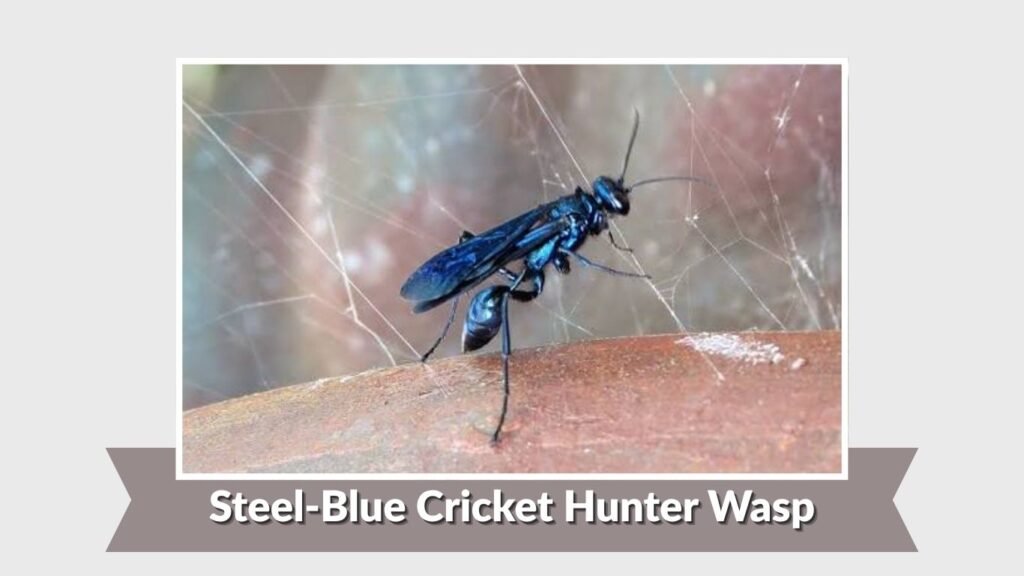
The steel-blue cricket hunter is a slender wasp with dark metallic coloration that can appear blue or blue-black in sunlight. It is a solitary hunter rather than a colony-forming social wasp. Its unusual appearance makes it a possible identification for a blue-black flying insect or a metallic blue wasp seen around buildings and gardens.
Identification
Typical characteristics include:
- Metallic steel-blue or blue-black body
- Slender wasp-like shape
- Narrow waist
- Long legs
- Dark wings
- Smooth, somewhat shiny body
- Fast movement while searching for prey
Its dark metallic coloration can change noticeably depending on lighting conditions.
Where Steel-Blue Cricket Hunter Wasps Live
These wasps can occur around gardens, lawns, woodland edges, buildings, and other areas where suitable prey is available.
Females search for crickets and related insects, which they capture for their developing offspring. Nesting may occur in existing cavities or other protected spaces depending on the species and available habitat.
Do Steel-Blue Cricket Hunter Wasps Sting?
Females possess a functional stinger that is primarily used to paralyze prey. They are solitary insects and generally do not aggressively defend large colonies.
Stings to people are uncommon and are most likely when a wasp is grabbed, trapped against the skin, or otherwise directly threatened.
What Do Steel-Blue Cricket Hunter Wasps Eat?
Adults may feed on nectar and other sugary plant resources. Females hunt crickets to provide food for their larvae.
After finding suitable prey, the female stings and immobilizes it before transporting it to a nesting location. This predatory behavior makes these wasps useful natural enemies of other insects.
10. Blue Orchard Bee
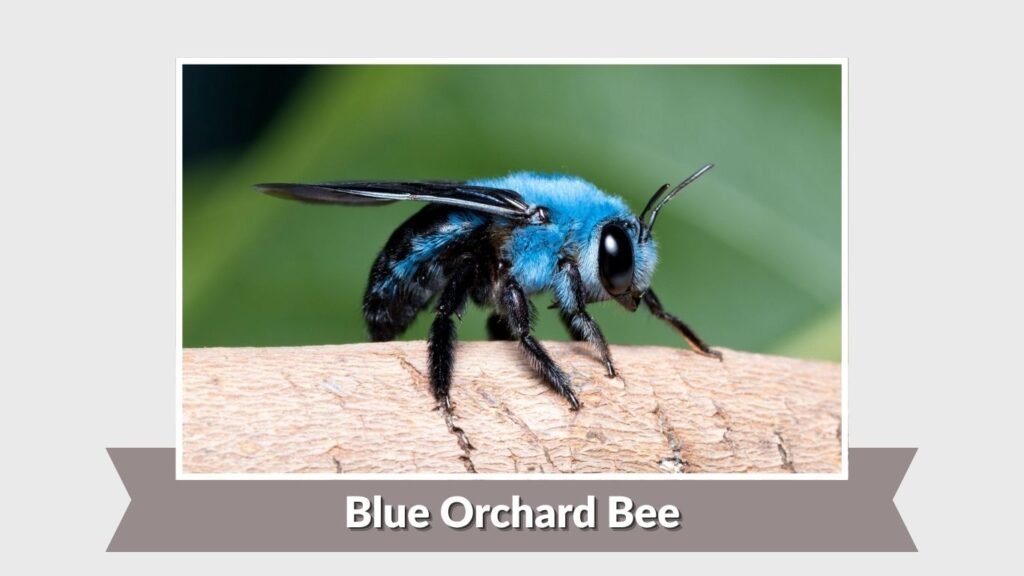
The blue orchard bee, also known as the orchard mason bee, is a small solitary bee with a dark metallic body that can shine blue or blue-green. It is an important spring pollinator and frequently visits fruit-tree blossoms. Its coloration makes it a likely match for someone searching for a small metallic blue flying insect around flowers.
Identification
Blue orchard bees can be identified by features such as:
- Metallic dark blue or blue-green body
- Approximately 1/3 to 1/2 inch long
- Compact bee-like shape
- Noticeable body hair
- Dark wings
- Females carry pollen on hairs beneath the abdomen
- Smaller than most bumblebees
Their metallic appearance can make them look very different from familiar yellow-and-black bees.
Where Blue Orchard Bees Live
Blue orchard bees occur around gardens, orchards, woodland edges, farms, and areas containing spring-blooming plants.
They do not construct large communal hives. Females use narrow existing cavities, including hollow stems and holes in wood. Individual brood cells are separated with mud, which explains the name “mason bee.”
Do Blue Orchard Bees Sting?
Female blue orchard bees have stingers, but they are notably docile and rarely sting people. Because they are solitary, they do not have a large colony or honey supply to defend.
Stinging is most likely only if a female is squeezed or handled roughly.
Why Are Blue Orchard Bees Beneficial?
Blue orchard bees are highly valuable pollinators, particularly for fruit trees that bloom during spring. They visit flowers while collecting pollen and nectar for their nests.
Apples, cherries, pears, and other flowering plants can benefit from their activity. Providing appropriate flowering plants and suitable nesting cavities can help support these useful metallic blue bees.
11. Metallic Green Sweat Bee
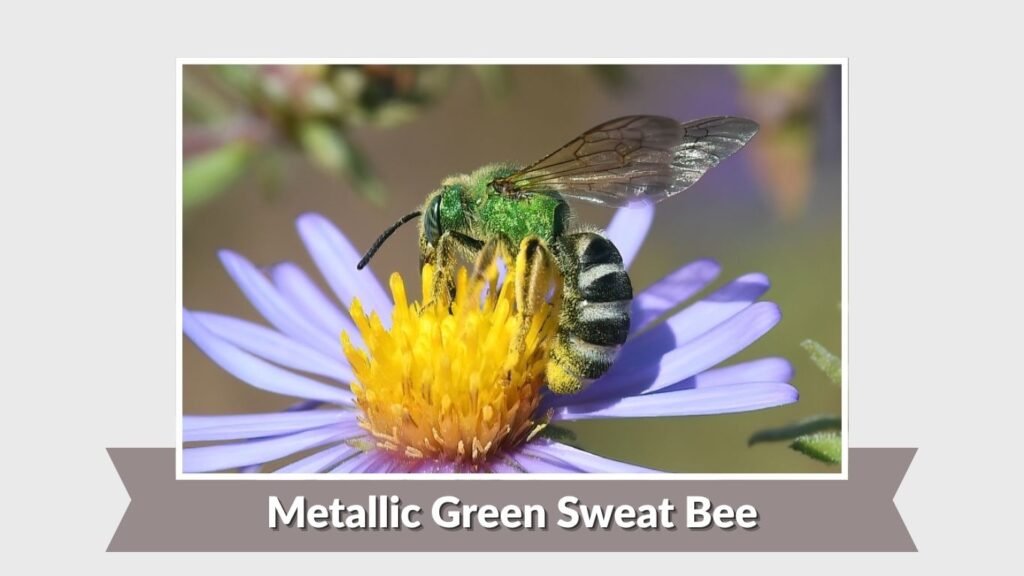
Metallic green sweat bees are small, brilliantly colored bees that often display shades of emerald green, turquoise, blue-green, or even bluish purple. Their reflective bodies make them easy to notice on flowers during sunny weather. Depending on the species and lighting, they can easily be mistaken for a small blue-green flying insect.
Identification
Metallic sweat bees have several recognizable features:
- Small to medium-sized bee
- Metallic green, blue-green, or turquoise body
- Shiny, reflective exoskeleton
- Dark or transparent wings
- Relatively slender body
- Some species have striped abdomens
- Females may carry visible pollen
Their metallic coloration is often much brighter than that of typical honey bees.
Where Metallic Green Sweat Bees Live
These bees occur in gardens, meadows, woodland edges, farms, parks, and other areas containing flowering plants. Many species construct nests in the soil, although nesting behavior varies considerably.
Adults frequently visit wildflowers and garden plants for nectar and pollen.
Do Metallic Green Sweat Bees Sting?
Females can sting, but they are generally not aggressive. A sting is most likely when a bee is accidentally trapped against the skin or handled.
Some sweat bees are attracted to human perspiration because of its salts. If one lands on you, gently brushing it away is safer than crushing or swatting it.
Why Are Sweat Bees Beneficial?
Metallic sweat bees are valuable native pollinators. As they move between flowers collecting nectar and pollen, they transfer pollen between plants.
Their activity supports wildflowers, garden plants, and some agricultural crops. Their colorful appearance and generally mild behavior also make them interesting insects to observe.
12. Blue-Winged Wasp
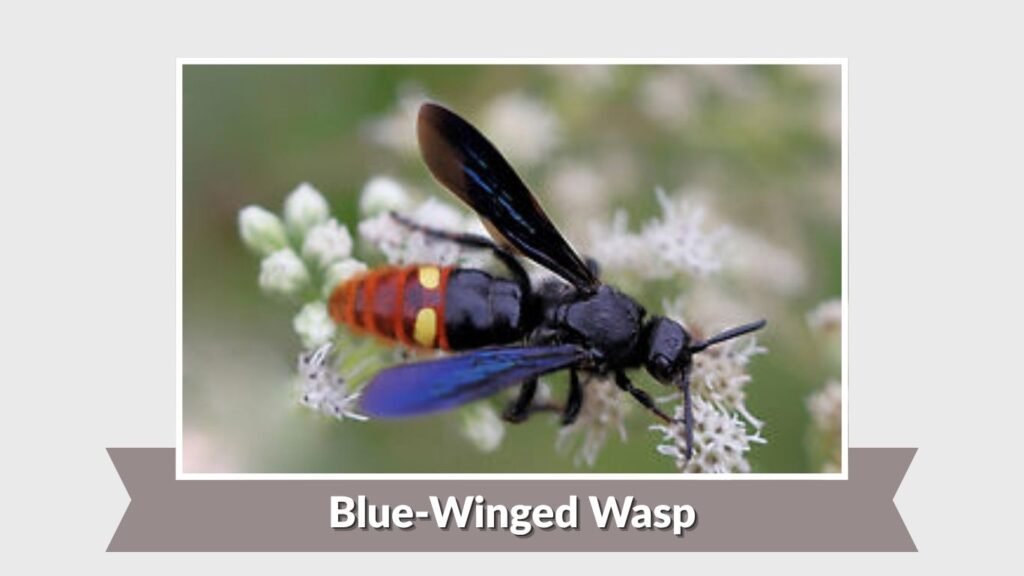
The blue-winged wasp is a robust wasp recognized by its dark body and wings that can display a distinctive bluish or violet sheen. Depending on the light, it may appear to be a black flying insect with blue wings. Despite its intimidating appearance, it is generally not aggressive toward humans.
Identification
Look for these characteristics:
- Dark or black body
- Blue, violet, or iridescent wings
- Yellowish markings may occur on the abdomen
- Relatively robust wasp body
- Hairy or bristly appearance
- Strong legs
- Often seen flying close to lawns
Its reflective wings are particularly noticeable in direct sunlight.
Where Blue-Winged Wasps Live
Blue-winged wasps commonly occur around lawns, gardens, meadows, and flowering areas. Adults frequently visit flowers to obtain nectar.
Females spend considerable time searching the ground for beetle larvae. They are often noticeable flying low over grassy areas where suitable hosts occur underground.
Do Blue-Winged Wasps Sting?
Females have stingers, but these wasps rarely sting people unless directly handled or threatened. They are solitary rather than highly defensive social wasps.
Their stinger is primarily important for their reproductive behavior and hunting rather than defense against humans.
Why Are Blue-Winged Wasps Beneficial?
Female blue-winged wasps search underground for beetle grubs, including larvae of certain scarab beetles. After locating a suitable grub, the female stings it and lays an egg on it.
The developing wasp larva feeds on the host, making these wasps useful natural biological-control insects in lawns and gardens.
13. Great Black Wasp
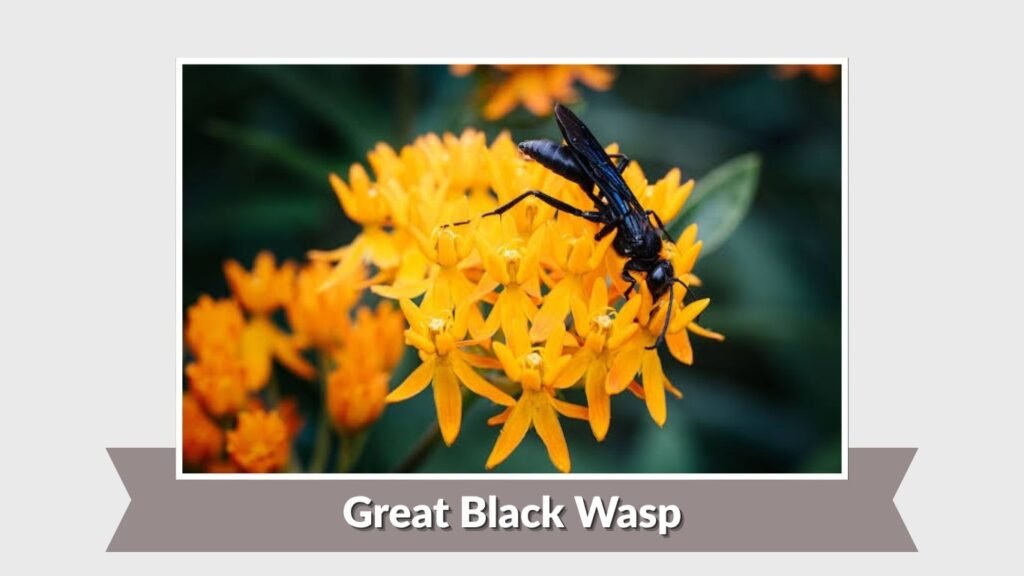
The great black wasp is a large solitary wasp with a glossy dark body and wings that may show a striking blue or violet iridescence. In bright sunlight, it can easily resemble a large black and blue flying insect. Although its size can be intimidating, it is generally peaceful around humans.
Identification
Great black wasps have several distinctive characteristics:
- Approximately 1 to 1.5 inches long
- Predominantly black body
- Blue or violet sheen on the wings
- Long, powerful legs
- Narrow waist
- Slender but relatively large body
- Strong, deliberate flight
Its combination of large size and iridescent wings makes it particularly noticeable.
Where Great Black Wasps Live
These wasps inhabit gardens, meadows, fields, woodland edges, and other open areas. Adults frequently visit flowers for nectar during summer.
Females construct underground nests containing separate chambers for their developing offspring. They may be observed dragging or flying with captured prey toward their burrows.
Do Great Black Wasps Sting?
Females possess stingers and can sting, but they rarely attack people without significant provocation. They do not maintain large colonies requiring aggressive group defense.
Their stingers are primarily used to immobilize prey. Handling or trapping a female can still result in a defensive sting.
What Do Great Black Wasps Eat?
Adults obtain energy primarily from flower nectar. Females hunt katydids and related insects to provide food for their larvae.
Captured prey is paralyzed and transported into an underground chamber. An egg is then laid with the stored prey, giving the developing larva a ready food supply.
14. Blue-Banded Bee
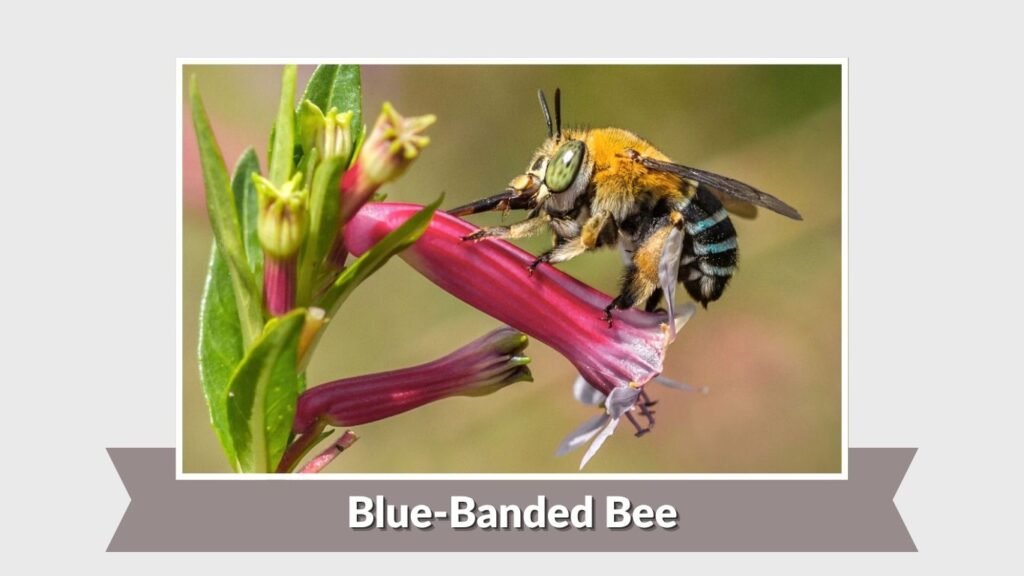
The blue-banded bee is a distinctive bee known for the bright blue or turquoise bands crossing its dark abdomen. These colorful bees are particularly well known in Australia and parts of the surrounding region. Their striking pattern makes them one of the best matches for a blue and black striped flying insect.
Identification
Blue-banded bees are characterized by:
- Dark body with bright blue abdominal bands
- Hairy bee-like appearance
- Relatively compact body
- Large compound eyes
- Strong wings
- Blue bands may appear turquoise or pale blue
- Females commonly carry pollen while foraging
The contrasting blue stripes make these bees difficult to confuse with ordinary honey bees.
Where Blue-Banded Bees Live
Blue-banded bees occur in gardens, woodlands, urban areas, and other habitats containing suitable flowers and nesting sites.
They are solitary bees rather than hive-forming insects. Females commonly excavate nesting tunnels in soft soil, clay banks, or similar materials and construct individual brood cells for their offspring.
Do Blue-Banded Bees Sting?
Females can sting, but blue-banded bees are generally not aggressive toward people. They have no large communal hive to defend.
Stinging is mainly a concern if a female is caught, squeezed, or deliberately handled. Watching them while they visit flowers presents little risk.
Why Are Blue-Banded Bees Beneficial?
Blue-banded bees are effective pollinators and can perform buzz pollination. During this process, the bee vibrates its flight muscles to shake pollen from certain flowers.
This behavior makes them particularly useful for pollinating plants such as tomatoes and other flowers that release pollen efficiently when vibrated.
15. Tarantula Hawk Wasp
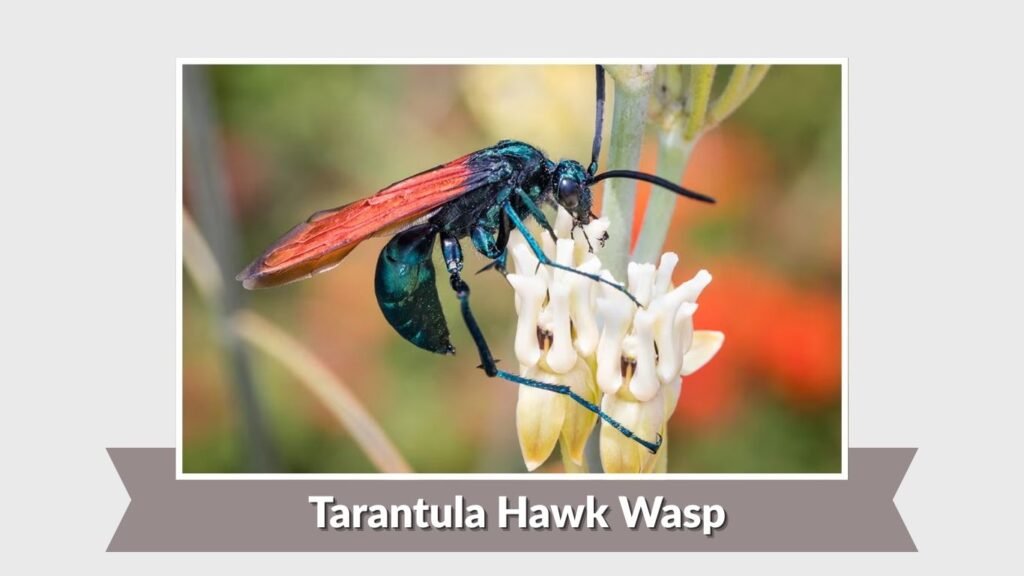
Tarantula hawk wasps are exceptionally large spider-hunting wasps. Many species have dark metallic bodies that can appear blue-black under sunlight, often combined with vivid orange or dark wings. Their appearance fits searches for a big blue-black flying insect or a blue flying insect with a stinger.
Identification
Typical characteristics include:
- Large body, sometimes approaching 2 inches long
- Metallic blue-black or dark body
- Long legs
- Large, powerful wings
- Wings may be orange, reddish, or dark
- Long antennae
- Strong, fast flight
Their size and contrasting coloration make them among the most impressive solitary wasps.
Where Tarantula Hawk Wasps Live
Tarantula hawks are particularly associated with warm and dry environments where tarantulas occur. They can be encountered in deserts, grasslands, scrublands, and gardens.
Adults often visit flowers for nectar. Females also spend considerable time moving across the ground while searching for tarantulas.
Do Tarantula Hawk Wasps Sting?
Yes. Female tarantula hawks possess an extremely painful sting, primarily used for paralyzing tarantulas. Fortunately, they are generally reluctant to sting humans and usually do so only when handled or severely threatened.
The safest approach is simply to observe these wasps from a comfortable distance and never attempt to capture them by hand.
Why Do Tarantula Hawks Hunt Spiders?
A female searches for a tarantula, stings and paralyzes it, and then transports it to a prepared burrow. She lays an egg on the immobilized spider.
After hatching, the wasp larva feeds on the paralyzed tarantula. Although dramatic, this behavior is a natural part of the tarantula hawk’s reproductive life cycle.