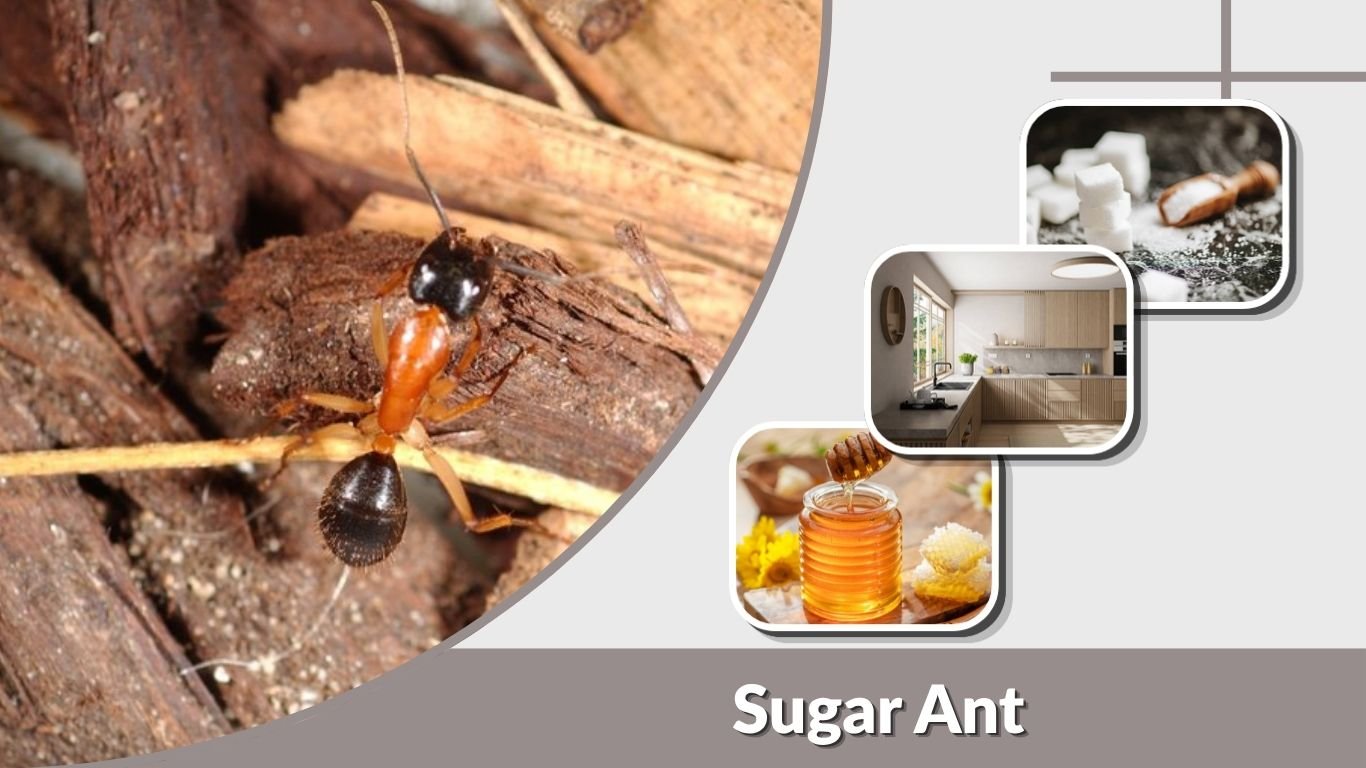
Sugar ants are small ants commonly seen following trails across kitchen counters, sinks, cupboards, and floors. However, “sugar ant” is not always a precise species name. In many countries, people use it for any household ant attracted to sweet food. In Australia, the name often refers specifically to the banded sugar ant. Identifying the ant’s size, color, body shape, nesting location, and behavior can help determine which species has entered your home.
What Is a Sugar Ant?
The term sugar ant describes ants that actively seek sugar, syrup, honey, fruit, nectar, and other carbohydrate-rich foods. Several unrelated ant species may receive this nickname because they form visible trails leading to sweet substances.
Household Sugar Ants
In North America, the odorous house ant is frequently called a sugar ant. Argentine ants, pavement ants, pharaoh ants, and other small household species may also be given the same name. Therefore, identifying an ant only by its attraction to sugar is unreliable.
Odorous house ants are among the most common candidates. They are small, brown to dark brown ants that prefer sweets, particularly the sugary honeydew produced by aphids and similar insects. They may also consume insects, meat, and other household foods.
Australian Banded Sugar Ant
In Australia, “sugar ant” commonly refers to the banded sugar ant (Camponotus consobrinus). It is considerably larger than most ants called sugar ants in North American homes.
Banded sugar ant workers vary in size because their colonies contain smaller minor workers and larger major workers. They have a distinctive combination of a black head, an orange-brown middle section, and a dark abdomen. This species belongs to the carpenter ant genus Camponotus and is native to Australia.
Sugar Ant Size and Color
Sugar ants can be tiny, medium-sized, or relatively large, depending on the actual species. Size and color are useful initial clues, but neither feature should be used alone for identification.
| Ant commonly called a sugar ant | Approximate worker size | Typical color | Helpful identification clue |
| Odorous house ant | About 1/10–1/8 inch | Brown to dark brown or black | Strong unpleasant odor when crushed |
| Argentine ant | About 1/8 inch | Uniform dull brown | Workers are similar in size and travel in long trails |
| Pavement ant | About 1/8 inch | Reddish-brown to black | Often nests under concrete and paving |
| Pharaoh ant | About 1/16 inch | Yellow, honey-colored, or orange | Extremely small and often found in warm buildings |
| Banded sugar ant | About 5–15 mm | Black with orange-brown bands | Much larger, long-legged Australian species |
Household ant measurements and colors can overlap substantially. A magnifying glass may be necessary to examine waist nodes, thorax shape, antennae, and body markings.
How Small Are Household Sugar Ants?
Most household sugar ants appear as tiny moving dots. Odorous house ant workers are approximately 1/10 inch long, while pharaoh ants may measure only about 1/16 inch. Their small bodies allow them to enter through narrow cracks around windows, pipes, doors, flooring, and foundations.
Carpenter ants are much larger, usually ranging from about 3/16 to 1/2 inch. Finding large ants with workers of noticeably different sizes may indicate carpenter ants rather than typical tiny sugar ants.
What Color Are Sugar Ants?
Household sugar ants may be light yellow, reddish-brown, dull brown, dark brown, or nearly black. Color varies among species and can also appear different under indoor lighting.
The banded sugar ant is easier to recognize in photographs. It normally has a glossy black head, an orange to reddish-brown thorax and legs, and a dark abdomen. Its contrasting colors create the “banded” appearance associated with its common name.
Sugar Ant Habitat and Nesting Places
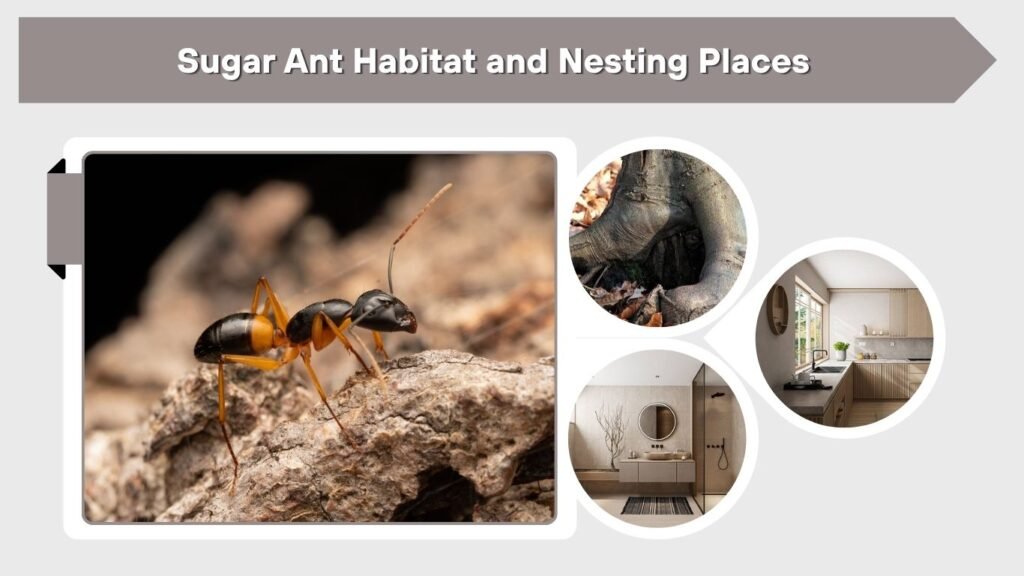
Sugar ants live anywhere that offers suitable nesting shelter, moisture, and reliable food. Outdoor colonies frequently send workers indoors without establishing a permanent nest inside the building.
Outdoor Habitat
Small household species commonly nest in soil, mulch, plant beds, rotting wood, tree cavities, and spaces underneath stones, boards, patio blocks, logs, or pavement. Pavement ants often establish colonies beneath sidewalks and driveways, while odorous house ants use shallow protected spaces in soil and debris.
Plants infested with aphids, scale insects, whiteflies, or mealybugs may attract sugar-feeding ants. These plant pests release honeydew, a sticky, sugar-rich liquid that ants collect as food.
Indoor Habitat
Indoors, sugar ants are frequently found in:
- Kitchen cupboards and countertops
- Spaces beneath sinks and appliances
- Bathrooms and laundry rooms
- Wall voids and flooring gaps
- Areas around water heaters and plumbing
- Cracks behind baseboards and cabinets
Moisture is often an important attraction. Odorous house ants may nest in wall voids or under floors near water, while pharaoh ants prefer warm, dark, humid spaces that can be difficult to locate.
Seeing ants in a kitchen does not necessarily mean the nest is indoors. Workers may be traveling from an outdoor colony through a tiny structural opening.
What Do Sugar Ants Eat?
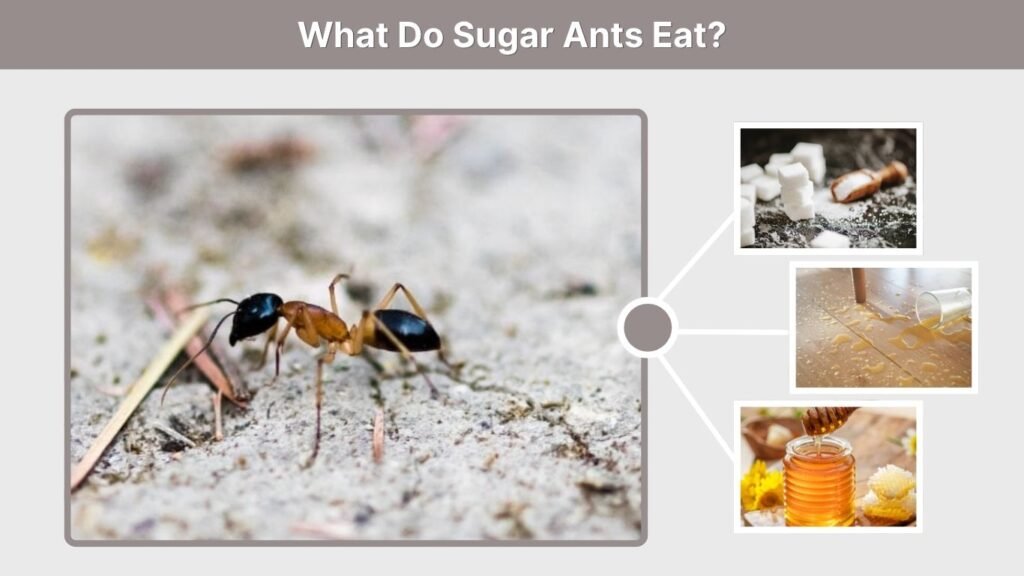
Sugar ants are strongly attracted to carbohydrates because sweet substances provide workers with quick energy. Common indoor foods include table sugar, spilled juice, syrup, honey, jam, soft drinks, fruit, cake, candy, and sweet crumbs.
Outdoors, many species feed on flower nectar and insect honeydew. They may protect aphids and scale insects from predators to maintain access to this sugary resource.
Despite their name, sugar ants do not survive on sugar alone. Depending on the species and the colony’s needs, they may also eat:
- Dead or living insects
- Meat and greasy food
- Pet food
- Seeds and plant material
- Protein-rich crumbs
- Other small invertebrates
Odorous house ants prefer sweets but can eat insects and meat. Pavement ants consume sweets, proteins, grease, bread, nuts, pet food, and insects. Pharaoh ants accept both sugary and fatty foods.
How to Identify Sugar Ants with Pictures
Close-up sugar ant pictures are most useful when they show the ant from the side and above. A clear image should reveal body color, worker size, antenna shape, thorax profile, and the small nodes between the thorax and abdomen.
Check the Body Shape
True ants have three distinct body regions, elbowed antennae, six legs, and a narrow waist. Winged ants have front wings that are longer than their hind wings. Termites have straighter antennae, broad waists, and wings of approximately equal length.
Look at the Waist Nodes
The tiny bumps forming an ant’s waist are called nodes. Odorous house ants have one node, although it is often hidden beneath the abdomen. Pavement and pharaoh ants have two visible nodes.
Counting nodes usually requires magnification and a side-view photograph. It is one of the most useful methods for separating similar-looking household ants.
Observe the Trail
Sugar-feeding ants often move along organized trails between the nest and food. Long trails of uniformly brown ants may suggest Argentine ants. Small dark ants near moisture and sweet food may be odorous house ants, while reddish-brown ants emerging from cracks around concrete may be pavement ants.
Trail behavior alone cannot confirm the species, but it provides an important clue when combined with size and appearance.
Notice Any Distinctive Odor
Odorous house ants release a strong smell when crushed. People commonly compare it to rotten coconut or strong cheese. This odor, together with their small brown body and hidden waist node, can support identification.
Avoid crushing many ants along an active trail. Photographing one specimen beside a ruler or coin generally provides a more useful record for professional identification.
Do Sugar Ants Bite or Cause Damage?
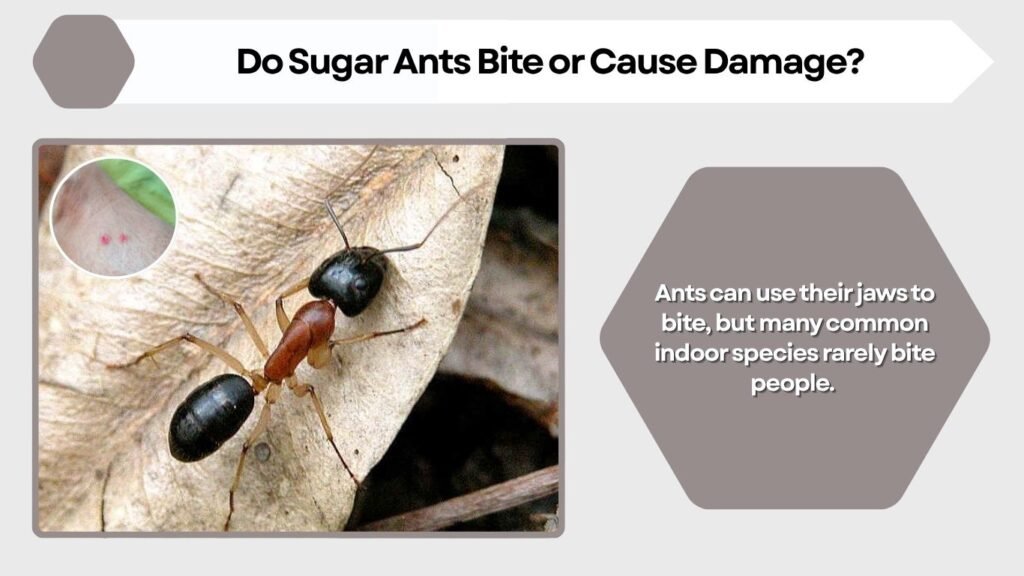
Most tiny household sugar ants are nuisance pests rather than dangerous insects. Ants can use their jaws to bite, but many common indoor species rarely bite people. They generally do not sting or cause significant structural damage.
The main concern is food contamination as ants travel across counters, waste containers, floors, and stored products. Large carpenter-type sugar ants require closer attention because carpenter ants can excavate damp or decaying wood to create nesting galleries. They do not eat wood, but a mature indoor colony may indicate moisture-damaged material.
FAQs
Are sugar ants the same as odorous house ants?
Not always. Odorous house ants are frequently called sugar ants because they strongly prefer sweet foods. However, the nickname may also refer to Argentine ants, pavement ants, pharaoh ants, and several other species. In Australia, it commonly means the banded sugar ant.
How big is a sugar ant?
Tiny household sugar ants often measure approximately 1/16 to 1/8 inch long. Australian banded sugar ants are substantially larger, with workers measuring roughly 5–15 millimeters. The exact size depends on the species and whether the individual is a minor worker, major worker, queen, or male.
Why do sugar ants appear in the kitchen?
Kitchens provide sugar ants with food, water, warmth, and protected hiding spaces. Syrup, crumbs, fruit, grease, pet food, leaking pipes, and damp sinks can attract workers. They may be nesting inside the building or entering from an outdoor colony through small cracks.
Are black sugar ants dangerous?
Most small black ants attracted to sugar are not dangerous. They are mainly a sanitation nuisance and may contaminate exposed food. However, large black ants could be carpenter ants, especially when found near damp wood, sawdust-like material, wall cavities, or damaged window frames.
Can sugar ants have wings?
Yes. Mature ant colonies produce winged reproductive males and females at certain times. Winged ants have narrow waists, elbowed antennae, and unequal wing pairs. Because they can resemble termites, examining the antennae, waist, and relative wing lengths is important before identifying them.