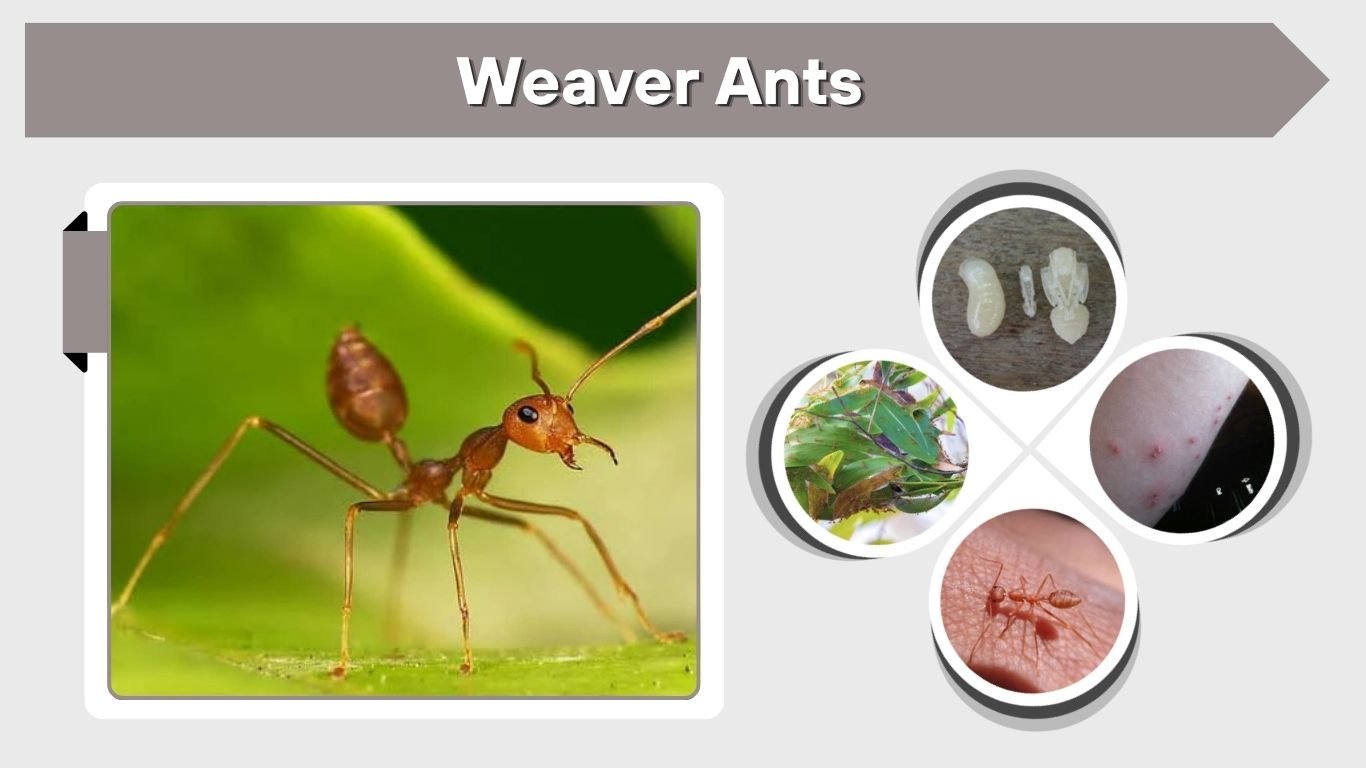
Weaver ants are remarkable tree-dwelling insects famous for building nests from living leaves. Rather than collecting ordinary construction materials, worker ants pull leaves together and fasten them with silk produced by their larvae. These highly social ants form organized colonies containing workers, developing brood, males, and a reproductive queen. Weaver ants are also aggressive hunters that protect their territory from insects and rival ant colonies. Although their bites can be painful, they are generally more beneficial than dangerous.
What Are Weaver Ants?
Weaver ants are arboreal ants belonging primarily to the genus Oecophylla. Arboreal means that they spend most of their lives in trees rather than underground.
There are two living species generally recognized:
- Asian weaver ant: Oecophylla smaragdina
- African weaver ant: Oecophylla longinoda
The Asian species occurs from South Asia through Southeast Asia and into northern Australia, while the African species inhabits humid tropical regions of sub-Saharan Africa. Both species create distinctive leaf nests with silk supplied by their larvae.
Weaver ants are sometimes called green ants, green tree ants, red weaver ants, orange ants, or leaf weaver ants. Their common name and color can vary depending on their species and location.
Weaver Ant Characteristics
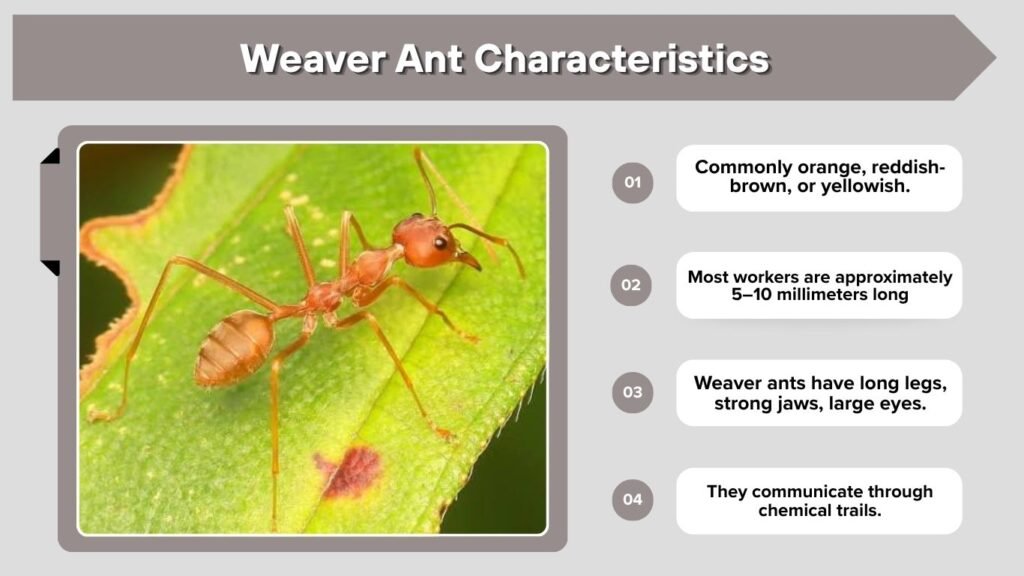
Weaver ants have long legs, strong jaws, large eyes, and slender bodies adapted for moving across branches and leaves. Their excellent grip allows them to climb smooth plant surfaces and hang from leaves while constructing nests.
Color and Appearance
Asian weaver ants are commonly orange, reddish-brown, or yellowish. In parts of Australia, their abdomens may appear bright green, which explains the name “green tree ant.”
African weaver ants are usually orange-brown to dark brown. Color alone is not always enough to identify them because workers from the same species can vary.
Weaver Ant Size
Colonies normally contain workers of different sizes. Smaller workers remain closer to the nest, where they care for eggs and larvae. Larger workers patrol the territory, hunt prey, defend the colony, and help construct nests.
Most workers are approximately 5–10 millimeters long, while queens are much larger and have swollen abdomens designed for egg production.
Aggressive Behavior
Weaver ants are highly territorial. When disturbed, workers may raise their bodies, open their jaws, and quickly rush toward the threat.
They communicate through chemical trails, body movements, and physical contact. Groups can cooperate to overpower prey much larger than an individual ant.
Where Do Weaver Ants Live?
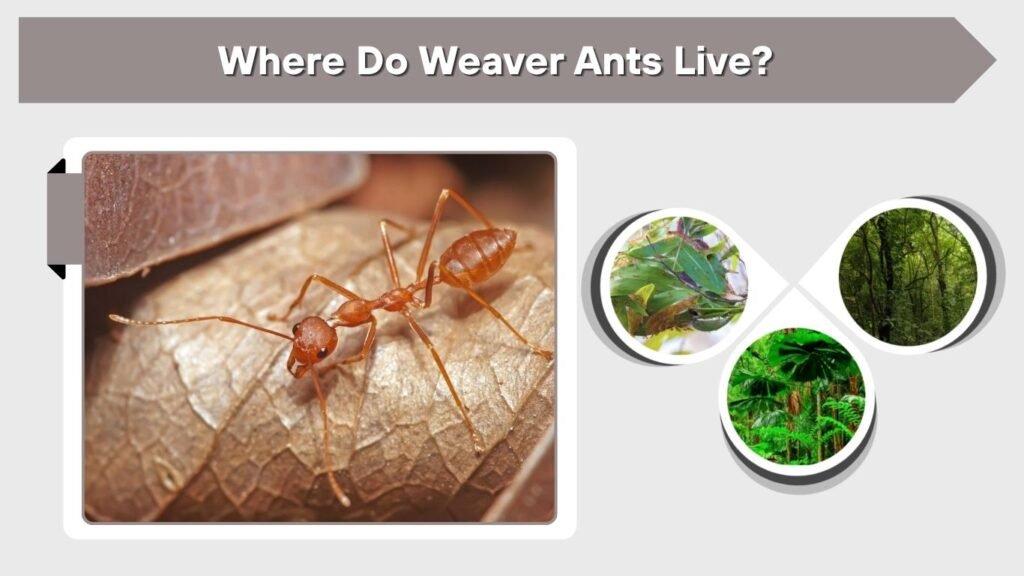
Weaver ants prefer warm tropical and subtropical environments containing trees, shrubs, and abundant insect prey.
Asian weaver ants are found in countries across India, Sri Lanka, Bangladesh, China, Southeast Asia, the Philippines, Indonesia, Papua New Guinea, and northern Australia. African weaver ants live throughout many forested and agricultural regions of tropical Africa.
Common weaver ant habitats include:
- Tropical forests
- Rainforest edges
- Fruit orchards
- Plantations
- Mangroves
- Gardens
- Urban shade trees
A colony may occupy one large tree or spread across several neighboring trees. Workers travel along branches and temporary body bridges to move between feeding areas and nests.
How Do Weaver Ants Build Their Nests?
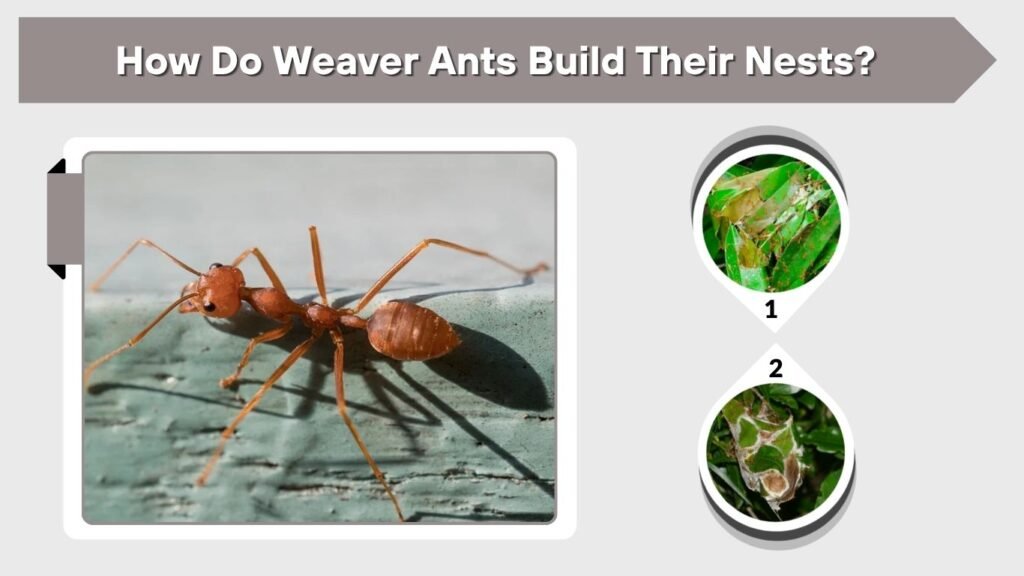
A weaver ant nest looks like a cluster of fresh or dried leaves folded and attached together. Depending on its age, it may be green, brown, round, oval, or irregularly shaped.
Pulling the Leaves Together
Construction begins when workers inspect suitable leaves. They grip leaf edges with their jaws and legs and pull them toward one another.
When the distance is too great, several ants form chains by holding onto one another. The chain functions like a living rope, allowing the colony to apply enough force to bend or draw the leaves together.
Using Larvae as Silk Producers
Adult weaver ants cannot produce the silk required to seal the nest. Instead, workers carry mature larvae in their jaws and gently move them along the leaf edges.
The larvae release silk from specialized glands. Workers guide them back and forth like living glue applicators, creating silk sheets that fasten the leaves together.
A Colony With Multiple Nests
A mature weaver ant colony usually contains numerous interconnected nests rather than one central structure. Different nests may be used for queens, developing brood, food storage, workers, or territorial outposts.
This multi-nest arrangement allows the ants to control a large section of the tree canopy.
Weaver Ant Queen and Colony Structure
The queen is the reproductive center of a weaver ant colony. She is considerably larger than the workers and has an enlarged abdomen.
Starting a New Colony
A young queen develops wings and leaves her birth colony during a reproductive flight. After mating with a male, she lands, removes her wings, and searches for a protected place among leaves.
The queen initially lays eggs and raises the first generation of workers using nutrients stored in her body. After those workers mature, they begin collecting food, caring for the brood, expanding the nest, and protecting the queen.
Queen Weaver Ant Food
A mature queen normally remains deep inside a protected nest. Workers feed her liquid food obtained from prey, nectar, honeydew, and other available resources.
The queen’s primary role is laying eggs. Without a healthy reproductive queen, an established colony cannot continue replacing workers indefinitely.
Male Weaver Ants
Male weaver ants, often called drones, are winged reproductive individuals. Their main purpose is to mate with young queens. They do not participate significantly in hunting, nest construction, or colony defense.
Weaver Ant Life Cycle
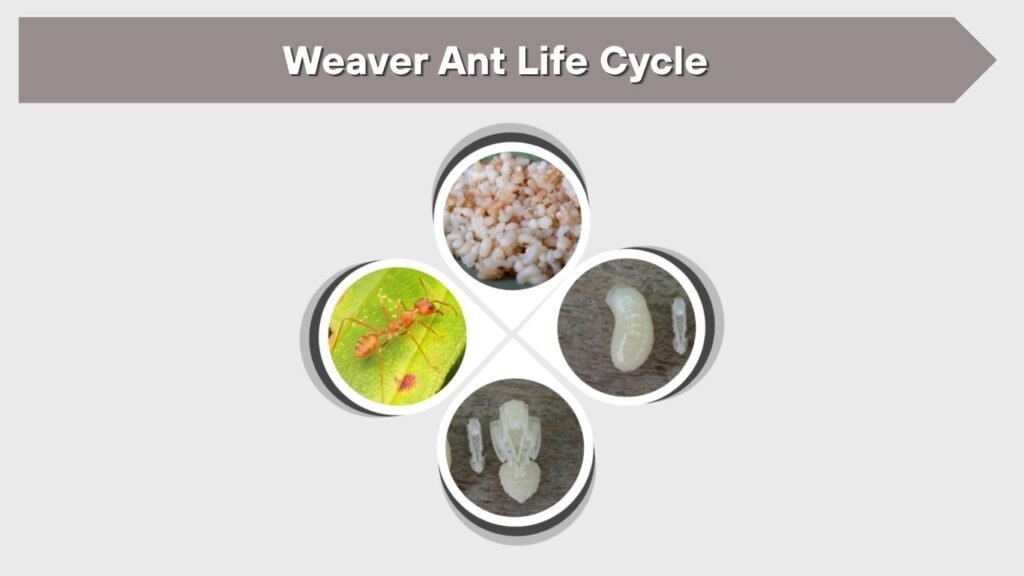
Weaver ants undergo complete metamorphosis and pass through four stages:
| Life stage | Description |
|---|---|
| Egg | Tiny eggs are laid by the queen and cared for by workers. |
| Larva | Legless larvae are fed and cleaned by workers; older larvae produce nest-building silk. |
| Pupa | The developing ant transforms into its adult form. |
| Adult | The ant becomes a worker, queen, or reproductive male. |
Workers carefully move eggs, larvae, and pupae between nests when temperature, humidity, or safety conditions change.
The total development period varies with species, food supply, temperature, colony health, and environmental conditions.
What Do Weaver Ants Eat?
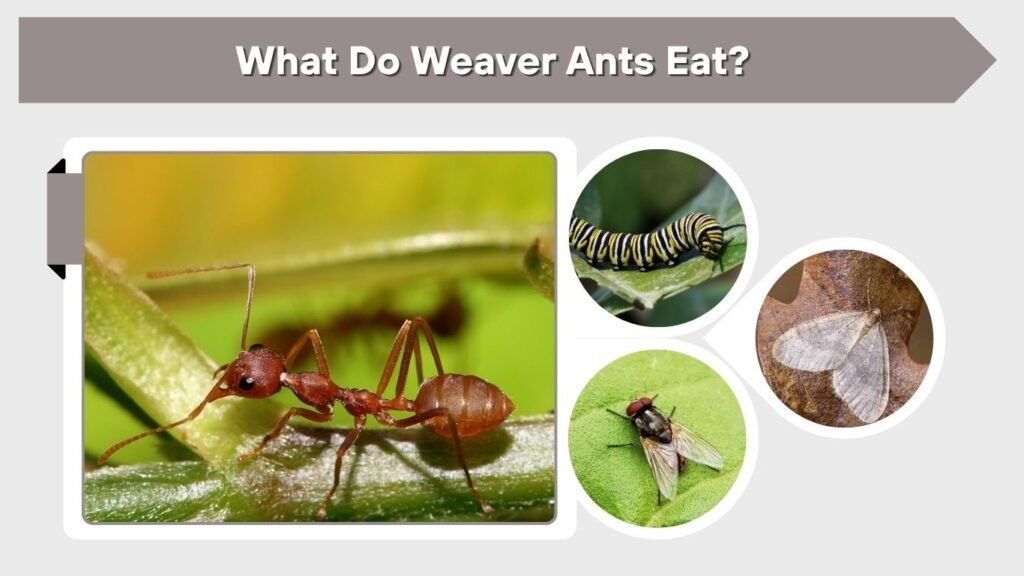
Weaver ants are opportunistic omnivores, but they are especially effective predators.
Their food may include:
- Caterpillars
- Beetles
- Flies
- Moths
- Termites
- Other ants
- Spiders
- Insect eggs
- Nectar
- Fruit juices
- Honeydew
Workers often hunt cooperatively. Several ants may surround an insect, bite its legs, stretch its body, and carry pieces back to the colony.
They also collect sugary honeydew released by aphids, scale insects, and similar sap-feeding insects. Protein-rich prey supports larval development, while sugary liquids provide workers with energy.
Are Weaver Ants Dangerous?
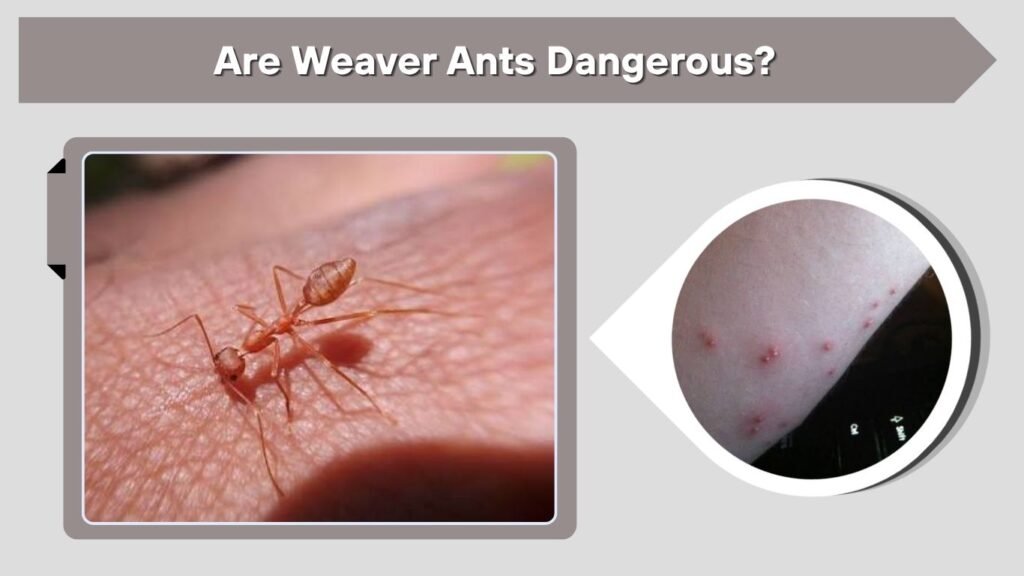
Weaver ants are not considered dangerously venomous to most people. However, they are defensive and may attack when their nest or territory is disturbed.
Do Weaver Ants Bite?
Yes. Weaver ants have powerful jaws and can deliver a sharp, pinching bite. While biting, some species may release acidic defensive chemicals onto the skin, increasing the burning sensation.
Common reactions include:
- Immediate pain
- Mild burning
- Redness
- Itching
- Temporary swelling
Most bites are uncomfortable but not medically serious.
Weaver Ant Bite Treatment
Wash the affected skin with soap and clean water. Apply a cold compress for approximately 10 minutes to reduce discomfort and swelling.
Avoid scratching because broken skin can become infected. Seek medical attention if the person develops severe swelling, breathing difficulty, dizziness, spreading hives, or other signs of an allergic reaction.
Weaver Ants Versus Leafcutter Ants
Weaver ants and leafcutter ants both interact closely with leaves, but they use them in completely different ways.
| Feature | Weaver ants | Leafcutter ants |
|---|---|---|
| Main habitat | Trees and shrubs | Mostly underground colonies |
| Use of leaves | Join living leaves to build nests | Cut leaf pieces to grow fungus |
| Main food | Insects and sugary liquids | Fungus cultivated on plant material |
| Nest material | Leaves sealed with larval silk | Soil chambers and tunnels |
| Distribution | Tropical Africa, Asia, and Australia | North, Central, and South America |
Leafcutter ants do not usually eat the leaf pieces directly. They use them to cultivate fungus, which becomes the colony’s primary food.
Ecological Benefits of Weaver Ants
Weaver ants are important predators in forests, orchards, and plantations. They capture many insects that feed on fruit, leaves, shoots, and bark.
Farmers have historically encouraged weaver ant colonies in crops such as mango, citrus, cashew, and coconut. Research and agricultural observations have documented their ability to reduce certain insect pests, including beetles, leaf-feeding insects, and sap-feeding pests.
However, the ants may also protect honeydew-producing insects because those insects provide a valuable source of sugar. Their overall effect can therefore vary depending on the crop and pest species involved.
How to Get Rid of Weaver Ants
Control may be necessary when nests hang over doors, patios, walkways, playgrounds, or frequently used garden areas.
Begin by trimming branches that touch buildings, fences, roofs, or nearby trees. This reduces the routes ants use to enter the property.
Other practical steps include:
- Remove fallen fruit and sugary food sources.
- Seal gaps around windows, roofs, pipes, and doors.
- Avoid directly shaking or cutting an occupied nest.
- Spray small nests with soapy water only when it can be done safely.
- Contact a pest-control professional for large colonies or high nests.
Broad insecticide spraying should be avoided when possible because weaver ants can help suppress plant pests. Removing a single nest may not eliminate the colony because numerous connected nests can exist across several trees.
Interesting Facts About Weaver Ants
- Workers use their own larvae as silk-producing tools.
- Several ants can form living chains and bridges between leaves.
- Colonies may defend territories extending across multiple trees.
- Larger workers usually hunt and defend, while smaller workers care for brood.
- Weaver ants communicate through chemical trails and physical signals.
- Their eggs and larvae are eaten in parts of Asia and Africa.
- Red weaver ant chutney is a traditional food in some regions of India.
- Farmers have used weaver ants for natural pest control for centuries.
- Colonies can capture insects much larger than individual workers.
- The queen usually remains hidden inside one of the colony’s best-protected nests.
FAQs
Are weaver ants poisonous?
Weaver ants are not poisonous in the usual sense, and touching one does not expose a person to poison. However, workers can bite and release irritating defensive chemicals. The resulting pain, redness, or burning is normally temporary unless the person experiences an unusual allergic reaction.
Why are they called weaver ants?
They are called weaver ants because workers join leaves together to construct nests. The adults pull leaves into position and carry larvae along the seams. Silk released by the larvae binds the leaf edges, creating a secure chamber for the colony.
Can weaver ants live inside a house?
Weaver ants normally nest in living trees rather than inside buildings. Workers may enter houses while searching for food or use branches touching a roof as access routes. An indoor trail usually indicates that a colony is located in a nearby tree or shrub.
Are weaver ants good for gardens?
Weaver ants can benefit gardens by hunting caterpillars, beetles, and other plant-feeding insects. However, they may bite people and sometimes protect honeydew-producing pests. Their usefulness depends on where the colony is located and whether it interferes with normal garden activities.
What is the scientific name of a weaver ant?
The Asian weaver ant is scientifically named Oecophylla smaragdina, while the African weaver ant is Oecophylla longinoda. These are the two recognized living species in the genus Oecophylla, and both build tree nests by fastening leaves with larval silk.