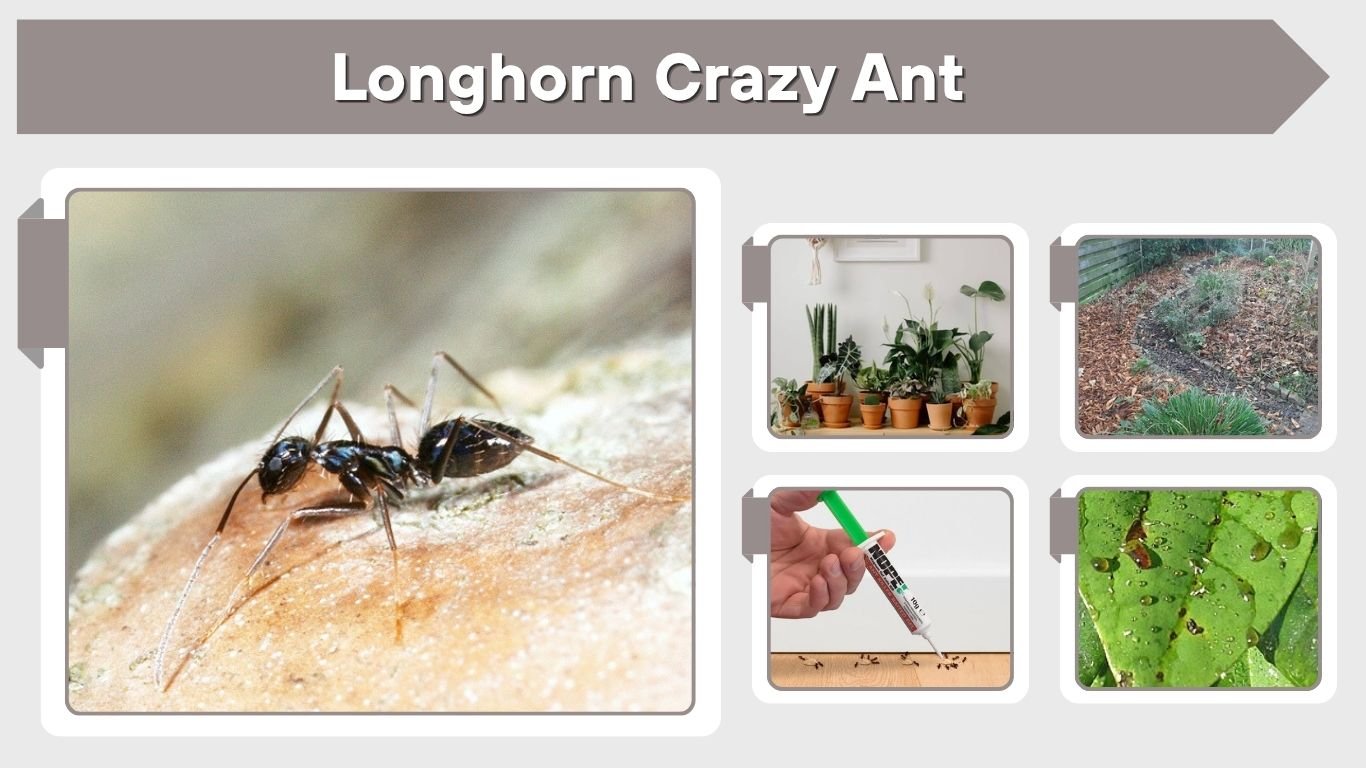
The longhorn crazy ant is a small, fast-moving ant recognized by its extremely long legs and antennae. It frequently enters houses, restaurants, greenhouses, hospitals, and other buildings while searching for food and moisture. Although it does not deliver a painful sting, a large colony can become a persistent nuisance. Longhorn crazy ants are also notable for their unusual reproductive system, in which queens and males can maintain separate clonal genetic lines while workers are produced sexually.
What Is a Longhorn Crazy Ant?
The longhorn crazy ant is a widespread tropical and subtropical pest ant. Its scientific name is Paratrechina longicornis. It is also called the long-legged crazy ant or black crazy ant.
The word “longhorn” refers to the ant’s unusually long antennae, while “crazy” describes its rapid, irregular running behavior. Instead of following slow, clearly defined trails, workers often dart in different directions when disturbed.
The species has been transported widely through international commerce and now occurs across many warm parts of the world. It is commonly associated with disturbed habitats, buildings, ports, gardens, farms, and urban landscapes. Researchers have described it as one of the world’s most widespread invasive ants.
What Do Longhorn Crazy Ants Look Like?
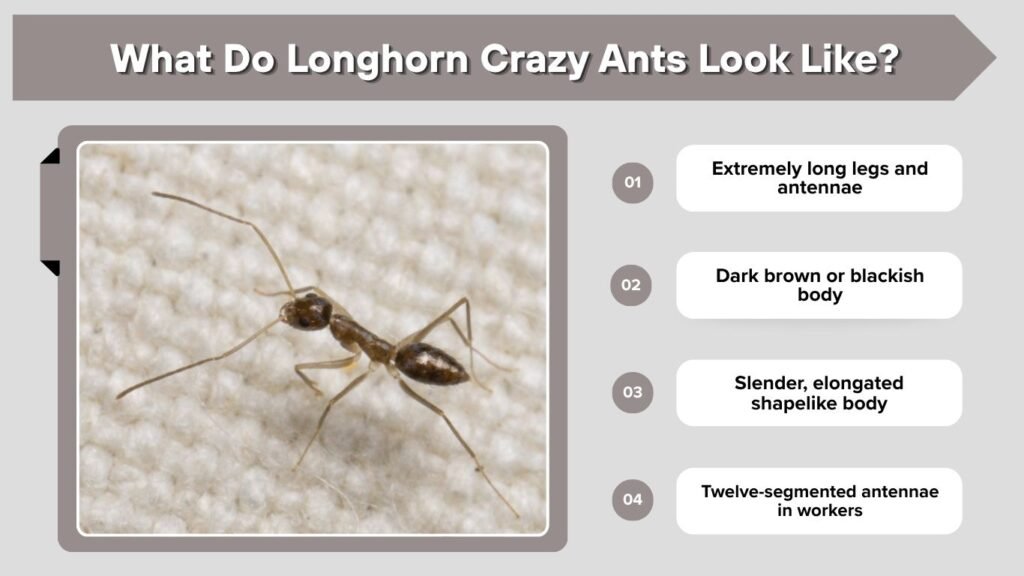
Longhorn crazy ants have slender bodies, long appendages, large eyes, and a dark brown to nearly black appearance. Their legs, antennae, and some joints may be slightly lighter than the rest of the body.
The most useful identification features include:
- Extremely long legs and antennae
- Dark brown or blackish body
- Slender, elongated shape
- One waist node
- Twelve-segmented antennae in workers
- Long, pale hairs on the body
- Rapid and unpredictable movement
- Workers that are generally similar in size
Their antennae are so long that the first segment extends far beyond the back of the head. The combination of long legs, long antennae, dark coloration, and erratic movement helps distinguish them from many household ants.
Longhorn Crazy Ant Size
Workers are usually approximately 2.3 to 3 millimeters long, excluding their extended antennae and legs. Their long appendages can make them appear considerably larger.
Queens are much larger and more robust than workers. A mature queen may be roughly twice the worker’s size, with an enlarged thorax and abdomen. Males are winged during their reproductive stage and generally have slimmer bodies than queens.
| Colony member | General appearance | Approximate relative size |
|---|---|---|
| Worker | Slender, dark and long-legged | 2.3–3 mm |
| Queen | Broad thorax and enlarged abdomen | About twice worker size |
| Male | Slender, winged reproductive | Larger than worker |
| Larva | Pale, legless and grub-like | Varies by development |
Longhorn Crazy Ant Queen
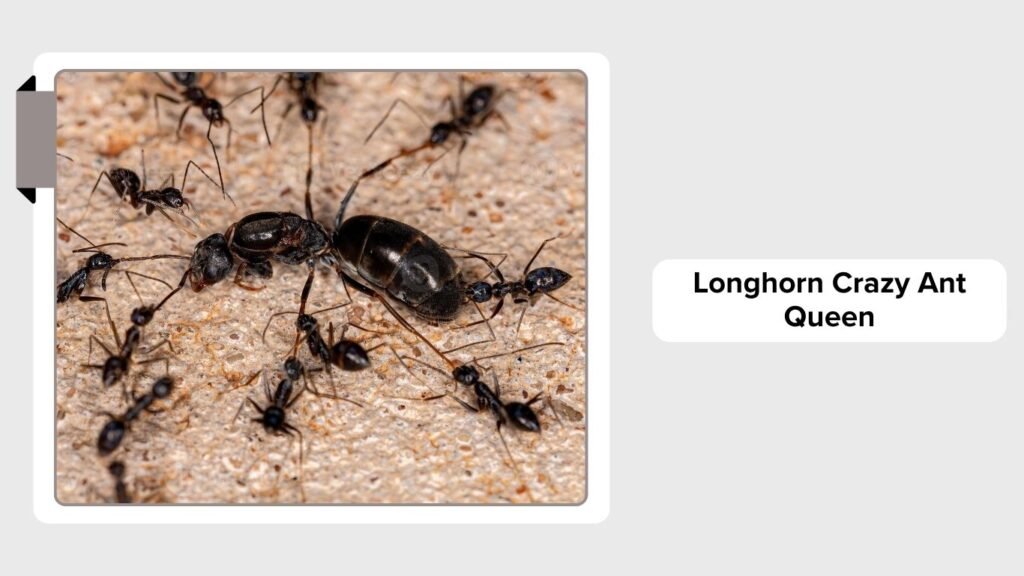
A longhorn crazy ant colony can contain multiple queens. This condition, known as polygyny, helps colonies expand rapidly because several queens can produce eggs simultaneously.
The queen has a darker, heavier body than a worker and a noticeably enlarged abdomen. A newly matured queen may have wings, but she can shed them after mating or establishing herself within a colony.
Unlike ants that depend on one central queen and one permanent nest, longhorn crazy ants can occupy interconnected nesting sites. Workers and queens may move between these sites when conditions change. This flexibility makes infestations difficult to locate and eliminate.
Colonies can also divide through budding. During budding, one or more queens leave with groups of workers and brood to establish a nearby satellite nest. They do not necessarily need to complete a long-distance mating flight before spreading through a building or property.
How Does Male Cloning Work in Longhorn Crazy Ants?
Longhorn crazy ants have an unusual system known as double-clonal reproduction. In studied populations, new queens can be produced as genetic clones of their mothers, while males preserve the father’s genetic line. Workers, however, are normally produced sexually and receive genetic material from both queen and male lines.
This means a queen can mate with a male that belongs to a separate genetic lineage. Their worker daughters receive genes from both parents, maintaining genetic diversity within the working population. Reproductive queens preserve the maternal line, while reproductive males preserve the paternal line.
The system is especially useful for an invasive species because it allows related colony members to mate without creating the same degree of harmful inbreeding expected under ordinary reproduction. Scientists still study the exact cellular processes involved, but research indicates that this reproductive strategy occurs widely across the species’ introduced range.
Longhorn Crazy Ant Habitat
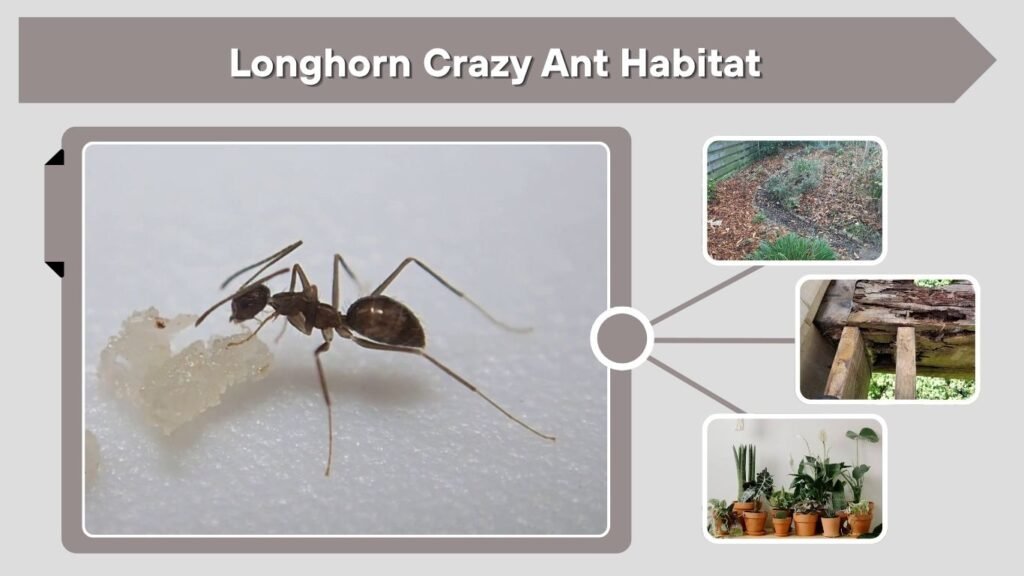
Longhorn crazy ants prefer warm, humid environments but are highly adaptable. In cooler regions, they can survive year-round inside heated buildings, greenhouses, warehouses, and other protected structures.
Common outdoor nesting locations include:
- Beneath stones, boards and bricks
- Under mulch and leaf litter
- Inside rotten wood
- Beneath flowerpots
- Around tree roots
- In cracks in pavement
- Inside accumulated garden debris
- Near compost and trash areas
Indoors, nests may occur inside wall voids, cabinets, appliances, roof spaces, bathrooms, kitchens, and other humid locations.
The ants frequently forage far from their nests. Therefore, finding workers around food does not necessarily mean the colony is close by. This long-distance foraging behavior is one reason conventional spot treatments often provide only temporary control.
What Do Longhorn Crazy Ants Eat?
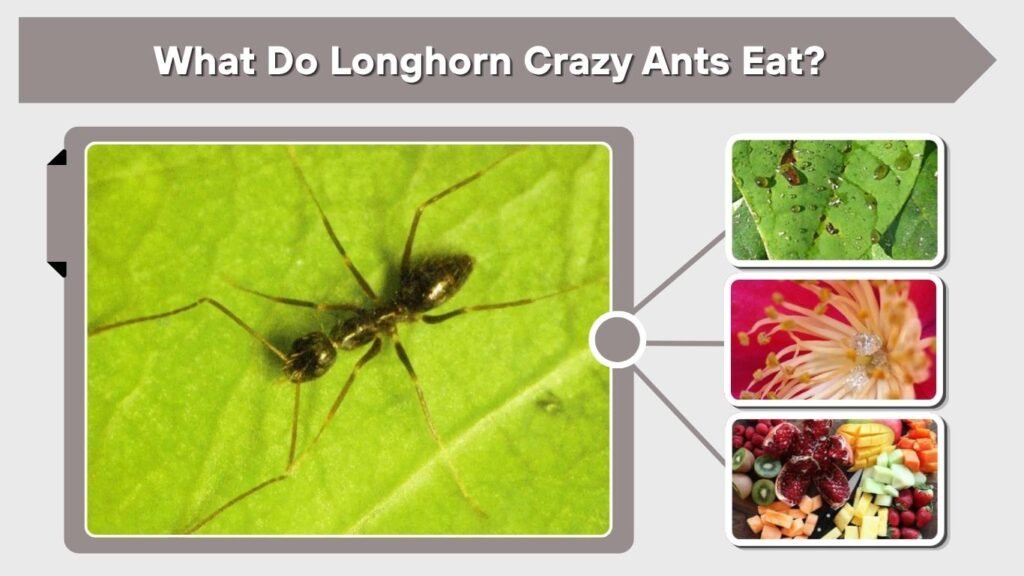
Longhorn crazy ants are opportunistic omnivores. Their broad diet allows them to survive in natural habitats, gardens, businesses, and homes.
They commonly feed on:
- Live and dead insects
- Honeydew from aphids and scale insects
- Plant nectar and other sweet secretions
- Fruit and fruit juice
- Seeds
- Grease and oils
- Meat and protein-rich scraps
- Soda syrup, sweets and household crumbs
Workers often protect aphids, mealybugs, whiteflies, and scale insects because these pests produce sugary honeydew. As the ants defend these insects from predators, plant pest populations may increase.
Food preferences can change according to season and the nutritional needs of the colony. Workers may prefer carbohydrates at one time and proteins or fats at another. This variation is important when selecting ant bait.
Longhorn Crazy Ants in Fruit
Finding these ants on fruit does not always mean they are directly attacking healthy produce. They may be feeding on juice from damaged or overripe fruit, collecting sweet plant secretions, or tending honeydew-producing insects nearby.
Remove fallen fruit promptly and inspect plants for aphids, scales, and mealybugs. Controlling these insects can reduce the sugary resources that attract and support ant colonies.
Longhorn Crazy Ants in the House
Longhorn crazy ants commonly enter buildings through tiny cracks, doors, windows, pipes, vents, and utility lines. They may become especially noticeable after heavy rain, drought, landscaping disturbance, or changes in temperature.
Inside a house, workers are often found around:
- Kitchen counters and cabinets
- Sinks and drains
- Pet food bowls
- Bathrooms
- Indoor plants
- Trash containers
- Window frames
- Electrical outlets
- Leaking plumbing
Their presence does not necessarily indicate structural damage. Unlike carpenter ants, they do not excavate sound wood to make nests. However, large numbers can contaminate food and become difficult to manage.
Do Longhorn Crazy Ants Bite?
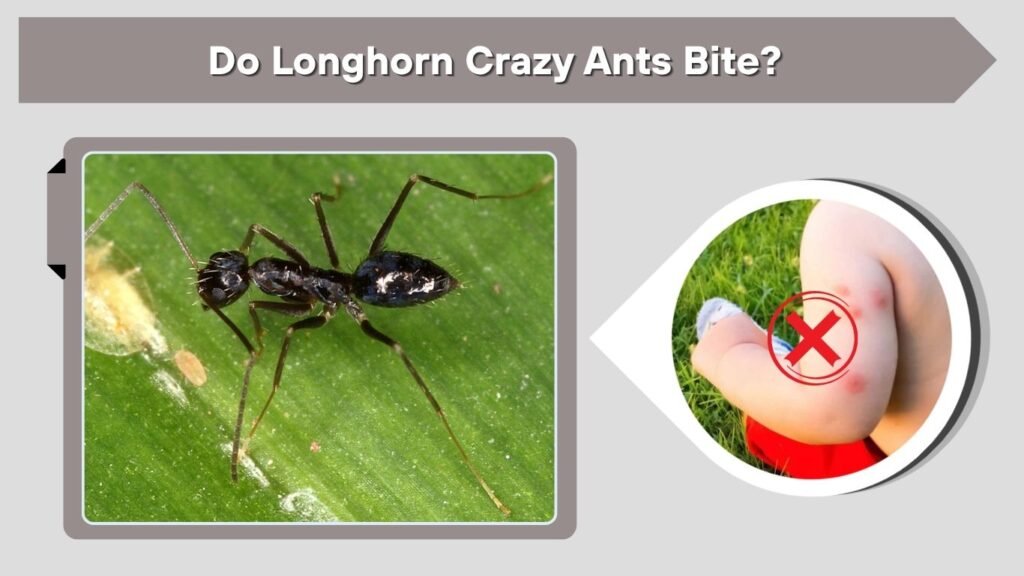
Longhorn crazy ants are not considered dangerous to most people. They lack the powerful sting associated with fire ants and usually run away when disturbed.
A worker may bite when trapped against the skin, but the bite is generally mild and may not be noticed. Sensitive individuals could experience temporary irritation.
Wash the area with soap and water and avoid scratching. Seek medical assistance for unusual swelling, breathing difficulty, widespread hives, or another severe reaction following contact with any insect.
Longhorn Crazy Ant Predators
Longhorn crazy ants can be eaten by spiders, lizards, frogs, birds, predatory insects, and other ants. Ant-eating arthropods may also attack workers or brood.
Natural predators rarely eradicate an established infestation. Colonies can contain large numbers of workers, several queens, and multiple nesting sites. Their speed and ability to relocate also help them avoid predators.
For this reason, introducing predators is not a practical household control method. Habitat modification, exclusion, baiting, and sanitation are more reliable.
How to Get Rid of Longhorn Crazy Ants
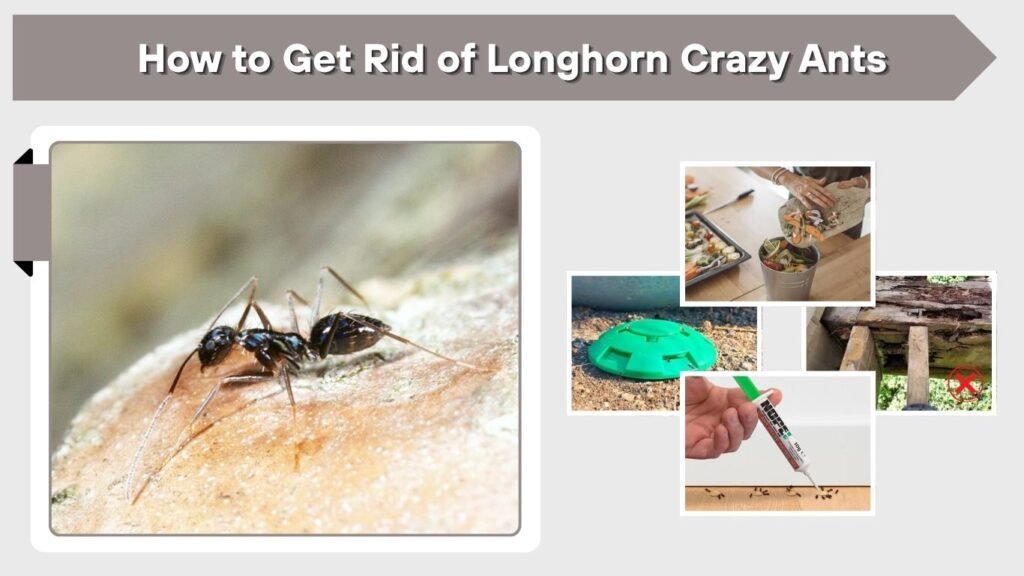
Complete eradication can be challenging because nests may be hidden and workers travel long distances. The best program combines several control methods.
1. Locate Active Trails
Observe where workers enter and leave the building. Follow them toward baseboards, landscaping, plant containers, plumbing openings, or outdoor debris. Avoid disturbing the trail before placing bait.
2. Remove Food and Moisture
Store food in sealed containers, clean spills, rinse recyclable containers, and empty garbage regularly. Repair leaking pipes and eliminate standing water.
Outdoors, remove fallen fruit and treat aphids or scale insects when necessary.
3. Reduce Nesting Sites
Move lumber, stones, pots, and debris away from the foundation. Thin excessive mulch and trim vegetation touching the building. Longhorn crazy ants frequently nest beneath objects and in accumulated litter.
4. Use Slow-Acting Bait
Place labeled ant bait near active foraging trails. Slow-acting bait allows workers to carry the active ingredient back to hidden colony members.
Because feeding preferences change, a bait that works initially may later become less attractive. A pest-management professional may use both carbohydrate-based and protein- or grease-based formulations.
Do not spray repellent insecticide directly on a baited trail. Sprays may kill foragers before they share the bait or cause the ants to avoid the area.
5. Seal Entry Points
Close gaps around windows, doors, pipes, wires, vents, and foundations. Repair damaged screens and add weather stripping where necessary.
6. Consider Professional Treatment
Professional assistance is appropriate when ants occupy several rooms, repeatedly return after treatment, or nest inside inaccessible structural spaces. A professional can identify the ant, evaluate the full infestation, and select treatments labeled for indoor and outdoor use.
FAQs
Are longhorn crazy ants and black crazy ants the same?
The longhorn crazy ant is often called the black crazy ant because workers are dark brown or nearly black. However, common names can be inconsistent. Identification should also consider the ant’s very long legs and antennae, slender shape, large eyes, and rapid movement.
Where did longhorn crazy ants originate?
Their exact native range remains uncertain. Earlier theories proposed either an African or Asian origin. Genetic research has provided evidence supporting a possible native range in parts of Southeast Asia, but the species has now been transported throughout tropical and subtropical regions worldwide.
Can longhorn crazy ants damage a house?
They do not normally damage wood like carpenter ants or consume structural materials like termites. Their main impacts are food contamination, nuisance infestations, and the protection of honeydew-producing plant pests. Large colonies may also occupy appliances and other protected indoor spaces.
Why are longhorn crazy ants difficult to eradicate?
Colonies may contain multiple queens and several interconnected nests. Workers travel far from nesting sites, and colonies can relocate or divide through budding. Killing visible workers may therefore have little effect on hidden queens, brood, and satellite nests.
What is the best bait for longhorn crazy ants?
The most effective bait depends on the colony’s current food preference. Workers may seek sugar at one time and protein or fat at another. Use a slow-acting product specifically labeled for ants and follow all placement and safety instructions on the label.