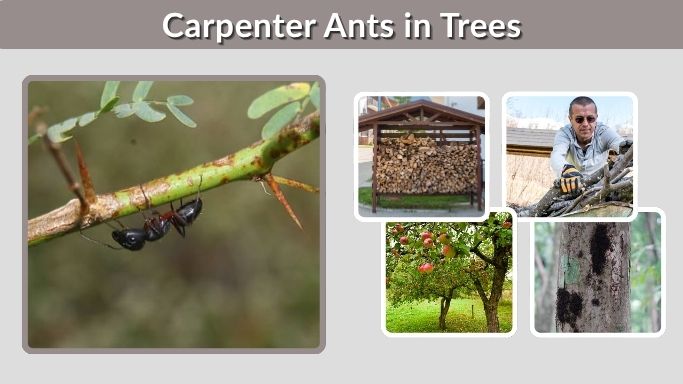
Carpenter ants in trees can worry homeowners, especially when the tree is near a house, deck, garage, or fence. These large black or reddish-black ants often nest in dead, moist, or decayed wood inside trunks, branches, roots, stumps, and logs. They do not eat wood like termites, but they excavate tunnels for nesting. This guide explains the signs of carpenter ants in trees, when they are a problem, and how to control them safely.
Do Carpenter Ants Live in Trees?
Yes, carpenter ants can live in trees. In fact, outdoor parent nests are often found in decaying wood, including trees, tree roots, stumps, logs, and buried wood. Carpenter ants may also create satellite nests closer to homes if moisture-damaged wood is available.
Carpenter ants usually prefer wood that is already weakened by decay, injury, moisture, or disease. They are not usually the original reason a tree became unhealthy. Instead, they often move into soft, dead, or rotting areas that already exist inside the tree.
Common Trees Where Carpenter Ants May Nest
Carpenter ants can appear in many types of trees, including:
- Oak trees
- Maple trees
- Apple trees
- Cherry trees
- Cedar trees
- Pine trees
- Willow trees
- Birch trees
- Ash trees
- Palm trees
- Dead trees and tree stumps
The tree species matters less than the condition of the wood. A damaged oak, maple, or apple tree with internal decay is more attractive than a healthy tree with solid wood.
Signs of Carpenter Ants in Trees
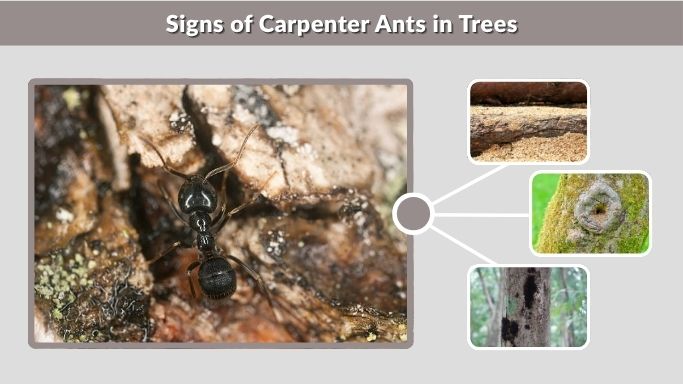
The most common signs of carpenter ants in trees include sawdust, ant trails, holes in the trunk, activity around cracks, and ants moving up and down the bark. Carpenter ants excavate smooth tunnels in moist or decayed wood and may create coarse sawdust around openings.
| Sign | What It May Mean |
| Coarse sawdust at tree base | Ants may be excavating tunnels inside |
| Ants entering holes or cracks | Possible nest entrance |
| Large black or red-black ants | Common carpenter ant appearance |
| Hollow trunk or branch | Internal decay may be present |
| Ant trails on bark | Workers are traveling to food or nest |
| Weak or breaking branches | Galleries may weaken already decayed wood |
Seeing a few ants on a tree does not always mean there is a serious infestation. Ants may simply be foraging for food, honeydew, or other insects. A nest is more likely when ants repeatedly enter the same hole, crack, branch cavity, or trunk opening.
Carpenter Ant Holes in Trees
Carpenter ant holes in trees are usually openings into existing cracks, cavities, wounds, or decayed areas. The ants may use these openings to push out wood debris and travel in and out of the nest.
Unlike termites, carpenter ants do not consume the wood. They remove wood to make nesting galleries. UC IPM explains that carpenter ants excavate wood to make nests rather than eating it like termites.
What the Holes May Look Like
Carpenter ant holes may appear as:
- Small openings in bark
- Cracks near branch unions
- Cavities in old wounds
- Openings near dead branches
- Holes with sawdust below
- Gaps in rotted trunk sections
If you see sawdust below a hole, watch the area during the evening or early morning. Carpenter ants are often more active during cooler, darker hours.
Carpenter Ant Nest in Tree
A carpenter ant nest in a tree is usually hidden inside decayed or hollow wood. The nest may be in the trunk, branch, roots, or an old wound where moisture has entered. The inside galleries are usually smooth and clean because carpenter ants remove debris from the nest.
A nest in a tree does not always mean the tree must be removed. Some hollow trees can live for years because the living tissue is near the outer part of the trunk. However, hollow or rotten trees can become structurally weak, especially if large limbs, the trunk, or root flare are affected.
Carpenter Ants in Tree Stump
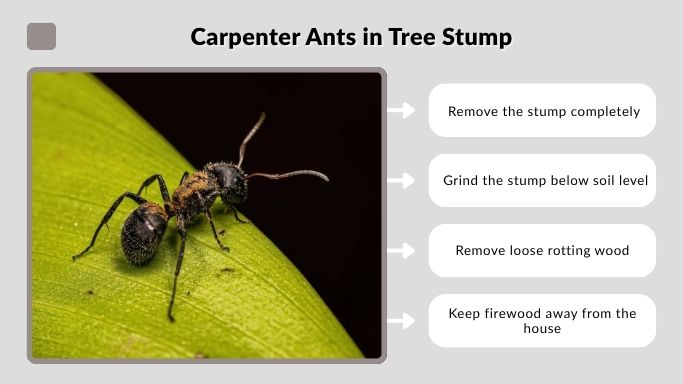
Carpenter ants in a tree stump are very common. A stump provides dead, moist wood that is easy for ants to tunnel through. Stumps, logs, and buried wood can also support outdoor colonies close to the house.
If the stump is far from buildings, it may not be urgent. But if the stump is near your home, deck, shed, fence, or garage, it can become a source of ants moving indoors.
What to Do With an Infested Stump
For a carpenter ant nest in a stump, you can:
- Remove the stump completely
- Grind the stump below soil level
- Remove loose rotting wood
- Keep firewood away from the house
- Avoid leaving logs against the foundation
- Watch for ant trails leading toward structures
Removing the stump is often the most permanent solution because it removes both the nest site and the decaying wood.
Carpenter Ants in Live Trees
Carpenter ants can be found in live trees, but they are usually nesting in dead or decayed parts of that tree. A live tree may still have hollow sections, old pruning wounds, storm damage, dead branches, root decay, or internal rot.
If you find carpenter ants in a live tree, the bigger question is not only “How do I kill the ants?” but also “Why is the tree decaying?” Carpenter ants may indicate that the tree has internal damage, moisture problems, disease, or structural weakness.
Are Carpenter Ants Killing the Tree?
Carpenter ants usually do not kill healthy trees directly. They are more likely to move into wood that is already dead, damp, or decayed. However, their galleries can weaken already compromised branches or trunk sections. UMN Extension notes that galleries in trees can weaken branches and cause them to break.
This means carpenter ants are often a warning sign. The ants may not be the original cause of the problem, but their presence can show that the tree needs inspection.
Carpenter Ants in Tree Near House
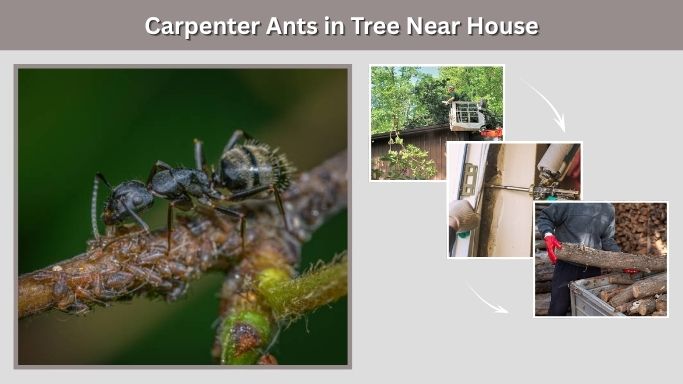
A carpenter ant nest in a tree near a house deserves extra attention. Workers can travel from outdoor nests to homes while searching for food. UMD Extension notes that carpenter ants found indoors may come from nests in the house or surrounding property, and workers may travel hundreds of feet from the nest.
Branches touching the roof, siding, gutters, or windows can act like bridges. Carpenter ants may use foliage, wires, pipes, and structural gaps to enter the house.
Reduce the Risk to Your Home
To reduce indoor carpenter ant problems:
- Trim branches away from the roof and siding
- Seal cracks around windows and doors
- Repair damaged screens
- Move firewood away from the house
- Fix roof leaks and plumbing leaks
- Keep mulch and soil away from wood siding
- Remove rotting logs and stumps near the foundation
- Check decks, porches, and fence posts for decay
Moisture control is very important. UC IPM recommends eliminating damp conditions, fixing leaks, improving drainage, and replacing decayed wood to help prevent carpenter ant infestations.
How to Get Rid of Carpenter Ants in Trees
The best way to get rid of carpenter ants in trees depends on whether the tree is healthy, decayed, dangerous, or close to your home. Do not only spray the outside of the trunk. Surface sprays may kill visible ants but miss the hidden nest inside the wood.
Step-by-Step Treatment Approach
Follow these steps:
- Confirm the pest is carpenter ants, not termites or another ant.
- Watch where ants enter and exit the tree.
- Look for sawdust, holes, cracks, and hollow areas.
- Check whether the tree is structurally safe.
- Remove nearby logs, stumps, and rotting wood.
- Trim branches touching the house.
- Fix moisture issues around nearby structures.
- Use bait or professional treatment if the colony is active.
- Call an arborist if the tree looks hollow, cracked, leaning, or weak.
- Call pest control if ants are entering the house.
If the tree is large, valuable, or near a structure, professional help is usually the safest option.
How to Get Rid of Carpenter Ants in Trees Naturally
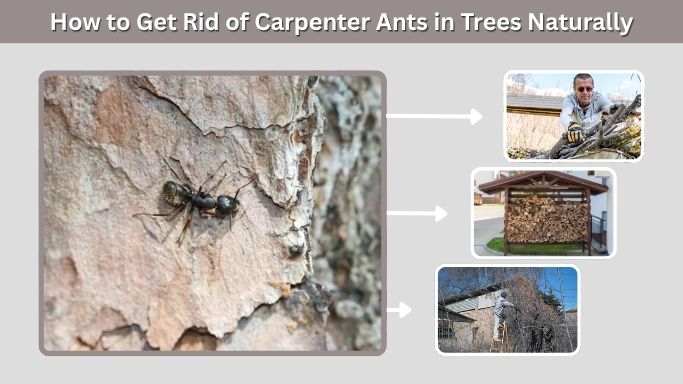
Natural control focuses on removing conditions that attract ants rather than simply killing visible workers. This is often the best first step, especially for live trees and trees near gardens.
Natural Control Methods
You can reduce carpenter ants naturally by:
- Removing dead wood and fallen branches
- Grinding or removing old stumps
- Keeping firewood off the ground
- Storing firewood away from the home
- Pruning dead branches correctly
- Reducing moisture around the tree base
- Improving drainage in wet areas
- Trimming branches away from buildings
- Managing aphids and scale insects that produce honeydew
Ants are often attracted to honeydew from aphids and scale insects on trees and shrubs. UC IPM recommends managing honeydew-producing pests because ants protect these insects and may become more active around trees.
Avoid pouring harsh chemicals, gasoline, bleach, or large amounts of boiling water into a live tree. These methods can damage the tree, contaminate soil, or create safety hazards.
How to Kill Carpenter Ants in a Tree
If the nest is active and the tree is near your home, treatment may be needed. The best option is usually ant bait or professional pest control. Baits work because foraging ants carry the material back to the colony, which can help reach ants hidden inside the nest.
For live trees, avoid drilling, injecting, or applying insecticides without proper product labeling and local guidance. Misusing insecticides can harm beneficial insects, soil, pets, people, and the tree itself.
| Situation | Best Action |
| Ants in dead stump | Remove or grind stump |
| Ants in live healthy-looking tree | Inspect for decay and monitor |
| Ants in hollow or cracked tree | Call an arborist |
| Ants entering house from tree | Call pest control and trim branches |
| Ants with sawdust at trunk base | Check for nest and internal decay |
| Tree near power lines or structure | Do not DIY removal; call a professional |
If the tree is structurally weak, killing the ants will not fix the wood. The tree may still need pruning, bracing, treatment, or removal.
Carpenter Ants in Oak, Maple, Apple, and Other Trees
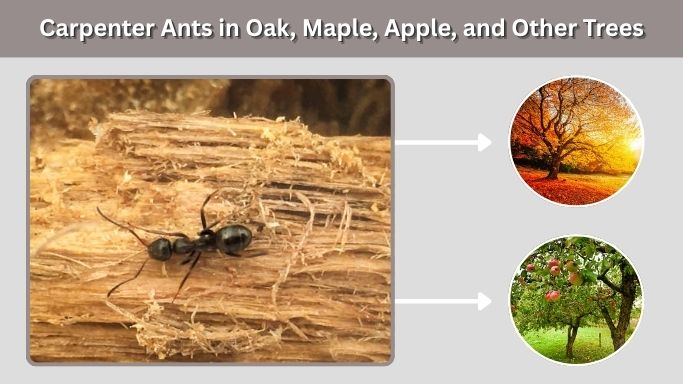
Carpenter ants may appear in many tree species, but the signs are usually similar. Oak and maple trees may develop cavities from old wounds, storm damage, pruning cuts, or decay. Apple and cherry trees may attract ants if there are cracks, old branch wounds, fruit debris, or aphid activity.
In pine, cedar, willow, birch, ash, or palm trees, carpenter ants may use soft or decayed areas. The key is to inspect the exact entry point and determine whether the ants are nesting or only foraging.
When to Worry About a Specific Tree
Be more concerned if the tree has:
- A large hollow trunk
- Mushrooms or fungal growth near the base
- Cracks in the trunk
- Dead major limbs
- Carpenter ant sawdust piles
- Leaning or root damage
- Branches hanging over the roof
- Ants entering the house nearby
For large shade trees, hire a certified arborist before deciding to remove the tree.
Carpenter Ants in Trees Treatment: When to Call a Pro
You should call a professional if the tree is large, close to the house, near power lines, visibly hollow, leaning, or dropping branches. An arborist can judge tree safety, while a pest control professional can identify and treat the ant colony.
A guide from UMD Extension says that if about one-third of a tree’s interior is hollow or rotten, removal may be needed because trunk strength can be compromised.
Professional help is especially important when carpenter ants are both in the tree and inside the home. That may mean there is an outdoor parent colony and one or more indoor satellite nests.
FAQs
Do carpenter ants live in trees?
Yes, carpenter ants can live in trees, tree roots, stumps, logs, and decayed wood. Outdoor parent nests are commonly found in dead or rotting wood. They often use wood that is already damaged by moisture or decay.
What are the signs of carpenter ants in trees?
Common signs include large black or reddish-black ants, coarse sawdust at the base of the tree, ants entering holes or cracks, hollow areas, and activity around old wounds or dead branches.
How do I get rid of carpenter ants in a tree?
First, confirm the ants are nesting in the tree. Remove nearby dead wood, fix moisture problems, trim branches away from structures, and consider bait or professional treatment. If the tree is hollow or unsafe, call an arborist.
Are carpenter ants killing my tree?
Carpenter ants usually do not kill healthy trees directly. They often nest in wood that is already dead, damp, or decayed. However, their tunnels can weaken damaged branches or hollow sections.
Should I remove a tree with carpenter ants?
Not always. A tree with carpenter ants may still be alive and stable. However, if the tree is hollow, cracked, leaning, dropping limbs, or close to a house, have it inspected by a certified arborist.