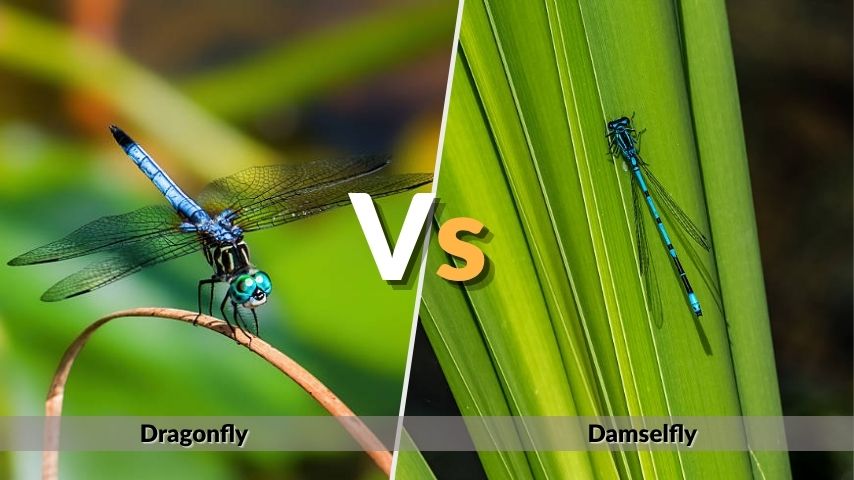
Damselflies and dragonflies look similar at first, especially when they are flying near ponds, lakes, rivers, and wetlands. Both are beautiful insects with long bodies, large eyes, and clear wings. They also belong to the same insect order, Odonata. However, when you compare damselfly vs dragonfly features closely, the differences become much easier to see.
The fastest way to tell them apart is to look at the wings, eyes, body shape, and resting position. Dragonflies are usually stronger, bulkier insects that hold their wings open when resting. Damselflies are usually slimmer, more delicate insects that often fold their wings together above the body.
Damselfly vs Dragonfly: Quick Comparison
The main difference between a damselfly and a dragonfly is body structure. Dragonflies usually have broader bodies, larger eyes that touch or nearly touch, and wings held open at rest. Damselflies usually have slender bodies, separated eyes, and wings folded together when resting.
| Feature | Dragonfly | Damselfly |
|---|---|---|
| Body shape | Thicker and more robust | Slim and delicate |
| Eyes | Very large, often touching or nearly touching | Separated with a clear gap |
| Wings at rest | Held open flat or slightly downward | Usually folded together above body |
| Wing shape | Hind wings broader than front wings | Front and hind wings similar in shape |
| Flight | Strong, fast, direct | Lighter, fluttering, weaker |
| Nymph body | Stocky or rounded | Slender with tail gills |
This table gives the basic answer, but each difference becomes clearer when you know what to look for in the field.
What Is a Dragonfly?
A dragonfly is a strong-flying insect in the order Odonata and suborder Anisoptera. Dragonflies are often seen patrolling ponds, marshes, lakes, streams, and garden water features. They are active hunters that catch flying insects such as mosquitoes, flies, gnats, and midges.
Dragonflies usually have thick bodies, large eyes, and powerful wings. They can hover, fly backward, turn quickly, and chase prey at high speed. Many species perch on reeds, sticks, rocks, or open ground between flights.
Adult dragonflies are often easier to notice than damselflies because they are larger, faster, and more direct in flight. Some are brightly colored, while others are brown, green, blue, red, or black.
What Is a Damselfly?
A damselfly is also an insect in the order Odonata, but it belongs to the suborder Zygoptera. Damselflies are generally slimmer and more delicate than dragonflies. They are often found near ponds, streams, marshes, and wetland vegetation.
Damselflies usually fly more slowly and lightly. Many species stay close to plants and rest on stems or leaves. Their bodies may be blue, green, red, brown, black, or metallic, depending on the species.
The easiest field clue is their resting posture. Most damselflies fold their wings together over the abdomen when perched. Their eyes are also clearly separated, giving the head a wider, more “hammer-like” appearance.
Damselfly vs Dragonfly Wings
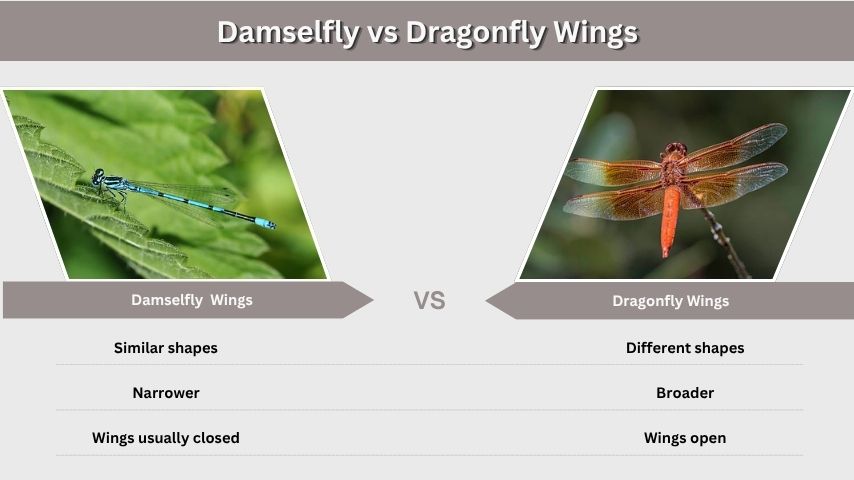
Wings are one of the best ways to compare dragonfly vs damselfly insects. Dragonflies have two pairs of wings, but the hind wings are usually broader at the base than the front wings. This helps them fly powerfully and cover more distance.
Damselflies also have two pairs of wings, but the front and hind wings are usually similar in size and shape. Most damselflies hold their wings closed above the body when resting.
| Wing Feature | Dragonfly | Damselfly |
|---|---|---|
| Front and hind wings | Different shapes | Similar shapes |
| Hind wing base | Broader | Narrower |
| Resting position | Wings open | Wings usually closed |
| Flight power | Strong and fast | Gentle and fluttery |
| Long-distance flight | Often stronger | Usually shorter and weaker |
There are exceptions. Some damselflies, such as spreadwings, rest with wings partly open. Even so, their slim body and separated eyes usually make them easy to distinguish from dragonflies.
Dragonfly vs Damselfly Eyes
Eye position is another reliable difference. Dragonfly eyes are huge and take up much of the head. In many dragonflies, the eyes touch or nearly touch at the top of the head.
Damselfly eyes are also large, but they are separated by a noticeable gap. This gives damselflies a wider-looking head compared with their thin body.
A simple rule:
- Eyes touching or almost touching: probably a dragonfly
- Eyes clearly separated: probably a damselfly
This difference is especially useful when the insect is resting and you can get a close look without disturbing it.
Body Shape and Size
Dragonflies are usually larger and stronger-looking. Their bodies are often thick, sturdy, and built for fast flight. Some species are long and slender, but they still usually look more powerful than damselflies.
Damselflies are usually thinner, lighter, and more delicate. Their abdomen often looks like a fine twig or thread. Even colorful damselflies usually have a fragile appearance compared with dragonflies.
Common body differences include:
- Dragonflies have broader bodies.
- Damselflies have slimmer bodies.
- Dragonflies often look muscular.
- Damselflies look more delicate.
- Dragonflies are often easier to spot from a distance.
- Damselflies often blend into plants and stems.
Dragonfly vs Damselfly Flight
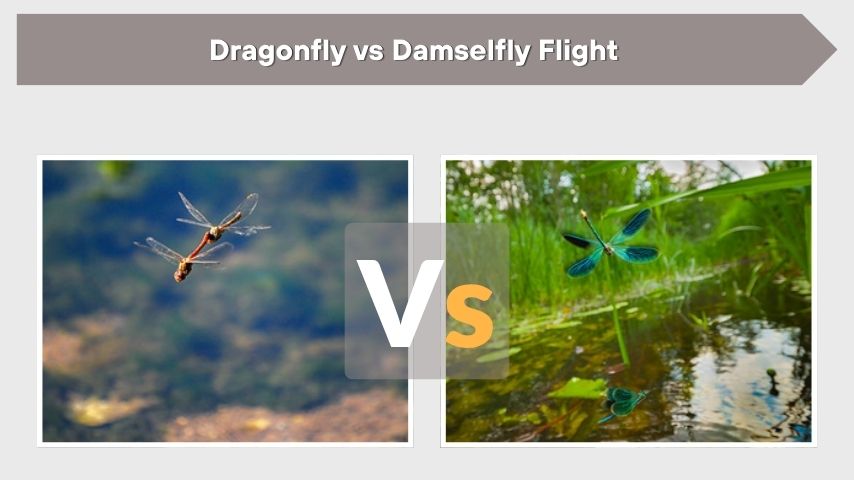
Dragonflies are among the strongest fliers in the insect world. They can hover, dart, turn sharply, fly backward, and chase prey in open air. Many dragonflies patrol a territory repeatedly, flying back and forth over water.
Damselflies fly more softly. Their flight is often slower, fluttering, and less direct. They usually stay closer to vegetation and make shorter flights between perches.
This difference in flight style is useful when the insect will not land long enough for you to inspect its wings or eyes. A fast insect patrolling open water is more likely to be a dragonfly. A delicate insect fluttering among reeds is more likely to be a damselfly.
Damselfly vs Dragonfly Behavior
Both dragonflies and damselflies are predators. Adults hunt smaller flying insects, while their young live in water and hunt aquatic prey. However, their behavior can look different.
Dragonflies often behave like aerial hunters. They patrol open spaces, chase rivals, and defend territories. Males may repeatedly return to the same perch or flight path.
Damselflies often remain closer to vegetation. They may perch on grasses, reeds, or low plants, then make short flights to catch small prey. Many damselflies are less aggressive in flight than dragonflies.
Both insects are beneficial because they eat mosquitoes, midges, and other small insects.
Damselfly Nymph vs Dragonfly Nymph
The immature stage is one of the clearest differences between the two groups. Both dragonfly and damselfly young are aquatic and are often called nymphs or larvae. However, their body shapes and gills are different.
Dragonfly nymphs are usually stockier. They breathe with internal rectal gills and often look broad, rounded, or torpedo-shaped. Damselfly nymphs are usually slender and have three leaflike external gills at the tip of the abdomen.
| Feature | Dragonfly Nymph | Damselfly Nymph |
|---|---|---|
| Body shape | Stocky, broad, or chunky | Slim and narrow |
| Gills | Internal rectal gills | Three external tail gills |
| Movement | Crawls, stalks, or jet-propels | Swims with slender body and gills |
| Habitat | Mud, pond bottom, plants | Plants, stems, shallow water |
| Hunting | Ambush predator | Ambush predator |
The three tail gills are the easiest way to identify a damselfly nymph. If the aquatic insect has a slender body and three leaflike structures at the end, it is likely a damselfly nymph.
Damselfly vs Dragonfly Larvae
The terms larvae and nymphs are often used interchangeably in everyday writing. Scientifically, “nymph” is usually more accurate for dragonflies and damselflies because they have incomplete metamorphosis. They do not go through a pupal stage like butterflies.
Dragonfly larvae are aquatic predators with strong mouthparts. They may eat mosquito larvae, aquatic insects, tadpoles, worms, and small fish fry. Damselfly larvae also hunt small aquatic prey, but they are usually slimmer and often live among plants.
Both types are important in freshwater food webs. They control small aquatic animals and also become food for fish, frogs, birds, and larger insects.
Damselfly vs Dragonfly Habitat
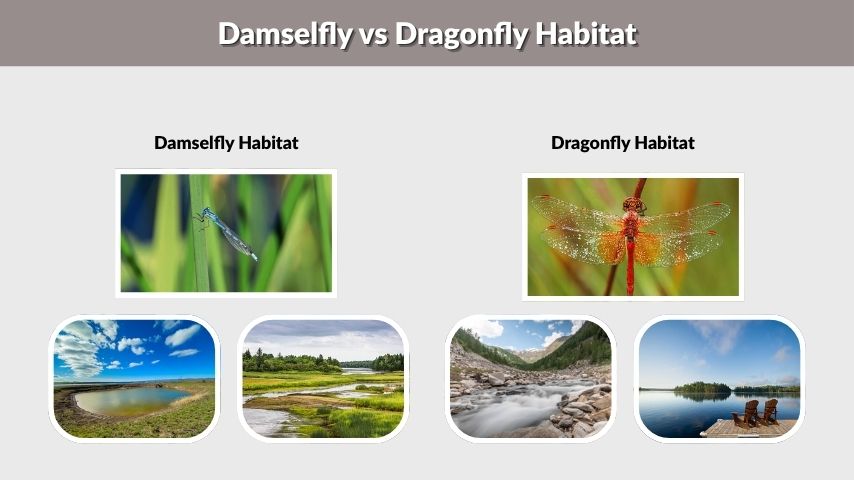
Dragonflies and damselflies both need freshwater for reproduction. Their eggs and nymphs develop in water, so adults are usually found near ponds, lakes, wetlands, rivers, streams, ditches, or marshes.
Dragonflies are often seen flying over open water, sunny paths, meadows, and pond edges. Some species travel far from water while hunting.
Damselflies are often found closer to plants, grasses, reeds, and shaded edges. Many species prefer slow water, pond margins, or vegetation-rich habitats.
Good habitats for both include:
- Clean ponds
- Wetlands
- Slow streams
- Lakeshores
- Aquatic plants
- Sunny perches
- Shallow water edges
- Low pesticide use
A healthy pond may support both dragonflies and damselflies at the same time.
Damselfly vs Dragonfly vs Mayfly
Some people also compare damselflies, dragonflies, and mayflies. Mayflies are different insects and belong to a different order, Ephemeroptera. They are usually more delicate, have shorter adult lives, and often hold their wings upright when resting.
Mayflies also have long tail filaments, usually two or three, at the end of the body. Dragonflies and damselflies do not have long adult tails like mayflies.
Simple comparison:
- Dragonfly: strong body, wings open, powerful flight
- Damselfly: slim body, wings usually folded, gentle flight
- Mayfly: delicate body, upright wings, long tail filaments
Mayfly adults are often short-lived and mostly focused on mating. Dragonflies and damselflies are active predators as adults.
Who Would Win: Damselfly vs Dragonfly?
In a “damselfly vs dragonfly who would win” comparison, a dragonfly would usually have the advantage. Dragonflies are generally larger, stronger, and faster. They are powerful aerial predators and can catch many flying insects.
However, this is not a normal or useful way to understand them. Damselflies and dragonflies usually occupy slightly different niches. Both are predators, both help control insect populations, and both are important parts of freshwater ecosystems.
A large dragonfly might eat a small damselfly if it catches one, but most of the time they are simply sharing the same habitat.
Easy Way to Tell Them Apart
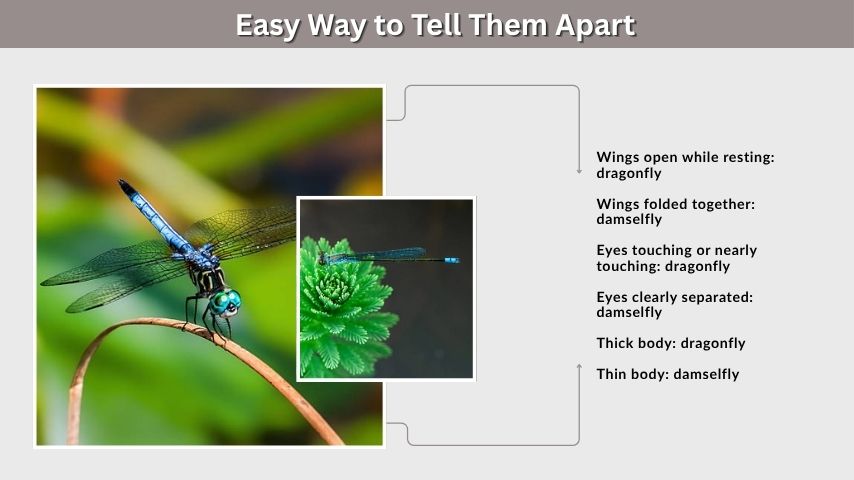
Use this quick field checklist:
- Wings open while resting: dragonfly
- Wings folded together: damselfly
- Eyes touching or nearly touching: dragonfly
- Eyes clearly separated: damselfly
- Thick body: dragonfly
- Thin body: damselfly
- Fast, strong flight: dragonfly
- Soft, fluttery flight: damselfly
- Stocky nymph with no tail gills: dragonfly
- Slender nymph with three tail gills: damselfly
If you remember only one thing, look at the wings at rest. That is usually the quickest clue.
FAQs
What is the main difference between a damselfly and a dragonfly?
The main difference is body and wing position. Dragonflies are usually larger and hold their wings open when resting. Damselflies are usually slimmer and often fold their wings together above the body.
How can you tell a dragonfly from a damselfly?
Look at the eyes, wings, and body. Dragonflies have large eyes that often touch, thicker bodies, and open wings at rest. Damselflies have separated eyes, thin bodies, and usually closed wings when resting.
What is the difference between dragonfly and damselfly nymphs?
Dragonfly nymphs are usually stocky and breathe with internal rectal gills. Damselfly nymphs are slimmer and have three external leaflike gills at the end of the abdomen.
Are damselflies and dragonflies related?
Yes, damselflies and dragonflies are closely related. Both belong to the insect order Odonata. Dragonflies are in the suborder Anisoptera, while damselflies are in the suborder Zygoptera.
Are dragonflies stronger than damselflies?
In general, yes. Dragonflies are usually stronger and faster fliers than damselflies. Damselflies tend to be smaller, lighter, and more delicate, with a softer fluttering flight.