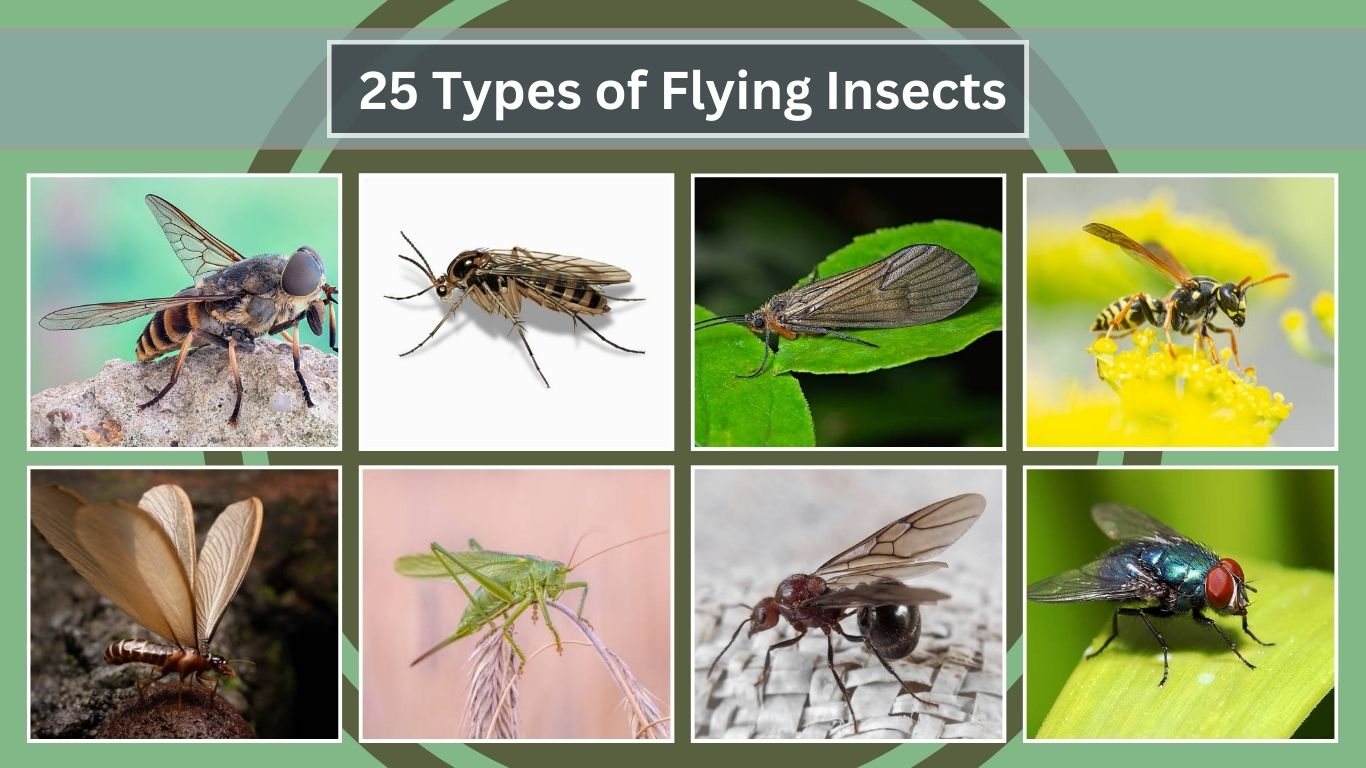
Flying insects make up one of the most fascinating and diverse groups in the animal kingdom. From delicate butterflies and dragonflies to biting mosquitoes and powerful hornets, each species plays a unique role in ecosystems worldwide. Some are important pollinators, while others act as predators or decomposers. This list highlights 25 different types of flying insects, their traits, habitats, and where they are commonly found, offering a complete guide to their diversity.
1. Dragonfly

Dragonflies are fast and agile flying insects known for their large eyes, elongated bodies, and strong wings. They are among the oldest insect species, with fossils dating back millions of years. Dragonflies play a vital role in controlling mosquito populations and are often found near water bodies.
Identification
- Long slender body, often brightly colored
- Two pairs of strong, transparent wings
- Very large compound eyes covering most of the head
- Can grow up to 2–5 inches in length
Habitat
Dragonflies thrive near freshwater sources like ponds, lakes, rivers, and wetlands. They require water bodies for breeding, as their larvae (nymphs) develop underwater.
Flying and Diet
Dragonflies are powerful fliers, capable of hovering, flying backward, and darting quickly. Their diet mainly consists of mosquitoes, flies, gnats, moths, and other small insects, making them excellent natural pest controllers.
Commonly Found Area
Dragonflies are found worldwide, with the highest diversity in tropical regions. They are especially common in Asia, Africa, and North America, often seen during warm months around water-rich environments.
2. Damselfly

Damselflies are delicate flying insects closely related to dragonflies but smaller and slimmer. They are graceful fliers and usually rest with their wings closed along their bodies.
Identification
- Slender body, thinner than dragonflies
- Two pairs of narrow, transparent wings held together at rest
- Large compound eyes, spaced apart on the sides of the head
- Typically measure 1–2 inches in length
Habitat
They inhabit areas near ponds, lakes, rivers, and marshes. Like dragonflies, their larvae develop underwater.
Flying and Diet
Damselflies are weaker fliers compared to dragonflies. They feed on mosquitoes, small flies, and other tiny insects caught during flight.
Commonly Found Area
Damselflies are distributed worldwide, with high populations in tropical and subtropical regions, often around freshwater habitats.
3. Butterfly

Butterflies are colorful insects admired for their beauty and ecological role as pollinators. They belong to the order Lepidoptera and are diurnal, flying mainly during the day.
Identification
- Two pairs of large, brightly colored wings with scales
- Slender body and long antennae with clubbed tips
- Undergo complete metamorphosis (egg, larva, pupa, adult)
- Wing span varies from 0.5 to 12 inches depending on the species
Habitat
Butterflies live in gardens, forests, grasslands, meadows, and near flowering plants. They prefer sunny, open areas with abundant nectar sources.
Flying and Diet
They are strong fliers, though flight speed and patterns vary by species. Adult butterflies mainly feed on nectar, while caterpillars consume leaves and plant material.
Commonly Found Area
Butterflies are found on every continent except Antarctica, with the greatest diversity in tropical regions such as South America, Africa, and Asia.
4. Moth

Moths are nocturnal insects belonging to the order Lepidoptera, closely related to butterflies. They are extremely diverse, with over 160,000 recognized species, ranging from tiny micro-moths to large, colorful silk moths. Unlike butterflies, moths are generally active at night and are strongly attracted to artificial light sources.
Identification
- Two pairs of scaly wings, usually dull, gray, or brown in color (though some are brightly patterned)
- Antennae are feathery or threadlike, not clubbed like butterflies
- Stout, furry body compared to slender butterflies
- Resting posture with wings spread flat or folded tent-like over the body
- Size varies widely: from a few millimeters to over 30 cm in wingspan
Habitat
Moths inhabit a wide range of environments including forests, grasslands, wetlands, gardens, agricultural fields, and even homes. Their larvae, called caterpillars, feed on plants, fabrics, stored grains, or natural fibers, making them ecologically important but sometimes destructive to crops and clothing.
Flying and Diet
Moths are usually weak, fluttery fliers, though some species are strong travelers capable of long migrations. Their diet includes:
- Adults: Nectar, fruit juices, tree sap, and in some cases, they do not feed at all
- Larvae (caterpillars): Leaves, fruits, crops, wool, silk, cotton, and stored grains
Commonly Found Area
Moths are found all over the world, except Antarctica. They are most abundant in tropical and subtropical climates, but also thrive in temperate regions across North America, Europe, Asia, and Africa.
5. Mosquito

Mosquitoes are small, delicate flying insects belonging to the family Culicidae. They are infamous for their bites and role in spreading dangerous diseases like malaria, dengue, Zika, and West Nile virus. Despite their reputation, they also play ecological roles, serving as food for birds, fish, and bats.
Identification
- Small, slender body about 3–6 mm long
- Long, thin legs
- One pair of narrow, scaled wings
- Females have elongated proboscis for piercing skin and feeding on blood
- Characteristic high-pitched buzzing sound during flight
Habitat
Mosquitoes thrive in warm, humid environments. They breed in stagnant or slow-moving water sources such as ponds, marshes, puddles, flowerpots, and discarded containers. Larvae, called “wrigglers,” live in water until adulthood.
Flying and Diet
Mosquitoes are weak fliers, often moving short distances, but some species can travel several miles in search of food. Their diet varies by sex:
- Males: Feed only on nectar and plant juices
- Females: Feed on nectar but require blood meals from mammals, birds, reptiles, or amphibians to develop eggs
Commonly Found Area
Mosquitoes are found worldwide except Antarctica. They are most abundant in tropical and subtropical regions but also thrive in temperate climates, especially near wetlands and populated areas.
6. Housefly

Houseflies (Musca domestica) are among the most widespread insects in the world and live closely alongside humans. They are known for their rapid breeding, short life cycle, and role in spreading diseases because they feed and breed in unsanitary places.
Identification
- Small, grayish body about 6–7 mm long
- Four distinct dark stripes on the thorax
- One pair of wings with halteres (balancing organs) behind them
- Large, reddish compound eyes covering most of the head
- Sponging-type mouthparts for sucking up liquids
Habitat
Houseflies thrive in human environments, particularly where there is food waste, garbage, or animal manure. They lay eggs in decaying organic matter, garbage heaps, and moist areas where their larvae (maggots) can grow.
Flying and Diet
Houseflies are quick, erratic fliers capable of short bursts of speed. Their diet consists of:
- Adults: Liquids such as sugary substances, food scraps, decaying matter, and animal waste (they regurgitate digestive fluids to liquefy solid food before consumption)
- Larvae (maggots): Feed on rotting organic material where they hatch
Commonly Found Area
Houseflies are found on every continent except Antarctica. They are especially abundant in cities, farms, markets, and rural areas worldwide, where humans and animals provide food sources and breeding grounds.
7. Horsefly

Horseflies (family Tabanidae) are large, strong-flying insects known for their painful bites. Females are blood-feeders, while males live on nectar. They are often considered pests to both humans and livestock, but they also play a role in pollination.
Identification
- Large body, usually 10–25 mm long, some species even bigger
- Broad head with large, brightly patterned compound eyes
- Sturdy body with dark or striped markings
- Clear or dark wings depending on the species
- Females have sharp, blade-like mouthparts for cutting skin and sucking blood
Habitat
Horseflies are commonly found near wetlands, lakes, rivers, and damp meadows where conditions are suitable for their larvae. They often stay close to livestock, farms, and woodland edges. Their larvae develop in moist soil or aquatic environments, feeding on small invertebrates.
Flying and Diet
Horseflies are among the strongest fliers of the insect world. They are capable of chasing moving animals and even vehicles.
- Females: Feed on the blood of mammals, including cattle, horses, deer, and humans, to develop eggs
- Males: Feed on nectar and plant juices, playing a role in pollination
Commonly Found Area
Horseflies are found worldwide, with the greatest numbers in warm, humid regions. They are especially common in North America, Europe, Asia, and Africa, particularly in rural areas with livestock and wetlands.
8. Fruit Fly

Fruit flies (Drosophilidae family) are tiny insects well known for infesting ripe and fermenting fruits. They are also one of the most studied organisms in genetics and biology because of their short life cycle and simple genome.
Identification
- Very small size, about 3–4 mm long
- Light brown or yellowish body
- Distinctive red or dark compound eyes
- Clear wings with minimal vein patterns
- Short life cycle, usually a few weeks
Habitat
Fruit flies prefer moist, fermenting environments. They are commonly found in kitchens, restaurants, compost heaps, fruit markets, and anywhere fruits, vegetables, or sugary liquids are stored. They lay eggs in overripe or decaying organic matter where larvae feed.
Flying and Diet
Fruit flies have weak but fast, darting flight. They often hover in swarms around food sources.
- Adults: Feed on yeast and microorganisms growing on fermenting fruits and sugary liquids
- Larvae: Consume decaying fruits, vegetables, and other organic matter where they hatch
Commonly Found Area
Fruit flies are distributed worldwide, thriving in both tropical and temperate regions. They are especially abundant in human habitations where fruits, vegetables, and sweet beverages are available.
9. Bee

Bees are one of the most important groups of flying insects, belonging to the superfamily Apoidea. They are famous for their role as pollinators, and some species, such as honeybees, also produce honey and wax. With more than 20,000 species worldwide, bees vary greatly in size, color, and behavior.
Identification
- Medium-sized body with three clear segments: head, thorax, and abdomen
- Usually black and yellow striped, though some are metallic blue, green, or solid black
- Hairy bodies that help collect pollen
- Two pairs of wings, with hind wings smaller than the forewings
- Antennae bent and segmented
- Females typically have stingers
Habitat
Bees inhabit forests, meadows, gardens, deserts, and grasslands. Social species, like honeybees and bumblebees, live in colonies within hives or underground nests. Solitary bees, such as mason and carpenter bees, nest individually in soil, wood, or plant stems.
Flying and Diet
Bees are strong, purposeful fliers, capable of hovering and quick directional changes.
- Adults: Feed primarily on nectar (energy source) and pollen (protein source)
- Larvae: Fed with a mixture of nectar and pollen, often called “bee bread”
Honeybees store nectar as honey to feed the colony through the year.
Commonly Found Area
Bees are found worldwide except Antarctica. They are most diverse in regions rich in flowering plants, especially in tropical and temperate zones. North America, South America, Africa, Europe, and Asia host thousands of species, each adapted to its environment.
10. Wasp

Wasps are a diverse group of flying insects belonging to the order Hymenoptera. Unlike bees, most wasps do not produce honey, but they are important in ecosystems as pollinators and natural pest controllers. Wasps range from solitary species to highly social colony builders like yellowjackets.
Identification
- Slender, elongated body with a narrow waist between thorax and abdomen
- Smooth, shiny exoskeleton (unlike the hairy body of bees)
- Two pairs of transparent wings, with hind wings smaller
- Bright coloration—commonly black with yellow, red, or white markings
- Females have a stinger, often used multiple times
Habitat
Wasps can be found in forests, grasslands, gardens, and urban areas. Their nests are made from chewed wood fibers (paper wasps), mud (mud daubers), or dug underground (yellowjackets). Social species live in colonies, while solitary species build individual nests.
Flying and Diet
Wasps are fast, agile fliers with precise control in the air. Their diet includes:
- Adults: Nectar, fruit, honeydew, and sugary substances
- Larvae: Fed with captured prey such as caterpillars, spiders, and other insects brought by adults
Parasitic wasps lay eggs inside host insects, and their larvae feed internally.
Commonly Found Area
Wasps are found worldwide except Antarctica. They are especially abundant in temperate and tropical regions. North America, Europe, and Asia are home to well-known species such as hornets, paper wasps, and yellowjackets.
11. Hornet

Hornets are large, social wasps in the genus Vespa. They are known for their strong stings, large size, and aggressive defense of their nests. While feared, they are also beneficial as natural pest controllers, feeding on many insects that harm crops and gardens.
Identification
- Large, robust body—typically 1–2 inches long
- Broad head with powerful mandibles
- Distinctive black-and-yellow or brown-and-orange striped abdomen
- Two pairs of clear wings, forewings larger than hindwings
- Smooth stinger, allowing females to sting multiple times
Habitat
Hornets usually build large, enclosed paper nests created from chewed wood fibers mixed with saliva. These nests can be found in trees, shrubs, attics, wall voids, and sometimes underground. Colonies are structured with a queen, workers, and drones, similar to bee colonies.
Flying and Diet
Hornets are strong, rapid fliers, capable of chasing intruders over distances. Their diet includes:
- Adults: Sap, nectar, fruit, and sugary substances
- Larvae: Fed on protein-rich prey such as flies, caterpillars, grasshoppers, and even other wasps, caught and chewed by adult workers
Commonly Found Area
Hornets are native to Europe, Asia, and Africa, but some species have spread to North America. The European hornet (Vespa crabro) is widespread, while the Asian giant hornet (Vespa mandarinia), the world’s largest hornet, is found in East Asia.
12. Gnat

Gnats are small flying insects that belong to several families within the order Diptera. They are delicate, long-legged flies that often appear in swarms, especially around moist environments. While many species are harmless, some bite and can be serious pests to humans, livestock, and crops.
Identification
- Tiny size, usually 1–5 mm long
- Slender, fragile body with long legs and antennae
- Transparent or slightly veined wings
- Often confused with very small mosquitoes
- Some species have biting mouthparts
Habitat
Gnats thrive in damp, shaded environments. Outdoors, they are found in wetlands, forests, gardens, and near water sources. Indoors, fungus gnats commonly infest houseplants, breeding in the moist soil. They lay eggs in decaying organic matter, compost, or damp vegetation.
Flying and Diet
Gnats are weak fliers with erratic, swarming movements. Their diet varies by species:
- Non-biting gnats: Feed on nectar, fungi, and decaying organic matter
- Biting gnats (e.g., black flies, midges, sand flies): Females feed on blood to produce eggs, while males usually feed on plant juices
Commonly Found Area
Gnats are found worldwide in both temperate and tropical climates. They are especially common in gardens, wetlands, near livestock, and inside homes with damp houseplant soil.
13. Midge

Midges are tiny two-winged insects belonging to several families within the order Diptera. They resemble mosquitoes but are usually smaller. While many species are harmless, some biting midges (often called “no-see-ums” or “sand flies”) can cause painful bites and transmit diseases.
Identification
- Small, delicate body, usually 1–3 mm long
- Slender legs and narrow wings with fine veins
- Some species have feathered antennae
- Often swarm in large numbers, especially near water
- Can be confused with gnats or mosquitoes
Habitat
Midges thrive in moist, aquatic, or semi-aquatic habitats. Non-biting midges often breed in lakes, ponds, rivers, and wetlands, while biting midges prefer damp soil, coastal marshes, or muddy areas where they lay eggs. Larvae develop in water or moist organic matter.
Flying and Diet
Midges are weak fliers, commonly seen swarming in clouds, especially at dusk.
- Non-biting midges: Feed on nectar and plant sap, playing an important role in pollination
- Biting midges: Males feed on nectar, while females require blood meals from mammals, birds, or reptiles to produce eggs
Commonly Found Area
Midges are found worldwide, from tropical regions to the Arctic. They are most abundant in areas with abundant water sources such as lakes, rivers, wetlands, and coastal marshes. Large swarms are common in summer evenings near water bodies.
14. Crane Fly

Crane flies are slender, long-legged insects belonging to the family Tipulidae. They are often mistaken for giant mosquitoes, but they do not bite or sting. Despite their delicate appearance, crane flies are harmless and play roles in both ecosystems and as a food source for birds, fish, and amphibians.
Identification
- Large size compared to other flies, body length 1–3 cm, wingspan up to 6 cm
- Extremely long, fragile legs that break off easily when handled
- Narrow body, usually brown or gray in color
- Long, straight antennae
- Wings often transparent with subtle vein patterns
Habitat
Crane flies prefer moist environments. They are commonly found near ponds, streams, marshes, wetlands, and damp soil. Their larvae, called “leatherjackets,” live in soil or aquatic habitats, feeding on roots, decaying vegetation, and organic matter.
Flying and Diet
Crane flies are weak, clumsy fliers, often seen bouncing or wobbling in the air.
- Adults: Do not bite; many species feed on nectar or do not feed at all due to their short lifespan
- Larvae (leatherjackets): Feed on plant roots, grass, algae, fungi, and decaying matter, sometimes causing lawn and crop damage
Commonly Found Area
Crane flies are found worldwide, especially in temperate and moist regions. They are very common in North America, Europe, and Asia, frequently seen around lights at night during warm, wet seasons.
15. Cicada

Cicadas are medium to large flying insects belonging to the family Cicadidae. They are best known for their loud, buzzing songs produced by males and for their unique life cycles, with some species emerging only once every 13 or 17 years.
Identification
- Body length typically 2–5 cm, though some tropical species grow larger
- Stout body with large, membranous, transparent wings
- Prominent, bulging compound eyes set wide apart
- Distinctive sound-producing organs (tymbals) on the abdomen of males
- Nymphs live underground with strong, digging forelegs
Habitat
Cicadas are usually found in warm, temperate, and tropical regions. They live in woodlands, forests, gardens, and orchards. Nymphs spend most of their lives underground, feeding on sap from tree roots, before emerging as adults to reproduce.
Flying and Diet
Cicadas are clumsy fliers, often moving short distances before resting on trees or shrubs.
- Adults: Feed on plant sap, piercing stems and twigs with their specialized mouthparts
- Nymphs: Feed underground on the xylem fluids of tree roots for years before molting into adults
Commonly Found Area
Cicadas are distributed worldwide, with the highest diversity in tropical regions. They are especially common in North America, Australia, Asia, and Africa. Periodical cicadas, found mainly in the United States, are famous for emerging in massive synchronized broods after 13 or 17 years underground.
16. Leafhopper

Leafhoppers are small, agile flying insects belonging to the family Cicadellidae. They are plant feeders and are notorious agricultural pests because they transmit plant diseases and cause leaf damage through their feeding.
Identification
- Small body size, usually 3–15 mm long
- Wedge-shaped body, tapering toward the rear
- Strong hind legs adapted for jumping
- Two pairs of membranous wings, often held roof-like over the body at rest
- Bright coloration in some species, including green, yellow, or patterned markings
Habitat
Leafhoppers inhabit a wide variety of environments including forests, grasslands, gardens, orchards, and agricultural fields. They live on the stems and leaves of plants, where they pierce and suck plant sap.
Flying and Diet
Leafhoppers are quick, agile fliers but are more famous for their powerful jumping ability.
- Adults and Nymphs: Feed exclusively on plant sap by piercing leaves and stems with needle-like mouthparts
Their feeding often causes leaf curling, yellowing, and stunted growth in crops. They can also transmit viral and bacterial plant pathogens.
Commonly Found Area
Leafhoppers are found worldwide, from tropical to temperate regions. They are especially abundant in warm climates and agricultural zones, where crops like grapes, beans, rice, and potatoes are often attacked.
17. Planthopper

Planthoppers are small, plant-feeding insects belonging to the superfamily Fulgoroidea. They are often mistaken for leafhoppers but can be distinguished by their unique body structure and resting posture. Some species mimic leaves or sticks for camouflage.
Identification
- Size ranges from 2–15 mm, though some tropical species are larger
- Wedge- or tent-shaped body with waxy or powdery coatings
- Wings held tent-like over the body when at rest
- Long antennae and often ornate or bizarre body shapes
- Some species have extended head structures that resemble snouts or horns
Habitat
Planthoppers are primarily found on grasses, shrubs, and trees. They prefer warm, humid environments such as tropical forests, wetlands, and agricultural fields. Their nymphs produce a waxy, cotton-like substance that helps protect them from predators.
Flying and Diet
Planthoppers are capable of short flights but are more recognized for their jumping ability, aided by their strong hind legs.
- Adults and Nymphs: Feed exclusively on plant sap by piercing stems and leaves with their specialized mouthparts
Excess sap is often excreted as honeydew, which can encourage sooty mold growth on plants.
Commonly Found Area
Planthoppers are distributed worldwide, with the greatest diversity in tropical regions of Asia, Africa, and South America. Many species are considered agricultural pests, especially in rice-growing areas where they spread plant diseases.
18. Lacewing

Lacewings are delicate flying insects belonging to the family Chrysopidae (green lacewings) and several related families. They are highly valued in agriculture and gardening because their larvae are voracious predators of pests like aphids and mites. Adults are more fragile-looking but equally important in ecosystems.
Identification
- Slender body, usually 1–2.5 cm long
- Two pairs of large, transparent wings with fine, lace-like vein patterns
- Wings often held roof-like over the body when at rest
- Most species are green or brown, with golden or copper-colored eyes
- Larvae resemble small alligators with curved mandibles
Habitat
Lacewings are commonly found in gardens, meadows, woodlands, agricultural fields, and near lights at night. They lay eggs on plants, often suspended on fine stalks to protect them from predators and cannibalism among larvae.
Flying and Diet
Lacewings are weak, fluttery fliers, often attracted to lights at night.
- Adults: Feed on nectar, pollen, and honeydew (some species also eat small insects)
- Larvae (“aphid lions”): Aggressively prey on aphids, mites, mealybugs, thrips, whiteflies, and other small soft-bodied insects
Commonly Found Area
Lacewings are distributed worldwide, especially in temperate and tropical climates. They are commonly found in North America, Europe, Asia, and Africa, where they are used in biological pest control programs.
19. Caddisfly

Caddisflies are aquatic insects belonging to the order Trichoptera. They are closely related to moths and butterflies but are unique for their aquatic larvae, which often build protective cases from sand, stones, or plant material. They play an important role in freshwater ecosystems as prey and as bioindicators of water quality.
Identification
- Adults resemble small moths, body length 5–15 mm
- Two pairs of hairy, tent-like wings held roof-like over the body
- Long, slender antennae, often as long as or longer than the body
- Soft-bodied larvae with distinct head capsules
- Larvae often enclosed in portable cases made of sand, stones, or plant fragments
Habitat
Caddisflies are typically found near rivers, streams, lakes, and ponds. Their larvae live underwater, clinging to rocks, plants, or sediment. Because they require clean, oxygen-rich water, caddisflies are considered good indicators of environmental health. Adults rest on vegetation near water sources.
Flying and Diet
Caddisflies are weak, fluttery fliers, usually active at night and often attracted to lights.
- Adults: Some feed on nectar, but many do not feed at all during their short lifespan
- Larvae: Diet varies; some are herbivores feeding on algae and plant material, while others are predators of small aquatic invertebrates
Commonly Found Area
Caddisflies are found worldwide, with the highest diversity in temperate regions. They are particularly abundant in freshwater habitats across Europe, North America, Asia, and Africa.
20. Alderfly

Alderflies are aquatic insects belonging to the family Sialidae, within the order Megaloptera. They are relatively small compared to their close relatives, dobsonflies, and are often seen near freshwater habitats. Their aquatic larvae are important in food chains as prey for fish and other animals.
Identification
- Adult body length about 10–25 mm
- Two pairs of dark, soft, veined wings held roof-like over the body at rest
- Long, threadlike antennae
- Larvae are elongated, with well-developed jaws and filament-like gills along the abdomen
- Dark brown or black coloration in most species
Habitat
Alderflies are strongly associated with freshwater environments. Adults are usually found near rivers, lakes, and ponds, resting on vegetation during the day. Their larvae live underwater in muddy or sandy bottoms, hiding under stones or plant debris.
Flying and Diet
Alderflies are weak fliers and generally stay close to water. They are more active during warm, humid conditions.
- Adults: Feed on nectar, pollen, and sometimes small insects
- Larvae: Aquatic predators, feeding on worms, insect larvae, and other small aquatic organisms
Commonly Found Area
Alderflies are found in Europe, North America, and Asia, especially in temperate regions. They are more common in areas with clean, slow-moving waters, where their larvae can thrive.
21. Mayfly

Mayflies are delicate aquatic insects belonging to the order Ephemeroptera. They are unique for their extremely short adult lifespan and for being the only insects that molt after reaching winged adulthood. Mayflies are important indicators of water quality and serve as a vital food source in freshwater ecosystems.
Identification
- Slender body length ranging from 5–30 mm depending on species
- Two pairs of delicate, membranous wings: large triangular forewings and much smaller hindwings
- Long, threadlike tails (usually two or three cerci)
- Large compound eyes and short antennae
- Nymphs (naiads) have flattened bodies with visible gills on the abdomen
Habitat
Mayflies live in close association with freshwater habitats. The larvae, or naiads, develop underwater in rivers, streams, ponds, and lakes, clinging to rocks or burrowing in sediment. Adults are found near water sources, emerging in large swarms during mating seasons.
Flying and Diet
Mayflies are weak, fluttery fliers, often forming dense mating swarms above water.
- Adults: Do not feed; their sole purpose is to reproduce during their brief lifespan (from a few hours to a few days)
- Naiads (larvae): Feed on algae, detritus, and organic matter in water, helping to recycle nutrients in aquatic ecosystems
Commonly Found Area
Mayflies are found worldwide, especially in clean, unpolluted freshwater systems. They are abundant in temperate regions of North America and Europe, with diverse species also occurring in Africa, Asia, and South America. Their presence often indicates healthy water conditions.
22. Stonefly

Stoneflies are ancient aquatic insects belonging to the order Plecoptera. They are considered excellent indicators of freshwater quality because their larvae require clean, well-oxygenated water to survive. Stoneflies have been present for millions of years, making them one of the oldest insect groups still alive today.
Identification
- Adults range from 6–50 mm in length depending on species
- Two pairs of long, membranous wings that are folded flat over the back when at rest
- Slender body with long antennae and two long tail filaments (cerci)
- Larvae (naiads) have robust bodies with visible wing pads and gills along the thorax and legs
- Typically brown, black, or yellow in color for camouflage near water
Habitat
Stoneflies are closely tied to freshwater habitats. The larvae live under stones, gravel, and submerged vegetation in clean, cold streams and rivers. Adults remain near these aquatic habitats, resting on rocks, plants, or nearby tree trunks. Because they need highly oxygenated water, their presence usually signals unpolluted streams.
Flying and Diet
Stoneflies are weak, short-distance fliers and are often more active during cooler parts of the day.
- Adults: Some feed on algae, lichens, or decaying plant matter, while others may not feed at all during their short lifespan
- Larvae (naiads): Diet varies—many are herbivores, scraping algae and plant material, while others are predators feeding on smaller aquatic invertebrates
Commonly Found Area
Stoneflies are distributed worldwide, though they are most common in temperate and mountainous regions with cold, fast-flowing rivers. They are especially abundant in North America and Europe, with fewer species in tropical climates.
23. Termite (Alates – Winged Form)

Winged termites, also called alates or swarmers, are the reproductive members of termite colonies. They emerge in large swarms during warm, humid conditions to mate and establish new colonies. Although often confused with flying ants, alates have distinct physical traits.
Identification
- Medium-sized body, usually 6–12 mm long depending on species
- Straight, bead-like antennae (unlike the bent antennae of ants)
- Two pairs of equal-length, membranous wings that break off easily after flight
- Broad waist (not pinched like ants)
- Soft-bodied and pale to dark brown in color
Habitat
Alates are produced in mature termite colonies and are released in swarms. They are most commonly seen near soil, decaying wood, tree stumps, wooden structures, and around lights at dusk or night. After mating, they shed their wings and burrow into soil or wood to establish a new colony.
Flying and Diet
Alates are weak fliers and rely on wind currents during swarming events. Their flight is brief, serving mainly for dispersal and reproduction.
- Adults (Alates): Do not feed during swarming; once settled, they become kings and queens, sustained by workers in the new colony
- Colonies: Workers feed on cellulose-based materials like wood, paper, cardboard, and plant matter
Commonly Found Area
Alates are found worldwide, with the highest populations in tropical and subtropical regions. They are common in Africa, Asia, South America, and the southern United States, where warm and humid climates support frequent swarming events.
24. Ant (Winged Form)

Winged ants, also called alates, are the reproductive members of ant colonies. They appear seasonally in large swarms during “nuptial flights,” where males and virgin queens leave the nest to mate and establish new colonies. These flying ants are often mistaken for termites, but they can be distinguished by body shape and wing differences.
Identification
- Medium size, 5–15 mm depending on species
- Two pairs of wings: forewings larger than hindwings
- Elbowed antennae (unlike termites’ straight antennae)
- Narrow, constricted “waist” between thorax and abdomen
- Dark brown, black, or reddish coloration depending on species
Habitat
Winged ants emerge from mature colonies during warm, humid conditions, often after rain. They are seen around soil, lawns, sidewalks, rotting wood, or inside houses near windows and lights. After mating, queens shed their wings and search for nesting sites, while males die shortly afterward.
Flying and Diet
Flying ants are relatively weak but persistent fliers, relying on swarming behavior for reproduction.
- Adults (Alates): Do not feed much during flight; their main purpose is reproduction
- Colonies: Once established, queens are fed and sustained by worker ants. The colony diet includes a wide range of substances such as plant material, nectar, honeydew, fungi, seeds, or animal prey depending on the species
Commonly Found Area
Winged ants are found worldwide, from temperate to tropical climates. They are common in North America, Europe, Asia, Africa, and South America, with local species adapted to each region’s environment. Seasonal swarms often occur in late spring and summer.
25. Katydid

Katydids are large, leaflike insects belonging to the family Tettigoniidae, closely related to grasshoppers and crickets. They are well known for their excellent camouflage and for producing loud mating calls, often heard on warm summer nights.
Identification
- Medium to large size, ranging from 1.5–5 cm depending on species
- Green, brown, or leaflike body that blends perfectly into vegetation
- Long, slender antennae, often longer than their body
- Two pairs of wings: forewings resemble leaves, while hindwings are used for flight
- Powerful hind legs adapted for jumping
Habitat
Katydids live primarily in vegetation-rich environments such as forests, grasslands, gardens, and shrubs. They perch on leaves and branches, using their camouflage to avoid predators. Some tropical species live high in the canopy, while others stay closer to ground vegetation.
Flying and Diet
Katydids are moderate fliers but are better adapted for climbing and jumping. Their flight is usually short and clumsy compared to other flying insects.
- Adults and Nymphs: Primarily herbivores, feeding on leaves, flowers, fruits, and seeds
- Some species are omnivorous, eating smaller insects or larvae in addition to plants
Commonly Found Area
Katydids are found worldwide, with the greatest diversity in tropical and subtropical regions. They are especially abundant in South America, Africa, and Asia, but also common in North America and Europe during summer months.